





What Does an IQ of 190 Mean? One Number on Three Scales
An IQ of 190 is 1 in 1.01 billion on the standard scale, about 8 people alive, but only 1 in 11,300 on a Cattell scale. See what 190 means as a child's ratio IQ, whether any test can measure it, and who is said to have it.

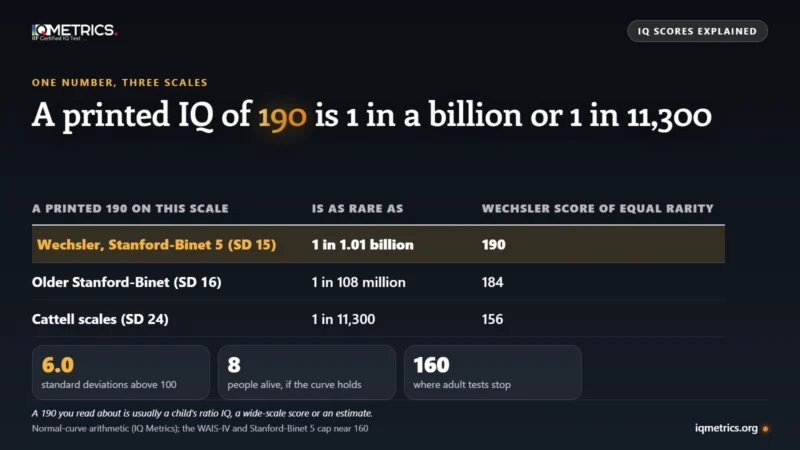
An IQ of 190 is 6 standard deviations above the average of 100 on the standard scale (SD 15). About 1 person in 1.01 billion would reach it, or roughly 8 people alive. No adult test can report it, because the WAIS-IV and the Stanford-Binet 5 stop near 160. A 190 you read about is almost always a child’s ratio IQ, a score on a wide scale, or an estimate.
Below: how rare 190 is on three scales, what it means as a mental age, who is said to have it, and what to ask when someone quotes you a 190.
How rare is an IQ of 190?
On the standard scale, with a mean of 100 and an SD of 15, a score of 190 sits at z = +6.0. That is the 99.9999999th percentile, about 1 person in 1.01 billion. Across a world population of 8.2 billion, the curve implies about 8 people. Nobody has checked that the curve holds this far out.
The 190 IQ meaning changes with the scale, because each scale spreads scores differently. The same printed number is far less rare on a wide scale.
| Scale | SD | z-score | How rare | Wechsler score of equal rarity |
|---|---|---|---|---|
| Wechsler tests, Stanford-Binet 5 | 15 | 6.00 | 1 in 1.01 billion | 190 |
| Older Stanford-Binet (Form L-M) | 16 | 5.63 | 1 in 108 million | 184 |
| Cattell scales | 24 | 3.75 | 1 in 11,300 | 156 |
To match the rarity of a Wechsler 190 you would need 196 on the old Stanford-Binet scale or 244 on a Cattell scale. The IQ score converter moves a score between scales, and our post on what an IQ of 180 means shows the same pattern at 180.
How much rarer does each ten points make a score?
Rarity grows very fast in the tail. On the standard scale, each extra ten points from 150 to 190 makes a score between 14 and 49 times rarer. The table gives the steps, with the number of people the curve implies among 8.2 billion.
| IQ | z-score | How rare | People among 8.2 billion |
|---|---|---|---|
| 150 | 3.33 | 1 in 2,330 | 3,520,000 |
| 160 | 4.00 | 1 in 31,600 | 260,000 |
| 170 | 4.67 | 1 in 653,000 | 12,600 |
| 180 | 5.33 | 1 in 20.7 million | 395 |
| 190 | 6.00 | 1 in 1.01 billion | 8 |
Is an IQ of 190 good, and what percentile is it?
It is far above any cut-off that matters. The Mensa line is the 98th percentile, about 131 on the standard scale. A 190 sits 2.9 times as far above the average as that line. But a number that high is a statistical claim, not a result you can verify. No test has enough hard questions, and no norm sample is big enough, to measure it.
A norm sample of 2,000 people would hold about 2 in a million of one person at this level. So the top of every norm table is extrapolated. Our post on the IQ ceiling effect explains why reports stop near 160, and our guide to the highest IQ ever recorded lists the largest figures people quote.
There is a second problem. A test score has a margin of error, called the standard error of measurement. It is smallest near the middle of the range and grows toward the extremes, as our ceiling post explains. A 190 would carry a wide margin that no manual publishes, so even a real result at this level would be a rough estimate.
What does an IQ of 190 mean as a child's ratio IQ?
Most 190s you read about are old-style ratio IQs. A ratio IQ is mental age divided by real age, times 100. A child who performs like a child 1.9 times older scores 190. The table shows what that takes.
| Child's age | Mental age needed |
|---|---|
| 4 years | 7 years 7 months |
| 6 years | 11 years 5 months |
| 8 years | 15 years 2 months |
| 10 years | 19 years 0 months |
Look at the last row: a 10-year-old would need to perform like a 19-year-old. Mental age stops rising in adulthood, so the ratio method breaks down for older children and adults. That is why modern tests use a deviation IQ instead, as our guide to IQ and mental age explains. A child’s 190 and an adult’s 190 are different kinds of number.
A well-known source of children with ratios this high is Leta Hollingworth’s 1942 book Children Above 180 IQ. It reports twelve children who scored 180 or more on the Stanford-Binet in 23 years of searching in New York City. Those were ratio IQs too, as our post on an IQ of 180 explains.
Where would your own score land?
Take the IIF-certified assessment and get your score with the scale it was measured on, the percentile it corresponds to and the confidence range around it — the three figures most online tests leave out.
Find your IQ score now! →Is an IQ of 190 possible?
In theory, yes. The bell curve says about 8 people alive would score 190 on the standard scale. In practice, nobody can confirm it, because no test has a hard enough question set and no norm group is large enough. Pearson’s WISC-V extended norms reach 210 for children who top out on several subtests, but a number on a table is not a measured score.
How many people could score 190 in each country?
If the curve held out to six standard deviations, each country would have only a handful of people at 190 or above. The table multiplies the tail by each population. Read it as arithmetic, not as a census.
| Population | People | Expected at 190 or above |
|---|---|---|
| The world | 8,200,000,000 | 8.1 |
| United States | 336,755,052 | 0.3 |
| Japan | 124,516,650 | 0.1 |
| Germany | 83,287,273 | 0.08 |
| United Kingdom | 68,526,000 | 0.07 |
| South Korea | 51,712,619 | 0.05 |
| Canada | 40,049,088 | 0.04 |
A figure of 0.08 for Germany means the chance of even one person is under 8 in 100. That is why a country or a school claiming several 190s is almost certainly using a different scale or a different test.
Who is said to have an IQ of 190?
Celebrity lists attach 190 to people as different as Isaac Newton, Voltaire, Enrico Fermi and Magnus Carlsen, and to fictional geniuses such as Sherlock Holmes. Our profiles check what stands behind each figure. For Magnus Carlsen, the 190 has no source. For Garry Kasparov, a reported test gave 135.
An online quiz that prints 190 cannot have a norm group behind it. To place a score that high you would need a sample of billions of people. Our report on chess players ranked by IQ traces the best-known chess numbers to their sources.
How does 190 compare with 180 and 200?
At 180 the standard scale gives 1 in 20.7 million, about 400 people. At 190 it gives 1 in 1.01 billion, about 8. At 200 it gives 1 in 76.4 billion, fewer than one person in the whole world. See the posts on an IQ of 160, 180 and 200 for the steps below and above.
What should you ask when someone quotes a 190?
- Which test, and on which scale? A 190 needs its SD.
- Was it a child’s ratio IQ or an adult deviation IQ?
- Was the test supervised, and who gave it?
- What norm group and year stand behind the number?
- What is the same score on the Wechsler scale? Use the table above.
To see where your own score sits on the standard scale, take the IQ test and then use the IQ percentile calculator.
Keep reading
All articles →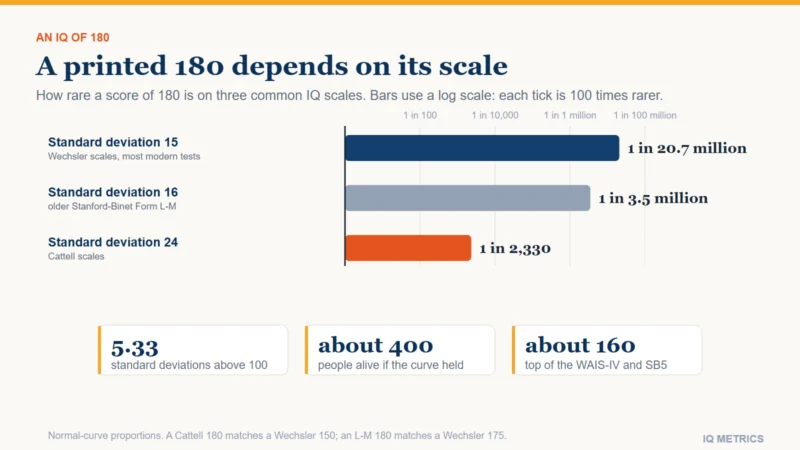 Scores & Scales
What Does an IQ of 180 Mean?
An IQ of 180 is 5.3 standard deviations above average: about 1 in 20.7 million on the Wechsler scale, 1 in 3.5 million on SD 16 and 1 in 2,330 on Cattell's SD 24. See why no adult test prints it and where 180 really comes from, from children's ratio IQs to Hollingworth's twelve.
 Scores & Scales
What Does an IQ of 200 Mean?
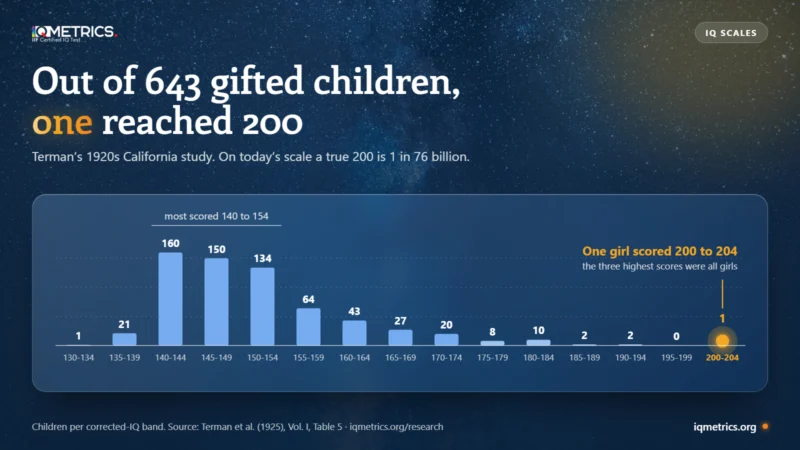
An IQ of 200 is 6.67 standard deviations above average, about 1 in 76 billion, and no adult test can measure it. See why a child's ratio IQ of 200 is possible, how test ceilings stop it by about age 11, what Terman and Cox found near that line and where the famous 200s come from.
 Scores & Scales
IQ Score Ceiling Effects
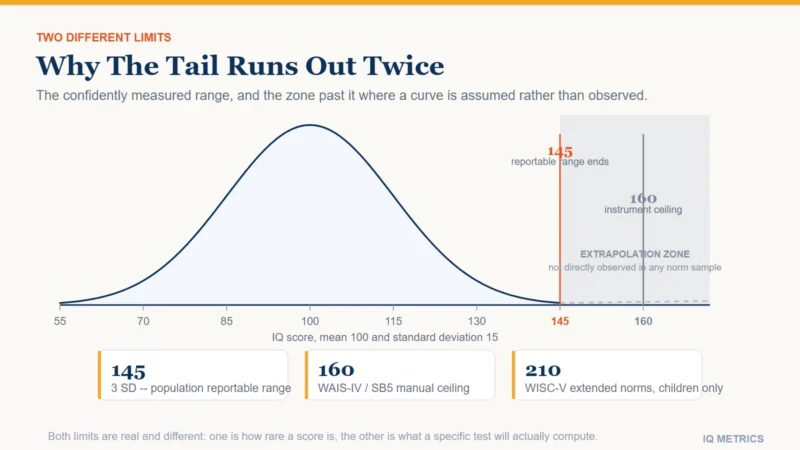
Two different numbers get used as "the top of the scale," 145 and 160, and they come from two different kinds of limit. One is a statement about population statistics; the other is about what a specific test manual will actually compute.