





How Smart Are You? How to Tell, and What a Test Really Measures
How smart are you? A test score with its margin of error is the best answer. Your own guess matches test results at only r = .33 across 41 studies, so smart is better measured than felt. See what an IQ score says, the five parts of smart on a test, how accurate a score is and how to find yours.

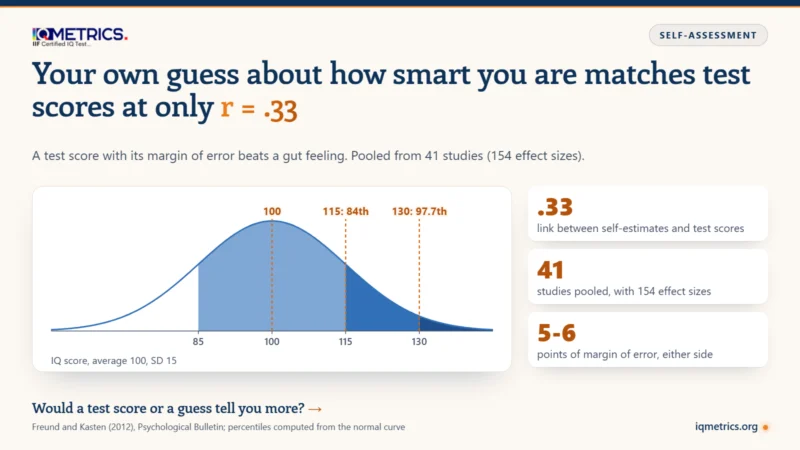
How smart are you? The most reliable answer is a score from a well-built test, shown with its margin of error. Your own guess is a weaker guide: a meta-analysis of 41 studies found that people’s self-estimates match their test results at only r = .33. So the honest way to ask “how smart am I?” is to measure reasoning, memory and speed, and then read the result as a range.
Below: what “smart” means, what an IQ score tells you, how accurate any single score is, and how to find your own number. The finding most pages skip is how weak self-judgment is. A correlation of .33 means your gut feeling explains only about 11% of the differences in test scores.
Key takeaways
- Smart is not one thing. A WISC-V report gives five index scores: Verbal Comprehension, Visual Spatial, Fluid Reasoning, Working Memory and Processing Speed.
- Self-estimates: across 41 studies and 154 effect sizes, self-rated and measured ability correlated at r = .33 (Freund and Kasten, 2012).
- An IQ score is a place in a line: 100 is the middle, 115 is about the 84th percentile and 130 is the 97.7th.
- Every score has a margin of error of roughly 5 to 6 points either side, so a 110 is best read as “probably 104 to 116”.
- A quiz about your habits measures preferences, not ability.
How smart are you? What does "smart" actually mean?
Smart is a bundle of abilities, not one trait. Tests split it into parts, and the parts do not always match.
The WISC-V, a widely used test for children aged 6 to 16, reports five index scores: Verbal Comprehension, Visual Spatial, Fluid Reasoning, Working Memory and Processing Speed. In Pearson’s norm sample of 2,200 children, 56.6% had a gap of 23 points or more between two of these five scores. So a person can think fast but hold little in mind, or reason well and read slowly. Our guide to WISC-V index scores explains each one.
You can try a few of these skills in our brain games: a memory game, the Stroop test for attention and logic puzzles for reasoning. A game score is not an IQ, but it shows which skills feel easy.
What are the five parts of "smart" on a test?
On the WISC-V, each primary index is built from two subtests. Our WISC-V guide, which follows Pearson’s sample report, lists them like this:
- Verbal Comprehension: Similarities and Vocabulary, which measure verbal reasoning and word knowledge.
- Visual Spatial: Block Design and Visual Puzzles, which measure how well you analyse and assemble visual detail.
- Fluid Reasoning: Matrix Reasoning and Figure Weights, which measure pattern-based and number-based reasoning on new problems.
- Working Memory: Digit Span and Picture Span, which measure how much you can hold in mind for a few seconds.
- Processing Speed: Coding and Symbol Search, which measure how fast you make simple visual decisions.
Most people feel stronger on some of these than others. A single IQ number averages across them, so it hides that shape.
Am I smart or dumb? What does an IQ score say?
An IQ score says where you stand among people of your age, not how smart you are in general. The test sets the average at 100 and one standard deviation (SD) at 15 points. The SD shows how spread out scores are, so 85 and 115 sit one SD below and above average.
| IQ score | Percentile rank | People who score higher |
|---|---|---|
| 85 | 15.9 | 84 in 100 |
| 100 | 50 | 50 in 100 |
| 115 | 84.1 | 16 in 100 |
| 130 | 97.7 | 2 in 100 (about 1 in 44) |
| 145 | 99.9 | about 1 in 741 |
Take 130. It is two SD above average, the 97.7th percentile, so about 1 in 44 people score higher. That is not exactly “the top 2%”. On the WISC-V, Pearson treats scores of 90 to 109 as average, which covers about half of children. Our percentile calculator works out any score, and IQ classifications lists the labels used for each band.
What are the signs of high intelligence?
Online lists of signs are not tests, and they come with no norms, so none of them can tell you where you stand. Even your own sense of it is only a modest guide, as the next section shows.
For children, our guide to the signs of a gifted child sticks to what the research finds. For adults, the one measure with published norms and a published margin of error is a test score.
How accurate is your own idea of how smart you are?
Not very. Freund and Kasten (Psychological Bulletin, 2012) pooled 154 effect sizes from 41 published studies on self-estimated and measured ability. The overall link was r = .33.
That is a modest link. It means self-estimates account for about 11% of the differences in test scores. The link was stronger when people rated themselves against a clearly named group, and when the skill was numerical ability. It was weaker for less common skills such as reasoning speed.
So ask a better question than “am I smart?”. Ask how you do against a defined group, on a test with norms.
Where would your own score land?
Take the IIF-certified assessment and get your score with the scale it was measured on, the percentile it corresponds to and the confidence range around it — the three figures most online tests leave out.
Find your IQ score now! →How accurate is an IQ score?
A score is a best estimate with a margin of error. On well-normed tests the standard error is about 2 to 3 points, so the 95% interval runs roughly 5 to 6 points either side.
A reported 110 therefore fits anywhere from about 104 to 116. A 110 on one test and a 115 on another are not reliably different. Our guide to the IQ score margin of error shows how to compare two results. The right test also depends on age, and the labels differ by test.
How do you know your IQ?
How to know your IQ: a test given by a psychologist is the reference. For children, that is usually the WISC-V; adults take a Wechsler adult scale. An online test gives an estimate, not a clinical result.
You can start with the IQ test on our home page, and read the score as a range, not a single number. For a child, age-based norms matter: see the average IQ for 12-year-olds.
When you pick any test, check three things:
- Does it report a percentile and a range, not only a single number?
- Is it normed on a named group of people your age?
- Does it say which scale it uses? A test with an SD of 16 instead of 15 puts the same percentile at a different number, so scores from different tests are not interchangeable.
Do quizzes that ask about your habits show how smart you are?
No. A quiz that asks what you prefer measures preferences. A test of ability gives problems with right answers and compares your result with a norm group. Only the second can be read as an IQ-type score. Treat habit quizzes as entertainment.
To see what is known about the brain behind any score, read our human brain facts.
Quick answers
- How smart are you (or “how smart are u”)? The best answer is a test score with its margin of error. Your own guess matches test results at only r = .33.
- How smart am I? Measure reasoning, working memory and speed, then read the result against a norm group.
- Am I smart or dumb? Those labels do not exist on an IQ scale. A score of 85 is about the 16th percentile and 115 about the 84th.
- What are the signs of high intelligence? Lists of signs have no norms. Only a test score does.
- How can I know my IQ? Take a test built for people, and treat the result as a range of about 5 to 6 points either side.
The bottom line
How smart you are is best answered with a measurement, not a feeling. Pick a test with norms, ask for the margin of error, and remember that smart has several parts. A single number is a snapshot, and the range around it matters as much as the score. If you take one step, use a test built for people.
Sources
- Freund PA, Kasten N (2012). How smart do you think you are? A meta-analysis on the validity of self-estimates of cognitive ability. Psychological Bulletin 138(2), 296-321.
- WISC-V index scores, norm sample and gaps between indexes: Pearson’s published FAQ and scoring guide, as summarised in our WISC-V index scores guide.
- Standard error of measurement and the 95% interval: our IQ score margin of error guide.
- Percentiles in the table are computed from the normal curve with mean 100 and SD 15.
Keep reading
All articles → Scores & Scales
IQ Scale By Age
The IQ scale is the same at every age, with an average of 100, but the test changes: the WPPSI-IV covers ages 2.5 to 7.5, the WISC-V ages 6 to 16 and the WAIS-IV and WAIS-5 ages 16 to 90. See which test fits each age, how a child's IQ was once calculated and how stable IQ is over a lifetime.
 Scores & Scales
IQ Classifications
IQ classification sorts scores into named bands, and the names depend on the test: Average is 90 to 109 on the Wechsler scales, but 130 and above is Very Superior on one test and Extremely High on another. See the labels side by side, where they came from and what they do not mean.
 Research & Evidence
Human Brain Facts
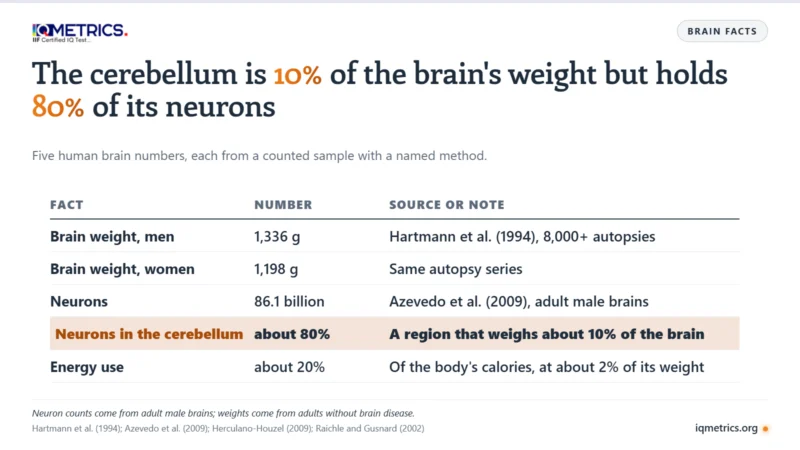
Human brain facts, each with its source: about 1,336 g in men and 1,198 g in women, 86.1 billion neurons and about 20% of the body's calories. The surprise is that the cerebellum holds about 80% of the neurons. Colour, weight, neurons and energy, with the study and method behind each.