





What Is the Average IQ for 12-Year-Olds? Norms, Percentiles and Gifted Cut-offs
The average IQ for 12-year-olds is 100, the same as at every age, because IQ is scored against children of the same age. About 2 in 3 score 85 to 115, a 120 is about the 91st percentile and 130 is the usual gifted line. Norms, WISC score bands and cut-offs, with sources.

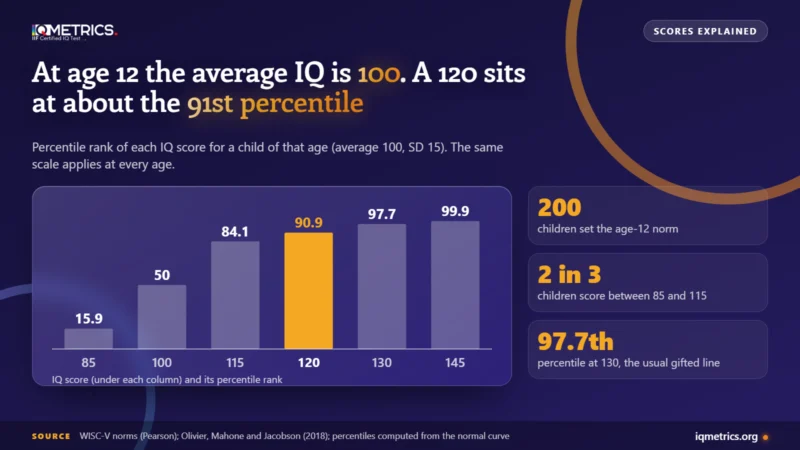
The average IQ for 12-year-olds is 100, the same as at every other age, because IQ is scored against children of the same age. On the WISC-V, a widely used test for ages 6 to 16, about 2 in 3 children score between 85 and 115. A 120 is about the 91st percentile, and 130, the usual gifted line, is the 97.7th.
Below: what the norms are built from, what 120 and 130 mean at age 12, which tests are used, and why one score can move. The finding most pages skip is how small the norm group is. The age-12 average rests on about 200 children, 100 boys and 100 girls.
Key takeaways
- The average IQ at age 12 is 100 by design. Scores are set against children of the same age, with an average of 100 and an SD of 15.
- About 2 in 3 children aged 12 score 85 to 115. A 120 is about the 91st percentile and a 130 is the 97.7th.
- The WISC-V covers ages 6:0 to 16:11. Its 2,200-child norm sample had 100 boys and 100 girls at each of 11 age levels.
- A score is a snapshot. In 33 teenagers retested after about 3.5 years, the group average stayed at 112 and 113, but individual scores changed by -18 to +21 points (Ramsden et al., 2011).
- What rises with age is the raw score, the number of items answered correctly. It is not the average IQ.
What is the average IQ for 12-year-olds?
It is 100. An IQ test compares each child with a large sample of children of the same age, and the average of that sample is set to 100, with a standard deviation (SD) of 15.
So a typical 11-year-old, 12-year-old and 14-year-old all average 100. About 2 in 3 children, 68%, score between 85 and 115, one SD either side. Our news article on the average IQ for a teenager covers ages 13 to 19 the same way.
The norm group is small and specific. The WISC-V was normed on 2,200 US children aged 6 to 16, matched to 2012 census data, with 100 boys and 100 girls at each of 11 age levels (Olivier, Mahone and Jacobson, Encyclopedia of Clinical Neuropsychology, 2018). So the age-12 average rests on about 200 children.
Is 120 IQ good for a 12-year-old?
Yes. A 120 is one and a third SD above average, about the 91st percentile, so roughly 9 in 10 children of the same age score lower.
| IQ score | Percentile rank | Of 200 children aged 12, about how many score higher |
|---|---|---|
| 85 | 15.9 | 168 |
| 100 | 50 | 100 |
| 115 | 84.1 | 32 |
| 120 | 90.9 | 18 |
| 125 | 95.2 | 10 |
| 130 | 97.7 | 5 (about 1 in 44) |
| 145 | 99.9 | fewer than 1 |
Remember the margin of error. A single score is accurate to about 5 points either side, so a 120 fits roughly 115 to 125. Our guide to the IQ score margin of error shows how to read two results side by side.
What IQ is gifted at age 12?
A gifted IQ at age 12 usually means 130 or above, the usual entry line for gifted programmes. It is two SD above average, the 97.7th percentile, or about 1 in 44 children.
That line is a convention, not a discovery. Our guide to gifted cutoff scores shows why: a child who scores 128 has a plausible range of roughly 123 to 133, so a strict cut-off at 130 can admit a child who scores 132 and refuse one who scores 128, though the two cannot be told apart. For children, our signs of a gifted child guide lists what the research finds.
What IQ test is used for 12-year-olds, and what are WISC scores at age 12?
A widely used individual test is the WISC-V, which covers ages 6:0 to 16:11. It gives a Full Scale IQ and five index scores, all with a mean of 100 and an SD of 15. The Full Scale IQ runs from 40 to 160, and Pearson treats 90 to 109 as average.
A psychologist gives it one-to-one. The Full Scale IQ is built from seven of the ten primary subtests, so it is not the average of the five indexes. WISC-V index scores explained shows what each index contains.
Pearson’s reports attach a descriptor to each score band. With percentiles worked out from the normal curve, the bands read:
- 130 and above: Extremely High, the 98th percentile and up.
- 120 to 129: Very High, about the 91st to 97th percentile.
- 110 to 119: High Average, about the 75th to 90th percentile.
- 90 to 109: Average, about the 25th to 73rd percentile.
- 80 to 89: Low Average, about the 9th to 23rd percentile.
- 70 to 79: Very Low, about the 2nd to 8th percentile.
- 69 and below: Extremely Low, below about the 2nd percentile.
Pearson states the average band outright. The other cut points fit every score on its sample reports, but we could not read the manual table, so treat the edges at 80 and 120 as inferred.
An online test is a different thing. It gives an estimate, not a clinical result. To try an IQ test for 12 year olds, see the kids IQ test for ages 8 to 12 and IQ test questions for kids, or take the IQ test on our home page. Read any result as a range.
Where would your own score land?
Take the IIF-certified assessment and get your score with the scale it was measured on, the percentile it corresponds to and the confidence range around it — the three figures most online tests leave out.
Find your IQ score now! →Why is the average the same at every age if children keep learning?
Because a score compares a child with peers, not with the child at an earlier age. A 12-year-old answers more items correctly than a 9-year-old, so the raw score rises with age. The IQ stays near 100 for a typical child at each age.
Norms also age. The WISC-V norms come from children tested in 2013 and 2014. A meta-analysis of 271 samples (Pietschnig and Voracek, 2015) found that full-scale IQ test scores rose 0.28 points a year from 1909 to 2013. The gains were weaker for children than for adults, and they have shrunk in recent decades. An old test can still flatter a child today. See the IQ scale by age for which test fits each age.
Does a 12-year-old's IQ stay the same?
Not exactly. A score is a snapshot, and it can move. Ramsden and colleagues (Nature, 2011) tested 33 teenagers aged 12.6 to 16.5 at the first test, and again about 3.5 years later.
The group average stayed at 112 and 113. Individual full-scale scores changed by -18 to +21 points, and the changes matched changes in brain structure.
That sample is small and scored above average, so treat the numbers as an illustration, not a rule for every child. For more, see IQ and age and what age is most accurate for an IQ test.
Quick answers
- What is the average IQ for a 12-year-old? 100, by design. About 2 in 3 children score between 85 and 115.
- Is 120 IQ good for a 12-year-old? Yes. It is about the 91st percentile, above roughly 9 in 10 children of that age.
- What IQ is gifted at age 12? 130 is the usual line. It is the 97.7th percentile, about 1 in 44.
- What are WISC scores at age 12? A Full Scale IQ and five index scores, mean 100 and SD 15, with 90 to 109 treated as average.
- Which IQ test is best for a 12-year-old? A WISC-V given by a psychologist is the reference. An online test gives an estimate.
The bottom line
The average IQ for 12-year-olds is 100 because the scale is built that way. What matters for a child is where a score sits against same-age peers, how wide the margin of error is, and that a score can move. A number is a snapshot of one day, not a label. If you are asking about yourself rather than a child, see how smart are you.
Sources
- Olivier TW, Mahone EM, Jacobson LA (2018). Wechsler Intelligence Scale for Children. Encyclopedia of Clinical Neuropsychology, 3684-3692.
- Ramsden S, Richardson FM, Josse G, et al. (2011). Verbal and non-verbal intelligence changes in the teenage brain. Nature 479, 113-116.
- Pietschnig J, Voracek M (2015). One century of global IQ gains: a formal meta-analysis of the Flynn effect (1909-2013). Perspectives on Psychological Science 10(3), 282-306.
- WISC-V score ranges, Full Scale IQ and index scores: Pearson’s published FAQ and scoring guide, as summarised in our WISC-V index scores guide.
- Margin of error and gifted cut-offs: our margin of error guide and gifted cutoff scores guide.
- Percentiles in the table are computed from the normal curve with mean 100 and SD 15.
Keep reading
All articles →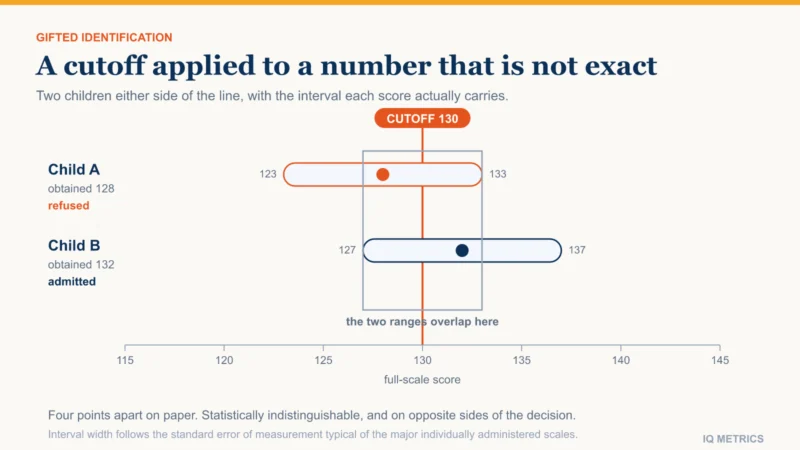 Scores & Scales
Gifted Cutoff Scores
Most gifted programmes draw their line at an IQ of 130. The number is a statistical convention rather than a boundary in nature, and three well-documented features of how the score is produced and used mean a strict cutoff reliably excludes children who belong on the other side of it.
 Scores & Scales
IQ Scale By Age
The IQ scale is the same at every age, with an average of 100, but the test changes: the WPPSI-IV covers ages 2.5 to 7.5, the WISC-V ages 6 to 16 and the WAIS-IV and WAIS-5 ages 16 to 90. See which test fits each age, how a child's IQ was once calculated and how stable IQ is over a lifetime.
 Taking a Test
What Age is Most Accurate to Take an IQ Test?
Scientists, teachers, and parents have always wondered how intelligence works. Although intelligence tests are widely accepted as credible measures of mental capacity, the scientific community disagrees on the best age to take one.