





Is There a Math IQ? What an IQ Test for Math Measures, and How Math Scores Relate to IQ
There is no single math IQ. See which IQ tests carry number subtests, how strongly fluid reasoning relates to math (r = 0.41, about 17% of the spread), what Wechsler's Arithmetic subtest measures, and why a child with a high-average IQ can still have dyscalculia.

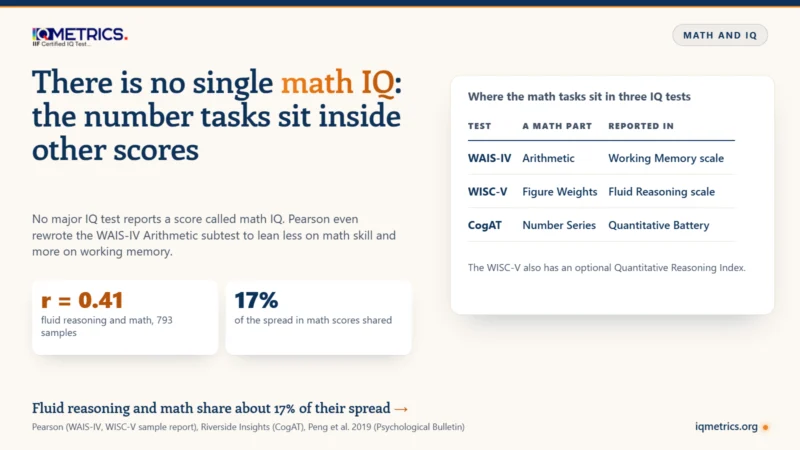
Is there an IQ test for math? Not one that gives a math IQ. Major IQ tests report a Full Scale IQ and a few index scores, and the math-related parts sit inside them. The best-measured link is moderate: fluid reasoning and math scores correlate at r = 0.41.
New here: Pearson rewrote the WAIS-IV Arithmetic subtest to put less weight on math skill and more on working memory. And r = 0.41 means fluid reasoning shares only about 17% of the spread in math scores (0.41 squared is 0.168, our arithmetic). Below: which IQ tests carry a math part, how strong the link is, what the number tests measure, and why a high IQ can still struggle.
Key takeaways
- No major IQ test reports a score called math IQ. Number and arithmetic tasks sit inside index scores such as working memory and fluid reasoning.
- Across 793 samples and more than 370,000 people, fluid reasoning and math correlate at r = 0.41. That is moderate: about 17% of the spread is shared.
- Working memory and arithmetic correlate at r = 0.312 in children aged 6 to 12 (46 studies, 11,224 children). About 10% of the spread is shared.
- A child can have a high-average IQ and still have dyscalculia, a specific difficulty with numbers.
- Our numerical IQ test is an online practice measure of number reasoning, not a clinical test.
Is there an IQ test for math?
There is no IQ test that reports a single math IQ. The big batteries spread number tasks across their scores, and each publisher names them differently.
The table shows what we could read at the publishers’ own pages and sample reports. Each row is a test, the math-related part, and where that part ends up in the score report.
| Test | Math-related part | Where it is reported |
|---|---|---|
| WAIS-IV (adults), Pearson | Arithmetic (core). Figure Weights (supplemental, ages 16 to 69) | Arithmetic counts in the Working Memory scale with Digit Span |
| WISC-V (children), Pearson | Figure Weights. Arithmetic (supplemental) | Fluid Reasoning scale; an optional Quantitative Reasoning Index adds the two |
| CogAT (levels 10 to 17/18), Riverside Insights | Number Analogies, Number Puzzles, Number Series | A separate Quantitative Battery score |
People also search for a math IQ test, IQ mathematics or a maths IQ score. All three ask for one number, and no major test gives it. Math ability and IQ overlap, but they are not the same thing: IQ tests measure reasoning, and a math exam measures what was taught. Is there a math IQ in any other sense? Only as the optional index described next.
Pearson’s WISC-V sample report prints the optional index. For one sample child the Quantitative Reasoning Index is 94 (34th percentile, 95% interval 88 to 101, “Average”), built from a Figure Weights score of 10 and an Arithmetic score of 8. That is the closest thing in these tests to a math score, and it is optional and marked ancillary.
Our numerical IQ test is an online practice test of number series and arithmetic puzzles. It is not a clinical test and it does not give a diagnosis. For the job-style version with tables and charts, see our numerical reasoning test guide.
Does a high IQ mean you are good at math?
Usually a bit better than average, but not reliably. Fluid reasoning and math correlate at r = 0.41, which is moderate.
That number comes from a 2019 meta-analysis in Psychological Bulletin by Peng and colleagues. It pooled 680 studies and 793 samples with more than 370,000 people. Fluid reasoning is the ability to solve new problems with logic. It related more strongly to math (r = 0.41) than to reading (r = 0.38). The link also grew with age and was stronger for complex skills than for basic ones.
| Link | Correlation (r) | Share of the spread in common (r squared) | Source |
|---|---|---|---|
| Fluid reasoning and math | 0.41 | 17% | Peng et al. 2019: 793 samples, 370,000+ people |
| Fluid reasoning and reading | 0.38 | 14% | Peng et al. 2019 |
| Working memory and arithmetic, ages 6 to 12 | 0.312 | 10% | Zhang, Tolmie and Gordon 2022: 46 studies, 11,224 children |
Read the last column as a plain fact: about 83 of every 100 units of the spread in math scores come from something other than fluid reasoning. That means teaching, practice, interest and anxiety matter a lot. It also means two people with the same IQ can differ a lot in math.
What does the numerical reasoning part of an IQ test measure?
It measures rule-finding with numbers: spotting a pattern in a series, a pair of numbers or an equation with a gap. It is not a school math exam.
Riverside’s CogAT descriptions show the idea. On the quantitative tests of the upper levels, students examine two pairs of numbers and find the rule, fill in the missing parts of an equation, or find the rule in a number series. The test makers call this reasoning with quantitative concepts, the number version of the verbal analogy. Younger levels use pictures instead: trains to balance in the number puzzles and strings of beads in the number series.
Wechsler’s Arithmetic subtest is different on purpose. In a presentation on the WAIS-IV, Pearson lists Arithmetic and Digit Span as the core Working Memory subtests. It says Arithmetic was revised with “decreased emphasis on mathematical skills to increase emphasis on working memory”. So a low Arithmetic score on a Wechsler test does not show weak math. It points at holding numbers in mind.
That fits the research on children. A 2022 meta-analysis by Zhang, Tolmie and Gordon in Brain Sciences found that working memory and arithmetic correlate at r = 0.312 (95% interval 0.276 to 0.348). Verbal working memory scored 0.332 and visuospatial 0.297. Our working memory and math guide, our note on mental math and IQ and our digit span test guide go deeper.
Where would your own score land?
Take the IIF-certified assessment and get your score with the scale it was measured on, the percentile it corresponds to and the confidence range around it — the three figures most online tests leave out.
Find your IQ score now! →Can you have a high IQ and still struggle with math?
Yes. Dyscalculia is a specific, lasting difficulty with numbers, and it can sit alongside a high-average IQ.
In a 2004 study in Cognition, Landerl, Bevan and Butterworth tested 31 children aged 8 and 9. Children with dyscalculia only did poorly on basic number tasks despite high-average scores on tests of IQ, vocabulary and working memory. The authors concluded that dyscalculia comes from specific problems with basic number processing, not from weak general ability. Our dyscalculia and IQ guide explains how it is assessed.
The reverse also happens: a child can be quick with numbers and score lower on verbal tasks. That is why a single IQ number tells you little about one subject. The IQ scale for adults shows what a Full Scale score means and what it leaves out.
Is PISA or a college math score a math IQ?
No. PISA and college-entry tests measure what students have learned and can apply, not general ability.
The Educational Research Centre in Ireland describes PISA as the largest educational study in the world, assessing 15-year-olds in science, reading and mathematics. Our guide to PISA and IQ tests covers how they differ, and our note on a good PSAT score by grade covers a college-entry test. For a country-level example of PISA maths scores, see our page on the average IQ in Ireland. For fun with numbers, try our math brain teasers for adults.
To see how your own reasoning compares, take our IQ test. It gives one overall estimate, not a separate math score.
Quick answers
- Is there an IQ test for math? No single one. Number tasks sit inside the WAIS-IV, WISC-V and CogAT scores, and none reports a math IQ.
- Does a high IQ mean you are good at math? Often, but not reliably: fluid reasoning and math correlate at r = 0.41, about 17% of the spread.
- What does the Arithmetic subtest measure? Mostly working memory. Pearson revised it to put less weight on math skill.
- Can you have a high IQ and struggle with math? Yes. Children with dyscalculia can have high-average IQ scores.
- Is our numerical IQ test a clinical test? No. It is an online practice measure of number reasoning.
Sources
- Pearson. WAIS-IV presentation, Introducing the WAIS-IV (test structure and changes to the working memory subtests; read on 24 November 2026).
- Pearson. WISC-V score report (sample), Fluid Reasoning subtests and the ancillary Quantitative Reasoning Index (read on 22 November 2026).
- Riverside Insights. CogAT test descriptions (Quantitative Battery, levels 10 to 17/18; read on 24 November 2026).
- Peng P, Wang T, Wang C, Lin X. A meta-analysis on the relation between fluid intelligence and reading/mathematics. Psychological Bulletin 2019;145:189-236. doi:10.1037/bul0000182 (abstract read).
- Zhang Y, Tolmie A, Gordon R. The relationship between working memory and arithmetic in primary school children: a meta-analysis. Brain Sciences 2022;13:22. doi:10.3390/brainsci13010022 (full text read on Europe PMC).
- Landerl K, Bevan A, Butterworth B. Developmental dyscalculia and basic numerical capacities. Cognition 2004;93:99-125. doi:10.1016/j.cognition.2003.11.004 (abstract read).
- Educational Research Centre. PISA 2025: Ireland’s 15-year-olds demonstrate strong educational performance (read on 24 November 2026).
- Squared correlations: arithmetic by IQ Metrics, computed in code, not copied.
Keep reading
All articles →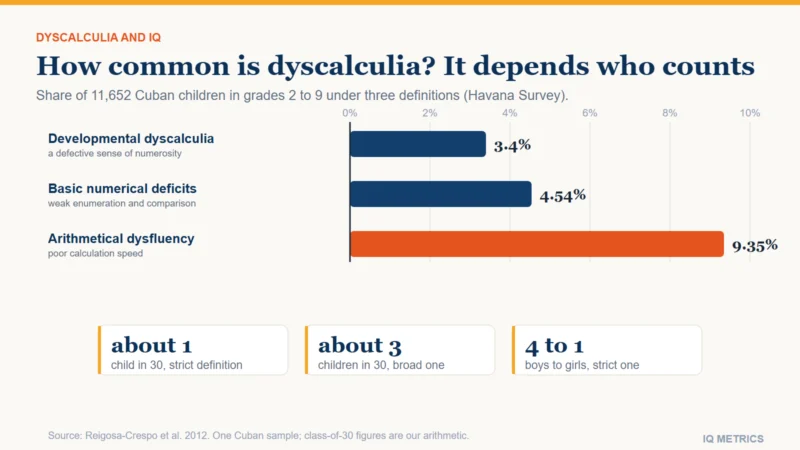 Understanding IQ
Dyscalculia and IQ
Can you have dyscalculia and a high IQ? Yes: it is a specific difficulty with numbers, not a low-IQ condition. Estimates of how common it is run from 3.4% to over 9% depending on the definition. Here is what the studies say, how it is assessed and how it differs from maths anxiety.
 Scores & Scales
Digit Span Test
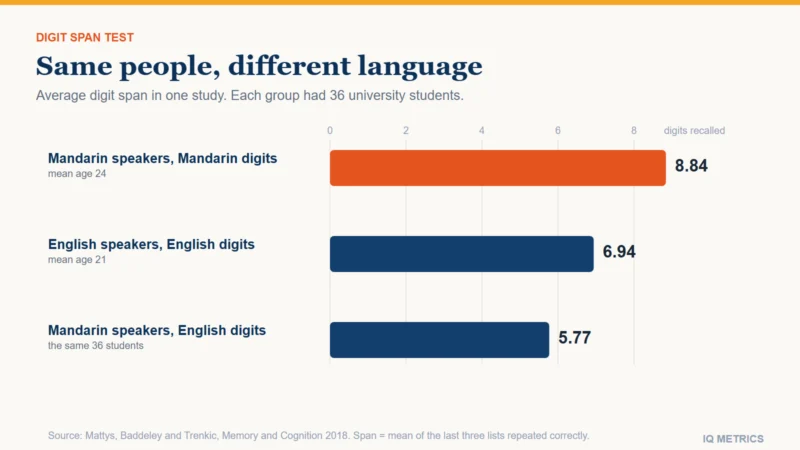
A digit span test asks you to repeat lists of digits; on the WAIS it has three tasks of eight items. Verified adult averages run from 5.3 to 6.9 digits, not seven, and language matters: 8.84 in Mandarin versus 5.77 in English for the same people.
 Understanding IQ
PISA Test vs IQ Test
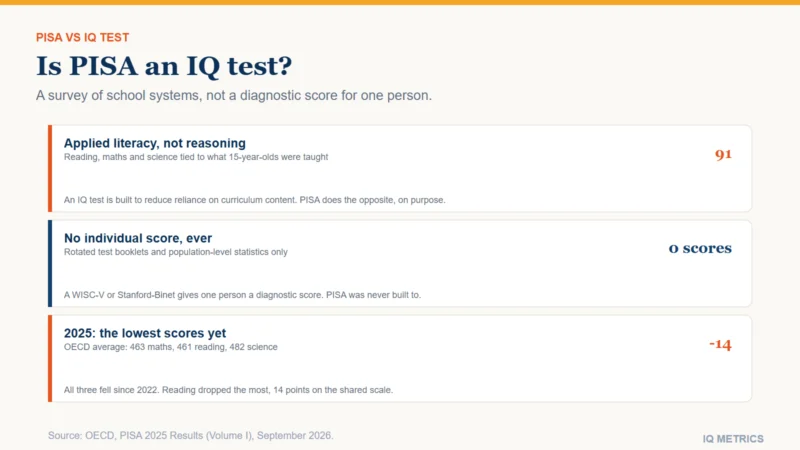
Is PISA an IQ test? No. PISA surveys applied school literacy across whole education systems and returns no individual score, while an IQ test diagnoses one person. See the new PISA 2025 results, published September 2026, and the real debate over using PISA as a national IQ proxy.