How Many Cognitive Biases Are There? We Count 174, and Only 23 Have a Replication We Could Find
Every named bias we could count, with its first paper, how much it is studied and read, and whether it was ever repeated: 174 counted, 23 with a replication attempt found.

By Leon Falkner, Data & Research Analyst · Reviewed by Aarav Vardhan, Editor-in-Chief · Published 20 November 2026 · 16 min read
About this study
- Report type
- Data study: one open table of 174 counted cognitive biases (and every name we left out), with first paper, papers, readers and replication status
- Data
- 245 Wikipedia list entries (names only), 238 Wikidata items, 96 first papers resolved in Crossref, OpenAlex counts for 72 biases, Wikimedia human pageviews 2015-07 to 2026-10, FReD and our replication scorecard
- Sources
- Wikipedia (names), Wikidata (CC0), Crossref, OpenAlex (CC0), Wikimedia pageviews (CC0), FReD (CC BY 4.0), published papers cited by DOI
- Dates
- Names read and counted on 20 November 2026; pageviews to October 2026; as of 20 November 2026
- Licence
- CC BY 4.0 (our dataset and charts)
- Version
- 2026.11
- Sources
- 24
We count 174 named cognitive biases under a written rule, against 242 names on Wikipedia’s list and 154 in one 2020 taxonomy. Of the 174, 96 have a verified first paper and 23 a replication attempt we could find. Counts of IQ Metrics Research, 20 November 2026; a lower bound, not a census.
01 Key findings
- We count 174 named cognitive biases under a written rule (197 with memory-performance and group effects), from 242 distinct names on Wikipedia’s list, 133 Wikidata items and 21 names we added with a source. 31 listed names with no article or source are not counted.IQ Metrics table
- The published answers run from 41 to 242 because each uses a different rule. A 2020 taxonomy files 154 biases in 7 categories; a 2023 review found 41 with a task that measures individual differences; Wikipedia’s page links 719 articles, which is not a count.Dimara et al. 2020; Berthet and de Gardelle 2023
- 41 of the 96 dated biases have a first paper from 1990 or later, and the median first paper is from 1985; the 1970s to 1990s hold 63. These 96 are the best-known biases, not all 174.Crossref; IQ Metrics table
- Ten articles hold 56% of the readers: Dunning–Kruger effect leads among 165 biases with a Wikipedia article of their own, and the median article had 13,718 views in 2025.Wikimedia pageviews
- Readers fell for 107 of the 124 biases whose article kept one title from 2016 to 2025, by a median 45%; 50 others are left out because the article was created, moved, merged or is a broader page.Wikimedia pageviews
- Only 23 of 174 counted biases have a replication attempt we could find in FReD or our scorecard (22 with a result read). Of those, 14 held up, 2 came back weaker, 2 were mixed and 4 did not hold up. “None found” is a lower bound.FReD; IQ Metrics scorecard
- The most-studied and the most-read biases overlap little: 3 names are in both top tens, and the rank correlation between papers and 2025 views is 0.28 across 72 biases.OpenAlex; Wikimedia pageviews
- In two open studies the printed correlations of a reasoning test with bias tasks run from -0.02 to +0.49 (13 values; 11 below 0.20). Eight more papers, read from abstracts, report little or no link for many bias tasks and a modest one for a few.Bruckmaier et al. 2021; Jackson et al. 2016
02 How many cognitive biases are there? The numbers to quote
IQ Metrics Research counts 174 named cognitive biases under a written rule (defined below), and 197 if memory-performance effects such as the spacing effect and group effects such as groupthink are allowed in. Wikipedia’s “List of cognitive biases” holds 242 distinct names [1]; one 2020 taxonomy files 154 biases in 7 categories [9]. The honest answer to “how many” is therefore “it depends on the rule”, and this page prints the rule and every name. For 96 of the 174 we verified a first paper by its DOI [5]; for the 72 most-read we counted papers per year [4]; for all of them with an article of their own we read human pageviews [3]; and we looked for a replication attempt in two sources [6] [7]. All of it is one open CSV with 255 rows.
named cognitive biases counted under our written rule, 20 November 2026; 197 on the broad count.
IQ Metrics tabledistinct names on Wikipedia’s “List of cognitive biases” (245 entries); 719 article links on the page are not a count.
Wikipedia list (names only)biases in a 2020 task-based taxonomy (7 categories); a 2023 review found 41 with a task for individual differences.
Dimara et al. 2020; Berthet and de Gardelle 2023counted biases have a first paper verified by DOI; median year 1985, and 41 are from 1990 or later.
Crossref; IQ Metrics tableof 2025 Wikipedia views of the 165 counted biases with an article go to ten articles, led by Dunning–Kruger effect.
Wikimedia pageviewsbiases with a stable article title lost readers from 2016 to 2025; the median change is -45%.
Wikimedia pageviewscounted biases have a replication attempt we could find; 151 have none in FReD or our scorecard (a lower bound).
FReD; IQ Metrics scorecardreplications of named biases on our scorecard held up; 3 came back weaker and 4 failed.
IQ Metrics scorecardrank correlation of papers mentioning a bias with its 2025 Wikipedia views across 72 biases; 3 names are in both top tens.
OpenAlex; Wikimedia pageviewsprinted correlations of a reasoning test with 13 bias tasks in two open-access studies (N = 2,643 and N = 250).
Bruckmaier et al. 2021; Jackson et al. 2016daily views of “Confirmation bias” on English Wikipedia, 2019 and 2025; weekdays run 1.2 times the weekend average.
Wikimedia pageviewsWikidata items filed under “cognitive bias” through the subclass “stereotype” (the Nerd, the Geek …): none is counted.
WikidataWhat this study does not say
This page counts and dates names and reports what was published about them. It does not say that any bias makes a person stupid or irrational, and it gives no advice on avoiding biases. Cognitive ability here means scores on reasoning tests as the papers report them; no IQ is shown for any person or group.
03 What counts as a named cognitive bias here?
A name counts once if it is a distinct, named tendency in how people judge, decide, remember or perceive others, and the literature describes a systematic departure from a standard such as accuracy or probability. We wrote the rule before counting (data/DEFINITIONS.md). Synonyms count once (the merge table lists 14), so “pessimism bias” counts under “optimism bias” and “primacy effect” and “recency effect” count under one serial-position row. The field’s own label is kept: of the 174, 47 are called effects, 39 biases, 4 heuristics, 6 fallacies and 14 illusions, and all count.
- Cognitive bias
- A named, systematic tendency in judgment, decision, memory of past events or perception of people, described as a departure from a standard (accuracy, probability, consistency). The name does not say the tendency is a flaw: some are argued to be useful shortcuts.
- Core count
- Names that pass the rule, after merging synonyms: 174 on 20 November 2026.
- Broad count
- The core count plus 19 memory or learning performance effects with no error standard (spacing, testing, serial position …) and 4 group processes (groupthink …): 197.
- Listed only
- 31 names that Wikipedia’s list gives but that have no article of their own and no source we used. They stay in the table and are not counted; some, such as the compromise effect, are well studied, so the core count is a lower bound.
- First paper (verified)
- The paper the field cites for introducing the named effect, resolved in Crossref by DOI with author, year and title matched (96 biases). A lower bound: an earlier paper may exist.
- Papers that mention
- OpenAlex works whose title or abstract contain the exact phrase. It counts mentions, not studies of the bias, and a bias known by another name is undercounted.
- Human pageviews
- Visits of people (not automated agents) to an English Wikipedia article, by month, 2015-07 to 2026-10 [3]; a visit through a redirect title is counted under the redirect, so every figure is a floor.
- Replication attempt
- A later test of the same finding, found in the FORRT Replication Database or our replication scorecard. “None found” means none in those two sources.
Not counted: people, books and theories (Weber-Fechner law, cognitive dissonance); measures and tests (the Implicit-association test); data artefacts (selection bias, Berkson’s paradox); clinical terms; biases of systems or media (gender bias); logical fallacies that are forms of argument, such as those in our page on the circular reasoning fallacy; and bias in tests, a different subject covered in our page on cultural bias in IQ tests. Wikidata files 87 stereotype items (the Nerd, the Geek) under “cognitive bias” through a subclass; none is a tendency of judgment and none is counted. The full log of left-out names is below and in the CSV.
Six published or countable answers to "how many cognitive biases" run from 41 to 242, depending on the rule
Number of named biases each source counts, with its rule in the label: 41 with a task that measures individual differences (2023 review), 133 Wikidata items, 154 in a 2020 taxonomy, our core count 174 and broad count 197 (broad adds 19 memory-performance and 4 group effects), and 242 distinct names on Wikipedia's list. The 719 article links on that page are not a count. IQ Metrics counts and the sources named. As of 20 November 2026.
Source: Wikipedia list [1]; Wikidata [2]; Dimara et al. [9]; Berthet and de Gardelle [10]; IQ Metrics count
Data table
| label | value |
|---|---|
| Berthet and de Gardelle 2023: biases with a task for individual differences | 41 |
| Wikidata: items typed "cognitive bias" (direct) | 133 |
| Dimara et al. 2020: task-based taxonomy | 154 |
| IQ Metrics core count (this page) | 174 |
| IQ Metrics broad count (this page) | 197 |
| Wikipedia list: distinct names, 20 Nov 2026 | 242 |
Embed this chart
Paste this HTML into your page: it carries the numbers and the credit link to this figure.
04 Why do published counts of cognitive biases differ so much?
Each source counts something different. Dimara and colleagues built a taxonomy for visualisation designers and sorted 154 biases into 7 task-based categories [9]; Wikipedia’s list groups its 242 names into six task sections (estimation, decision, hypothesis assessment, causal attribution, recall, opinion reporting) [1]. Berthet and de Gardelle counted only the 41 biases for which a published task measures differences between people [10]. Oeberst and Imhoff argue that several biases (bias blind spot, hostile media bias, egocentric bias, outcome bias) are one process of belief-consistent information processing under different names [11]; if they are right, a lower count is the better description. Our rule sits between: it merges synonyms but keeps a name when the literature treats it as its own effect.
Of 174 counted biases, 96 have a verified first paper, 66 of those have papers counted, 16 of those have a replication attempt we could find and 12 of those held up
Each stage is the biases that meet its test AND every test above it, so the stages nest: all counted biases, with a first paper verified in Crossref, with papers per year counted in OpenAlex (the most-read biases only), with a replication attempt found in FReD or our scorecard, and with that attempt held up (held up or weaker). Lower bounds: "none found" is not "none". IQ Metrics count. As of 20 November 2026.
Source: IQ Metrics table; Crossref [5]; OpenAlex [4]; FReD [6]; scorecard [7]
Data table
| stage | count | pct_of_first | pct_of_previous |
|---|---|---|---|
| Counted under our core rule | 174 | 100 | 100 |
| First paper verified (DOI, author, year, title) | 96 | 55.2 | 55.2 |
| Papers per year counted in OpenAlex | 66 | 37.9 | 68.8 |
| A replication attempt found | 16 | 9.2 | 24.2 |
| That attempt held up or was weaker | 12 | 6.9 | 75 |
Embed this chart
Paste this HTML into your page: it carries the numbers and the credit link to this figure.
05 When was each cognitive bias named?
For 96 biases the first paper is verified; their median year is 1985, and the busiest decade is the 1980s with 22. 41 of 96 date from 1990 or later and 55 from before. The classics (anchoring, availability and representativeness, 1972 to 1974) are papers by Tversky and Kahneman [5], and the later names are often effects with a narrower scope. Our table is a record of the best-known names, so it cannot say whether biases are being named faster over time; the share named after 1990 describes the 96 dated here only.
The first papers of 96 biases cluster in the 1970s to 1990s: 63 date from 1970 to 1999, and 4 from 2010 on
Number of counted biases by the decade of their first paper, for the 96 of 174 counted biases whose first paper we verified in Crossref (author, year and title match). The other 78 are not dated, so this is the best-known biases, not a census; an earlier paper may exist. Median year 1985. IQ Metrics table. As of 20 November 2026.
Decade of the first paper (verified)
Source: Crossref [5]; IQ Metrics table
Data table
| from | to | biases |
|---|---|---|
| 1920 | 1930 | 1 |
| 1930 | 1940 | 0 |
| 1940 | 1950 | 1 |
| 1950 | 1960 | 2 |
| 1960 | 1970 | 8 |
| 1970 | 1980 | 21 |
| 1980 | 1990 | 22 |
| 1990 | 2000 | 20 |
| 2000 | 2010 | 17 |
| 2010 | 2020 | 3 |
| 2020 | 2030 | 1 |
Embed this chart
Paste this HTML into your page: it carries the numbers and the credit link to this figure.
Social and belief biases peak in the 1970s, choice biases in the 1980s and memory biases in the 1990s, among the dated biases
Counted biases with a verified first paper, by family (rows, our coding rule) and decade of that paper (columns); a blank cell is none. 96 biases in all; the families are a coding choice and one bias has one family. IQ Metrics table. As of 20 November 2026.
Source: Crossref [5]; IQ Metrics table and family coding
Data table
| family (biases dated) | 1920s | 1940s | 1950s | 1960s | 1970s | 1980s | 1990s | 2000s | 2010s | 2020s |
|---|---|---|---|---|---|---|---|---|---|---|
| Estimation (21) | 1 | 6 | 6 | 6 | 2 | |||||
| Choice (25) | 1 | 1 | 1 | 9 | 7 | 3 | 2 | 1 | ||
| Belief (16) | 1 | 1 | 6 | 1 | 1 | 5 | 1 | |||
| Social (20) | 1 | 2 | 6 | 4 | 2 | 5 | ||||
| Memory (11) | 2 | 2 | 2 | 4 | 1 | |||||
| Attention (3) | 1 | 1 | 1 |
Embed this chart
Paste this HTML into your page: it carries the numbers and the credit link to this figure.
A search index does not date a name reliably. For the 66 biases with both dates, the earliest OpenAlex work whose title or abstract contains the phrase is a median 3 years EARLIER than the verified first paper: 37 are earlier (26 by 10 years or more, usually a mis-dated or unrelated record: the earliest “hindsight bias” hit is a 1967 clinical text, eight years before Fischhoff’s paper), 11 the same year and 18 later (8 by 10 years or more). That is why the verified year is the one the page uses, and the index year is kept in the CSV as a second column.
06 Which cognitive biases do researchers write about most?
Among the 72 biases we counted, Negativity bias is the most-mentioned phrase, with 18,366 papers whose title or abstract contain “negativity bias” [4]. The ten most-mentioned hold 60% of the 91,455 papers counted, and 28% of them are from 2021 to 2025. The count is the phrase, not the topic: “belief in a just world” is the field’s name for the just-world fallacy and is not searched, and a generic phrase such as “negativity bias” is used in several fields.
Negativity bias is the most-mentioned bias in research titles and abstracts, with 18,366 papers; the top ten hold 60% of the 91,455 counted
OpenAlex works whose title or abstract contain the exact phrase shown, all years to 20 November 2026, for the 72 biases we counted (the most-read ones; OpenAlex answers keyless requests from one shared daily budget). Papers that MENTION a phrase, not papers that study the bias; a bias with a different usual name ("belief in a just world") is undercounted. IQ Metrics query, filter printed in the CSV.
Source: OpenAlex [4]; IQ Metrics query
Data table
| label | value |
|---|---|
| Negativity bias | 18366 |
| Loss aversion | 8631 |
| Confirmation bias | 5845 |
| False memory | 5264 |
| Social-desirability bias | 3043 |
| Anchoring effect | 2978 |
| Mental accounting | 2861 |
| Halo effect | 2782 |
| Framing effect (psychology) | 2485 |
| Automation bias | 2242 |
Embed this chart
Paste this HTML into your page: it carries the numbers and the credit link to this figure.
07 Which cognitive biases do people read about, and is that changing?
In 2025, Dunning–Kruger effect was the most-read article among the 165 counted biases that have a Wikipedia article of their own, and ten articles held 56% of all their views [3]. The median bias article had 13,718 views in 2025, and 66 of 165 had under 10,000. The umbrella page “List of cognitive biases” fell from 1,217,882 views in 2016 to 577,003 in 2025, and “Cognitive bias” from 326,020 to 220,060. For the 124 biases whose article kept one title across the window, 107 fell and 17 rose from 2016 to 2025; 51 lost half or more.
Most of the twenty most-read biases lost readers between 2016 and 2025: 17 of 20 fell
Human pageviews of the English Wikipedia article in full-year 2016 and 2025 (user agents, all access), for the 20 most-read of the 124 biases whose article kept one title across the window, after the Dunning-Kruger effect, which is off the axis (3,088,343 in 2016, 1,567,802 in 2025). Articles that were created, moved or merged are left out (see the table). Reading Wikipedia is one channel of attention, not interest in the topic; Wikimedia revised its bot detection in 2025. Wikimedia pageviews. As of 20 November 2026.
Source: Wikimedia pageviews [3]; IQ Metrics calculation
Data table
| article | 2016 | 2025 |
|---|---|---|
| Survivorship bias | 230437 | 779414 |
| Pareidolia | 693507 | 582347 |
| Confirmation bias | 827641 | 369122 |
| Apophenia | 308260 | 223346 |
| Barnum effect | 230886 | 209771 |
| Halo effect | 308680 | 180876 |
| Gambler's fallacy | 399181 | 158487 |
| Law of the instrument | 68685 | 146370 |
| Fundamental attribution error | 344325 | 102609 |
| Base rate fallacy | 98500 | 91549 |
| Mere-exposure effect | 131169 | 90219 |
| Curse of knowledge | 91838 | 82612 |
| Loss aversion | 142179 | 74586 |
| Negativity bias | 89877 | 73575 |
| Availability heuristic | 155043 | 69649 |
| Bandwagon effect | 148820 | 59811 |
| Illusory superiority | 198900 | 57550 |
| Hindsight bias | 119698 | 54189 |
| Spotlight effect | 51904 | 52840 |
| Planning fallacy | 60926 | 49842 |
Embed this chart
Paste this HTML into your page: it carries the numbers and the credit link to this figure.
Dunning–Kruger effect is the most-read of the 124 comparable biases in all four years; the order of the next seven shifted year by year
Rank by full-year human pageviews of the English Wikipedia article (1 = most read) in 2016, 2019, 2022 and 2025, for the eight most-read biases of 2025 among the 124 whose article kept one title and had views in all four years. Ranks only; the counts are in the table. Wikimedia pageviews. As of 20 November 2026.
Source: Wikimedia pageviews [3]; IQ Metrics calculation
Data table
| article | 2016 | 2019 | 2022 | 2025 |
|---|---|---|---|---|
| Dunning–Kruger effect | 1 | 1 | 1 | 1 |
| Survivorship bias | 9 | 4 | 3 | 2 |
| Pareidolia | 3 | 3 | 4 | 3 |
| Confirmation bias | 2 | 2 | 2 | 4 |
| Apophenia | 7 | 6 | 8 | 5 |
| Barnum effect | 8 | 5 | 6 | 6 |
| Halo effect | 6 | 7 | 5 | 7 |
| Gambler's fallacy | 4 | 9 | 7 | 8 |
Embed this chart
Paste this HTML into your page: it carries the numbers and the credit link to this figure.
Readers left every family of bias between 2016 and 2025: the median bias lost 45% of its views, and 107 of 124 fell
Change in human pageviews of the English Wikipedia article, 2016 to 2025, in percent, one dot per bias with a stable article title (124 biases), grouped by family. The box covers the middle half, the line is the median, the whiskers run from the smallest to the largest. A fall is not a loss of interest in the topic. Wikimedia pageviews. As of 20 November 2026.
Dotted line: No change.
Source: Wikimedia pageviews [3]; IQ Metrics calculation and family coding
Data table
| family | n | low | q1 | median | q3 | high |
|---|---|---|---|---|---|---|
| Estimation | 25 | -80 | -55 | -39 | -10 | 238 |
| Choice | 29 | -74 | -58 | -45 | -15 | 132 |
| Belief | 23 | -72 | -57 | -35 | -13 | 124 |
| Social | 23 | -73 | -60 | -49 | -34 | 6 |
| Memory | 16 | -75 | -68 | -52 | -32 | 229 |
| Attention | 8 | -69 | -65 | -36 | -26 | -16 |
Embed this chart
Paste this HTML into your page: it carries the numbers and the credit link to this figure.
50 counted biases are kept out of these trend figures: their article was created or moved after 2016, was merged, has under 1,000 views in 2016, shows a step change we could not explain from the move history, or the name redirects to a broader page. Wikipedia articles move: “Sunk cost” and “False memory”, for example, show year-on-year jumps of 10 to 16 times, which are more likely a title change or a merge than sudden interest, so they are left out. The Wikimedia Foundation reported in October 2025 that after it updated its bot detection, human pageviews for March to August 2025 were roughly 8% below the same months of 2024 and much of the unusually high May and June traffic had come from bots built to evade detection [8]; a fall in human views is therefore not proof of fewer readers, and the Foundation’s reasons for the fall are its own account, not ours.
Daily views of the English Wikipedia article "Confirmation bias" rise and fall with the school year: 689,734 in 2019 and 369,122 in 2025
Each square is one day of human pageviews (user agents, all access) from 2019-01-01 to 2026-10-31. The average a day was 1,890 in 2019 and 1,011 in 2025; weekdays ran 1.29 times the weekend average in 2019 and 1.23 in 2025; July and August averaged 0.80 of the April, May, October and November average in 2019. Wikimedia pageviews. As of 20 November 2026.
- Fri 19 Aug 2022 the busiest day (38,457 views)
Source: Wikimedia pageviews [3]
Data table
| date | views of "Confirmation bias" on English Wikipedia |
|---|---|
| 2019-01-01 | 1434 |
| 2019-01-02 | 1743 |
| 2019-01-03 | 1776 |
| 2019-01-04 | 1851 |
| 2019-01-05 | 1570 |
| 2019-01-06 | 1687 |
| 2019-01-07 | 1967 |
| 2019-01-08 | 2109 |
| 2019-01-09 | 2046 |
| 2019-01-10 | 1957 |
| 2019-01-11 | 1967 |
| 2019-01-12 | 1462 |
| 2019-01-13 | 1581 |
| 2019-01-14 | 1913 |
| 2019-01-15 | 2096 |
| 2019-01-16 | 2267 |
| 2019-01-17 | 2257 |
| 2019-01-18 | 2063 |
| 2019-01-19 | 2533 |
| 2019-01-20 | 1814 |
| 2019-01-21 | 2296 |
| 2019-01-22 | 2319 |
| 2019-01-23 | 3372 |
| 2019-01-24 | 2515 |
| 2019-01-25 | 2287 |
| 2019-01-26 | 1592 |
| 2019-01-27 | 1911 |
| 2019-01-28 | 2431 |
| 2019-01-29 | 2466 |
| 2019-01-30 | 2428 |
| 2019-01-31 | 2471 |
| 2019-02-01 | 2068 |
| 2019-02-02 | 1488 |
| 2019-02-03 | 1843 |
| 2019-02-04 | 2389 |
| 2019-02-05 | 2274 |
| 2019-02-06 | 2161 |
| 2019-02-07 | 2136 |
| 2019-02-08 | 1976 |
| 2019-02-09 | 1715 |
| 2019-02-10 | 2725 |
| 2019-02-11 | 2570 |
| 2019-02-12 | 2351 |
| 2019-02-13 | 2180 |
| 2019-02-14 | 4053 |
| 2019-02-15 | 1979 |
| 2019-02-16 | 1687 |
| 2019-02-17 | 1707 |
| 2019-02-18 | 2270 |
| 2019-02-19 | 2589 |
| 2019-02-20 | 2343 |
| 2019-02-21 | 2516 |
| 2019-02-22 | 2224 |
| 2019-02-23 | 1964 |
| 2019-02-24 | 2007 |
| 2019-02-25 | 2569 |
| 2019-02-26 | 2678 |
| 2019-02-27 | 2446 |
| 2019-02-28 | 2507 |
| 2019-03-01 | 2365 |
| 2019-03-02 | 1758 |
| 2019-03-03 | 2115 |
| 2019-03-04 | 2427 |
| 2019-03-05 | 2595 |
| 2019-03-06 | 2482 |
| 2019-03-07 | 2445 |
| 2019-03-08 | 2114 |
| 2019-03-09 | 1725 |
| 2019-03-10 | 1799 |
| 2019-03-11 | 2394 |
| 2019-03-12 | 2496 |
| 2019-03-13 | 2167 |
| 2019-03-14 | 2172 |
| 2019-03-15 | 2168 |
| 2019-03-16 | 1991 |
| 2019-03-17 | 1657 |
| 2019-03-18 | 2303 |
| 2019-03-19 | 2352 |
| 2019-03-20 | 2185 |
| 2019-03-21 | 2269 |
First 80 of 2861 rows; the Data button gives all of them.
Embed this chart
Paste this HTML into your page: it carries the numbers and the credit link to this figure.
“Confirmation bias” is the clearest case of a school-year rhythm: weekdays ran 1.29 times the weekend average in 2019 and 1.23 in 2025, and July and August averaged 0.80 of the April, May, October and November level in 2019. That fits students and teachers as a main audience, but it does not show why; the exception is 2022, when a spike on 2022-08-19 (38,457 views) lifted August above the spring level.
08 Do the most-studied biases get the most readers?
Only partly. Across 72 biases the rank correlation between papers that mention a bias and its 2025 views is 0.28, and 3 names are in both top tens (Confirmation bias, False memory, Halo effect). The year of a bias’s first paper hardly predicts either measure (-0.15 with papers, -0.26 with views, 55 biases). A bias can be heavily written about by researchers and rarely read about by the public, and the reverse.
Papers and readers only loosely go together: Spearman r = 0.28 across 72 biases, and 3 names are in both top tens
One bubble per bias with an own Wikipedia article and papers counted: papers that mention the phrase (all years, log scale) against 2025 human pageviews (log scale), bubble area = papers from 2021 to 2025, colour = replication status in our sources. Rank correlation 0.28. A link between two counts, not a cause. OpenAlex and Wikimedia pageviews. As of 20 November 2026.
Wikipedia views in 2025 (log scale)
Papers mentioning the phrase (log scale)
Source: OpenAlex [4]; Wikimedia pageviews [3]; IQ Metrics table
Data table
| bias | oa_papers_total | views_2025 | group | papers_2021_2025 |
|---|---|---|---|---|
| Affect heuristic | 405 | 9871 | held up | 94 |
| Ambiguity effect | 1436 | 8737 | none found | 337 |
| Anchoring effect | 2978 | 85392 | mixed | 1146 |
| Attribute substitution | 165 | 9916 | none found | 48 |
| Automation bias | 2242 | 18935 | none found | 518 |
| Availability heuristic | 895 | 69649 | weaker | 252 |
| Bandwagon effect | 870 | 59811 | none found | 290 |
| Barnum effect | 158 | 209771 | none found | 36 |
| Base rate fallacy | 218 | 91549 | none found | 41 |
| Belief perseverance | 174 | 28677 | none found | 43 |
| Bias blind spot | 178 | 18952 | held up | 75 |
| Choice-supportive bias | 20 | 16463 | none found | 12 |
| Confirmation bias | 5845 | 369122 | none found | 2397 |
| Conjunction fallacy | 477 | 43846 | held up | 92 |
| Cross-race effect | 180 | 34112 | none found | 42 |
| Cryptomnesia | 103 | 47738 | none found | 17 |
| Curse of knowledge | 199 | 82612 | failed | 54 |
| Decoy effect | 368 | 22472 | none found | 142 |
| Default effect | 161 | 8380 | mixed | 50 |
| Disposition effect | 1691 | 11967 | none found | 501 |
| Dunning–Kruger effect | 692 | 1567802 | none found | 349 |
| Egocentric bias | 436 | 11644 | none found | 102 |
| Endowment effect | 1489 | 45368 | held up | 422 |
| Escalation of commitment | 963 | 36708 | none found | 151 |
| False consensus effect | 264 | 43215 | held up | 47 |
| False memory | 5264 | 191352 | none found | 1086 |
| Framing effect (psychology) | 2485 | 37103 | weaker | 728 |
| Fundamental attribution error | 509 | 102609 | none found | 89 |
| Gambler's fallacy | 732 | 158487 | none found | 180 |
| Group attribution error | 7 | 5629 | none found | 1 |
| Halo effect | 2782 | 180876 | none found | 737 |
| Hindsight bias | 1433 | 54189 | held up | 284 |
| Hot hand | 577 | 19299 | none found | 103 |
| Hyperbolic discounting | 1624 | 35362 | none found | 312 |
| Identifiable victim effect | 115 | 9235 | none found | 31 |
| Illusion of control | 1530 | 26120 | none found | 387 |
| Illusion of explanatory depth | 119 | 13718 | none found | 32 |
| Illusion of transparency | 166 | 13168 | none found | 33 |
| Illusory correlation | 422 | 16680 | none found | 43 |
| Illusory truth effect | 212 | 86978 | none found | 106 |
| In-group favoritism | 839 | 35580 | none found | 238 |
| Just-world fallacy | 11 | 81481 | none found | 6 |
| Loss aversion | 8631 | 74586 | none found | 2761 |
| Mental accounting | 2861 | 14496 | none found | 1012 |
| Mere-exposure effect | 530 | 90219 | none found | 111 |
| Misinformation effect | 437 | 14864 | none found | 115 |
| Money illusion | 580 | 11392 | held up | 80 |
| Naïve realism (psychology) | 955 | 15437 | none found | 238 |
| Negativity bias | 18366 | 73575 | none found | 3975 |
| Observer-expectancy effect | 7 | 17876 | none found | 2 |
| Omission bias | 330 | 13006 | held up | 82 |
| Optimism bias | 1482 | 33573 | held up | 491 |
| Out-group homogeneity | 84 | 12852 | none found | 9 |
| Outcome bias | 623 | 9996 | held up | 190 |
| Overchoice | 807 | 19458 | none found | 284 |
| Overconfidence effect | 119 | 39100 | none found | 36 |
| Pareidolia | 719 | 582347 | none found | 319 |
| Peak–end rule | 213 | 31488 | none found | 80 |
| Planning fallacy | 290 | 49842 | none found | 73 |
| Present bias | 2131 | 9113 | none found | 683 |
| Representativeness heuristic | 563 | 20529 | none found | 144 |
| Rosy retrospection | 15 | 38904 | none found | 5 |
| Self-licensing | 706 | 11554 | none found | 299 |
| Self-serving bias | 1063 | 28947 | none found | 193 |
| Social-desirability bias | 3043 | 28997 | none found | 1008 |
| Spotlight effect | 118 | 52840 | none found | 42 |
| Status quo bias | 1694 | 31566 | none found | 563 |
| Sunk cost | 2184 | 206191 | attempt found, result not read | 490 |
| Survivorship bias | 1312 | 779414 | none found | 296 |
| Telescoping effect | 93 | 5279 | none found | 16 |
| Ultimate attribution error | 48 | 11085 | none found | 8 |
| Zero-sum thinking | 17 | 35617 | none found | 8 |
Embed this chart
Paste this HTML into your page: it carries the numbers and the credit link to this figure.
Among 55 biases, the year of a bias's first paper hardly predicts how much it is studied or read today, while papers and readers go together at +0.29
Spearman rank correlations across the 55 counted biases that have a verified first-paper year, papers counted in OpenAlex, 2025 views and a stable article title: year of first paper, papers mentioning the phrase, 2025 views and the change in views 2016 to 2025 (ratio). A link between measures, not a cause. As of 20 November 2026.
Source: OpenAlex [4]; Wikimedia pageviews [3]; Crossref [5]; IQ Metrics calculation
Data table
| measure | Year of first paper | Papers mentioning | Views in 2025 | Views 2025 / 2016 |
|---|---|---|---|---|
| Year of first paper | 1 | -0.1 | -0.3 | 0.4 |
| Papers mentioning | -0.1 | 1 | 0.3 | -0.3 |
| Views in 2025 | -0.3 | 0.3 | 1 | 0.1 |
| Views 2025 / 2016 | 0.4 | -0.3 | 0.1 | 1 |
Embed this chart
Paste this HTML into your page: it carries the numbers and the credit link to this figure.
09 Which cognitive biases held up when they were repeated?
Few counted biases have a replication attempt we could find: 23 of 174. We looked in the FORRT Replication Database [6] and in our own replication scorecard [7]; 31 attempts match a counted bias. Of the 22 with a result we read, 14 held up, 2 came back weaker, 2 were mixed and 4 did not hold up; for sunk cost, the Many Labs 1 project lists the effect among its 13 tested effects [23] but its data paper prints no effect size, so we left the result unread. A 2024 replication of a goals-as-reference-points paper (Heath et al. 1999) held up; it is not a test of loss aversion itself, so it is not counted. Attempts exist mostly for judgment and choice tasks, not for the most-read names: only 1 of the ten most-read biases has one, 6 of the thirty, and the median 2025 views are 26,262 for biases with an attempt against 13,168 for those without.
23 of the 174 counted biases have a replication attempt we could find; for the other 151 we found none
Every counted bias as one square, coloured by what happened when someone repeated it: held up, held up but weaker, mixed, did not hold up, an attempt exists whose result we did not read, or none found in FReD and our scorecard. "None found" is a lower bound for these two sources, not "never repeated". IQ Metrics table. As of 20 November 2026.
174 biasesone square = one bias
Source: FReD [6]; scorecard [7]; IQ Metrics coding
Data table
| bias | group | label | detail |
|---|---|---|---|
| b0 | Held up when repeated | Affect heuristic | held up; family: Belief and evidence; attempts found: 1 |
| b1 | Held up when repeated | Bias blind spot | held up; family: Social and self-perception; attempts found: 1 |
| b2 | Held up when repeated | Conjunction fallacy | held up; family: Estimation and probability; attempts found: 1 |
| b3 | Held up when repeated | Endowment effect | held up; family: Choice, risk and time; attempts found: 1 |
| b4 | Held up when repeated | False consensus effect | held up; family: Estimation and probability; attempts found: 1 |
| b5 | Held up when repeated | Hindsight bias | held up; family: Memory and recall; attempts found: 1 |
| b6 | Held up when repeated | Illusory superiority | held up; family: Social and self-perception; attempts found: 2 |
| b7 | Held up when repeated | Less-is-better effect | held up; family: Choice, risk and time; attempts found: 1 |
| b8 | Held up when repeated | Money illusion | held up; family: Choice, risk and time; attempts found: 1 |
| b9 | Held up when repeated | Omission bias | held up; family: Choice, risk and time; attempts found: 1 |
| b10 | Held up when repeated | Optimism bias | held up; family: Estimation and probability; attempts found: 1 |
| b11 | Held up when repeated | Outcome bias | held up; family: Choice, risk and time; attempts found: 1 |
| b12 | Held up when repeated | Scope neglect | held up; family: Choice, risk and time; attempts found: 1 |
| b13 | Held up when repeated | Worse-than-average effect | held up; family: Estimation and probability; attempts found: 1 |
| b14 | Held up, but weaker | Availability heuristic | weaker; family: Estimation and probability; attempts found: 1 |
| b15 | Held up, but weaker | Framing effect (psychology) | weaker; family: Choice, risk and time; attempts found: 2 |
| b16 | Mixed: some attempts held, some did not | Anchoring effect | mixed; family: Estimation and probability; attempts found: 4 |
| b17 | Mixed: some attempts held, some did not | Default effect | mixed; family: Choice, risk and time; attempts found: 3 |
| b18 | Did not hold up | Backfire effect | failed; family: Belief and evidence; attempts found: 1 |
| b19 | Did not hold up | Contrast effect | failed; family: Attention and perception; attempts found: 1 |
| b20 | Did not hold up | Curse of knowledge | failed; family: Estimation and probability; attempts found: 1 |
| b21 | Did not hold up | Neglect of probability | failed; family: Choice, risk and time; attempts found: 1 |
| b22 | An attempt exists; result not read here | Sunk cost | attempt found, result not read; family: Choice, risk and time; attempts found: 1 |
| b23 | No replication attempt found in our sources | Accentuation effect | none found; family: Attention and perception; attempts found: 0 |
| b24 | No replication attempt found in our sources | Action bias | none found; family: Choice, risk and time; attempts found: 0 |
| b25 | No replication attempt found in our sources | Actor–observer asymmetry | none found; family: Social and self-perception; attempts found: 0 |
| b26 | No replication attempt found in our sources | Additive bias | none found; family: Choice, risk and time; attempts found: 0 |
| b27 | No replication attempt found in our sources | Aesthetic–usability effect | none found; family: Attention and perception; attempts found: 0 |
| b28 | No replication attempt found in our sources | Affective forecasting | none found; family: Estimation and probability; attempts found: 0 |
| b29 | No replication attempt found in our sources | Ambiguity effect | none found; family: Choice, risk and time; attempts found: 0 |
| b30 | No replication attempt found in our sources | Apophenia | none found; family: Attention and perception; attempts found: 0 |
| b31 | No replication attempt found in our sources | Attribute substitution | none found; family: Estimation and probability; attempts found: 0 |
| b32 | No replication attempt found in our sources | Attribution bias | none found; family: Social and self-perception; attempts found: 0 |
| b33 | No replication attempt found in our sources | Authority bias | none found; family: Social and self-perception; attempts found: 0 |
| b34 | No replication attempt found in our sources | Automation bias | none found; family: Choice, risk and time; attempts found: 0 |
| b35 | No replication attempt found in our sources | Ballot order effect | none found; family: Choice, risk and time; attempts found: 0 |
| b36 | No replication attempt found in our sources | Bandwagon effect | none found; family: Social and self-perception; attempts found: 0 |
| b37 | No replication attempt found in our sources | Barnum effect | none found; family: Belief and evidence; attempts found: 0 |
| b38 | No replication attempt found in our sources | Base rate fallacy | none found; family: Estimation and probability; attempts found: 0 |
| b39 | No replication attempt found in our sources | Belief bias | none found; family: Belief and evidence; attempts found: 0 |
| b40 | No replication attempt found in our sources | Belief perseverance | none found; family: Belief and evidence; attempts found: 0 |
| b41 | No replication attempt found in our sources | Benjamin Franklin effect | none found; family: Social and self-perception; attempts found: 0 |
| b42 | No replication attempt found in our sources | Boundary extension | none found; family: Memory and recall; attempts found: 0 |
| b43 | No replication attempt found in our sources | Certainty effect | none found; family: Choice, risk and time; attempts found: 0 |
| b44 | No replication attempt found in our sources | Cheerleader effect | none found; family: Attention and perception; attempts found: 0 |
| b45 | No replication attempt found in our sources | Choice-supportive bias | none found; family: Memory and recall; attempts found: 0 |
| b46 | No replication attempt found in our sources | Clustering illusion | none found; family: Estimation and probability; attempts found: 0 |
| b47 | No replication attempt found in our sources | Compassion fade | none found; family: Choice, risk and time; attempts found: 0 |
| b48 | No replication attempt found in our sources | Compromise effect | none found; family: Choice, risk and time; attempts found: 0 |
| b49 | No replication attempt found in our sources | Confirmation bias | none found; family: Belief and evidence; attempts found: 0 |
| b50 | No replication attempt found in our sources | Congruence bias | none found; family: Belief and evidence; attempts found: 0 |
| b51 | No replication attempt found in our sources | Conservatism (belief revision) | none found; family: Estimation and probability; attempts found: 0 |
| b52 | No replication attempt found in our sources | Continued influence effect | none found; family: Belief and evidence; attempts found: 0 |
| b53 | No replication attempt found in our sources | Cross-race effect | none found; family: Memory and recall; attempts found: 0 |
| b54 | No replication attempt found in our sources | Cryptomnesia | none found; family: Memory and recall; attempts found: 0 |
| b55 | No replication attempt found in our sources | Declinism | none found; family: Memory and recall; attempts found: 0 |
| b56 | No replication attempt found in our sources | Decoy effect | none found; family: Choice, risk and time; attempts found: 0 |
| b57 | No replication attempt found in our sources | Defensive attribution hypothesis | none found; family: Social and self-perception; attempts found: 0 |
| b58 | No replication attempt found in our sources | Denomination effect | none found; family: Choice, risk and time; attempts found: 0 |
| b59 | No replication attempt found in our sources | Disposition effect | none found; family: Choice, risk and time; attempts found: 0 |
| b60 | No replication attempt found in our sources | Distinction bias | none found; family: Choice, risk and time; attempts found: 0 |
| b61 | No replication attempt found in our sources | Dunning–Kruger effect | none found; family: Social and self-perception; attempts found: 0 |
| b62 | No replication attempt found in our sources | Duration neglect | none found; family: Memory and recall; attempts found: 0 |
| b63 | No replication attempt found in our sources | Effort justification | none found; family: Choice, risk and time; attempts found: 0 |
| b64 | No replication attempt found in our sources | Egocentric bias | none found; family: Social and self-perception; attempts found: 0 |
| b65 | No replication attempt found in our sources | Einstellung effect | none found; family: Belief and evidence; attempts found: 0 |
| b66 | No replication attempt found in our sources | End-of-history illusion | none found; family: Belief and evidence; attempts found: 0 |
| b67 | No replication attempt found in our sources | Error management theory | none found; family: Social and self-perception; attempts found: 0 |
| b68 | No replication attempt found in our sources | Escalation of commitment | none found; family: Choice, risk and time; attempts found: 0 |
| b69 | No replication attempt found in our sources | Extension neglect | none found; family: Estimation and probability; attempts found: 0 |
| b70 | No replication attempt found in our sources | Extrinsic incentives bias | none found; family: Estimation and probability; attempts found: 0 |
| b71 | No replication attempt found in our sources | Fading affect bias | none found; family: Memory and recall; attempts found: 0 |
| b72 | No replication attempt found in our sources | False memory | none found; family: Memory and recall; attempts found: 0 |
| b73 | No replication attempt found in our sources | False-uniqueness effect | none found; family: Social and self-perception; attempts found: 0 |
| b74 | No replication attempt found in our sources | Fiscal illusion | none found; family: Belief and evidence; attempts found: 0 |
| b75 | No replication attempt found in our sources | Fluency heuristic | none found; family: Belief and evidence; attempts found: 0 |
| b76 | No replication attempt found in our sources | Focusing illusion | none found; family: Estimation and probability; attempts found: 0 |
| b77 | No replication attempt found in our sources | Frequency illusion | none found; family: Attention and perception; attempts found: 0 |
| b78 | No replication attempt found in our sources | Functional fixedness | none found; family: Belief and evidence; attempts found: 0 |
| b79 | No replication attempt found in our sources | Fundamental attribution error | none found; family: Social and self-perception; attempts found: 0 |
First 80 of 174 rows; the Data button gives all of them.
Embed this chart
Paste this HTML into your page: it carries the numbers and the credit link to this figure.
Replication attempts sit in the judgment-and-choice families: 23% of estimation biases and 26% of choice biases have one, against 5% of memory biases
Flow of the 174 counted biases from family (our coding rule) to replication status in FReD and our scorecard. Width = number of biases. "None found" is a lower bound. IQ Metrics table. As of 20 November 2026.
Source: FReD [6]; scorecard [7]; IQ Metrics coding
Data table
| from | to | biases |
|---|---|---|
| Estimation | Held up | 4 |
| Estimation | Weaker | 1 |
| Estimation | Mixed | 1 |
| Estimation | Did not hold up | 1 |
| Estimation | None found | 24 |
| Choice | Held up | 6 |
| Choice | Weaker | 1 |
| Choice | Mixed | 1 |
| Choice | Did not hold up | 1 |
| Choice | Attempt, not read | 1 |
| Choice | None found | 29 |
| Belief | Held up | 1 |
| Belief | Did not hold up | 1 |
| Belief | None found | 33 |
| Social | Held up | 2 |
| Social | None found | 33 |
| Memory | Held up | 1 |
| Memory | None found | 19 |
| Attention | Did not hold up | 1 |
| Attention | None found | 13 |
Embed this chart
Paste this HTML into your page: it carries the numbers and the credit link to this figure.
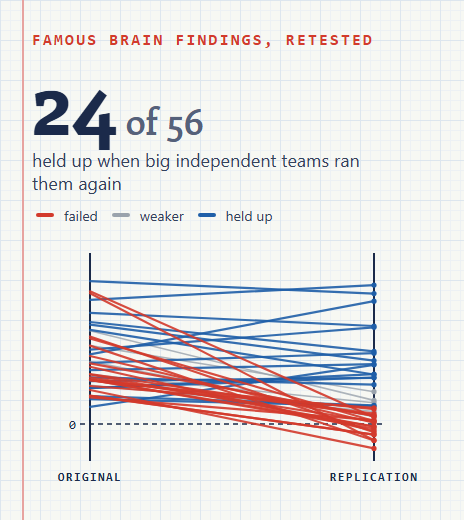
Anchoring shows why one verdict is too coarse. The four estimation questions of Many Labs 1 replicated strongly (r = 0.74 in 5,627 people on our scorecard), while subliminal anchors and the adjustment account failed in later attempts [6]; we file anchoring as mixed. The Dunning-Kruger effect has no multi-site replication in our sources; its first paper is Kruger and Dunning 1999 [24], and our news page asks whether the effect is real. For the first author’s own solo paper of the same year (the below-average effect on hard tasks, original r = 0.96 in 37 people), the replication held up (r = 0.85, n = 240). The backfire effect, where a correction raises belief, is the clearest failure: a 2020 review says recent studies failed to find it, even under favourable conditions [12]. Our own page on which famous brain and intelligence findings held up lists the 56 findings behind these rows.
In 20 replications of named biases the effect held up in 13, came back weaker in 3 and failed in 4; 3 intervals include zero
The replication effect as a correlation r with its 95% interval, one row per finding on our replication scorecard that matches a counted bias; square area = replication sample size. Intervals are the ones printed in the replication report where it printed one; otherwise Fisher z from r and n (scorecard method). A replication is one test, not the last word. IQ Metrics scorecard. As of 20 November 2026.
Replication effect size (r)
Source: IQ Metrics replication scorecard [7] from FReD [6] and the replication reports
Data table
| finding | study | detail | n | estimate | ci_low | ci_high |
|---|---|---|---|---|---|---|
| All 20 findings | Affect heuristic | 2000 original, 2022 replication | 776 | 0.9 | 0.6 | 1 |
| All 20 findings | Worse-than-average effect | 1999 original, 2022 replication: the below-average effect on ha. | 240 | 0.8 | 0.4 | 1 |
| All 20 findings | Illusory superiority | 1981 original, 2023 replication: drivers rating themselves abov. | 1203 | 0.8 | 0.8 | 0.8 |
| All 20 findings | Bias blind spot | 2002 original, 2021 replication | 621 | 0.8 | 0.8 | 0.8 |
| All 20 findings | Anchoring effect | 1995 original, 2014 replication: four estimation questions in M. | 5627 | 0.7 | 0.7 | 0.8 |
| All 20 findings | Illusory superiority | 1985 original, 2020 replication: good traits rated as more self. | 1573 | 0.7 | 0.7 | 0.8 |
| All 20 findings | False consensus effect | 1977 original, 2018 replication | 7827 | 0.4 | 0.4 | 0.5 |
| All 20 findings | Outcome bias | 1988 original, 2023 replication | 692 | 0.4 | 0.3 | 0.4 |
| All 20 findings | Less-is-better effect | 1998 original, 2018 replication | 7646 | 0.4 | 0.3 | 0.4 |
| All 20 findings | Money illusion | 1997 original, 2021 replication | 604 | 0.3 | 0.2 | 0.4 |
| All 20 findings | Conjunction fallacy | 2001 original, 2021 replication: whether frequency formats remo. | 1032 | 0.2 | 0.1 | 0.3 |
| All 20 findings | Framing effect (psychology) | 1981 original, 2018 replication: gain-loss framing of the Asian. | 7228 | 0.2 | 0.2 | 0.2 |
| All 20 findings | Hindsight bias | 1977 original, 2021 replication | 608 | 0.2 | 0.1 | 0.3 |
| All 20 findings | Scope neglect | 2004 original, 2024 replication: affect-rich options and insens. | 1041 | 0.1 | 0.1 | 0.2 |
| All 20 findings | Curse of knowledge | 2007 original, 2023 replication | 225 | 0.1 | -0 | 0.2 |
| All 20 findings | Framing effect (psychology) | 2006 original, 2023 replication: whether low numeracy gives a b. | 860 | 0.1 | 0 | 0.1 |
| All 20 findings | Google effect | 2011 original, 2018 replication | 234 | 0.1 | -0.1 | 0.2 |
| All 20 findings | Availability heuristic | 1973 original, 2016 replication | 3088 | 0 | 0 | 0.1 |
| All 20 findings | Neglect of probability | 2001 original, 2018 replication: affect-rich outcomes and insen. | 7218 | -0 | -0.1 | -0 |
| All 20 findings | Anchoring effect | 2006 original, 2024 replication: the adjustment account (need f. | 303 | -0.1 | -0.2 | 0.1 |
Embed this chart
Paste this HTML into your page: it carries the numbers and the credit link to this figure.
10 Does a high IQ protect you from cognitive biases?
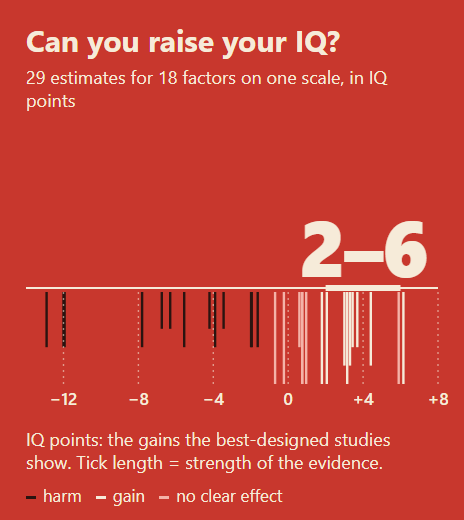
Not in general, according to the papers we could read: the evidence is that many bias tasks show little or no correlation with cognitive ability, and a few show a modest one. Stanovich and West reported in seven studies that a large number of thinking biases (conjunction, framing, anchoring, outcome bias, base-rate neglect, sunk cost and others) were uncorrelated with cognitive ability, and in a further experiment that denominator neglect, probability matching, belief bias and matching bias did correlate with it [15]. The magnitude of myside bias shows very little relation to intelligence [16], and a larger bias blind spot went, if anything, with higher cognitive ability [17]. The Cognitive Reflection Test, a short test of overriding a first answer, correlated substantially with ability and predicted bias tasks beyond it [18]; CRT scores went with fewer conjunction errors, less conservatism and less overconfidence but not with anchoring [19]. Our page on why smart people make bad decisions covers the same ground in plain language, and what raises or lowers IQ sets out what is known about cognitive ability itself.
In two open-access studies the printed correlations between a reasoning test and bias tasks run from -0.02 to +0.49; 11 of 13 are under 0.20
Every correlation r these two papers print between a reasoning test score and one task: eight tasks in a sample of 2,643 students (Bruckmaier et al. 2021, Spearman) and five in 250 students (Jackson et al. 2016, Pearson, Raven's matrices). The 2021 test has a reliability of alpha 0.43, which lowers any correlation. Different tasks and samples, so the dots are not one distribution. Printed values, no IQ shown. As of 20 November 2026.
Source: Bruckmaier et al. 2021 [13]; Jackson et al. 2016 [14]
Data table
| label | value |
|---|---|
| Cognitive Reflection Test (matrices test, n = 250) | 0.5 |
| Applying Decision Rules (matrices test, n = 250) | 0.3 |
| Consistency in Risk Perception (matrices test, n = 250) | 0.2 |
| AIDS problem (frequencies, version 2) (reasoning test, n = 2,643) | 0.1 |
| Monty Hall problem (reasoning test, n = 2,643) | 0.1 |
| Wason task (contextualised) (reasoning test, n = 2,643) | 0.1 |
| AIDS problem (frequencies, version 1) (reasoning test, n = 2,643) | 0.1 |
| Resistance to Framing (matrices test, n = 250) | 0.1 |
| Hospital problem (law of large numbers) (reasoning test, n = 2,643) | 0.1 |
| Wason selection task (classic wording) (reasoning test, n = 2,643) | 0 |
| Linda problem (conjunction) (reasoning test, n = 2,643) | 0 |
| AIDS problem (probabilities) (reasoning test, n = 2,643) | -0 |
| Risky Gambles (matrices test, n = 250) | -0 |
Embed this chart
Paste this HTML into your page: it carries the numbers and the credit link to this figure.
The 10 papers behind the table: what each prints about cognitive ability and bias tasks
Facts only. "Not printed in the abstract" means the paper may print it in the full text, which was paywalled and not read. No sample, table or passage is copied; the two open-access papers (CC BY) were read in full, Tables 2 and 3. As of 20 November 2026.
| Stanovich and West 2008 | not printed in the abstract | cognitive ability (measures not named in the abstract) | conjunction, framing, anchoring, outcome bias, base-rate neglect, less-is-more, affect biases, omission bias, myside bia | In 7 studies a large number of thinking biases were uncorrelated with cognitive ability; in a further experiment ability did correlate with denominator neglect, probability matching, belief bias and matching bias on the 4-card selection task | not printed in the abstract | abstract (paywalled) |
| Stanovich and West 2007 | not printed (no abstract in Crossref) | cognitive ability | myside bias | The title states that natural myside bias is independent of cognitive ability | not read | title only (paywalled) |
| Stanovich, West and Toplak 2013 | review: no single n | intelligence (as measured in the reviewed studies) | myside bias paradigms (evaluating, generating and testing evidence) | Across a wide variety of myside bias paradigms the magnitude of myside bias shows very little relation to intelligence | not printed in the abstract | abstract (paywalled) |
| West, Meserve and Stanovich 2012 | two studies; n not printed in the abstract | cognitive ability and thinking dispositions | bias blind spot for classic heuristics-and-biases tasks | None of the bias blind spots was attenuated by cognitive ability or thinking dispositions; if anything a larger bias blind spot went with higher cognitive ability | not printed in the abstract | abstract (paywalled) |
| Toplak, West and Stanovich 2011 | not printed in the abstract | cognitive ability; Cognitive Reflection Test (CRT) | a wide sample of heuristics-and-biases tasks | The CRT had a substantial correlation with cognitive ability and was a unique predictor of heuristics-and-biases performance after ability, thinking dispositions and executive functioning were controlled | not printed in the abstract | abstract (paywalled) |
| Bruine de Bruin, Parker and Fischhoff 2007 | not printed in the abstract | cognitive ability | 7 decision tasks combined in an Adult Decision-Making Competence index | The index related significantly to cognitive ability and socioeconomic status, and kept predictive validity for negative life events after cognitive ability was controlled | not printed in the abstract | abstract (paywalled) |
| Oechssler, Roider and Schmitz 2009 | not printed in the abstract | Cognitive Reflection Test score (three items) | conjunction fallacy, conservatism in updating, overconfidence, anchoring, time and risk preferences | Higher CRT scores went with fewer conjunction fallacies, less conservatism in updating and less overconfidence; no influence on anchoring; biases stayed substantial even for high scorers | not printed in the abstract | abstract of the working paper version (SSRN, doi 10.2139/ssrn.1294555) |
| Del Missier, Mantyla and Bruine de Bruin 2012 | not printed in the abstract | fluid intelligence and numeracy; executive functions | decision-making competence tasks (framing, decision rules, risk perception, social norms, sunk costs) | Executive functions explained parts of decision-making competence beyond fluid intelligence and numeracy; resistance to sunk costs and recognising social norms were not significantly related to executive functions | not printed in the abstract | abstract (paywalled) |
| Bruckmaier, Krauss, Binder, Hilbert and Brunner 2021 | 2,643 students aged 16 to 18 (Luxembourg) | a 12-item general-intelligence test (Cronbach alpha 0.43, Table 2) | Wason selection task, hospital problem, Linda problem, AIDS probability problem, Monty Hall and facilitated versions | Spearman r with the intelligence test: composite of the traditional illusions 0.16; single items from -0.02 to 0.13 (Table 3) | -0.02 to 0.16 | full text (CC BY) |
| Jackson, Kleitman, Howie and Stankov 2016 | 250 first-year psychology students (Sydney) | Raven’s Advanced Progressive Matrices accuracy | Cognitive Reflection Test, Applying Decision Rules, Consistency in Risk Perception, Resistance to Framing, Risky Gambles | Pearson r with matrices accuracy (Table 2): CRT 0.49, Applying Decision Rules 0.34, Consistency in Risk Perception 0.16, Resistance to Framing 0.06 (not significant), Risky Gambles -0.02 (not significant) | -0.02 to 0.49 | full text (CC BY) |
Source: The papers cited, by DOI
Two cautions apply. The printed correlations come from different tasks, samples and tests, so they are not one distribution; and a short, unreliable test lowers any correlation: the 12-item intelligence test in the largest study has a reliability of alpha 0.43, which the authors print in Table 2. Whether a person with a high score shows a given bias is a statement about groups of people on a task, not about any individual. Your own score on a test says nothing about your biases; if you want a reasoning measure, our critical thinking test and logical reasoning test measure different things from the tasks above.
11 What else connects cognitive biases to memory, attention and AI?
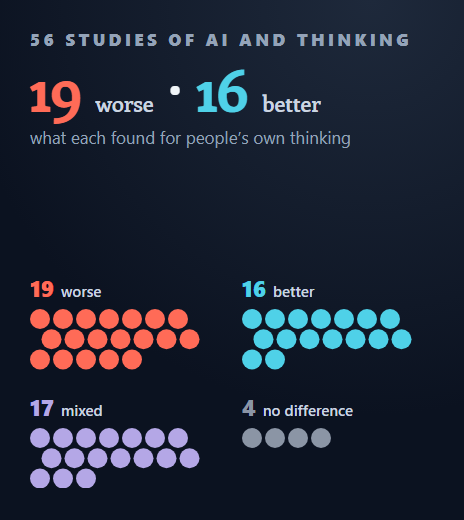
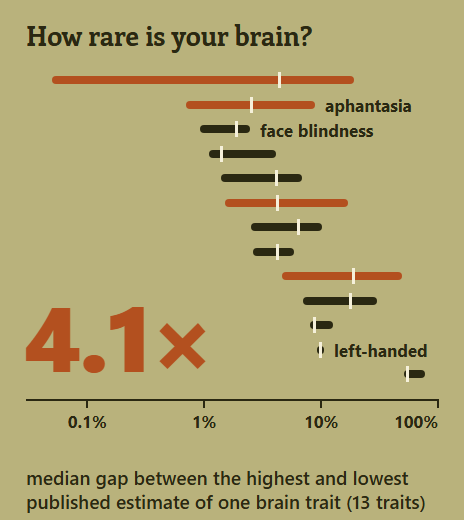
Memory abilities as tests measure them are a different subject from the memory biases in the table; see our page on memory and IQ. The “Google effect” (remembering where to find a fact rather than the fact) is a broad-count row that failed to replicate in a sample of 234 people, and the related research on cognitive offloading is in our news on AI and memory. Attention claims have the same shape: the popular figure for human attention span is tested in the goldfish comparison. On related ability questions, working memory and reasoning are closely related but not the same, according to this explainer, and what practice changes on a cognitive-ability test is covered in the practice-effect news. Stereotype threat, another effect whose size is questioned, has its own page: does it really change test scores. On how common unusual traits are, see how rare is your brain; for neuroscience myths by country, neuromyths by country; on AI and thinking, AI and your brain.
Measure your own reasoning
Cognitive biases are tendencies in groups of people on tasks; they are not a score. If you want to see how you do on a timed reasoning test, take the IQ test and read the result as a percentile among adults.
Take the IQ test12 What does this count not show?
Read every number with these in mind
- The core count of 174 follows our written rule and our judgment on each name; a different rule gives a different number (the broad count is 197). It trusts that a name with an English Wikipedia article of its own is used in the literature; only the 72 most-read were checked in OpenAlex.
- 31 names on Wikipedia’s list have no article of their own and are not counted, although some are well studied. Names that Wikipedia lacks entirely are missing except the 21 we added with a source.
- The first paper is verified for 96 of 174 biases only, and “first” means the paper the field cites; an earlier paper may exist. The OpenAlex first-hit year is shown for 66 biases and is noisy (old or mis-dated records).
- OpenAlex counts are papers that mention an exact phrase, not papers that study the bias; a bias known by another name is undercounted. OpenAlex answers keyless requests from one shared daily budget, so only the most-read biases were counted (72 biases).
- Wikipedia pageviews measure one channel. A visit through a redirect title counts under the redirect, articles were created, moved and merged, Wikimedia revised its bot classification in 2025, and reading Wikipedia is not the same as being interested in a topic.
- “No replication attempt found” is a lower bound for two sources (FReD, version of 1 February 2026, and our scorecard of 56 findings); it never means “never repeated”. A replication is one test, and the matching of a replication to a bias name is ours (printed in the CSV). A 2024 replication of a goals-as-reference-points paper (Heath et al. 1999) held up; it is not a test of loss aversion itself, so it is not counted and loss aversion reads none found.
- The families are our coding (one family per bias, first rule that fits). A different split gives different family figures.
- The IQ table rests on two open-access papers with printed correlations and eight abstracts; the full texts of the paywalled papers were not read.
13 How was this dataset built?
- 01
Define
data/DEFINITIONS.md was written first: the inclusion rule, the exclusion classes, the merge rule, what “first named”, “papers” and “attention” mean, and the family rule.
- 02
Collect names
The names of the 245 bullet entries on Wikipedia’s list (revision 1383579135, names only) through the MediaWiki API, 238 Wikidata items through the Wikidata API (the Query Service refused with HTTP 429), and 21 names we added with a source.
- 03
Apply the rule
Each name was resolved to its Wikipedia article (redirects followed), merged where two names are one article, and coded as core, broad, left out (with a reason) or listed only. The logs are in the CSV and data/out.
- 04
Date
The standard first reference for each of 96 biases was looked up in Crossref and accepted only when first author, year and title matched.
- 05
Count papers
One OpenAlex call per phrase (title or abstract, exact phrase, grouped by publication year) for the 72 most-read biases.
- 06
Measure attention
Monthly human pageviews 2015-07 to 2026-10 for each article, plus daily views of Confirmation bias; articles with no data in some month of 2016, under 1,000 views in 2016, a step change, or a broader redirect target are kept out of trend charts.
- 07
Find replications
FReD matched by original paper (first author and year) to a named bias, and the 20 matching findings of our replication scorecard; every counted attempt row is in the CSV with its sizes and verdict.
- 08
Check
A second script (data/recount.py) recounts every headline number from the raw files; the figures read data/out/numbers.json at build time.
Using this in a class or thesis
The CSV (how-many-cognitive-biases-are-there-2026-iqmetrics.csv, 255 rows, CC BY 4.0) lists every name with its tier, family, first paper and DOI, papers per year where counted, human pageviews for four years, the trend flag and the replication status. Use it to find names, dates and primary papers and cite the paper, not this page, for a fact about a bias. It cannot tell you whether a bias is real, how large it is, or whether a person has it; the counts depend on our rule; “none found” is not “none”. Do not use the views to rank topics by importance.
14 Every named bias: the full table
All 255 names: counted, broad-only, listed only and left out
Name (the Wikipedia article title), tier, family, first paper (linked to its DOI), papers that mention the phrase (the 72 most-read only), human views in 2016 (only where the article kept one title), views in 2025, change, and replication status where one was found. Click a column to sort. The CSV adds aliases, phrases, DOIs, first-hit years, flags and the replication detail. As of 20 November 2026.
| Accentuation effect | Counted | Attention | 5,066 | 1,757 | -65% | |||
| Action bias | Counted | Choice | 9,405 | |||||
| Actor–observer asymmetry | Counted | Social | 25,498 | 9,884 | -61% | |||
| Additive bias | Counted | Choice | 2021 | 2,491 | ||||
| Aesthetic–usability effect | Counted | Attention | 9,185 | |||||
| Affect heuristic | Counted | Belief | 2000 | 405 | 27,098 | 9,871 | -64% | Held up |
| Affective forecasting | Counted | Estimation | ||||||
| Ambiguity effect | Counted | Choice | 1961 | 1,436 | 20,695 | 8,737 | -58% | |
| Anchoring effect | Counted | Estimation | 1974 | 2,978 | 85,392 | Mixed | ||
| Apophenia | Counted | Attention | 308,260 | 223,346 | -28% | |||
| Attribute substitution | Counted | Estimation | 2002 | 165 | 14,717 | 9,916 | -33% | |
| Attribution bias | Counted | Social | 92,273 | 27,966 | -70% | |||
| Authority bias | Counted | Social | 18,515 | |||||
| Automation bias | Counted | Choice | 1999 | 2,242 | 8,156 | 18,935 | +132% | |
| Availability heuristic | Counted | Estimation | 1973 | 895 | 155,043 | 69,649 | -55% | Weaker |
| Backfire effect | Counted | Belief | 2010 | Failed | ||||
| Ballot order effect | Counted | Choice | 3,095 | |||||
| Bandwagon effect | Counted | Social | 1950 | 870 | 148,820 | 59,811 | -60% | |
| Barnum effect | Counted | Belief | 1949 | 158 | 230,886 | 209,771 | -9% | |
| Base rate fallacy | Counted | Estimation | 1980 | 218 | 98,500 | 91,549 | -7% | |
| Belief bias | Counted | Belief | 1983 | 19,495 | 7,495 | -62% | ||
| Belief perseverance | Counted | Belief | 1975 | 174 | 15,825 | 28,677 | +81% | |
| Benjamin Franklin effect | Counted | Social | 32 | |||||
| Bias blind spot | Counted | Social | 2002 | 178 | 30,710 | 18,952 | -38% | Held up |
| Boundary extension | Counted | Memory | 1989 | 1,083 | ||||
| Certainty effect | Counted | Choice | 1979 | 8,467 | 2,657 | -69% | ||
| Cheerleader effect | Counted | Attention | 31,088 | |||||
| Choice-supportive bias | Counted | Memory | 2000 | 20 | 31,495 | 16,463 | -48% | |
| Clustering illusion | Counted | Estimation | 34,912 | 21,255 | -39% | |||
| Compassion fade | Counted | Choice | 2014 | 8,540 | ||||
| Compromise effect | Counted | Choice | 1989 | |||||
| Confirmation bias | Counted | Belief | 1960 | 5,845 | 827,641 | 369,122 | -55% | |
| Congruence bias | Counted | Belief | 12,553 | 4,587 | -64% | |||
| Conjunction fallacy | Counted | Estimation | 1983 | 477 | 80,128 | 43,846 | -45% | Held up |
| Conservatism (belief revision) | Counted | Estimation | 10,398 | 7,637 | -27% | |||
| Continued influence effect | Counted | Belief | 1994 | |||||
| Contrast effect | Counted | Attention | 35,632 | 11,192 | -69% | Failed | ||
| Cross-race effect | Counted | Memory | 1969 | 180 | 91,014 | 34,112 | -62% | |
| Cryptomnesia | Counted | Memory | 1989 | 103 | 86,184 | 47,738 | -45% | |
| Curse of knowledge | Counted | Estimation | 1989 | 199 | 91,838 | 82,612 | -10% | Failed |
| Declinism | Counted | Memory | 7,915 | 26,030 | +229% | |||
| Decoy effect | Counted | Choice | 1982 | 368 | 33,835 | 22,472 | -34% | |
| Default effect | Counted | Choice | 2003 | 161 | 8,380 | Mixed | ||
| Defensive attribution hypothesis | Counted | Social | 8,423 | 3,468 | -59% | |||
| Denomination effect | Counted | Choice | 5,698 | 3,316 | -42% | |||
| Disposition effect | Counted | Choice | 1985 | 1,691 | 31,238 | 11,967 | -62% | |
| Distinction bias | Counted | Choice | 6,473 | 3,526 | -45% | |||
| Dunning–Kruger effect | Counted | Social | 1999 | 692 | 3,088,343 | 1,567,802 | -49% | |
| Duration neglect | Counted | Memory | 1993 | 6,426 | 3,579 | -44% | ||
| Effort justification | Counted | Choice | 1959 | 19,167 | 12,096 | -37% | ||
| Egocentric bias | Counted | Social | 1979 | 436 | 14,470 | 11,644 | -19% | |
| Einstellung effect | Counted | Belief | 34,270 | 27,756 | -19% | |||
| End-of-history illusion | Counted | Belief | 14,587 | 12,113 | -17% | |||
| Endowment effect | Counted | Choice | 1980 | 1,489 | 94,376 | 45,368 | -52% | Held up |
| Error management theory | Counted | Social | 2000 | |||||
| Escalation of commitment | Counted | Choice | 963 | 94,486 | 36,708 | -61% | ||
| Extension neglect | Counted | Estimation | 5,568 | 5,080 | -9% | |||
| Extrinsic incentives bias | Counted | Estimation | 4,097 | 2,872 | -30% | |||
| Fading affect bias | Counted | Memory | 5,330 | 10,909 | +105% | |||
| False consensus effect | Counted | Estimation | 1977 | 264 | 43,215 | Held up | ||
| False memory | Counted | Memory | 1995 | 5,264 | 191,352 | |||
| False-uniqueness effect | Counted | Social | 7,209 | |||||
| Fiscal illusion | Counted | Belief | 3,568 | 3,816 | +7% | |||
| Fluency heuristic | Counted | Belief | 2008 | 6,818 | 4,869 | -29% | ||
| Focusing illusion | Counted | Estimation | 1998 | 3,861 | ||||
| Framing effect (psychology) | Counted | Choice | 1981 | 2,485 | 143,271 | 37,103 | -74% | Weaker |
| Frequency illusion | Counted | Attention | 271,327 | |||||
| Functional fixedness | Counted | Belief | 41,852 | 16,059 | -62% | |||
| Fundamental attribution error | Counted | Social | 1977 | 509 | 344,325 | 102,609 | -70% | |
| Gambler’s fallacy | Counted | Estimation | 1971 | 732 | 399,181 | 158,487 | -60% | |
| Group attribution error | Counted | Social | 1985 | 7 | 7,736 | 5,629 | -27% | |
| Halo effect | Counted | Attention | 1920 | 2,782 | 308,680 | 180,876 | -41% | |
| Hard–easy effect | Counted | Belief | 1977 | 6,625 | 4,413 | -33% | ||
| Hindsight bias | Counted | Memory | 1975 | 1,433 | 119,698 | 54,189 | -55% | Held up |
| Hostile attribution bias | Counted | Social | 16,615 | 17,686 | +6% | |||
| Hostile media effect | Counted | Social | 1985 | 22,846 | 9,813 | -57% | ||
| Hot hand | Counted | Estimation | 1985 | 577 | 19,299 | |||
| Hot-cold empathy gap | Counted | Social | 2005 | 10,347 | ||||
| Hyperbolic discounting | Counted | Choice | 1997 | 1,624 | 84,192 | 35,362 | -58% | |
| IKEA effect | Counted | Choice | 2011 | 128,357 | 49,157 | -62% | ||
| Identifiable victim effect | Counted | Choice | 1997 | 115 | 8,486 | 9,235 | +9% | |
| Illusion of asymmetric insight | Counted | Social | 9,271 | 5,183 | -44% | |||
| Illusion of control | Counted | Belief | 1975 | 1,530 | 51,957 | 26,120 | -50% | |
| Illusion of explanatory depth | Counted | Belief | 2002 | 119 | 13,718 | |||
| Illusion of transparency | Counted | Estimation | 1998 | 166 | 14,867 | 13,168 | -11% | |
| Illusion of validity | Counted | Belief | 1978 | 5,681 | 4,103 | -28% | ||
| Illusory correlation | Counted | Estimation | 1967 | 422 | 45,210 | 16,680 | -63% | |
| Illusory superiority | Counted | Social | 1981 | 198,900 | 57,550 | -71% | Held up | |
| Illusory truth effect | Counted | Belief | 1977 | 212 | 86,978 | |||
| Impact bias | Counted | Estimation | 10,665 | 5,325 | -50% | |||
| Implicit stereotype | Counted | Belief | 21,899 | 23,648 | +8% | |||
| In-group favoritism | Counted | Social | 1971 | 839 | 51,046 | 35,580 | -30% | |
| Insensitivity to sample size | Counted | Estimation | 1971 | 7,466 | 6,873 | -8% | ||
| Intentionality bias | Counted | Social | 1,488 | |||||
| Introspection illusion | Counted | Social | 1977 | 34,196 | 15,118 | -56% | ||
| Just-world fallacy | Counted | Social | 1966 | 11 | 81,481 | |||
| Law of the instrument | Counted | Choice | 68,685 | 146,370 | +113% | |||
| Less-is-better effect | Counted | Choice | 10,595 | 9,162 | -14% | Held up | ||
| Leveling and sharpening | Counted | Memory | 1,615 | |||||
| Loss aversion | Counted | Choice | 1991 | 8,631 | 142,179 | 74,586 | -48% | |
| Mental accounting | Counted | Choice | 1985 | 2,861 | 26,807 | 14,496 | -46% | |
| Mere-exposure effect | Counted | Attention | 1968 | 530 | 131,169 | 90,219 | -31% | |
| Misattribution of memory | Counted | Memory | 16,997 | 8,682 | -49% | |||
| Misinformation effect | Counted | Memory | 1974 | 437 | 58,583 | 14,864 | -75% | |
| Money illusion | Counted | Choice | 1997 | 580 | 30,404 | 11,392 | -62% | Held up |
| Motonormativity | Counted | Belief | 11,753 | |||||
| Naïve cynicism | Counted | Estimation | 1999 | 8,209 | ||||
| Naïve realism (psychology) | Counted | Social | 955 | 15,437 | ||||
| Negativity bias | Counted | Attention | 2001 | 18,366 | 89,877 | 73,575 | -18% | |
| Neglect of probability | Counted | Choice | 2002 | 10,448 | 4,497 | -57% | Failed | |
| Normalcy bias | Counted | Choice | 42,909 | |||||
| Novelty bias | Counted | Attention | ||||||
| Observer bias | Counted | Social | 13,905 | |||||
| Observer-expectancy effect | Counted | Belief | 7 | 62,642 | 17,876 | -72% | ||
| Omission bias | Counted | Choice | 1990 | 330 | 15,215 | 13,006 | -15% | Held up |
| Optimism bias | Counted | Estimation | 1980 | 1,482 | 86,488 | 33,573 | -61% | Held up |
| Ostrich effect | Counted | Belief | 2006 | 20,834 | 21,840 | +5% | ||
| Out-group homogeneity | Counted | Estimation | 1980 | 84 | 25,947 | 12,852 | -50% | |
| Outcome bias | Counted | Choice | 1988 | 623 | 16,805 | 9,996 | -40% | Held up |
| Outgroup favoritism | Counted | Social | 4,351 | |||||
| Overchoice | Counted | Choice | 2000 | 807 | 20,328 | 19,458 | -4% | |
| Overconfidence effect | Counted | Belief | 1977 | 119 | 84,962 | 39,100 | -54% | |
| Pareidolia | Counted | Attention | 719 | 693,507 | 582,347 | -16% | ||
| Peak–end rule | Counted | Memory | 1993 | 213 | 30,975 | 31,488 | +2% | |
| Planning fallacy | Counted | Estimation | 1994 | 290 | 60,926 | 49,842 | -18% | |
| Plant blindness | Counted | Attention | 6,910 | |||||
| Pollyanna principle | Counted | Memory | 123,743 | 37,897 | -69% | |||
| Present bias | Counted | Choice | 1999 | 2,131 | 9,113 | |||
| Pro-innovation bias | Counted | Belief | 6,786 | 3,216 | -53% | |||
| Probability matching | Counted | Estimation | 4,590 | 2,317 | -50% | |||
| Proportionality bias | Counted | Belief | 4,216 | |||||
| Pseudocertainty effect | Counted | Choice | 8,343 | 3,690 | -56% | |||
| Puritanical bias | Counted | Belief | 1,357 | |||||
| Reactive devaluation | Counted | Social | 1991 | 6,060 | 3,098 | -49% | ||
| Recency illusion | Counted | Memory | 17,631 | 5,557 | -68% | |||
| Regression fallacy | Counted | Estimation | 24,047 | 4,932 | -80% | |||
| Representativeness heuristic | Counted | Estimation | 1972 | 563 | 97,054 | 20,529 | -79% | |
| Restraint bias | Counted | Social | 2009 | 4,554 | 3,183 | -30% | ||
| Rhyme-as-reason effect | Counted | Belief | 2000 | 7,180 | 16,071 | +124% | ||
| Risk compensation | Counted | Choice | 36,515 | 19,895 | -45% | |||
| Rosy retrospection | Counted | Memory | 1997 | 15 | 19,151 | 38,904 | +103% | |
| Salience (neuroscience) | Counted | Attention | ||||||
| Scope neglect | Counted | Choice | 4,966 | 7,716 | +55% | Held up | ||
| Selective perception | Counted | Attention | 51,276 | 17,857 | -65% | |||
| Self-licensing | Counted | Social | 2001 | 706 | 31,991 | 11,554 | -64% | |
| Self-serving bias | Counted | Social | 1975 | 1,063 | 108,079 | 28,947 | -73% | |
| Semmelweis reflex | Counted | Belief | 33,911 | 21,963 | -35% | |||
| Social comparison bias | Counted | Social | 7,763 | 7,478 | -4% | |||
| Social cryptomnesia | Counted | Memory | 1,734 | |||||
| Social-desirability bias | Counted | Social | 1960 | 3,043 | 28,997 | |||
| Spotlight effect | Counted | Estimation | 2000 | 118 | 51,904 | 52,840 | +2% | |
| State-dependent memory | Counted | Memory | 63,241 | 19,163 | -70% | |||
| Status quo bias | Counted | Choice | 1988 | 1,694 | 56,070 | 31,566 | -44% | |
| Streetlight effect | Counted | Belief | 35,746 | |||||
| Subadditivity effect | Counted | Estimation | 1994 | 4,418 | 2,569 | -42% | ||
| Subjective validation | Counted | Belief | 17,763 | 7,248 | -59% | |||
| Suggestibility | Counted | Memory | 44,842 | 18,390 | -59% | |||
| Sunk cost | Counted | Choice | 1985 | 2,184 | 206,191 | attempt found, result not read | ||
| Surrogation | Counted | Belief | 6,886 | |||||
| Survivorship bias | Counted | Estimation | 1,312 | 230,437 | 779,414 | +238% | ||
| Telescoping effect | Counted | Memory | 1964 | 93 | 17,556 | 5,279 | -70% | |
| Third-person effect | Counted | Social | 1983 | 24,995 | 12,583 | -50% | ||
| Time-saving bias | Counted | Estimation | 4,606 | 4,157 | -10% | |||
| Trait ascription bias | Counted | Social | 5,512 | 3,104 | -44% | |||
| Truth-default theory | Counted | Belief | ||||||
| Turkey illusion | Counted | Belief | 11,088 | |||||
| Ultimate attribution error | Counted | Social | 1979 | 48 | 18,565 | 11,085 | -40% | |
| Unit bias | Counted | Choice | ||||||
| Well travelled road effect | Counted | Choice | 3,795 | 3,974 | +5% | |||
| Wishful thinking | Counted | Belief | 78,972 | 39,339 | -50% | |||
| Women-are-wonderful effect | Counted | Social | 99,129 | |||||
| Worse-than-average effect | Counted | Estimation | 1999 | 6,841 | 3,019 | -56% | Held up | |
| Zero-risk bias | Counted | Choice | 9,258 | 6,387 | -31% | |||
| Zero-sum thinking | Counted | Belief | 17 | 35,617 | ||||
| Availability cascade | Broad only | Belief | 9,619 | 7,284 | -24% | |||
| Bizarreness effect | Broad only | Memory | 5,320 | 4,189 | -21% | |||
| Cheves Perky | Broad only | Memory | ||||||
| Childhood amnesia | Broad only | Memory | 120,754 | 85,219 | -29% | |||
| Cue-dependent forgetting | Broad only | Memory | 12,510 | 4,682 | -63% | |||
| Generation effect | Broad only | Memory | 1978 | 10,791 | 8,125 | -25% | ||
| Google effect | Broad only | Memory | 2011 | 21,644 | 18,711 | -14% | Failed | |
| Groupshift | Broad only | Belief | 13,363 | 3,756 | -72% | |||
| Groupthink | Broad only | Belief | 400,432 | 117,602 | -71% | |||
| Memory inhibition | Broad only | Memory | 13,832 | 12,439 | -10% | |||
| Modality effect | Broad only | Memory | 8,829 | 3,836 | -57% | |||
| Next-in-line effect | Broad only | Memory | 2,326 | |||||
| Picture superiority effect | Broad only | Memory | 29,865 | 21,061 | -30% | |||
| Reminiscence bump | Broad only | Memory | 16,733 | 15,044 | -10% | |||
| Repetition blindness | Broad only | Memory | 3,357 | 2,397 | -29% | |||
| Self-reference effect | Broad only | Memory | 1977 | 19,511 | 7,380 | -62% | ||
| Serial-position effect | Broad only | Memory | 1962 | 23,109 | ||||
| Shared information bias | Broad only | Choice | 5,214 | 2,051 | -61% | |||
| Spacing effect | Broad only | Memory | 43,228 | 29,095 | -33% | |||
| Testing effect | Broad only | Memory | 30,416 | 36,747 | +21% | |||
| Tip of the tongue | Broad only | Memory | 104,880 | 35,679 | -66% | |||
| Von Restorff effect | Broad only | Memory | 24,868 | 16,880 | -32% | |||
| Zeigarnik effect | Broad only | Memory | 47,528 | 92,857 | +95% | |||
| Assumed similarity bias | Listed only | Social | ||||||
| Consistency bias | Listed only | Memory | ||||||
| Context neglect bias | Listed only | Social | ||||||
| Domain neglect | Listed only | Social | ||||||
| Doubling-back aversion | Listed only | Choice | ||||||
| Dread aversion | Listed only | Choice | ||||||
| Exaggerated expectation | Listed only | Estimation | ||||||
| False priors | Listed only | Belief | ||||||
| Form function attribution bias | Listed only | Social | ||||||
| G. I. Joe fallacy | Listed only | Social | ||||||
| Gender differences in eyewitness memory | Listed only | Memory | ||||||
| Hedonic recall bias | Listed only | Estimation | ||||||
| Humor effect | Listed only | Memory | ||||||
| Illusion of learning | Listed only | Social | ||||||
| Interoceptive bias or hungry judge effect | Listed only | Estimation | ||||||
| Lag effect | Listed only | Memory | ||||||
| List-length effect | Listed only | Memory | ||||||
| Non-adaptive choice switching | Listed only | Choice | ||||||
| Objectivity illusion | Listed only | Social | ||||||
| Phantom effect | Listed only | Choice | ||||||
| Placement bias | Listed only | Memory | ||||||
| Positivity effect (Socioemotional selectivity theory) | Listed only | Memory | ||||||
| Prevention bias | Listed only | Choice | ||||||
| Processing difficulty effect | Listed only | Memory | ||||||
| Quantification bias | Listed only | Belief | ||||||
| Response bias | Listed only | Social | ||||||
| Saying is believing effect | Listed only | Belief | ||||||
| Stereotype bias or stereotypical bias | Listed only | Memory | ||||||
| Suffix effect | Listed only | Memory | ||||||
| Teleological bias | Listed only | Social | ||||||
| Verbatim effect | Listed only | Memory | ||||||
| Agent detection | Left out | Belief | ||||||
| Anthropocentrism | Left out | Social | ||||||
| Anthropomorphism | Left out | Social | ||||||
| Attentional bias | Left out | Memory | ||||||
| Berkson’s paradox | Left out | Belief | ||||||
| Cognitive dissonance | Left out | Belief | ||||||
| Common source bias | Left out | Belief | ||||||
| Embodied cognition | Left out | Social | ||||||
| Euphoric recall | Left out | Memory | ||||||
| Gender bias | Left out | Belief | ||||||
| Implicit-association test | Left out | Memory | ||||||
| Impostor syndrome | Left out | Social | ||||||
| Information bias (psychology) | Left out | Belief | ||||||
| Levels of processing model | Left out | Memory | ||||||
| Misinterpreted-effort hypothesis | Left out | Social | ||||||
| Moral luck | Left out | Social | ||||||
| Not invented here | Left out | Choice | ||||||
| Persistence | Left out | Memory | ||||||
| Pygmalion effect | Left out | Social | ||||||
| Reactance (psychology) | Left out | Choice | ||||||
| Selection bias | Left out | Belief | ||||||
| Stereotype | Left out | Social | ||||||
| System justification theory | Left out | Social | ||||||
| Systematic bias | Left out | Estimation | ||||||
| Time perception | Left out | Estimation | ||||||
| Value selection bias | Left out | Belief | ||||||
| Weber–Fechner law | Left out | Estimation |
Source: IQ Metrics table (Wikipedia list names, Wikidata, Crossref, OpenAlex, Wikimedia pageviews, FReD, scorecard)
The 31 replication attempts matched to a counted bias
Original paper, replication report, replication sample size, verdict and who gave it: our scorecard rule (interval and size) for the scorecard rows, the replication authors' own verdict (FReD) for the rest. One row per replication paper. As of 20 November 2026.
| Affect heuristic | Finucane et al. (2000), n = 219 | Efendić et al. (2022), n = 776 | 776 | Held up | IQ Metrics scorecard rule (interval and size) |
| Anchoring effect | Mussweiler, T., & Englich, B. (2005). Subliminal anchoring: | Röseler, L., Schütz, A., Blank, P. A., Dück, M., Fels, S., Kupfer, J., | 165 | Failed | the replication authors’ own verdict (FReD reported_success; |
| Anchoring effect | Reitsma-van Rooijen, M., & L. Daamen, D. D. (2006). Sublimin | Röseler, L., Schütz, A., Blank, P. A., Dück, M., Fels, S., Kupfer, J., | 170 | Failed | the replication authors’ own verdict (FReD reported_success; |
| Anchoring effect | Epley & Gilovich (2006), n = 81 | Röseler et al. (2024), n = 303 | 303 | Failed | IQ Metrics scorecard rule (interval and size) |
| Anchoring effect | Jacowitz & Kahneman (1995), n = 104 | Klein et al. (2014), n = 5,627 | 5627 | Held up | IQ Metrics scorecard rule (interval and size) |
| Availability heuristic | Tversky & Kahneman (1973), n = 152 | Ebersole et al. (2016), n = 3,088 | 3088 | Weaker | IQ Metrics scorecard rule (interval and size) |
| Backfire effect | Nyhan & Reifler 2010 | review of later attempts: Swire-Thompson, DeGutis & Lazer 2020 (J. App | Failed | authors, read from the paper record | |
| Bias blind spot | Pronin et al. (2002), n = 24 | Chandrashekar et al. (2021), n = 621 | 621 | Held up | IQ Metrics scorecard rule (interval and size) |
| Conjunction fallacy | Mellers et al. (2001), n = 108 | Chandrashekar et al. (2021), n = 1,032 | 1032 | Held up | IQ Metrics scorecard rule (interval and size) |
| Contrast effect | Schwarz, N., Strack, F., & Mai, H.-P. (1991). Assimilation a | Klein, R. A., Vianello, M., Hasselman, F., Adams, B. G., Adams, R. B., | 7460 | Failed | the replication authors’ own verdict (FReD reported_success; |
| Curse of knowledge | Birch & Bloom (2007), n = 155 | Boyce et al. (2023), n = 225 | 225 | Failed | IQ Metrics scorecard rule (interval and size) |
| Default effect | Johnson, E. J., & Goldstein, D. (2003). Do Defaults Save Liv | Chandrashekar, S. P., Adelina, N., Zeng, S., Chiu, Y. Y. E., Leung, G. | 970 | Held up | the replication authors’ own verdict (FReD reported_success; |
| Default effect | Johnson, E. J., Bellman, S., & Lohse, G. L. (2002). Defaults | Chandrashekar, S. P., Adelina, N., Zeng, S., Chiu, Y. Y. E., Leung, G. | 1920 | Failed | the replication authors’ own verdict (FReD reported_success; |
| Default effect | Johnson, E. J., Bellman, S., & Lohse, G. L. (2002). Defaults | Chandrashekar, S. P., Adelina, N., Zeng, S., Esther, C. Y. Y., Leung, | 1920 | Failed | the replication authors’ own verdict (FReD reported_success; |
| Endowment effect | Mandel, D. R. (2002). Beyond mere ownership: transaction dem | Ziano, I., Yao, J. D., Gao, Y., & Feldman, G. (2020). Impact of owners | 311 | Held up | the replication authors’ own verdict (FReD reported_success; |
| False consensus effect | Ross et al. (1977), n = 80 | Klein et al. (2018), n = 7,827 | 7827 | Held up | IQ Metrics scorecard rule (interval and size) |
| Framing effect (psychology) | Tversky & Kahneman (1981), n = 181 | Klein et al. (2018), n = 7,228 | 7228 | Weaker | IQ Metrics scorecard rule (interval and size) |
| Framing effect (psychology) | Peters et al. (2006), n = 100 | Zhu & Feldman (2023), n = 860 | 860 | Weaker | IQ Metrics scorecard rule (interval and size) |
| Google effect | Sparrow et al. (2011), n = 69 | Camerer et al. (2018), n = 234 | 234 | Failed | IQ Metrics scorecard rule (interval and size) |
| Hindsight bias | Slovic & Fischhoff (1977), n = 184 | Chen et al. (2021), n = 608 | 608 | Held up | IQ Metrics scorecard rule (interval and size) |
| Illusory superiority | Svenson (1981), n = 86 | Koppel et al. (2023), n = 1,203 | 1203 | Held up | IQ Metrics scorecard rule (interval and size) |
| Illusory superiority | Alicke (1985), n = 88 | Ziano et al. (2020), n = 1,573 | 1573 | Held up | IQ Metrics scorecard rule (interval and size) |
| Less-is-better effect | Hsee (1998), n = 83 | Klein et al. (2018), n = 7,646 | 7646 | Held up | IQ Metrics scorecard rule (interval and size) |
| Money illusion | Shafir et al. (1997), n = 358 | Ziano et al. (2021), n = 604 | 604 | Held up | IQ Metrics scorecard rule (interval and size) |
| Neglect of probability | Rottenstreich & Hsee (2001), n = 40 | Klein et al. (2018), n = 7,218 | 7218 | Failed | IQ Metrics scorecard rule (interval and size) |
| Omission bias | Spranca, M., Minsk, E., & Baron, J. (1991). Omission and com | Jamison, J., Yay, T., & Feldman, G. (2020). Action-inaction asymmetrie | 313 | Held up | the replication authors’ own verdict (FReD reported_success; |
| Optimism bias | Weinstein, N. D. (1984). Why it won’t happen to me: Percepti | Chan, C. H. & Feldman, G. Weinstein (1984): Replication and extension. | 480 | Held up | the replication authors’ own verdict (FReD reported_success; |
| Outcome bias | Baron & Hershey (1988), n = 20 | Aiyer et al. (2023), n = 692 | 692 | Held up | IQ Metrics scorecard rule (interval and size) |
| Scope neglect | Hsee & Rottenstreich (2004), n = 331 | Tam & Feldman (2024), n = 1,041 | 1041 | Held up | IQ Metrics scorecard rule (interval and size) |
| Sunk cost | Oppenheimer, Meyvis & Davidenko 2009 | Many Labs 1 (Klein et al. 2014) | attempt found, result not read | authors, read from the paper record | |
| Worse-than-average effect | Kruger (1999), n = 37 | Korbmacher et al. (2022), n = 240 | 240 | Held up | IQ Metrics scorecard rule (interval and size) |
Source: FReD [6]; IQ Metrics scorecard [7]; Swire-Thompson et al. [12]
The 58 names on Wikipedia's list that we left out, with the reason
Reason codes follow data/DEFINITIONS.md. A further 87 Wikidata stereotype items, 7 argument fallacies and other Wikidata items are in the CSV exclusion log. As of 20 November 2026.
| Agent detection bias | theory | a theory, model, law, test or measure, not a tendency |
| Anthropocentric thinking | theory | a theory, model, law, test or measure, not a tendency |
| Anthropomorphism | theory | a theory, model, law, test or measure, not a tendency |
| Assumed similarity bias | nostudy | listed by Wikipedia, but we found no article of its own and no source in this build (listed only) |
| Attentional bias | clinical | clinical or disorder content (not covered on this page) |
| Berkson’s paradox | stat | a statistical or sampling artefact of data, not a tendency of people |
| Cognitive dissonance | theory | a theory, model, law, test or measure, not a tendency |
| Common source bias | stat | a statistical or sampling artefact of data, not a tendency of people |
| Consistency bias | nostudy | listed by Wikipedia, but we found no article of its own and no source in this build (listed only) |
| Context neglect bias | nostudy | listed by Wikipedia, but we found no article of its own and no source in this build (listed only) |
| Courtesy bias | nostudy | listed by Wikipedia, but we found no article of its own and no source in this build (listed only) |
| Domain neglect | nostudy | listed by Wikipedia, but we found no article of its own and no source in this build (listed only) |
| Doubling-back aversion | nostudy | listed by Wikipedia, but we found no article of its own and no source in this build (listed only) |
| Dread aversion | nostudy | listed by Wikipedia, but we found no article of its own and no source in this build (listed only) |
| Embodied cognition | umbrella | a general term for a family of effects, not one pattern |
| Euphoric recall | clinical | clinical or disorder content (not covered on this page) |
| Exaggerated expectation | nostudy | listed by Wikipedia, but we found no article of its own and no source in this build (listed only) |
| False priors | nostudy | listed by Wikipedia, but we found no article of its own and no source in this build (listed only) |
| Form function attribution bias | nostudy | listed by Wikipedia, but we found no article of its own and no source in this build (listed only) |
| G. I. Joe fallacy | nostudy | listed by Wikipedia, but we found no article of its own and no source in this build (listed only) |
| Gender bias | system | bias of a system, institution, algorithm or medium, not individual cognition |
| Gender differences in eyewitness memory | nostudy | listed by Wikipedia, but we found no article of its own and no source in this build (listed only) |
| Hedonic recall bias | nostudy | listed by Wikipedia, but we found no article of its own and no source in this build (listed only) |
| Humor effect | nostudy | listed by Wikipedia, but we found no article of its own and no source in this build (listed only) |
| Illusion of learning | nostudy | listed by Wikipedia, but we found no article of its own and no source in this build (listed only) |
| Implicit association test | theory | a theory, model, law, test or measure, not a tendency |
| Impostor Syndrome | clinical | clinical or disorder content (not covered on this page) |
| Information bias (psychology) | stat | a statistical or sampling artefact of data, not a tendency of people |
| Interoceptive bias or hungry judge effect | nostudy | listed by Wikipedia, but we found no article of its own and no source in this build (listed only) |
| Lag effect | nostudy | listed by Wikipedia, but we found no article of its own and no source in this build (listed only) |
| Levels-of-processing effect | theory | a theory, model, law, test or measure, not a tendency |
| List-length effect | nostudy | listed by Wikipedia, but we found no article of its own and no source in this build (listed only) |
| Misinterpreted-effort hypothesis | theory | a theory, model, law, test or measure, not a tendency |
| Moral luck | theory | a theory, model, law, test or measure, not a tendency |
| Non-adaptive choice switching | nostudy | listed by Wikipedia, but we found no article of its own and no source in this build (listed only) |
| Not invented here | system | bias of a system, institution, algorithm or medium, not individual cognition |
| Objectivity illusion | nostudy | listed by Wikipedia, but we found no article of its own and no source in this build (listed only) |
| Persistence | clinical | clinical or disorder content (not covered on this page) |
| Phantom effect | nostudy | listed by Wikipedia, but we found no article of its own and no source in this build (listed only) |
| Placement bias | nostudy | listed by Wikipedia, but we found no article of its own and no source in this build (listed only) |
| Positivity effect (Socioemotional selectivity theory) | nostudy | listed by Wikipedia, but we found no article of its own and no source in this build (listed only) |
| Prevention bias | nostudy | listed by Wikipedia, but we found no article of its own and no source in this build (listed only) |
| Processing difficulty effect | nostudy | listed by Wikipedia, but we found no article of its own and no source in this build (listed only) |
| Pygmalion effect | behaviour | an effect on behaviour of the people observed, not a judgment tendency |
| Quantification bias | nostudy | listed by Wikipedia, but we found no article of its own and no source in this build (listed only) |
| Reactance (psychology) | theory | a theory, model, law, test or measure, not a tendency |
| Saying is believing effect | nostudy | listed by Wikipedia, but we found no article of its own and no source in this build (listed only) |
| Selection bias | stat | a statistical or sampling artefact of data, not a tendency of people |
| Stereotype bias or stereotypical bias | nostudy | listed by Wikipedia, but we found no article of its own and no source in this build (listed only) |
| Stereotyping | umbrella | a general term for a family of effects, not one pattern |
| Suffix effect | nostudy | listed by Wikipedia, but we found no article of its own and no source in this build (listed only) |
| System justification | theory | a theory, model, law, test or measure, not a tendency |
| Systematic bias | stat | a statistical or sampling artefact of data, not a tendency of people |
| Tachypsychia | theory | a theory, model, law, test or measure, not a tendency |
| Teleological bias | nostudy | listed by Wikipedia, but we found no article of its own and no source in this build (listed only) |
| Value selection bias | stat | a statistical or sampling artefact of data, not a tendency of people |
| Verbatim effect | nostudy | listed by Wikipedia, but we found no article of its own and no source in this build (listed only) |
| Weber–Fechner law | theory | a theory, model, law, test or measure, not a tendency |
Source: IQ Metrics exclusion log
Sources
- Wikimedia Foundation. Wikipedia contributors. List of cognitive biases (English Wikipedia, revision 1383579135, read through the MediaWiki API). 2026. en.wikipedia.org/w/index.php?title=List_of_cognitive_biases&oldid=1383579135Text is CC BY-SA 4.0: only the NAMES in the list (facts) and its section structure are used; no description or sentence is copied
- Wikimedia Foundation. Wikidata: items that are an instance of "cognitive bias" (Q1127759) or of a direct subclass, read through the Wikidata API (the Query Service refused with HTTP 429). 2026. www.wikidata.org/wiki/Q1127759CC0 (Wikidata structured data)
- Wikimedia Foundation. Wikimedia Foundation. Pageviews of English Wikipedia articles, per article, monthly (2015-07 to 2026-10) and daily (Confirmation bias, 2019 to 2026-10), user agents, all access, REST API. 2026. wikimedia.org/api/rest_v1CC0 (the Wikimedia Analytics datasets are released under the Creative Commons CC0 dedication)
- OurResearch (OpenAlex). OpenAlex works: counts per publication year of works whose title or abstract contain an exact phrase (one call per bias), 20 Nov 2026. 2026. openalex.orgCC0 ("Every record is released under a CC0 public-domain license", help.openalex.org)
- Crossref. Crossref REST API: DOI, title, year and first author of each first paper cited in the table. 2026. api.crossref.orgCrossref metadata is openly available through its public REST API; DOIs, years and titles stored only
- FORRT, Open Science Framework (osf.io/9r62x). FORRT Replication Database (FReD), effect-level file, version of 1 February 2026. Wallrich, Roseler et al.. 2026. doi.org/10.17605/OSF.IO/9R62XCC BY 4.0
- IQ Metrics. IQ Metrics Research. Which famous brain and intelligence findings held up? (replication-scorecard, 56 findings, 27 October 2026). 2026. iqmetrics.org/research/replication-scorecardCC BY 4.0 (our own study)
- Wikimedia Foundation. Miller M. New User Trends on Wikipedia. Wikimedia Foundation, Diff blog, 17 October 2025 (updated 13 February 2026). 2025. diff.wikimedia.org/2025/10/17/new-user-trends-on-wikipediaThe Foundation's own blog post, cited by paraphrase with credit (no text copied)
- IEEE. Dimara E, Franconeri S, Plaisant C, Bezerianos A, Dragicevic P. A task-based taxonomy of cognitive biases for information visualization. IEEE Transactions on Visualization and Computer Graphics 26(2), 2020 [doi:10.1109/TVCG.2018.2872577]. 2020. doi.org/10.1109/TVCG.2018.2872577Cited for facts from the record abstract (154 biases in 7 categories); no table or figure is copied
- Frontiers. Berthet V, de Gardelle V. The heuristics-and-biases inventory: An open-source tool to explore individual differences in rationality. Frontiers in Psychology 14, 2023 [doi:10.3389/fpsyg.2023.1145246]. 2023. doi.org/10.3389/fpsyg.2023.1145246CC BY 4.0 (open access; Europe PMC full text read)
- SAGE. Oeberst A, Imhoff R. Toward parsimony in bias research: A proposed common framework of belief-consistent information processing for a set of biases. Perspectives on Psychological Science 18(6), 2023 [doi:10.1177/17456916221148147]. 2023. doi.org/10.1177/17456916221148147Open access (Europe PMC PMC10623627); abstract facts only
- Elsevier. Swire-Thompson B, DeGutis J, Lazer D. Searching for the backfire effect: Measurement and design considerations. Journal of Applied Research in Memory and Cognition 9(3), 2020 [doi:10.1016/j.jarmac.2020.06.006]. 2020. doi.org/10.1016/j.jarmac.2020.06.006Abstract facts only (Europe PMC record)
- Frontiers. Bruckmaier G, Krauss S, Binder K, Hilbert S, Brunner M. Tversky and Kahneman's cognitive illusions: Who can solve them, and why? Frontiers in Psychology 12, 2021 [doi:10.3389/fpsyg.2021.584689]. 2021. doi.org/10.3389/fpsyg.2021.584689CC BY 4.0 (open access; Europe PMC full text, Tables 2 and 3 read)
- Frontiers. Jackson SA, Kleitman S, Howie P, Stankov L. Cognitive abilities, monitoring confidence, and control thresholds explain individual differences in heuristics and biases. Frontiers in Psychology 7, 2016 [doi:10.3389/fpsyg.2016.01559]. 2016. doi.org/10.3389/fpsyg.2016.01559CC BY 4.0 (open access; Europe PMC full text, Table 2 read)
- APA. Stanovich KE, West RF. On the relative independence of thinking biases and cognitive ability. Journal of Personality and Social Psychology 94(4), 2008 [doi:10.1037/0022-3514.94.4.672]. 2008. doi.org/10.1037/0022-3514.94.4.672Paywalled: abstract facts only
- SAGE. Stanovich KE, West RF, Toplak ME. Myside bias, rational thinking, and intelligence. Current Directions in Psychological Science 22(4), 2013 [doi:10.1177/0963721413480174]. 2013. doi.org/10.1177/0963721413480174Paywalled: abstract facts only
- APA. West RF, Meserve RJ, Stanovich KE. Cognitive sophistication does not attenuate the bias blind spot. Journal of Personality and Social Psychology 103(3), 2012 [doi:10.1037/a0028857]. 2012. doi.org/10.1037/a0028857Paywalled: abstract facts only
- Springer. Toplak ME, West RF, Stanovich KE. The Cognitive Reflection Test as a predictor of performance on heuristics-and-biases tasks. Memory and Cognition 39(7), 2011 [doi:10.3758/s13421-011-0104-1]. 2011. doi.org/10.3758/s13421-011-0104-1Paywalled: abstract facts only
- Elsevier. Oechssler J, Roider A, Schmitz PW. Cognitive abilities and behavioral biases. Journal of Economic Behavior and Organization 72(1), 2009 [doi:10.1016/j.jebo.2009.04.018; working paper abstract doi:10.2139/ssrn.1294555]. 2009. doi.org/10.1016/j.jebo.2009.04.018Paywalled: working-paper abstract facts only
- APA. Bruine de Bruin W, Parker AM, Fischhoff B. Individual differences in adult decision-making competence. Journal of Personality and Social Psychology 92(5), 2007 [doi:10.1037/0022-3514.92.5.938]. 2007. doi.org/10.1037/0022-3514.92.5.938Paywalled: abstract facts only
- Wiley. Del Missier F, Mantyla T, Bruine de Bruin W. Decision-making competence, executive functioning, and general cognitive abilities. Journal of Behavioral Decision Making 25(4), 2012 [doi:10.1002/bdm.731]. 2012. doi.org/10.1002/bdm.731Paywalled: abstract facts only
- Taylor and Francis. Stanovich KE, West RF. Natural myside bias is independent of cognitive ability. Thinking and Reasoning 13(3), 2007 [doi:10.1080/13546780600780796]. 2007. doi.org/10.1080/13546780600780796Paywalled: title only (no abstract in Crossref)
- Ubiquity Press. Klein RA et al. Data from Investigating Variation in Replicability: A "Many Labs" Replication Project. Journal of Open Psychology Data 2(1), 2014 [doi:10.5334/jopd.ad]. 2014. doi.org/10.5334/jopd.adCC BY 4.0 (article); datasets CC0
- APA. Kruger J, Dunning D. Unskilled and unaware of it: How difficulties in recognizing one's own incompetence lead to inflated self-assessments. Journal of Personality and Social Psychology 77(6), 1999 [doi:10.1037/0022-3514.77.6.1121]. 1999. doi.org/10.1037/0022-3514.77.6.1121Cited by DOI for the name and year only
Version history
- 2026.1120 November 2026First release: 174 named cognitive biases counted on 20 November 2026. Next update about 20 May 2027, or sooner if Wikipedia’s list changes materially or a multi-site replication of a counted bias is published.
Leon Falkner, Data & Research Analyst. Leon owns the arithmetic on IQ Metrics: the percentile tables, the score converter and the figures in everyone else's drafts. On the research desk Leon pulls the data, builds each index and writes the method. More about Leon.
Questions
How many cognitive biases are there?
There is no single number: we count 174 named cognitive biases under a written rule (197 on a broad count), Wikipedia's list names 242, a 2020 taxonomy files 154, and a 2023 review found 41 with a task for individual differences (20 November 2026).
What is the list of cognitive biases?
Wikipedia's "List of cognitive biases" holds 242 distinct names in six task groups (estimation, decision, hypothesis assessment, causal attribution, recall, opinion reporting). Our table adds a first paper, papers, readers and replication status for each name we count, as of 20 November 2026.
What are the types of cognitive bias?
We sort the 174 counted biases into six families by a written rule: choice, risk and time (39), social and self-perception (35), belief and evidence (35), estimation and probability (31), memory and recall (20), and attention and perception (14).
What is the most common cognitive bias?
By papers, Negativity bias is the most-mentioned of 72 biases we counted (18,366 papers); by readers, Dunning–Kruger effect led Wikipedia in 2025 among 165 counted biases. "Most common" in people is not measured here: these are counts of writing and reading, not of how often people show a bias.
Are cognitive biases real?
Many replicate, some weaker, some not. Of 22 counted biases with a replication result we read, 14 held up, 2 came back weaker, 2 were mixed and 4 did not; 151 counted biases have no attempt in our two sources (a lower bound, 20 November 2026).
Do smart people have cognitive biases?
Yes, and in two open studies the printed correlations of a reasoning test with 13 bias tasks ran from -0.02 to +0.49, mostly under 0.20. Published abstracts report many biases uncorrelated with cognitive ability and a few that correlate. These are group results on tasks, not statements about one person.
Does IQ protect against cognitive bias?
Not in general, on the papers we read: Stanovich and West found many biases uncorrelated with cognitive ability and a few that correlate (denominator neglect, probability matching, belief bias); a larger bias blind spot went, if anything, with higher ability. A reasoning-test score is not a measure of your biases.
What is confirmation bias?
Confirmation bias is the tendency to look for, favour or remember evidence that fits what one already believes. Its first paper in our table is Wason 1960 (DOI-verified), and its English Wikipedia article averaged 1,011 human views a day in 2025, the fourth most-read of the biases we counted.
Is the Dunning-Kruger effect real?
Its first paper is Kruger and Dunning 1999 [[kruger1999]], but we found no multi-site replication of the full pattern in FReD or our scorecard; a replication of Kruger 1999 on easy and hard tasks held up (r = 0.85). Our news page asks <a href="https://iqmetrics.org/news/is-the-dunning-kruger-effect-real/">whether the effect is real</a>.
Where can I download the data on cognitive biases?
The open CSV (how-many-cognitive-biases-are-there-2026-iqmetrics.csv, 255 rows, CC BY 4.0) is on this page under "Get the data", with a data dictionary. Each row gives the name, tier, family, first paper and DOI, papers per year where counted, human pageviews for four years and replication status, as of 20 November 2026.
Share it, cite it, download it
You may reuse everything on this page under CC BY 4.0: in articles, reports, lessons and posts. The one condition is credit to IQ Metrics with a link to this page.
Cite this study
Version 2026.11. Citing the version lets readers find the exact numbers.
Falkner, L. (2026). How Many Cognitive Biases Are There? We Count 174, and Only 23 Have a Replication We Could Find (Version 2026.11) [Data set]. IQ Metrics Research. https://iqmetrics.org/research/how-many-cognitive-biases-are-there/
Falkner, Leon. "How Many Cognitive Biases Are There? We Count 174, and Only 23 Have a Replication We Could Find." IQ Metrics Research, 20 Nov. 2026, iqmetrics.org/research/how-many-cognitive-biases-are-there/.
Falkner, Leon. "How Many Cognitive Biases Are There? We Count 174, and Only 23 Have a Replication We Could Find." IQ Metrics Research. November 20, 2026. https://iqmetrics.org/research/how-many-cognitive-biases-are-there/.
@misc{iqmetrics2026howmanycognitivebiasesarethere, author = {Falkner, Leon}, title = {How Many Cognitive Biases Are There? We Count 174, and Only 23 Have a Replication We Could Find}, institution = {IQ Metrics}, year = {2026}, version = {2026.11}, url = {https://iqmetrics.org/research/how-many-cognitive-biases-are-there/} }
Source: Leon Falkner, "How Many Cognitive Biases Are There? We Count 174, and Only 23 Have a Replication We Could Find." IQ Metrics Research, version 2026.11, https://iqmetrics.org/research/how-many-cognitive-biases-are-there/
Get the data
One row per name (255): 174 counted biases, 23 broad-only names, 31 listed-only names and 27 Wikipedia-list names left out with a reason code. Columns give the family, a verified first paper, papers per year for the most-read, human Wikipedia pageviews and the replication status. Rules: cognitive-biases/data/DEFINITIONS.md. Names only from Wikipedia (CC BY-SA); no description text is copied. No participant is in the file.
| Column | What it holds |
|---|---|
name, id | The name as the English Wikipedia article is titled (or the listed name when there is no article), and a short key |
listed_as | Other names that count under this row (synonyms, redirects, names listed twice) |
tier | core (counted), broad_perf and broad_group (broad count only), listed_only (no article or source; not counted), excluded (left out, see code) |
code | Exclusion class (theory, behaviour, stat, clinical, system, umbrella, perf, group, nostudy) |
family | Our family coding, one per bias (DEFINITIONS.md section 5) |
field_label | The field's own label: effect, bias, heuristic, fallacy, illusion … |
in_wikipedia_list, in_wikidata | Whether the name is on Wikipedia's list (20 Nov 2026) and in the Wikidata "cognitive bias" class |
named_year, named_cite, named_doi, verify_level | Year, first author and DOI of the first paper verified in Crossref; A = the name stem is in the record's title or abstract, B = verified but the name is not |
oa_phrase, oa_first_year, oa_first_year_2plus, oa_papers_total, papers_* | OpenAlex exact phrase searched, earliest year of a work with it (and first year with 2 or more), total works, works in 2016, 2019, 2025 and 2021-2025 (the most-read biases only) |
article, view_basis, views_* | The resolved Wikipedia article, whether it is the bias's own article or a broader redirect target, and human views for full years 2016, 2019, 2023, 2025 and the 12 months to October 2026 |
views_ratio_2025_2016, trend_ok, trend_note | Views 2025 divided by 2016, whether the article kept one title and is own (yes/no), and the reason when no |
rep_status, rep_attempts, rep_detail | held up / weaker / mixed / failed / attempt found, result not read / none found; number of attempts; the attempts in a line |
For journalists, researchers and teachers
Everything on this page may be quoted, charted and republished with credit. No embargo, no permission needed, no sign-up. If you need a number that is not here, ask.
Summary you can paste
Plain news style. Edit freely; keep the credit.
IQ Metrics Research counts 174 named cognitive biases under a written rule (197 on a broad count) from 242 names on Wikipedia's list, 238 Wikidata items and 21 added names, as of 20 November 2026. 96 have a first paper verified by DOI, 72 have papers counted per year, 165 have human pageviews, and 23 have a replication attempt we could find. A lower bound. Source: IQ Metrics Research, https://iqmetrics.org/research/how-many-cognitive-biases-are-there/
Angles for a story
- “How many cognitive biases” has no single answer. 41 to 242 depending on the rule: a 2023 review, Wikidata, a 2020 taxonomy, our 174 and Wikipedia’s 242 names.
- Few biases have been re-tested. 23 of 174 counted biases have a replication attempt we could find; anchoring is mixed and the backfire effect failed.
- The most-studied are not the most-read. 3 names are in both top tens; rank correlation 0.28 across 72 biases.
- Readers fell. 107 of 124 bias articles with a stable title lost human views from 2016 to 2025, a median 45%, in the year Wikimedia revised its bot classification.
- A school-year rhythm. “Confirmation bias” weekday views run 1.2 times weekend views.
- Cognitive ability and bias. Two open studies print correlations from -0.02 to +0.49; most are small.
Quotes you can use
Attributable as written, with the name and title. For a different angle or a quote on a specific figure, ask through the contact page.
There is no number of cognitive biases, only a number under a rule. We count 174, Wikipedia lists 242 names and one taxonomy files 154; what changes is what each source lets in.
Leon Falkner, Data & Research Analyst, IQ Metrics ResearchOnly 23 of the 174 biases we count have a replication attempt we could find. That is a statement about where the testing has been done, not a verdict on the other 151.
Leon Falkner, Data & Research Analyst, IQ Metrics ResearchThe biases researchers write about most and the ones people read about most are different lists. A bias can be a research staple and a rarely visited page, and the reverse.
Leon Falkner, Data & Research Analyst, IQ Metrics Research
Files
- CSV of every name: tier, family, aliases, first paper and DOI, papers per year where counted, human pageviews for 2016, 2019, 2023 and 2025, trend flag and replication status (255 rows, CC BY 4.0)
- Every figure as a print-ready PNG: use the Image button under each figure
- Embed code and data table under every figure
- Share images for social media in three sizes, with the credit line built in
- Citations in APA, MLA, Chicago, BibTeX and plain text
- Also in the data pack: the merge table, the exclusion log, the added-names log and the replication attempt rows, shared on request through the contact page
Terms, contact and corrections
Licence and credit: CC BY 4.0. Credit “IQ Metrics Research, How many cognitive biases are there? (2026)” with a link to this page. On air or in print, “IQ Metrics” and the page address are enough.
What it covers: names, dates, counts and published replication results for named cognitive biases. It makes no claim that a bias harms anyone, gives no advice and prints no IQ for any person or group. Wikipedia text is not copied: only names and the list structure are used.
Contact: the research desk answers requests through the contact page.
Related research