





What Is the Circular Reasoning Logical Fallacy? 8 Examples and How to Spot It
What is the circular reasoning logical fallacy? An argument whose premise already assumes its conclusion. Eight examples, a three-question check, and the finding that people spot circles by repeated words, not by missing evidence. Includes circular reasoning vs begging the question.

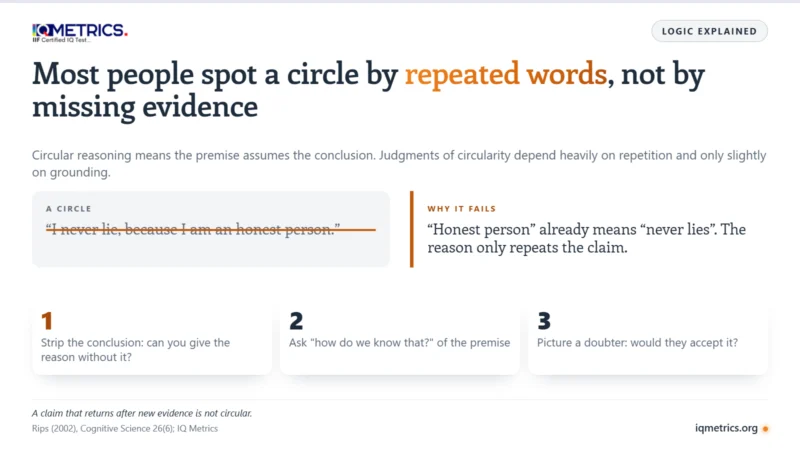
What is the circular reasoning logical fallacy? It is an argument whose conclusion is already assumed in its premises, so the “reason” only repeats the claim. “The manual is right because it says it is right” is an example. The form is valid, yet it gives a doubter no reason to agree.
Below: eight examples, a three-question check you can run in a minute, and a finding most guides skip. When Rips tested how people judge circular arguments, their verdicts depended heavily on whether a claim was repeated and only slightly on whether it was grounded in agreed facts (Cognitive Science, 2002). So repetition alone is not a circle.
Key takeaways
- Circular reasoning means the premise assumes the conclusion. Older logic books call it begging the question, from the Latin petitio principii.
- It is valid but not persuasive. “P, therefore P” can never be false when P is true, yet it gives a doubter no reason to accept P.
- People spot circles mostly by repeated words, not by whether the claim is grounded (Rips, 2002). That means harmless repetition gets flagged and rephrased circles can slip through.
- IQ and logic tests rarely name the fallacy. They test the skill behind it: judging whether a conclusion follows, even when you like the conclusion.
What is circular reasoning?
Circular reasoning is an argument that uses its own conclusion as a reason. It is also called the circular argument fallacy, circular logic or begging the question.
The argument goes round: A is true because of B, and B is true because of A. Nothing outside the loop supports either claim. In formal logic an argument is valid if the conclusion must be true whenever the premises are. “P, therefore P” passes that test. The flaw is different: the one person who needs persuading doubts P, so a premise that is P persuades no one.
What are examples of circular reasoning?
Here are eight statements, six circular and two that only look circular. The last two matter, because most guides never show a case where a repeated claim is fine.
| Statement | Circular? | Why |
|---|---|---|
| “I never lie, because I am an honest person.” | Yes | “Honest person” means someone who never lies, so the reason restates the claim. |
| “This is the best pizza in town because no other pizza is better.” | Yes | “Best” and “none is better” are one claim said twice. |
| “We hire the best people because our people are the best.” | Yes | The claim is its own reason. No test, result or outside comparison appears. |
| “Her report is accurate because the audit approved it. The audit is reliable because it only approves accurate reports.” | Yes | The report vouches for the audit and the audit vouches for the report. |
| “A good leader is someone who leads well.” | Yes | The definition uses the word it is meant to define, so it explains nothing. |
| “Sleeping pills make you sleepy because they have a sleep-making power.” | Yes | The effect is offered as its own cause. Molière mocked this in his 1673 play The Imaginary Invalid. |
| “The bridge is safe. Inspectors measured every cable in March and all passed. So the bridge is safe.” | No | The last line repeats the first, but the inspection is evidence from outside the claim. |
| “The server was down for an hour. The logs show no requests from 2 to 3 pm. So it was down for an hour.” | No | Again the claim returns at the end, but the logs support it independently. |
The pattern in the two safe cases is simple: the claim comes back, but something new came in between. In a circle nothing new comes in.
How do you spot the circular reasoning logical fallacy?
Run three checks, each taking a few seconds. They match the three factors Rips tested: whether a claim repeats, whether it repeats inside the same line of justification, and whether it is grounded in agreed information.
- Strip the conclusion. State the reason without using the conclusion’s words or idea. If you cannot, the reason is the conclusion in disguise.
- Ask “how do we know that?” of the premise. If the chain of answers leads back to the conclusion, you have found the loop.
- Picture a doubter. Would someone who doubts the conclusion accept your first reason? If not, the reason is not grounded.
A quick trick from logic puzzles helps too: swap the real words for letters. “I never lie because I am honest” becomes “A because A”, and the circle is plain. Our guide to syllogism questions on IQ tests uses the same swap to defeat tempting answers.
Why do people fall for circular arguments?
Mostly because they already agree with the conclusion. When we like where an argument ends, we stop checking how it got there.
That is belief bias. In 1983 Evans, Barston and Pollard found that people accept invalid conclusions that sound believable and reject valid ones that sound false (Memory and Cognition). A circle is the easy case: the conclusion is built into the premise, so a believer feels no gap. Rips adds a second reason. People judged circularity mostly by repeated claims and where they sat in the argument. In our reading, that makes a circle in new words easier to miss. The abstract does not test that directly.
Where would your own score land?
Take the IIF-certified assessment and get your score with the scale it was measured on, the percentile it corresponds to and the confidence range around it — the three figures most online tests leave out.
Find your IQ score now! →Circular reasoning vs begging the question: is there a difference?
In modern use, almost none. Most logic texts treat begging the question as the same fault as circular reasoning, where the premises assume the conclusion without supporting it.
The older phrase comes from Aristotle’s Greek for “asking for the initial thing”, which the Latin petitio principii translated. Wikipedia’s summary points to his Prior Analytics and Sophistical Refutations. In everyday speech, “begs the question” now often means “raises the question”, a use that critics say blurs the logic term.
Two nearby terms are easy to mix up with it:
- Circular reasoning vs a non sequitur. In a non sequitur the conclusion does not follow from the reasons. In a circle it follows too easily, because it is the reason.
- Circular reasoning vs a valid argument. A valid argument can have a conclusion hidden in its premises, as every deduction does. It becomes a fallacy when the premise is the very claim in dispute.
Do IQ tests check for circular reasoning?
Not by name. IQ and aptitude tests do not ask you to label a fallacy, but they do test the skill that catches one: deciding whether a conclusion must follow.
Syllogism and deduction items do this directly. Our critical thinking test has five parts, among them deduction, recognizing assumptions and evaluating arguments. You can practice these skills on our logical reasoning test and critical thinking test, and read what else appears in our overview of the types of questions on an IQ test and the verbal reasoning test.
Even a famous line about intelligence can loop. Edwin Boring’s “Intelligence is what the tests test” defines the thing by the instrument that measures it. Our check of intelligence quotient quotes traces where that line comes from, and which famous ones are misattributed.
The pull of a wrong but tempting answer is real. Frederick’s three-question Cognitive Reflection Test averaged 1.24 correct across 3,428 people, as our guide to the bat-and-ball puzzle explains. The same habit lets a circle through: the first answer feels right, so we do not check it. To see how you do on reasoning items, take the IQ test.
Quick answers
- What is circular reasoning? An argument whose premise already assumes the conclusion.
- What is the circular reasoning logical fallacy? The same thing, named as a fault: the reasons only repeat the claim.
- Is circular reasoning the same as begging the question? In modern logic texts, yes. In everyday speech “begs the question” often just means “raises the question”.
- Is a circular argument invalid? No. It is valid in form but gives a doubter no reason, which is why it fails as persuasion.
- Is a repeated claim always circular? No. If independent evidence sits between the two statements, it is fine.
The bottom line
Circular reasoning is an argument that proves its claim with its claim. Spot it by stripping the conclusion, asking how we know the premise, and picturing a doubter. Repeated words alone do not make a circle, and a circle in new words can still fool you.
Sources
- Rips LJ (2002). Circular reasoning. Cognitive Science 26(6), 767-795.
- Evans JStBT, Barston JL, Pollard P (1983). On the conflict between logic and belief in syllogistic reasoning. Memory and Cognition.
- Begging the question: history of the term from Aristotle, Wikipedia.
- Frederick S (2005), Cognitive Reflection Test results as summarised in our guide to the bat-and-ball puzzle.
Keep reading
All articles →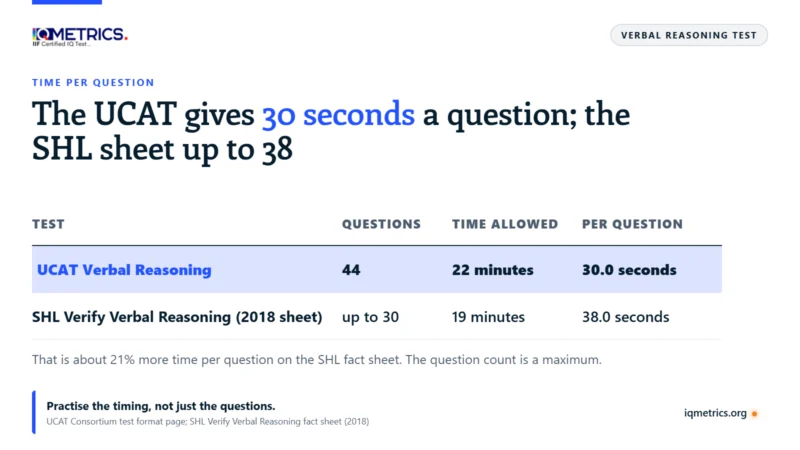 Taking a Test
Verbal Reasoning Test
A verbal reasoning test asks whether a passage supports a statement: True, False or Cannot Say. Three worked examples with answers, the time per question on the UCAT (30 seconds) and the SHL fact sheet (38), how scores work and what the UK police recruitment process uses.
 Mind & Everyday Life
Why Smart People Make Bad Decisions
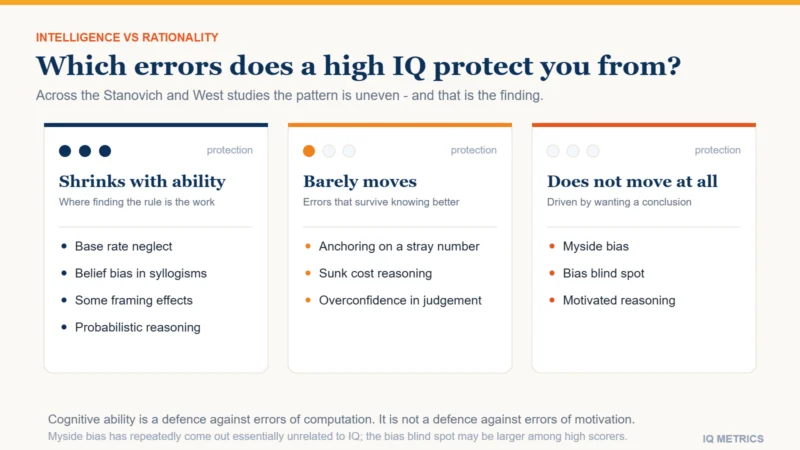
Everyone knows someone brilliant who keeps making terrible calls. That is not a paradox; it is a measurement gap. Intelligence tests and rationality tests load on different things, and several of the best-studied thinking errors turn out to be almost completely independent of how high you score.
 Understanding IQ
Spatial Reasoning
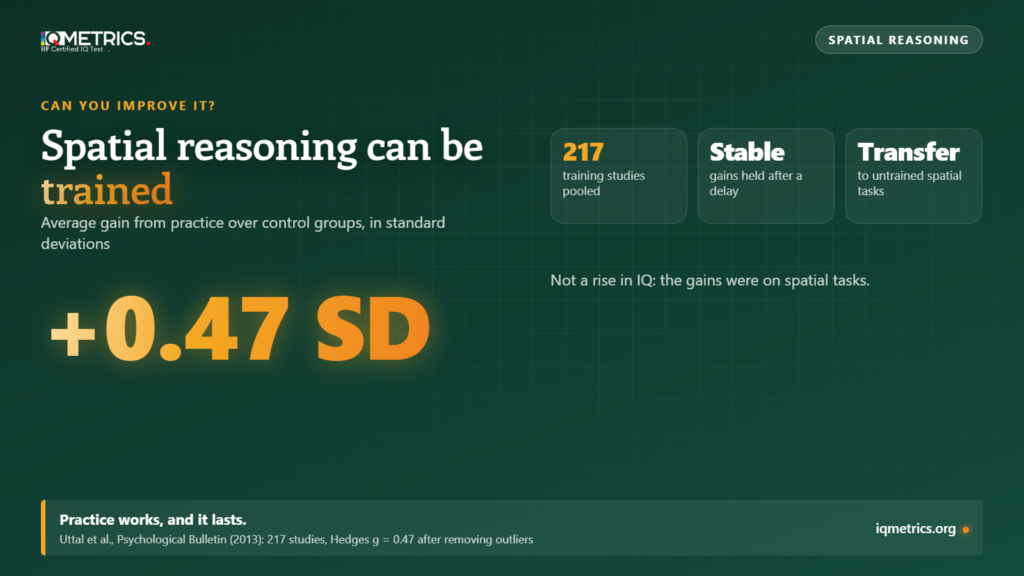
Spatial reasoning is the skill of picturing and turning shapes in your mind. What it means, everyday examples, how the Wechsler IQ tests measure it with Block Design and Visual Puzzles, why it predicts careers in science and engineering, and why 217 training studies say you can improve it.