The 100 Most-Cited Works on Human Intelligence, Ranked
Our ranked list and open dataset of the 100 most-cited works on human intelligence, built from 2,463 candidates in OpenAlex with Crossref counts beside them: 11,152 citations for the first, 867 for the 100th, 187,674 in all. Counted on 16 November 2026; a count is attention, not quality.

By Leon Falkner, Data & Research Analyst · Reviewed by Aarav Vardhan, Editor-in-Chief · Published 16 November 2026 · 15 min read
About this study
- Report type
- Data study: our ranked list and dataset of the most-cited works on human intelligence
- Data
- 2,463 candidate works from OpenAlex, 669 read by eye, 100 ranked; Crossref counts for 90; a retraction check of 115 records
- Sources
- OpenAlex, Crossref, Retraction Watch database (via Crossref); three nearest existing studies named for comparison
- Dates
- Counts read 16 November 2026; works published 1904 to 2020; as of 16 November 2026
- Licence
- CC BY 4.0 (our dataset and charts)
- Version
- 2026.11
- Sources
- 7
The 100 most-cited works on human intelligence have between 867 and 11,152 citations each, 187,674 in all, and the top 10 hold 29%. We ranked 2,463 candidates by OpenAlex citations; 29 are books or chapters and none is retracted. A count is attention, not quality. Source: IQ Metrics Research, 16 November 2026.
01 Key findings
- The 100 most-cited works have 867 to 11,152 citations each, 187,674 in all. The median is 1,338; the top 10 hold 29% and the bottom 50 together 28%.OpenAlex; IQ Metrics calculation
- 29 of the 100 are books or chapters, among them test manuals; 10 OpenAlex records are journal reviews that carry a book title and hold 23,175 citations, against 51 in Crossref.OpenAlex; Crossref; IQ Metrics coding
- 43 of the 100 date from 2000 or later; the 1990s and 2000s hold 55. Median publication year 1996.OpenAlex; IQ Metrics count
- Factor models and theory (29) and life outcomes (26) are the two biggest topic groups; tests 18, brain 12, genetics 3.IQ Metrics coding
- OpenAlex and Crossref agree only loosely (rank correlation 0.50; 0.69 without book-review records).OpenAlex; Crossref; IQ Metrics calculation
- None of the 100 is flagged as retracted in OpenAlex or in the Retraction Watch database (115 records checked); Crossref lists corrections for 2.OpenAlex; Retraction Watch; Crossref
- A multiple-intelligences work has more citations than any work on the list (13,598); we count it as a theory of several intelligences and leave it out by a printed rule.OpenAlex; IQ Metrics decision
02 What are the most-cited papers on human intelligence? The numbers to quote
The 100 most-cited works on human intelligence have between 867 and 11,152 citations each, 187,674 in all, counted by OpenAlex on 16 November 2026 [1]. IQ Metrics Research built the list from 2,463 candidate works, read 669 titles by eye and kept the 100 most-cited works whose main subject is human intelligence or cognitive ability, such as IQ and tests, the g factor, heritability, brain correlates and the Flynn effect. A citation count is attention, not truth or quality: a work is cited because it is influential, because it is criticised, or because researchers must cite a test manual.
No one has published a ranked list of this kind for the whole field. The nearest existing work is a top-100 list for neuropsychology [4], a keyword analysis of one journal, Intelligence [5], and a 2023 study of two journals [6]. Ours adds the full ranked list with two citation counts side by side, our own coding by topic, type, decade, journal and first-author country, and a retraction check of every work. The counts will not match Google Scholar, which is not an open source and is not used here.
citations of the most-cited work on our list, Piaget 1952, “The origins of intelligence in children.” (a book on how intelligence develops in children).
OpenAlex; IQ Metrics rankingcitations of the 100th work: the cut-off for the list, from 11,152 at the top.
OpenAlex; IQ Metrics rankingcitations in all across the 100 works (OpenAlex), median 1,338 each.
OpenAlex; IQ Metrics sumof all those citations (54,663) sit in the top 10; the top 3 hold 13% and the bottom 50 together 28%.
IQ Metrics calculationof the 100 were published in 2000 or later; 26 before 1980. The median publication year is 1996; the oldest is Spearman 1904.
IQ Metrics countof the 100 are books or book chapters (including 10 OpenAlex records that are journal reviews carrying a book’s title); the other 71 are articles.
IQ Metrics codingworks on factor models and theory, the biggest of our eight topic groups; life outcomes 26, tests 18, brain 12, genetics 3.
IQ Metrics codingworks with a listed first-author institution are at a US institution; OpenAlex lists no institution for 30 works. The country is where the first author worked.
OpenAlex; IQ Metrics countrank correlation (Spearman) between the OpenAlex and Crossref counts of the 90 works that have both; 0.69 without the 10 book-review records.
OpenAlex; Crossref; IQ Metrics calculationOpenAlex citations on the 10 records that are journal reviews carrying a book title; Crossref counts 51 for the same records.
OpenAlex; Crossref; IQ Metrics sumof the 100 carry a retraction flag in OpenAlex, and none of 115 records matches the Retraction Watch database (by DOI, or by title where there is no DOI).
OpenAlex; Retraction Watch via Crossrefcitations a year for the fastest-gaining work, Lövdén 2020; the median is 50 a year. By citations a year, 5 of the top 10 by total stay in the top 10.
IQ Metrics calculationWhat this study does not say
This page counts citations. It does not say which work is best, most important or correct, summarises no finding of any work, quotes no work beyond its title and does not rank countries or groups of people by intelligence. A country in the data is where a first author’s institution was. Authors appear as first-author surname and year only.
03 How was the list of most-cited intelligence papers built?
We pulled candidates from OpenAlex by five routes, sorted each by citations, merged duplicates, read every title with 800 or more citations by eye and kept the first 100 that are mainly about human intelligence. The routes are a text search of titles and abstracts for intelligence terms, a search for the word “intelligence” in titles, OpenAlex’s own topic “Cognitive Abilities and Testing”, and two lists of well-known works to test the net. The union is 2,463 works [1] [7].
We pulled 2,463 candidate works, read 669 of them and kept the 100 most cited that are about human intelligence
Works narrowed in steps: the union of five OpenAlex query routes, then the works with 800 or more citations (read by eye), then the works judged to be mainly about human intelligence (merged records counted once), then the ranked list. The 6 works just below the line are in the open CSV. IQ Metrics count. As of 16 November 2026.
Source: OpenAlex [1]; IQ Metrics reading log [7]
Data table
| stage | count | pct_of_first | pct_of_previous |
|---|---|---|---|
| Candidate works pulled (five routes) | 2463 | 100 | 100 |
| With 800+ citations, read by eye | 669 | 27.2 | 27.2 |
| Judged mainly about human intelligence | 106 | 4.3 | 15.8 |
| The ranked list | 100 | 4.1 | 94.3 |
Embed this chart
Paste this HTML into your page: it carries the numbers and the credit link to this figure.
- 01
Pull the pool
OpenAlex works of type article, review, book or book chapter, five routes (queries printed in data/DEFINITIONS.md): 1,000 from the text search, 1,000 from the title word, 400 from the topic, 200 + 200 from two checks; 2,463 after removing duplicates. Artificial, emotional, business, military and similar “intelligence” is excluded by the query.
- 02
Read by eye
A scripted pre-sort decided only what to read first. Every one of the 669 works with 800+ citations was then read by title (abstract and topic where needed) and logged as include, exclude, merged or borderline, each with a reason, in inclusion-log.csv. The pool was net-wide: of the works read, 26 were about artificial intelligence or computing, and 93 about working memory or executive function alone.
- 03
Merge, never add
10 extra OpenAlex records are merged into 8 works (a book with its second record, an edition, or a journal review that carries the book’s title). The main row is the record with the most citations; the other count is shown in the CSV and never added.
- 04
Rank
Rank = OpenAlex citations (it covers books and old works). Crossref’s count is read for every work with a DOI and shown beside it (90 of 100 have one). Ties go to the higher Crossref count.
- 05
Code
Topic group, type, decade, first-author country and open-access status. The topic group is a scripted title rule checked by eye; the {n_override} changes are listed in coding-overrides.csv. Country is OpenAlex’s first-author institution, empty for many older works and books; we never fill it in.
- 06
Check
OpenAlex is_retracted, a lookup in the Retraction Watch database (Crossref copy, 73,822 rows) by DOI or title, Crossref update notices, and a match against our live studies.
The cut-off is 867 citations. The 6 works just below it (for example Hartshorne 2015, 866) are in the open CSV. A work that matched none of the five routes, or that OpenAlex credits with too few citations, cannot appear; a work counts as “on topic” only by our reading of its title and abstract, and the decisions are public.
04 Which are the 10 most-cited papers on human intelligence?
The most-cited work on our list is Piaget 1952, “The origins of intelligence in children.”, with 11,152 OpenAlex citations; the tenth, Ryan 2001, has 3,767. Here are the 10, by OpenAlex citations on 16 November 2026, with the Crossref count after the slash (blank where the work has no DOI):
- 1. Piaget 1952, “The origins of intelligence in children”: 11,152 / 5,733
- 2. Math. Psychology 1961, “Probabilistic Models for Some Intelligence and Attainment Tests”: 6,935 / 11 (record is a journal review carrying the book’s title)
- 3. Spearman 1904, “”General Intelligence,” Objectively Determined and Measured”: 6,476 / 4,239
- 4. McClelland 1973, “Testing for competence rather than for “intelligence.””: 5,021 / 2,579
- 5. Wechsler 1955, “Manual for the Wechsler Adult Intelligence Scale”: 4,961 / –
- 6. Carroll 1993, “Human Cognitive Abilities: A Survey of Factor-Analytic Studies”: 4,284 / 3,529
- 7. Raven 1998, “Manual for Raven’s progressive matrices and vocabulary scales”: 4,175 / –
- 8. Preston 1995, “The Bell Curve: Intelligence and Class Structure in American Life”: 4,025 / 1 (record is a journal review carrying the book’s title)
- 9. Guilford 1967, “The nature of human intelligence”: 3,867 / –
- 10. Ryan 2001, “Wechsler Adult Intelligence Scale-III”: 3,767 / 90
5 of the top 10 are on tests and measurement (Math. Psychology 1961, McClelland 1973, Wechsler 1955, Raven 1998, Ryan 2001), and 4 of those are books, test manuals or test entries, which researchers cite whenever they use a test; 2 of the top 10 are records of journal reviews that carry a book’s title. The most-cited journal article that is not a review record is Spearman 1904 (6,476), also the oldest work on the list; a later idea that carries his name is covered in our news page on Spearman’s law of diminishing returns.
Citations by year of publication: the 100 works run from 867 to 11,152 citations, and 75 of them have 2,000 or fewer
One bubble per work (100): year of publication against OpenAlex citations (log scale), colour = our topic group, bubble area = citations a year since publication. The works from 1904 to 2020; 43 were published in 2000 or later. IQ Metrics coding. As of 16 November 2026.
OpenAlex citations (log scale)
Year of publication
Citation counts are attention, not quality; records that are journal reviews carrying a book title are in the table at the end.
Source: OpenAlex [1]; IQ Metrics coding and calculation [7]
Data table
| work | year | openalex_cited_by_count | group | cites_per_year |
|---|---|---|---|---|
| Piaget 1952 | 1952 | 11152 | Development and ageing | 148.7 |
| Math. Psychology 1961 | 1961 | 6935 | Tests and measurement | 105.1 |
| Spearman 1904 | 1904 | 6476 | Factor models and theory | 52.6 |
| McClelland 1973 | 1973 | 5021 | Tests and measurement | 93 |
| Wechsler 1955 | 1955 | 4961 | Tests and measurement | 68.9 |
| Carroll 1993 | 1993 | 4284 | Factor models and theory | 126 |
| Raven 1998 | 1998 | 4175 | Tests and measurement | 144 |
| Preston 1995 | 1995 | 4025 | Health, education and life outcomes | 125.8 |
| Guilford 1967 | 1967 | 3867 | Factor models and theory | 64.5 |
| Ryan 2001 | 2001 | 3767 | Tests and measurement | 144.9 |
| Engle 1999a | 1999 | 3250 | Factor models and theory | 116.1 |
| Neisser 1996 | 1996 | 3056 | Factor models and theory | 98.6 |
| Piaget 2005 | 2005 | 3030 | Development and ageing | 137.7 |
| Jensen 1969 | 1969 | 2935 | Genetics and heritability | 50.6 |
| Clarke 1986 | 1986 | 2863 | Factor models and theory | 69.8 |
| Cattell 1963 | 1963 | 2736 | Factor models and theory | 42.8 |
| Block 1996 | 1996 | 2516 | Other | 81.2 |
| Duckworth 2005 | 2005 | 2506 | Health, education and life outcomes | 113.9 |
| Kane 2002 | 2002 | 2368 | Brain and neuroscience | 94.7 |
| Jaeggi 2008 | 2008 | 2360 | Health, education and life outcomes | 124.2 |
| Lanphear 2005 | 2005 | 2300 | Health, education and life outcomes | 104.5 |
| Judge 1999 | 1999 | 2279 | Health, education and life outcomes | 81.4 |
| Kanfer 1989 | 1989 | 2173 | Health, education and life outcomes | 57.2 |
| Thurstone 1973 | 1973 | 2129 | Factor models and theory | 39.4 |
| Canfield 2003 | 2003 | 2112 | Health, education and life outcomes | 88 |
| Halpern 2000 | 2000 | 1991 | Other | 73.7 |
| Flynn 1987 | 1987 | 1968 | Flynn effect and score trends | 49.2 |
| Deary 2006 | 2006 | 1888 | Health, education and life outcomes | 89.9 |
| Jensen 1974 | 1974 | 1874 | Factor models and theory | 35.4 |
| Kyllonen 1990 | 1990 | 1871 | Factor models and theory | 50.6 |
| Ackerman 1997 | 1997 | 1836 | Factor models and theory | 61.2 |
| Webster 1958 | 1958 | 1813 | Tests and measurement | 26.3 |
| Sternberg 2014 | 2014 | 1768 | Factor models and theory | 136 |
| Carpenter 1990 | 1990 | 1725 | Tests and measurement | 46.6 |
| Lani 2010 | 2010 | 1688 | Tests and measurement | 99.3 |
| Guilford 1956 | 1956 | 1685 | Factor models and theory | 23.7 |
| Jung 2007 | 2007 | 1671 | Brain and neuroscience | 83.5 |
| Horn 1966 | 1966 | 1648 | Factor models and theory | 27 |
| Shaw 2006 | 2006 | 1644 | Brain and neuroscience | 78.3 |
| Raven 2000 | 2000 | 1640 | Flynn effect and score trends | 60.7 |
| Wechsler 1981 | 1981 | 1559 | Tests and measurement | 33.9 |
| Alloway 2009 | 2009 | 1500 | Health, education and life outcomes | 83.3 |
| Peal 1962 | 1962 | 1496 | Health, education and life outcomes | 23 |
| Gottfredson 1997 | 1997 | 1465 | Factor models and theory | 48.8 |
| Lövdén 2020 | 2020 | 1433 | Health, education and life outcomes | 204.7 |
| Horn 1967 | 1967 | 1432 | Development and ageing | 23.9 |
| Friedman 2006 | 2006 | 1430 | Brain and neuroscience | 68.1 |
| Thorndike 1920 | 1920 | 1408 | Factor models and theory | 13.2 |
| Turkheimer 2003 | 2003 | 1407 | Genetics and heritability | 58.6 |
| Dohmen 2010 | 2010 | 1350 | Health, education and life outcomes | 79.4 |
| Savage 2018 | 2018 | 1326 | Genetics and heritability | 147.3 |
| Wechsler 1974 | 1974 | 1303 | Tests and measurement | 24.6 |
| Schmidt 2004 | 2004 | 1300 | Health, education and life outcomes | 56.5 |
| Conway 2003 | 2003 | 1285 | Brain and neuroscience | 53.5 |
| Cronbach 1984 | 1984 | 1276 | Factor models and theory | 29.7 |
| Flynn 1984 | 1984 | 1252 | Flynn effect and score trends | 29.1 |
| Lindenberger 1994 | 1994 | 1240 | Development and ageing | 37.6 |
| Lucas 1992 | 1992 | 1228 | Health, education and life outcomes | 35.1 |
| Engle 1999b | 1999 | 1228 | Factor models and theory | 43.9 |
| Kaufman 1979 | 1979 | 1215 | Tests and measurement | 25.3 |
| Silverstein 1962 | 1962 | 1205 | Factor models and theory | 18.5 |
| Gould 1928 | 1928 | 1193 | Tests and measurement | 12.1 |
| Conway 2002 | 2002 | 1175 | Factor models and theory | 47 |
| Hedges 1995 | 1995 | 1143 | Other | 35.7 |
| Jacobson 1996 | 1996 | 1140 | Health, education and life outcomes | 36.8 |
| Nelson 1978 | 1978 | 1131 | Tests and measurement | 23.1 |
| Heuvel 2009 | 2009 | 1124 | Brain and neuroscience | 62.4 |
| Gray 2003 | 2003 | 1118 | Brain and neuroscience | 46.6 |
| Kaufman 1990 | 1990 | 1109 | Tests and measurement | 30 |
| Deary 2010 | 2010 | 1108 | Brain and neuroscience | 65.2 |
| Schellenberg 2004 | 2004 | 1085 | Health, education and life outcomes | 47.2 |
| Maas 2006 | 2006 | 1067 | Factor models and theory | 50.8 |
| Duncan 2000 | 2000 | 1057 | Brain and neuroscience | 39.1 |
| Hunter 1986 | 1986 | 1042 | Health, education and life outcomes | 25.4 |
| Ackerman 2005 | 2005 | 1039 | Factor models and theory | 47.2 |
| Nisbett 2012 | 2012 | 1034 | Factor models and theory | 68.9 |
| Strenze 2006 | 2006 | 1021 | Health, education and life outcomes | 48.6 |
| Terman 1916 | 1916 | 1019 | Tests and measurement | 9.2 |
| Blair 1989 | 1989 | 1009 | Tests and measurement | 26.6 |
| Horta 2015 | 2015 | 1007 | Health, education and life outcomes | 83.9 |
First 80 of 100 rows; the Data button gives all of them.
Embed this chart
Paste this HTML into your page: it carries the numbers and the credit link to this figure.
The citation order and the “per year” order differ: Lövdén 2020 gains 205 citations a year, Piaget 1952 149 and Savage 2018 147, so a work from 2018 and one from 1904 are on different clocks (the section on concentration compares them).
05 When were the most-cited intelligence papers published?
55 of the 100 were published in the 1990s and 2000s, and 26 before 1980, in OpenAlex as of 16 November 2026. The median publication year is 1996, so the median work is 31 years old; only 10 are from 2010 or later, because recent work has had less time to collect citations. The long history of IQ testing shows in the works before 1970: 18 of the 100, of which 9 are books or chapters.
The 1990s and 2000s produced 55 of the 100 works; the 2010s only 9
Works by decade of publication and type (our coding): 26 works before 1980, 31 in 1980-1999 and 43 from 2000. Recent works have had less time to collect citations, so the fall after 2010 shows time as much as interest. IQ Metrics coding. As of 16 November 2026.
Source: OpenAlex [1]; IQ Metrics coding [7]
Data table
| decade | Empirical study | Book or chapter | Review or meta-analysis | Theory or commentary | total |
|---|---|---|---|---|---|
| 1900s | 1 | 1 | |||
| 1910s | 1 | 1 | |||
| 1920s | 1 | 1 | 2 | ||
| 1940s | 1 | 1 | |||
| 1950s | 3 | 2 | 5 | ||
| 1960s | 3 | 3 | 2 | 8 | |
| 1970s | 1 | 6 | 1 | 8 | |
| 1980s | 6 | 3 | 9 | ||
| 1990s | 14 | 5 | 1 | 2 | 22 |
| 2000s | 22 | 4 | 5 | 2 | 33 |
| 2010s | 2 | 2 | 5 | 9 | |
| 2020s | 1 | 1 |
Embed this chart
Paste this HTML into your page: it carries the numbers and the credit link to this figure.
Every one of the 100 works on a time line: tests and theory start in 1904, brain works only in 1996
One mark per work, in a lane for our topic group, at its year of publication; the colour is our type coding. Labels print only where they do not run into the one before; every mark has a tooltip with the title and citations. The oldest is Spearman 1904; the newest is Lövdén 2020. IQ Metrics coding. As of 16 November 2026.
Source: OpenAlex [1]; IQ Metrics coding [7]
Data table
| topic group | type | from | to | label | detail |
|---|---|---|---|---|---|
| Factor models and theory | event | 1904 | Spearman 1904 | Spearman 1904: "General Intelligence," Objectively Determined and Measured; 6,476 citations | |
| Factor models and theory | event | 1920 | Thorndike 1920 | Thorndike 1920: Intelligence and its uses.; 1,408 citations | |
| Factor models and theory | event | 1956 | Guilford 1956 | Guilford 1956: The structure of intellect.; 1,685 citations | |
| Factor models and theory | event | 1959 | Guilford 1959 | Guilford 1959: Three faces of intellect.; 944 citations | |
| Factor models and theory | event | 1962 | Silverstein 1962 | Silverstein 1962: Intelligence and Experience; 1,205 citations | |
| Factor models and theory | event | 1963 | Cattell 1963 | Cattell 1963: Theory of fluid and crystallized intelligence: A critical experiment.; 2,736 citations | |
| Factor models and theory | event | 1966 | Horn 1966 | Horn 1966: Refinement and test of the theory of fluid and crystallized general intelligenc…; 1,648 citations | |
| Factor models and theory | event | 1967 | Guilford 1967 | Guilford 1967: The nature of human intelligence; 3,867 citations | |
| Factor models and theory | event | 1973 | Thurstone 1973 | Thurstone 1973: Primary Mental Abilities; 2,129 citations | |
| Factor models and theory | event | 1974 | Jensen 1974 | Jensen 1974: Abilities: Their Structure, Growth, and Action; 1,874 citations | |
| Factor models and theory | event | 1975 | Fulker 1975 | Fulker 1975: The Science and Politics of IQ; 1,001 citations | |
| Factor models and theory | event | 1978 | Johnson 1978 | Johnson 1978: Intelligence, Information Processing, and Analogical Reasoning: The Componentia…; 990 citations | |
| Factor models and theory | event | 1984 | Cronbach 1984 | Cronbach 1984: Handbook of Human Intelligence; 1,276 citations | |
| Factor models and theory | event | 1986 | Clarke 1986 | Clarke 1986: Beyond IQ: A Triarchic Theory of Human Intelligence; 2,863 citations | |
| Factor models and theory | event | 1988 | Ackerman 1988 | Ackerman 1988: Determinants of individual differences during skill acquisition: Cognitive abil…; 923 citations | |
| Factor models and theory | event | 1990 | Kyllonen 1990 | Kyllonen 1990: Reasoning ability is (little more than) working-memory capacity?!; 1,871 citations | |
| Factor models and theory | event | 1993 | Carroll 1993 | Carroll 1993: Human Cognitive Abilities: A Survey of Factor-Analytic Studies; 4,284 citations | |
| Factor models and theory | event | 1996 | Neisser 1996 | Neisser 1996: Intelligence: Knowns and unknowns.; 3,056 citations | |
| Factor models and theory | event | 1996 | Ackerman 1996 | Ackerman 1996: A theory of adult intellectual development: Process, personality, interests, an…; 883 citations | |
| Factor models and theory | event | 1997 | Ackerman 1997 | Ackerman 1997: Intelligence, personality, and interests: Evidence for overlapping traits.; 1,836 citations | |
| Factor models and theory | event | 1997 | Gottfredson 1997 | Gottfredson 1997: Why g matters: The complexity of everyday life; 1,465 citations | |
| Factor models and theory | event | 1999 | Engle 1999a | Engle 1999a: Working memory, short-term memory, and general fluid intelligence: A latent-var…; 3,250 citations | |
| Factor models and theory | event | 1999 | Engle 1999b | Engle 1999b: Individual Differences in Working Memory Capacity and What They Tell Us About C…; 1,228 citations | |
| Factor models and theory | event | 2000 | No author listed 2000 | No author listed 2000: Handbook of Intelligence; 888 citations | |
| Factor models and theory | event | 2002 | Conway 2002 | Conway 2002: A latent variable analysis of working memory capacity, short-term memory capaci…; 1,175 citations | |
| Factor models and theory | event | 2005 | Ackerman 2005 | Ackerman 2005: Working Memory and Intelligence: The Same or Different Constructs?; 1,039 citations | |
| Factor models and theory | event | 2006 | Maas 2006 | Maas 2006: A dynamical model of general intelligence: The positive manifold of intelligenc…; 1,067 citations | |
| Factor models and theory | event | 2012 | Nisbett 2012 | Nisbett 2012: Intelligence: New findings and theoretical developments.; 1,034 citations | |
| Factor models and theory | event | 2014 | Sternberg 2014 | Sternberg 2014: Advances in the Psychology of Human Intelligence; 1,768 citations | |
| Health, education and life outcomes | event | 1962 | Peal 1962 | Peal 1962: The relation of bilingualism to intelligence.; 1,496 citations | |
| Health, education and life outcomes | event | 1986 | Hunter 1986 | Hunter 1986: Cognitive ability, cognitive aptitudes, job knowledge, and job performance; 1,042 citations | |
| Health, education and life outcomes | event | 1989 | Kanfer 1989 | Kanfer 1989: Motivation and cognitive abilities: An integrative/aptitude-treatment interacti…; 2,173 citations | |
| Health, education and life outcomes | event | 1991 | Ceci 1991 | Ceci 1991: How much does schooling influence general intelligence and its cognitive compon…; 867 citations | |
| Health, education and life outcomes | event | 1992 | Lucas 1992 | Lucas 1992: Breast milk and subsequent intelligence quotient in children born preterm; 1,228 citations | |
| Health, education and life outcomes | event | 1995 | Preston 1995 | Preston 1995: The Bell Curve: Intelligence and Class Structure in American Life.; 4,025 citations | |
| Health, education and life outcomes | event | 1996 | Jacobson 1996 | Jacobson 1996: Intellectual Impairment in Children Exposed to Polychlorinated Biphenyls in Ute…; 1,140 citations | |
| Health, education and life outcomes | event | 1999 | Judge 1999 | Judge 1999: THE BIG FIVE PERSONALITY TRAITS, GENERAL MENTAL ABILITY, AND CAREER SUCCESS ACR…; 2,279 citations | |
| Health, education and life outcomes | event | 2003 | Canfield 2003 | Canfield 2003: Intellectual Impairment in Children with Blood Lead Concentrations below 10 μg…; 2,112 citations | |
| Health, education and life outcomes | event | 2004 | Schmidt 2004 | Schmidt 2004: General Mental Ability in the World of Work: Occupational Attainment and Job Pe…; 1,300 citations | |
| Health, education and life outcomes | event | 2004 | Schellenberg 2004 | Schellenberg 2004: Music Lessons Enhance IQ; 1,085 citations | |
| Health, education and life outcomes | event | 2004 | Kuncel 2004 | Kuncel 2004: Academic Performance, Career Potential, Creativity, and Job Performance: Can On…; 964 citations | |
| Health, education and life outcomes | event | 2005 | Duckworth 2005 | Duckworth 2005: Self-Discipline Outdoes IQ in Predicting Academic Performance of Adolescents; 2,506 citations | |
| Health, education and life outcomes | event | 2005 | Lanphear 2005 | Lanphear 2005: Low-Level Environmental Lead Exposure and Children’s Intellectual Function: An…; 2,300 citations | |
| Health, education and life outcomes | event | 2006 | Deary 2006 | Deary 2006: Intelligence and educational achievement; 1,888 citations | |
| Health, education and life outcomes | event | 2006 | Strenze 2006 | Strenze 2006: Intelligence and socioeconomic success: A meta-analytic review of longitudinal…; 1,021 citations | |
| Health, education and life outcomes | event | 2007 | Tomporowski 2007 | Tomporowski 2007: Exercise and Children’s Intelligence, Cognition, and Academic Achievement; 988 citations | |
| Health, education and life outcomes | event | 2008 | Jaeggi 2008 | Jaeggi 2008: Improving fluid intelligence with training on working memory; 2,360 citations | |
| Health, education and life outcomes | event | 2008 | Stanovich 2008 | Stanovich 2008: On the relative independence of thinking biases and cognitive ability.; 928 citations | |
| Health, education and life outcomes | event | 2009 | Alloway 2009 | Alloway 2009: Investigating the predictive roles of working memory and IQ in academic attainm…; 1,500 citations | |
| Health, education and life outcomes | event | 2009 | Christelis 2009 | Christelis 2009: Cognitive abilities and portfolio choice; 997 citations | |
| Health, education and life outcomes | event | 2010 | Dohmen 2010 | Dohmen 2010: Are Risk Aversion and Impatience Related to Cognitive Ability?; 1,350 citations | |
| Health, education and life outcomes | event | 2011 | Moreno 2011 | Moreno 2011: Short-Term Music Training Enhances Verbal Intelligence and Executive Function; 905 citations | |
| Health, education and life outcomes | event | 2015 | Horta 2015 | Horta 2015: Breastfeeding and intelligence: a systematic review and meta‐analysis; 1,007 citations | |
| Health, education and life outcomes | event | 2016 | Melby‐Lervåg 2016 | Melby‐Lervåg 2016: Working Memory Training Does Not Improve Performance on Measures of Intelligenc…; 994 citations | |
| Health, education and life outcomes | event | 2020 | Lövdén 2020 | Lövdén 2020: Education and Cognitive Functioning Across the Life Span; 1,433 citations | |
| Tests and measurement | event | 1916 | Terman 1916 | Terman 1916: The measurement of intelligence.; 1,019 citations | |
| Tests and measurement | event | 1928 | Gould 1928 | Gould 1928: Measurement of Intelligence by Drawings; 1,193 citations | |
| Tests and measurement | event | 1940 | Wechsler 1940 | Wechsler 1940: The Measurement of Adult Intelligence.; 980 citations | |
| Tests and measurement | event | 1955 | Wechsler 1955 | Wechsler 1955: Manual for the Wechsler Adult Intelligence Scale.; 4,961 citations | |
| Tests and measurement | event | 1958 | Webster 1958 | Webster 1958: The Measurement and Appraisal of Adult Intelligence; 1,813 citations | |
| Tests and measurement | event | 1961 | Math. Psychology 1961 | Math. Psychology 1961: Probabilistic Models for Some Intelligence and Attainment Tests; 6,935 citations | |
| Tests and measurement | event | 1973 | McClelland 1973 | McClelland 1973: Testing for competence rather than for "intelligence."; 5,021 citations | |
| Tests and measurement | event | 1974 | Wechsler 1974 | Wechsler 1974: Manual for the Wechsler intelligence scale for children; 1,303 citations | |
| Tests and measurement | event | 1978 | Nelson 1978 | Nelson 1978: Dementia: The Estimation of Premorbid Intelligence Levels Using the New Adult R…; 1,131 citations | |
| Tests and measurement | event | 1979 | Kaufman 1979 | Kaufman 1979: Intelligent testing with the WISC-R; 1,215 citations | |
| Tests and measurement | event | 1981 | Wechsler 1981 | Wechsler 1981: WAIS-R manual : Wechsler adult intelligence scale-revised; 1,559 citations | |
| Tests and measurement | event | 1989 | Blair 1989 | Blair 1989: Predicting premorbid IQ: A revision of the national adult reading test; 1,009 citations | |
| Tests and measurement | event | 1990 | Carpenter 1990 | Carpenter 1990: What one intelligence test measures: A theoretical account of the processing in…; 1,725 citations | |
| Tests and measurement | event | 1990 | Kaufman 1990 | Kaufman 1990: Assessing Adolescent and Adult Intelligence; 1,109 citations | |
| Tests and measurement | event | 1998 | Raven 1998 | Raven 1998: Manual for Raven's progressive matrices and vocabulary scales; 4,175 citations | |
| Tests and measurement | event | 2001 | Ryan 2001 | Ryan 2001: Wechsler Adult Intelligence Scale-III; 3,767 citations | |
| Tests and measurement | event | 2009 | Dennis 2009 | Dennis 2009: Why IQ is not a covariate in cognitive studies of neurodevelopmental disorders; 923 citations | |
| Tests and measurement | event | 2010 | Lani 2010 | Lani 2010: Wechsler Adult Intelligence Scale—Fourth Edition (WAIS-IV); 1,688 citations | |
| Brain and neuroscience | event | 1996 | Duncan 1996 | Duncan 1996: Intelligence and the Frontal Lobe: The Organization of Goal-Directed Behavior; 955 citations | |
| Brain and neuroscience | event | 1996 | Reiss 1996 | Reiss 1996: Brain development, gender and IQ in children: A volumetric imaging study; 903 citations | |
| Brain and neuroscience | event | 2000 | Duncan 2000 | Duncan 2000: A Neural Basis for General Intelligence; 1,057 citations | |
| Brain and neuroscience | event | 2002 | Kane 2002 | Kane 2002: The role of prefrontal cortex in working-memory capacity, executive attention,…; 2,368 citations | |
| Brain and neuroscience | event | 2003 | Conway 2003 | Conway 2003: Working memory capacity and its relation to general intelligence; 1,285 citations | |
| Brain and neuroscience | event | 2003 | Gray 2003 | Gray 2003: Neural mechanisms of general fluid intelligence; 1,118 citations | |
| Brain and neuroscience | event | 2006 | Shaw 2006 | Shaw 2006: Intellectual ability and cortical development in children and adolescents; 1,644 citations |
First 80 of 100 rows; the Data button gives all of them.
Embed this chart
Paste this HTML into your page: it carries the numbers and the credit link to this figure.
The 1990s hold 22 works and the 2000s 33. The 2000s hold the most citations in total (50,390), partly because that decade holds the most works; the 1990s hold 42,057 citations in 22 works.
06 What do the most-cited intelligence works study?
29 of the 100 are about factor models and theories of intelligence, 26 about intelligence and life outcomes, 18 about tests and measurement, 12 about the brain, 6 about development and ageing, 3 about genetics, 3 about score trends and 3 other. Each work has one group, from our reading of its title (a scripted rule, then checked by eye).
Factor models and theory (29) and life outcomes (26) are over half of the 100 works; genetics has only 3
One square per work (100), coloured by our topic group, in rank order inside each group. One group per work, by our reading of the title (scripted rule printed in the method, then checked by eye). IQ Metrics coding. As of 16 November 2026.
100 worksone square = one work
Source: IQ Metrics coding [7]
Data table
| work | group | label | detail |
|---|---|---|---|
| W2133487567 | Factor models and theory | Spearman 1904 | Spearman 1904: "General Intelligence," Objectively Determined and Measured |
| W2999665664 | Factor models and theory | Carroll 1993 | Carroll 1993: Human Cognitive Abilities: A Survey of Factor-Analytic Studies |
| W3146361359 | Factor models and theory | Guilford 1967 | Guilford 1967: The nature of human intelligence |
| W2025264833 | Factor models and theory | Engle 1999a | Engle 1999a: Working memory, short-term memory, and general fluid intelligence: A… |
| W2131730780 | Factor models and theory | Neisser 1996 | Neisser 1996: Intelligence: Knowns and unknowns. |
| W2029808144 | Factor models and theory | Clarke 1986 | Clarke 1986: Beyond IQ: A Triarchic Theory of Human Intelligence |
| W2006500696 | Factor models and theory | Cattell 1963 | Cattell 1963: Theory of fluid and crystallized intelligence: A critical experiment. |
| W2088963425 | Factor models and theory | Thurstone 1973 | Thurstone 1973: Primary Mental Abilities |
| W2317543039 | Factor models and theory | Jensen 1974 | Jensen 1974: Abilities: Their Structure, Growth, and Action |
| W2165579771 | Factor models and theory | Kyllonen 1990 | Kyllonen 1990: Reasoning ability is (little more than) working-memory capacity?! |
| W2093371949 | Factor models and theory | Ackerman 1997 | Ackerman 1997: Intelligence, personality, and interests: Evidence for overlapping tr… |
| W655464054 | Factor models and theory | Sternberg 2014 | Sternberg 2014: Advances in the Psychology of Human Intelligence |
| W1986642396 | Factor models and theory | Guilford 1956 | Guilford 1956: The structure of intellect. |
| W2025521298 | Factor models and theory | Horn 1966 | Horn 1966: Refinement and test of the theory of fluid and crystallized general i… |
| W2079072929 | Factor models and theory | Gottfredson 1997 | Gottfredson 1997: Why g matters: The complexity of everyday life |
| W2906664059 | Factor models and theory | Thorndike 1920 | Thorndike 1920: Intelligence and its uses. |
| W2000460085 | Factor models and theory | Cronbach 1984 | Cronbach 1984: Handbook of Human Intelligence |
| W1559852210 | Factor models and theory | Engle 1999b | Engle 1999b: Individual Differences in Working Memory Capacity and What They Tell… |
| W2167699898 | Factor models and theory | Silverstein 1962 | Silverstein 1962: Intelligence and Experience |
| W2139913331 | Factor models and theory | Conway 2002 | Conway 2002: A latent variable analysis of working memory capacity, short-term mem… |
| W2100107646 | Factor models and theory | Maas 2006 | Maas 2006: A dynamical model of general intelligence: The positive manifold of i… |
| W2168058916 | Factor models and theory | Ackerman 2005 | Ackerman 2005: Working Memory and Intelligence: The Same or Different Constructs? |
| W2039036421 | Factor models and theory | Nisbett 2012 | Nisbett 2012: Intelligence: New findings and theoretical developments. |
| W2312555258 | Factor models and theory | Fulker 1975 | Fulker 1975: The Science and Politics of IQ |
| W2069182223 | Factor models and theory | Johnson 1978 | Johnson 1978: Intelligence, Information Processing, and Analogical Reasoning: The C… |
| W2049394617 | Factor models and theory | Guilford 1959 | Guilford 1959: Three faces of intellect. |
| W2052385711 | Factor models and theory | Ackerman 1988 | Ackerman 1988: Determinants of individual differences during skill acquisition: Cogn… |
| W4249911376 | Factor models and theory | No author listed 2000 | No author listed 2000: Handbook of Intelligence |
| W2025806909 | Factor models and theory | Ackerman 1996 | Ackerman 1996: A theory of adult intellectual development: Process, personality, int… |
| W2021551171 | Health, education and life outcomes | Preston 1995 | Preston 1995: The Bell Curve: Intelligence and Class Structure in American Life. |
| W2152831629 | Health, education and life outcomes | Duckworth 2005 | Duckworth 2005: Self-Discipline Outdoes IQ in Predicting Academic Performance of Adol… |
| W2123803218 | Health, education and life outcomes | Jaeggi 2008 | Jaeggi 2008: Improving fluid intelligence with training on working memory |
| W2126489758 | Health, education and life outcomes | Lanphear 2005 | Lanphear 2005: Low-Level Environmental Lead Exposure and Children’s Intellectual Fun… |
| W2168432963 | Health, education and life outcomes | Judge 1999 | Judge 1999: THE BIG FIVE PERSONALITY TRAITS, GENERAL MENTAL ABILITY, AND CAREER S… |
| W2064482980 | Health, education and life outcomes | Kanfer 1989 | Kanfer 1989: Motivation and cognitive abilities: An integrative/aptitude-treatment… |
| W2146334297 | Health, education and life outcomes | Canfield 2003 | Canfield 2003: Intellectual Impairment in Children with Blood Lead Concentrations be… |
| W1992354224 | Health, education and life outcomes | Deary 2006 | Deary 2006: Intelligence and educational achievement |
| W2134860728 | Health, education and life outcomes | Alloway 2009 | Alloway 2009: Investigating the predictive roles of working memory and IQ in academ… |
| W2023318939 | Health, education and life outcomes | Peal 1962 | Peal 1962: The relation of bilingualism to intelligence. |
| W3047728892 | Health, education and life outcomes | Lövdén 2020 | Lövdén 2020: Education and Cognitive Functioning Across the Life Span |
| W3122744032 | Health, education and life outcomes | Dohmen 2010 | Dohmen 2010: Are Risk Aversion and Impatience Related to Cognitive Ability? |
| W2092968198 | Health, education and life outcomes | Schmidt 2004 | Schmidt 2004: General Mental Ability in the World of Work: Occupational Attainment… |
| W2052771993 | Health, education and life outcomes | Lucas 1992 | Lucas 1992: Breast milk and subsequent intelligence quotient in children born pre… |
| W2330340734 | Health, education and life outcomes | Jacobson 1996 | Jacobson 1996: Intellectual Impairment in Children Exposed to Polychlorinated Biphen… |
| W2170463298 | Health, education and life outcomes | Schellenberg 2004 | Schellenberg 2004: Music Lessons Enhance IQ |
| W2138261560 | Health, education and life outcomes | Hunter 1986 | Hunter 1986: Cognitive ability, cognitive aptitudes, job knowledge, and job perfor… |
| W1968530262 | Health, education and life outcomes | Strenze 2006 | Strenze 2006: Intelligence and socioeconomic success: A meta-analytic review of lon… |
| W1934656702 | Health, education and life outcomes | Horta 2015 | Horta 2015: Breastfeeding and intelligence: a systematic review and meta‐analysis |
| W3122351359 | Health, education and life outcomes | Christelis 2009 | Christelis 2009: Cognitive abilities and portfolio choice |
| W2480700159 | Health, education and life outcomes | Melby‐Lervåg 2016 | Melby‐Lervåg 2016: Working Memory Training Does Not Improve Performance on Measures of I… |
| W1998063406 | Health, education and life outcomes | Tomporowski 2007 | Tomporowski 2007: Exercise and Children’s Intelligence, Cognition, and Academic Achieve… |
| W2127837421 | Health, education and life outcomes | Kuncel 2004 | Kuncel 2004: Academic Performance, Career Potential, Creativity, and Job Performan… |
| W2090789917 | Health, education and life outcomes | Stanovich 2008 | Stanovich 2008: On the relative independence of thinking biases and cognitive ability. |
| W2105410945 | Health, education and life outcomes | Moreno 2011 | Moreno 2011: Short-Term Music Training Enhances Verbal Intelligence and Executive… |
| W1987959969 | Health, education and life outcomes | Ceci 1991 | Ceci 1991: How much does schooling influence general intelligence and its cognit… |
| W2127374659 | Tests and measurement | Math. Psychology 1961 | Math. Psychology 1961: Probabilistic Models for Some Intelligence and Attainment Tests |
| W2159399759 | Tests and measurement | McClelland 1973 | McClelland 1973: Testing for competence rather than for "intelligence." |
| W2053293311 | Tests and measurement | Wechsler 1955 | Wechsler 1955: Manual for the Wechsler Adult Intelligence Scale. |
| W1894134410 | Tests and measurement | Raven 1998 | Raven 1998: Manual for Raven's progressive matrices and vocabulary scales |
| W1914703486 | Tests and measurement | Ryan 2001 | Ryan 2001: Wechsler Adult Intelligence Scale-III |
| W1554151696 | Tests and measurement | Webster 1958 | Webster 1958: The Measurement and Appraisal of Adult Intelligence |
| W2067737176 | Tests and measurement | Carpenter 1990 | Carpenter 1990: What one intelligence test measures: A theoretical account of the pro… |
| W2370820144 | Tests and measurement | Lani 2010 | Lani 2010: Wechsler Adult Intelligence Scale—Fourth Edition (WAIS-IV) |
| W618310327 | Tests and measurement | Wechsler 1981 | Wechsler 1981: WAIS-R manual : Wechsler adult intelligence scale-revised |
| W1519372146 | Tests and measurement | Wechsler 1974 | Wechsler 1974: Manual for the Wechsler intelligence scale for children |
| W1996569541 | Tests and measurement | Kaufman 1979 | Kaufman 1979: Intelligent testing with the WISC-R |
| W2000895760 | Tests and measurement | Gould 1928 | Gould 1928: Measurement of Intelligence by Drawings |
| W2014550164 | Tests and measurement | Nelson 1978 | Nelson 1978: Dementia: The Estimation of Premorbid Intelligence Levels Using the N… |
| W1919586704 | Tests and measurement | Kaufman 1990 | Kaufman 1990: Assessing Adolescent and Adult Intelligence |
| W4229781515 | Tests and measurement | Terman 1916 | Terman 1916: The measurement of intelligence. |
| W1979636244 | Tests and measurement | Blair 1989 | Blair 1989: Predicting premorbid IQ: A revision of the national adult reading test |
| W1508982298 | Tests and measurement | Wechsler 1940 | Wechsler 1940: The Measurement of Adult Intelligence. |
| W2008850124 | Tests and measurement | Dennis 2009 | Dennis 2009: Why IQ is not a covariate in cognitive studies of neurodevelopmental… |
| W2151179877 | Brain and neuroscience | Kane 2002 | Kane 2002: The role of prefrontal cortex in working-memory capacity, executive a… |
| W2165360032 | Brain and neuroscience | Jung 2007 | Jung 2007: The Parieto-Frontal Integration Theory (P-FIT) of intelligence: Conve… |
| W2122739133 | Brain and neuroscience | Shaw 2006 | Shaw 2006: Intellectual ability and cortical development in children and adolesc… |
| W2127016810 | Brain and neuroscience | Friedman 2006 | Friedman 2006: Not All Executive Functions Are Related to Intelligence |
| W2150672384 | Brain and neuroscience | Conway 2003 | Conway 2003: Working memory capacity and its relation to general intelligence |
| W2165985389 | Brain and neuroscience | Heuvel 2009 | Heuvel 2009: Efficiency of Functional Brain Networks and Intellectual Performance |
| W2168983113 | Brain and neuroscience | Gray 2003 | Gray 2003: Neural mechanisms of general fluid intelligence |
First 80 of 100 rows; the Data button gives all of them.
Embed this chart
Paste this HTML into your page: it carries the numbers and the credit link to this figure.
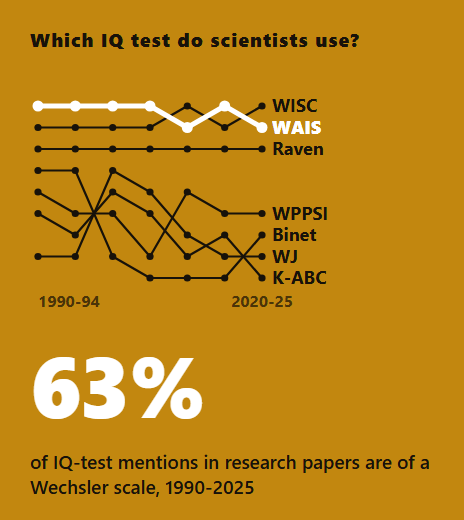
Factor models and theory run from Spearman 1904 to Sternberg 2014, including the ideas behind fluid and crystallized intelligence and the question of how working memory relates to intelligence. Works on tests are mostly manuals for the Wechsler scales and Raven’s matrices (see Raven’s Progressive Matrices scores explained), and our study of which IQ tests scientists use shows how often each test is named in research.
Works on tests and theory run through the whole century; brain works start in 1996
Number of the 100 works by topic group (rows) and decade of publication (columns). Every cell prints its count. The 1990s and 2000s hold 55 of the 100. IQ Metrics coding. As of 16 November 2026.
Source: IQ Metrics coding [7]
Data table
| topic group | 1900s | 1910s | 1920s | 1940s | 1950s | 1960s | 1970s | 1980s | 1990s | 2000s | 2010s | 2020s |
|---|---|---|---|---|---|---|---|---|---|---|---|---|
| Factor models and theory | 1 | 0 | 1 | 0 | 2 | 4 | 4 | 3 | 8 | 4 | 2 | 0 |
| Health, education and life outcomes | 0 | 0 | 0 | 0 | 0 | 1 | 0 | 2 | 5 | 13 | 4 | 1 |
| Tests and measurement | 0 | 1 | 1 | 1 | 2 | 1 | 4 | 2 | 3 | 2 | 1 | 0 |
| Brain and neuroscience | 0 | 0 | 0 | 0 | 0 | 0 | 0 | 0 | 2 | 9 | 1 | 0 |
| Development and ageing | 0 | 0 | 0 | 0 | 1 | 1 | 0 | 0 | 2 | 2 | 0 | 0 |
| Genetics and heritability | 0 | 0 | 0 | 0 | 0 | 1 | 0 | 0 | 0 | 1 | 1 | 0 |
| Other | 0 | 0 | 0 | 0 | 0 | 0 | 0 | 0 | 2 | 1 | 0 | 0 |
| Flynn effect and score trends | 0 | 0 | 0 | 0 | 0 | 0 | 0 | 2 | 0 | 1 | 0 | 0 |
Embed this chart
Paste this HTML into your page: it carries the numbers and the credit link to this figure.
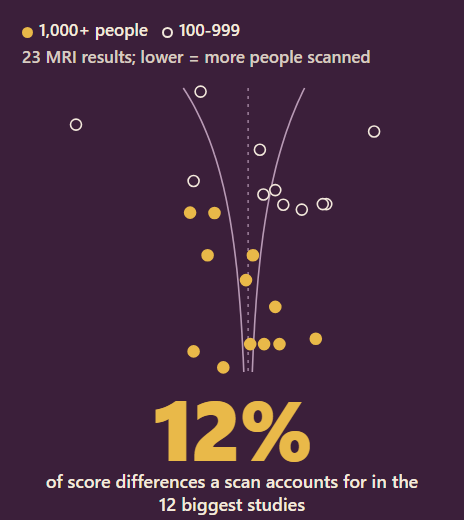
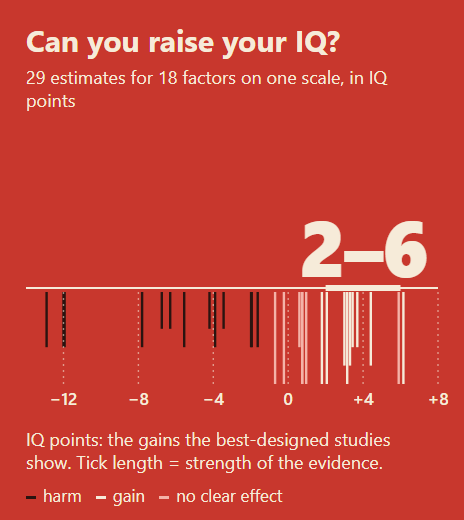
The 26 outcome works link intelligence with school and job performance, income and health exposures; our news page on whether IQ predicts income and our ledger what raises or lowers IQ cover the same questions from other angles. 4 of the 100 also appear in our live studies: the fluid-intelligence training study (Jaeggi 2008) in the replication scorecard and the ledger, and the lead-exposure, breastfeeding and working-memory-training works in the ledger. The 12 brain works are all from 1996 or later; for what a scan can and cannot show, see can a brain scan show your IQ and brain size and IQ. Only 3 are mainly about genetics (see twin studies and IQ heritability), and 3 about score trends.
Books and chapters are 29 of the 100 works and sit in 5 of the 8 topic groups
Flow from our topic group (left) to our type coding (right); each ribbon is a number of works, 100 in all. 10 records are journal reviews that carry a book's title; they are coded as books. IQ Metrics coding. As of 16 November 2026.
Source: IQ Metrics coding [7]
Data table
| from | to | topic group |
|---|---|---|
| Factor models and theory | Empirical study | 7 |
| Factor models and theory | Book or chapter | 12 |
| Factor models and theory | Review or meta-analysis | 2 |
| Factor models and theory | Theory or commentary | 8 |
| Health, education and life outcomes | Empirical study | 20 |
| Health, education and life outcomes | Book or chapter | 1 |
| Health, education and life outcomes | Review or meta-analysis | 5 |
| Tests and measurement | Empirical study | 3 |
| Tests and measurement | Book or chapter | 13 |
| Tests and measurement | Theory or commentary | 2 |
| Brain and neuroscience | Empirical study | 8 |
| Brain and neuroscience | Review or meta-analysis | 4 |
| Development and ageing | Empirical study | 4 |
| Development and ageing | Book or chapter | 2 |
| Genetics and heritability | Empirical study | 1 |
| Genetics and heritability | Review or meta-analysis | 1 |
| Genetics and heritability | Theory or commentary | 1 |
| Other | Empirical study | 2 |
| Other | Book or chapter | 1 |
| Flynn effect and score trends | Empirical study | 3 |
Embed this chart
Paste this HTML into your page: it carries the numbers and the credit link to this figure.
07 Which countries and journals are behind the most-cited intelligence works?
43 of the 70 works with a listed first-author institution are at a United States institution (61%), followed by the United Kingdom (6) and Canada (6); OpenAlex lists no institution for 30 works, mostly books and old articles. The country is where the first author’s institution was (an OpenAlex fact); it says nothing about who is intelligent, where a study’s participants lived or where a work was done.
Of the 70 works whose first author has a listed institution, 43 are in the United States; OpenAlex lists none for 30 works
Works by the country of the first author's listed institution (OpenAlex), 13 countries. It is where the first author worked, not who is intelligent and not where the work was done. 30 of the 100 (mostly older works and books) have no listed institution; they are not on the map. IQ Metrics count. As of 16 November 2026.
Source: OpenAlex first-author institution [1]; IQ Metrics count
Data table
| country | iso2 | value |
|---|---|---|
| United States | US | 43 |
| United Kingdom | GB | 6 |
| Canada | CA | 6 |
| Netherlands | NL | 4 |
| Switzerland | CH | 2 |
| New Zealand | NZ | 2 |
| Sweden | SE | 1 |
| Germany | DE | 1 |
| Estonia | EE | 1 |
| Brazil | BR | 1 |
| Italy | IT | 1 |
| Norway | NO | 1 |
| Austria | AT | 1 |
Embed this chart
Paste this HTML into your page: it carries the numbers and the credit link to this figure.
The works sit in 57 different sources, listed as OpenAlex gives them, and 7 have none. Only 7 sources hold three or more: The American Journal of Psychology (6), Intelligence (6), Psychological Science (5), Psychological Bulletin (5), American Psychologist (4), Journal of Personality and Social Psychology (4), Cambridge University Press eBooks (3). The journal Intelligence has 6; the count for The American Journal of Psychology is mainly journal reviews of books, which OpenAlex keeps under the book’s title.
Only 7 sources hold 3 or more of the 100 works, and 5 of the 6 in The American Journal of Psychology are book-review records
Works by the source OpenAlex lists (journal or book publisher), sources with 3 or more works; 57 sources in all, and 7 works with no source listed. The American Journal of Psychology count is mostly journal reviews that carry a book title. IQ Metrics count. As of 16 November 2026.
Source: OpenAlex [1]; IQ Metrics count
Data table
| label | value |
|---|---|
| The American Journal of Psychology | 6 |
| Intelligence | 6 |
| Psychological Science | 5 |
| Psychological Bulletin | 5 |
| American Psychologist | 4 |
| Journal of Personality and Social Psychology | 4 |
| Cambridge University Press eBooks | 3 |
Embed this chart
Paste this HTML into your page: it carries the numbers and the credit link to this figure.
23 of the 100 are open access in some form (green 11, bronze 8, hybrid 3, gold 1) and 77 are closed, by OpenAlex’s status on 16 November 2026. Open and closed are not a measure of quality.
08 How concentrated are the citations of the top 100 intelligence papers?
The top 10 hold 29% of the 187,674 citations, the top 3 13%, and the bottom 50 together 28%. The median work has 1,338 citations; the middle half runs from 1,035 to 2,082.
Half of the 100 works have under 1,338 citations; the top 10 hold 29% of all 187,674
Works in citation bands of 500 (OpenAlex, 16 November 2026). Median 1,338; the middle half runs from 1,035 to 2,082. The long right tail is 13 works with 3,000 or more citations. IQ Metrics calculation.
OpenAlex citations
Source: OpenAlex [1]; IQ Metrics calculation
Data table
| from | to | works |
|---|---|---|
| 500 | 1000 | 19 |
| 1000 | 1500 | 39 |
| 1500 | 2000 | 17 |
| 2000 | 2500 | 7 |
| 2500 | 3000 | 5 |
| 3000 | 3500 | 3 |
| 3500 | 4000 | 2 |
| 4000 | 4500 | 3 |
| 4500 | 5000 | 1 |
| 5000 | 5500 | 1 |
| 5500 | 6000 | 0 |
| 6000 | 6500 | 1 |
| 6500 | 7000 | 1 |
| 7000 | 7500 | 0 |
| 7500 | 8000 | 0 |
| 8000 | 8500 | 0 |
| 8500 | 9000 | 0 |
| 9000 | 9500 | 0 |
| 9500 | 10000 | 0 |
| 10000 | 10500 | 0 |
| 10500 | 11000 | 0 |
| 11000 | 11500 | 1 |
Embed this chart
Paste this HTML into your page: it carries the numbers and the credit link to this figure.
Counted per year since publication, the median work gains 50 citations a year; the range is 9 to 205. The fastest gainer is Lövdén 2020, a recent work whose citations built up in a few years, and the largest slide is Guilford 1956: rank 36 by total, 89 by citations a year.
Counted per year since publication, the median work gains 50 citations a year, and the spread inside every group is wide
Citations a year = OpenAlex citations divided by years since publication (publication year to 2026, at least 1). One dot per work (100), box = middle half, whiskers = lowest and highest, median printed. The fastest are Lövdén 2020 (205 a year) and Piaget 1952 (149). Groups of 3 works are too small for a box: read their dots one by one. IQ Metrics calculation. As of 16 November 2026.
Source: OpenAlex [1]; IQ Metrics calculation [7]
Data table
| topic group | n | low | q1 | median | q3 | high |
|---|---|---|---|---|---|---|
| Factor models and theory | 29 | 13.2 | 25.4 | 43.9 | 62.8 | 136 |
| Health, education and life outcomes | 26 | 23 | 45.9 | 56.9 | 90 | 204.7 |
| Tests and measurement | 18 | 9.2 | 24.2 | 31.9 | 94.6 | 144.9 |
| Brain and neuroscience | 12 | 29.1 | 41 | 58 | 75.7 | 94.7 |
| Development and ageing | 6 | 23.9 | 25.4 | 36.1 | 140.5 | 148.7 |
| Genetics and heritability | 3 | 50.6 | 50.6 | 58.6 | 147.3 | 147.3 |
| Other | 3 | 35.7 | 35.7 | 73.7 | 81.2 | 81.2 |
| Flynn effect and score trends | 3 | 29.1 | 29.1 | 49.2 | 60.7 | 60.7 |
Embed this chart
Paste this HTML into your page: it carries the numbers and the credit link to this figure.
Ranked by citations a year instead of total citations, 5 of the top 10 stay in the top 10 and the order changes a lot
Rank among the 100 works for the 10 most-cited: by total OpenAlex citations (left) and by citations a year since publication (right). Spearman rank correlation of the two orders across all 100: 0.58. Older works lose ground, newer ones gain. IQ Metrics calculation. As of 16 November 2026.
Source: OpenAlex [1]; IQ Metrics calculation
Data table
| work | Total citations | Citations a year |
|---|---|---|
| Piaget 1952 | 1 | 2 |
| Math. Psychology 1961 | 2 | 13 |
| Spearman 1904 | 3 | 46 |
| McClelland 1973 | 4 | 18 |
| Wechsler 1955 | 5 | 32 |
| Carroll 1993 | 6 | 8 |
| Raven 1998 | 7 | 5 |
| Preston 1995 | 8 | 9 |
| Guilford 1967 | 9 | 35 |
| Ryan 2001 | 10 | 4 |
Embed this chart
Paste this HTML into your page: it carries the numbers and the credit link to this figure.
Curious how reasoning is measured?
This page counts citations of research on intelligence. An IQ test is how reasoning is measured in practice.
Take the IQ test09 Do OpenAlex and Crossref agree on how often these papers are cited?
Only loosely: the rank correlation between the two counts is 0.50 across the 90 works that have both, and 4 of the top 10, 16 of the top 25 and 34 of the top 50 by OpenAlex are also in the same top group by Crossref (among the 96 included works with a Crossref count). The gap is mostly two things. Crossref counts only citations that publishers deposited with a DOI, so books and old works are under-counted; and OpenAlex attaches many citations to the title of a book to whichever record carries that title, which is sometimes a journal review of the book.
OpenAlex and Crossref count the same work very differently: 5 of the top 20 have under a tenth as many citations in Crossref
Citations in Crossref (left dot) and OpenAlex (right dot) for the 20 most-cited works that have a Crossref count. Works with no DOI (test manuals and books) have none and are left out of this figure. The widest gaps are journal reviews that carry a book's title, whose citations OpenAlex attaches to the title. Counts on 16 November 2026.
Source: OpenAlex [1]; Crossref [2]
Data table
| work | Crossref | OpenAlex |
|---|---|---|
| Piaget 1952 | 5733 | 11152 |
| Math. Psychology 1961 | 11 | 6935 |
| Spearman 1904 | 4239 | 6476 |
| McClelland 1973 | 2579 | 5021 |
| Carroll 1993 | 3529 | 4284 |
| Preston 1995 | 1 | 4025 |
| Ryan 2001 | 90 | 3767 |
| Engle 1999a | 2111 | 3250 |
| Neisser 1996 | 1822 | 3056 |
| Piaget 2005 | 72 | 3030 |
| Jensen 1969 | 1897 | 2935 |
| Clarke 1986 | 7 | 2863 |
| Cattell 1963 | 1775 | 2736 |
| Block 1996 | 1635 | 2516 |
| Duckworth 2005 | 1503 | 2506 |
| Kane 2002 | 1643 | 2368 |
| Jaeggi 2008 | 1651 | 2360 |
| Lanphear 2005 | 1873 | 2300 |
| Judge 1999 | 1418 | 2279 |
| Kanfer 1989 | 1404 | 2173 |
Embed this chart
Paste this HTML into your page: it carries the numbers and the credit link to this figure.
10 of the 100 records are such journal-review records: OpenAlex gives them 23,175 citations in all, and Crossref counts 51. We keep them on the list because the title is the work people cite and the OpenAlex count is the one that attaches to it, and we mark each one in the table; counted without them, the two databases agree better (0.69 across 79 works). The median OpenAlex count is 1.5 times the Crossref count. Neither database is “the” right number; reading both is the check.
Across the 100 works the two counts agree in order only loosely (rank correlation 0.50); without the review records it is 0.69
Each dot is a work with a Crossref count of 1 or more (86 works; 4 with 0 and 10 with no Crossref count are not drawn): OpenAlex citations against Crossref citations, both log scales; dashed line = equal counts. Orange = records that are journal reviews carrying a book title. Spearman rank correlation by IQ Metrics. Counts on 16 November 2026.
Crossref citations (log scale)
OpenAlex citations (log scale)
Source: OpenAlex [1]; Crossref [2]; IQ Metrics calculation
Data table
| work | openalex_cited_by_count | crossref_cited_by_count | group |
|---|---|---|---|
| Piaget 1952 | 11152 | 5733 | reg |
| Math. Psychology 1961 | 6935 | 11 | rev |
| Spearman 1904 | 6476 | 4239 | reg |
| McClelland 1973 | 5021 | 2579 | reg |
| Carroll 1993 | 4284 | 3529 | reg |
| Preston 1995 | 4025 | 1 | rev |
| Ryan 2001 | 3767 | 90 | reg |
| Engle 1999a | 3250 | 2111 | reg |
| Neisser 1996 | 3056 | 1822 | reg |
| Piaget 2005 | 3030 | 72 | reg |
| Jensen 1969 | 2935 | 1897 | reg |
| Clarke 1986 | 2863 | 7 | rev |
| Cattell 1963 | 2736 | 1775 | reg |
| Block 1996 | 2516 | 1635 | reg |
| Duckworth 2005 | 2506 | 1503 | reg |
| Kane 2002 | 2368 | 1643 | reg |
| Jaeggi 2008 | 2360 | 1651 | reg |
| Lanphear 2005 | 2300 | 1873 | reg |
| Judge 1999 | 2279 | 1418 | reg |
| Kanfer 1989 | 2173 | 1404 | reg |
| Thurstone 1973 | 2129 | 22 | reg |
| Canfield 2003 | 2112 | 1694 | reg |
| Halpern 2000 | 1991 | 548 | reg |
| Flynn 1987 | 1968 | 1296 | reg |
| Deary 2006 | 1888 | 1352 | reg |
| Jensen 1974 | 1874 | 8 | rev |
| Kyllonen 1990 | 1871 | 1222 | reg |
| Ackerman 1997 | 1836 | 1161 | reg |
| Webster 1958 | 1813 | 1 | rev |
| Sternberg 2014 | 1768 | 34 | reg |
| Carpenter 1990 | 1725 | 1178 | reg |
| Guilford 1956 | 1685 | 1082 | reg |
| Jung 2007 | 1671 | 1304 | reg |
| Horn 1966 | 1648 | 1138 | reg |
| Shaw 2006 | 1644 | 1281 | reg |
| Raven 2000 | 1640 | 1202 | reg |
| Alloway 2009 | 1500 | 1007 | reg |
| Peal 1962 | 1496 | 738 | reg |
| Gottfredson 1997 | 1465 | 981 | reg |
| Lövdén 2020 | 1433 | 1135 | reg |
| Horn 1967 | 1432 | 949 | reg |
| Friedman 2006 | 1430 | 908 | reg |
| Turkheimer 2003 | 1407 | 926 | reg |
| Dohmen 2010 | 1350 | 985 | reg |
| Savage 2018 | 1326 | 1272 | reg |
| Schmidt 2004 | 1300 | 801 | reg |
| Conway 2003 | 1285 | 858 | reg |
| Flynn 1984 | 1252 | 909 | reg |
| Lindenberger 1994 | 1240 | 870 | reg |
| Lucas 1992 | 1228 | 947 | reg |
| Engle 1999b | 1228 | 556 | reg |
| Gould 1928 | 1193 | 2 | rev |
| Conway 2002 | 1175 | 768 | reg |
| Hedges 1995 | 1143 | 725 | reg |
| Jacobson 1996 | 1140 | 853 | reg |
| Nelson 1978 | 1131 | 918 | reg |
| Heuvel 2009 | 1124 | 972 | reg |
| Gray 2003 | 1118 | 837 | reg |
| Deary 2010 | 1108 | 859 | reg |
| Schellenberg 2004 | 1085 | 594 | reg |
| Maas 2006 | 1067 | 730 | reg |
| Duncan 2000 | 1057 | 728 | reg |
| Hunter 1986 | 1042 | 630 | reg |
| Ackerman 2005 | 1039 | 699 | reg |
| Nisbett 2012 | 1034 | 685 | reg |
| Strenze 2006 | 1021 | 752 | reg |
| Terman 1916 | 1019 | 721 | reg |
| Blair 1989 | 1009 | 735 | reg |
| Horta 2015 | 1007 | 623 | reg |
| Fulker 1975 | 1001 | 21 | rev |
| Christelis 2009 | 997 | 701 | reg |
| Melby‐Lervåg 2016 | 994 | 819 | reg |
| Tomporowski 2007 | 988 | 585 | reg |
| Kuncel 2004 | 964 | 601 | reg |
| Duncan 1996 | 955 | 646 | reg |
| Neubauer 2009 | 950 | 821 | reg |
| Guilford 1959 | 944 | 599 | reg |
| Stanovich 2008 | 928 | 571 | reg |
| Dennis 2009 | 923 | 740 | reg |
| Ackerman 1988 | 923 | 596 | reg |
First 80 of 86 rows; the Data button gives all of them.
Embed this chart
Paste this HTML into your page: it carries the numbers and the credit link to this figure.
10 Has any of the 100 most-cited intelligence papers been retracted?
No: none of the 100 carries a retraction flag in OpenAlex, and none of the 115 records (the 100 works, the 6 just below the line and their merged records) matches the Retraction Watch database, which Crossref publishes under CC0 [3]. We matched 104 by DOI and 11 with no DOI by exact title; a title match is weaker, so “no match” is a lower bound.
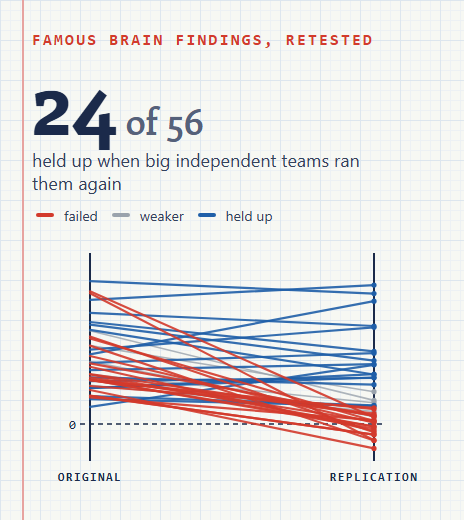
Crossref lists a correction notice for 2 works (Flynn 1987, Nisbett 2012); a correction is not a retraction. No work is called “contested” on this page: that word is used only where a retraction notice or an expression of concern exists in the data, and none does. Our study of replication tracks which findings held up when repeated, and it includes one of these works (Jaeggi 2008); a retraction and a failed replication are different things.
11 What did we leave out, and would it change the list?
We left out 33 borderline works that matched our query, with a reason for each (borderline.csv). The biggest group is “multiple intelligences”: the most-cited, “Frames of Mind: The Theory of Multiple Intelligences” (1984), has 13,598 citations, more than any work on our list, and 4 such works would enter the top 100 if they counted, which would move the cut-off from 867 to 888. We left them out because they are mainly about a theory of several intelligences, a decision we print. Others left out are works on beliefs about intelligence (mindset) and works where intelligence is one predictor among many.
We also left out 26 works about artificial or machine intelligence, work on working memory or executive function alone (93 works), autism and clinical-population studies, dementia screening and animal intelligence. Works on differences between groups are counted on the same rule as any other work: they appear in the table by title, year and citations only, and we summarise none of them.
12 How we built the dataset, and what its limits are
Every number comes from scripts in top-cited-intelligence/data (analyse.py runs 426 checks) that read only cached copies of the OpenAlex and Crossref answers, each logged with its date and sha256.
- Most-cited work
- A work ranked by its OpenAlex citation count on the access date; not “best”, “most important” or “correct”.
- Work
- One article, review, book or book chapter; extra OpenAlex records of the same title are merged and never added.
- OpenAlex citations
- cited_by_count in the OpenAlex works API: how many other works in OpenAlex cite this record, as of 16 November 2026.
- Crossref citations
- is-referenced-by-count in Crossref: citations deposited by publishers for a DOI. Empty for works without a DOI.
- Review record
- An OpenAlex record that is a journal review of a book but carries the book’s title; OpenAlex attaches the book’s citations to it. Marked in the table.
- Citations a year
- OpenAlex citations divided by years since publication (to 2026, at least 1): a rough, age-adjusted rate, our calculation.
- First-author country
- The country of the first author’s first listed institution in OpenAlex; empty for many older works. Not nationality, and not a statement about intelligence.
- Retraction Watch database
- A list of retraction and update notices kept by Retraction Watch and published by Crossref; a match by DOI is a retraction, expression of concern or correction.
Read every number with these in mind
- A citation count is attention, not truth or quality. It rises for work that is influential, criticised, required (test manuals) or old; it says nothing about whether a finding is right.
- Counts are as of 16 November 2026 and change every day. OpenAlex and Crossref differ, and both differ from Google Scholar, which is not an open source and is not used here.
- “On topic” is our reading of titles and abstracts: 33 borderline works were left out, and a work with no query term in its title or abstract may be missing. Works with fewer than 800 citations were not read; that is our read window, not a natural boundary.
- OpenAlex attaches the citations of some books to journal-review records that carry the same title (10 of the 100); they are marked, and their first author is the reviewer, not the book’s author. 48 of the 100 records have no abstract in OpenAlex.
- The first-author country is missing for 30 works and is not a statement about who is intelligent or where the work was done. No ranking of countries is made.
- Recent works have had less time to be cited, so the 2010s and 2020s are under-represented (only 10 works from 2010 or later). Citations a year is a rough fix.
- Works on group differences are counted on the same rule as any other, listed by title, year and citations only; no finding is summarised.
- The Retraction Watch check is by DOI, or by exact title where there is no DOI; a work with no DOI and a changed title would not match.
13 Which are all 100 most-cited papers on intelligence? The full table
The 100 works, ranked by OpenAlex citations on 16 November 2026; click a header to sort. “Review record” marks OpenAlex records that are journal reviews carrying a book title. The CSV (most-cited-papers-on-human-intelligence-2026-iqmetrics.csv) also lists the merged records, the next six works and the coding.
The 100 most-cited works on human intelligence: both citation counts, our coding and the DOI (as of 16 November 2026)
| 1 | Piaget | 1,952 | The origins of intelligence in children. | W W Norton & Co eBooks | Book or chapter | Development and ageing | 11,152 | 5,733 | 149 | 10.1037/11494-000 |
| 2 | Math. Psychology (review record) | 1,961 | Probabilistic Models for Some Intelligence and Attainment Tests | Information and Control | Book or chapter | Tests and measurement | 6,935 | 11 | 105 | 10.1016/s0019-9958(61)80061-2 |
| 3 | Spearman | 1,904 | “General Intelligence,” Objectively Determined and Measured | The American Journal of Psychology | Theory or commentary | Factor models and theory | 6,476 | 4,239 | 53 | 10.2307/1412107 |
| 4 | McClelland | 1,973 | Testing for competence rather than for “intelligence.” | American Psychologist | Theory or commentary | Tests and measurement | 5,021 | 2,579 | 93 | 10.1037/h0034092 |
| 5 | Wechsler | 1,955 | Manual for the Wechsler Adult Intelligence Scale. | Psychological Corp. eBooks | Book or chapter | Tests and measurement | 4,961 | 69 | none | |
| 6 | Carroll | 1,993 | Human Cognitive Abilities: A Survey of Factor-Analytic Studies | Cambridge University Press eBooks | Book or chapter | Factor models and theory | 4,284 | 3,529 | 126 | 10.1017/cbo9780511571312 |
| 7 | Raven | 1,998 | Manual for Raven’s progressive matrices and vocabulary scales | Book or chapter | Tests and measurement | 4,175 | 144 | none | ||
| 8 | Preston (review record) | 1,995 | The Bell Curve: Intelligence and Class Structure in American Life. | Population and Development Review | Book or chapter | Health, education and life outcomes | 4,025 | 1 | 126 | 10.2307/2137757 |
| 9 | Guilford | 1,967 | The nature of human intelligence | McGraw-Hill eBooks | Book or chapter | Factor models and theory | 3,867 | 64 | none | |
| 10 | Ryan | 2,001 | Wechsler Adult Intelligence Scale-III | Springer eBooks | Book or chapter | Tests and measurement | 3,767 | 90 | 145 | 10.1007/978-1-4615-1185-4_2 |
| 11 | Engle | 1,999 | Working memory, short-term memory, and general fluid intelligence: A latent-variable approach. | Journal of Experimental Psychology General | Empirical study | Factor models and theory | 3,250 | 2,111 | 116 | 10.1037/0096-3445.128.3.309 |
| 12 | Neisser | 1,996 | Intelligence: Knowns and unknowns. | American Psychologist | Review or meta-analysis | Factor models and theory | 3,056 | 1,822 | 99 | 10.1037/0003-066x.51.2.77 |
| 13 | Piaget | 2,005 | The Psychology Of Intelligence | Routledge eBooks | Book or chapter | Development and ageing | 3,030 | 72 | 138 | 10.4324/9780203981528 |
| 14 | Jensen | 1,969 | How Much Can We Boost IQ and Scholastic Achievement | Harvard Educational Review | Theory or commentary | Genetics and heritability | 2,935 | 1,897 | 51 | 10.17763/haer.39.1.l3u15956627424k7 |
| 15 | Clarke (review record) | 1,986 | Beyond IQ: A Triarchic Theory of Human Intelligence | British Journal of Educational Studies | Book or chapter | Factor models and theory | 2,863 | 7 | 70 | 10.2307/3121332 |
| 16 | Cattell | 1,963 | Theory of fluid and crystallized intelligence: A critical experiment. | Journal of Educational Psychology | Empirical study | Factor models and theory | 2,736 | 1,775 | 43 | 10.1037/h0046743 |
| 17 | Block | 1,996 | IQ and ego-resiliency: Conceptual and empirical connections and separateness. | Journal of Personality and Social Psychology | Empirical study | Other | 2,516 | 1,635 | 81 | 10.1037/0022-3514.70.2.349 |
| 18 | Duckworth | 2,005 | Self-Discipline Outdoes IQ in Predicting Academic Performance of Adolescents | Psychological Science | Empirical study | Health, education and life outcomes | 2,506 | 1,503 | 114 | 10.1111/j.1467-9280.2005.01641.x |
| 19 | Kane | 2,002 | The role of prefrontal cortex in working-memory capacity, executive attention, and general fluid intelligence: An individual-differences perspective | Psychonomic Bulletin & Review | Review or meta-analysis | Brain and neuroscience | 2,368 | 1,643 | 95 | 10.3758/bf03196323 |
| 20 | Jaeggi | 2,008 | Improving fluid intelligence with training on working memory | Proceedings of the National Academy of Sciences | Empirical study | Health, education and life outcomes | 2,360 | 1,651 | 124 | 10.1073/pnas.0801268105 |
| 21 | Lanphear | 2,005 | Low-Level Environmental Lead Exposure and Children’s Intellectual Function: An International Pooled Analysis | Environmental Health Perspectives | Empirical study | Health, education and life outcomes | 2,300 | 1,873 | 105 | 10.1289/ehp.7688 |
| 22 | Judge | 1,999 | THE BIG FIVE PERSONALITY TRAITS, GENERAL MENTAL ABILITY, AND CAREER SUCCESS ACROSS THE LIFE SPAN | Personnel Psychology | Empirical study | Health, education and life outcomes | 2,279 | 1,418 | 81 | 10.1111/j.1744-6570.1999.tb00174.x |
| 23 | Kanfer | 1,989 | Motivation and cognitive abilities: An integrative/aptitude-treatment interaction approach to skill acquisition. | Journal of Applied Psychology | Empirical study | Health, education and life outcomes | 2,173 | 1,404 | 57 | 10.1037/0021-9010.74.4.657 |
| 24 | Thurstone | 1,973 | Primary Mental Abilities | Springer eBooks | Book or chapter | Factor models and theory | 2,129 | 22 | 39 | 10.1007/978-94-011-6129-9_8 |
| 25 | Canfield | 2,003 | Intellectual Impairment in Children with Blood Lead Concentrations below 10 μg per Deciliter | New England Journal of Medicine | Empirical study | Health, education and life outcomes | 2,112 | 1,694 | 88 | 10.1056/nejmoa022848 |
| 26 | Halpern | 2,000 | Sex Differences in Cognitive Abilities | Psychology Press eBooks | Book or chapter | Other | 1,991 | 548 | 74 | 10.4324/9781410605290 |
| 27 | Flynn | 1,987 | Massive IQ gains in 14 nations: What IQ tests really measure. | Psychological Bulletin | Empirical study | Flynn effect and score trends | 1,968 | 1,296 | 49 | 10.1037/0033-2909.101.2.171 |
| 28 | Deary | 2,006 | Intelligence and educational achievement | Intelligence | Empirical study | Health, education and life outcomes | 1,888 | 1,352 | 90 | 10.1016/j.intell.2006.02.001 |
| 29 | Jensen (review record) | 1,974 | Abilities: Their Structure, Growth, and Action | The American Journal of Psychology | Book or chapter | Factor models and theory | 1,874 | 8 | 35 | 10.2307/1422024 |
| 30 | Kyllonen | 1,990 | Reasoning ability is (little more than) working-memory capacity?! | Intelligence | Empirical study | Factor models and theory | 1,871 | 1,222 | 51 | 10.1016/s0160-2896(05)80012-1 |
| 31 | Ackerman | 1,997 | Intelligence, personality, and interests: Evidence for overlapping traits. | Psychological Bulletin | Empirical study | Factor models and theory | 1,836 | 1,161 | 61 | 10.1037/0033-2909.121.2.219 |
| 32 | Webster (review record) | 1,958 | The Measurement and Appraisal of Adult Intelligence | The Journal of Criminal Law Criminology and Police Science | Book or chapter | Tests and measurement | 1,813 | 1 | 26 | 10.2307/1141601 |
| 33 | Sternberg | 2,014 | Advances in the Psychology of Human Intelligence | Psychology Press eBooks | Book or chapter | Factor models and theory | 1,768 | 34 | 136 | 10.4324/9781315808246 |
| 34 | Carpenter | 1,990 | What one intelligence test measures: A theoretical account of the processing in the Raven Progressive Matrices Test. | Psychological Review | Empirical study | Tests and measurement | 1,725 | 1,178 | 47 | 10.1037/0033-295x.97.3.404 |
| 35 | Lani | 2,010 | Wechsler Adult Intelligence Scale—Fourth Edition (WAIS-IV) | Book or chapter | Tests and measurement | 1,688 | 99 | none | ||
| 36 | Guilford | 1,956 | The structure of intellect. | Psychological Bulletin | Theory or commentary | Factor models and theory | 1,685 | 1,082 | 24 | 10.1037/h0040755 |
| 37 | Jung | 2,007 | The Parieto-Frontal Integration Theory (P-FIT) of intelligence: Converging neuroimaging evidence | Behavioral and Brain Sciences | Review or meta-analysis | Brain and neuroscience | 1,671 | 1,304 | 84 | 10.1017/s0140525x07001185 |
| 38 | Horn | 1,966 | Refinement and test of the theory of fluid and crystallized general intelligences. | Journal of Educational Psychology | Theory or commentary | Factor models and theory | 1,648 | 1,138 | 27 | 10.1037/h0023816 |
| 39 | Shaw | 2,006 | Intellectual ability and cortical development in children and adolescents | Nature | Empirical study | Brain and neuroscience | 1,644 | 1,281 | 78 | 10.1038/nature04513 |
| 40 | Raven | 2,000 | The Raven’s Progressive Matrices: Change and Stability over Culture and Time | Cognitive Psychology | Empirical study | Flynn effect and score trends | 1,640 | 1,202 | 61 | 10.1006/cogp.1999.0735 |
| 41 | Wechsler | 1,981 | WAIS-R manual : Wechsler adult intelligence scale-revised | Book or chapter | Tests and measurement | 1,559 | 34 | none | ||
| 42 | Alloway | 2,009 | Investigating the predictive roles of working memory and IQ in academic attainment | Journal of Experimental Child Psychology | Empirical study | Health, education and life outcomes | 1,500 | 1,007 | 83 | 10.1016/j.jecp.2009.11.003 |
| 43 | Peal | 1,962 | The relation of bilingualism to intelligence. | The Psychological Monographs | Empirical study | Health, education and life outcomes | 1,496 | 738 | 23 | 10.1037/h0093840 |
| 44 | Gottfredson | 1,997 | Why g matters: The complexity of everyday life | Intelligence | Theory or commentary | Factor models and theory | 1,465 | 981 | 49 | 10.1016/s0160-2896(97)90014-3 |
| 45 | Lövdén | 2,020 | Education and Cognitive Functioning Across the Life Span | Psychological Science in the Public Interest | Review or meta-analysis | Health, education and life outcomes | 1,433 | 1,135 | 205 | 10.1177/1529100620920576 |
| 46 | Horn | 1,967 | Age differences in fluid and crystallized intelligence | Acta Psychologica | Empirical study | Development and ageing | 1,432 | 949 | 24 | 10.1016/0001-6918(67)90011-x |
| 47 | Friedman | 2,006 | Not All Executive Functions Are Related to Intelligence | Psychological Science | Empirical study | Brain and neuroscience | 1,430 | 908 | 68 | 10.1111/j.1467-9280.2006.01681.x |
| 48 | Thorndike | 1,920 | Intelligence and its uses. | Theory or commentary | Factor models and theory | 1,408 | 13 | none | ||
| 49 | Turkheimer | 2,003 | Socioeconomic Status Modifies Heritability of IQ in Young Children | Psychological Science | Empirical study | Genetics and heritability | 1,407 | 926 | 59 | 10.1046/j.0956-7976.2003.psci_1475.x |
| 50 | Dohmen | 2,010 | Are Risk Aversion and Impatience Related to Cognitive Ability? | American Economic Review | Empirical study | Health, education and life outcomes | 1,350 | 985 | 79 | 10.1257/aer.100.3.1238 |
| 51 | Savage | 2,018 | Genome-wide association meta-analysis in 269,867 individuals identifies new genetic and functional links to intelligence | Nature Genetics | Review or meta-analysis | Genetics and heritability | 1,326 | 1,272 | 147 | 10.1038/s41588-018-0152-6 |
| 52 | Wechsler | 1,974 | Manual for the Wechsler intelligence scale for children | Psychological Corp. eBooks | Book or chapter | Tests and measurement | 1,303 | 25 | none | |
| 53 | Schmidt | 2,004 | General Mental Ability in the World of Work: Occupational Attainment and Job Performance. | Journal of Personality and Social Psychology | Empirical study | Health, education and life outcomes | 1,300 | 801 | 57 | 10.1037/0022-3514.86.1.162 |
| 54 | Conway | 2,003 | Working memory capacity and its relation to general intelligence | Trends in Cognitive Sciences | Review or meta-analysis | Brain and neuroscience | 1,285 | 858 | 54 | 10.1016/j.tics.2003.10.005 |
| 55 | Cronbach (review record) | 1,984 | Handbook of Human Intelligence | The American Journal of Psychology | Book or chapter | Factor models and theory | 1,276 | 0 | 30 | 10.2307/1422532 |
| 56 | Flynn | 1,984 | The mean IQ of Americans: Massive gains 1932 to 1978. | Psychological Bulletin | Empirical study | Flynn effect and score trends | 1,252 | 909 | 29 | 10.1037/0033-2909.95.1.29 |
| 57 | Lindenberger | 1,994 | Sensory functioning and intelligence in old age: A strong connection. | Psychology and Aging | Empirical study | Development and ageing | 1,240 | 870 | 38 | 10.1037/0882-7974.9.3.339 |
| 58 | Lucas | 1,992 | Breast milk and subsequent intelligence quotient in children born preterm | The Lancet | Empirical study | Health, education and life outcomes | 1,228 | 947 | 35 | 10.1016/0140-6736(92)91329-7 |
| 59 | Engle | 1,999 | Individual Differences in Working Memory Capacity and What They Tell Us About Controlled Attention, General Fluid Intelligence, and Functions of the Prefrontal Cortex | Cambridge University Press eBooks | Book or chapter | Factor models and theory | 1,228 | 556 | 44 | 10.1017/cbo9781139174909.007 |
| 60 | Kaufman | 1,979 | Intelligent testing with the WISC-R | Book or chapter | Tests and measurement | 1,215 | 25 | none | ||
| 61 | Silverstein (review record) | 1,962 | Intelligence and Experience | The Journal of Nervous and Mental Disease | Book or chapter | Factor models and theory | 1,205 | 0 | 19 | 10.1097/00005053-196211000-00016 |
| 62 | Gould (review record) | 1,928 | Measurement of Intelligence by Drawings | The American Journal of Psychology | Book or chapter | Tests and measurement | 1,193 | 2 | 12 | 10.2307/1414371 |
| 63 | Conway | 2,002 | A latent variable analysis of working memory capacity, short-term memory capacity, processing speed, and general fluid intelligence | Intelligence | Empirical study | Factor models and theory | 1,175 | 768 | 47 | 10.1016/s0160-2896(01)00096-4 |
| 64 | Hedges | 1,995 | Sex Differences in Mental Test Scores, Variability, and Numbers of High-Scoring Individuals | Science | Empirical study | Other | 1,143 | 725 | 36 | 10.1126/science.7604277 |
| 65 | Jacobson | 1,996 | Intellectual Impairment in Children Exposed to Polychlorinated Biphenyls in Utero | New England Journal of Medicine | Empirical study | Health, education and life outcomes | 1,140 | 853 | 37 | 10.1056/nejm199609123351104 |
| 66 | Nelson | 1,978 | Dementia: The Estimation of Premorbid Intelligence Levels Using the New Adult Reading Test | Cortex | Empirical study | Tests and measurement | 1,131 | 918 | 23 | 10.1016/s0010-9452(78)80049-5 |
| 67 | Heuvel | 2,009 | Efficiency of Functional Brain Networks and Intellectual Performance | Journal of Neuroscience | Empirical study | Brain and neuroscience | 1,124 | 972 | 62 | 10.1523/jneurosci.1443-09.2009 |
| 68 | Gray | 2,003 | Neural mechanisms of general fluid intelligence | Nature Neuroscience | Empirical study | Brain and neuroscience | 1,118 | 837 | 47 | 10.1038/nn1014 |
| 69 | Kaufman | 1,990 | Assessing Adolescent and Adult Intelligence | Book or chapter | Tests and measurement | 1,109 | 30 | none | ||
| 70 | Deary | 2,010 | The neuroscience of human intelligence differences | Nature reviews. Neuroscience | Review or meta-analysis | Brain and neuroscience | 1,108 | 859 | 65 | 10.1038/nrn2793 |
| 71 | Schellenberg | 2,004 | Music Lessons Enhance IQ | Psychological Science | Empirical study | Health, education and life outcomes | 1,085 | 594 | 47 | 10.1111/j.0956-7976.2004.00711.x |
| 72 | Maas | 2,006 | A dynamical model of general intelligence: The positive manifold of intelligence by mutualism. | Psychological Review | Theory or commentary | Factor models and theory | 1,067 | 730 | 51 | 10.1037/0033-295x.113.4.842 |
| 73 | Duncan | 2,000 | A Neural Basis for General Intelligence | Science | Empirical study | Brain and neuroscience | 1,057 | 728 | 39 | 10.1126/science.289.5478.457 |
| 74 | Hunter | 1,986 | Cognitive ability, cognitive aptitudes, job knowledge, and job performance | Journal of Vocational Behavior | Empirical study | Health, education and life outcomes | 1,042 | 630 | 25 | 10.1016/0001-8791(86)90013-8 |
| 75 | Ackerman | 2,005 | Working Memory and Intelligence: The Same or Different Constructs? | Psychological Bulletin | Empirical study | Factor models and theory | 1,039 | 699 | 47 | 10.1037/0033-2909.131.1.30 |
| 76 | Nisbett | 2,012 | Intelligence: New findings and theoretical developments. | American Psychologist | Review or meta-analysis | Factor models and theory | 1,034 | 685 | 69 | 10.1037/a0026699 |
| 77 | Strenze | 2,006 | Intelligence and socioeconomic success: A meta-analytic review of longitudinal research | Intelligence | Review or meta-analysis | Health, education and life outcomes | 1,021 | 752 | 49 | 10.1016/j.intell.2006.09.004 |
| 78 | Terman | 1,916 | The measurement of intelligence. | Book or chapter | Tests and measurement | 1,019 | 721 | 9 | 10.1037/10014-000 | |
| 79 | Blair | 1,989 | Predicting premorbid IQ: A revision of the national adult reading test | The Clinical Neuropsychologist | Empirical study | Tests and measurement | 1,009 | 735 | 27 | 10.1080/13854048908403285 |
| 80 | Horta | 2,015 | Breastfeeding and intelligence: a systematic review and meta‐analysis | Acta Paediatrica | Review or meta-analysis | Health, education and life outcomes | 1,007 | 623 | 84 | 10.1111/apa.13139 |
| 81 | Fulker (review record) | 1,975 | The Science and Politics of IQ | The American Journal of Psychology | Book or chapter | Factor models and theory | 1,001 | 21 | 19 | 10.2307/1421782 |
| 82 | Christelis | 2,009 | Cognitive abilities and portfolio choice | European Economic Review | Empirical study | Health, education and life outcomes | 997 | 701 | 55 | 10.1016/j.euroecorev.2009.04.001 |
| 83 | Melby‐Lervåg | 2,016 | Working Memory Training Does Not Improve Performance on Measures of Intelligence or Other Measures of “Far Transfer”: Evidence From a Meta-Analytic Review | Perspectives on Psychological Science | Review or meta-analysis | Health, education and life outcomes | 994 | 819 | 90 | 10.1177/1745691616635612 |
| 84 | Johnson (review record) | 1,978 | Intelligence, Information Processing, and Analogical Reasoning: The Componential Analysis of Human Abilities | The American Journal of Psychology | Book or chapter | Factor models and theory | 990 | 0 | 20 | 10.2307/1421839 |
| 85 | Tomporowski | 2,007 | Exercise and Children’s Intelligence, Cognition, and Academic Achievement | Educational Psychology Review | Empirical study | Health, education and life outcomes | 988 | 585 | 49 | 10.1007/s10648-007-9057-0 |
| 86 | Wechsler | 1,940 | The Measurement of Adult Intelligence. | Archives of Neurology And Psychiatry | Book or chapter | Tests and measurement | 980 | 0 | 11 | 10.1001/archneurpsyc.1940.02280030188021 |
| 87 | Kuncel | 2,004 | Academic Performance, Career Potential, Creativity, and Job Performance: Can One Construct Predict Them All? | Journal of Personality and Social Psychology | Review or meta-analysis | Health, education and life outcomes | 964 | 601 | 42 | 10.1037/0022-3514.86.1.148 |
| 88 | Duncan | 1,996 | Intelligence and the Frontal Lobe: The Organization of Goal-Directed Behavior | Cognitive Psychology | Empirical study | Brain and neuroscience | 955 | 646 | 31 | 10.1006/cogp.1996.0008 |
| 89 | Neubauer | 2,009 | Intelligence and neural efficiency | Neuroscience & Biobehavioral Reviews | Empirical study | Brain and neuroscience | 950 | 821 | 53 | 10.1016/j.neubiorev.2009.04.001 |
| 90 | Guilford | 1,959 | Three faces of intellect. | American Psychologist | Theory or commentary | Factor models and theory | 944 | 599 | 14 | 10.1037/h0046827 |
| 91 | Stanovich | 2,008 | On the relative independence of thinking biases and cognitive ability. | Journal of Personality and Social Psychology | Empirical study | Health, education and life outcomes | 928 | 571 | 49 | 10.1037/0022-3514.94.4.672 |
| 92 | Dennis | 2,009 | Why IQ is not a covariate in cognitive studies of neurodevelopmental disorders | Journal of the International Neuropsychological Society | Theory or commentary | Tests and measurement | 923 | 740 | 51 | 10.1017/s1355617709090481 |
| 93 | Ackerman | 1,988 | Determinants of individual differences during skill acquisition: Cognitive abilities and information processing. | Journal of Experimental Psychology General | Empirical study | Factor models and theory | 923 | 596 | 24 | 10.1037/0096-3445.117.3.288 |
| 94 | Moreno | 2,011 | Short-Term Music Training Enhances Verbal Intelligence and Executive Function | Psychological Science | Empirical study | Health, education and life outcomes | 905 | 555 | 57 | 10.1177/0956797611416999 |
| 95 | Reiss | 1,996 | Brain development, gender and IQ in children: A volumetric imaging study | Brain | Empirical study | Brain and neuroscience | 903 | 690 | 29 | 10.1093/brain/119.5.1763 |
| 96 | No author listed | 2,000 | Handbook of Intelligence | Cambridge University Press eBooks | Book or chapter | Factor models and theory | 888 | 296 | 33 | 10.1017/cbo9780511807947 |
| 97 | Ackerman | 1,996 | A theory of adult intellectual development: Process, personality, interests, and knowledge | Intelligence | Theory or commentary | Factor models and theory | 883 | 584 | 28 | 10.1016/s0160-2896(96)90016-1 |
| 98 | Sameroff | 1,993 | Stability of Intelligence from Preschool to Adolescence: The Influence of Social and Family Risk Factors | Child Development | Empirical study | Development and ageing | 879 | 26 | 10.1111/j.1467-8624.1993.tb02896.x | |
| 99 | Wilson | 2,002 | Individual differences in rates of change in cognitive abilities of older persons. | Psychology and Aging | Empirical study | Development and ageing | 867 | 649 | 35 | 10.1037/0882-7974.17.2.179 |
| 100 | Ceci | 1,991 | How much does schooling influence general intelligence and its cognitive components? A reassessment of the evidence. | Developmental Psychology | Empirical study | Health, education and life outcomes | 867 | 565 | 24 | 10.1037/0012-1649.27.5.703 |
Source:
Sources
- OurResearch (OpenAlex). OpenAlex works API (api.openalex.org/works): five query routes, sorted by cited_by_count, 2,463 works in the union; first-author institution country, journal, open-access status, is_retracted flag and citation counts as OpenAlex holds them on the access date. 2026. docs.openalex.org/how-to-use-the-api/api-overviewCC0 (OpenAlex documentation: "all data is CC0"; wording as read for the 14 Nov 2026 brain-banks study, not re-read on 16 Nov)
- Crossref. Crossref REST API (api.crossref.org/works): is-referenced-by-count, type and update notices of the 96 included works that have a registered DOI (batches of 25 DOIs, no key, no e-mail). 2026. www.crossref.org/documentation/retrieve-metadataCrossref documentation, "Licensing": "The majority of metadata is considered to be 'facts' which are not copyrightable and are thus in the public domain (CC0)."
- Crossref (Retraction Watch database). Retraction Watch database as published by Crossref (gitlab.com/crossref/retraction-watch-data), CSV of 73,822 rows, sha256 4d0509f648ec6dc7…, file generated 2026-11-13; read from the copy the retractions study cached the same day. 2026. gitlab.com/crossref/retraction-watch-dataCrossref documentation, "Licensing" table: "Open Funder Registry, Retraction Watch database: CC0"
- Frontiers Media. Zhang Y, Xiong Y, Cai Y, Zheng L, Zhang Y. The 100 Top-Cited Studies on Neuropsychology: A Bibliometric Analysis. Frontiers in Psychology 2020; 11: 550716. 2020. doi.org/10.3389/fpsyg.2020.550716CC BY 4.0 (Crossref licence record)
- MDPI. Pesta B, Fuerst J, Kirkegaard E. Bibliometric Keyword Analysis across Seventeen Years (2000-2016) of Intelligence Articles. Journal of Intelligence 2018; 6(4): 46. 2018. doi.org/10.3390/jintelligence6040046CC BY 4.0 (Crossref licence record)
- MDPI. The Evolution of Intelligence: Analysis of the Journal of Intelligence and Intelligence. Journal of Intelligence 2023; 11(2): 35. 2023. doi.org/10.3390/jintelligence11020035Open access article; cited by title only, no data or text used
- IQ Metrics Research. IQ Metrics candidate pool and decisions: 669 works read, 106 included, 33 borderline works left out with a reason; scripts and logs in top-cited-intelligence/data (inclusion-log.csv, merges.csv, borderline.csv). 2026. iqmetrics.org/research/most-cited-papers-on-human-intelligence/#tab-allCC BY 4.0 (our dataset)
Version history
- 2026.1116 November 2026First release: counts read 16 November 2026. Next update due in six months, or sooner if OpenAlex changes its book-review records; counts will change every day, so each release prints its access date.
Leon Falkner, Data & Research Analyst. Leon owns the arithmetic on IQ Metrics: the percentile tables, the score converter and the figures in everyone else's drafts. On the research desk Leon pulls the data, builds each index and writes the method. More about Leon.
Questions
What is the most-cited paper on human intelligence?
On our list, Piaget 1952, "The origins of intelligence in children", with 11,152 OpenAlex citations on 16 November 2026; the most-cited journal article that is not a book-review record is Spearman 1904 (6,476). A count is attention, not quality.
How many citations does the 100th most-cited intelligence paper have?
867 in OpenAlex on 16 November 2026, against 11,152 for the first. The top 100 hold 187,674 citations in all, a median of 1,338 each; the top 10 hold 29%.
Which decade produced the most-cited intelligence papers?
The 2000s, with 33 of the 100 works, then the 1990s with 22. The median publication year is 1996; only 10 are from 2010 or later because recent work has had less time to be cited.
Are the most-cited intelligence works papers or books?
29 of the 100 are books or book chapters (including 10 OpenAlex records that are journal reviews carrying a book title) and 71 are journal articles, in OpenAlex on 16 November 2026. Books cover Wechsler and Raven test manuals and several classic texts.
Which topics do the most-cited intelligence papers cover?
29 are about factor models and theory, 26 about life outcomes, 18 about tests, 12 about the brain and 3 about genetics (IQ Metrics coding of titles, 16 November 2026).
Which journal has the most of the most-cited intelligence papers?
Intelligence, Psychological Science and Psychological Bulletin hold 6, 5 and 5 of the 100 works; the American Journal of Psychology also has 6, 5 of them book-review records. 57 sources appear in all (OpenAlex, 16 November 2026).
Has any of the most-cited intelligence papers been retracted?
No. None of the 100 is flagged as retracted in OpenAlex, and none of 115 records matches the Retraction Watch database (checked 16 November 2026). Crossref lists correction notices for 2 works; a correction is not a retraction.
Why is Frames of Mind not on the list of most-cited intelligence papers?
We count it as a theory of multiple intelligences and leave it out by a printed rule. Its OpenAlex record has 13,598 citations, more than any work on the list; if 4 such works counted, the cut-off would rise from 867 to 888.
Do OpenAlex and Google Scholar give the same citation counts?
No. They count different sources and update at different times; OpenAlex and Crossref also differ (rank correlation 0.50 across 90 works). We use OpenAlex (open data, covers books) and show Crossref beside it; Google Scholar is not an open source.
Which countries do the most-cited intelligence papers come from?
Of the 70 works with a listed first-author institution, 43 are in the United States, 6 in the United Kingdom and 6 in Canada; 30 have none listed. It is where the first author worked, not who is intelligent.
Share it, cite it, download it
You may reuse everything on this page under CC BY 4.0: in articles, reports, lessons and posts. The one condition is credit to IQ Metrics with a link to this page.
Cite this study
Version 2026.11. Citing the version lets readers find the exact numbers.
Archived copy with a DOI: 10.5281/zenodo.24359887 (report PDF and data on Zenodo).
Falkner, L. (2026). The 100 Most-Cited Works on Human Intelligence, Ranked (Version 2026.11) [Data set]. IQ Metrics Research. https://iqmetrics.org/research/most-cited-papers-on-human-intelligence/ (DOI: 10.5281/zenodo.24359887)
Falkner, Leon. "The 100 Most-Cited Works on Human Intelligence, Ranked." IQ Metrics Research, 16 Nov. 2026, iqmetrics.org/research/most-cited-papers-on-human-intelligence/. DOI: 10.5281/zenodo.24359887.
Falkner, Leon. "The 100 Most-Cited Works on Human Intelligence, Ranked." IQ Metrics Research. November 16, 2026. https://iqmetrics.org/research/most-cited-papers-on-human-intelligence/. DOI: 10.5281/zenodo.24359887.
@misc{iqmetrics2026mostcitedpapersonhumanintelligence, author = {Falkner, Leon}, title = {The 100 Most-Cited Works on Human Intelligence, Ranked}, institution = {IQ Metrics}, year = {2026}, version = {2026.11}, doi = {10.5281/zenodo.24359887}, url = {https://iqmetrics.org/research/most-cited-papers-on-human-intelligence/} }
Source: Leon Falkner, "The 100 Most-Cited Works on Human Intelligence, Ranked." IQ Metrics Research, version 2026.11, https://iqmetrics.org/research/most-cited-papers-on-human-intelligence/ (DOI 10.5281/zenodo.24359887)
Get the data
One row per work (100 rows), ranked by OpenAlex citations on 16 November 2026. Titles, years, sources, first-author country and counts are OpenAlex and Crossref facts; topic group and type are IQ Metrics coding. Records that are journal reviews carrying a book title are marked. Rules: top-cited-intelligence/data/DEFINITIONS.md.
| Column | What it holds |
|---|---|
rank | Rank by OpenAlex citations (ties: higher Crossref count first) |
openalex_id, doi | OpenAlex work id and DOI (empty when the work has none) |
first_author, first_author_country | First author as OpenAlex lists them; ISO code of the first listed institution (empty when none) |
year, title, source | Publication year, title and the journal or publisher OpenAlex lists |
type, topic_group | IQ Metrics coding of the type and of the topic group (one per work) |
openalex_cited_by_count, crossref_cited_by_count | Citations on 2026-11-16 in OpenAlex and in Crossref (empty when no DOI) |
cites_per_year, rank_by_cites_per_year | OpenAlex citations divided by years since publication (to 2026, at least 1), and its rank among the 100 |
open_access_status | OpenAlex oa_status (gold, green, hybrid, bronze, closed) |
openalex_is_retracted, retraction_watch_matches | OpenAlex flag, and number of matches in the Retraction Watch database |
record_is_book_review | yes = the OpenAlex record is a journal review carrying a book title |
merged_openalex_ids, merged_openalex_counts | Other records merged into this work (counts never added) |
first_author_note, access_date | Note where a first author was corrected or is not a person; the date counts were read |
For journalists, researchers and teachers
Everything on this page may be quoted, charted and republished with credit. No embargo, no permission needed, no sign-up. If you need a number that is not here, ask.
Summary you can paste
Plain news style. Edit freely; keep the credit.
IQ Metrics Research ranked the 100 most-cited works on human intelligence from 2,463 candidates in OpenAlex, counted on 16 November 2026: 11,152 citations for the first, 867 for the 100th, 187,674 in all; the top 10 hold 29%; 29 are books or chapters; none is flagged as retracted. Source: IQ Metrics Research, https://iqmetrics.org/research/most-cited-papers-on-human-intelligence/
Angles for a story
- One in four citations goes to ten works. The top 10 of the 100 hold 29% of 187,674 citations; the bottom 50 hold 28%.
- The list is old. The median work was published in 1996; only 10 of the 100 are from 2010 or later, and 26 are from before 1980.
- Test manuals and books are among the most-cited “papers”. 29 of the 100 are books or chapters, including manuals for the Wechsler scales and Raven’s matrices.
- Two databases, two answers. OpenAlex gives 23,175 citations to 10 book-review records where Crossref counts 51; the rank correlation between the databases is 0.50.
- A famous theory is not on the list, by a printed rule. A multiple-intelligences book has 13,598 citations, more than any work on the list; we show what including it would do.
Quotes you can use
Attributable as written, with the name and title. For a different angle or a quote on a specific figure, ask through the contact page.
Ten works hold 29% of the citations of the top 100 on human intelligence. After that the counts fall quickly.
Leon Falkner, Data & Research Analyst, IQ Metrics ResearchA citation count is attention, not quality. Our list says how often a work is cited, and it shows that two databases disagree about the same books.
Leon Falkner, Data & Research Analyst, IQ Metrics ResearchThe median work on the list was published in 1996. The most-cited papers on intelligence are mostly old, and many of them are books and test manuals.
Leon Falkner, Data & Research Analyst, IQ Metrics Research
Files
- CSV of the 100 works: rank, DOI, first author, year, title, source, topic group, type, both citation counts, citations a year, open-access status and retraction checks (CC BY 4.0)
- Every figure as a print-ready PNG: use the Image button under each figure
- Embed code and data table under every figure
- Share images for social media in three sizes, with the credit line built in
- Citations in APA, MLA, Chicago, BibTeX and plain text
- Also in the data pack: inclusion-log.csv (every work read, with a reason), borderline.csv, merges.csv and next-in-line.csv, shared on request through the contact page
Terms, contact and corrections
Licence and credit: CC BY 4.0. Credit “IQ Metrics Research, The 100 most-cited works on human intelligence (2026)” with a link to this page. On air or in print, “IQ Metrics” and the page address are enough.
What it covers: citation counts, titles and years of published works (facts from OpenAlex, Crossref, CC0), with our own coding. No work is quoted beyond its title; no finding is summarised; authors are first-author surname and year only.
Contact: the research team, through the contact page. Corrections are made on this page with a dated note in the version history.