





What Does an IQ of 160 Mean? Rarity, Accuracy and Limits
An IQ of 160 is about 1 person in 31,600 on a standard deviation 15 scale, but only 1 in 161 on the Cattell scale. What a 160 means on each scale, which tests can print one, how accurate it is, what it predicts and where the claims come from.

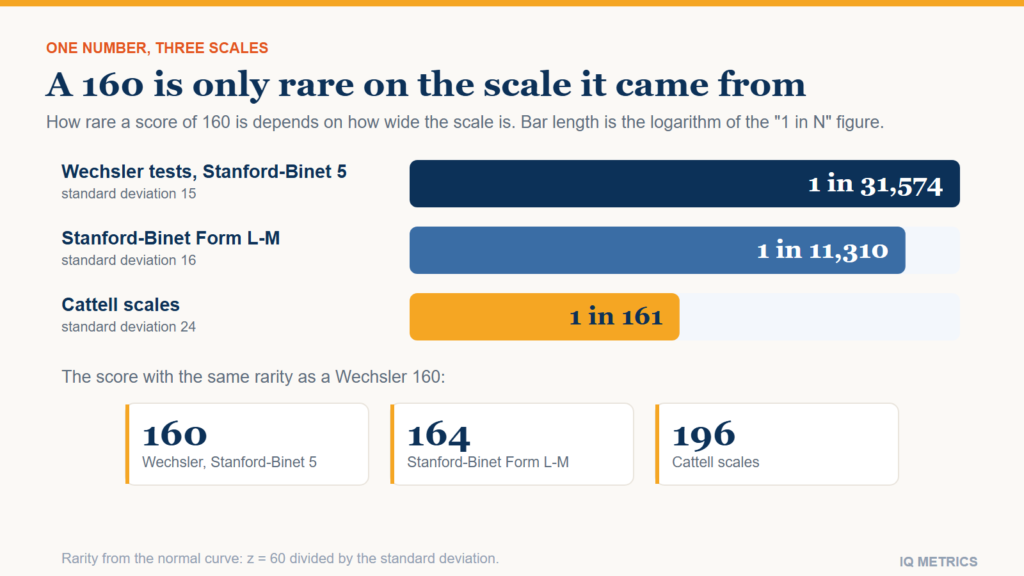
An IQ of 160 is four standard deviations above the mean of 100 on a standard deviation 15 scale, the scale used by the Wechsler tests and the current Stanford–Binet. That is the 99.997th percentile, roughly one person in 31,600. The number is not portable, though: the same 160 on the old Stanford–Binet L-M scale (standard deviation 16) is about 1 in 11,300, and on Cattell’s scale (standard deviation 24) it is only about 1 in 161. This article covers what a 160 means on each scale, which tests can print one, how accurate it is, what scores this high predict, where claims of 160 come from and what to do with one.
- Rarity: about 1 in 31,574 on a standard deviation 15 scale. A stadium of 70,000 randomly chosen people would be expected to hold about two.
- Ceiling: the WAIS-IV and the Stanford–Binet Fifth Edition stop near 160, so a printed 160 usually means “at or above the top of the scale”, not an exact value.
- Accuracy: a reported 160 has an expected true score of about 157 to 159 and a 95% range that runs from the low 150s to about 163.
- Evidence: the best long-term data on people this rare comes from the Study of Mathematically Precocious Youth, which followed the top 1 in 10,000.
How rare is an IQ of 160?
On a normal curve with a mean of 100 and a standard deviation of 15, a score of 160 sits at z = +4.0. About 0.0032% of people score that high or higher, which is 1 in 31,574. Applied to a world population of about 8.2 billion, that implies roughly 260,000 people; fill a 70,000-seat stadium with people chosen at random and the expected count is about two. Two cautions go with those numbers. The bell curve is a model, and real distributions drift from it in the extreme tails (the explainer how rare is a high IQ score? shows how far the model and the data can part). And almost none of those people have ever sat a test that could measure them.
| IQ score | Percentile | About 1 person in |
|---|---|---|
| 130 | 97.72 | 44 |
| 140 | 99.62 | 261 |
| 145 | 99.865 | 741 |
| 150 | 99.957 | 2,331 |
| 155 | 99.988 | 8,139 |
| 160 | 99.997 | 31,574 |
| 165 | 99.9993 | 136,176 |
| 170 | 99.9998 | 653,327 |
To turn any score into a percentile, use the IQ percentile calculator. The IQ bell curve page explains why anything much beyond 145 is extrapolation rather than measurement.
Is an IQ of 160 genius level?
Genius is not a psychometric category. Test manuals label scores of 130 and above “very superior” or “extremely high” and stop there. The word appears in popular tables: Lewis Terman’s 1916 Stanford–Binet scheme labelled 140 and above “near genius or genius”, so 160 clears that bar with 20 points to spare. But work that changes a field depends on creativity, opportunity and years of effort, which is why many very high scorers stay unknown and most famous minds have no test score at all. The numbers attached to Einstein or Hawking are estimates, not results; where celebrity IQ numbers come from walks through the sourcing. For the wider question, see what is a genius IQ level and whether 130 is genius.
What is a 160 IQ on other scales?
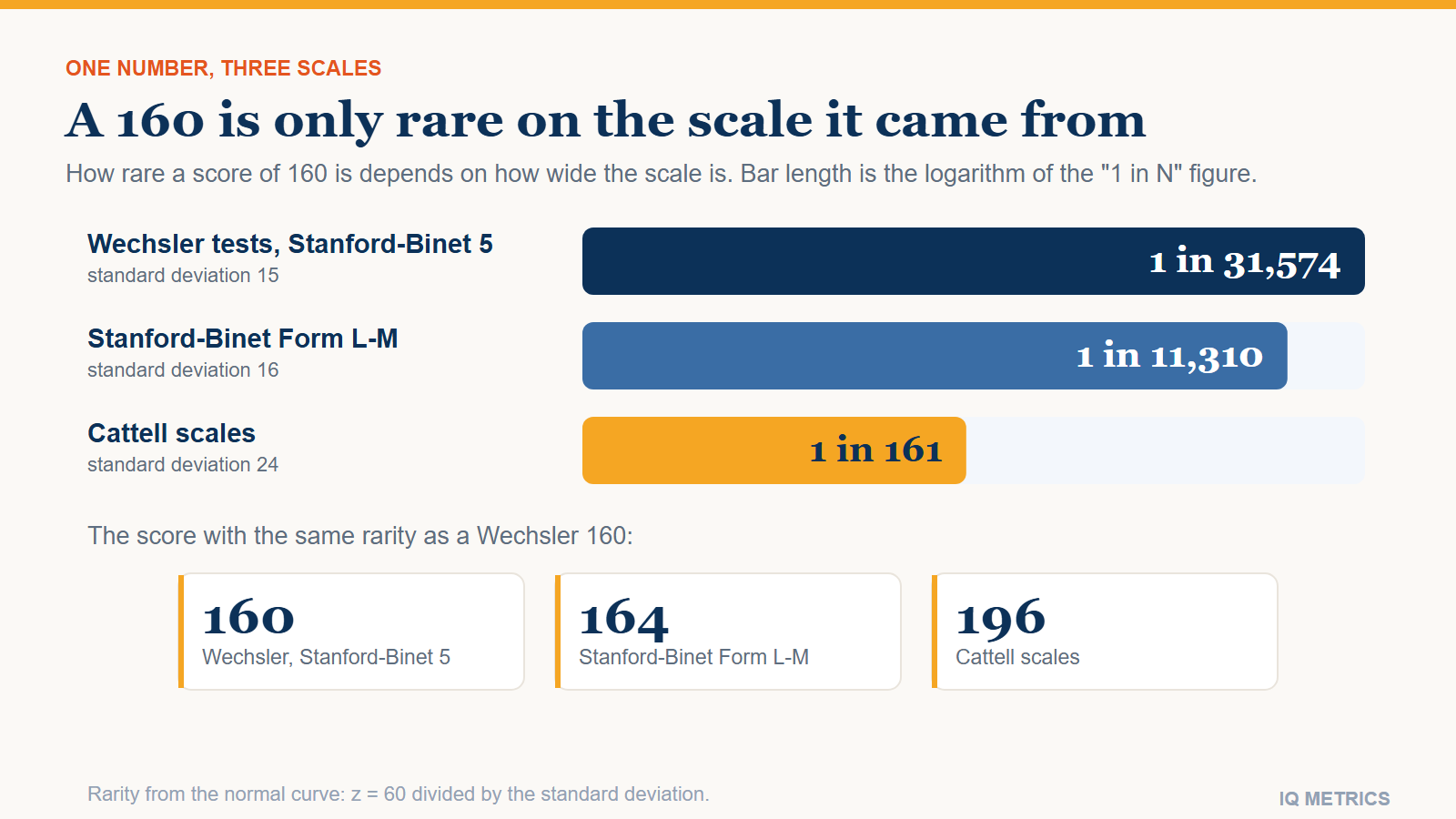
IQ scales differ in spread, and a bare “160” hides which one was used. The Wechsler tests and the current Stanford–Binet use a standard deviation of 15. The older Stanford–Binet Form L-M used 16. Cattell’s scales use 24. A given number of points above 100 is worth fewer standard deviations on a wider scale, so it is far less rare.
| Scale | Standard deviation | A score of 160 is about 1 in | Score with the same rarity as a Wechsler 160 |
|---|---|---|---|
| Wechsler tests, Stanford–Binet 5 | 15 | 31,574 | 160 |
| Stanford–Binet Form L-M | 16 | 11,310 | 164 |
| Cattell scales | 24 | 161 | 196 |
So a Cattell 160 is roughly a 137 on the Wechsler scale, and an L-M 160 is roughly a 156. It is also one reason very large numbers such as 180 or 200 turn up in older and high-range literature: they were quoted on wide scales. The explainer on standard deviation 15 versus 16 covers the mechanics, and the IQ score converter moves a score between scales.
Which tests can report a 160?
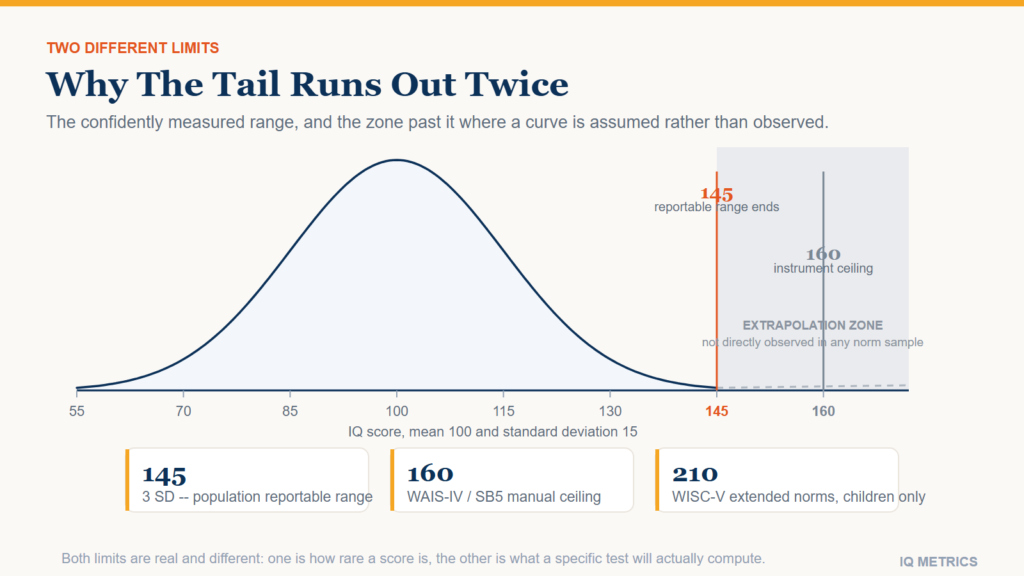
Very few. The two most widely used individually administered tests, the WAIS-IV and the Stanford–Binet Fifth Edition, cap their Full Scale IQ at about 160, and their manuals give no conversion above the hardest items. A report that says 160 therefore often means “at or above the top of what this test can measure”: a floor rather than a point estimate. Beneath the ceiling sits a second problem. Standardisation samples run to a few thousand people, too few to contain anyone this rare, so the top rows of a norms table are extrapolated rather than observed. The IQ ceiling effect and the explainer what is the highest IQ score a test can report? cover both limits in detail.
How accurate is a score of 160?
Every score carries measurement error, and an extreme score is more likely than a typical one to have been helped by chance. Statisticians correct for this with Kelley’s formula: the expected true score is 100 plus the test’s reliability times the distance of the observed score from 100. Assuming ordinary, normally distributed error, an observed 160 works out as follows.
| Test reliability | Expected true score | Likely range (95%) |
|---|---|---|
| 0.90 (a short or unsupervised test) | 154 | 145 to 163 |
| 0.95 (a good group-administered test) | 157 | 151 to 163 |
| 0.98 (a full individually administered battery) | 159 | 155 to 163 |
The pattern is regression to the mean. The person who scores 160 is, on average, a little less exceptional than the score says, and a retest on a different instrument usually lands a little lower. Retaking the same test pushes scores back up through practice (Scharfen, Peters and Holling, 2018). The table is also optimistic, because error grows toward the tails rather than staying constant, and the top of every range sits above the ceiling of most tests. Read a 160 as “somewhere in the top hundredth of a percent”, not as a single value. The regression to the mean page and the margin-of-error explainer show the same arithmetic for other scores.
Where would your own score land?
Take the IIF-certified assessment and get your score with the scale it was measured on, the percentile it corresponds to and the confidence range around it — the three figures most online tests leave out.
Find your IQ score now! →What does an IQ of 160 predict?
The best evidence on people this rare comes from the Study of Mathematically Precocious Youth (SMPY), which has followed young people identified before age 13 as the top 1 in 10,000 in mathematical or verbal reasoning. That rarity matches an IQ of roughly 156 on a standard deviation 15 scale (z = 3.72), close to a 160, although SMPY selected on above-level SAT scores rather than IQ tests. In a 2013 paper in Psychological Science, Kell, Lubinski and Benbow followed 320 of them for nearly three decades and found that by age 38 many held leadership positions in business, health care, law, the professoriate and STEM fields.
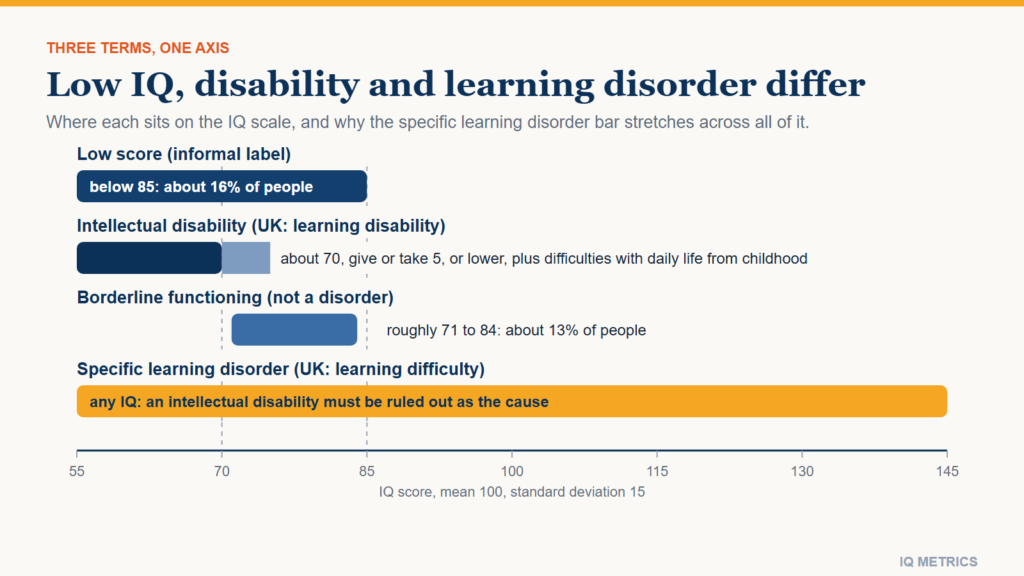
Three things keep that from becoming a promise. It is a group result, not a guarantee for any one person, and interests, opportunity and persistence carry much of the rest. The SMPY team also reports that ability differences inside the top 1% still line up with later accomplishment on average, but individual outcomes vary widely. And across the whole population the link between IQ and income is real but modest, as does IQ predict income? and does IQ predict school success? show. A very high score does not rule out a specific learning disability either; see low IQ versus learning disability.
Where do claims of an IQ of 160 come from?
- High-IQ societies. The Prometheus Society sets its line at 1 in 30,000 (the 99.997th percentile), which is about 160 on a standard deviation 15 scale and 164 on a standard deviation 16 scale. Each society decides which tests it accepts, and self-report does not count; see high-IQ societies.
- Children’s ratio IQs. Under the old formula, mental age divided by chronological age times 100, a 5-year-old who performs like a typical 8-year-old scores exactly 160. The formula stretches badly at the extremes and does not match modern deviation scores; see deviation IQ versus ratio IQ.
- Online tests. A short unsupervised quiz can print any number but cannot certify one this rare. A result above about 145 from that kind of test says more about the scoring formula than about the test-taker.
- Retrospective estimates. Scores attached to historical figures were inferred from biographies, not measured; see the highest IQ ever recorded.
If you have been told you scored 160
- Find the scale. Ask which test it was and whether its spread was 15, 16 or 24. The same number means very different things.
- Check who gave it. An individually administered test from a psychologist carries weight; an unsupervised web quiz does not.
- Read the index scores. A full-scale number can hide an uneven profile; full-scale IQ versus index scores explains how to read them.
- Quote a range or a percentile. “Top 0.01%” is honest; “exactly 160” is not.
- Treat a child’s score as provisional. Scores are less stable in childhood; see what age is most accurate for an IQ test.
To see how a score of your own compares, the IQ Metrics IQ test and the IQ tests hub are the place to start.
Quick answers
- Is 160 IQ good? It is higher than all but about 1 in 31,600 people on a standard deviation 15 scale.
- How many people have an IQ of 160? About 1 in 31,574 if the bell curve holds, which is roughly 260,000 people worldwide.
- Is an IQ of 160 possible? Yes, on paper. On the WAIS-IV and the Stanford–Binet 5 it is the top of the printed scale.
- Is 160 higher than Einstein’s IQ? Einstein never sat a modern IQ test, so there is no verified number to compare with.
- Can an online test give a 160? It can print one, but it cannot certify one.
- Is a Cattell 160 the same as a Wechsler 160? No. The Cattell 160 is about 1 in 161, close to a Wechsler 137.
The bottom line
An IQ of 160 means four standard deviations above average on a standard deviation 15 scale: about 1 in 31,600, the top of the printed scale on the leading tests and beyond what any norm sample can check. It is best read as a range from the high 150s up to the ceiling, tied to its scale and its test, and as a statement about rank rather than worth. The number that travels between tests is the percentile, not the score.
Sources
- Kell, Lubinski and Benbow (2013), Psychological Science: who rises to the top? Early indicators.
- Vanderbilt University: Study of Mathematically Precocious Youth, publications.
- Scharfen, Peters and Holling (2018), Intelligence: retest effects in cognitive ability tests.
- Terman (1916), The Measurement of Intelligence: the classification table that set the near-genius line at 140.
Keep reading
All articles →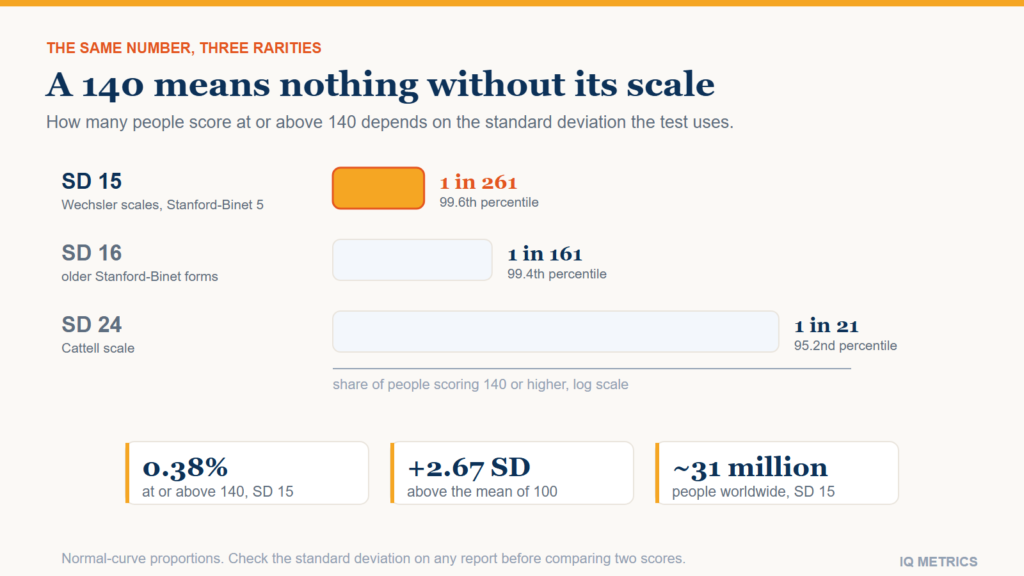 Scores & Scales
What an IQ of 140 Means
An IQ of 140 sits 2.67 standard deviations above the mean, at about the 99.6th percentile: roughly one person in 261 scores that high. It clears the gifted line and most high-IQ society cutoffs, but no current test manual calls it genius, and a single 140 is far less exact than the number suggests.
 Scores & Scales
IQ Score Ceiling Effects
Two different numbers get used as "the top of the scale," 145 and 160, and they come from two different kinds of limit. One is a statement about population statistics; the other is about what a specific test manual will actually compute.
 Understanding IQ
Low IQ vs Learning Disability
A low IQ, an intellectual disability and a specific learning disability are three different things, and the UK uses "learning disability" for the second. What each requires, how each is assessed, the US and UK terms, and what to do if you are worried.