





Are Rabbits Smart? What Studies Show, and How a Rabbit Brain Compares
Are rabbits smart? Yes, at learning signals and food cues, but no rabbit IQ exists. A rabbit brain holds about 494 million neurons, 41% of a cat's and 9% more than a squirrel's. Each study, with journal and year, and how rabbit brains compare with squirrels, cats and dogs.

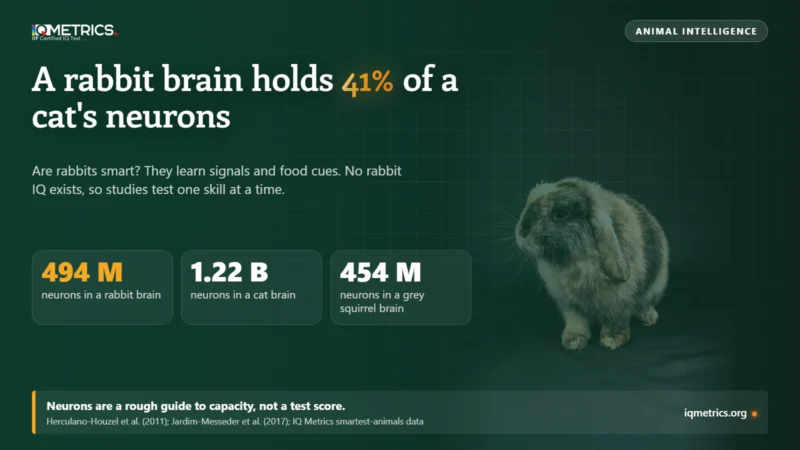
Are rabbits smart? Yes, at what a rabbit’s life needs, but no one has measured a rabbit IQ. Studies show that rabbits learn that a signal predicts a puff of air, that pups learn their mother’s diet before they leave the nest, and that older rabbits learn more slowly. A rabbit brain holds about 494 million neurons, 41% of a cat’s.
Below: what each study found, with the journal and year, how a rabbit’s brain compares with a squirrel’s, a cat’s and a dog’s, and why “are rabbits smarter than cats” has no tested answer. The finding most pages miss: a rabbit brain is 65% heavier than a squirrel’s, yet it holds about 8% fewer neurons in the cortex.
Key takeaways
- There is no rabbit IQ. IQ compares a person with a norm group of people, and no such norm group or test exists for rabbits.
- Learning: rabbits learned and then unlearned a blink to a signal in a 1962 Science study, and labs used the method for decades to study memory and ageing.
- Ageing: in rabbits aged 2 to 41 months, learning problems were significant by 24 months and differed a lot from rabbit to rabbit (Neurobiology of Aging, 1996).
- Diet: pups preferred the food their mother ate, and the womb, her droppings in the nest and nursing worked equally well (Physiology and Behavior, 1994).
- Brain: about 494 million neurons in the whole brain, 41% of a cat’s 1.22 billion and 9% more than a grey squirrel’s 454 million.
Do rabbits have an IQ?
No. IQ is a score that compares one person with a large sample of people of the same age, and nothing like that exists for rabbits.
So any “rabbit IQ” you see online is a joke or a guess. The honest question is how smart a rabbit is at specific skills, and scientists test those one at a time. Our ranking of the smartest animals by neuron count and test scores follows the same rule: every number has a published source, and no species gets an invented IQ.
How do scientists test how smart a rabbit is?
They mostly test learning and memory, and the rabbit’s eyeblink is the classic tool. A rabbit hears a tone, then gets a puff of air at the eye, and soon blinks at the tone alone.
In 1962 Gormezano, Schneiderman, Deaux and Fuentes reported classical conditioning and extinction of the third-eyelid response in the albino rabbit (Science). The animal learned the link, and then lost it again when the puff stopped coming. Labs kept using the method for decades.
A 1996 study by Thompson, Moyer and Disterhoft used it to ask how learning changes with age. Rabbits from 2 to 41 months old were trained on a hard version of the task, and the aim was 80% blinks to the tone. Age-related problems were significant by 24 months, and the title stresses that learning ability differed both between and within age groups. Even severely impaired 36-month-old rabbits reached 80% when the task was switched to an easier version.
| Study | What the rabbits did | Skill it samples |
|---|---|---|
| Gormezano and colleagues, Science, 1962 | Learned a blink to a tone, then unlearned it | Simple associative learning |
| Thompson, Moyer and Disterhoft, 1996 | Rabbits aged 2 to 41 months trained to 80% blinks; problems significant by 24 months | Learning that depends on the hippocampus |
| Bilkó, Altbäcker and Hudson, 1994 | Pups preferred their mother’s diet at weaning | Odour and social learning |
Do baby rabbits learn from their mothers?
Yes, they learn what their mother eats, and they start before birth. Pups raised by mothers on different diets showed a clear preference for their mother’s diet at weaning, according to Bilkó, Altbäcker and Hudson (Physiology and Behavior, 1994).
The team added juniper berries to some mothers’ food and then tested three routes: her droppings in the nest, experience in the womb, and contact during nursing. All three were equally effective. A 1995 paper by Semke, Distel and Hudson in Naturwissenschaften reports a rise in nose-receptor sensitivity linked to foetal learning of food odours. We read that paper’s title and citation, not the full text.
This is odour learning, a skill a prey animal needs. It is not reasoning, and it says little about how a rabbit would do on a problem it has never seen.
How does a rabbit brain compare with a squirrel, cat and dog?
A rabbit has about 494 million neurons in the whole brain. That is 9% more than a grey squirrel and 41% of a cat, from the published counts in our smartest-animals data table.
| Animal | Brain mass (g) | Neurons, whole brain | Neurons, cortex |
|---|---|---|---|
| Rabbit | 9.1 | about 494 million | about 71 million |
| Grey squirrel | 5.5 | about 454 million | about 77 million |
| Cat | 34.9 | about 1.22 billion | about 250 million |
| Pig | 57.8 | about 2.22 billion | about 293 million |
| Dog | 86.5 | about 2.25 billion | about 528 million |
The rabbit and squirrel counts come from Herculano-Houzel and colleagues (Brain, Behavior and Evolution, 2011). The cat and dog counts are from Jardim-Messeder and colleagues (2017) and the pig count from Kazu and colleagues (2014).
Look at the first two rows. The rabbit’s brain weighs 9.1 g against the squirrel’s 5.5 g, which is 65% heavier. Yet the rabbit has about 71 million cortex neurons and the squirrel about 77 million, roughly 8% fewer. Weight overstates what a brain can do. Neurons are a better guide to processing capacity, but still not a test score. Our post on brain size and IQ covers why.
Are rabbits smarter than cats?
Nobody has tested that, so nobody can say. A cat has about 2.5 times the neurons of a rabbit, but the two animals hunt and hide in different ways and use different senses.
A dog has about 4.6 times the neurons of a rabbit. For the animals that do have named tests, see our guides to dog IQ, cat IQ, pig IQ and cow IQ. Two smaller animals are covered in are squirrels smart and are chickens smart.
Where would your own score land?
Take the IIF-certified assessment and get your score with the scale it was measured on, the percentile it corresponds to and the confidence range around it — the three figures most online tests leave out.
Find your IQ score now! →What about pet rabbits, litter boxes and names?
Those skills are plausible, but we found no published study that measures them. Owners report that rabbits use a litter box, come when called and learn tricks.
The lab work makes this believable, because rabbits clearly link a signal to a result. Still, a report from an owner is an anecdote, not a measurement. So we give these skills no number, and we would not call a rabbit smarter or less smart than a dog on that basis.
So, are rabbits smart?
Smart enough to learn quickly from signals and from its mother, with a mid-sized brain for a small mammal. That is as far as the published evidence goes.
If you want a number for yourself, take the IQ test. It is built and normed for people.
Quick answers
- Are rabbits smart? Yes, at learning signals and food cues. No rabbit IQ exists.
- How smart is a rabbit? It learns a blink to a tone and its mother’s diet, but no study ranks it against a dog.
- What is a rabbit’s IQ? There is no score. IQ compares people with a norm group of people.
- Are rabbits smarter than cats? Untested. A cat has about 2.5 times the neurons, but neurons are not a test score.
- Do rabbits have good memory? They learn associations well enough to be a standard lab animal for memory studies.
The bottom line
Rabbits are smart in the ways that matter for a small prey animal: they learn signals, follow food cues from their mother and keep what they learn. That is measured one skill at a time. There is no rabbit IQ, and no study that ranks a rabbit against a cat or a dog.
Sources
- Gormezano I, Schneiderman N, Deaux E, Fuentes I (1962). Nictitating membrane: classical conditioning and extinction in the albino rabbit. Science 138(3536), 33-34.
- Thompson LT, Moyer JR, Disterhoft JF (1996). Trace eyeblink conditioning in rabbits demonstrates heterogeneity of learning ability both between and within age groups. Neurobiology of Aging.
- Bilkó A, Altbäcker V, Hudson R (1994). Transmission of food preference in the rabbit: the means of information transfer. Physiology and Behavior 56(5), 907-912.
- Semke E, Distel H, Hudson R (1995). Specific enhancement of olfactory receptor sensitivity associated with foetal learning of food odors in the rabbit. Naturwissenschaften 82(3), 148-149.
- Herculano-Houzel S, Ribeiro P, Campos L, et al. (2011). Updated neuronal scaling rules for the brains of Glires (rodents/lagomorphs). Brain, Behavior and Evolution 78(4), 302-314.
- Cat and dog neuron counts: Jardim-Messeder et al. (2017); pig: Kazu et al. (2014). Both are in the data table of our smartest animals study, built from 14 published papers.
Keep reading
All articles →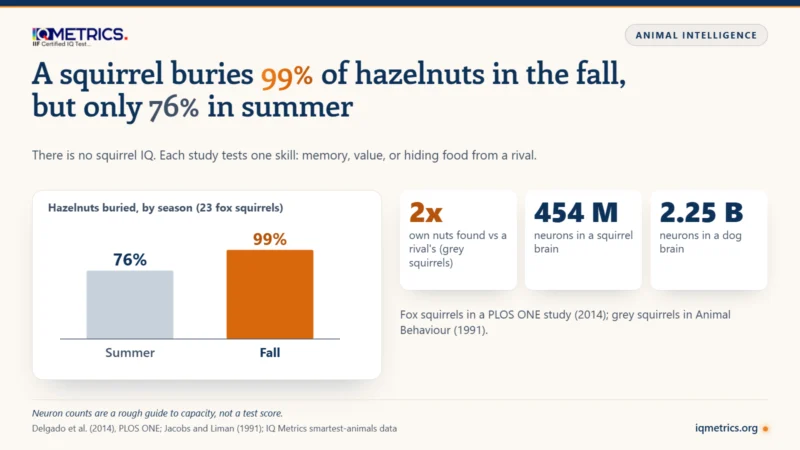 Mind & Everyday Life
Are Squirrels Smart?
Are squirrels smart? Yes, for rodents: grey squirrels recover their own buried nuts at about twice the rate of a rival's, and fox squirrels bury 99% of hazelnuts in the fall but 76% in summer. There is no squirrel IQ. Each study, with journal, year and number of animals.
 Understanding IQ
Cat IQ
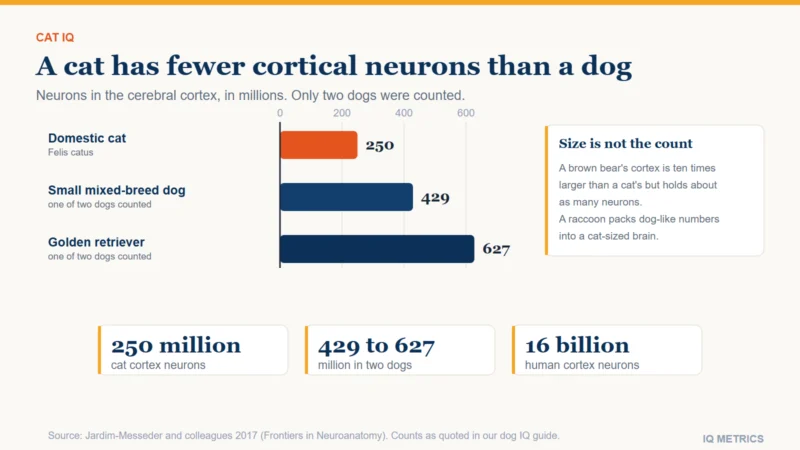
Cats have no IQ: no validated test gives one. Studies measure narrower skills. Cats tell their own names from other words and follow a pointing finger as well as dogs do, but struggle with hidden-object puzzles, and a cat's cortex holds about 250 million neurons against 429 to 627 million in the dogs counted.
 Understanding IQ
Dog IQ
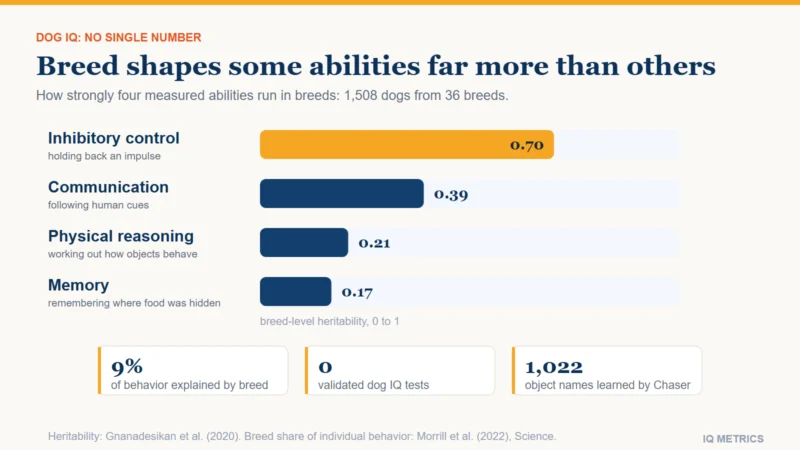
Dogs have no IQ score: no validated test gives one. See dog IQ compared with humans, what researchers measure instead (words, memory, self-control, a gifted border collie that learned 1,022 names), how breeds differ, and how a dog cortex compares with a cat, a pig and a person.