





Deductive Reasoning Test: 6 Original Questions With Answers and How It Is Scored
A deductive reasoning test asks what must follow from the statements you are given. Try six original questions with answers, see the same premises give a valid and an invalid conclusion, and learn why guessing alone gets 4 of 6 right about 1 time in 10.

A deductive reasoning test gives you a few statements and asks whether a conclusion must follow from them. You answer true, false or cannot say, using only the statements and never what you know about the world. Below are six original questions with answers, the rule for each and the wrong answer that catches people.
New here: we checked every answer by trying every possible case, so each answer below is proved, not assumed. The same two premises are shown with one valid and one invalid conclusion, side by side. And blind guessing gets 4 or more of six three-way questions right about 1 time in 10, so a score of 4 out of 6 proves little.
Key takeaways
- A deductive reasoning test asks what must follow from the statements you are given. The answer is true, false or cannot say.
- A conclusion is valid only if it holds in every case where the statements are true. One counter-case makes it invalid.
- The two traps behind most wrong answers: reading “if P then Q” backwards, and assuming from “some”.
- Guessing three-way questions gets 4 or more of 6 right 10.0% of the time, and 5 or more 1.8% of the time.
- It is not an IQ test. Many tests turn the raw score into a percentile against a norm group, not an IQ.
What is a deductive reasoning test?
A deductive reasoning test checks whether you can tell what must be true when some statements are true. The American Psychological Association’s dictionary describes deductive reasoning as reasoning in which a conclusion follows necessarily from the premises, and inductive reasoning as drawing general principles from specific cases.
That makes it a test of logic, not of knowledge. The statements can be about librarians, trams or parcels, and you need no school facts. Our report on syllogism questions on IQ tests names the tests where this kind of item turns up, and our aptitude test guide shows where it sits among the other test families.
A deductive reasoning skills test does not report an IQ. Your result is a raw count, often turned into a percentile against a group. For the same item type with practice questions, try our logical reasoning test.
What do deductive reasoning test questions look like? Six original examples
Here is a deductive reasoning test with answers: six questions in all. Try each before you read the answer. These deductive reasoning test examples were written for this page, and none is copied from any exam or practice site. For each one, pick True, False or Cannot say, using only the statements. Questions 1 to 3 are syllogism test examples, 4 and 5 use if-then statements, and 6 is an ordering item.
Question 1: a chain of "all" statements
All the librarians in this branch can use the archive. Everyone who can use the archive has a key card. Maya is a librarian in this branch. Statement: Maya has a key card.
Answer: True. The rule: a chain of “all” statements passes a property along, so Maya inherits both. The trap: Cannot say, because the premises never say “Maya has a key card” in so many words.
Question 2: a "some" statement
All the trams on line 7 are electric. Some electric vehicles in the city are late today. Statement: Some trams on line 7 are late today.
Answer: Cannot say. The rule: “some” says something about part of a group, not which part. The late electric vehicles could all be buses. The trap: True, because the two sentences share the word “electric” and sound linked.
Question 3: a "none" statement
None of the volunteers is under 18. Priya is a volunteer. Statement: Priya is under 18.
Answer: False. The rule: “none” closes a door for the whole group, and Priya is in the group. The trap: Cannot say, because her age is never given. The rule gives it.
Question 4: an "if-then" statement read backwards
If a parcel is signed for, the courier marks it as delivered. The courier marked Tom’s parcel as delivered. Statement: Tom’s parcel was signed for.
Answer: Cannot say. The rule: “if P then Q” runs one way. Signing leads to “delivered”, but “delivered” can have other causes, such as a parcel left in a safe place. The trap: True. This is called affirming the consequent.
Question 5: an "if-then" statement with the result missing
If the alarm is armed, the green light is on. The green light is off. Statement: The alarm is not armed.
Answer: True. The rule: if the result is missing, the cause is missing, because an armed alarm would have lit the light. The trap: Cannot say, because the bulb might be broken. Nothing in the statements says so.
Question 6: putting people in order
Eli finished before Ben. Ben finished before Cora. Dev finished after Cora. Statement: Dev finished before Ben.
Answer: False. The rule: line the names up in one row, Eli, Ben, Cora, Dev. Dev is last, so he finished after Ben. The trap: Cannot say, because Dev and Ben are never compared directly. The chain through Cora does it.
We proved all six by trying every possible case. In Questions 1, 3, 5 and 6 the conclusion holds, or fails, in every case that fits the statements. In Questions 2 and 4 both outcomes fit, so only “cannot say” is correct.
How do you tell a valid conclusion from an invalid one?
A conclusion is valid if it is true in every case where the premises are true. To show it is invalid, find one case where the premises hold and the conclusion fails. The psychologist Philip Johnson-Laird (PNAS, 2010) writes that our ability to use counterexamples to refute invalid inferences is a foundation for rationality.
Here are the same two premises with two different conclusions. Premises: All the gadgets in the lab are calibrated. Some gadgets in the lab are old.
- Valid: “Some calibrated things are old.” The old lab gadgets are calibrated, so at least those are calibrated and old.
- Invalid: “All old things are calibrated.” An old gadget kept outside the lab fits the premises and is not calibrated. One such case is enough.
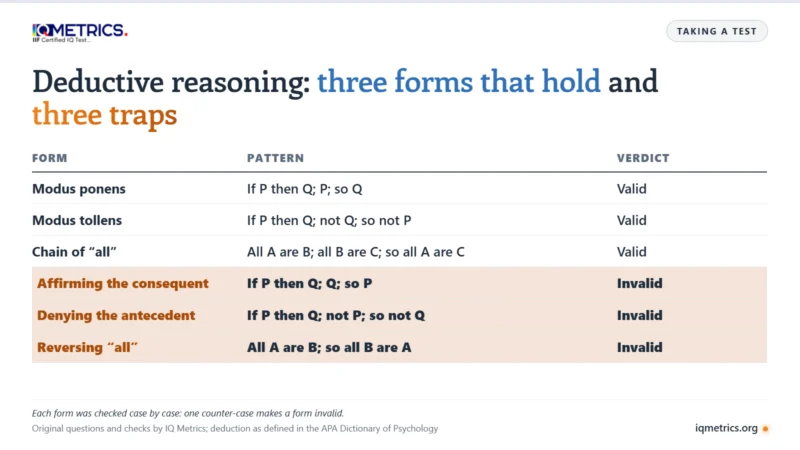
| Form | Pattern | Verdict |
|---|---|---|
| Chain of “all” | All A are B; all B are C; so all A are C | Valid |
| Modus ponens | If P then Q; P; so Q | Valid |
| Modus tollens | If P then Q; not Q; so not P | Valid |
| Either-or | P or Q; not P; so Q | Valid |
| Affirming the consequent | If P then Q; Q; so P | Invalid |
| Denying the antecedent | If P then Q; not P; so not Q | Invalid |
| Reversing “all” | All A are B; so all B are A | Invalid |
| Two “some” premises | Some A are B; some B are C; so some A are C | Invalid |
How is a deductive reasoning test scored?
Many tests give one point for each correct answer and compare your total with a norm group, then report a percentile. Check the test’s own instructions for the time limit and for whether a wrong answer costs a mark.
The three-way format matters. With True, False and Cannot say, a blind guess is right 1 time in 3, so guessing gets 2 of 6 right on average. The table shows how often guessing alone reaches a higher score on six questions.
| Score of at least | Chance by guessing | About 1 in |
|---|---|---|
| 3 of 6 | 32.0% | 3 |
| 4 of 6 | 10.0% | 10 |
| 5 of 6 | 1.8% | 56 |
| 6 of 6 | 0.14% | 729 |
So 4 out of 6 is within reach of luck, and 6 out of 6 is not. If a provider reports an IQ-style score, the same percentiles map onto the IQ scale, as our page on what an IQ of 121 means shows. Our percentile calculator does the sum for any score.
Where would your own score land?
Take the IIF-certified assessment and get your score with the scale it was measured on, the percentile it corresponds to and the confidence range around it — the three figures most online tests leave out.
Find your IQ score now! →Deductive vs inductive reasoning test: what is the difference?
In a deductive vs inductive reasoning test, the first asks what must be true and the second asks what is probably true, or what rule a set of examples follows. Abstract reasoning is the pictorial form of the second.
| Test | What you are given | What you do | Our page |
|---|---|---|---|
| Deductive | Statements in words | Decide what must follow | Logical reasoning |
| Inductive or abstract | Shapes, patterns or sequences | Find the rule and extend it | Abstract reasoning |
| Verbal | A passage of text | Judge claims against the passage | Verbal reasoning |
| Numerical | Tables and figures | Work out a value | Numerical reasoning |
| Critical thinking | Arguments and evidence | Weigh how strong they are | Critical thinking |
None of these is an IQ test on its own. For a nonverbal test that mixes several of these skills, see our culture-fair IQ test.
How do you get better at deductive reasoning?
Practise judging the form of the argument, not its topic. The two traps in this article, reading “if P then Q” backwards and assuming from “some”, account for most wrong answers.
- Mark the words: circle all, none, some, if and not before you read on.
- Try to break the conclusion: look for one case where the statements hold and the conclusion fails. If you find one, the answer is Cannot say.
- Use only the statements: do not add facts, such as a broken bulb or a parcel in a safe place.
- Swap the nouns: replace the real words with A, B and C. The form is the same, and your beliefs stop interfering.
That last step is the one our syllogism report recommends, because people tend to accept a conclusion that sounds true. Practise on logical fallacies as well, and take the IQ test to see how a timed reasoning score reads.
Quick answers
- What is a deductive reasoning test? A test of what must follow from given statements. You answer true, false or cannot say.
- Is a deductive reasoning test an IQ test? No. It reports a count or a percentile, not an IQ, unless a provider converts it.
- Deductive vs inductive? Deductive asks what must be true. Inductive asks what is probably true or what rule fits.
- How is a deductive reasoning test scored? Often one point per correct answer, compared with a norm group. Guessing gets 4 or more of 6 right 10.0% of the time.
- What are the two traps? Reading “if P then Q” backwards, and assuming from “some”.
Sources
- American Psychological Association. Deductive reasoning and Inductive reasoning, APA Dictionary of Psychology (pages read on 21 November 2026).
- Johnson-Laird, P. N. Mental models and human reasoning. Proceedings of the National Academy of Sciences, 2010 (abstract read on 21 November 2026).
- All six questions, the premises pair and the form table are original. Every answer and verdict was checked by trying every possible case in code; the guessing odds are binomial arithmetic.
- Our own pages: syllogism questions on IQ tests, logical reasoning test and abstract reasoning test.
Keep reading
All articles →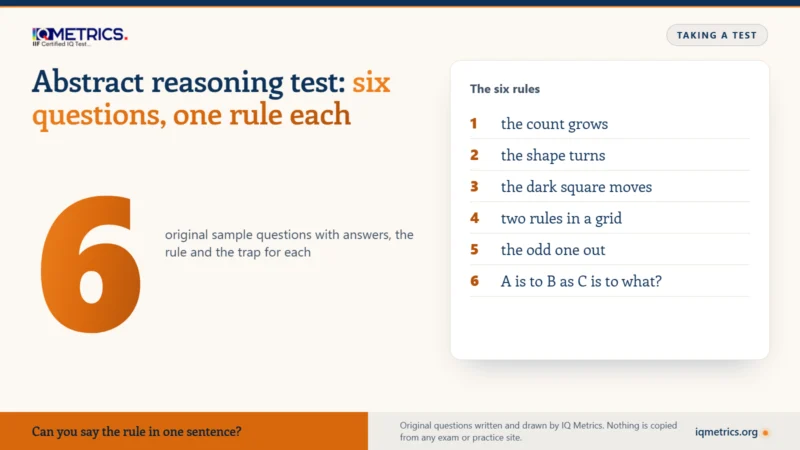 Taking a Test
Abstract Reasoning Test: 6 Sample Questions
An abstract reasoning test asks you to find the rule in a sequence, grid or set of shapes. See six original sample questions with answers, the rule and the wrong-answer trap for each, how scores are reported as percentiles, and how abstract reasoning differs from logical, verbal and fluid reasoning.
 Taking a Test
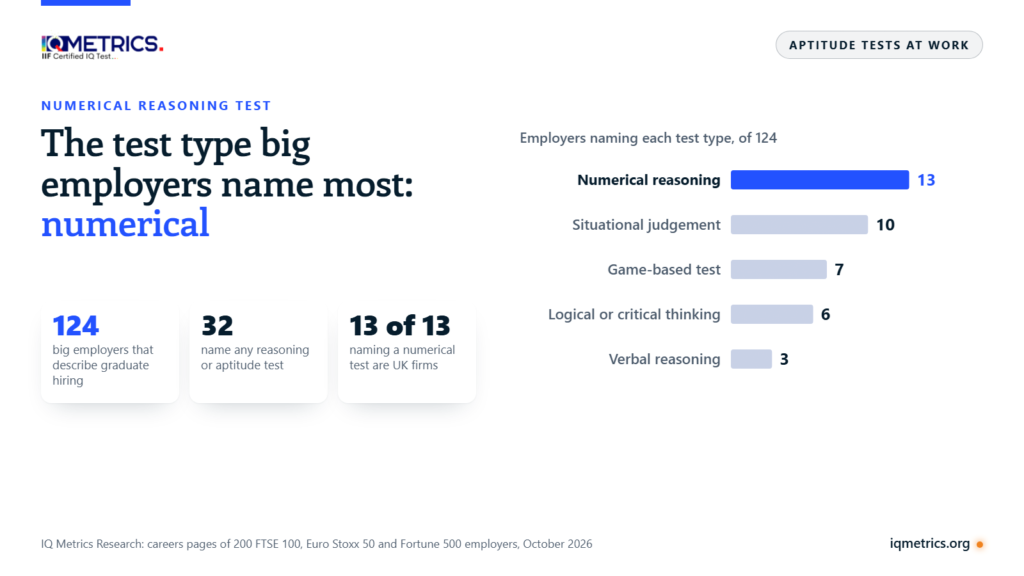
Numerical Reasoning Test
A numerical reasoning test asks you to read tables and charts against the clock. Five worked example questions with answers, the mistakes that cost the most points, what a good score means, and the 13 big employers in our study of 124 that name a numerical test.
 Taking a Test
What Are The Type of Questions Asked On IQ Test?
IQ tests ask a small set of question types: pattern and matrix reasoning, verbal reasoning, number series, spatial puzzles, working memory and speed tasks. See what each looks like, how many questions a test has and which tests are multiple choice.