





Abstract Reasoning Test: 6 Sample Questions With Answers, How It Is Scored and What It Measures
An abstract reasoning test asks you to find the rule in a sequence, grid or set of shapes. See six original sample questions with answers, the rule and the wrong-answer trap for each, how scores are reported as percentiles, and how abstract reasoning differs from logical, verbal and fluid reasoning.

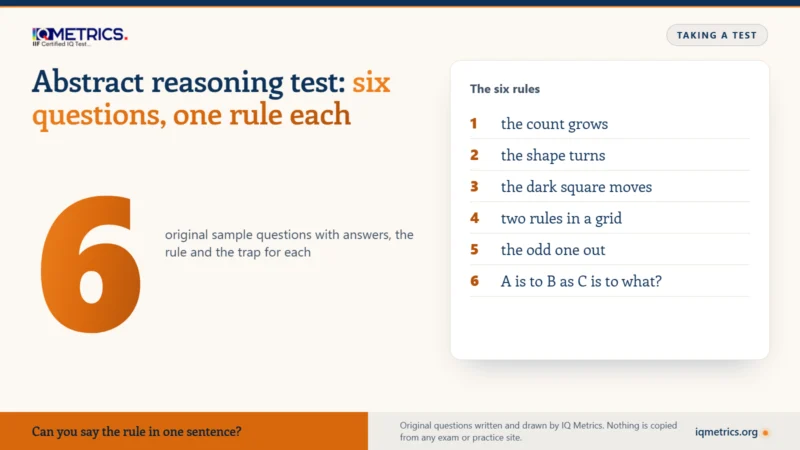
An abstract reasoning test shows shapes, patterns or sequences and asks which option completes the rule. It needs no words, numbers or school facts, only the rule hidden in the picture. Below are six original sample questions with answers, the rule and the trap for each. You also get how scores are reported and how abstract reasoning differs from logical, verbal and fluid reasoning.
New here: every question can be solved by saying its rule in one sentence, and each wrong option is a trap, such as repeating the last box or flipping when it should turn. The questions are original, written and drawn for this page, and they cover the six simplest rule families, a starting point and not a full syllabus. Below: the six questions, the scoring, and what the test does and does not measure.
Key takeaways
- An abstract reasoning test asks you to find the rule in a sequence, grid or set of shapes. No reading, maths or school knowledge is needed.
- Every question below has one rule you can say in one sentence, and each wrong option is explained.
- Scores are usually a count of correct answers turned into a percentile against a norm group. A good score is a high percentile for the group that sets the bar.
- Abstract reasoning is not an IQ. Our pages on Raven’s matrices and the DAT say a raw count or a percentile is not an IQ score.
- Practice improves you at this kind of question. That is a real but narrow gain.
What is an abstract reasoning test and who uses it?
What is an abstract reasoning test? It is a test of rules in shapes and patterns. You see a sequence, a grid or a set of figures and pick the option that fits the rule. Schools, apprenticeship schemes and employers use it, and so do IQ tests built on matrices.
Abstract reasoning is a named subtest in the Differential Aptitude Test. Our report on the Differential Aptitude Test says the classic battery has eight subtests, including abstract reasoning, and that DAT Next Generation lists five, with abstract reasoning described as seeing sequences in shapes and patterns. For the wider picture of which employers use such tests, see our research on which employers use aptitude tests and our aptitude test guide.
What do abstract reasoning questions look like? Six original examples
Here are six abstract reasoning questions and answers. Try each before you read the answer. These abstract reasoning test examples were written for this page, and none is copied from any exam or practice site.
Question 1: the count grows
Which box comes next in the sequence?
Answer: C. One more circle is added each step, in reading order. So the fourth box has four circles.
The traps:
- Option A: repeats the last box (three circles).
- Option B: gets the count right but changes the shape.
- Option D: skips a step (five instead of four).
Question 2: the shape turns
Which arrow comes next? Look at the small flag as well as the direction.
Answer: A. The arrow turns a quarter turn clockwise each step: up, right, down, left. So the fourth box points left, with the flag on top.
The traps:
- Option B: goes back to the start too early.
- Option C: points the right way but is a flipped copy, not a turn (see the flag).
- Option D: repeats the last box.
Question 3: the dark square moves
Where does the dark square go in the fourth box?
Answer: D. The dark square steps clockwise one corner at a time: top left, top right, bottom right, bottom left. So the dark square lands in the bottom left corner.
The traps:
- Option A: repeats the second box.
- Option B: repeats the last box (nothing moves).
- Option C: restarts the cycle one step early.
Question 4: two rules in a grid
Which option completes the grid?
Answer: B. Two rules at once: the shape is the same along a row (circles, squares, triangles from top to bottom) and the count grows along the row (one, two, three). So the missing box is three triangles.
The traps:
- Option A: right count, but it is the shape of the row above.
- Option C: right shape, but it copies the box to its left instead of adding one.
- Option D: right count, but it is the shape at the top of the column.
Question 5: the odd one out
Which shape does not belong with the others?
Answer: C. In every shape except one, the number of dots equals the number of sides. So the octagon, which has eight sides and only six dots, is the odd one out.
The traps:
- Option A: the square fits the rule: four dots, four sides.
- Option B: the hexagon also has six dots, so counting dots alone sends you to it, but it has six sides and fits.
- Option E: the pentagon fits the rule: five dots, five sides.
Question 6: A is to B as C is to what?
Which option is to the third box what the second box is to the first?
Answer: A. The second box is the first flipped left to right, so the answer is the third box flipped left to right. So the answer is the third box flipped left to right.
The traps:
- Option B: flips top to bottom, the wrong mirror line.
- Option C: turns the box upside down, which is a flip in both directions.
- Option D: leaves it unchanged.
Say the rule out loud before you look at the options, as our page on a matrix puzzle with one rule advises. The options are built to be plausible, and each trap above is a wrong rule that fits part of the picture.
How is an abstract reasoning test scored and what counts as a good score?
Most tests count your correct answers and compare that raw score with a norm group, then report a percentile. A good score is a high percentile for the group that sets the bar, not a fixed number of correct answers. We found no public pass mark for any provider, so we give none.
Our page on Raven’s Progressive Matrices scores shows the same chain. The Standard form returns a raw count out of 60, and the meaning comes from a norm table of percentile grades by age, with Grade I at or above the 95th percentile. Time limits and rules on guessing differ by test, so read the instructions first.
The table below is an invented example to show the sum, not a real test: a 40-question test where the group’s mean is 24 correct and one standard deviation (SD) is 6. A score is turned into a z-score, which is how many SDs it sits from the mean, and then into a percentile.
| Correct answers | z-score | Percentile | Same standing on the IQ scale (SD 15) |
|---|---|---|---|
| 18 of 40 | -1.0 | 15.9th | 85 |
| 24 of 40 | +0.0 | 50.0th | 100 |
| 30 of 40 | +1.0 | 84.1st | 115 |
| 36 of 40 | +2.0 | 97.7th | 130 |
If a provider reports an IQ-style score, the same percentiles map onto the IQ scale: the 84.1st percentile is 115 and the 97.7th is 130. Our IQ percentile calculator does the sum for any score, and what an IQ of 123 means shows one worked case.
Where would your own score land?
Take the IIF-certified assessment and get your score with the scale it was measured on, the percentile it corresponds to and the confidence range around it — the three figures most online tests leave out.
Find your IQ score now! →Is abstract reasoning the same as fluid, logical or verbal reasoning?
Not the same, but close to the first. Abstract reasoning is finding a rule in new patterns, which is close to what psychologists call fluid reasoning. Our guide to fluid and crystallized intelligence explains the difference from learned knowledge.
Abstract vs logical reasoning is a question of what you are given. Abstract reasoning gives you pictures and asks for the rule. Logical reasoning gives you the rule in words and asks what follows.
| Test | What you are given | What you do | Our page |
|---|---|---|---|
| Abstract reasoning | Shapes, grids, sequences | Find the rule and extend it | This page and our culture-fair test |
| Logical reasoning | Statements in words | Work out what must follow | Logical reasoning test |
| Verbal reasoning | Passages and word relations | Judge meaning and arguments | Verbal reasoning test |
| Numerical reasoning | Tables, charts, figures | Calculate and compare | Numerical reasoning test |
| Spatial reasoning | Shapes in space | Rotate and fold in your head | Spatial reasoning |
None of these is an IQ test. Our DAT report says no DAT report it read gives an IQ score, and a DAT percentile is a rank within a norm group. Our Raven’s page says the same of a raw count.
How do I practise for an abstract reasoning test?
Practise the rule, not the answer key. For abstract reasoning test practice, say the rule out loud before you look at the options, then check each option against the rule. Work through the six families above: count, turn, move, grid, odd one out and mirror. Time yourself only once you can do them untimed.
Practice helps with this kind of question. Our matrix-puzzle page calls the gain real and narrow, and not the same as a change in general reasoning. For a 30-question nonverbal test, try our culture-fair IQ test. For a 30-question test with a 20-minute limit, try our logical reasoning test. To see where your own result falls, take the IQ test.
Quick answers
- What is an abstract reasoning test? A test of rules in shapes and patterns: you find the rule in a sequence, grid or set of figures and pick the option that fits.
- Are there abstract reasoning questions and answers I can try? Yes, six original ones above, each with the rule and the trap.
- How is it scored? Usually a count of correct answers, turned into a percentile against a norm group.
- Is abstract reasoning the same as logical reasoning? No. Abstract reasoning finds the rule in pictures. Logical reasoning works from rules stated in words.
- Is an abstract reasoning test an IQ test? No. It gives a raw count or a percentile, not an IQ score.
Sources
- Our own pages, read on 20 November 2026: Differential Aptitude Test, Raven’s Progressive Matrices scores and a matrix puzzle with one rule.
- The six sample questions are original and were written and drawn for this page. No question is copied from any exam, publisher or practice site.
- The scoring table is an invented example. Percentiles and IQ-scale equivalents in it are normal-curve arithmetic by IQ Metrics.
Keep reading
All articles →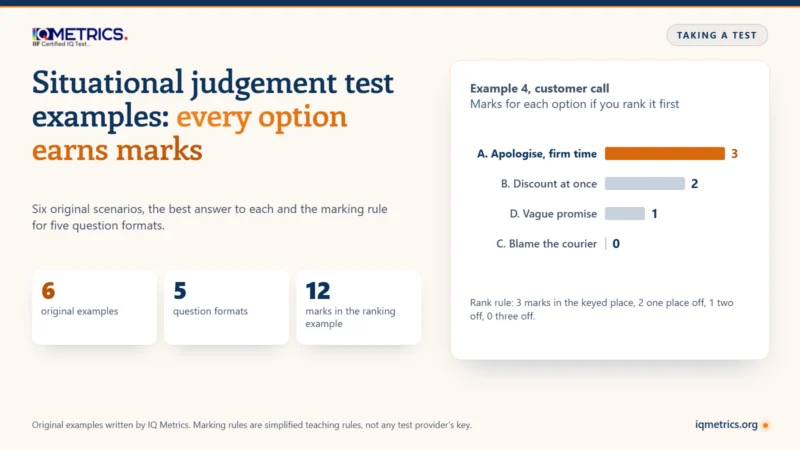 Taking a Test
Situational Judgement Test Examples
Six original situational judgement test examples, each with the best answer and the marks every option earns under five question formats, including worked scores. See how SJTs are scored, why they are not IQ tests, and which of our practice tests matches each employer test.
 Taking a Test
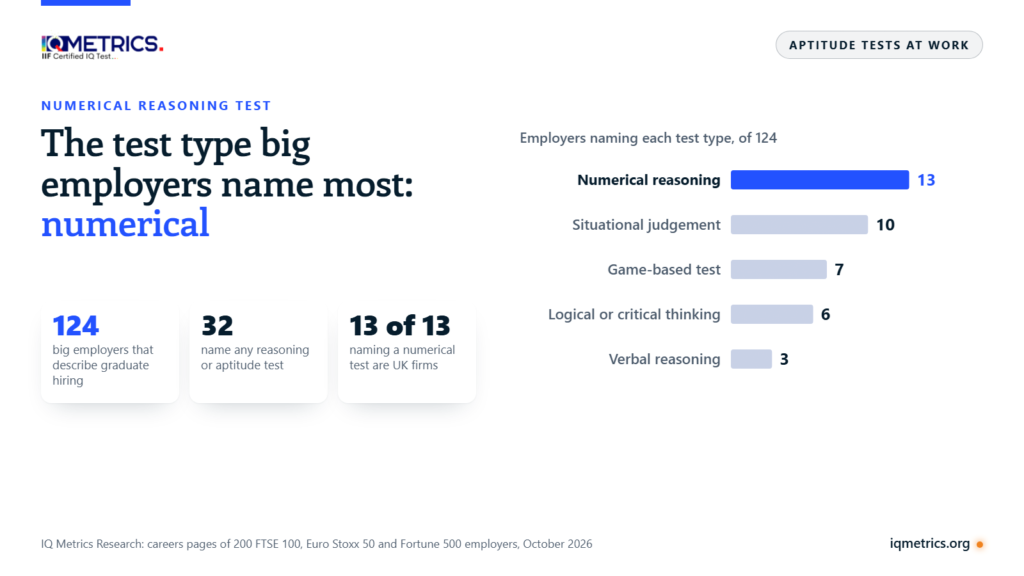
Numerical Reasoning Test
A numerical reasoning test asks you to read tables and charts against the clock. Five worked example questions with answers, the mistakes that cost the most points, what a good score means, and the 13 big employers in our study of 124 that name a numerical test.
 Understanding IQ
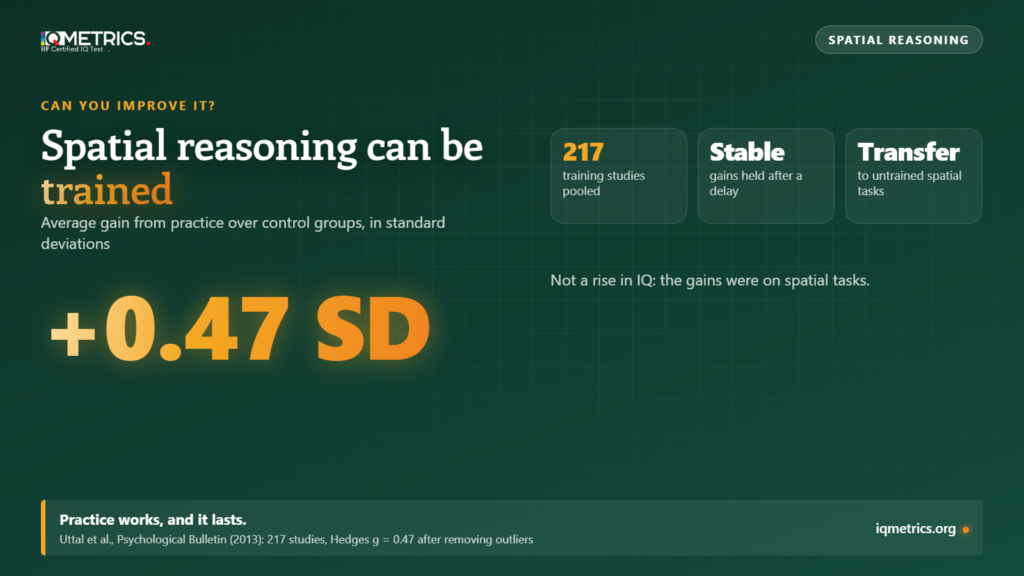
Spatial Reasoning
Spatial reasoning is the skill of picturing and turning shapes in your mind. What it means, everyday examples, how the Wechsler IQ tests measure it with Block Design and Visual Puzzles, why it predicts careers in science and engineering, and why 217 training studies say you can improve it.