





Are Turtles Smart? What Tortoise and Sea Turtle Studies Show About Learning, Memory and Navigation
How smart are turtles? Tortoises learned a maze, copied each other and kept a task for years in small studies, and sea turtles read Earth's magnetic field to navigate. See eight experiments in one table, why no turtle has an IQ, and what a 2022 brain-cell count says about size.

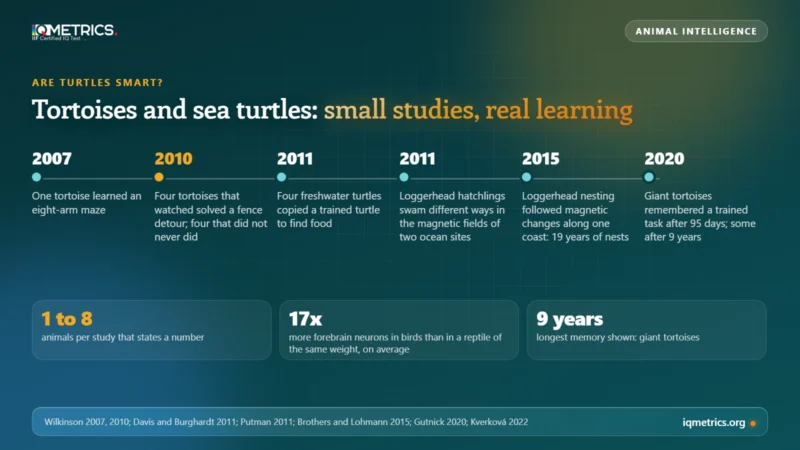
Are turtles smart? Smart enough to learn a maze, copy another turtle and remember a task for years, but no one has given a turtle an IQ. We found no test that ranks turtles against birds or mammals either. Lab studies show learning and memory in tortoises, and sea turtles cross ocean basins by reading Earth’s magnetic field.
New here: one table of the eight experiments we read, with the year, the species, what was shown and how many animals took part. The numbers are small, from 1 tortoise in a maze to 8 in a detour test. And in a 2022 count of brain cells, birds had about 17 times and mammals about 9 times more forebrain neurons than a reptile of the same body weight.
Key takeaways
- Tortoises learned a maze, copied another tortoise and kept a learned task for years in small lab studies. We found no study that ranks turtles against other animals.
- In the 2010 detour test, all 4 red-footed tortoises that watched another tortoise solved the task and none of the 4 that did not watch did.
- Sea turtles use Earth’s magnetic field as a kind of map. Hatchling loggerheads swam in different directions in the fields of two sites across the Atlantic.
- A 2022 study of 107 reptile species, 19 of them turtles, found far fewer forebrain neurons than in birds and mammals of the same body weight.
- A turtle IQ does not exist. No like-for-like test has been given to turtles and to people.
How smart are turtles compared with birds, mammals and other reptiles?
No one can rank them. We found no study that gives turtles, birds and mammals the same task, and each lab uses its own. Turtle intelligence is studied through a set of small experiments and one large brain-cell count.
How smart is a turtle in IQ terms? There is no answer. A turtle IQ cannot be measured, because IQ tests for people use language and pictures, and turtle studies each use a different task. Human reasoning tests ask for rules in words, such as the six questions in our deductive reasoning test. A turtle cannot take one.
Our report on the smartest reptile reaches the same view: it found no study that ranks reptile species on one set of tasks. Our smartest animals research compares measured neuron counts and test results across species, and our pages on ravens, octopuses, fish, mice and ants show how the same caution applies there.
A note on words. A tortoise is a land-living turtle, so a result for one tortoise species is a result for one species, not for every turtle.
Are turtles smart? Eight experiments in one table
Smart enough to learn, copy and remember in small tests. The table lists every experiment we read, oldest first, and gives the number of animals only where the source states it.
| Year | Species | What was shown | Animals | Source |
|---|---|---|---|---|
| 2004 | Green sea turtle | Has a navigation map that is at least partly based on geomagnetic cues | Not stated in the abstract | Lohmann and others, Nature |
| 2007 | Red-footed tortoise | Learned an eight-arm maze: chose baited arms above chance, and smell did not explain it | 1 | Wilkinson, Chan and Hall, Journal of Comparative Psychology |
| 2010 | Red-footed tortoise | Detour around a fence: all 4 that watched another tortoise solved it, none of the 4 that did not | 8 (4 + 4) | Wilkinson and others, Biology Letters |
| 2011 | Freshwater turtle (Pseudemys nelsoni) | Learned to follow another turtle to a food cue, then to choose the right cue alone | 4 | Davis and Burghardt, Journal of Comparative Psychology |
| 2011 | Loggerhead hatchlings | Swam different ways in the magnetic fields of two sites at the same latitude across the Atlantic | Not stated in the abstract | Putman and others, Current Biology |
| 2015 | Loggerhead sea turtle | Nesting rose where the magnetic signatures of beaches converged, in a 19-year record | 19-year nest database | Brothers and Lohmann, Current Biology |
| 2020 | Galapagos and Seychelles giant tortoises | Remembered a trained task after 95 days; some still showed it after 9 years | Not stated in the abstract | Gutnick and others, Animal Cognition |
| 2022 | 107 reptile species, 19 of them turtles | Birds and mammals have about 17 and 9 times more forebrain neurons than a reptile of the same body weight | 19 turtle species | Kverková and others, PNAS |
Read the last two columns first. The studies that state a number used between 1 and 8 animals, so each one is a first demonstration, not a measure of how common the skill is.
Can tortoises learn from each other?
Can turtles learn? Yes, in small lab tests. In the 2010 detour test, all 4 red-footed tortoises that watched another tortoise solved the task, and none of the 4 that did not watch did.
In that test a tortoise had to walk away from food, go round a V-shaped fence and come back. Each non-observer had 12 daily trials and reached the food in none of them. Each observer completed the detour at least twice, and two did it on the first trial. The authors call it the first evidence of social learning in a solitary reptile. Our smartest reptile report covers the study and a later four-tortoise maze.
A freshwater turtle did the same in 2011. All four Pseudemys nelsoni learned to follow a trained turtle to the cue that meant food. Then, with no demonstrator, they chose the right cue wherever it sat. The authors say it is the first experimental study of social learning in an aquatic reptile.
Do turtles have a good memory? One zoo study says yes for giant tortoises. All the animals remembered the trained task 95 days later, most relearned a colour choice up to three times faster than new animals, and some still showed the task 9 years on. The abstract does not give the number of animals, so treat it as a first look. You can try a short memory task yourself in our memory game.
Spatial memory shows up too. In 2007 one red-footed tortoise learned an eight-arm radial maze, the layout used to test rats. It picked baited arms above chance, and tests ruled out smell. The authors report spatial learning comparable to that seen in mammals, but from a single animal.
Where would your own score land?
Take the IIF-certified assessment and get your score with the scale it was measured on, the percentile it corresponds to and the confidence range around it — the three figures most online tests leave out.
Find your IQ score now! →How do sea turtles find their way across an ocean?
With a magnetic map. Experiments with green and loggerhead turtles show they use Earth’s magnetic field to tell where they are, not only which way is north.
In 2004, Lohmann and colleagues reported that the green sea turtle has a map that is at least partly based on geomagnetic cues. In 2011, hatchling loggerheads from Florida met the magnetic fields of two sites at the same latitude on opposite sides of the Atlantic. They swam in different directions, and each direction would help them along their circular migration route. The authors say this is the first sign that longitude can be written into a magnetic map.
The 2015 study asked where adults nest. Loggerheads leave as hatchlings and later return to the coast where they began. In a 19-year nest database, nesting rose where the magnetic signatures of neighbouring beaches converged. That fits the idea that turtles imprint on the magnetic signature of their home beach.
How smart are sea turtles? This is a skill, and a remarkable one. But navigation by a built-in sense shows what a turtle can do, not how it would rank against a crow or a mouse on a thinking task.
How big is a turtle brain, and does size say anything about smarts?
Size alone says little. A 2022 study counted brain cells in 107 reptile species, 19 of them turtles, and found that birds and mammals pack far more neurons into the forebrain than a reptile of the same body weight.
On tortoise vs turtle brain size: a tortoise is a land-living turtle, so it belongs to the same group, and the study sampled the two major turtle lineages, 14 and 5 species.
The researchers (Kverková and colleagues, PNAS) start from the point that similar-sized brains of distantly related animals can hold very different numbers of neurons. Compared with reptiles, birds had about 17 times and mammals about 9 times more neurons in the telencephalon than expected for the same body mass. In the cerebellum the gaps were about 45 and 69 times.
We did not read the per-species turtle counts, which sit in the paper’s data set, so we give no neuron number for any turtle. The comparison fits a simple reading: a reptile brain has less raw capacity than a bird or mammal brain of the same body size. It does not say what a turtle can learn, and the experiments above show real learning with a small brain.
To see how a score on a human test reads, take the IQ test. Turtles do not take it, but our percentile calculator shows how a human score is read against a norm group.
Quick answers
- How smart are turtles? Smart enough to learn mazes, copy each other and keep a trained task for years, in small lab studies. No test ranks them against other animals.
- Are tortoises smart? In one test, 4 of 4 red-footed tortoises that watched another solved a detour task, and 0 of 4 that did not watch did.
- What is a turtle’s IQ? There is none. No like-for-like IQ test exists for turtles.
- How do sea turtles navigate? By a map partly based on Earth’s magnetic field, shown in green and loggerhead turtles.
- Do turtles have good memory? Giant tortoises in one zoo study remembered a trained task after 95 days, and some after 9 years.
Sources
- Wilkinson, A., Kuenstner, K., Mueller, J. and Huber, L. Social learning in a non-social reptile (Geochelone carbonaria). Biology Letters, 2010 (full text read).
- Wilkinson, A., Chan, H. M. and Hall, G. Spatial learning and memory in the tortoise. Journal of Comparative Psychology, 2007; Davis, K. M. and Burghardt, G. M. Turtles (Pseudemys nelsoni) learn about visual cues indicating food from experienced turtles. Journal of Comparative Psychology, 2011 (abstracts read).
- Gutnick, T., Weissenbacher, A. and Kuba, M. J. The underestimated giants. Animal Cognition, 2020 (abstract read).
- Lohmann, K. J. and others. Geomagnetic map used in sea-turtle navigation. Nature, 2004; Putman, N. F. and others. Longitude perception and bicoordinate magnetic maps in sea turtles. Current Biology, 2011; Brothers, J. R. and Lohmann, K. J. Evidence for geomagnetic imprinting and magnetic navigation in the natal homing of sea turtles. Current Biology, 2015 (abstracts read).
- Kverková, K. and others. The evolution of brain neuron numbers in amniotes. PNAS, 2022 (full text read; open access).
- Our own pages: smartest reptile and smartest animals.
Keep reading
All articles →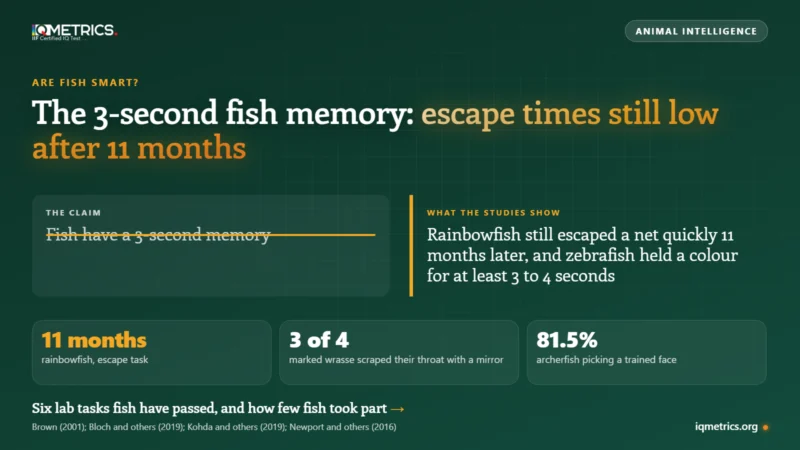 Research & Evidence
Are Fish Smart?
Fish have passed memory, face-recognition and quantity tasks, and cleaner wrasse reacted to a mark seen in a mirror, but most results rest on a handful of fish. The 3-second memory claim fails: rainbowfish escape times were still low after 11 months. See each study, its sample size and why there is no fish IQ.
 Understanding IQ
Octopus IQ
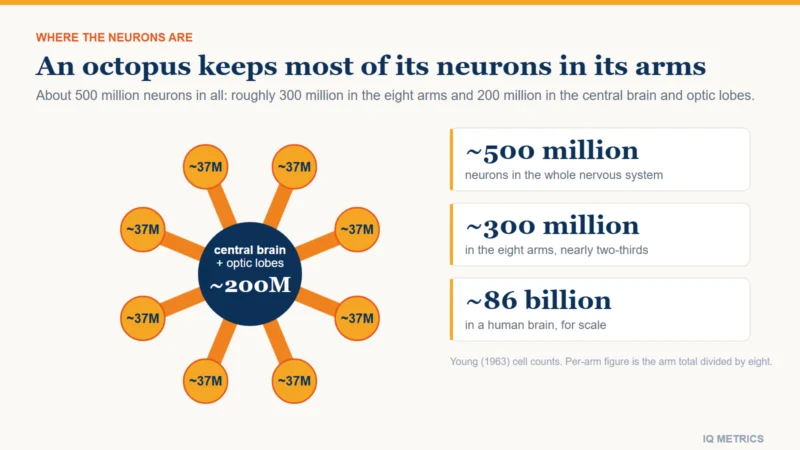
An octopus has no IQ, but it has about 500 million neurons, most of them in its arms. The neuron count, the tool-use and recognition studies, why short lives leave no room for teaching, and why UK law now treats octopuses as sentient.
 Research & Evidence
Are Ravens Smart?
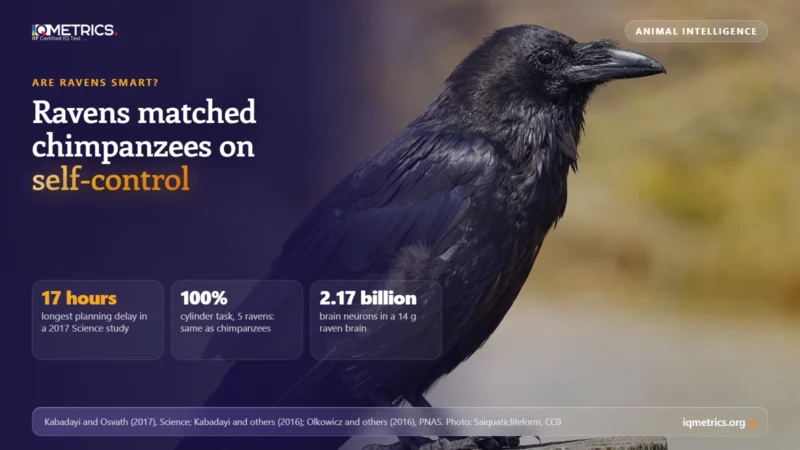
Ravens are smart on the tasks tested: they planned for tool use up to 17 hours ahead, guarded food from rivals they only heard, and matched chimpanzees on a self-control task. See the studies and how many birds each used, how ravens compare with crows and parrots, and why no raven has an IQ.