





What Does an IQ of 123 Mean? IQ 123 Percentile, Rarity and the Real Gap to 130
IQ 123 is the 93.7th percentile on SD 15, about 1 in 16 people, a Superior score 7 points under the 130 Mensa line. Those 7 points are only 4.0 percentile points but make a person 2.8 times rarer. See the percentile, the gap to 130, the other scales and how a retest can move it.

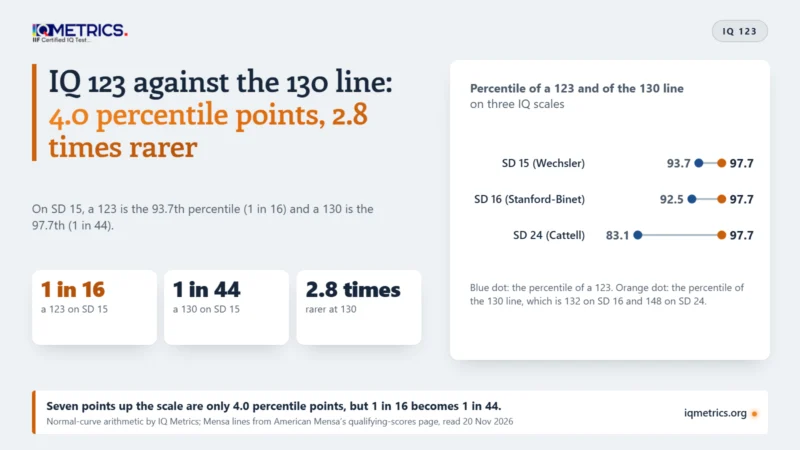
IQ 123 is the 93.7th percentile on a scale with a mean of 100 and a standard deviation (SD) of 15. About 1 in 16 people score 123 or higher. It is a Superior score on the Wechsler adult scale and the Stanford-Binet 5, 23 points above average and 7 points short of the 130 line that Mensa and most gifted programmes use.
New here: those 7 points are small on the percentile scale and large in rarity. From 123 to 130 you climb only 4.0 percentile points, from the 93.7th to the 97.7th. But you become 2.8 times rarer, from 1 in 16 to 1 in 44, and only about 1 in 3 of the people at 123 or higher also reach 130. Below: the meaning, the percentile, the gap, the other scales and the retest.
Key takeaways
- An IQ of 123 is the 93.7th percentile on SD 15 (1 in 16), the 92.5th on SD 16 (1 in 13) and the 83.1st on SD 24 (1 in 6).
- The 7 points from 123 to 130 are worth 4.0 percentile points but make a person 2.8 times rarer: 1 in 16 becomes 1 in 44.
- Of every 1,000 people, about 63 score 123 or higher and about 23 score 130 or higher. So about 36% of the people at 123 also reach 130.
- Mensa’s lines are 130 on the Wechsler scales, 132 on the DAS and 148 on the Cattell scale. A 123 is 7 to 25 points under them.
- A single score is an estimate with a margin of error, so one 123 neither proves nor rules out a true score near 130.
What does IQ 123 mean?
An IQ of 123 means a score well above average: 23 points over the mean of 100 and 1.53 standard deviations above it. Our IQ classification guide labels the 120 to 129 band Superior on the WAIS-IV and the Stanford-Binet 5, and Very High on the WISC-V.
That is the IQ 123 meaning on the scales most psychologists use. It is one band below the Very Superior and gifted labels that start at 130, and one band above High Average, which runs from 110 to 119. For the step below, see what an IQ of 122 means. For the step above, see what an IQ of 125 means.
What percentile is an IQ of 123?
The 123 IQ percentile is the 93.7th on SD 15. That means 93.7% of people in the test’s norm group score below 123, and 6.3% score at or above it.
Here is the sum. The z-score is (123 minus 100) divided by 15, which is 1.53. On a normal curve, 93.7% of people fall below that point and 6.3% above. One divided by 0.0626 is about 16, so 1 person in 16 scores 123 or higher.
Our IQ percentile calculator gives the same figure for any score, and the IQ level chart shows the bands side by side. Near 123 one point is worth about 0.8 percentile points, so a 123 and a 124 are close neighbours.
| IQ score | Percentile | About 1 in | People per 1,000 at or above |
|---|---|---|---|
| 121 | 91.9th | 1 in 12 | 80.8 |
| 122 | 92.9th | 1 in 14 | 71.2 |
| 123 | 93.7th | 1 in 16 | 62.6 |
| 124 | 94.5th | 1 in 18 | 54.8 |
| 125 | 95.2nd | 1 in 21 | 47.8 |
Is 123 IQ good?
Yes. Is 123 IQ good? An IQ of 123 is higher than about 94 of every 100 people in the norm group, and it is 23 points above the average of 100.
Is it good for school and college? Our report on the average IQ of college students puts the average college student at about 102, on a 2024 meta-analysis of Wechsler samples. A 123 is 21 points above that. It is also well above the range of everyday normal: see our guide to what a normal IQ is. A score is one measurement. Grades, health, effort and teaching all shape how a person does, and a test score does not replace them.
Schools and employers also use pattern tests that do not report an IQ at all: see six abstract reasoning sample questions.
Is an IQ of 123 gifted, high or genius?
High, yes. Gifted by the usual line, no. Most gifted programmes and Mensa start at 130, and an IQ of 123 is 7 points under it.
American Mensa’s qualifying-scores page, read on 20 November 2026, lists 130 for the Wechsler scales (WAIS and WISC) and the Stanford-Binet 5. It lists 132 for the DAS and the older Stanford-Binet, and 148 for the Cattell. So a 123 is 7 points under the first group, 9 under the second and 25 under the Cattell line. Our Mensa IQ requirements guide lists the line for every accepted test.
Gifted programmes work the same way. Our guide to gifted cut-off scores says 130 is the usual entry line and that it is a convention. It also says the 95% interval around a full-scale score is about 5 points either side. Even the top of that range, 128, stays under 130. The labels that start at 130, such as Very Superior, are not given to a 123. For the 130 line itself, see whether a 130 IQ is genius.
Where would your own score land?
Take the IIF-certified assessment and get your score with the scale it was measured on, the percentile it corresponds to and the confidence range around it — the three figures most online tests leave out.
Find your IQ score now! →123 IQ score vs 130: how far apart are they?
In a 123 IQ score vs 130 comparison the gap is only seven points, but it is much further in rarity. From 123 to 130 you move up only 4.0 percentile points, from the 93.7th to the 97.7th. In people, the share at or above falls from 6.3% to 2.3%: 1 in 16 becomes 1 in 44, which is 2.8 times rarer.
Out of 1,000 people, about 63 score 123 or higher and about 23 score 130 or higher. So about 36% of the people at 123 or higher, a little over 1 in 3, also reach 130. Every point on the way cuts the share at or above by about 13.5% on average, which is why the last few points are the hardest to reach.
| IQ score | Percentile | Share at or above | About 1 in | Rarer than 123 by |
|---|---|---|---|---|
| 123 | 93.7th | 6.3% | 1 in 16 | - |
| 124 | 94.5th | 5.5% | 1 in 18 | 14% |
| 125 | 95.2nd | 4.8% | 1 in 21 | 31% |
| 126 | 95.8th | 4.2% | 1 in 24 | 51% |
| 127 | 96.4th | 3.6% | 1 in 28 | 74% |
| 128 | 96.9th | 3.1% | 1 in 32 | 102% |
| 129 | 97.3rd | 2.7% | 1 in 38 | 135% |
| 130 | 97.7th | 2.3% | 1 in 44 | 175% |
In a class of 30 you would expect about 2 pupils at 123 or higher, and the chance of at least one is 86%. For 130 or higher you would expect fewer than 1 pupil, and the chance of at least one is 50%. In a town of 10,000, about 626 people score 123 or higher and about 228 score 130 or higher. These are expectations for a random group, so a selective school or workplace will hold more.
What is the same 123 on SD 16 and SD 24?
The same number is a different rank on another scale. A 123 is the 92.5th percentile on SD 16 and the 83.1st on SD 24.
| Scale (SD) | Used by | Percentile of a 123 | Share at or above | About 1 in | Same standing on SD 15 |
|---|---|---|---|---|---|
| SD 15 | Wechsler scales, Stanford-Binet 5 | 93.7th | 6.3% | 1 in 16 | 123 |
| SD 16 | Older Stanford-Binet forms | 92.5th | 7.5% | 1 in 13 | 122 |
| SD 24 | Cattell scales | 83.1st | 16.9% | 1 in 6 | 114 |
A 123 on a Cattell test has the standing of a 114 on SD 15, which is High Average in our classification guide. The 130 line moves with the scale too: it is 132 on SD 16 and 148 on SD 24, the Cattell line Mensa lists. Going the other way, a 123 on SD 15 would read as about 137 on SD 24. The IQ score converter converts any score from one scale to another.
How accurate is a single IQ of 123?
A single 123 is a good estimate, not an exact one. Every IQ test has a standard error of measurement, which is how far one sitting can land from the next. Each test manual publishes its own figure, and a retest can land a few points either side.
We did not read a test manual for this page, so we give no error band here. Our report on the IQ score margin of error explains how the error is built and why a score is best read as a range. One thing is safe to say from the curve. The 130 line is 7 points away and a score can move a few points on a retest, so one 123 neither proves nor rules out a true score near 130.
To see where your own result falls on the curve, take the IQ test and check it with the percentile calculator.
Quick answers
- What does IQ 123 mean? The 93.7th percentile on SD 15: the top 6.3%, about 1 in 16 people, in the Superior band.
- Is 123 IQ good? Yes. It is higher than about 94 of every 100 people and 23 points above average.
- What percentile is an IQ of 123? The 93.7th on SD 15, the 92.5th on SD 16 and the 83.1st on SD 24.
- Is an IQ of 123 gifted? Not by the usual line. Mensa’s Wechsler line is 130, 7 points higher, and its Cattell line is 148.
- How far is 123 from 130? 7 points and 4.0 percentile points, but 2.8 times rarer: 1 in 16 against 1 in 44.
Sources
- American Mensa. Qualifying test scores (page read on 20 November 2026).
- Percentiles, 1-in-N figures, people per 1,000, percentile lines and group chances: normal-curve arithmetic by IQ Metrics, computed in code, not copied.
- Our own pages: IQ classifications, gifted cut-off scores and average IQ of college students (read on 19 November 2026, figures unchanged).
Keep reading
All articles →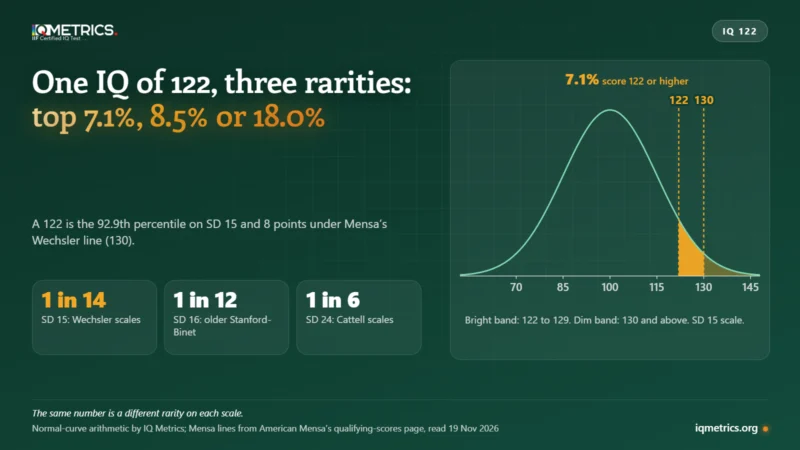 Scores & Scales
What Does an IQ of 122 Mean?
IQ 122 is the 92.9th percentile on SD 15, about 1 in 14 people, a Superior score 8 points under the 130 Mensa line. The same 122 is the top 18.0% on SD 24. See the percentile, what it means for school and Mensa, the other scales and how a retest can move it.
 Scores & Scales
What an IQ of 125 Means
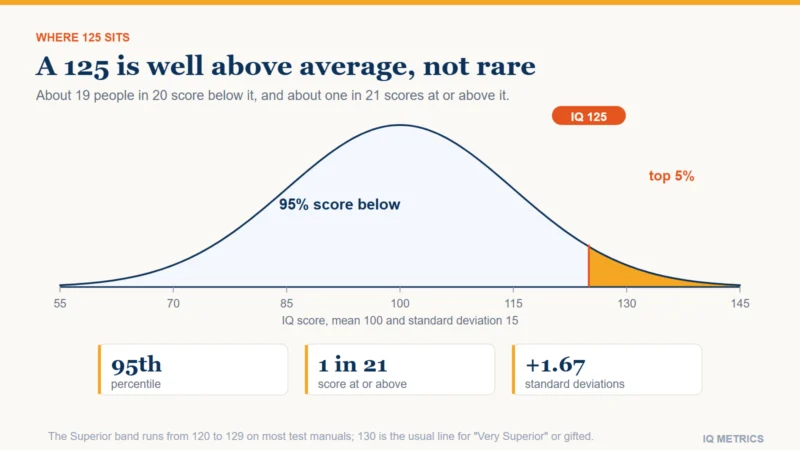
An IQ of 125 is the 95th percentile on the standard scale: about 1 person in 21, in the Superior band and one band below most gifted cutoffs. See how many people that is, what an IQ between 115 and 125 means, how accurate a single score is and what a 125 predicts.
 Scores & Scales
Mensa IQ Score Requirements
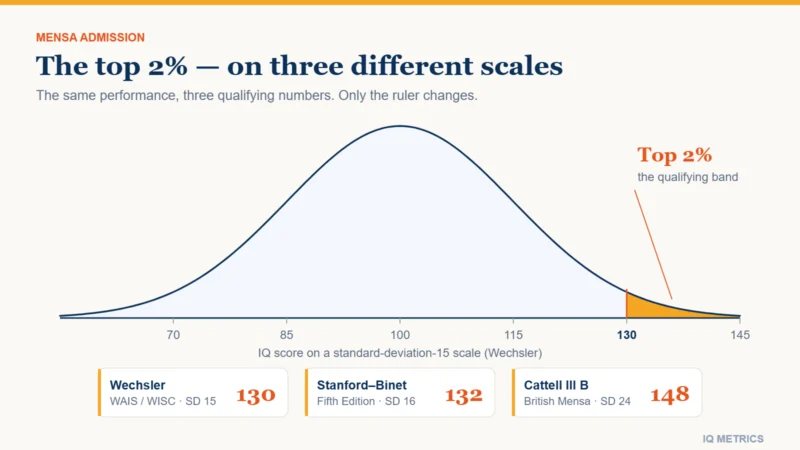
Mensa admits the top 2% of scorers, but "the top 2%" is a rank, not a number, and the number it maps to changes with the test you sat. Here is what qualifies on the Wechsler, Stanford-Binet and Cattell scales, the two routes to membership, and what the supervised admission test is actually like.