





Adoption and IQ: What Adoption Studies Show About Nature and Nurture
Adoption can raise average IQ by about 3 to 4 points in a large Swedish sibling study and by 8 to 20 in a French study of neglected children, yet adoptees come to resemble their birth parents. See what adoption and twin studies show, and what they cannot.

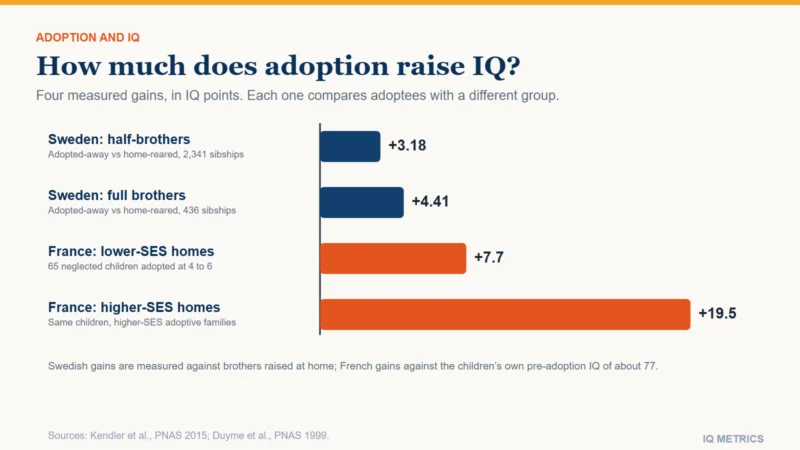
Adoption and IQ: does adoption raise a child’s IQ? Adoption studies show that the home a child grows up in can move average IQ, and how far depends on where the child starts: about 3 to 4 points in a large Swedish sibling study, and roughly 8 to 20 points in a French study of neglected children moved into better-off homes. But adopted children’s IQ also comes to resemble their birth parents’ more than their adoptive parents’ as they grow up, and identical twins reared apart correlate about .70 in adult IQ. Both findings hold at once: environment can shift the average level, especially for children in poor starting conditions, while genes account for more of the differences among people raised in ordinary, similar-quality homes. This guide sets out what each major study measured, what the numbers are, and what adoption designs cannot show.
- Swedish siblings (2015): adopted-away men scored 4.41 IQ points higher than their home-reared full brothers (436 sibships); a half-sibling replication gave 3.18 points (2,341 sibships).
- French adoptees (1999): neglected children with a pre-adoption IQ near 77 gained 7.7 points in lower-SES adoptive homes and 19.5 points in higher-SES homes by adolescence.
- Colorado Adoption Project: adoptees resembled their adoptive parents slightly in early childhood but not at all by adolescence.
- Twins reared apart (1990): an identical-twin IQ correlation of .69 on the Wechsler adult scale, with a warning not to extend it to extreme disadvantage.
- Romanian institutions: at age 8, children placed in foster care averaged IQ 81 against 107 for never-institutionalized children.
Why do researchers use adoption studies?
An adopted child inherits genes from one family and grows up in another, which pulls apart two things that are tangled together in ordinary families. If adoptees end up resembling their birth parents, genes are doing the work; if they resemble their adoptive parents, or outscore siblings who stayed behind, the home is. Adoption designs have limits, and the biggest is that adoptive parents are screened and are on average better off than birth parents, a point we return to below. For the wider debate see our guides to whether IQ is genetic, twin studies and IQ and socioeconomic status and IQ.
Does adoption raise IQ? What the meta-analysis found
The broadest evidence is a 2005 meta-analysis in Psychological Bulletin by van IJzendoorn, Juffer and Klein Poelhuis, covering 62 studies and 17,767 adopted children. Its answer depends on the comparison group. Adopted children scored higher on IQ tests than the siblings or peers who stayed behind. They did not differ in IQ from their nonadopted peers or siblings in their new communities, though their school performance and language abilities lagged behind and more of them developed learning problems. In other words, adoption looks like a large improvement relative to what the child left behind, and like a normal starting point relative to peers in the new community.
A widely quoted range comes from Nisbett and colleagues (2012), who describe a 12-point to 18-point rise in IQ when children are adopted from working-class to middle-class homes. They add that the meta-analysis figure of 18 points included comparisons with extremely deprived institutional settings. Those are large numbers, and the designs below suggest they sit at the top of the range rather than being the typical case.
How big is the gain? Four measured numbers
The Swedish study uses national registers and gives the most cautious estimate. Kendler and colleagues (2015) used national registers to find male siblings where one was raised by biological parents and the other was adopted away, with IQ taken from the military conscription exam at age 18 to 20. Across 436 full-sibling sets the adopted brother scored 4.41 points higher (standard error 0.75); a replication with 2,341 half-sibling sets gave 3.18 (standard error 0.34). The authors call this smaller than differences in earlier, smaller studies, and note that the environmental difference between the adoptive and biological families was not especially large and that the adoptive families were screened by the adoption agency. The effect also ran both ways: children placed in the best-educated homes scored highest, while those placed in homes less educated than the family of origin “actually performed worse” than their siblings.
The French study shows a bigger effect at a lower starting point. Duyme, Dumaret and Tomkiewicz (1999) picked 65 children, from 5,003 adoption files, who had been abused or neglected in infancy and were adopted between ages 4 and 6, with a pre-adoption IQ below 86 (mean 77). By adolescence the mean IQ was 85 in adoptive families of lower socioeconomic status (SES) and 98 in higher-SES ones, gains of 7.7 and 19.5 points. One caution is ours, not the paper’s: children chosen for a low first score tend to score somewhat higher on retest by chance alone, the effect described in our guide to regression to the mean, so some of the 7.7 may reflect that statistical rebound rather than adoption itself. A classic 1989 French cross-fostering study of 38 children, as summarized in a 2018 review, found children born to higher-SES families and adopted into lower-SES homes averaged 107.5, against 103.6 for children born to lower-SES families and adopted into higher-SES homes, which suggests, on our reading, that birth background and adoptive home both mattered.
| Study | Comparison | Gain |
|---|---|---|
| Kendler et al. 2015, Sweden (half-siblings) | Adopted-away men against home-reared half-brothers, 2,341 sibships, IQ at conscription | 3.18 points |
| Kendler et al. 2015, Sweden (full siblings) | Adopted-away men against home-reared full brothers, 436 sibships | 4.41 points |
| Duyme et al. 1999, France (lower-SES homes) | 65 neglected children adopted at 4 to 6, pre-adoption IQ near 77; measured in adolescence | 7.7 points |
| Duyme et al. 1999, France (higher-SES homes) | Same children, adopted into higher-SES families | 19.5 points |
Do adopted children come to resemble their birth parents or their adoptive parents?
The Colorado Adoption Project followed adopted children and their biological and adoptive parents for 20 years, alongside matched non-adoptive families. Plomin and colleagues reported in 1997 that adopted children resemble their adoptive parents “slightly in early childhood but not at all” in middle childhood or adolescence, while becoming more like their biological parents, to the same degree as children in non-adoptive families. A later analysis of the project’s sibling data by Petrill and colleagues (2004), covering 245 adoptive and 245 biological families with IQ measured from age 1 to 16, found considerable genetic influence at each age and modest shared-environmental influence, and reported that selective placement was negligible for the cognitive measures.
This fits a pattern documented in twin and adoption work: the share of IQ differences linked to genes rises with age. Plomin and Deary (2015) put heritability at about 20% in infancy, rising to perhaps 80% in later adulthood, with cross-sectional twin data from 11,000 pairs showing roughly 40% in childhood, 50% in adolescence and 60% in young adulthood. That is consistent with parental influence looking strongest in early childhood and weakest in adulthood. See also IQ scale by age and whether intelligence comes from mother or father.
The two findings do not contradict each other. A 2018 review by Sauce and Matzel puts it in one line: “the magnitude of a correlation is independent of changes in means.” Adoption can raise the average score of a group while genes still explain most of the differences among individuals within it.
What do twins reared apart show?
The Minnesota Study of Twins Reared Apart, reported by Bouchard and colleagues in Science in 1990, covered more than 100 sets of reared-apart twins or triplets, with the main analysis on 56 sets of identical twins. The IQ correlation was .69 on the Wechsler adult scale (48 pairs) and near .78 on other composites; three earlier studies gave .64 to .74. The authors concluded that about 70% of the variance in IQ was associated with genetic variation. Identical twins raised together, mostly children, correlated .86 across 34 studies, against .72 for the mostly adult reared-apart twins; the samples differ in age as well as in rearing, so the comparison is not clean.
The paper is also explicit about its limits. Few of the twins were reared in real poverty and none was intellectually disabled, so the estimate “should not be extrapolated to the extremes of environmental disadvantage,” and the findings “do not define or limit what might be conceivably achieved in an optimal environment.” The authors add that the evidence does not detract from the value of parenting, education and other interventions.
Where would your own score land?
Take the IIF-certified assessment and get your score with the scale it was measured on, the percentile it corresponds to and the confidence range around it — the three figures most online tests leave out.
Find your IQ score now! →What happens when the early environment is very poor?
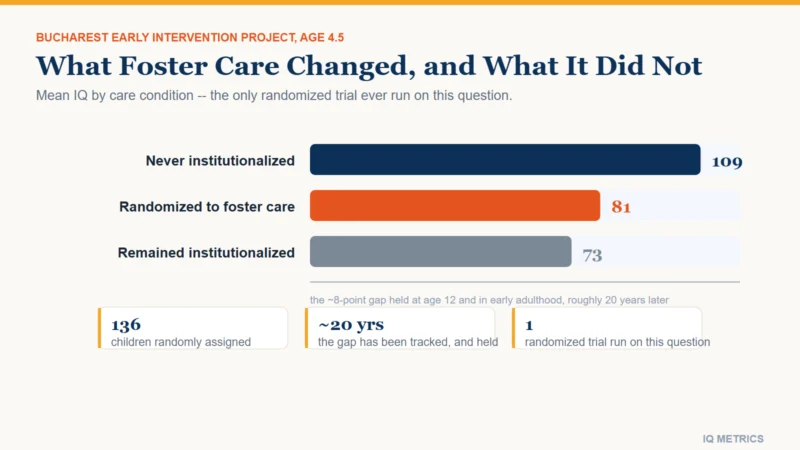
The strongest evidence on severe deprivation comes from Romania. In the Bucharest Early Intervention Project, abandoned children were randomly assigned to foster care or to remain in institutions. By 42 and 54 months, children who stayed in institutions scored markedly below both never-institutionalized children and those moved to foster care, and the gains were largest for the youngest children placed. At age 8, Fox and colleagues (2011) tested 103 of the original 136 children on the WISC-IV: the foster-care group averaged 81.46, the care-as-usual group 76.16 and never-institutionalized children 107.00. The gap between foster care and care as usual was only marginal (p = .07), and the care-as-usual average rose between 54 months and age 8, partly because Romania began moving institutionalized children into foster homes. Even the foster-care group was about 25 points below never-institutionalized peers. Our guide to toxic stress and IQ covers the trial in more depth.
The English and Romanian Adoptees study followed children adopted into UK families after up to 43 months of severe deprivation. Sonuga-Barke and colleagues (2017) found that among those who had spent more than six months in an institution, rates of IQ below 80 were markedly higher than in UK-born adoptees at ages 6 (p = .0001) and 11 (p = .0016), but had fallen to normal rates by age 22 to 25 (p = .76). Other difficulties did not fade: autism-spectrum-like symptoms, disinhibited social engagement and inattention stayed higher, and about a fifth of that group (15 people) had no problems at any assessment. IQ can recover when the environment improves, but a score is not the whole picture. For more on adversity and thinking skills, see our news piece on childhood adversity and cognition.
What adoption studies cannot show
- Adoptive homes are screened. Adoptive parents are on average better off than birth parents. Nisbett and colleagues argue this restricted range may make adoption studies underestimate environmental effects; other researchers dispute that, so it stays open.
- The comparison group decides the answer. Left in an institution, left with birth parents, or living next door in the adoptive community give very different gains.
- Birth-family effects are not only genes. Prenatal conditions travel with birth mothers, and parental education is only an imperfect indicator of environmental quality, as Kendler and colleagues note.
- Extreme deprivation is not ordinary adoption. The Romanian studies show what happens at the far end and should not be stretched to typical adoptions.
- Numbers differ by test and age. The studies used different tests at different ages, from military conscription exams in Sweden to the WISC-IV in Bucharest and the Wechsler adult scale in Minnesota, so gains in points are not perfectly comparable.
- Nothing here describes an individual. These are averages across groups. They say nothing about any one child’s potential or any one family’s parenting.
Adoption research also reaches beyond IQ. In a natural experiment in which Korean-born adoptees were quasi-randomly assigned to American families, Sacerdote (2007) found that parents’ education and family size predicted adoptees’ education, income and health more than parents’ income did, and that shared family environment explained 14% of the variation in educational attainment. That study did not measure IQ. Traits such as persistence are shaped by genes as well: in a UK twin study, perseverance of effort was 37% heritable, a finding covered in our guide to grit vs IQ.
Quick answers
- Does adoption raise IQ? On average, yes, relative to siblings or peers left behind: about 3 to 4 points in a Swedish sibling comparison and roughly 8 to 20 points in a French study of neglected children. Adoptees do not differ in IQ from peers in their new communities.
- Do adopted children take on their adoptive parents’ IQ? Not by adolescence. In the Colorado Adoption Project they resembled adoptive parents slightly early on and not at all by middle childhood.
- How much of IQ is genetic? It rises with age, from about 20% in infancy to perhaps 80% in later adulthood, and about 70% in the Minnesota twin study of mostly middle-class adults.
- Does early neglect permanently lower IQ? Not always. Romanian adoptees with more than six months of deprivation had normal rates of IQ below 80 by age 22 to 25, though other difficulties persisted.
- Does high heritability mean parenting does not matter? No. The twin authors say their findings do not detract from the value of parenting and education, and the Swedish authors say the malleability they found is fully consistent with genetic influence.
The bottom line
Adoption studies say two things that sound opposed but are not. Environment can change the average IQ of a group, by a few points in ordinary comparisons and by much more when children leave severe deprivation. And as children grow, differences between people raised in ordinary homes track their birth parents more than their adoptive ones. Both come with limits: adoptive homes are screened, deprivation studies describe extremes, and none of the numbers applies to a single child.
Sources
- van IJzendoorn, M.H., Juffer, F. and Klein Poelhuis, C.W. (2005): Adoption and cognitive development: a meta-analytic comparison of adopted and nonadopted children’s IQ and school performance, Psychological Bulletin, 131(2), 301-316.
- Kendler, K.S., Turkheimer, E., Ohlsson, H., Sundquist, J. and Sundquist, K. (2015): Family environment and the malleability of cognitive ability: a Swedish national home-reared and adopted-away cosibling control study, PNAS, 112(15), 4612-4617.
- Duyme, M., Dumaret, A.-C. and Tomkiewicz, S. (1999): How can we boost IQs of “dull children”? A late adoption study, PNAS, 96(15), 8790-8794.
- Bouchard, T.J. et al. (1990): Sources of human psychological differences: the Minnesota Study of Twins Reared Apart, Science, 250, 223-228.
- Plomin, R., Fulker, D.W., Corley, R. and DeFries, J.C. (1997): Nature, nurture, and cognitive development from 1 to 16 years: a parent-offspring adoption study, Psychological Science, 8(6), 442-447.
- Petrill, S.A. et al. (2004): Genetic and environmental contributions to general cognitive ability through the first 16 years of life, Developmental Psychology, 40(5), 805-812.
- Plomin, R. and Deary, I.J. (2015): Genetics and intelligence differences: five special findings, Molecular Psychiatry, 20(1), 98-108.
- Nisbett, R.E. et al. (2012): Intelligence: new findings and theoretical developments, American Psychologist, 67(2), 130-159.
- Nelson, C.A. et al. (2007): Cognitive recovery in socially deprived young children: the Bucharest Early Intervention Project, Science, 318, 1937-1940.
- Fox, N.A., Almas, A.N., Degnan, K.A., Nelson, C.A. and Zeanah, C.H. (2011): The effects of severe psychosocial deprivation and foster care intervention on cognitive development at 8 years of age: findings from the Bucharest Early Intervention Project, Journal of Child Psychology and Psychiatry, 52(9), 919-928.
- Sonuga-Barke, E.J.S. et al. (2017): Child-to-adult neurodevelopmental and mental health trajectories after early life deprivation: the young adult follow-up of the longitudinal English and Romanian Adoptees study, The Lancet, 389(10078), 1539-1548.
- Sacerdote, B. (2007): How large are the effects from changes in family environment? A study of Korean American adoptees, Quarterly Journal of Economics, 122(1), 119-157.
- Sauce, B. and Matzel, L.D. (2018): The paradox of intelligence: heritability and malleability coexist in hidden gene-environment interplay, Psychological Bulletin, 144(1), 26-47.
Keep reading
All articles →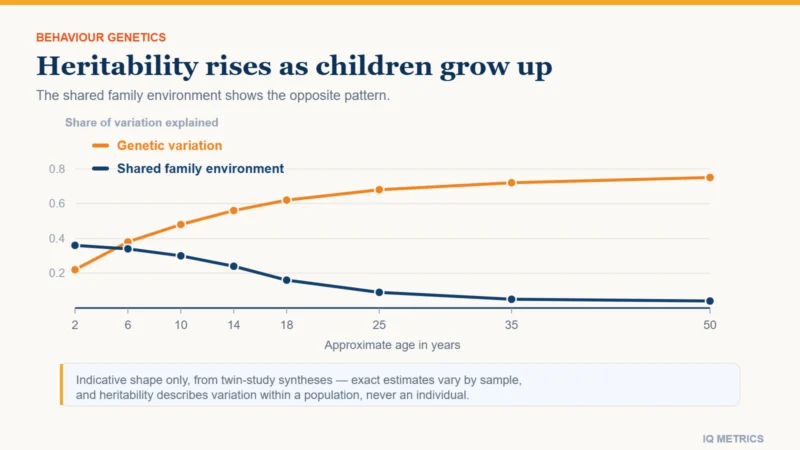 Research & Evidence
Is IQ Genetic?
Heritability estimates for IQ rise from roughly 0.4 in childhood to 0.7 or higher in adulthood, which sounds decisive until you know what heritability measures. Here is what twin and adoption studies actually show, and the four conclusions people draw from them that the statistic does not support.
 Research & Evidence
Toxic Stress and IQ
Researchers in Romania did something that can never be done again for ethical reasons: they randomly assigned some institutionalized children to foster care and left others in the institution, then followed both groups for twenty years. The IQ gap that opened up has held at every check-in since. What has not held up as cleanly is the famous claim about exactly when the window closes.
 Understanding IQ
Grit vs IQ
Grit is weakly to moderately linked to school achievement and overlaps almost completely with conscientiousness. See what the original grit studies, two large meta-analyses, the marshmallow test and a retracted test-motivation paper really show about grit vs IQ.