





What Is the Average IQ in Russia? What the Estimates Say and What PISA and TIMSS Data Cover
The average IQ in Russia is not measured: a compiled estimate says 96.29 and a 2026 online table says 103.78. On TIMSS 2019 maths Russia ranked 6th of 58. See which PISA, TIMSS and PIRLS rounds include Russia, how it compares with Germany, the UK, China and the US, and why national IQ numbers need care.

There is no measured average IQ in Russia. Every IQ test is built so that its average is 100 among the people it was normed on, so a Russian-normed test averages 100 by design. The two national figures that circulate are 96.29, a compiled estimate from 3 studies and 1,290 people, and 103.78, from a 2026 online table of 29,170 self-selected test-takers.
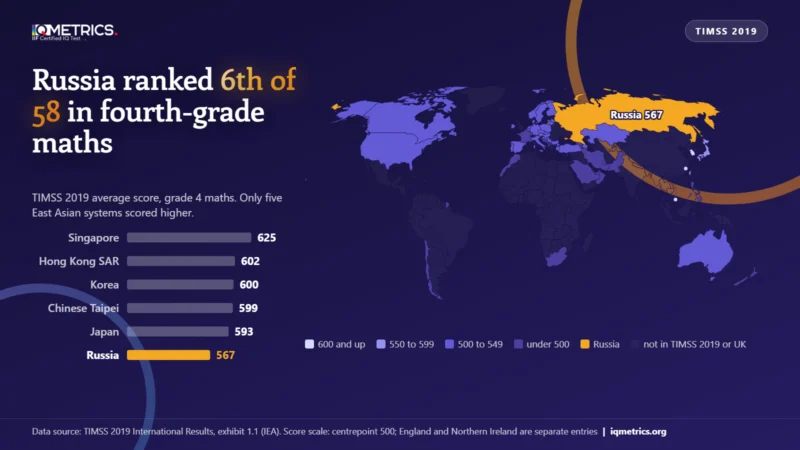
New here: Russia’s place flips with the source. It is below Germany, the UK and the US in the compiled estimate, but above all three in the online table and in the 2019 TIMSS maths test, where Russian fourth graders scored 567, sixth of 58 countries. Below: the two figures, which school-test rounds include Russia and which do not, and why you should treat any national IQ number with care.
Key takeaways
- The average IQ in Russia is not measured. The compiled figure is 96.29 (3 studies, 1,290 people). A 2026 online table gives 103.78 (29,170 self-selected takers). They are 7.49 points apart.
- On TIMSS 2019, Russia scored 567 in fourth-grade maths (6th of 58) and 543 in eighth-grade maths (6th of 41). Only East Asian systems scored higher in maths.
- Russia took part in every PISA round from 2000 to 2018. It is not in the 2022 or 2025 lists, and it is not on the IEA’s TIMSS 2023 participant list.
- Russia ranks below Germany, the UK and the US in the compiled IQ estimate, and above them in the online table and in TIMSS fourth-grade maths.
- A school test measures what children were taught as well as how they think. It is not an IQ test.
What is the average IQ in Russia?
The average IQ in Russia depends on where the figure comes from, and none comes from a national IQ test. The compiled estimate is 96.29. A 2026 online table says 103.78.
The average Russian IQ is not a fixed fact. Any properly normed IQ test sets the average of its own norm sample at 100, with a standard deviation (SD) of 15. So a test normed in Russia averages 100 in Russia. A national figure only means something when one test is given the same way in every country. That has not been done.
| Source | Russia | Rank | People behind it | What it is |
|---|---|---|---|---|
| Lynn and Becker 2019 (as on our country hub) | 96.29 | 35th of 201 entries | 1,290 in 3 studies | Compiled published samples, quality-weighted |
| 2026 online table (our news report) | 103.78 | 6th of 137 countries | 29,170 takers | Self-selected people who chose to take one online test in 2025 |
The gap is 7.49 points. Russia’s average IQ is 96.29 in one and 103.78 in the other, so neither figure says how clever Russians are.
The first rests on only three studies in Russia. By comparison, the US figure in the same dataset rests on 62,649 people in 58 studies. The second counts people who chose to take an online test, so it measures an audience. Our average IQ by country page and our report on the 2026 online ranking explain each source and its weak points.
Search terms such as “russia average iq 2026” and “iq of russians” usually lead to one of these two tables. Neither has been checked against a representative sample of Russian adults.
What do PISA, TIMSS and PIRLS say about Russian students, and which rounds is Russia missing from?
Russian students score high on the TIMSS maths and science tests, and Russia took part in PISA from 2000 to 2018. It is absent from the PISA 2022 and 2025 lists and from the TIMSS 2023 list.
PISA Russia questions come up often, so here is exactly what we read. The US Department of Education’s participation table lists the Russian Federation in PISA 2000, 2003, 2006, 2009, 2012, 2015 and 2018, and shows no entry for 2022 or 2025. We did not read the OECD’s own PISA pages, because they blocked our tools, so we give no PISA score. The sources do not say why Russia is absent from later rounds.
| Test and year | Russia in the round? | What we read |
|---|---|---|
| PISA 2000 to 2018 | Yes, all seven rounds | Participation table; scores not read |
| PISA 2022 and 2025 | No entry | Participation table |
| TIMSS 2019, grade 4 maths | Yes | 567, 6th of 58 countries |
| TIMSS 2019, grade 4 science | Yes | 567, 3rd of 58 countries |
| TIMSS 2019, grade 8 maths | Yes | 543, 6th of 41 countries |
| TIMSS 2019, grade 8 science | Yes | 543, 5th of 41 (level with Finland) |
| TIMSS 2023 | Not on the participant list | IEA results page (it reports 64 countries) |
| PIRLS 2021 (reading) | Yes | Listed as a participant; score not read |
Look at TIMSS 2019. On fourth-grade maths the five East Asian systems came first: Singapore 625, Hong Kong SAR 602, Korea 600, Chinese Taipei 599 and Japan 593. Russia came next with 567, ahead of England (556), the US (535) and Germany (521). The IEA’s own report says all five of those systems scored higher than every other country except each other, and that Russia and Northern Ireland followed them.
Science tells a similar story. In fourth-grade science Russia scored 567, third of 58 behind Singapore (595) and Korea (588). In eighth-grade science it scored 543, level with Finland and fifth of 41. These are results for school children of one age, in one year, on a test built around what is taught.
The IEA report also says that, in fourth-grade maths, about one-fifth of Russian students (20%) reached the Advanced benchmark and 99% reached the Low benchmark. In eighth-grade maths Russia scored 543, behind Singapore (616), Chinese Taipei (612), Korea (607), Japan (594) and Hong Kong SAR (578). Moscow City, a separate benchmarking participant, scored 593 in grade 4 and 575 in grade 8.
How does Russia sit next to Germany, the UK, China and the US?
It depends on the measure. Russia is below Germany, the UK and the US on the compiled IQ estimate, and above Germany, England and the US on TIMSS fourth-grade maths.
| Country | Compiled estimate (2019) | Online table (2026) | TIMSS 2019 grade 4 maths | TIMSS 2019 grade 8 maths |
|---|---|---|---|---|
| Russia | 96.29 | 103.78 | 567 | 543 |
| Germany | 100.74 | 99.32 | 521 | not in the round |
| UK (TIMSS: England) | 99.18 | 101.57 | 556 | 515 |
| United States | 97.43 | 101.04 | 535 | 515 |
| China | 104.10 | 106.48 | not in the round | not in the round |
| Japan | 107.01 | 106.30 | 593 | 594 |
Read the table with care. TIMSS reports England, not the whole UK. Mainland China is not among the TIMSS 2019 countries, and the 2026 online “China” also counts Hong Kong and Taiwan, as our China page explains. Germany did not test eighth graders in 2019.
Still, the pattern holds. On the compiled estimate, Russia sits 4.45 points under Germany, 2.89 under the UK and 1.14 under the US. In the online table it sits above all three. In TIMSS fourth-grade maths it leads England by 11 points, the US by 32 and Germany by 46. For each neighbour, see our pages on Germany, the UK and the US and Japan.
Where would your own score land?
Take the IIF-certified assessment and get your score with the scale it was measured on, the percentile it corresponds to and the confidence range around it — the three figures most online tests leave out.
Find your IQ score now! →Why should you treat any national IQ number with care?
Because a national IQ figure compares people who took different tests, in different years, with different norms. A number such as 96.29 looks exact, but it is built from a handful of samples.
There are four reasons. First, every test sets its own average at 100, so national averages from different tests are not on one scale. Second, the evidence is uneven: three studies in Russia, 58 in the US. Third, online tables count volunteers. Fourth, school tests such as TIMSS measure curriculum and teaching as well as thinking skills, so a high maths score is not an IQ score. Our smartest countries study and our Europe comparison of PISA, adult skills and IQ estimates set out the same caution.
The honest answer to “what is the average IQ in Russia?” is that nobody has measured it with one test across the country. To see where you stand on the standard scale, take our IQ test, then use the percentile calculator to read your result against the normal curve. For what a score near the top of the High Average band means, see an IQ of 119.
Quick answers
- What is the average IQ in Russia? Not measured. A compiled estimate gives 96.29 and a 2026 online table gives 103.78. A Russian-normed test averages 100 by design.
- Russia vs USA IQ: who is higher? 96.29 against 97.43 in the compiled estimate, but 103.78 against 101.04 in the online table.
- Is Russia in PISA? It took part from 2000 to 2018 and has no entry in the 2022 or 2025 rounds in the US participation table.
- How did Russia do in TIMSS? In 2019 it scored 567 in fourth-grade maths (6th of 58) and 543 in eighth-grade maths (6th of 41). It is not on the TIMSS 2023 participant list.
- Is a school-test score an IQ? No. It reflects teaching and curriculum as well as ability.
Sources
- IEA. TIMSS 2019 International Results: student achievement, exhibits 1.1, 2.1, 3.1 and 4.1 (read on 22 November 2026).
- IEA. TIMSS 2023 International Results, list of participating countries (read on 22 November 2026).
- IEA. PIRLS 2021 Encyclopedia, list of participants (read on 22 November 2026).
- National Center for Education Statistics (US). Participation in PISA by year (read on 22 November 2026).
- National estimates: Lynn R, Becker D. The Intelligence of Nations (2019), as reproduced and criticised on our average IQ by country page. The 2026 online table is described in our own news report.
Keep reading
All articles →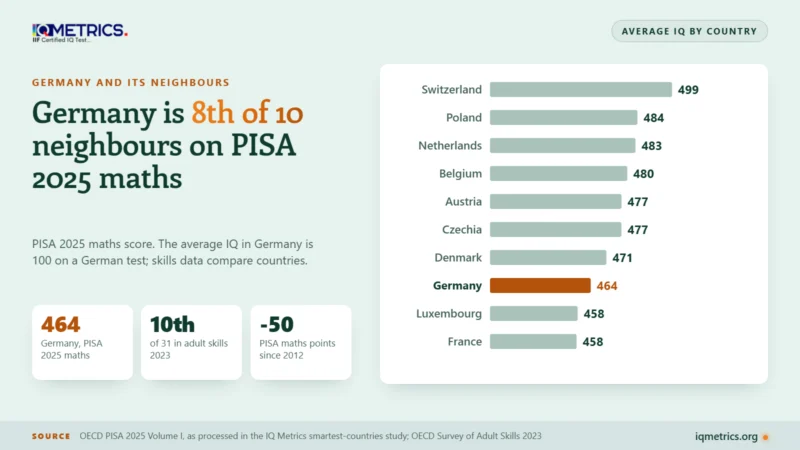 Scores & Scales
Average IQ in Germany
Average IQ in Germany is 100 on a German test. Germany's 15-year-olds scored 464 in PISA 2025 maths, adults rank 10th of 31 in adult skills, and an online test gives 99.32. See the UK, US and neighbour comparisons.
 Scores & Scales
Average IQ in China
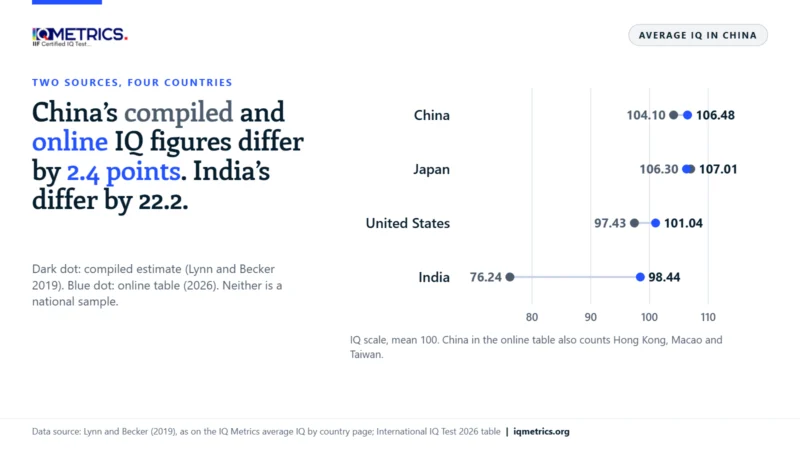
The average IQ in China is 100 on a China-normed test. The circulating national figures are 104.10 from a compiled estimate and 106.48 from an online table that also counts Hong Kong and Taiwan. See where each comes from, what PISA's four-region result covers, and how China compares with Japan and the US.
 Scores & Scales
Average IQ in Japan
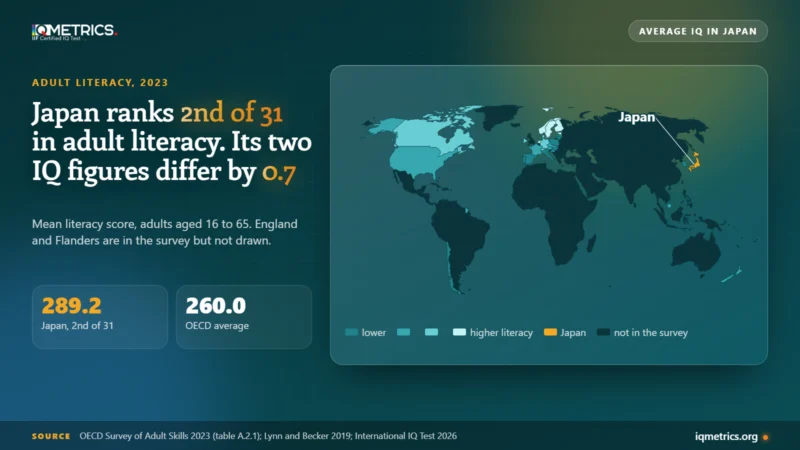
The average IQ in Japan is 100 on a Japanese-normed test. The circulating national figures are 107.01 (compiled) and 106.30 (online), only 0.7 points apart. See where each comes from, what PISA 2025 and the adult-skills survey show, and how Japan compares with South Korea, China and the US.