



What is Gukesh Dommaraju’s IQ?
Grandmaster at 12 years, 7 months and 17 days; World Champion at 18. The record is documented to the day. His IQ is not.

No published IQ test result exists for Gukesh Dommaraju (Gukesh D). The only number online for his IQ level is a generic 140–160 range for elite players, with no test behind it; the documented record (a peak FIDE rating of 2794, the 2024 Candidates win, board-one Olympiad gold and the world title at 18) supports an estimated IQ of about 135–150.
Gukesh Dommaraju’s estimated IQ
- Peak FIDE standard rating of 2794 on the October 2024 list, when he ranked fifth in the world; his best world rank is third (2787 on the March, April and May 2025 lists), and he has been rated 2700 or higher on all 49 lists from September 2022 to September 2026.
- Won the 2024 Candidates Tournament in Toronto with nine points from 14 rounds at 17, the youngest winner and the youngest challenger on record, then beat Ding Liren 7½–6½ in Singapore on December 12, 2024 to become the 18th World Champion.
- Board-one gold at the 2024 Chess Olympiad in Budapest: 9/10 (eight wins, two draws) with a performance rating of 3056, the best in the tournament, as India’s men won with 21 of 22 match points.
- Grandmaster at 12 years, 7 months and 17 days (January 15, 2019), the second-youngest in history at the time; FIDE lists his titles as Candidate Master 2015, International Master 2018 and Grandmaster 2019.
- Published research finds a positive but modest link between cognitive ability and chess skill (r = .24 across 19 studies in a 2016 meta-analysis, revised to .22 in 2018), and the ratings in the studies it pooled ran only from 1,311 to 2,607, which is why this is a band and not a point estimate.
Elo measures chess strength, not general reasoning: among rated players the link between fluid reasoning and chess skill was only r = .14 in the 2016 meta-analysis (.10 after the 2018 correction, no longer statistically significant), and the ratings in the pooled studies stopped at 2607, below his 2794 peak. Gukesh’s estimated IQ here is a band inferred from a record, not a measurement.
- Born
- May 29, 2006, Chennai, Tamil Nadu, India
- Field
- Chess; FIDE grandmaster (title 2019, earned at 12 years, 7 months and 17 days)
- World title
- World Champion since December 12, 2024 (beat Ding Liren 7½–6½, Singapore); defends against Javokhir Sindarov from November 24, 2026
- Peak FIDE rating
- 2794 (October 2024 list); best world rank No. 3 (March–May 2025 lists)
- FIDE rating, Sept. 2026
- 2703 standard, 2686 rapid, 2659 blitz; 32nd among active players
- 2024 results
- Candidates Tournament winner (Toronto, 9/14); Olympiad team gold and board-one gold (Budapest, 9/10)
- Honors
- Major Dhyan Chand Khel Ratna (presented January 17, 2025)
- Circulating IQ figure
- Only a generic 140–160 range for elite players; no test result published
What an IQ of 135–150 actually means
Set the claim aside for a moment. If someone genuinely scored in this range, here is what that would represent.
Average is 100 by construction, and about two-thirds of people fall between 85 and 115. Take the test to place your own score on this scale.
| Score range | Classification | Share of people | What it indicates |
|---|---|---|---|
| 85 – 114 | Average | ~68% | The range most people fall into. |
| 115 – 129 | Above average | ~13.6% | Roughly one person in seven. |
| 130 – 144 | Gifted | ~2% | The threshold most high-IQ societies use. |
| Above 144 | Highly gifted | ~0.1% | Figures above this range are extrapolated from the curve rather than measured. |
Percentages are approximate and describe a normal distribution. The same number means different things on tests with different standard deviations.
Thirty questions gives you a measured position on this exact scale — your score, your percentile and the ability breakdown behind it.
Find out in 30 minutes →Who Gukesh Dommaraju is
Gukesh Dommaraju was born on May 29, 2006 in Chennai, Tamil Nadu, and started playing chess at seven. FIDE’s records give his titles as Candidate Master in 2015, International Master in 2018 (approved at the Presidential Board meeting in Bucharest, July 8–11) and Grandmaster in 2019 (approved at the meeting in Astana, March 4–6). Wikipedia dates the grandmaster achievement to January 15, 2019, at 12 years, 7 months and 17 days, which made him the second-youngest grandmaster in history at the time, after Sergey Karjakin; on its list of the youngest grandmasters, updated September 18, 2026, he now ranks fourth. It also credits him with the under-12 title at the 2018 World Youth Chess Championship.
His FIDE rating passed 2700 on the September 2022 list (2726) and has stayed there: all 49 lists since show 2703 or higher. In April 2024 he won the Candidates Tournament in Toronto with nine points from 14 rounds, half a point ahead of Hikaru Nakamura, Ian Nepomniachtchi and Fabiano Caruana, who each scored 8½; at 17 he was the youngest winner of the tournament and the youngest challenger for the world title. That September he played board one for India at the Chess Olympiad in Budapest and scored 9/10 (eight wins, two draws) with a performance rating of 3056, the best in the tournament, as the Indian men won gold with 21 of 22 match points and the women’s team won gold as well. His October 2024 rating, 2794 and fifth in the world, is still his career high.
The title match against Ding Liren ran from November 25 to December 12, 2024 at Resorts World Sentosa in Singapore, over a maximum of 14 classical games. Gukesh went in as the higher-rated player, 2783 to 2728, and won 7½–6½: in game 14, with Black, he took the match when Ding blundered on move 55, allowing a winning king-and-pawn endgame, and resigned on move 58. Aged 18, he became the 18th World Champion and the youngest undisputed one, breaking the record Garry Kasparov set in 1985 (Chess.com notes that Ruslan Ponomariov won a separate FIDE title, in a 2002 knockout, at a slightly younger age). On January 17, 2025 President Droupadi Murmu presented him with the Major Dhyan Chand Khel Ratna.
Since the title win his rating has moved with his results: No. 3 in the world at 2787 on the March, April and May 2025 lists, and 2703 in standard chess (2686 rapid, 2659 blitz), 32nd among active players, on the September 2026 list. As reigning champion he did not play in the 2026 Candidates Tournament (Pegeia, Cyprus, March 28 to April 16), which Javokhir Sindarov of Uzbekistan won with 10/14. FIDE’s schedule, published September 14, 2026, has the title match between them at the Fondation Martin Bodmer in Cologny, Geneva: opening ceremony on November 22, first game on November 24, last scheduled classical game on December 11 and tie-breaks on December 12, 2026, with a prize fund of US$2.5 million; the first player to 7½ points wins. As of September 21, 2026, Gukesh D is the defending World Champion.
 By Elora Mercer, Celebrity Research WriterFigures checked by Leon Falkner, Data & Research Analyst
Reviewed by Aarav Vardhan, Editor-in-Chief · Last reviewed August 2026
.jpg)
Gukesh Dommaraju: the documented record
The estimate above rests on this record. Every entry here is a matter of public fact, which is more than can be said for the number itself.
- 2006Born on May 29 in Chennai, Tamil Nadu, India.
- 2015–18Candidate Master (2015), then International Master (2018, approved at FIDE’s Presidential Board in Bucharest, July 8–11).
- 2019Earns the grandmaster title on January 15 at 12 years, 7 months and 17 days, second-youngest ever at the time; FIDE approves it at its March 4–6 meeting in Astana.
- 2022September list: passes 2700 for the first time (2726) and stays above it on every list since.
- April 2024Wins the Candidates Tournament in Toronto with 9/14, aged 17: the youngest winner and youngest challenger on record.
- September 2024Board-one gold at the Chess Olympiad in Budapest, 9/10 with a performance rating of 3056, as India’s open and women’s teams both win gold.
- October 2024Reaches his peak FIDE rating, 2794, fifth in the world.
- December 2024Beats Ding Liren 7½–6½ in Singapore on December 12 to become the 18th World Champion and the youngest undisputed one.
- 2025Receives the Major Dhyan Chand Khel Ratna on January 17; reaches world No. 3 (2787) on the March–May lists.
- 2026Sindarov wins the Candidates (Cyprus, March 28–April 16); on the September list Gukesh is 2703 and 32nd, and FIDE schedules the title match for November 24–December 12 in Geneva.
Where the 140–160 figure came from
Following a claim back to its first appearance is the part almost nobody does — and it is what most people are actually asking.
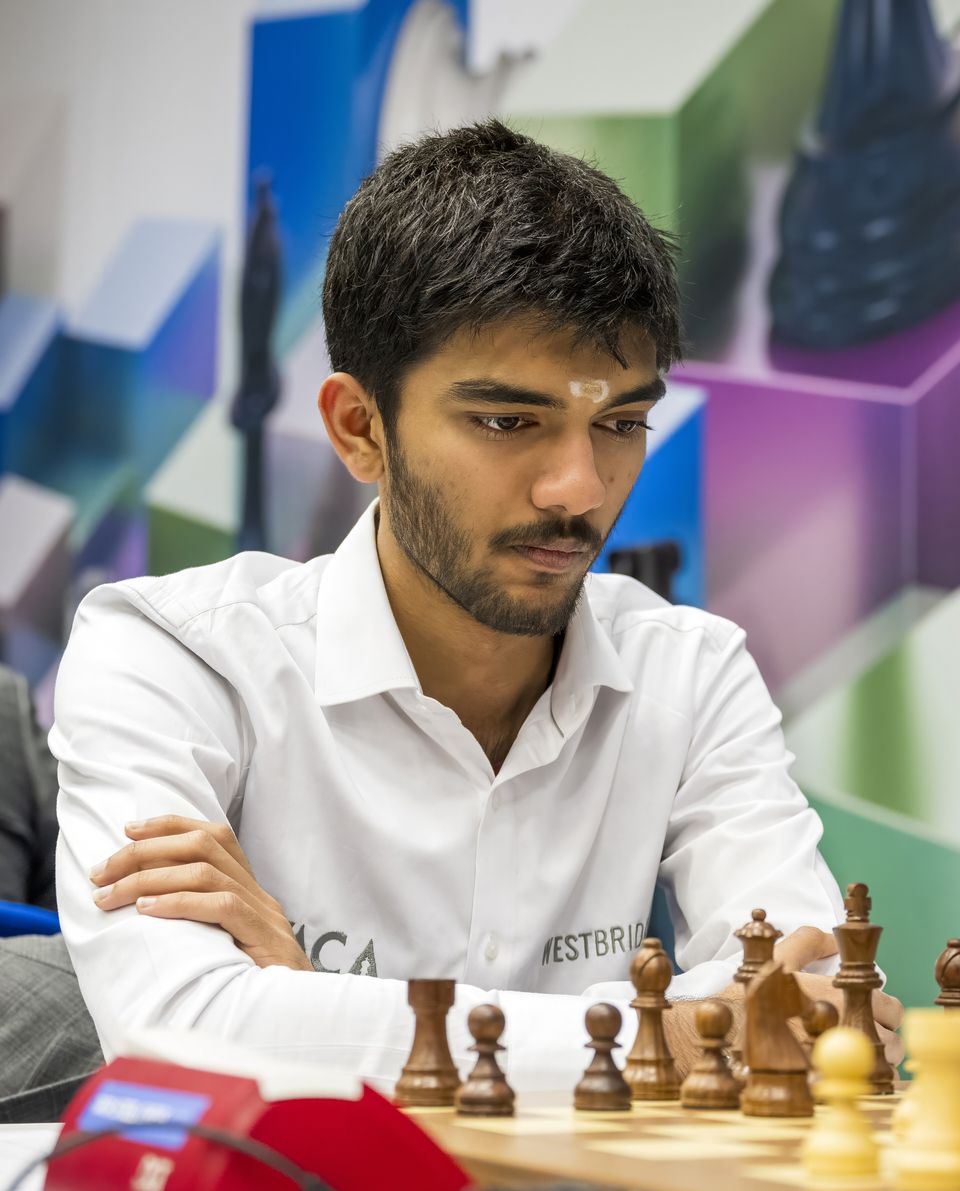
Gukesh’s IQ level is a question with no number behind it. FIDE lists him as Gukesh D, Wikipedia as Gukesh Dommaraju, and his name is also written D Gukesh, so searches such as “gukesh d iq” and “iq gukesh dommaraju” lead to the same few explainers. The one that gives a figure, a KhelaDesk English page dated April 18, 2026, says there is no publicly disclosed official score, then adds that experts estimate elite players like him fall between 140 and 160, or higher, without naming an expert, a test or a date; its stated basis is the cognitive demands of becoming World Champion at 18, so it reasons from the achievement to the score. chess.game’s explainer on the average IQ of chess players (updated February 26, 2026) mentions him only as the reigning champion and puts grandmasters at 120–130, again with no study. Two pages, two different bands for strong players, neither sourced: that is how a rating turns into an IQ without anyone measuring anything (where celebrity IQ numbers come from).
Gukesh’s IQ in chess is usually answered with his Elo rating, which says something about ability at the board and very little about IQ; the KhelaDesk page goes further and calls the skills chess demands strongly correlated with high intelligence. The largest synthesis, the 2016 meta-analysis by Burgoyne and colleagues in Intelligence (19 studies, 26 samples, 1,779 players), tested the claim, made in a 2007 Harvard Business Review article, that there is no correlation between IQ and expert performance in chess (talent versus practice). It found a small-to-medium positive one: r = .24 on average, about 6 percent of the variance as first reported, revised to .22 in the authors’ 2018 corrigendum. For fluid reasoning among rated players the correlation was r = .14 as first reported (.10 after the correction, no longer statistically significant), and full-scale IQ tests explained under 1 percent. The ratings in the studies ran from 1,311 to 2,607, so his 2794 peak lies 187 points above the highest rating they reported. See what a chess rating can and cannot say about IQ and the wider research on chess and intelligence.
Two features of his record make a conversion especially weak. Ratings move between lists: his standard rating was 2794 on the October 2024 list and 2703 on the September 2026 list, and any formula would return a different IQ for each, which a trait cannot do. That is why this page ties the band to the whole record (49 consecutive lists at 2700 or above since September 2022, a best world rank of third, a Candidates win and a title) and not to one list. He also reached the top young. The meta-analysis found its strongest fluid-reasoning link in youth samples (r = .32, against .11 in adult samples; .31 and .04 after the correction), but most young players in those studies were unranked and were assessed with chess tests, not ratings; among ranked youth the estimate was r = .27 as first reported (.18 corrected), with an interval that includes zero.
So the range follows the record, as on the site’s other chess profiles. Gukesh’s peak of 2794 sits below the 2817 of Viswanathan Anand and the 2816 of Hikaru Nakamura, whose bands are both 140–155, and well below the 2882 of Magnus Carlsen, whose band is 145–160; his estimate of 135–150 sits a step under the first two, a gap smaller than the uncertainty in any of them. Nakamura scored 8½ at the 2024 Candidates, half a point behind him, but a tournament finish is not an IQ point. As on most pages here, the documented record supports a range no higher than the circulating one: the top of ours is 150, ten below the top of the generic range, which is open-ended. For what a score in the middle of the band means in practice, see what an IQ of 140 means.
How we read a number →Standard 2703, rapid 2686 and blitz 2659 on the September 2026 list; 32nd among active players. Titles: Candidate Master 2015, International Master 2018 (Presidential Board, Bucharest, July 8–11) and Grandmaster 2019 (Presidential Board, Astana, March 4–6). Top Records shows 2794 and fifth in the world on the October 2024 list, 2787 and third on the March, April and May 2025 lists, and 2726 on the September 2022 list, the first above 2700; every list from September 2022 to September 2026 is at 2703 or higher.
Final score 7.5–6.5; Gukesh had Black in game 14; Ding Liren erred on move 55 and resigned on move 58; Gukesh is the 18th World Champion and the youngest ever in that line. No IQ figure.
Reigning World Champion Gukesh D against challenger Javokhir Sindarov at the Fondation Martin Bodmer, Cologny, Geneva: opening ceremony November 22, first game on November 24, last scheduled classical game December 11, tie-breaks December 12, 2026; up to 14 classical games, first to 7.5 points; prize fund USD 2.5 million. Sindarov won the 2026 Candidates Tournament in Cyprus with 10/14.
Birth date and place; the grandmaster date and age (January 15, 2019; 12 years, 7 months, 17 days; second-youngest at the time, fourth on the list updated September 18, 2026); the 2024 Candidates (Toronto, 9/14, youngest winner and challenger); the 2024 match (dates, venue, ratings 2783 and 2728); the Olympiad (21 of 22 match points, board-one gold, performance rating 3056); the 2026 Candidates (Sindarov 10/14; Gukesh ineligible as reigning champion); the Khel Ratna of January 17, 2025. Used for orientation and cross-checked against FIDE and Chess.com where they overlap; no IQ figure appears. Wikidata confirms the item is the chess grandmaster born May 29, 2006 in Chennai, FIDE ID 46616543.
Score 7.5–6.5 with ratings 2783 and 2728; “youngest-ever undisputed” champion, with the note that Ruslan Ponomariov won a separate FIDE title in a 2002 knockout at a slightly younger age. Olympiad: India’s men unbeaten with 21 of 22 match points, the women 19 of 21; Gukesh’s board-one gold with a performance rating of 3056, 30.1 rating points gained.
Score 7.5–6.5; Garry Kasparov had been the youngest world champion since 1985, when he beat Anatoly Karpov.
19 studies, 26 samples, 1,779 players; average r = .24, corrected to .22; fluid reasoning r = .14 in ranked samples (.10 corrected, not significant) and .32 in unranked; youth .32 and adult .11 (.31 and .04 corrected); full-scale IQ under 1 percent of variance; Elo ratings in the studies from 1,311 to 2,607; the authors caution about restricted rating range (standard deviation 148 against 200 for the Elo system) and confounding of age with skill level.
KhelaDesk says no official IQ score is public and gives a generic estimate of 140–160 (or higher) for elite players like him, based on the demands of becoming World Champion at 18, and citing no expert, test or method; its rating line (2732, No. 15, April 2026) matches FIDE’s April 2026 list. chess.game mentions Gukesh only as the reigning champion and gives 100–110 for chess players and 120–130 for grandmasters without a study.
Bands and peak ratings used for comparison: Anand 140–155 (peak 2817), Nakamura 140–155 (peak 2816) and Carlsen 145–160 (peak 2882).
None appears in FIDE’s profile, Wikipedia, Chess.com or FIDE’s reports of his title win, or on the two explainer pages above, and we found no interview in which Gukesh discusses an IQ test. Two other pages that surfaced in search could not be read (a ChessEasy Academy page returned a browser check; a Geniuses.Club profile did not load its content), so nothing here rests on them.
The sources behind our estimate
The figures that circulate for Gukesh Dommaraju, what we were able to confirm, and where the two diverge.
No specific IQ figure circulates for Gukesh Dommaraju. The closest is a generic range: a KhelaDesk English explainer dated April 18, 2026 says there is no publicly disclosed official IQ score for him, and adds that experts estimate elite players like him fall in a 140–160 range, or higher, based on the demands of becoming World Champion at 18. No expert, test or method is named.
No published IQ test result exists for Gukesh Dommaraju. We checked FIDE’s profile, the biographical articles listed under sources and the explainer pages that answer the question. KhelaDesk English gives the 140–160 range with no source; chess.game’s explainer on chess players’ IQs (updated February 26, 2026) mentions him only as the reigning World Champion and puts the average grandmaster at 120–130, also with no study cited. We found no interview in which Gukesh discusses an IQ test. Two other pages that surfaced in search could not be read (one refused our request, one did not load its profile), so we do not rely on them.
Our band ends at 150 and the generic range runs from 140 to 160, or higher, so the two overlap between 140 and 150. That overlap is not confirmation: the range describes elite players as a class and cites nothing, while ours is inferred from his own published record. An IQ score needs a test, and none has been published.
Want a number that does hold up? Every figure on this page is somebody’s claim. Take the 30-question test and get a percentile you can check rather than a figure you have to trust.
Gukesh Dommaraju — frequently asked
What is Gukesh Dommaraju’s IQ?
No IQ test result has been published for Gukesh Dommaraju, also written Gukesh D or D Gukesh. The only figure online is a generic 140–160 range for elite chess players, with no test or expert named. Our estimate, inferred from his chess record (peak FIDE rating 2794, Candidates and Olympiad wins, the world title at 18), is 135–150.
What is Gukesh’s IQ level: is it 140 to 160?
Gukesh’s IQ level is unknown because no test result exists. A KhelaDesk English page (April 18, 2026) says experts estimate elite players like him fall between 140 and 160, or higher, but it names no expert or test and admits no official score is public. Our inferred band, 135–150, overlaps it and is not a measurement.
Did Gukesh ever take an IQ test?
No result from any IQ test has been published, by Gukesh or anyone else, and we found no interview in which he mentions taking one. The only published measure of his ability is his FIDE rating, which peaked at 2794 in October 2024 and measures chess strength, not general reasoning.
What is Gukesh’s IQ in chess?
Chess has ratings, not IQ scores. Gukesh’s peak FIDE rating is 2794 (October 2024). A 2016 meta-analysis found chess skill correlates with cognitive ability at only r = .24 (.22 after a 2018 correction), far too loose to turn a rating into an IQ, and its ratings stopped at 2607. Our estimate for him is 135–150.
How does Gukesh’s estimated IQ compare with Viswanathan Anand’s and Magnus Carlsen’s?
Our range for Gukesh is 135–150, against 140–155 for Viswanathan Anand and 145–160 for Magnus Carlsen. All three are inferred from published FIDE ratings (peaks of 2794, 2817 and 2882), and none is a test score, so the gaps are smaller than the uncertainty in any of them.
What is Gukesh’s chess rating, and is he still world champion?
On the September 2026 FIDE list Gukesh D is rated 2703 in standard chess, 32nd among active players; his peak was 2794 in October 2024. He has been World Champion since December 12, 2024 and defends the title against Javokhir Sindarov in Geneva, with the first game on November 24, 2026.
Is Gukesh a genius?
“Genius” is a label, not a measurement, and no test result exists to apply it to. What the record shows is elite chess results reached young: grandmaster at 12, Candidates winner at 17, World Champion at 18. That measures one skill, so we do not turn it into a genius-level IQ; our band is 135–150.
How does my IQ compare with Gukesh Dommaraju?
You can find out in about fifteen minutes. The IQ Metrics assessment is 30 questions, scored on the same 100-mean scale used throughout this page, so your result and the estimate above are at least expressed in the same units — one measured, one inferred. Once you have a number, the leaderboard shows where it would sit, and how we score and norm it explains the benchmarking.
Where does this estimate come from?
From the documented record rather than a test — the method is named above and set out in full under how we read a number. Compare it against the other athletes profiles, starting with Magnus Carlsen.
- Take the 30-question IQ test — get a measured score and percentile of your own
- Average IQ by country — how the scale behaves across populations
- How IQ Metrics scores its assessment — the method behind our own number
- More on how IQ testing works — reliability, error and what a score can and cannot say
- More athletes profiles — same field, same method
More athletes
Portrait © Frans Peeters, CC BY-SA 2.0. The background-removed portrait above is a derivative work and is likewise offered under the same licence. · Photograph by Bert Verhoeff for Anefo (1972), CC0. Background removed for the portrait above. · Photograph by Fryta 73 (2015), CC BY-SA 2.0. Background removed for the portrait above.


_(cropped)_2.jpg)
An estimate is an inference.
Yours can be measured.
Thirty questions, scored against general-population benchmarks. Your score, your percentile, your ability breakdown and a printable IIF certificate.
Find your IQ score now! →