



What was Victor Hugo’s IQ?
180 is a real number from 1926. The caveats that came with it didn’t make the trip.
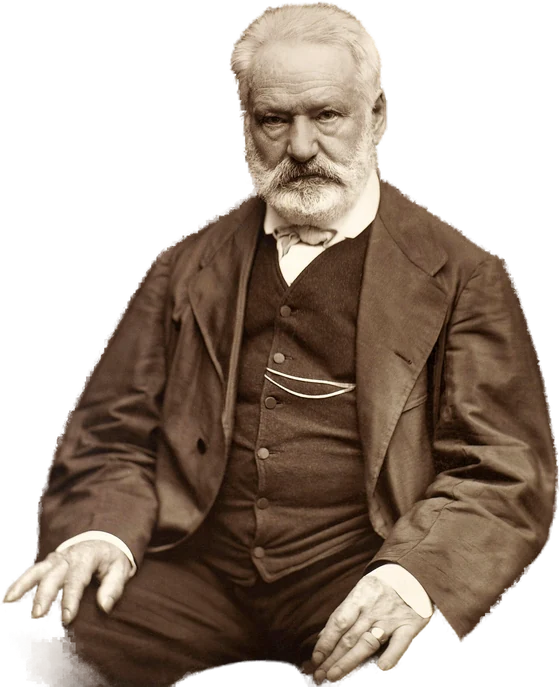
Victor Hugo’s documented record includes an Académie française seat, a career in the National Assembly and the Senate, and nearly nineteen years of self-imposed exile rather than live under a regime he refused to recognize. The IQ figure attached to him, 180, is not invented — it is Catharine Cox’s own 1926 estimate, the same source behind several other names on this site, and it circulates almost everywhere as a bare fact, with her year, her method and her caveats left off.
Victor Hugo’s estimated IQ
- Cox’s 1926 study assigns Hugo a “corrected IQ estimate” of 180 in Table 12A, column 25 (AII) — the same column and method behind this site’s Voltaire and Goethe estimates.
- Won an honorable mention — not the top prize — in the Académie française’s 1817 poetry competition at age fifteen; the judges suspected he was lying about his age.
- Published across poetry, drama and the novel for roughly six decades, from Odes et poésies diverses (1822) to Quatrevingt-treize (Ninety-Three, 1874), alongside a political career and a correspondence historiometry can draw on much as it draws on Voltaire’s.
No IQ test result exists for Hugo — he died in 1885, two decades before the first practical intelligence scale was published. Cox’s method infers a score from documented childhood and early-adulthood achievement, which rewards exactly what Hugo left behind in unusual quantity: contest entries, published verse, and a paper trail most of his contemporaries didn’t generate. That is a real signal about a well-archived life, not a measured mind.
- Born
- 26 February 1802, Besançon
- Died
- 22 May 1885, Paris
- Académie française
- Elected 7 January 1841
- Political career
- Peer of France (1845); National Assembly (1848–51, 1871); Senate (1876–85)
- Exile
- Nearly 19 years, 1851–1870 — Brussels, then Jersey, then Guernsey
- In Cox’s 1926 study?
- Yes — Table 12A, “corrected” estimate of 180
What an IQ of 165–180 actually means
Set the claim aside for a moment. If someone genuinely scored in this range, here is what that would represent.
Average is 100 by construction, and about two-thirds of people fall between 85 and 115. Take the test to place your own score on this scale.
| Score range | Classification | Share of people | What it indicates |
|---|---|---|---|
| 85 – 114 | Average | ~68% | The range most people fall into. |
| 115 – 129 | Above average | ~13.6% | Roughly one person in seven. |
| 130 – 144 | Gifted | ~2% | The threshold most high-IQ societies use. |
| Above 144 | Highly gifted | ~0.1% | Figures above this range are extrapolated from the curve rather than measured. |
Percentages are approximate and describe a normal distribution. The same number means different things on tests with different standard deviations.
Thirty questions gives you a measured position on this exact scale — your score, your percentile and the ability breakdown behind it.
Find out in 30 minutes →Who Victor Hugo was
Born in Besançon in 1802 to a Napoleonic general and a royalist mother, Hugo published his first poetry collection, Odes et poésies diverses, in 1822 — the same year he married Adèle Foucher — and won a pension from Louis XVIII for it. Hernani’s 1830 premiere set off the “Battle of Hernani”, several nights of jeering and outright rioting between Romantic and traditionalist factions in the audience. Notre-Dame de Paris followed in 1831; the novel is widely credited with reviving public interest in the cathedral’s neglected state and feeding into the restoration Eugène Viollet-le-Duc began there in 1842. Hugo was elected to the Académie française in January 1841, after several earlier attempts had failed.
His politics moved the opposite direction from his fame: raised a royalist, he was a declared republican by the late 1840s, made a Peer of France in 1845 and elected to the National Assembly in 1848. He broke publicly with Louis-Napoleon Bonaparte over the coup of 2 December 1851 that dissolved the Assembly and made Bonaparte Emperor Napoleon III, fled to Brussels on a false passport, and spent nearly nineteen years in exile — Jersey until his circle’s expulsion in 1855, then Guernsey. When Napoleon III offered a general amnesty in 1859, Hugo refused it publicly, from his house on Guernsey: “Quand la liberté rentrera, je rentrerai” — “When liberty returns, I will return.” He kept his word, returning to France on 5 September 1870, only once the Second Empire had actually fallen.
Les Misérables, underway for years before the exile, was finally published in 1862, appearing simultaneously in eight cities and selling out in Paris within a week. Hugo returned briefly to the National Assembly in 1871 and served as a senator for Seine from 1876 until his death in Paris on 22 May 1885, aged eighty-three. His state funeral drew an estimated two to three million people along the route between the Arc de Triomphe and the Panthéon, which the government secularized for the occasion so that an outspoken critic of the Church could be buried there, in the plain pauper’s hearse he had requested in his will.
 By Elora Mercer, Celebrity Research WriterFigures checked by Leon Falkner, Data & Research Analyst
Reviewed by Aarav Vardhan, Editor-in-Chief · Last reviewed August 2026

Where the 180 figure came from
Following a claim back to its first appearance is the part almost nobody does — and it is what most people are actually asking.
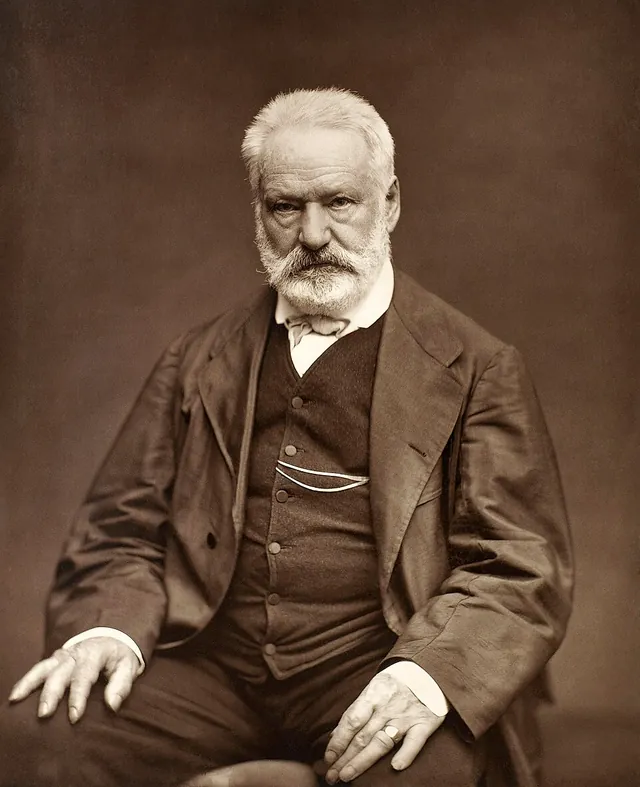
Victor Hugo is a genuine subject of Catharine Cox’s 1926 study, The Early Mental Traits of Three Hundred Geniuses — unlike Bertrand Russell, whose “180” has no traceable source at all and who was born too late to qualify. Cox’s Table 12A gives Hugo a “corrected IQ estimate” of 180, the exact figure that still circulates for him, cited from the same column this site uses for Voltaire’s 190 and Goethe’s 210.
The method rewards exactly the kind of paper trail Hugo left behind. At fifteen he entered the Académie française’s own poetry competition; suspecting the prodigy was lying about his age, the judges gave him an honorable mention rather than the top prize. He went on to publish across poetry, drama and the novel for roughly six decades, building the kind of dense, dated biographical record that a method built from biographical record will always score highly.
What gets lost is everything the number stands in for. geniuses.club lists Hugo at “IQ 180” with no source attached, the same unsourced-listing pattern already found on this site’s Bertrand Russell and Henry Kissinger pages. A 1926 inference from a well-documented childhood is a strange thing to reach for when the adult record needs no inference at all — a National Assembly seat, a Senate seat, and nineteen years of exile taken by choice are already on file.
How we read a number →Lists Hugo’s “corrected IQ estimate” (AII) as 180 — the same figure and the same column cited for Voltaire and Goethe elsewhere on this site.
Confirms the 1817 honorable mention at age fifteen, and the January 1841 election on a later attempt.
Confirms the 1845 peerage, the 1848–51 and 1871 Assembly seats, the 1876 Senate election, and quotes his 18 August 1859 refusal of Napoleon III’s amnesty in full.
Hugo died in 1885. Alfred Binet and Théodore Simon published the first practical intelligence scale in 1905, twenty years later.
Source of the circulating 180 figure as a bare fact, with no citation to Cox, to 1926, or to the historiometric method.
The sources behind our estimate
The figures that circulate for Victor Hugo, what we were able to confirm, and where the two diverge.
“180” is the figure most often attached to Victor Hugo online, on genius-ranking sites and in forum discussion alike.
The 180 that circulates for Victor Hugo is not fabricated: it is Catharine Cox’s own 1926 “corrected” estimate for him, Table 12A, column 25 — the identical citation this site already uses for Voltaire’s 190. geniuses.club lists Hugo at “IQ 180” among its “Greatest French Geniuses”, with no citation attached to the number, the same pattern already documented on Bertrand Russell’s and Henry Kissinger’s pages. A few corners of the internet do credit Cox by name — one Quora thread is framed as “Cox thought Victor Hugo’s IQ was 180” — but most repeat the number with her study, her year and her method for it removed.
Unlike most subjects on this site, these two numbers don’t contradict each other: 158 and 180 are the same 1926 estimate, before and after a modern statistical adjustment for score inflation over time. The sites that just print “180” have picked the older, larger, unadjusted one.
Want a number that does hold up? Every figure on this page is somebody’s claim. Take the 30-question test and get a percentile you can check rather than a figure you have to trust.
Victor Hugo — frequently asked
What was Victor Hugo’s IQ?
No test result exists — intelligence testing wasn’t invented until twenty years after his death. The 180 that circulates for him is a real number, but it’s Catharine Cox’s 1926 historiometric estimate, built from his documented achievements, not a measured score.
Is the “180” IQ figure for Victor Hugo accurate?
It accurately repeats a real number: Cox published exactly 180 as Hugo’s “corrected” estimate in her 1926 study. What’s inaccurate is how it travels — as a flat, sourceless fact, with Cox’s name, her year and her method all left out.
Was Victor Hugo actually part of Cox’s 1926 genius study?
Yes. Unlike Bertrand Russell, who is sometimes linked to the same study despite not qualifying for it, Hugo genuinely appears in Cox’s table of 301 historical subjects, born inside her 1450–1850 window, with a corrected estimate of 180.
Why was Victor Hugo exiled?
He publicly opposed Louis-Napoleon Bonaparte’s coup of 2 December 1851, which dissolved the elected National Assembly and led to the Second Empire. Hugo fled to Brussels, then the Channel Islands, and stayed in exile for nearly nineteen years, refusing an 1859 amnesty on principle and returning only after the Empire fell in 1870.
What is Victor Hugo best known for?
The novels Notre-Dame de Paris (1831; better known in English as The Hunchback of Notre-Dame) and Les Misérables (1862), along with a decades-long parallel career as a poet, playwright and politician.
Did Victor Hugo hold political office?
Yes. He was made a Peer of France in 1845, sat in the National Assembly from 1848 to 1851 and again briefly in 1871, and served as a senator for Seine from 1876 until his death in 1885.
How does my IQ compare with Victor Hugo?
You can find out in about fifteen minutes. The IQ Metrics assessment is 30 questions, scored on the same 100-mean scale used throughout this page, so your result and the estimate above are at least expressed in the same units — one measured, one inferred. Once you have a number, the leaderboard shows where it would sit, and how we score and norm it explains the benchmarking.
Where does this estimate come from?
From the documented record rather than a test — the method is named above and set out in full under how we read a number. Compare it against the other writers profiles, starting with Voltaire.
- Take the 30-question IQ test — get a measured score and percentile of your own
- Average IQ by country — how the scale behaves across populations
- How IQ Metrics scores its assessment — the method behind our own number
- More on how IQ testing works — reliability, error and what a score can and cannot say
- More writers profiles — same field, same method
More writers


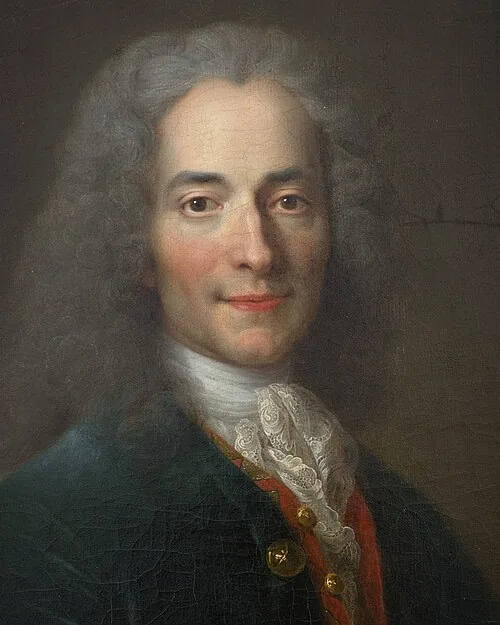
Photograph by Christopher Michel (March 18, 2016), CC BY-SA 4.0. Cropped from the original. Background removed for the portrait above. · Photograph by Kevin Payravi (Toronto International Film Festival, September 6, 2024), CC BY-SA 4.0. Cropped and with background removed for the portrait above. · Portrait from the workshop of Nicolas de Largillière, public domain.
.jpg)
.jpg)
_-002.jpg)
An estimate is an inference.
Yours can be measured.
Thirty questions, scored against general-population benchmarks. Your score, your percentile, your ability breakdown and a printable IIF certificate.
Find your IQ score now! →