


What is Sam Harris’ IQ?
His UCLA doctorate studied what belief looks like in the brain. The IQ numbers attached to his name ask to be believed with no test behind them.
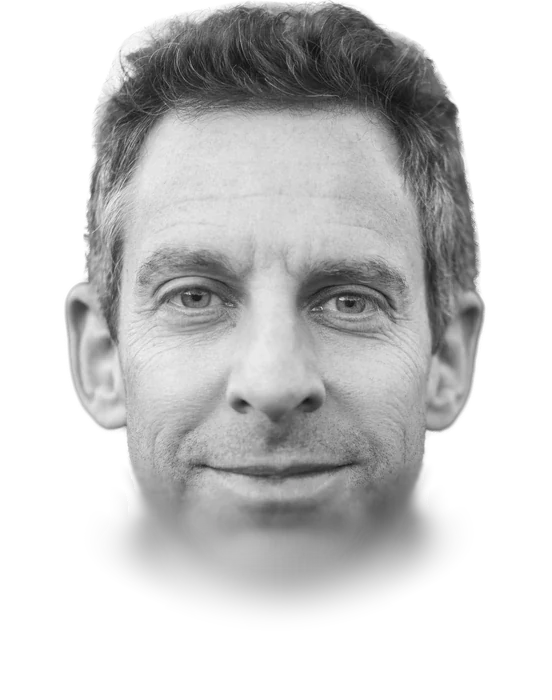
No IQ test result for Sam Harris has been published, and the IQ score one aggregator prints for him, 150, names no test, examiner or date. What is documented — a Stanford philosophy degree (2000), a UCLA neuroscience Ph.D. (2009) with first-author fMRI papers and a 2005 PEN award for The End of Faith — supports an estimated IQ of 130–145: an inference from the record, not a measurement.
Sam Harris’ estimated IQ
- A philosophy degree from Stanford University (a B.A., per Wikipedia and Wikidata), completed in 2000 after he stopped out to study Eastern philosophies and returned at age 30, according to a July/August 2005 Stanford Magazine profile.
- A Ph.D. in neuroscience from UCLA (2009), earned in the lab of Mark S. Cohen; a UCLA Health release of October 1, 2009 says he had “recently completed his doctoral dissertation” there.
- First author of two peer-reviewed fMRI papers from his doctoral years: Harris, Sheth and Cohen on belief, disbelief and uncertainty (Annals of Neurology, 2008) and Harris and five co-authors on religious and nonreligious belief (PLoS ONE, 2009).
- His first book, The End of Faith (W. W. Norton, 2004), won the PEN/Martha Albrand Award for First Nonfiction in 2005, according to PEN America’s winners list.
This is an inference from credentials, not a measurement: a bachelor’s degree, a doctorate and two first-author papers show sustained academic ability but track IQ only loosely, and his books, podcast and app are left out because audience size measures readers and listeners, not reasoning. Fluent public argument is easy to mistake for a higher number, so the true value could fall outside this range in either direction.
- Born
- April 9, 1967, Los Angeles, California
- Education
- Stanford University, philosophy degree (B.A.), 2000; UCLA, Ph.D. in neuroscience, 2009
- Doctoral work
- fMRI research on belief, disbelief and uncertainty in Mark S. Cohen’s lab; dissertation catalogued as “The Moral Landscape: How Science Could Determine Human Values”
- Best-known books
- The End of Faith (2004); Letter to a Christian Nation (2006); The Moral Landscape (2010); Waking Up (2014)
- Award
- PEN/Martha Albrand Award for First Nonfiction, 2005, for The End of Faith
- Media
- Making Sense podcast (originally Waking Up), from September 2013; Waking Up app, 2018
- Circulating IQ figure
- 150 on celebrityiq.info, labeled an estimate; no test cited
- Published IQ test result
- None found
What an IQ of 130–145 actually means
Set the claim aside for a moment. If someone genuinely scored in this range, here is what that would represent.
Average is 100 by construction, and about two-thirds of people fall between 85 and 115. Take the test to place your own score on this scale.
| Score range | Classification | Share of people | What it indicates |
|---|---|---|---|
| 85 – 114 | Average | ~68% | The range most people fall into. |
| 115 – 129 | Above average | ~13.6% | Roughly one person in seven. |
| 130 – 144 | Gifted | ~2% | The threshold most high-IQ societies use. |
| Above 144 | Highly gifted | ~0.1% | Figures above this range are extrapolated from the curve rather than measured. |
Percentages are approximate and describe a normal distribution. The same number means different things on tests with different standard deviations.
Thirty questions gives you a measured position on this exact scale — your score, your percentile and the ability breakdown behind it.
Find out in 30 minutes →Who Sam Harris is
Sam Harris, the American author, philosopher and neuroscientist, was born on April 9, 1967, in Los Angeles; he is one of eight people with the name on Wikipedia’s disambiguation page. A July/August 2005 Stanford Magazine profile says he studied English at Stanford University for two years, stopped out to study Eastern philosophies, and returned at age 30 to major in philosophy, graduating in 2000. Wikipedia places the years away in India and Nepal, studying meditation with Buddhist and Hindu teachers, eleven years overseas in all. The day after the September 11, 2001 attacks he began writing The End of Faith: Religion, Terror, and the Future of Reason.
The End of Faith was published by W. W. Norton in 2004 and won the 2005 PEN/Martha Albrand Award for First Nonfiction; Letter to a Christian Nation followed in 2006. By then he was working toward a Ph.D. in neuroscience at UCLA: the Stanford Magazine profile has him pursuing it in mid-2005, and a UCLA Health release of December 11, 2007 calls him “a UCLA graduate student in the lab of Mark Cohen” as his group’s Annals of Neurology paper reported that belief, disbelief and uncertainty engage different brain regions in fMRI scans. A second study, in PLoS ONE (September 30, 2009), compared how 30 adult volunteers’ brains responded to religious and nonreligious statements, and UCLA’s release of October 1, 2009 says Harris had “recently completed his doctoral dissertation” in Cohen’s lab. Wikipedia dates the degree to 2009 and calls it cognitive neuroscience; ProQuest catalogs the dissertation as “The Moral Landscape: How Science Could Determine Human Values.”
After the doctorate, The Moral Landscape (Free Press, 2010) and Free Will (Free Press, 2012) reached general readers, followed by Waking Up: A Guide to Spirituality Without Religion (2014). Wikipedia dates his podcast, now called Making Sense and originally Waking Up, to September 2013. Episode #68, released March 19, 2017, was a conversation with Yuval Noah Harari about meditation, stories and meaning, and in 2018 Harris held four public conversations with Jordan Peterson in Vancouver, Dublin and London. The Waking Up meditation app dates to 2018, and the podcast is still running: episode #494, dated September 22, 2026, was the most recent we could see.
Read together, the record anchors a range rather than a number. Group averages tend to rise with education (see average IQ by education level), so a completed UCLA doctorate with two first-author papers makes an estimated IQ around 130–145 reasonable, roughly the territory of an IQ of 135. That range sits level with Yuval Noah Harari (130–145), whose page also rests on a completed doctorate, and a little above Jordan Peterson (125–140), a gap smaller than the method can resolve. It sits below Nassim Nicholas Taleb (145–160), whose page adds a Wharton MBA and a trading career, and well below Bertrand Russell (160–175), another philosopher who wrote against religious belief for general readers, in the 1927 pamphlet Why I Am Not a Christian, but whose page rests on a ranked Cambridge result and a Nobel Prize. Whether Harris reaches what is usually called a genius IQ level is a question only a test could answer.
 By Elora Mercer, Celebrity Research WriterFigures checked by Leon Falkner, Data & Research Analyst
Reviewed by Aarav Vardhan, Editor-in-Chief · Last reviewed August 2026
.jpg)
Sam Harris: the documented record
The estimate above rests on this record. Every entry here is a matter of public fact, which is more than can be said for the number itself.
- 1967Born on April 9 in Los Angeles.
- 2000Graduates from Stanford with a philosophy degree, having returned at age 30 after stopping out to study Eastern philosophies.
- 2001–2004Begins writing The End of Faith the day after the September 11 attacks; W. W. Norton publishes it in 2004.
- 2005The End of Faith wins the PEN/Martha Albrand Award for First Nonfiction; a Stanford Magazine profile has him pursuing a Ph.D. in neuroscience.
- 2007On December 11, UCLA Health describes him as a UCLA graduate student in Mark Cohen’s lab as the Annals of Neurology belief study is announced.
- 2009Completes his UCLA doctorate; the PLoS ONE study of religious and nonreligious belief appears on September 30.
- 2010Publishes The Moral Landscape, the title his 2009 doctoral dissertation also carries in ProQuest’s catalog.
- 2013The podcast now called Making Sense, originally titled Waking Up, begins in September, according to Wikipedia.
- 2017Episode #68 of the podcast, released March 19, is a conversation with Yuval Noah Harari.
- 2018Holds public conversations with Jordan Peterson in Vancouver (June 24 and 25), Dublin (July 14) and London (July 16); the Waking Up app launches.
Where the 150 figure came from
Following a claim back to its first appearance is the part almost nobody does — and it is what most people are actually asking.
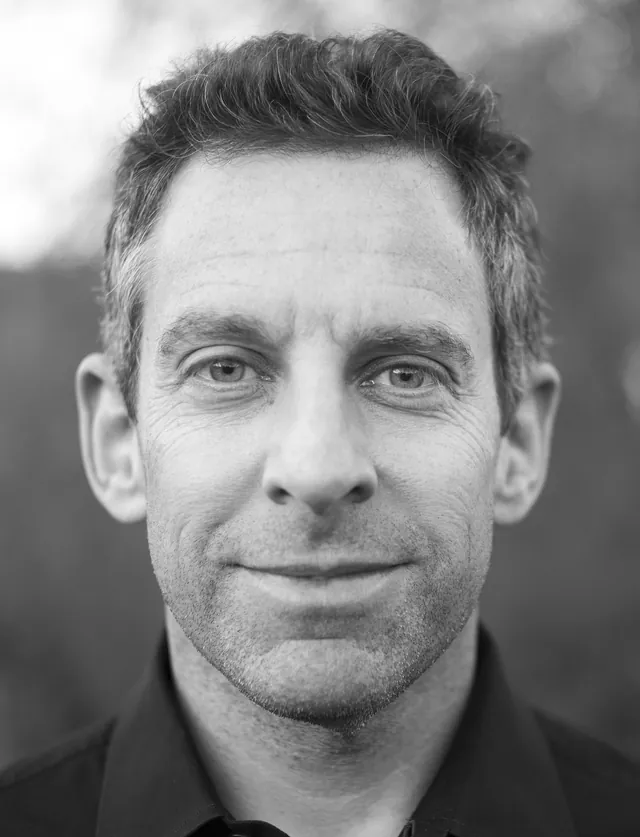
Search for “Sam Harris IQ” and the results include a page that prints a number and a page that says none exists. celebrityiq.info gives 150 as an “Estimated IQ,” with a 99.957th percentile attached, while whats-your-iq.com says plainly that he has no published test result and that no reliable figure circulates. What the 150 rests on is visible on celebrityiq.info: a list of general traits, such as a following built on intellectual credibility and an ability to explain complex ideas, and a footer saying the figures are estimates compiled from public sources, not verified test results. For how numbers like this usually get attached to famous names, see where celebrity IQ numbers come from; here, a real biography has been converted into a figure that no examiner produced.
One forum guess goes higher still. On Reddit, an August 16, 2023 post on r/cognitiveTesting, which we read through a public archive, asked whether Harris or Jordan Peterson has the higher “verbal IQ” and conjectured that both were above 165; the replies we could read called that far too high and put Harris near 150, again without a test for him. The pairing is natural: the two held public conversations in Vancouver, Dublin and London in 2018, according to Peterson’s own site. Peterson’s page traces his 150 to his own recollection of a test he says he once took; we found no comparable recollection from Harris.
A figure like 150 asks a lot of a biography. On the usual scale, with a standard deviation of 15, it sits about 3.3 standard deviations above the mean, the “1 in 2,300” that celebrityiq.info prints. Because a high IQ score is rare, a claim that high needs a named test, an examiner and a date to stand on, and no degree, book or podcast can supply those. The direction of the error is the usual one on this site: the circulating figure runs above what the record supports. The documented record backs a range that tops out at 145, so the 150 sits just above it, and it is an estimate, not a measurement.
What would settle the question is a documented result: a named test, an examiner and a date, released by Harris or by a source close to him. We found none. His own biographies, a 2005 Stanford Magazine profile, UCLA’s press releases about his research and PEN America’s listing for his first book describe degrees, studies and books, and none says he has been tested. Anyone curious about their own reasoning can take a timed test such as the IQ Metrics test, but a score for someone else has to come from a record, and the records for Harris contain none.
How we read a number →The About page and the Edge.org bio both say he has a philosophy degree from Stanford and a Ph.D. in neuroscience from UCLA, and samharris.org adds that The End of Faith won the 2005 PEN award; neither mentions IQ. Episode #68, “Reality and the Imagination,” is dated March 19, 2017 (guest Yuval Noah Harari); episode #494, dated September 22, 2026, shows he is active. The books page subtitles The Moral Landscape “How Science Can Determine Human Values.”
Says he studied English at Stanford for two years before stopping out to study Eastern philosophies, returned at age 30 and majored in philosophy, graduated in 2000 and was pursuing a Ph.D. in neuroscience on the biology of belief; that he began writing The End of Faith the day after September 11, 2001; and that the book won the 2005 PEN award for first nonfiction. No mention of IQ.
The first calls Harris a UCLA graduate student in the lab of Mark Cohen and reports the Annals of Neurology fMRI study (14 volunteers). The second says he “recently completed his doctoral dissertation” in Cohen’s lab and was a lead author of the PLoS ONE study (30 adults; co-authors at UCLA and Pepperdine). Neither mentions IQ or a test.
Lists 2005: Sam Harris, The End of Faith: Religion, Terror, and the Future of Reason (W. W. Norton & Company). The page gives no finalists or criteria; Harris’s own site calls the honor “the 2005 PEN Award for Nonfiction.”
Europe PMC records (DOIs 10.1002/ana.21301 and 10.1371/journal.pone.0007272) list Harris as first author of both and give his affiliation as UCLA’s brain mapping center. Peer-reviewed output from the doctoral years; evidence of academic ability, not a measurement of it.
Confirms the title, author, institution and year. The record preview did not show the degree type, so “Ph.D.” rests on his own biography, Wikipedia and Wikidata (which lists Doctor of Philosophy, 2009). The 2010 book of the same name carries the subtitle “How Science Can Determine Human Values,” with “Can” rather than “Could.”
Peterson writes that he and Harris met in Vancouver on June 24 and 25, 2018 for about five hours of discussion of morality, science and religion, with further events in Dublin (July 14) and London (July 16). The Spectator piece places the Dublin (3Arena) and London (O2 Arena) events in July 2018, moderated by Murray after Bret Weinstein moderated Vancouver.
Wikidata confirms the identity (American author, philosopher and neuroscientist; born April 9, 1967, Los Angeles) and lists a Stanford Bachelor of Arts in philosophy (2000) and a UCLA Doctor of Philosophy (2009). Open Library dates the books. Wikipedia alone supports the India and Nepal years and the 1997 return, the cognitive neuroscience label, Mark S. Cohen as adviser, the podcast’s September 2013 start and original title, the 1927 date of Russell’s pamphlet, and the count of eight people named Sam Harris.
celebrityiq.info: “Estimated IQ” 150, 99.957th percentile, “1 in 2,300”; evidence is general traits; footer says estimates are compiled from public sources and are not verified test results. Reddit (August 16, 2023, 40 comments, read through a public archive): one poster conjectures verbal IQs above 165 for Harris and Peterson; replies put Harris near 150; no test for him.
No test, score or self-report appears in Harris’s biographies, Stanford Magazine, UCLA Health’s releases, PEN America’s list, Wikipedia or Wikidata, and whats-your-iq.com states that he has no published IQ test result and no reliable figure circulates.
The sources behind our estimate
The figures that circulate for Sam Harris, what we were able to confirm, and where the two diverge.
Sam Harris’s IQ appears as one specific figure on the pages we could open: celebrityiq.info prints 150 as an “Estimated IQ.” A forum guess goes higher for verbal ability: an August 2023 post on Reddit’s r/cognitiveTesting conjectured verbal IQs above 165 for him and Jordan Peterson, without citing a test.
No IQ test result and no self-reported score appears on any page we read — his own biography on samharris.org, his Edge.org member bio, the Waking Up site’s About page, a 2005 Stanford Magazine profile, UCLA Health’s 2007 and 2009 press releases about his research, PEN America’s winners list, or Wikipedia and Wikidata. celebrityiq.info describes its 150 as an estimate compiled from public sources, not a verified test result, and supports it with general traits such as analytical insight and explaining complex ideas rather than a test. whats-your-iq.com goes the other way and says that he has no published test result and that no reliable figure circulates.
The 150 sits just above the top of a 130–145 range, and it is not a measurement: the page that prints it calls it an estimate. A Reddit guess of verbal IQs above 165 runs higher still, which shows these numbers follow impressions of a speaker, not results.
Want a number that does hold up? Every figure on this page is somebody’s claim. Take the 30-question test and get a percentile you can check rather than a figure you have to trust.
Sam Harris — frequently asked
What is Sam Harris’s IQ?
No IQ test result for Sam Harris has been published, so his IQ has no measured value. The estimate that circulates, 150, comes from an aggregator page that cites no test. IQ Metrics estimates a range of 130–145, inferred from his Stanford philosophy degree, his UCLA neuroscience Ph.D. and his first-author fMRI papers. It is an inference, not a score.
Did Sam Harris ever take an IQ test?
There is no public record of one. His own biographies, a 2005 Stanford Magazine profile, UCLA press releases about his research and PEN America’s awards list describe degrees, studies and books, and none mentions an IQ test or score. We also found no interview in which he gives a figure, so any number attached to him is an outside estimate.
Where does Sam Harris’s 150 IQ score come from?
It appears as an “Estimated IQ” on celebrityiq.info, which says its figures are compiled from public sources and are not verified test results. The page names no test, examiner or date; its evidence is general traits such as analytical insight and explaining complex ideas. It is an estimate drawn from a biography, not a result.
What do Reddit threads say about Sam Harris’s IQ?
They are guesses, not evidence. An August 2023 post on r/cognitiveTesting asked whether he or Jordan Peterson has the higher verbal IQ and conjectured that both were above 165; replies we could read called that too high and put him near 150. None cited a test for him, and we found no thread in which he states a score himself.
Is Sam Harris a genius?
No IQ test has labeled him one, and “genius” is not a documented status. What is documented is a Stanford philosophy degree (2000), a UCLA neuroscience Ph.D. (2009), two first-author fMRI papers and a 2005 PEN award for The End of Faith. Those support an estimated IQ level of 130–145, high but not certified.
How does Sam Harris’s estimated IQ compare with Yuval Noah Harari’s or Jordan Peterson’s?
All three are placed by the same kind of evidence, completed doctorates and academic records, so the ranges overlap: 130–145 for Harris, 130–145 for Yuval Noah Harari and 125–140 for Jordan Peterson. Harris interviewed Harari on his podcast on March 19, 2017 and shared a stage with Peterson in 2018. None is a test result, and the differences sit inside the method’s margin of error.
Where did Sam Harris study, and what was his doctoral research about?
He studied English at Stanford for two years, stopped out to study Eastern philosophies, and returned at 30 to major in philosophy, graduating in 2000. He then earned a Ph.D. in neuroscience at UCLA (2009) in Mark S. Cohen’s lab, using fMRI to study belief, disbelief and uncertainty.
How does my IQ compare with Sam Harris?
You can find out in about fifteen minutes. The IQ Metrics assessment is 30 questions, scored on the same 100-mean scale used throughout this page, so your result and the estimate above are at least expressed in the same units — one measured, one inferred. Once you have a number, the leaderboard shows where it would sit, and how we score and norm it explains the benchmarking.
Where does this estimate come from?
From the documented record rather than a test — the method is named above and set out in full under how we read a number. Compare it against the other writers profiles, starting with Voltaire.
- Take the 30-question IQ test — get a measured score and percentile of your own
- Average IQ by country — how the scale behaves across populations
- How IQ Metrics scores its assessment — the method behind our own number
- More on how IQ testing works — reliability, error and what a score can and cannot say
- More writers profiles — same field, same method
More writers
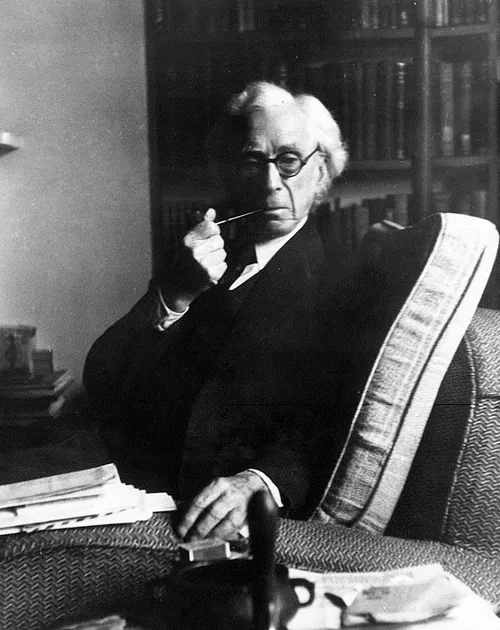
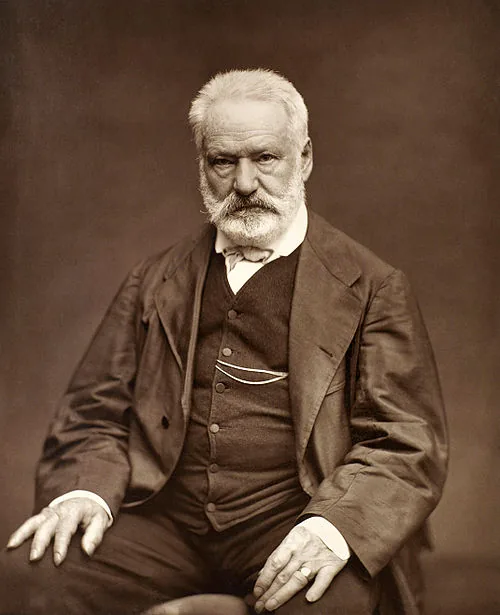
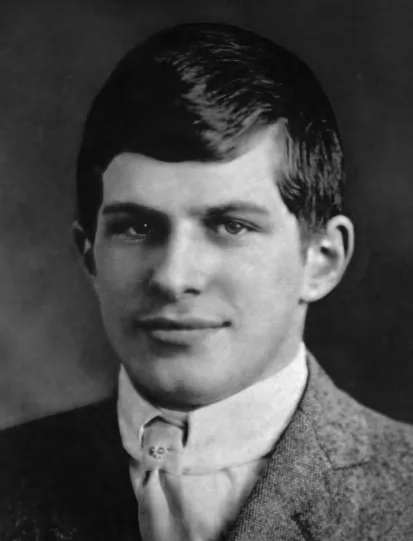
Photograph, 1954, via Wikimedia Commons, public domain. · Photograph by Étienne Carjat (1876), public domain. Background removed for the portrait above. · Photograph (1914), photographer unknown, via Wikimedia Commons, public domain.


An estimate is an inference.
Yours can be measured.
Thirty questions, scored against general-population benchmarks. Your score, your percentile, your ability breakdown and a printable IIF certificate.
Find your IQ score now! →