





Intelligence Quotient Quotes: Real Quotes About IQ and the Famous Ones Nobody Said
Intelligence quotient quotes checked against first sources: five of seven famous lines are verified, one is unconfirmed, and the fish-and-tree line has no evidence behind its Einstein label. Each quote, source and verdict, plus how to check a quote yourself.

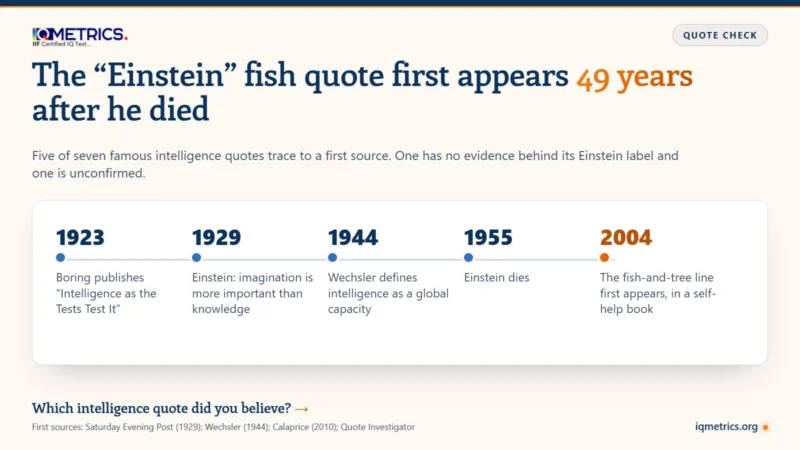
Which intelligence quotient quotes are real? David Wechsler’s 1944 definition and Stephen Hawking’s 2004 remark about people who boast about their IQ both have a first source. We checked seven famous lines. Five trace to a first source. One has no evidence behind its Einstein label. The last, Edwin Boring’s “Intelligence is what the tests test”, is tied to a 1923 article whose exact words we could not read.
Below: each quote with who said it, where and when, and how to check a quote yourself. The finding: the best-known “Einstein” line about intelligence, the fish that judged by tree-climbing, first appears in a 2004 book. Einstein died in 1955, so that is 49 years later.
Key takeaways
- Documented: Wechsler (1944), Hawking (New York Times Magazine, 2004), Russell (1933), Fitzgerald (Esquire, 1936) and Einstein on imagination (Saturday Evening Post, 1929).
- No evidence: the fish-and-tree line has no source before 2004 and is not in The Ultimate Quotable Einstein (Princeton University Press, 2010).
- Unconfirmed: Boring’s famous line is tied to his 1923 article, but we have not read the exact sentence there.
- Rule of thumb: no first source, no quote. A date after the speaker’s death is the biggest warning sign.
Which IQ quotes are real?
Five of the seven are real. The table gives each line, who said it and where it first appeared.
| Quote | Said by | First source | Verdict |
|---|---|---|---|
| “to act purposefully, to think rationally, and to deal effectively with his environment” | David Wechsler | The Measurement of Adult Intelligence, 1944 | Verified |
| “Intelligence is what the tests test.” | Edwin Boring | Tied to his 1923 article in The New Republic | Unconfirmed: exact sentence not read |
| “I have no idea. People who boast about their I.Q. are losers.” | Stephen Hawking | New York Times Magazine interview, 12 December 2004 | Verified |
| “the stupid are cocksure, while the intelligent are full of doubt” | Bertrand Russell | Essay in the San Francisco Examiner, 10 May 1933 | Verified |
| “hold two opposed ideas in the mind at the same time” | F. Scott Fitzgerald | “The Crack-Up”, Esquire, February 1936 | Verified (wording varies by edition) |
| “Imagination is more important than knowledge.” | Albert Einstein | Interview by G. S. Viereck, Saturday Evening Post, 26 October 1929 | Verified |
| “judge a fish by its ability to climb a tree” | Not shown to be Einstein | Earliest close match found: a 2004 self-help book | No evidence for Einstein |
What are the best intelligence quotient quotes about IQ?
Three stand out because each takes a different view of what intelligence is. They are a definition, a shortcut and a warning.
The definition. David Wechsler, whose scales are still the standard in clinics, described intelligence in 1944 as the global capacity of a person “to act purposefully, to think rationally, and to deal effectively with his environment”. It comes from his book The Measurement of Adult Intelligence. We checked the wording against widely cited references, not the page itself.
The shortcut. Edwin Boring, a Harvard psychologist, published “Intelligence as the Tests Test It” in The New Republic in 1923. Later, when asked to define intelligence, he adopted the phrase “Intelligence is what the tests test”, according to biographical sources. We could not read the 1923 text, so we do not claim that exact sentence is in it. As a definition it loops back on itself, a shape our guide to circular reasoning explains.
The warning. The New York Times Magazine asked Stephen Hawking his IQ on 12 December 2004. He answered: “I have no idea. People who boast about their I.Q. are losers.” No test result for him exists. Our profile of Stephen Hawking’s IQ explains why the 160 attached to his name is only an estimate.
Which famous quotes about intelligence are real?
Three more check out, and each was written for a reason that has nothing to do with IQ tests.
Bertrand Russell wrote in a 1933 essay that “the stupid are cocksure, while the intelligent are full of doubt”. The Quote Investigator website traced it to the San Francisco Examiner of 10 May 1933. F. Scott Fitzgerald opened “The Crack-Up” (Esquire, February 1936) with the test of a first-rate intelligence: the ability to “hold two opposed ideas in the mind at the same time” and still function. Published wording differs slightly by edition.
Albert Einstein did say “Imagination is more important than knowledge.” It is in an interview with George Sylvester Viereck in the Saturday Evening Post of 26 October 1929, on page 17.
Did Einstein really say that? The fish and the tree
No evidence says he did. The line, which begins “Everybody is a genius” and says a fish judged by its tree-climbing will think itself stupid, is not in The Ultimate Quotable Einstein (2010).
Quote Investigator, a site that traces quotations to their first appearance, found the earliest close match in a 2004 self-help book, Matthew Kelly’s The Rhythm of Life. Einstein died on 18 April 1955. A saying that first surfaces 49 years later cannot be shown to be his, however well it fits.
This matters for IQ, too. Einstein has no test score on record. Our Albert Einstein profile says no test result exists and the 160 that circulates has no source. For a comparison of the names people claim beat him, see who is said to have a higher IQ than Einstein.
Where would your own score land?
Take the IIF-certified assessment and get your score with the scale it was measured on, the percentile it corresponds to and the confidence range around it — the three figures most online tests leave out.
Find your IQ score now! →What do IQ test quotes say about the test itself?
Taken together they show the test’s limits as well as its aim. Wechsler wanted a capacity measured, Boring accepted that the test defines the thing, and Hawking distrusted the score as a status badge.
That mix is why we publish scores with their scale and their margin of error. For the bigger picture, see how IQ differs from emotional skills in IQ vs EQ, the highest IQ ever recorded, and the roundup of celebs with high IQ. The celebrity IQ hub lists every profile.
How can you check a quote before you share it?
Look for a first source: a named book, page, interview or date. Four steps catch most fakes.
- Find the first appearance. A real quote has a book, a page or a dated interview. “Attributed to” is not a source.
- Check the date against the life. A line that first appears after the speaker died is a red flag.
- Search a quotation reference. Collections such as The Ultimate Quotable Einstein and sites such as Quote Investigator list what is verified and what is not.
- Keep it short and exact. Quote the words that are documented, and say so when a wording varies by edition.
To test your own reasoning rather than someone else’s, take the IQ test.
Quick answers
- What are good IQ quotes? Wechsler’s 1944 definition, Boring’s “Intelligence is what the tests test” and Hawking’s 2004 remark about people who boast about their IQ.
- Did Einstein say “judge a fish by its ability to climb a tree”? No evidence shows he did. The earliest close match found is from 2004.
- Is “Imagination is more important than knowledge” a real Einstein quote? Yes. It is from a Saturday Evening Post interview of 26 October 1929.
- Who said intelligence is what the tests test? It is tied to Edwin Boring and his 1923 article, but we could not confirm the exact sentence there.
- How do you check a famous quote? Find the first source, check the date against the speaker’s life, and search a quotation reference.
The bottom line
Of the intelligence quotient quotes we checked, five of seven are real, one is unconfirmed and one has no evidence behind its Einstein label. Use the ones with a source, and drop the rest.
Sources
- Wechsler D (1944). The Measurement of Adult Intelligence, 3rd edition. Williams and Wilkins.
- Boring EG (1923). Intelligence as the tests test it. The New Republic, pp. 35-37. Background: Wikipedia on Edwin Boring.
- Solomon D (12 December 2004). The Science of Second-Guessing. The New York Times Magazine. Quoted in Wikiquote: Stephen Hawking.
- Russell B (1933), essay printed in the San Francisco Examiner, 10 May 1933, as traced by Quote Investigator.
- Fitzgerald FS (February 1936). The Crack-Up. Esquire.
- Viereck GS (26 October 1929). What Life Means to Einstein. The Saturday Evening Post, p. 17. Cited in Wikiquote: Albert Einstein.
- Calaprice A, ed. (2010). The Ultimate Quotable Einstein. Princeton University Press. Kelly M (2004). The Rhythm of Life. Fireside, as cited by Quote Investigator.
Keep reading
All articles →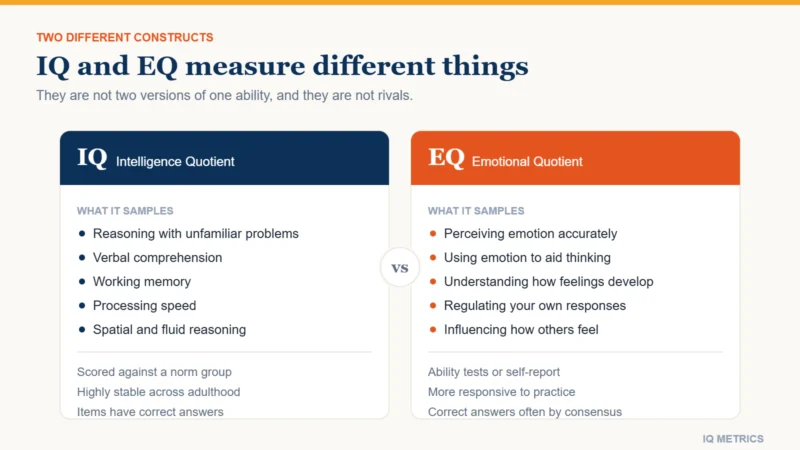 Mind & Everyday Life
IQ vs EQ
IQ measures reasoning; EQ measures how well you read and manage emotion. They are different constructs, measured in different ways, with different amounts of evidence behind them. Here is what each one actually predicts, which is easier to change, and where the popular claim that EQ matters more comes from.
 Scores & Scales
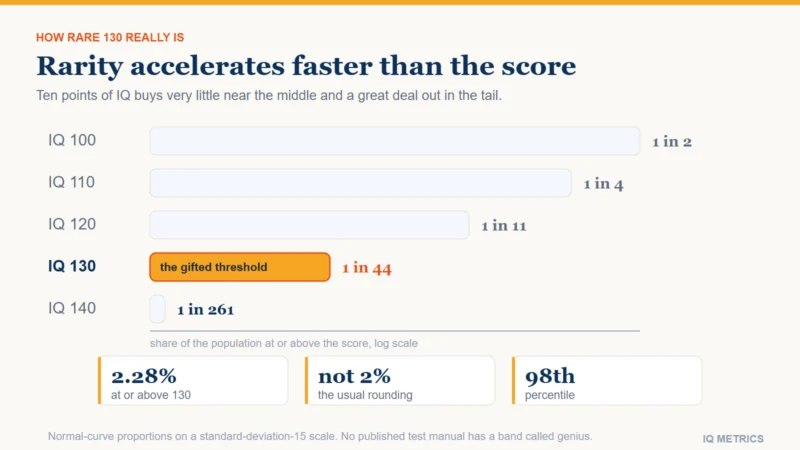
Is 130 IQ a Genius Score?
A score of 130 is the conventional threshold for gifted identification and for high-IQ society membership, and it is reached by about one person in 44. It is not, however, a "genius" score, because no published test defines such a band. The word is a popular import, and the difference is worth understanding.
 Research & Evidence
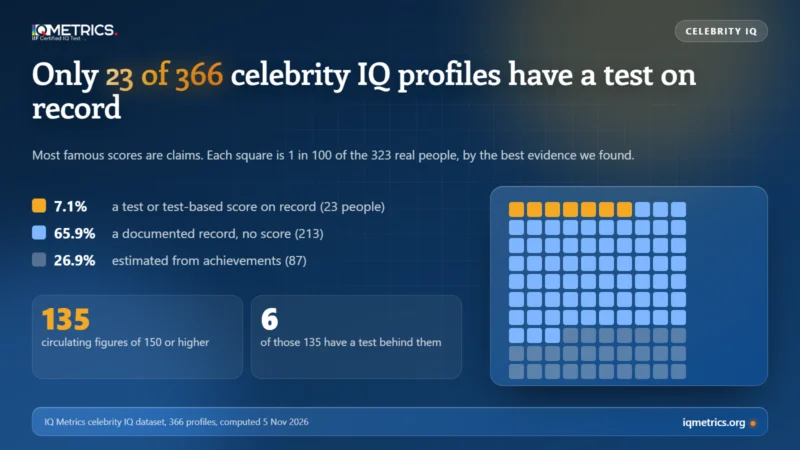
Celebs With High IQ
Very few celebrities have a published IQ score: of 366 profiles, 23 have a test or test-based score on record. 135 of 242 circulating figures are 150 or higher, and 6 have a test behind them. Which famous numbers hold up, and which are rumors.