





How Long Does an IQ Test Take? Test-by-Test Times, Questions and What Adds Hours
An official IQ test usually takes 45 to 90 minutes of testing: 45 for the WAIS-5, 60 to 90 for the WAIS-IV, 12 for the Wonderlic. See the time for every major test, how many questions to expect, why two people take different amounts of time and what a full evaluation adds.

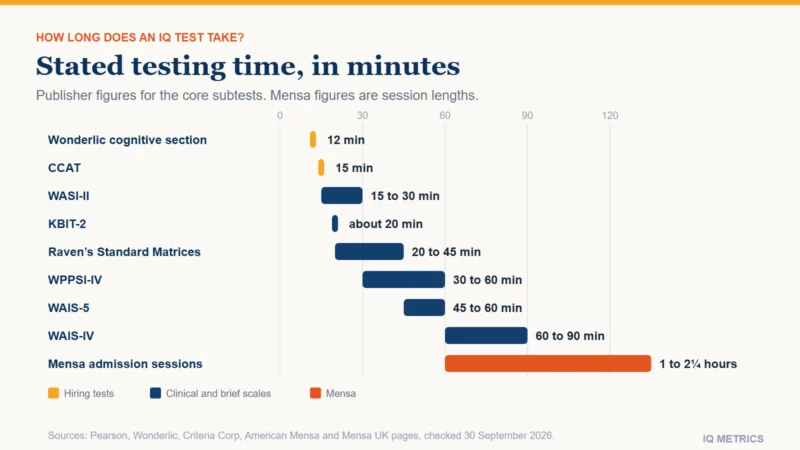
How long does an IQ test take? An official IQ test usually takes about 45 to 90 minutes of testing, and a full evaluation takes several hours over one or two visits. Publisher-stated times for the core subtests are 45 minutes for the WAIS-5’s seven-subtest Full Scale IQ (60 for its ten primary subtests), 60 to 90 minutes for the WAIS-IV, about 60 for the WISC-V, 30 to 60 for the WPPSI-IV, about 20 for the KBIT-2 and 15 to 30 for the WASI-II. Mensa sessions run one to two and a quarter hours. Hiring tests are shorter: the Wonderlic cognitive section gives 50 questions in 12 minutes and the CCAT 50 in 15. This guide covers the time test by test, how many questions to expect, why two people take different amounts of time, what a full evaluation adds, whether a shorter test can do the same job, and whether the time of day matters.
- Wechsler scales: WAIS-5 45 or 60 minutes (7 or 10 subtests), WAIS-IV 60 to 90, WISC-V about 60, WPPSI-IV 30 to 60 depending on age.
- Brief tests: WASI-II 15 or 30 minutes, KBIT-2 about 20; Raven’s Standard Progressive Matrices has 60 items and is listed as untimed at 20 to 45 minutes.
- Hiring tests: Wonderlic 50 questions in 12 minutes (the whole Select assessment takes about 35); CCAT 50 items in 15.
- Mensa: one to two hours in the US; 1½ hours online or 2¼ hours in person in the UK.
- A full evaluation: five to seven hours of testing over two visits plus a one-hour feedback meeting at one US university clinic, with the written report within about four weeks at another.
How long does an IQ test take, test by test?
Publisher-stated testing times for the main instruments are in the table, with Mensa’s session lengths and two hiring tests for comparison. Pearson labels its figure “completion time” for the core subtests, and none of its pages says the figure includes the interview, breaks, scoring or the report.
| Test | Ages | Stated time | Source |
|---|---|---|---|
| WAIS-5 (2024) | 16:0 to 90:11 | 45 minutes for the 7-subtest FSIQ; 60 minutes for the 10 primary subtests | Pearson |
| WAIS-IV (2008) | 16:0 to 90:11 | 60 to 90 minutes for the core subtests | Pearson |
| WISC-V (2014) | 6:0 to 16:11 | About 60 minutes for the core subtests | Pearson |
| WPPSI-IV (2012) | 2:6 to 7:7 | 30 to 45 minutes (ages 2:6 to 3:11); 45 to 60 minutes (ages 4:0 to 7:7) | Pearson |
| Stanford-Binet 5 | 2 to 85+ | “Typical administration time is 5 minutes per subtest” | Riverside |
| Differential Ability Scales II | 2:6 to 17:11 | Core battery 45 to 60 minutes; diagnostic subtests 30 minutes | Pearson |
| KBIT-2 | 4:0 to 90:0 | Approximately 20 minutes | Pearson |
| WASI-II (2011) | 6:0 to 90:11 | 30 minutes (four subtests); 15 minutes (two subtests) | Pearson |
| Raven’s Standard Progressive Matrices | 6:0 to 16:0; 17:0 and up | 60 items; “Untimed” at 20 to 45 minutes | Pearson |
| Raven’s Advanced Progressive Matrices | 12:0 to 16:0; 17:0 and up | “Untimed” at 40 to 60 minutes; the usual research procedure is 36 items in 40 minutes | Pearson; Little et al. 2014 |
| Wonderlic Select, cognitive section | not stated | 50 questions in 12 minutes; the whole assessment takes about 35 minutes | Wonderlic |
| CCAT | not stated | 50 items in a 15-minute limit | Criteria Corp |
| Mensa Norway online practice test | norm bands from 16 | 35 puzzles in a 25-minute limit | Mensa Norway |
| American Mensa admission test | 14 and over | “between one to two hours” | American Mensa |
| Mensa UK Home Test / online supervised / in-person | over 10½ for supervised | 45 minutes / 1½ hours / 2¼ hours | Mensa UK |
Pearson says the WAIS-5 Full Scale IQ, which now needs seven subtests instead of ten, “can be obtained about 20 minutes faster than the WAIS-IV.” The Woodcock-Johnson publisher pages we could read give no total time, only the size of the batteries: 20 cognitive and 26 achievement tests in the WJ V (see our Woodcock-Johnson guide). Our guides to the Stanford-Binet, the WPPSI-IV and the WISC-V cover the children’s instruments.
How many questions are on an IQ test?
There is no single number. A Wechsler scale is a set of subtests, each with its own item list that stops after a run of misses, so nobody answers every item. Raven’s Standard Progressive Matrices has 60 items in five sets of 12; the Wonderlic and the CCAT each give 50 questions, and test takers are not expected to finish either in time (Criteria says fewer than 1% answer all 50 on the CCAT). Mensa does not publish item counts for its supervised tests, and Mensa International says it is “in the final stages of implementing computerised adaptive testing,” a format that “does not have a fixed set of test items.” The practice test on Mensa Norway’s site is 35 puzzles in 25 minutes, and its own page warns it is “not a substitute for professional intelligence tests.” For sample items and how the question types differ, see our guides to IQ test question types and Raven’s matrices, and the Wonderlic practice test and CCAT score guide.
Why two people take different amounts of time
Wechsler subtests start at an age- or ability-based item and stop after a run of misses, so the number of questions answered differs from person to person. Pearson’s WAIS-5 FAQ points out an irony of this: “Examinees who are intellectually gifted commonly require long testing times because they meet discontinue rules late in the item order or not at all.” The WAIS-5 therefore has special start points for examinees suspected of giftedness that “result in testing time reduction of approximately 25%.” Time limits also differ by task. In Pearson’s telepractice guide for the WAIS-5, Block Design, Visual Puzzles, Figure Weights, Arithmetic and Naming Speed Quantity carry item time limits, and Coding and Symbol Search a limit for the whole task, while Similarities, Vocabulary, Matrix Reasoning and the digit tasks have no strict limit. Speed still earns credit where it is measured: Pearson says removing the WISC-V Block Design time bonuses “would result in a loss of the ceiling, greatly reduced reliability, and a much lower correlation with general intelligence.” Our guides to WAIS-IV and WAIS-5 index scores and processing speed explain which subtests reward speed, and our digit span guide covers one of the untimed working-memory subtests. The Raven’s tests show the same trade-off: in an online experiment with 18 items, “20 min were sufficient for virtually all participants” when time was unrestricted, “whereas 10 min were sufficient for less than half” (Gonthier 2023).
How long does a full IQ evaluation take?
A clinical evaluation is much longer than the intelligence test inside it, because it usually adds other instruments. The University of Tennessee, Knoxville says a psychoeducational evaluation starts with a parent interview and testing that “typically lasts between three and four hours on the first day,” needs a second appointment, and totals “somewhere between five and seven hours” of testing, followed by a one-hour feedback meeting. The San Diego State University Psychology Clinic describes two to four appointments of a few hours each and says the written report “is generally provided within four weeks of your final assessment session.” Those are US clinics testing more than intelligence, so an IQ-only booking can be much shorter. One Australian clinic states that its fee “includes interview, test administration, written report and feedback session.” Our guide to taking an official IQ test covers what such an evaluation costs and where to book one.
Can a shorter IQ test do the same job?
Only roughly. In a clinical sample of 94 adults, Ryan and colleagues found that the WASI-II two-subtest IQ (about 15 minutes) correlated .96 with the four-subtest IQ (about 30 minutes) but overestimated it in 69.1% of cases, and only half of the two-subtest scores fell within 3 points of the four-subtest score. In a study of 198 people with Fragile X syndrome, the Stanford-Binet abbreviated score fell within one standard deviation (15 points) of the full-scale score at 77.2% of time points; the authors’ experience was that the routing subtests take 10 to 15 minutes against 60 to 90 for the full battery. A short test is a screen, not a substitute, which matters for the 10-minute quizzes online; see our guide to online IQ test quality and the timed IQ test page.
Where would your own score land?
Take the IIF-certified assessment and get your score with the scale it was measured on, the percentile it corresponds to and the confidence range around it — the three figures most online tests leave out.
Find your IQ score now! →Does the time of day matter?
A little, at least for school tests. A study of 2,034,964 test results from 570,376 Danish school children aged 8 to 15 found that, for every hour later in the day, performance fell by 0.9% of a standard deviation, while a 20 to 30 minute break raised it by 1.7% of a standard deviation (Sievertsen, Gino and Piovesan, 2016). Those were computer-based national school tests, not IQ tests, so the numbers are not IQ points, but they are a reason to ask for a break and a morning slot. A separate study of 198 high-school students aged 17 to 20 found a time-of-day match effect for a crystallized test but not for fluid reasoning on the Cattell Culture Fair Scale 3 (Jankowski, Díaz-Morales and Vollmer, 2023). See also our guides to sleep loss and test performance and how to prepare for an IQ test.
How long until you get the result?
It depends on who scores the test. An online test scores at once. American Mensa lists private-testing results “in days”; Mensa Canada asks candidates to follow up if they have heard nothing after a month; and one US clinic says its written report generally arrives within four weeks of the last session. In the US, a school district’s initial special-education evaluation must be conducted within 60 days of parental consent, or within the state’s own timeframe (34 CFR 300.301). How long a result stays useful is a separate matter; see our guide to how long an IQ test result is valid.
Quick answers
- How long does an IQ test take? About 45 to 90 minutes of testing for a Wechsler scale, 15 to 20 minutes for a brief scale, and 12 to 15 minutes for a hiring test; a full evaluation takes several hours.
- How long does an official IQ test take for adults? Pearson lists 45 minutes for the WAIS-5 seven-subtest Full Scale IQ and 60 for its ten primary subtests; the WAIS-IV took 60 to 90.
- How long does an IQ test take for kids? About 60 minutes for the core WISC-V subtests and 30 to 60 for the WPPSI-IV, by age.
- How long does the Mensa test take? One to two hours in the US; 1½ hours online or 2¼ hours in person in the UK.
- How many questions are on an IQ test? No fixed number: Raven’s has 60 items, the Wonderlic and the CCAT 50, and Wechsler subtests stop after a run of misses.
- How long does an online IQ test take? It varies: Mensa UK’s online workout is up to 15 minutes, Mensa Norway’s practice test 25 and Mensa UK’s Home Test 45. A short quiz is a screen, not a substitute for a full test.
- Does a faster finish mean a higher IQ? No: on Wechsler scales high-ability examinees often take longer, and speed earns credit only on the timed subtests.
The bottom line
Plan on about an hour of testing for a Wechsler scale and an afternoon or two for a full evaluation, and on minutes rather than hours for a hiring test or a quiz. The publisher figures cover the core subtests only, so ask a psychologist what your booking includes and when the report will arrive. For what an evaluation costs, who can give it and what score you receive, read our guide to the official IQ test.
Sources
- Pearson: Wechsler Adult Intelligence Scale, Fifth Edition (WAIS-5) product page and FAQ (completion time, start points), checked 30 September 2026.
- Pearson product pages, each checked 30 September 2026: WAIS-IV, WISC-V, WPPSI-IV, KBIT-2, DAS-II, WASI-II, Raven’s SPM and Raven’s APM.
- Pearson: Telepractice and the WAIS-5 (which subtests carry time limits).
- Riverside Insights: Stanford-Binet Intelligence Scales (SB5).
- Wonderlic: Cognitive ability test for hiring, and the candidate FAQ (about 35 minutes in total).
- Criteria Corp: CCAT (50 items, 15 minutes).
- American Mensa and Mensa UK: test pages (durations, results timing), checked 30 September 2026; Mensa Canada: FAQ.
- Mensa Norway: online practice test (35 puzzles, 25 minutes), and Mensa International: getting your IQ tested FAQs (computerised adaptive testing).
- Little, D.R., Lewandowsky, S. and Craig, S. (2014): Working memory capacity and fluid abilities: the more difficult the item, the more more is better, Frontiers in Psychology, 5, 239.
- Gonthier, C. (2023): Should intelligence tests be speeded or unspeeded? A brief review of the effects of time pressure on response processes and an experimental study with Raven’s matrices, Journal of Intelligence, 11(6), 120.
- University of Tennessee, Knoxville: Psychoeducational evaluations (clinical services).
- San Diego State University Psychology Clinic: Psychological evaluation and testing.
- Western Sydney University: Psychology Clinics, about our services (what the fee includes).
- Ryan, J.J., Kreiner, D.S. and Gontkovsky, S.T.: Utility of the WASI-II 2-subtest Full Scale IQ for identifying impaired cognitive functions, Archives of Assessment Psychology, 15(1).
- McKinney, W.S. et al. (2025): Differences between Stanford-Binet abbreviated and full-scale estimates of IQ in fragile X syndrome vary across development, Journal of Autism and Developmental Disorders (online 23 October 2025).
- Sievertsen, H.H., Gino, F. and Piovesan, M. (2016): Cognitive fatigue influences students’ performance on standardized tests, Proceedings of the National Academy of Sciences, 113(10), 2621-2624.
- Jankowski, K.S., Díaz-Morales, J.F. and Vollmer, C. (2023): Chronotype, time of day, and performance on intelligence tests in the school setting, Journal of Intelligence, 11(1), 13.
- 34 CFR 300.301: Initial evaluations (IDEA).
Keep reading
All articles →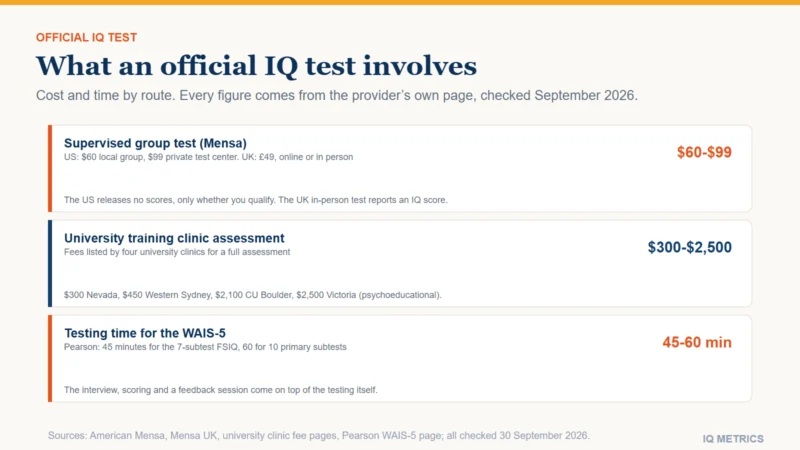 Taking a Test
Official IQ Test
There is no single official IQ test: official means a standardized test given by a qualified psychologist or a supervised exam such as Mensa's. See how long it takes, what it costs (from $60 to $2,500), where to book one and what score you actually get.
 Taking a Test
How to Prepare for an IQ Test?
Is your mind ready to be unleashed by mastering IQ tests? Our all-inclusive guide to IQ test success and mind mastery is your one-stop shop. To help you stand out and increase your IQ, this post contains expert advice, methods, and insights.
 Taking a Test
How long is IQ test valid?
Do you want to know how long an IQ test is valid for? Have you ever wondered how accurate it is and how it affects your IQ? Stop searching now. To better understand the significance of IQ test results, this article will investigate the validity period of these assessments.