How big is AI compared with a brain? 1,092 models against 11 animals
We put every notable AI model in Epoch AI’s table, 1,092 from 1950 to 2026, on the same scale as the synapses of 11 animals: the largest published model is about the size of a cat’s neocortex and 50 times under a human one.

By Leon Falkner, Data & Research Analyst · Reviewed by Aarav Vardhan, Editor-in-Chief · Published 10 November 2026 · 15 min read
About this study
- Report type
- Data study: our dataset of AI model sizes and animal synapse counts
- Data
- 1,092 notable AI models (728 with a parameter count), 1950-2026, and 11 animals with low and high synapse counts
- Sources
- Epoch AI notable-models table (CC BY 4.0, downloaded 10 November 2026) and 22 papers for the animals; the Epoch AI documentation
- Years
- Models 1950 to 28 October 2026; as of 10 November 2026
- Licence
- CC BY 4.0 (our dataset and charts); model data by Epoch AI, CC BY 4.0
- Version
- 2026.11
- Sources
- 24
The largest AI model with a published size has about 3 trillion parameters, roughly 50 times fewer than the 150 to 164 trillion synapses counted in a human neocortex. IQ Metrics Research set 728 notable models (Epoch AI, 1950-2026) against 11 animals; a parameter is not a synapse, and size is not ability.
01 Key findings
- The largest model with a published size is cat-sized, not human-sized. 3 trillion parameters against 2.2 to 2.4 trillion synapses in a cat neocortex and 150 to 164 trillion in a human one: a gap of about 1.7 orders of magnitude, 50 to 55 times.Epoch AI; IQ Metrics calculation
- AI passed a roundworm in 1975 and a fruit-fly larva in 1980. The first notable model above a mouse neocortex that is a real neural network appeared in 2019; a cat followed in 2025.IQ Metrics calculation
- Half of all notable models are at least as big as our low estimate for a honeybee (379 of 728), 128 are bigger than a mouse neocortex, 6 reach a cat, none reach a macaque or a human.IQ Metrics calculation
- Growth has stalled since 2021. The largest model doubled every 1.2 years from 2012 to 2026, but 1.6 trillion (2021) became only 3 trillion (2025).Epoch AI; IQ Metrics calculation
- Parameters are not synapses. Most trillion-parameter models are sparse: they use 3% to 16% of their parameters at once, and one real cortical neuron needed a five- to eight-layer network to copy.Epoch AI; Beniaguev et al. 2021
- The biggest models are the least documented. A size is printed for 41% of the models of 2026, against 92% in 2021.IQ Metrics calculation
02 Statistics to quote
parameters in the largest notable AI model with a published count (Grok 3, 2025; Grok 4 ties); Epoch AI confidence “Likely”.
Epoch AImore synapses in a human neocortex (150 to 164 trillion) than parameters in the largest model, 1.7 orders of magnitude.
IQ Metrics calculationsynapses counted in the human neocortex by stereology (Pakkenberg 2003; Tang 2001); nobody has counted the whole brain.
Tang 2001; Pakkenberg 2003neurons in the adult male human brain, 19% of them in the cerebral cortex (Azevedo et al. 2009).
Azevedo et al. 2009first notable AI model with more parameters than a roundworm has synapses: the Cognitron, 21,600 parameters against about 5,000 to 8,000 synapses.
IQ Metrics calculationyear a notable model (Grok 3, 3 trillion) first matched the low estimate for a cat neocortex, 2.2 trillion synapses; only 6 models are at that size.
IQ Metrics calculationnotable models with a parameter count are at or above the low estimate for a honeybee brain (391 million), 52%.
IQ Metrics calculationnotable models are at or above the 81 billion synapses of a mouse neocortex (18%); none is at or above a macaque or a human.
IQ Metrics calculationdoubling time of the largest model per year, 2012 to 2026 (x1.76 a year); from 2021 to 2026 it is 3.4 years.
IQ Metrics calculationof the notable models of 2026 have a parameter count in Epoch AI’s table, down from 92% in 2021.
IQ Metrics calculationAnthropic models since 2023 have a parameter count in the table; OpenAI has 6 of 59 and Google DeepMind 13 of 44.
IQ Metrics calculationmodels of 1 trillion parameters or more are described as sparse or mixture-of-experts; the 10 biggest of them with a stated active count use 3% to 16% of their parameters per token.
IQ Metrics calculationsynapses in the mouse neocortex (7.2 x 10^8 per mm3 times 112 mm3), the same size as a 2019 to 2020 language model.
Schuz and Palm 1989synapses in the adult fruit fly brain (139,255 neurons); the connectome of another fly counts 312 million postsynaptic sites.
Dorkenwald et al. 2024; Berg et al. 202603 How big is AI compared with a human brain?
The largest AI model with a published size has about 3 trillion parameters, roughly 50 to 55 times fewer than the 150 trillion to 164 trillion synapses counted in a human neocortex, and level with a cat’s neocortex (2.2 trillion to 2.4 trillion synapses by our calculation) while just under a macaque’s (3.1 trillion to 6.5 trillion) [1] [15] [14]. This page sets all 1,092 notable models in Epoch AI’s table against the synapse counts of 11 animals, so that a number such as “3 trillion” can be read on the same scale as a brain.
The comparison is about size only. A parameter is one number a model learns; a synapse is a physical contact between two neurons. Nothing here says that any model thinks like a cat, a mouse or a person, and the scale of a brain is not its ability: a crow, a honeybee and a human with half a brain all do more than their synapse counts suggest. Our own dataset joins two sources that are rarely put side by side: Epoch AI’s table of notable models (CC BY 4.0), and synapse counts from primary papers, from electron-microscopy reconstructions of whole fly and worm brains to the stereology of a human cortex. Where papers disagree we keep the range and show it [1].
Every notable AI model against the synapses of eight animals: the biggest models have just reached a cat
Each blue dot is one of 728 notable AI models with a parameter count (Epoch AI, 1950 to 2026): publication date across, size up as a power of ten (6 = a million, 12 = a trillion). Orange dots at the right are animal brains, plotted at the middle of their synapse range; the largest model, 3 trillion, sits level with a cat and just under a macaque, 50 times under a human neocortex. As of 10 November 2026.
Size: parameters (models) or synapses (animals), as a power of ten
Year published (animals at the right have no date)
Animals: neocortex for the mammals, whole brain or body for the small animals; one parameter is not one synapse.
Source: Epoch AI notable models [1]; animal counts: see the table of animals; plotted by IQ Metrics
Data table
| model_or_animal | year_published | log10_size | group |
|---|---|---|---|
| MAI-Base-2 | 2026.8 | 12.4 | moe |
| Mistral Large 4 | 2026.8 | 12 | moe |
| Grok 4.7 | 2026.7 | 12.3 | nn |
| Step 5 Preview | 2026.7 | 11.8 | nn |
| DeepSeek V4.1 Flash | 2026.7 | 11.7 | moe |
| Tencent Hy4 preview | 2026.7 | 11.9 | nn |
| GLM-5.3-Flash | 2026.6 | 11.5 | moe |
| GLM-5.3 | 2026.6 | 11.9 | moe |
| Qwen3.8-2.4T-A95B | 2026.6 | 12.4 | moe |
| Motif-3 | 2026.6 | 11.5 | moe |
| K-EXAONE 2.0 | 2026.6 | 11.9 | moe |
| A.X K2 | 2026.6 | 11.8 | moe |
| Qwen 3.8 Max | 2026.5 | 12.4 | moe |
| Kimi K3 | 2026.5 | 12.4 | moe |
| Inkling | 2026.5 | 12 | moe |
| Tencent Hy3 | 2026.5 | 11.5 | moe |
| LongCat-2.0 | 2026.5 | 12.2 | moe |
| Solar Open2 250B | 2026.5 | 11.4 | moe |
| Nemotron 3 Ultra | 2026.4 | 11.7 | moe |
| MiniMax-M3 | 2026.4 | 11.6 | moe |
| Composer 2.5 | 2026.4 | 12 | moe |
| TML-Interaction-Small | 2026.4 | 11.4 | moe |
| DeepSeek-V4-Pro | 2026.3 | 12.2 | moe |
| DeepSeek-V4-Flash | 2026.3 | 11.5 | moe |
| Tencent Hy3 preview | 2026.3 | 11.5 | moe |
| MiMo-V2.5-Pro | 2026.3 | 12 | moe |
| Kimi K2.6 | 2026.3 | 12 | nn |
| EXAONE 4.5 | 2026.3 | 10.5 | nn |
| GLM-5.1 | 2026.3 | 11.9 | nn |
| MolmoAct 2 | 2026.3 | 9.7 | nn |
| Composer 2 | 2026.2 | 12 | moe |
| MiMo-V2-Pro | 2026.2 | 12 | moe |
| Nemotron 3 Super | 2026.2 | 11.1 | moe |
| Qwen3.5-122B-A10B | 2026.1 | 11.1 | nn |
| Grok 4.20 | 2026.1 | 11.7 | moe |
| Qwen3.5 397B-A17B | 2026.1 | 11.6 | nn |
| GLM-5 | 2026.1 | 11.9 | nn |
| Qwen3-Coder-Next | 2026.1 | 10.9 | nn |
| Kimi K2.5 | 2026.1 | 12 | nn |
| Solar Open 100B | 2026 | 11 | moe |
| K-EXAONE | 2026 | 11.4 | nn |
| VAETKI | 2026 | 11 | moe |
| A.X K1 | 2026 | 11.7 | moe |
| HyperCLOVA X SEED 32B Think | 2026 | 10.5 | nn |
| MiniMax-M2.1 | 2026 | 11.4 | moe |
| GLM-4.7 | 2026 | 11.6 | moe |
| Nemotron 3-Nano-30B-A3B | 2026 | 10.5 | nn |
| DeepSeekMath-V2 | 2025.9 | 11.8 | nn |
| Olmo 3 | 2025.9 | 10.5 | nn |
| π0.6 (pi-0.6) | 2025.9 | 9.7 | nn |
| P1-235B-A22B | 2025.9 | 11.4 | moe |
| Kaiju Small | 2025.8 | 10.1 | nn |
| Kaiju Medium | 2025.8 | 10.5 | nn |
| Kaiju Large | 2025.8 | 11 | nn |
| Kimi K2 Thinking | 2025.8 | 12 | moe |
| Tongyi DeepResearch | 2025.8 | 10.5 | moe |
| MiniMax-M2 | 2025.8 | 11.4 | nn |
| Ling-1T | 2025.8 | 12 | moe |
| GLM-4.6 | 2025.7 | 11.6 | moe |
| Qwen3-VL-235B-A22B | 2025.7 | 11.4 | moe |
| Qwen3-Omni-30B-A3B | 2025.7 | 10.5 | moe |
| AgentFounder-30B | 2025.7 | 10.5 | nn |
| Qwen3-Max | 2025.7 | 12 | moe |
| LongCat-Flash | 2025.7 | 11.7 | moe |
| gpt-oss-120b | 2025.6 | 11.1 | nn |
| gpt-oss-20b | 2025.6 | 10.3 | nn |
| Qwen Image | 2025.6 | 10.4 | nn |
| Hierarchical Reasoning Model (HPM) | 2025.6 | 7.4 | nn |
| MindLink-72B | 2025.6 | 10.9 | nn |
| GLM-4.5 | 2025.6 | 11.6 | moe |
| Qwen3-235B-A22B-Thinking (Jul 2025) | 2025.6 | 11.4 | moe |
| Qwen3-235B-A22B (Jul 2025) | 2025.6 | 11.4 | moe |
| Qwen3-Coder-480B-A35B | 2025.6 | 11.7 | moe |
| EXAONE 4.0 (32B) | 2025.5 | 10.5 | nn |
| Kimi K2 | 2025.5 | 12 | moe |
| Grok 4 | 2025.5 | 12.5 | nn |
| EXAONE Path 2.0 | 2025.5 | 8.2 | nn |
| FGN | 2025.4 | 8.9 | nn |
| Seed-1.6-Thinking | 2025.4 | 11.4 | moe |
| Qwen3 Embedding | 2025.4 | 9.9 | nn |
First 80 of 736 rows; the Data button gives all of them.
Embed this chart
Paste this HTML into your page: it carries the numbers and the credit link to this figure.
Three reference points show how the page reads. The Perceptron Mark I, built at the Cornell Aeronautical Laboratory in 1957, had about 1,000 adjustable weights [1]; AlexNet, a 2012 image network, had 60 million; BERT-Large (2018) had 340 million; GPT-3 (2020) had 174.6 billion; and Switch Transformer (2021) had 1.57 trillion. On the same scale a roundworm has 5,000 to 8,000 synapses, an adult fruit fly 46 to 312 million, a mouse neocortex 81 billion and a human neocortex 150 to 164 trillion. Our guide to human brain facts gives the other numbers people ask about, and human brain vs dog brain compares neuron counts for two familiar species.
- Parameter
- One learned number in an AI model, a weight or a bias. Epoch AI records the “number of learnable parameters in the model” [2].
- Synapse
- A contact where one neuron signals to another. Counting rules differ: some papers count presynaptic sites, some postsynaptic densities, some connections between pairs of neurons.
- Neocortex
- The folded outer layer of the mammalian brain. We use it for mammals because it is the part for which synapse totals were counted.
- Connectome
- A complete map of the neurons of a nervous system and the synapses between them, reconstructed from electron-microscope images [3] [9].
- Mixture of experts (MoE)
- A model built from many sub-networks of which only a few run for each token. Its total parameter count is large; its active count is much smaller [2].
- Active parameters
- The parameters used to process one token in a sparse model. The Epoch AI column holds the total, with the active number in the note when it is known.
- Order of magnitude
- A factor of ten. The gap between the largest model and a human neocortex is 1.7 orders of magnitude, a factor of about 50.
- Notable model
- A model in Epoch AI’s table that is highly cited, expensive to train, widely used, state of the art or historically important [2].
04 Is an AI parameter the same as a brain synapse?
No: a parameter is a single stored number, while a detailed model of one cortical neuron needed a deep network to copy. A 2021 study trained artificial networks to copy a biophysical model of one layer 5 pyramidal neuron and found that a network with five to eight layers was needed to capture its input and output [24]. So counting one synapse as one parameter probably understates the brain; counting a trillion parameters of a sparse model as a trillion working connections probably overstates the model.
Several differences make the match loose. A synapse changes with time and activity; a trained model’s weights are fixed when it is used. A synapse is counted in different ways (a presynaptic site that talks to six cells is one synapse in one paper and six connections in another). Brains also differ from models in what else they carry: neurons, glia, wiring length, energy use, a body and a lifetime of learning. We use parameters and synapses because both are counts of adjustable links, and because they are the only numbers published on both sides. For what AI scores on tests built for people, see the ChatGPT IQ score and why a model’s “120” is not an IQ; our study AI against the maths olympiad tests ability directly.
05 How many neurons and synapses does a human brain have?
A human brain has about 86.1 billion neurons, 19% of them (about 16 billion) in the cerebral cortex, and the neocortex alone holds 150 to 164 trillion synapses; nobody has counted the synapses of the whole brain [18] [15] [14]. The neuron figure comes from the isotropic fractionator, which dissolves brain tissue and counts cell nuclei, applied to four adult men; it replaced the textbook figure of 100 billion, which the authors say was never a count; the synapse figures come from counting synapses in electron-microscope samples of five young men and multiplying by the volume of the neocortex, a measurement with a coefficient of variation of 0.17 between brains [14].
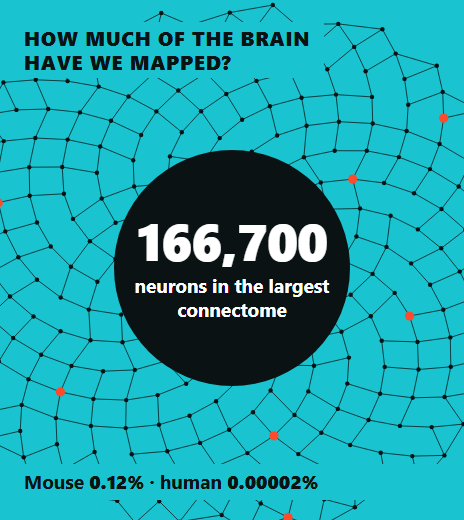
The two human synapse figures, 164 trillion in 2001 and 0.15 quadrillion in 2003, are not two independent checks: the 2003 figure appears in a review of neurostereology studies, and we found no second, independent counting study, so we treat them as one estimate of 150 to 164 trillion. Round figures such as “100 trillion synapses” and “1,000 trillion” appear in textbooks and articles; we found no counting study behind either. The cerebellum, the thalamus and the rest of the brain are not counted at all, so a human brain holds more synapses than the neocortex figure, and every comparison with a mammal on this page is a lower bound for the whole brain. A single cubic millimetre of human temporal cortex, reconstructed in 2024, holds 133.7 million synaptic connections and 57,216 cells [12]; our study of how much of the brain has been mapped shows how little of any brain is reconstructed so far, and how much data the brain can store covers the memory question.
Synapses from a roundworm to a human neocortex: 14 orders of magnitude; one fruit fly has counts 7 times apart, our honeybee bracket 21 times
Low to high published or calculated synapse count for 11 animals, as a power of ten (3 = a thousand, 9 = a billion, 12 = a trillion). Bar = low to high; dot = the headline count where a paper prints one (fruit fly: 54.5 million), otherwise the middle of the range. Mammals are neocortex only. The honeybee, cat and macaque are our calculations, not counts. As of 10 November 2026.
Source: See the table of animals: [3] [4] [5] [6] [7] [8] [9] [10] [13] [15] [14]; powers of ten by IQ Metrics
Data table
| label | low | estimate | high |
|---|---|---|---|
| Sea squirt larva: 4,846 to 6,618 | 3.7 | 3.8 | 3.8 |
| Roundworm: 5,000 to 8,000 | 3.7 | 3.8 | 3.9 |
| Marine worm larva: 26,881 to 32,381 | 4.4 | 4.5 | 4.5 |
| Fruit fly larva: 544,000 | 5.7 | 5.7 | 5.7 |
| Zebrafish larva: 25.25 million | 7.4 | 7.4 | 7.4 |
| Fruit fly: 46 million to 312 million | 7.7 | 7.7 | 8.5 |
| Honeybee: 391 million to 8.2 billion | 8.6 | 9.3 | 9.9 |
| Mouse cortex: 81 billion | 10.9 | 10.9 | 10.9 |
| Cat cortex: 2.2 trillion to 2.4 trillion | 12.3 | 12.4 | 12.4 |
| Macaque cortex: 3.1 trillion to 6.5 trillion | 12.5 | 12.7 | 12.8 |
| Human cortex: 150 trillion to 164 trillion | 14.2 | 14.2 | 14.2 |
Embed this chart
Paste this HTML into your page: it carries the numbers and the credit link to this figure.
Every animal on the ladder has its own caveat, listed in the table at the end of the page. The roundworm and the fruit-fly larva are counted by electron microscopy, synapse by synapse, and are the most exact rows; the mouse and human rows are densities times volumes; the cat and macaque rows are our calculation from neuron counts and the number of synapses per neuron measured in one cortical area; and the honeybee is a bracket, because we found no paper that prints a synapse count for a honeybee brain.
06 How many synapses do a fruit fly, a honeybee and a mouse have?
An adult fruit fly brain has 54.5 million synapses between 139,255 neurons, a honeybee brain has no published count but about one million neurons, and a mouse neocortex has about 81 billion synapses [9] [21] [13]. The FlyWire consortium reconstructed the fruit fly brain from electron-microscope images and counted 5 x 10⁷ chemical synapses; a separate reconstruction of the whole male fly central nervous system detected 46 million presynaptic sites connected to 312 million postsynaptic densities [10]. Same animal, three counts from 46 million to 312 million, largely because a synapse with several partners can be counted at its source or at each target. We show the whole range.
The honeybee is the row readers ask about most, and the one with the weakest data. Reviews say its brain has “approximately one million neurons” or “less than a million”, and its mushroom bodies hold about 368,000 Kenyon cells, more than 40% of the brain’s neurons [21] [22] [23]. No paper we found prints a total for its synapses, so we bracket it: one million neurons times the 391 synapses per neuron measured in the fly brain gives 391 million, and one million neurons times the 8,200 synapses per neuron of the mouse neocortex gives 8.2 billion. That bracket, 391 million to 8.2 billion, is a calculation by IQ Metrics, not a count. The one billion often quoted for the bee in blog posts sits inside it; we found no counting study behind that figure. See also what bees, ants and flies can do.
Smaller animals are better counted. The roundworm Caenorhabditis elegans has 302 neurons and about 5,000 chemical synapses in the original reconstruction, and about 8,000 in adults in a later one [3] [4]. A sea-squirt tadpole has 177 neurons and 6,618 synapses, 1,772 of them onto muscle [5]; a three-day marine worm larva has 26,881 synapses in its published connectome [6]; a first-instar fruit-fly larva has 3,013 neurons and 544,000 synapses [7]; and a six-day zebrafish larva has 25.25 million synapses detected automatically in a preprint [8]. One cubic millimetre of mouse visual cortex holds 524 million synaptic clefts, more than a language model of 2018 had parameters [11].
07 When did an AI model get as big as a fruit fly, a mouse or a cat?
Notable AI models matched a roundworm’s synapses in 1975, a fruit-fly larva’s in 1980, an adult fruit fly’s between 1995 and 2012 depending on which count and which kind of model is used, a mouse neocortex’s in 2019 to 2020, and a cat neocortex’s in 2025 [1]. The first row of Epoch’s table above each animal’s low synapse count is the earliest date; we also give the first real neural network, and the first year with three or more such models, so that one odd row cannot set the year.
The odd rows are worth naming. The first model above a roundworm is the Cognitron, a Japanese network of 1975 with 21,600 learnable weights; the first above a fruit-fly larva is the Neocognitron of 1980, from NHK’s research laboratories in Japan, with 1.14 million [1]. But the first row above a fruit fly (1995) is a support-vector machine whose 100 million parameters are, in Epoch’s note, the dimension of a polynomial feature space, and the first rows above a honeybee and a mouse (2007) are two Google n-gram tables, SB-LM with 300 billion entries and KN-LM with 21 billion, which count word sequences and are not neural networks. We keep them in the table, mark them, and show the first neural network too: 2009 for a fruit fly, 2012 for a honeybee, and 2019 for a mouse, the recommender DLRM at 100 billion, with GPT-3 at 174.6 billion following in 2020 [1].
The year AI got as big as each animal: a roundworm in 1975, a cat in 2025, nothing bigger yet
For each animal, the first notable AI model whose parameter count is at or above the low end of its synapse range (orange), the first real neural network if an n-gram or feature count came earlier (blue), and the first year with three or more such models (navy). Mouse: the 2007 n-gram table SB-LM comes first, GPT-3-era networks in 2019 and 2020. Macaque and human: no model yet. As of 10 November 2026.
Source: Epoch AI notable models [1]; synapse counts [3] [7] [9] [13] [15]; first-year logic by IQ Metrics (analyse.py)
Data table
| animal | type | from | to | label | detail |
|---|---|---|---|---|---|
| Sea squirt larva | event | 1975-09 | Cognitron 1975 | First notable model at or above 4,846 synapses: Cognitron, 1975-09-01 (21,600 parameters) | |
| Sea squirt larva | event | 1994 | 3+ models in 1994 | First year with three or more notable models at or above it: 1994 | |
| Roundworm | event | 1975-09 | Cognitron 1975 | First notable model at or above 5,000 synapses: Cognitron, 1975-09-01 (21,600 parameters) | |
| Roundworm | event | 1994 | 3+ models in 1994 | First year with three or more notable models at or above it: 1994 | |
| Marine worm larva | event | 1980-04 | Neocognitron 1980 | First notable model at or above 26,881 synapses: Neocognitron, 1980-04-01 (1.1 million parameters) | |
| Marine worm larva | event | 1994 | 3+ models in 1994 | First year with three or more notable models at or above it: 1994 | |
| Fruit fly larva | event | 1980-04 | Neocognitron 1980 | First notable model at or above 544,000 synapses: Neocognitron, 1980-04-01 (1.1 million parameters) | |
| Fruit fly larva | event | 2009 | 3+ models in 2009 | First year with three or more notable models at or above it: 2009 | |
| Zebrafish larva | event | 1995-09 | Support Vector Machines 1995 | First notable model at or above 25.25 million synapses: Support Vector Machines, 1995-09-01 (100 million parameters) – not a neural network | |
| Zebrafish larva | event | 2009-04 | RBM Image Classifier 2009 | First neural network at or above it: RBM Image Classifier, 2009-04-08 (80 million parameters) | |
| Zebrafish larva | event | 2012 | 3+ models in 2012 | First year with three or more notable models at or above it: 2012 | |
| Fruit fly | event | 1995-09 | Support Vector Machines 1995 | First notable model at or above 46 million synapses: Support Vector Machines, 1995-09-01 (100 million parameters) – not a neural network | |
| Fruit fly | event | 2009-04 | RBM Image Classifier 2009 | First neural network at or above it: RBM Image Classifier, 2009-04-08 (80 million parameters) | |
| Fruit fly | event | 2012 | 3+ models in 2012 | First year with three or more notable models at or above it: 2012 | |
| Honeybee | event | 2007-06 | KN-LM 2007 | First notable model at or above 391 million synapses: KN-LM, 2007-06-22 (21 billion parameters) – not a neural network | |
| Honeybee | event | 2012-07 | Unsupervised High-level Feature Learner 2012 | First neural network at or above it: Unsupervised High-level Feature Learner, 2012-07-12 (1 billion parameters) | |
| Honeybee | event | 2013 | 3+ models in 2013 | First year with three or more notable models at or above it: 2013 | |
| Mouse cortex | event | 2007-06 | SB-LM 2007 | First notable model at or above 81 billion synapses: SB-LM, 2007-06-22 (300 billion parameters) – not a neural network | |
| Mouse cortex | event | 2019-05 | DLRM-2020 2019 | First neural network at or above it: DLRM-2020, 2019-05-31 (100 billion parameters) | |
| Mouse cortex | event | 2021 | 3+ models in 2021 | First year with three or more notable models at or above it: 2021 | |
| Cat cortex | event | 2025-02 | Grok 3 2025 | First notable model at or above 2.2 trillion synapses: Grok 3, 2025-02-17 (3 trillion parameters) | |
| Cat cortex | event | 2026 | 3+ models in 2026 | First year with three or more notable models at or above it: 2026 |
Embed this chart
Paste this HTML into your page: it carries the numbers and the credit link to this figure.
The cat is the newest rung. Grok 3, published in February 2025 with 3 trillion parameters (Epoch confidence “Likely”), is the first notable model at or above the low estimate for a cat neocortex, 2.2 trillion; Grok 4 ties it. 6 models in total reach that size and 4 reach the cat’s high estimate of 2.4 trillion. No model reaches the low estimate for a macaque neocortex (3.1 trillion) – the largest is 4% short – or for a human. Our page on cat IQ covers what is known about how cats think; this page says nothing about it, only that the numbers of the two have the same order of magnitude.
08 How many AI models are bigger than a honeybee or a mouse?
Of the 728 notable models with a parameter count, 379 (52%) are at or above the low estimate for a honeybee, 128 (18%) at or above a mouse neocortex, 6 at or above a cat and none at or above a macaque or a human [1]. Another 364 notable models have no parameter count at all, so these shares are shares of the models that print one; the unprinted models include most recent frontier systems.
From 1,092 models to 128 above a mouse, 6 above a cat and none above a human
All 1,092 notable models in Epoch AI's table, the 728 with a parameter count (the other 364 print none), and how many of those are at or above the synapse count of five animals. The five rungs use the low estimates; no model reaches a macaque (3.1 trillion) or a human. As of 10 November 2026.
Source: Epoch AI notable models table [1]; animal counts [9] [13] [15] and our calculations; counted by IQ Metrics
Data table
| stage | count | pct_of_first | pct_of_previous |
|---|---|---|---|
| Notable AI models in the Epoch AI table | 1092 | 100 | 100 |
| With a published or estimated parameter count | 728 | 66.7 | 66.7 |
| At or above the synapses of a fruit fly (54.5 million) | 510 | 46.7 | 70 |
| At or above a honeybee (391 million, low estimate) | 379 | 34.7 | 74.3 |
| At or above a mouse neocortex (81 billion) | 128 | 11.7 | 33.8 |
| At or above a cat neocortex (2.2 trillion, low estimate) | 6 | 0.6 | 4.7 |
| At or above a human neocortex (150 trillion, low estimate) | 0 | 0 | 0 |
Embed this chart
Paste this HTML into your page: it carries the numbers and the credit link to this figure.
The typical notable model is small. The median has 558 million parameters, inside the honeybee range of 391 million to 8.2 billion, and 335 models have a billion parameters or more; 127 have 100 billion or more, and 27 reach a trillion [1]. Apart from two 2007 n-gram tables, models of at least a billion parameters first appear in 2012 (a Google image network with a billion connections) and make up 73% of the notable models of 2020 to 2026 that print a size.
Most notable AI models are small: the middle one has 558 million parameters, inside the honeybee range
How the 728 notable models with a parameter count spread across sizes, in bins of one power of ten (7 = ten million, 11 = a hundred billion). Median 558 million; 335 models have at least a billion parameters and 27 at least a trillion. Dotted lines: the median model, the adult fruit fly and the mouse neocortex. As of 10 November 2026.
Parameters, as a power of ten
Source: Epoch AI notable models [1]; bins by IQ Metrics
Data table
| from | to | models |
|---|---|---|
| 1 | 2 | 6 |
| 2 | 3 | 10 |
| 3 | 4 | 23 |
| 4 | 5 | 22 |
| 5 | 6 | 23 |
| 6 | 7 | 51 |
| 7 | 8 | 118 |
| 8 | 9 | 140 |
| 9 | 10 | 106 |
| 10 | 11 | 102 |
| 11 | 12 | 100 |
| 12 | 13 | 27 |
Embed this chart
Paste this HTML into your page: it carries the numbers and the credit link to this figure.
By period, the median model grew from about 4,100 in the 1980s to 55 billion in 2023-2026, but the spread widened: a notable model of 2023 to 2026 can have 57,000 or 3 trillion parameters. Before 2020 only 2 models reached the mouse tier (the 2007 n-gram table and the 2019 recommender DLRM), and from 2023 to 2026 101 of the 244 models with a count did [1].
Size by era: the typical notable model grew from thousands of parameters to tens of billions
One dot per model (728), grouped by publication period; box = middle half, whiskers = smallest and largest, sizes as a power of ten. The median rose from about 4,100 in the 1980s to 55 billion in 2023 to 2026; the dotted line is the mouse neocortex. As of 10 November 2026.
Parameters, as a power of ten. Dotted line: Mouse neocortex.
Source: Epoch AI notable models [1]; grouping by IQ Metrics
Data table
| period | n | low | q1 | median | q3 | high |
|---|---|---|---|---|---|---|
| Before 1980 | 12 | 1.2 | 1.6 | 2.8 | 3.3 | 4.3 |
| 1980s | 15 | 2.5 | 2.9 | 3.6 | 4 | 6.1 |
| 1990s | 29 | 1.6 | 3.4 | 4.1 | 4.9 | 8 |
| 2000s | 24 | 1.5 | 5.3 | 6.6 | 7.2 | 11.5 |
| 2010-2014 | 55 | 3 | 6 | 7.6 | 8.1 | 10.8 |
| 2015-2019 | 161 | 4.2 | 7.3 | 7.7 | 8.4 | 11 |
| 2020-2022 | 188 | 6 | 8.3 | 9 | 10 | 12.2 |
| 2023-2026 | 244 | 4.8 | 9.8 | 10.7 | 11.5 | 12.5 |
Embed this chart
Paste this HTML into your page: it carries the numbers and the credit link to this figure.
Size tier by period: before 2020, 88% of models sat below a honeybee; since 2023, 101 of 244 sit above a mouse
Number of notable models per size tier (the animal they have reached) and publication period. Tiers are cut at the fruit fly, honeybee, mouse neocortex and cat neocortex. In 2023 to 2026, 101 models are above a mouse and 124 are in the honeybee-to-mouse tier. Each column starts at the animal named: the first holds models below a fruit fly, "fly" is fruit fly to honeybee, "bee" honeybee to mouse, "mouse" mouse to cat and "cat+" cat or more. As of 10 November 2026.
Source: Epoch AI notable models [1]; tiers by IQ Metrics
Data table
| period | Below a fruit fly | Fruit fly to honeybee | Honeybee to mouse | Mouse to cat | Cat or more |
|---|---|---|---|---|---|
| Before 1980 | 12 | 0 | 0 | 0 | 0 |
| 1980s | 15 | 0 | 0 | 0 | 0 |
| 1990s | 28 | 1 | 0 | 0 | 0 |
| 2000s | 20 | 2 | 1 | 1 | 0 |
| 2010-2014 | 32 | 16 | 7 | 0 | 0 |
| 2015-2019 | 83 | 52 | 25 | 1 | 0 |
| 2020-2022 | 21 | 48 | 94 | 25 | 0 |
| 2023-2026 | 7 | 12 | 124 | 95 | 6 |
Embed this chart
Paste this HTML into your page: it carries the numbers and the credit link to this figure.
Notable models per year by size tier: models above a mouse arrive from 2019, and 2023 was the biggest year
Notable models with a parameter count per publication year, 2012 to 2026, split by which animal they have reached. Counts rise to 91 in 2023 and fall after, partly because fewer labs print a size (see the section on missing sizes). 2026 runs to 28 October. As of 10 November 2026.
Source: Epoch AI notable models [1]; tiers by IQ Metrics
Data table
| year | Below a fruit fly | Fruit fly to honeybee | Honeybee to mouse | Mouse to cat | Cat or more | total |
|---|---|---|---|---|---|---|
| 2012 | 5 | 2 | 2 | 9 | ||
| 2013 | 4 | 5 | 3 | 12 | ||
| 2014 | 12 | 7 | 2 | 21 | ||
| 2015 | 14 | 6 | 20 | |||
| 2016 | 21 | 7 | 2 | 30 | ||
| 2017 | 19 | 5 | 1 | 25 | ||
| 2018 | 13 | 13 | 4 | 30 | ||
| 2019 | 16 | 21 | 18 | 1 | 56 | |
| 2020 | 8 | 23 | 11 | 1 | 43 | |
| 2021 | 9 | 16 | 37 | 11 | 73 | |
| 2022 | 4 | 9 | 46 | 13 | 72 | |
| 2023 | 5 | 7 | 67 | 12 | 91 | |
| 2024 | 1 | 4 | 33 | 18 | 56 | |
| 2025 | 1 | 1 | 21 | 33 | 2 | 58 |
| 2026 | 3 | 32 | 4 | 39 |
Embed this chart
Paste this HTML into your page: it carries the numbers and the credit link to this figure.
09 How fast is the largest AI model growing, and when would it match a brain?
The largest model published each year doubled about every 1.2 years from 2012 to 2026, but from 2021 to 2026 it barely moved: 1.57 trillion (Switch, 2021) became 3 trillion (Grok 3, 2025) [1]. A straight line through the 15 yearly maxima rises x1.76 a year (R squared 0.72); using only rows Epoch rates Confident or Likely gives a doubling every 0.98 years. The window matters: 2018 to 2025 gives 0.99 years, 2021 to 2026 gives 3.4 years with an R squared of only 0.27.
The largest model doubled about every 1.2 years from 2012 to 2026, but has barely grown since 2021
The largest notable model with a parameter count in each year, 2012 to 2026 (size as a power of ten), with the straight least-squares line through all 15 points: x1.76 a year, a doubling every 1.23 years (R squared 0.72). With only Confident and Likely rows the doubling is 0.98 years; from 2021 to 2026 alone it is 3.4 years (R squared 0.27). 2026 runs to 28 October. As of 10 November 2026.
Largest model, parameters as a power of ten
Year
Source: Epoch AI notable models [1]; yearly maxima and fit by IQ Metrics
Data table
| year | year | log10_largest_parameters |
|---|---|---|
| 2012 | 2012 | 9.2 |
| 2013 | 2013 | 10.3 |
| 2014 | 2014 | 10.8 |
| 2015 | 2015 | 8.4 |
| 2016 | 2016 | 9.5 |
| 2017 | 2017 | 9.9 |
| 2018 | 2018 | 9.8 |
| 2019 | 2019 | 11 |
| 2020 | 2020 | 11.2 |
| 2021 | 2021 | 12.2 |
| 2022 | 2022 | 11.7 |
| 2023 | 2023 | 12.3 |
| 2024 | 2024 | 11.8 |
| 2025 | 2025 | 12.5 |
| 2026 | 2026 | 12.4 |
Embed this chart
Paste this HTML into your page: it carries the numbers and the credit link to this figure.
Arithmetic, not a forecast: if the 2018-to-2025 line (x2.02 a year) simply continued, the largest model would reach 150 trillion parameters around 2030. If the flatter 2021-to-2026 line continued, it would take well over a century. Neither is a prediction. Total parameter counts are not the only way models grow: longer training, more data and better methods raise ability without raising size, and the 2021-2026 stall in size coincides with the spread of sparse models and with labs ceasing to publish counts. Our study of AI and your brain looks at what people do with these systems, and whether AI can pass an IQ test at what they score.
10 Do a trillion parameters mean a trillion working connections?
No: of the 27 models with a trillion parameters or more, 20 are sparse or mixture-of-experts models, and the 10 largest of them whose notes state the active count use only 3% to 16% of their parameters for any one token [1] [2]. Epoch’s column holds the total, and its own guidance says that for a sparse model the compute heuristic should use the active experts. Kimi K3 stores 2.8 trillion parameters and uses 104 billion; MAI-Base-2 stores 2.8 trillion and uses 80 billion; GPT-4, if the rumour Epoch records is right, stores 1.8 trillion and uses 280 billion.
A trillion parameters stored, a few tens of billions used: the 10 biggest sparse models with a stated active count use 3% to 16%
Active parameters per token (orange) against total stored parameters (navy), in billions, for the 10 largest sparse models whose notes state both. The text and chart count the total, as Epoch's column does. GPT-4 is a rumoured figure (Epoch confidence "Likely"). As of 10 November 2026.
Parameters in billions (B)
Source: Epoch AI notable models, notes column [1]; ratios by IQ Metrics
Data table
| model | Active per token | Total stored |
|---|---|---|
| Kimi K3 | 104 | 2800 |
| MAI-Base-2 | 80 | 2800 |
| Qwen 3.8 Max | 95 | 2400 |
| Llama 4 Behemoth (preview) | 288 | 2000 |
| GPT-4 (rumoured) | 280 | 1800 |
| DeepSeek-V4-Pro | 49 | 1600 |
| LongCat-2.0 | 48 | 1600 |
| Mistral Large 4 | 49 | 1050 |
| MiMo-V2-Pro | 42 | 1020 |
| Inkling | 41 | 975 |
Embed this chart
Paste this HTML into your page: it carries the numbers and the credit link to this figure.
Read this way, the gap to a brain widens: these ten models use 41 to 288 billion parameters at a time, from half a mouse neocortex (81 billion synapses) to a little over three of them, and far under a cat’s 2.2 trillion. The brain has its own sparsity – most synapses are quiet at any moment – and no one knows how to compare the two. We therefore use the total, as the table does, and tell the reader what it hides. A fair version of the comparison would count active connections in both, which neither the models’ papers nor the brain’s counts supply.
11 Which AI companies publish how big their models are?
Epoch AI’s table has a parameter count for 41% of the notable models of 2026, against 92% in 2021, and for none of the 23 Anthropic models since 2023, 6 of 59 OpenAI models and 13 of 44 Google DeepMind models [1]. DeepSeek, which prints all 10 of its models’ sizes, and Alibaba, with 28 of 33, show that publishing a size is possible. Where a lab has not published one, the largest model in the world may be bigger than the 3 trillion on this page, and we cannot say by how much.
One row of the table carries an unconfirmed industry estimate of about 8 trillion parameters in its note while its parameter column is empty; we do not use it, because filling an empty cell with a rumour would turn a missing number into a false one. Even 8 trillion would sit 19 times below a human neocortex. GPT-4 is the best-known case: OpenAI has never published its size, and Epoch lists 1.8 trillion as a rumoured figure with a confidence of “Likely”, describing a mixture-of-experts model that uses about 280 billion parameters at once [1]. ChatGPT is a product built on such models; its size is not published either, and the row Epoch lists for GPT-3.5 Turbo gives 20 billion, taken from a Microsoft paper.
Fewer labs say how big their models are: a size was printed for 92% of notable models in 2021, 41% in 2026
Share of the notable models of each year that have a parameter count in Epoch AI's table, 2012 to 2026 (2026 runs to 28 October). Since 2023, OpenAI has 6 of 59 models with a count, Anthropic 0 of 23, Google DeepMind 13 of 44; DeepSeek 10 of 10 and Alibaba 28 of 33 print theirs. As of 10 November 2026.
Source: Epoch AI notable models [1]; shares by IQ Metrics
Data table
| label | value |
|---|---|
| 2012 | 69 |
| 2013 | 63 |
| 2014 | 64 |
| 2015 | 69 |
| 2016 | 61 |
| 2017 | 45 |
| 2018 | 81 |
| 2019 | 82 |
| 2020 | 86 |
| 2021 | 92 |
| 2022 | 79 |
| 2023 | 76 |
| 2024 | 57 |
| 2025 | 53 |
| 2026 | 41 |
Embed this chart
Paste this HTML into your page: it carries the numbers and the credit link to this figure.
12 Who builds the biggest AI models?
Industry builds 112 of the 128 models at or above a mouse neocortex, and 60 of the 128 models at that size come from developers wholly in China, against 44 wholly in the United States [1]. This is a count of rows in a table by the country of the developing organisation, not a ranking of countries or of quality, and it depends on which models Epoch AI marks notable.
US and Chinese developers: 354 vs 117 single-country models, but China has more above a mouse
Notable models with a parameter count whose developing organisations are all in the United States (354 models) or all in China (117), by size tier. Above the mouse tier: United States 44, China 60. Models from several countries or other single countries are not shown. A count of models, not a measure of quality. As of 10 November 2026.
Source: Epoch AI notable models, country of the developing organisation [1]; counts by IQ Metrics
Data table
| size_tier | United States | China |
|---|---|---|
| cat + | 3 | 3 |
| mouse-cat | 41 | 57 |
| bee-mouse | 142 | 40 |
| fly-bee | 72 | 11 |
| < fly | 96 | 6 |
Embed this chart
Paste this HTML into your page: it carries the numbers and the credit link to this figure.
Who builds the big ones: industry makes 112 of the 128 models above a mouse
Width = number of notable models with a parameter count (728). Left: the developer's sector in Epoch's table (Industry, Academia, a mix of sectors or other, not stated). Right: the size tier. Industry makes 112 of the 128 models in the two top tiers; academia makes 2. As of 10 November 2026.
Source: Epoch AI notable models [1]; flows by IQ Metrics
Data table
| from | to | models |
|---|---|---|
| Industry (395) | Below a fruit fly | 62 |
| Industry (395) | Fruit fly to honeybee | 58 |
| Industry (395) | Honeybee to mouse | 163 |
| Industry (395) | Mouse to cat | 106 |
| Industry (395) | Cat or more | 6 |
| Academia (156) | Below a fruit fly | 97 |
| Academia (156) | Fruit fly to honeybee | 34 |
| Academia (156) | Honeybee to mouse | 23 |
| Academia (156) | Mouse to cat | 2 |
| Mixed or other (160) | Below a fruit fly | 42 |
| Mixed or other (160) | Fruit fly to honeybee | 39 |
| Mixed or other (160) | Honeybee to mouse | 65 |
| Mixed or other (160) | Mouse to cat | 14 |
| Not stated (17) | Below a fruit fly | 17 |
Embed this chart
Paste this HTML into your page: it carries the numbers and the credit link to this figure.
Every model above a mouse, one square each: 60 from Chinese developers, 44 from US developers
One square = one of the 128 notable models with at least 81 billion parameters, coloured by the country of the developing organisation in Epoch's table: China 60, United States 44, another single country 18, several countries 6. Of the 60 Chinese models, 45 have open weights and 40 are described as sparse; of the 44 US models, 13 and 18. As of 10 November 2026.
128 modelsone square = one model
Source: Epoch AI notable models [1]; grouping by IQ Metrics
Data table
| model | group | label | detail |
|---|---|---|---|
| Step 5 Preview | China | Step 5 Preview | Step 5 Preview (2026-09): 600 billion parameters; China |
| DeepSeek V4.1 Flash | China | DeepSeek V4.1 Flash | DeepSeek V4.1 Flash (2026-09): 552 billion parameters; China |
| Tencent Hy4 preview | China | Tencent Hy4 preview | Tencent Hy4 preview (2026-08): 770 billion parameters; China |
| GLM-5.3-Flash | China | GLM-5.3-Flash | GLM-5.3-Flash (2026-08): 320 billion parameters; China |
| GLM-5.3 | China | GLM-5.3 | GLM-5.3 (2026-08): 744 billion parameters; China |
| Qwen3.8-2.4T-A95B | China | Qwen3.8-2.4T-A95B | Qwen3.8-2.4T-A95B (2026-08): 2.4 trillion parameters; China |
| Qwen 3.8 Max | China | Qwen 3.8 Max | Qwen 3.8 Max (2026-07): 2.4 trillion parameters; China |
| Kimi K3 | China | Kimi K3 | Kimi K3 (2026-07): 2.8 trillion parameters; China |
| Tencent Hy3 | China | Tencent Hy3 | Tencent Hy3 (2026-07): 295 billion parameters; China |
| LongCat-2.0 | China | LongCat-2.0 | LongCat-2.0 (2026-06): 1.6 trillion parameters; China |
| MiniMax-M3 | China | MiniMax-M3 | MiniMax-M3 (2026-06): 428 billion parameters; China |
| DeepSeek-V4-Pro | China | DeepSeek-V4-Pro | DeepSeek-V4-Pro (2026-04): 1.6 trillion parameters; China |
| DeepSeek-V4-Flash | China | DeepSeek-V4-Flash | DeepSeek-V4-Flash (2026-04): 284 billion parameters; China |
| Tencent Hy3 preview | China | Tencent Hy3 preview | Tencent Hy3 preview (2026-04): 295 billion parameters; China |
| MiMo-V2.5-Pro | China | MiMo-V2.5-Pro | MiMo-V2.5-Pro (2026-04): 1 trillion parameters; China |
| Kimi K2.6 | China | Kimi K2.6 | Kimi K2.6 (2026-04): 1 trillion parameters; China |
| GLM-5.1 | China | GLM-5.1 | GLM-5.1 (2026-04): 754 billion parameters; China |
| MiMo-V2-Pro | China | MiMo-V2-Pro | MiMo-V2-Pro (2026-03): 1 trillion parameters; China |
| Qwen3.5-122B-A10B | China | Qwen3.5-122B-A10B | Qwen3.5-122B-A10B (2026-02): 122 billion parameters; China |
| Qwen3.5 397B-A17B | China | Qwen3.5 397B-A17B | Qwen3.5 397B-A17B (2026-02): 397 billion parameters; China |
| GLM-5 | China | GLM-5 | GLM-5 (2026-02): 744 billion parameters; China |
| Kimi K2.5 | China | Kimi K2.5 | Kimi K2.5 (2026-02): 1 trillion parameters; China |
| MiniMax-M2.1 | China | MiniMax-M2.1 | MiniMax-M2.1 (2025-12): 229 billion parameters; China |
| GLM-4.7 | China | GLM-4.7 | GLM-4.7 (2025-12): 358 billion parameters; China |
| DeepSeekMath-V2 | China | DeepSeekMath-V2 | DeepSeekMath-V2 (2025-11): 685 billion parameters; China |
| P1-235B-A22B | China | P1-235B-A22B | P1-235B-A22B (2025-11): 235 billion parameters; China |
| Kimi K2 Thinking | China | Kimi K2 Thinking | Kimi K2 Thinking (2025-11): 1 trillion parameters; China |
| MiniMax-M2 | China | MiniMax-M2 | MiniMax-M2 (2025-10): 229 billion parameters; China |
| Ling-1T | China | Ling-1T | Ling-1T (2025-10): 1 trillion parameters; China |
| GLM-4.6 | China | GLM-4.6 | GLM-4.6 (2025-09): 357 billion parameters; China |
| Qwen3-VL-235B-A22B | China | Qwen3-VL-235B-A22B | Qwen3-VL-235B-A22B (2025-09): 235 billion parameters; China |
| Qwen3-Max | China | Qwen3-Max | Qwen3-Max (2025-09): 1 trillion parameters; China |
| LongCat-Flash | China | LongCat-Flash | LongCat-Flash (2025-09): 560 billion parameters; China |
| GLM-4.5 | China | GLM-4.5 | GLM-4.5 (2025-07): 355 billion parameters; China |
| Qwen3-235B-A22B-Thinking (Jul 2025) | China | Qwen3-235B-A22B-Thinking (Jul 2025) | Qwen3-235B-A22B-Thinking (Jul 2025) (2025-07): 235 billion parameters; China |
| Qwen3-235B-A22B (Jul 2025) | China | Qwen3-235B-A22B (Jul 2025) | Qwen3-235B-A22B (Jul 2025) (2025-07): 235 billion parameters; China |
| Qwen3-Coder-480B-A35B | China | Qwen3-Coder-480B-A35B | Qwen3-Coder-480B-A35B (2025-07): 480 billion parameters; China |
| Kimi K2 | China | Kimi K2 | Kimi K2 (2025-07): 1 trillion parameters; China |
| Seed-1.6-Thinking | China | Seed-1.6-Thinking | Seed-1.6-Thinking (2025-06): 230 billion parameters; China |
| DeepSeek-R1 (May 2025) | China | DeepSeek-R1 (May 2025) | DeepSeek-R1 (May 2025) (2025-05): 671 billion parameters; China |
| Qwen3-235B-A22B | China | Qwen3-235B-A22B | Qwen3-235B-A22B (2025-04): 235 billion parameters; China |
| Pangu Ultra | China | Pangu Ultra | Pangu Ultra (2025-04): 135 billion parameters; China |
| DeepSeek-V3 (Mar 2025) | China | DeepSeek-V3 (Mar 2025) | DeepSeek-V3 (Mar 2025) (2025-03): 671 billion parameters; China |
| ERNIE-4.5-VL-424B-A47B (文心大模型4.5) | China | ERNIE-4.5-VL-424B-A47B (文心大模型4.5) | ERNIE-4.5-VL-424B-A47B (文心大模型4.5) (2025-03): 424 billion parameters; China |
| Hunyuan-TurboS | China | Hunyuan-TurboS | Hunyuan-TurboS (2025-03): 560 billion parameters; China |
| DeepSeek-R1 | China | DeepSeek-R1 | DeepSeek-R1 (2025-01): 671 billion parameters; China |
| DeepSeek-V3 | China | DeepSeek-V3 | DeepSeek-V3 (2024-12): 671 billion parameters; China |
| Hunyuan-Large | China | Hunyuan-Large | Hunyuan-Large (2024-11): 389 billion parameters; China |
| Doubao-pro | China | Doubao-pro | Doubao-pro (2024-10): 500 billion parameters; China |
| Telechat2-115B | China | Telechat2-115B | Telechat2-115B (2024-09): 115 billion parameters; China |
| DeepSeek-V2.5 | China | DeepSeek-V2.5 | DeepSeek-V2.5 (2024-09): 236 billion parameters; China |
| DeepSeek-Coder-V2 236B | China | DeepSeek-Coder-V2 236B | DeepSeek-Coder-V2 236B (2024-06): 236 billion parameters; China |
| Yi-Large | China | Yi-Large | Yi-Large (2024-05): 100 billion parameters; China |
| MegaScale (Production) | China | MegaScale (Production) | MegaScale (Production) (2024-02): 530 billion parameters; China |
| xTrimoPGLM -100B | China | xTrimoPGLM -100B | xTrimoPGLM -100B (2023-07): 100 billion parameters; China |
| PanGu-Σ | China | PanGu-Σ | PanGu-Σ (2023-03): 1.1 trillion parameters; China |
| GLM-130B | China | GLM-130B | GLM-130B (2022-08): 130 billion parameters; China |
| ERNIE 3.0 Titan | China | ERNIE 3.0 Titan | ERNIE 3.0 Titan (2021-12): 260 billion parameters; China |
| Yuan 1.0 | China | Yuan 1.0 | Yuan 1.0 (2021-10): 246 billion parameters; China |
| M6-T | China | M6-T | M6-T (2021-03): 1 trillion parameters; China |
| MAI-Base-2 | United States | MAI-Base-2 | MAI-Base-2 (2026-10): 2.8 trillion parameters; United States of America |
| Grok 4.7 | United States | Grok 4.7 | Grok 4.7 (2026-09): 2.1 trillion parameters; United States of America |
| Inkling | United States | Inkling | Inkling (2026-07): 975 billion parameters; United States of America |
| Nemotron 3 Ultra | United States | Nemotron 3 Ultra | Nemotron 3 Ultra (2026-06): 550 billion parameters; United States of America |
| Composer 2.5 | United States | Composer 2.5 | Composer 2.5 (2026-05): 1 trillion parameters; United States of America |
| TML-Interaction-Small | United States | TML-Interaction-Small | TML-Interaction-Small (2026-05): 276 billion parameters; United States of America |
| Composer 2 | United States | Composer 2 | Composer 2 (2026-03): 1 trillion parameters; United States of America |
| Nemotron 3 Super | United States | Nemotron 3 Super | Nemotron 3 Super (2026-03): 120 billion parameters; United States of America |
| Grok 4.20 | United States | Grok 4.20 | Grok 4.20 (2026-02): 500 billion parameters; United States of America |
| Kaiju Large | United States | Kaiju Large | Kaiju Large (2025-11): 110 billion parameters; United States of America |
| gpt-oss-120b | United States | gpt-oss-120b | gpt-oss-120b (2025-08): 117 billion parameters; United States of America |
| Grok 4 | United States | Grok 4 | Grok 4 (2025-07): 3 trillion parameters; United States of America |
| Llama 4 Scout | United States | Llama 4 Scout | Llama 4 Scout (2025-04): 109 billion parameters; United States of America |
| Llama 4 Maverick | United States | Llama 4 Maverick | Llama 4 Maverick (2025-04): 400 billion parameters; United States of America |
| Llama 4 Behemoth (preview) | United States | Llama 4 Behemoth (preview) | Llama 4 Behemoth (preview) (2025-04): 2 trillion parameters; United States of America |
| Grok 3 | United States | Grok 3 | Grok 3 (2025-02): 3 trillion parameters; United States of America |
| Palmyra X 004 | United States | Palmyra X 004 | Palmyra X 004 (2024-10): 150 billion parameters; United States of America |
| Llama 3.1-405B | United States | Llama 3.1-405B | Llama 3.1-405B (2024-07): 405 billion parameters; United States of America |
| ESM3 (98B) | United States | ESM3 (98B) | ESM3 (98B) (2024-06): 98.5 billion parameters; United States of America |
| Nemotron-4 340B | United States | Nemotron-4 340B | Nemotron-4 340B (2024-06): 340 billion parameters; United States of America |
First 80 of 128 rows; the Data button gives all of them.
Embed this chart
Paste this HTML into your page: it carries the numbers and the credit link to this figure.
13 Does a bigger AI model cost more to train?
Yes: in the 478 notable models with both numbers, each tenfold rise in training compute goes with a 3.2-fold rise in parameters (a least-squares slope of 0.50 on log scales, correlation 0.92) [1]. Compute rises faster than size because models are also trained on more data. This is a link between two counts in one table, not a cause, and the compute figures are Epoch AI estimates of varying confidence.
Bigger models cost more to train: each tenfold rise in compute goes with a 3.2-fold rise in size (r = 0.92)
478 notable models with both a parameter count and a training-compute estimate: compute in floating-point operations across, parameters up, both as a power of ten, with a least-squares line (slope 0.50). A link, not a cause: compute also buys more training data. As of 10 November 2026.
Parameters as a power of ten
Training compute, FLOP, as a power of ten
Source: Epoch AI notable models, training compute column [1]; line and correlation by IQ Metrics
Data table
| model | log10_training_flop | log10_parameters | group |
|---|---|---|---|
| MAI-Base-2 | 25.4 | 12.4 | c |
| Mistral Large 4 | 25.1 | 12 | c |
| DeepSeek V4.1 Flash | 24.6 | 11.7 | c |
| GLM-5.3-Flash | 24.5 | 11.5 | c |
| Motif-3 | 24 | 11.5 | c |
| K-EXAONE 2.0 | 24.6 | 11.9 | c |
| A.X K2 | 24.3 | 11.8 | c |
| Kimi K3 | 25.3 | 12.4 | c |
| Inkling | 25 | 12 | c |
| LongCat-2.0 | 25 | 12.2 | c |
| Solar Open2 250B | 24 | 11.4 | c |
| Nemotron 3 Ultra | 24.8 | 11.7 | c |
| Composer 2.5 | 25.6 | 12 | c |
| DeepSeek-V4-Pro | 25 | 12.2 | c |
| DeepSeek-V4-Flash | 24.4 | 11.5 | c |
| MiMo-V2.5-Pro | 24.8 | 12 | c |
| EXAONE 4.5 | 24.6 | 10.5 | c |
| MolmoAct 2 | 22 | 9.7 | c |
| Composer 2 | 25.4 | 12 | c |
| GLM-5 | 24.8 | 11.9 | c |
| Kimi K2.5 | 24.8 | 12 | c |
| Solar Open 100B | 24.1 | 11 | c |
| K-EXAONE | 24.2 | 11.4 | c |
| GLM-4.7 | 24.6 | 11.6 | c |
| Nemotron 3-Nano-30B-A3B | 23.7 | 10.5 | c |
| Olmo 3 | 24 | 10.5 | c |
| Kimi K2 Thinking | 24.6 | 12 | c |
| Ling-1T | 24.8 | 12 | c |
| GLM-4.6 | 24.6 | 11.6 | c |
| Qwen3-VL-235B-A22B | 24.7 | 11.4 | c |
| Qwen3-Omni-30B-A3B | 22.6 | 10.5 | c |
| AgentFounder-30B | 23.8 | 10.5 | c |
| Qwen3-Max | 25.2 | 12 | c |
| LongCat-Flash | 24.6 | 11.7 | c |
| gpt-oss-120b | 24.7 | 11.1 | c |
| gpt-oss-20b | 23.7 | 10.3 | c |
| GLM-4.5 | 24.6 | 11.6 | c |
| Qwen3-235B-A22B-Thinking (Jul 2025) | 24.7 | 11.4 | c |
| Qwen3-235B-A22B (Jul 2025) | 24.7 | 11.4 | c |
| Qwen3-Coder-480B-A35B | 24.2 | 11.7 | c |
| EXAONE 4.0 (32B) | 24.4 | 10.5 | c |
| Kimi K2 | 24.5 | 12 | c |
| Grok 4 | 26.7 | 12.5 | c |
| FGN | 22 | 8.9 | c |
| DeepSeek-R1 (May 2025) | 24.5 | 11.8 | c |
| Qwen3-235B-A22B | 24.7 | 11.4 | c |
| Pangu Ultra | 25 | 11.1 | c |
| Llama 4 Scout | 24.6 | 11 | c |
| Llama 4 Maverick | 24.4 | 11.6 | c |
| Llama 4 Behemoth (preview) | 25.7 | 12.3 | c |
| DeepSeek-V3 (Mar 2025) | 24.5 | 11.8 | c |
| EXAONE Deep 32B | 24.1 | 10.5 | c |
| Hunyuan-TurboS | 24.7 | 11.7 | c |
| QwQ-32B | 24.5 | 10.5 | c |
| Grok 3 | 26.5 | 12.5 | c |
| Eagle 2 | 22.7 | 10 | c |
| DeepSeek-R1 | 24.5 | 11.8 | c |
| Eurus-2-7B-PRIME | 20.6 | 9.8 | c |
| DeepSeek-V3 | 24.5 | 11.8 | c |
| EXAONE 3.5 32B | 24.1 | 10.5 | c |
| Llama 3.3 70B | 24.8 | 10.8 | c |
| Hunyuan-Large | 24.5 | 11.6 | c |
| Doubao-pro | 25.4 | 11.7 | c |
| NVLM-X 72B | 24.5 | 10.9 | c |
| NVLM-H 72B | 24.5 | 10.9 | c |
| NVLM-D 72B | 24.5 | 10.9 | c |
| RDT-1B | 22.6 | 9.1 | c |
| Movie Gen Video | 24.2 | 10.5 | c |
| Llama 3.2 11B | 23.8 | 10 | c |
| Telechat2-115B | 24.8 | 11.1 | c |
| Qwen2.5-72B | 24.9 | 10.9 | c |
| Qwen2.5 Instruct (72B) | 24.9 | 10.9 | c |
| Qwen2.5-32B | 24.5 | 10.5 | c |
| DeepSeek-V2.5 | 24.3 | 11.4 | c |
| LLaVA-OV-72B | 24.5 | 10.9 | c |
| AFM-on-device | 23.7 | 9.4 | c |
| Llama 3.1-405B | 25.6 | 11.6 | c |
| ESM3 (98B) | 24 | 11 | c |
| DeepSeek-Coder-V2 236B | 24.1 | 11.4 | c |
| Nemotron-4 340B | 25.3 | 11.5 | c |
First 80 of 478 rows; the Data button gives all of them.
Embed this chart
Paste this HTML into your page: it carries the numbers and the credit link to this figure.
14 What does this comparison not show?
It does not show intelligence, ability or thinking: it compares how many adjustable links a model and a brain have, and size is not capacity. A honeybee, with about one million neurons, navigates and learns (see what bees, ants and flies can do), and models of any size can still fail puzzles that people solve on ARC-AGI-3. The link between brain size and human test scores is also weak, about 0.24 in the research on brain size and IQ. Our page on the smartest animals sets neuron counts for 222 species beside behavioural tests for some of them.
It does not forecast anything: the arithmetic line is a reading of a past trend. And it does not rest on exact numbers – three of the eleven animal rows are calculations, the Epoch AI column mixes confident and speculative values, and the animal ranges are 7 times wide for the fruit fly and 21 times for our honeybee bracket. The conclusion that survives every choice is the order of magnitude: the largest published model is about 1.7 orders of magnitude (50 to 55 times) below a human neocortex and about level with a cat.
Brains and machines both get measured.
Our IQ test measures pattern reasoning in people and gives a percentile.
Take the IQ test15 Every animal and every AI model in our dataset
Every animal in our dataset (11 brains and 2 samples)
Synapses = low and high count; "Counted" = a paper prints the number, "IQ Metrics calculation" = neurons times synapses per neuron (see the CSV). Mammals are neocortex only. First model = the first notable AI model at or above the low and the high count. As of 10 November 2026.
| Sea squirt larva (Ciona) [5] | whole central nervous system, tadpole larva | 177 | 4,846 | 6,618 | Counted | Cognitron (1975) | Cognitron (1975) |
| Roundworm (C. elegans) [3] [4] | whole nervous system, hermaphrodite | 302 | 5,000 | 8,000 | Counted | Cognitron (1975) | Cognitron (1975) |
| Marine worm larva (Platynereis, 3 days) [6] | whole body, 3-day larva | – | 26,881 | 32,381 | Counted | Neocognitron (1980) | Neocognitron (1980) |
| Fruit fly larva (first instar) [7] | whole brain, first-instar larva | 3,013 | 544,000 | 544,000 | Counted | Neocognitron (1980) | Neocognitron (1980) |
| Zebrafish larva (6 days) [8] | whole brain, retina and anterior spinal cord, algorithmic reconstruction | – | 25,250,000 | 25,250,000 | Counted | Support Vector Machines (1995) | Support Vector Machines (1995) |
| Fruit fly (adult) [9] [10] | whole brain (FlyWire, female); male central nervous system (Berg et al.) | 139,255 | 46,000,000 | 312,000,000 | Counted | Support Vector Machines (1995) | KN-LM (2007) |
| Honeybee [21] [22] [9] [13] | whole brain, estimate (no count published) | 1,000,000 | 391,370,000 | 8,200,000,000 | IQ Metrics calculation | KN-LM (2007) | KN-LM (2007) |
| Mouse (neocortex) [13] | neocortex, both hemispheres | 10,000,000 | 81,000,000,000 | 81,000,000,000 | Counted | SB-LM (2007) | SB-LM (2007) |
| Cat (neocortex) [19] [16] | cerebral cortex, calculated from neurons and synapses per neuron | 249,830,000 | 2,239,000,000,000 | 2,439,000,000,000 | IQ Metrics calculation | Grok 3 (2025) | Grok 3 (2025) |
| Macaque (neocortex) [20] [17] | cerebral cortex, calculated from neurons and synapses per neuron | 800,960,000 | 3,123,744,000,000 | 6,474,000,000,000 | IQ Metrics calculation | none yet | none yet |
| Human (neocortex) [15] [14] [18] | neocortex, both hemispheres | 16,300,000,000 | 150,000,000,000,000 | 164,000,000,000,000 | Counted | none yet | none yet |
| Mouse, 1 cubic millimetre of visual cortex (MICrONS) [11] | 1 cubic millimetre of cortex, not a whole brain | – | 524,000,000 | 524,000,000 | Counted (automatic) | not compared | not compared |
| Human, 1 cubic millimetre of temporal cortex (H01) [12] | 1 cubic millimetre of cortex, not a whole brain | – | 133,700,000 | 133,700,000 | Counted (automatic) | not compared | not compared |
Source: Papers cited in the table; passing years by IQ Metrics
The 25 largest notable models with a parameter count
Sorted by total parameters; ties share a size. Active = active parameters per token where the note states it. Confidence is Epoch AI's label for its estimate (Confident, Likely, Speculative, Unknown). Models with no count (for example every Anthropic model) are not ranked. As of 10 November 2026.
| 1 | Grok 3 | 2025-02-17 | xAI | 3 trillion | – | Likely | – |
| 2 | Grok 4 | 2025-07-09 | xAI | 3 trillion | – | Speculative | rumoured |
| 3 | Kimi K3 | 2026-07-16 | Moonshot | 2.8 trillion | 104 billion | Speculative | sparse (MoE), rumoured |
| 4 | MAI-Base-2 | 2026-10-15 | Microsoft | 2.8 trillion | 80 billion | Confident | sparse (MoE) |
| 5 | Qwen 3.8 Max | 2026-07-19 | Alibaba | 2.4 trillion | 95 billion | Confident | sparse (MoE) |
| 6 | Qwen3.8-2.4T-A95B | 2026-08-08 | Alibaba | 2.4 trillion | 95 billion | Confident | sparse (MoE) |
| 7 | Grok 4.7 | 2026-09-21 | xAI | 2.1 trillion | – | Likely | rumoured |
| 8 | Llama 4 Behemoth (preview) | 2025-04-05 | Meta AI | 2 trillion | 288 billion | Likely | sparse (MoE) |
| 9 | GPT-4 (Mar 2023) | 2023-03-15 | OpenAI | 1.8 trillion | 280 billion | Likely | sparse (MoE), rumoured |
| 10 | GPT-4 (Jun 2023) | 2023-06-13 | OpenAI | 1.8 trillion | 280 billion | Likely | sparse (MoE), rumoured |
| 11 | DeepSeek-V4-Pro | 2026-04-24 | DeepSeek | 1.6 trillion | 49 billion | Likely | sparse (MoE) |
| 12 | LongCat-2.0 | 2026-06-29 | Meituan Inc | 1.6 trillion | 48 billion | Likely | sparse (MoE) |
| 13 | Switch | 2021-01-11 | 1.6 trillion | – | Confident | – | |
| 14 | GLaM | 2021-12-13 | 1.2 trillion | – | Confident | – | |
| 15 | PanGu-Σ | 2023-03-20 | Huawei Noah’s Ark Lab | 1.1 trillion | – | Confident | sparse (MoE) |
| 16 | Mistral Large 4 | 2026-10-06 | Mistral AI | 1.05 trillion | 49 billion | Confident | sparse (MoE) |
| 17 | Kimi K2.5 | 2026-02-02 | Moonshot | 1 trillion | – | Likely | – |
| 18 | Composer 2 | 2026-03-19 | Cursor | 1 trillion | 32 billion | Confident | sparse (MoE) |
| 19 | Kimi K2.6 | 2026-04-20 | Moonshot | 1 trillion | – | Confident | – |
| 20 | Composer 2.5 | 2026-05-18 | Cursor | 1 trillion | 32 billion | Likely | sparse (MoE) |
| 21 | MiMo-V2-Pro | 2026-03-18 | Xiaomi Corp | 1 trillion | 42 billion | Confident | sparse (MoE) |
| 22 | MiMo-V2.5-Pro | 2026-04-23 | Xiaomi Corp | 1 trillion | 42 billion | Likely | sparse (MoE) |
| 23 | M6-T | 2021-03-05 | Alibaba | 1 trillion | – | Likely | sparse (MoE) |
| 24 | Kimi K2 | 2025-07-11 | Moonshot | 1 trillion | – | Confident | sparse (MoE) |
| 25 | Qwen3-Max | 2025-09-05 | Alibaba | 1 trillion | – | Speculative | sparse (MoE), rumoured |
Source: Epoch AI notable models [1]
Every notable AI model with a parameter count (728 rows)
Largest first; click a header to sort. Parameters as Epoch AI records them (total for sparse models). Tier = the animal the model has reached: < fly, fly-bee, bee-mouse, mouse-cat, cat +. The other 364 notable models have no count and are in the CSV with an empty size. As of 10 November 2026.
| Grok 3 | 2025-02-17 | xAI | United States | 3,000,000,000,000 | cat + | Likely | – |
| Grok 4 | 2025-07-09 | xAI | United States | 3,000,000,000,000 | cat + | Speculative | unconfirmed |
| Kimi K3 | 2026-07-16 | Moonshot | China | 2,800,000,000,000 | cat + | Speculative | sparse (MoE), unconfirmed |
| MAI-Base-2 | 2026-10-15 | Microsoft | United States | 2,800,000,000,000 | cat + | Confident | sparse (MoE) |
| Qwen 3.8 Max | 2026-07-19 | Alibaba | China | 2,400,000,000,000 | cat + | Confident | sparse (MoE) |
| Qwen3.8-2.4T-A95B | 2026-08-08 | Alibaba | China | 2,400,000,000,000 | cat + | Confident | sparse (MoE) |
| Grok 4.7 | 2026-09-21 | xAI | United States | 2,100,000,000,000 | mouse-cat | Likely | unconfirmed |
| Llama 4 Behemoth (preview) | 2025-04-05 | Meta AI | United States | 2,000,000,000,000 | mouse-cat | Likely | sparse (MoE) |
| GPT-4 (Mar 2023) | 2023-03-15 | OpenAI | United States | 1,800,000,000,000 | mouse-cat | Likely | sparse (MoE), unconfirmed |
| GPT-4 (Jun 2023) | 2023-06-13 | OpenAI | United States | 1,800,000,000,000 | mouse-cat | Likely | sparse (MoE), unconfirmed |
| DeepSeek-V4-Pro | 2026-04-24 | DeepSeek | China | 1,600,000,000,000 | mouse-cat | Likely | sparse (MoE) |
| LongCat-2.0 | 2026-06-29 | Meituan Inc | China | 1,600,000,000,000 | mouse-cat | Likely | sparse (MoE) |
| Switch | 2021-01-11 | United States | 1,571,000,000,000 | mouse-cat | Confident | – | |
| GLaM | 2021-12-13 | United States | 1,200,000,000,000 | mouse-cat | Confident | – | |
| PanGu-Σ | 2023-03-20 | Huawei Noah’s Ark Lab | China | 1,085,000,000,000 | mouse-cat | Confident | sparse (MoE) |
| Mistral Large 4 | 2026-10-06 | Mistral AI | France | 1,050,000,000,000 | mouse-cat | Confident | sparse (MoE) |
| Kimi K2.5 | 2026-02-02 | Moonshot | China | 1,040,000,000,000 | mouse-cat | Likely | – |
| Composer 2 | 2026-03-19 | Cursor | United States | 1,040,000,000,000 | mouse-cat | Confident | sparse (MoE) |
| Kimi K2.6 | 2026-04-20 | Moonshot | China | 1,040,000,000,000 | mouse-cat | Confident | – |
| Composer 2.5 | 2026-05-18 | Cursor | United States | 1,040,000,000,000 | mouse-cat | Likely | sparse (MoE) |
| MiMo-V2-Pro | 2026-03-18 | Xiaomi Corp | China | 1,020,000,000,000 | mouse-cat | Confident | sparse (MoE) |
| MiMo-V2.5-Pro | 2026-04-23 | Xiaomi Corp | China | 1,020,000,000,000 | mouse-cat | Likely | sparse (MoE) |
| M6-T | 2021-03-05 | Alibaba | China | 1,002,700,000,000 | mouse-cat | Likely | sparse (MoE) |
| Kimi K2 | 2025-07-11 | Moonshot | China | 1,000,000,000,000 | mouse-cat | Confident | sparse (MoE) |
| Qwen3-Max | 2025-09-05 | Alibaba | China | 1,000,000,000,000 | mouse-cat | Speculative | sparse (MoE), unconfirmed |
| Ling-1T | 2025-10-10 | Ant Group | China | 1,000,000,000,000 | mouse-cat | Confident | sparse (MoE) |
| Kimi K2 Thinking | 2025-11-06 | Moonshot | China | 1,000,000,000,000 | mouse-cat | Likely | sparse (MoE) |
| Inkling | 2026-07-15 | Thinking Machines | United States | 975,000,000,000 | mouse-cat | Likely | sparse (MoE) |
| Tencent Hy4 preview | 2026-08-28 | Tencent | China | 770,000,000,000 | mouse-cat | Likely | – |
| GLM-5.1 | 2026-04-07 | Z.ai (Zhipu AI) | China | 754,000,000,000 | mouse-cat | Confident | – |
| K-EXAONE 2.0 | 2026-07-31 | LG AI Research | South Korea | 750,000,000,000 | mouse-cat | Confident | sparse (MoE) |
| GLM-5 | 2026-02-12 | Z.ai (Zhipu AI) | China | 744,000,000,000 | mouse-cat | Likely | – |
| GLM-5.3 | 2026-08-14 | Z.ai (Zhipu AI) | China | 744,000,000,000 | mouse-cat | Confident | sparse (MoE) |
| A.X K2 | 2026-07-29 | SK Telecom | South Korea | 688,000,000,000 | mouse-cat | Confident | sparse (MoE) |
| DeepSeekMath-V2 | 2025-11-27 | DeepSeek | China | 685,000,000,000 | mouse-cat | Confident | – |
| DeepSeek-V3 | 2024-12-24 | DeepSeek | China | 671,000,000,000 | mouse-cat | Confident | sparse (MoE) |
| DeepSeek-R1 | 2025-01-20 | DeepSeek | China | 671,000,000,000 | mouse-cat | Confident | sparse (MoE) |
| DeepSeek-V3 (Mar 2025) | 2025-03-24 | DeepSeek | China | 671,000,000,000 | mouse-cat | Confident | sparse (MoE) |
| DeepSeek-R1 (May 2025) | 2025-05-28 | DeepSeek | China | 671,000,000,000 | mouse-cat | Confident | sparse (MoE) |
| SenseChat 5.5 | 2024-07-06 | SenseTime | Hong Kong | 600,000,000,000 | mouse-cat | Confident | – |
| Step 5 Preview | 2026-09-18 | StepFun | China | 600,000,000,000 | mouse-cat | Likely | – |
| PaLM-E | 2023-03-06 | Google,TU Berlin | Germany; United States | 562,000,000,000 | mouse-cat | Likely | – |
| Hunyuan-TurboS | 2025-03-11 | Tencent | China | 560,000,000,000 | mouse-cat | Confident | sparse (MoE) |
| LongCat-Flash | 2025-09-01 | Meituan Inc | China | 560,000,000,000 | mouse-cat | Likely | sparse (MoE) |
| DeepSeek V4.1 Flash | 2026-09-09 | DeepSeek | China | 552,000,000,000 | mouse-cat | Likely | sparse (MoE) |
| Nemotron 3 Ultra | 2026-06-04 | Nvidia | United States | 550,000,000,000 | mouse-cat | Likely | sparse (MoE) |
| PaLM (540B) | 2022-04-04 | Google Research | United States | 540,350,000,000 | mouse-cat | Confident | sparse (MoE) |
| Minerva (540B) | 2022-06-29 | United States | 540,350,000,000 | mouse-cat | Confident | sparse (MoE) | |
| U-PaLM (540B) | 2022-10-20 | United States | 540,000,000,000 | mouse-cat | Confident | – | |
| LMSI-Palm | 2022-10-20 | Google,University of Illinois Urbana-Champaign (UI | United States | 540,000,000,000 | mouse-cat | Confident | – |
| Flan-PaLM 540B | 2022-10-20 | United States | 540,000,000,000 | mouse-cat | Confident | – | |
| Megatron-Turing NLG 530B | 2021-10-11 | Microsoft,Nvidia | United States | 530,000,000,000 | mouse-cat | Confident | – |
| MegaScale (Production) | 2024-02-23 | ByteDance,Peking University | China | 530,000,000,000 | mouse-cat | Speculative | unconfirmed |
| A.X K1 | 2025-12-30 | SK Telecom | South Korea | 519,000,000,000 | mouse-cat | Confident | sparse (MoE) |
| Doubao-pro | 2024-10-28 | ByteDance | China | 500,000,000,000 | mouse-cat | Likely | – |
| Grok 4.20 | 2026-02-17 | xAI | United States | 500,000,000,000 | mouse-cat | Likely | sparse (MoE) |
| Qwen3-Coder-480B-A35B | 2025-07-22 | Alibaba | China | 480,000,000,000 | mouse-cat | Confident | sparse (MoE) |
| MiniMax-M3 | 2026-06-01 | MiniMax | China | 428,000,000,000 | mouse-cat | Confident | sparse (MoE) |
| ERNIE-4.5-VL-424B-A47B (文心大模型4.5) | 2025-03-16 | Baidu | China | 424,000,000,000 | mouse-cat | Confident | sparse (MoE) |
| Llama 3.1-405B | 2024-07-23 | Meta AI | United States | 405,000,000,000 | mouse-cat | Confident | – |
| Llama 4 Maverick | 2025-04-05 | Meta AI | United States | 400,000,000,000 | mouse-cat | Likely | sparse (MoE) |
| Jamba 1.5-Large | 2024-08-22 | AI21 Labs | Israel | 398,000,000,000 | mouse-cat | Confident | sparse (MoE) |
| Qwen3.5 397B-A17B | 2026-02-15 | Alibaba | China | 397,000,000,000 | mouse-cat | Likely | – |
| Hunyuan-Large | 2024-11-06 | Tencent | China | 389,000,000,000 | mouse-cat | Confident | – |
| GLM-4.7 | 2025-12-22 | Z.ai (Zhipu AI) | China | 358,000,000,000 | mouse-cat | Likely | sparse (MoE) |
| GLM-4.6 | 2025-09-30 | Z.ai (Zhipu AI),Tsinghua University | China | 357,000,000,000 | mouse-cat | Likely | sparse (MoE) |
| GLM-4.5 | 2025-07-28 | Z.ai (Zhipu AI),Tsinghua University | China | 355,000,000,000 | mouse-cat | Confident | sparse (MoE) |
| PaLM 2 | 2023-05-10 | United States | 340,000,000,000 | mouse-cat | Likely | – | |
| Med-PaLM 2 | 2023-05-16 | Google Research,DeepMind | United Kingdom; United States | 340,000,000,000 | mouse-cat | Likely | – |
| Nemotron-4 340B | 2024-06-14 | Nvidia | United States | 340,000,000,000 | mouse-cat | Confident | – |
| GLM-5.3-Flash | 2026-08-20 | Z.ai (Zhipu AI) | China | 320,000,000,000 | mouse-cat | Likely | sparse (MoE) |
| Grok-1 | 2023-11-04 | xAI | United States | 314,000,000,000 | mouse-cat | Likely | sparse (MoE) |
| Motif-3 | 2026-08-07 | Motif Technologies | South Korea | 314,000,000,000 | mouse-cat | Confident | sparse (MoE) |
| SB-LM | 2007-06-22 | United States | 300,000,000,000 | mouse-cat | Likely | not a neural network | |
| Tencent Hy3 preview | 2026-04-23 | Tencent | China | 295,000,000,000 | mouse-cat | Confident | sparse (MoE) |
| Tencent Hy3 | 2026-07-06 | Tencent | China | 295,000,000,000 | mouse-cat | Confident | sparse (MoE) |
| DeepSeek-V4-Flash | 2026-04-24 | DeepSeek | China | 284,000,000,000 | mouse-cat | Likely | sparse (MoE) |
| Gopher (280B) | 2021-12-08 | DeepMind | United Kingdom | 280,000,000,000 | mouse-cat | Confident | – |
| TML-Interaction-Small | 2026-05-11 | Thinking Machines | United States | 276,000,000,000 | mouse-cat | Confident | sparse (MoE) |
| ST-MoE | 2022-02-17 | Google,Google Brain,Google Research | United States | 269,000,000,000 | mouse-cat | Likely | sparse (MoE) |
| ERNIE 3.0 Titan | 2021-12-23 | Baidu,Peng Cheng Laboratory | China | 260,000,000,000 | mouse-cat | Confident | – |
| Solar Open2 250B | 2026-06-28 | Upstage | South Korea | 250,300,000,000 | mouse-cat | Likely | sparse (MoE) |
| Aramco Metabrain AI | 2024-03-04 | Saudi Aramco | Saudi Arabia | 250,000,000,000 | mouse-cat | Likely | – |
| Yuan 1.0 | 2021-10-12 | Inspur | China | 245,730,000,000 | mouse-cat | Confident | – |
| DeepSeek-Coder-V2 236B | 2024-06-17 | DeepSeek | China | 236,000,000,000 | mouse-cat | Confident | sparse (MoE) |
| DeepSeek-V2.5 | 2024-09-06 | DeepSeek | China | 236,000,000,000 | mouse-cat | Confident | sparse (MoE) |
| K-EXAONE | 2025-12-31 | LG AI Research | South Korea | 236,000,000,000 | mouse-cat | Confident | – |
| Qwen3-235B-A22B | 2025-04-29 | Alibaba | China | 235,000,000,000 | mouse-cat | Likely | sparse (MoE) |
| Qwen3-235B-A22B-Thinking (Jul 2025) | 2025-07-25 | Alibaba | China | 235,000,000,000 | mouse-cat | Likely | sparse (MoE) |
| Qwen3-235B-A22B (Jul 2025) | 2025-07-25 | Alibaba | China | 235,000,000,000 | mouse-cat | Likely | sparse (MoE) |
| Qwen3-VL-235B-A22B | 2025-09-23 | Alibaba | China | 235,000,000,000 | mouse-cat | Likely | sparse (MoE) |
| P1-235B-A22B | 2025-11-17 | Shanghai AI Lab | China | 235,000,000,000 | mouse-cat | Likely | sparse (MoE) |
| Seed-1.6-Thinking | 2025-06-11 | ByteDance | China | 230,000,000,000 | mouse-cat | Confident | sparse (MoE) |
| MiniMax-M2 | 2025-10-27 | MiniMax | China | 229,000,000,000 | mouse-cat | Confident | – |
| MiniMax-M2.1 | 2025-12-23 | MiniMax | China | 229,000,000,000 | mouse-cat | Confident | sparse (MoE) |
| HyperCLOVA 204B | 2021-09-10 | NAVER | South Korea | 204,000,000,000 | mouse-cat | Speculative | unconfirmed |
| Amazon Titan | 2023-09-28 | Amazon | United States | 200,000,000,000 | mouse-cat | Likely | – |
| Falcon-180B | 2023-09-06 | Technology Innovation Institute | United Arab Emirates | 180,000,000,000 | mouse-cat | Confident | – |
| Jurassic-1-Jumbo | 2021-08-11 | AI21 Labs | Israel | 178,000,000,000 | mouse-cat | Confident | – |
| BLOOM-176B | 2022-07-11 | Hugging Face,BigScience | France; United States | 176,247,271,424 | mouse-cat | Confident | – |
| BLUUMI | 2023-11-03 | University of Turku,Hugging Face | Finland; United States | 176,000,000,000 | mouse-cat | Likely | – |
| InstructGPT 175B | 2022-01-27 | OpenAI | United States | 175,000,000,000 | mouse-cat | Confident | – |
| OPT-175B | 2022-05-02 | Meta AI | United States | 175,000,000,000 | mouse-cat | Confident | – |
| BlenderBot 3 | 2022-08-10 | McGill University,Meta AI,Mila – Quebec AI (origin | Canada; United States | 175,000,000,000 | mouse-cat | Likely | – |
| GPT-3 175B (davinci) | 2020-05-28 | OpenAI | United States | 174,600,000,000 | mouse-cat | Confident | – |
| Palmyra X 004 | 2024-10-09 | Writer | United States | 150,000,000,000 | mouse-cat | – | – |
| FLAN 137B | 2021-09-03 | Google Research | United States | 137,000,000,000 | mouse-cat | Confident | – |
| LaMDA | 2022-02-10 | United States | 137,000,000,000 | mouse-cat | Confident | – | |
| MEB | 2021-09-04 | Microsoft | United States | 135,000,000,000 | mouse-cat | Confident | – |
| Pangu Ultra | 2025-04-10 | Huawei | China | 135,000,000,000 | mouse-cat | Confident | – |
| DBRX | 2024-03-27 | Databricks | United States | 132,000,000,000 | mouse-cat | Confident | sparse (MoE) |
| GLM-130B | 2022-08-04 | Tsinghua University | China | 130,000,000,000 | mouse-cat | Confident | – |
| Pixtral Large | 2024-11-18 | Mistral AI | France | 124,000,000,000 | mouse-cat | Confident | – |
| Mistral Large 2 | 2024-07-24 | Mistral AI | France | 123,000,000,000 | mouse-cat | Likely | – |
| Qwen3.5-122B-A10B | 2026-02-24 | Alibaba | China | 122,000,000,000 | mouse-cat | Likely | – |
| Galactica | 2022-11-16 | Meta AI | United States | 120,000,000,000 | mouse-cat | Likely | – |
| Nemotron 3 Super | 2026-03-11 | Nvidia | United States | 120,000,000,000 | mouse-cat | Likely | sparse (MoE) |
| gpt-oss-120b | 2025-08-05 | OpenAI | United States | 116,830,000,000 | mouse-cat | Confident | – |
| Telechat2-115B | 2024-09-20 | China Telecom | China | 115,000,000,000 | mouse-cat | Confident | – |
| Kaiju Large | 2025-11-07 | Character.ai | United States | 110,000,000,000 | mouse-cat | Likely | – |
| Llama 4 Scout | 2025-04-05 | Meta AI | United States | 109,000,000,000 | mouse-cat | Likely | sparse (MoE) |
| InternLM | 2023-07-06 | Shanghai AI Lab,SenseTime | China; Hong Kong | 104,000,000,000 | mouse-cat | Confident | – |
| Solar Open 100B | 2025-12-31 | Upstage | South Korea | 102,000,000,000 | mouse-cat | Confident | sparse (MoE) |
| DLRM-2020 | 2019-05-31 | Facebook AI | United States | 100,000,000,000 | mouse-cat | Confident | – |
| xTrimoPGLM -100B | 2023-07-06 | Tsinghua University,BioMap Research | China | 100,000,000,000 | mouse-cat | Confident | – |
| Yi-Large | 2024-05-13 | 01.AI | China | 100,000,000,000 | mouse-cat | Speculative | unconfirmed |
| VAETKI | 2025-12-30 | NC AI | South Korea | 100,000,000,000 | mouse-cat | Confident | sparse (MoE) |
| ESM3 (98B) | 2024-06-25 | EvolutionaryScale,University of California (UC) Be | United States | 98,500,000,000 | mouse-cat | Confident | – |
| Flamingo | 2022-04-29 | DeepMind | United Kingdom | 80,000,000,000 | bee-mouse | Confident | – |
| Qwen3-Coder-Next | 2026-02-02 | Alibaba | China | 80,000,000,000 | bee-mouse | Likely | – |
| Qwen2-72B | 2024-06-07 | Alibaba | China | 72,710,000,000 | bee-mouse | Confident | – |
| Qwen2.5-72B | 2024-09-19 | Alibaba | China | 72,700,000,000 | bee-mouse | Confident | – |
| Qwen2.5 Instruct (72B) | 2024-09-19 | Alibaba | China | 72,700,000,000 | bee-mouse | Confident | – |
| Qwen-72B | 2023-11-30 | Alibaba | China | 72,000,000,000 | bee-mouse | Confident | – |
| Palmyra X 003 | 2024-01-01 | Writer | United States | 72,000,000,000 | bee-mouse | – | – |
| Qwen1.5-72B | 2024-02-04 | Alibaba | China | 72,000,000,000 | bee-mouse | Confident | – |
| LLaVA-OV-72B | 2024-08-06 | ByteDance,Nanyang Technological University,Chinese | China; Hong Kong; Singapore | 72,000,000,000 | bee-mouse | Confident | – |
| NVLM-X 72B | 2024-10-22 | Nvidia | United States | 72,000,000,000 | bee-mouse | Likely | – |
| NVLM-H 72B | 2024-10-22 | Nvidia | United States | 72,000,000,000 | bee-mouse | Likely | – |
| NVLM-D 72B | 2024-10-22 | Nvidia | United States | 72,000,000,000 | bee-mouse | Confident | – |
| MindLink-72B | 2025-08-01 | Kunlun Inc. | China | 72,000,000,000 | bee-mouse | Confident | – |
| Chinchilla | 2022-03-29 | DeepMind | United Kingdom | 70,000,000,000 | bee-mouse | Confident | – |
| Llama 2-70B | 2023-07-18 | Meta AI | United States | 70,000,000,000 | bee-mouse | Confident | – |
| PPLX-70B-Online | 2023-11-29 | Perplexity | United States | 70,000,000,000 | bee-mouse | Likely | – |
| Llama 3-70B | 2024-04-18 | Meta AI | United States | 70,000,000,000 | bee-mouse | Confident | – |
| ALLaM adapted 70B | 2024-05-21 | Saudi Data and Artificial Intelligence Authority | Saudi Arabia | 70,000,000,000 | bee-mouse | Confident | – |
| Llama 3.3 70B | 2024-12-06 | Meta AI | United States | 70,000,000,000 | bee-mouse | Confident | – |
| Reka Core | 2024-04-15 | Reka AI | United States | 67,000,000,000 | bee-mouse | Speculative | unconfirmed |
| LLaMA-65B | 2023-02-24 | Meta AI | United States | 65,200,000,000 | bee-mouse | Confident | – |
| SNM-skip | 2014-12-03 | United States | 62,000,000,000 | bee-mouse | Speculative | unconfirmed | |
| PaLI-X | 2023-05-29 | Google Research | United States | 55,000,000,000 | bee-mouse | Likely | – |
| RT-2 | 2023-07-28 | Google DeepMind | United States | 55,000,000,000 | bee-mouse | Confident | – |
| RT-2-X | 2023-10-13 | Google DeepMind | United States | 55,000,000,000 | bee-mouse | Confident | – |
| NLLB | 2022-07-06 | Meta AI | United States | 54,500,000,000 | bee-mouse | Confident | – |
| BloombergGPT | 2023-03-30 | Bloomberg,Johns Hopkins University | United States | 50,558,868,480 | bee-mouse | Confident | – |
| M4-50B | 2019-10-11 | United States | 50,000,000,000 | bee-mouse | Confident | sparse (MoE) | |
| Mixtral 8x7B | 2023-12-11 | Mistral AI | France | 46,700,000,000 | bee-mouse | Speculative | sparse (MoE), unconfirmed |
| AlphaCode | 2022-02-02 | DeepMind | United Kingdom | 41,100,000,000 | bee-mouse | Confident | – |
| Falcon-40B | 2023-03-15 | Technology Innovation Institute | United Arab Emirates | 40,000,000,000 | bee-mouse | Confident | – |
| Qwen3-Omni-30B-A3B | 2025-09-22 | Alibaba | China | 35,300,000,000 | bee-mouse | Confident | sparse (MoE) |
| Yi-34B | 2023-11-02 | 01.AI | China | 34,000,000,000 | bee-mouse | Confident | – |
| Cambrian-1-34B | 2024-06-24 | New York University (NYU) | United States | 34,000,000,000 | bee-mouse | Confident | – |
| Oryx 34B | 2024-09-19 | Tsinghua University,Tencent,Nanyang Technological | China; Singapore | 34,000,000,000 | bee-mouse | Confident | – |
| Kaiju Medium | 2025-11-07 | Character.ai | United States | 34,000,000,000 | bee-mouse | Likely | – |
| EXAONE 4.5 | 2026-04-09 | LG AI Research | South Korea | 33,200,000,000 | bee-mouse | Confident | – |
| Qwen2.5-32B | 2024-09-17 | Alibaba | China | 32,500,000,000 | bee-mouse | Confident | – |
| QwQ-32B | 2025-03-06 | Alibaba | China | 32,500,000,000 | bee-mouse | Speculative | unconfirmed |
| EXAONE 3.5 32B | 2024-12-09 | LG AI Research | South Korea | 32,000,000,000 | bee-mouse | Confident | – |
| EXAONE Deep 32B | 2025-03-16 | LG AI Research | South Korea | 32,000,000,000 | bee-mouse | Confident | – |
| EXAONE 4.0 (32B) | 2025-07-15 | LG AI Research | South Korea | 32,000,000,000 | bee-mouse | Confident | – |
| Olmo 3 | 2025-11-20 | Allen Institute for AI | United States | 32,000,000,000 | bee-mouse | Confident | – |
| HyperCLOVA X SEED 32B Think | 2025-12-29 | NAVER | South Korea | 32,000,000,000 | bee-mouse | Confident | – |
| Nemotron 3-Nano-30B-A3B | 2025-12-15 | Nvidia | United States | 31,600,000,000 | bee-mouse | Likely | – |
| Tongyi DeepResearch | 2025-10-28 | Alibaba | China | 30,500,000,000 | bee-mouse | Confident | sparse (MoE) |
| MM1-30B | 2024-03-14 | Apple | United States | 30,000,000,000 | bee-mouse | Likely | – |
| Movie Gen Video | 2024-10-04 | Meta AI | United States | 30,000,000,000 | bee-mouse | Confident | – |
| AgentFounder-30B | 2025-09-16 | Alibaba | China | 30,000,000,000 | bee-mouse | Confident | – |
| PLUG | 2021-04-19 | Alibaba | China | 27,000,000,000 | bee-mouse | Confident | – |
| Qwen Image | 2025-08-04 | Alibaba | China | 27,000,000,000 | bee-mouse | Confident | – |
| GenSLM | 2022-10-11 | University of Chicago,Nvidia,Harvard University,Ce | Germany; United States | 25,000,000,000 | bee-mouse | Confident | – |
| ViT-22B | 2023-02-10 | United States | 21,743,000,000 | bee-mouse | Confident | – | |
| KN-LM | 2007-06-22 | United States | 21,000,000,000 | bee-mouse | Likely | not a neural network | |
| gpt-oss-20b | 2025-08-05 | OpenAI | United States | 20,910,000,000 | bee-mouse | Confident | – |
| RNN for 1B words | 2013-12-11 | United States | 20,000,000,000 | bee-mouse | Speculative | unconfirmed | |
| GPT-NeoX-20B | 2022-02-09 | EleutherAI | United States | 20,000,000,000 | bee-mouse | Confident | – |
| UL2 | 2022-05-10 | Google Research,Google Brain | United States | 20,000,000,000 | bee-mouse | Confident | – |
| Parti | 2022-06-22 | Google Research | United States | 20,000,000,000 | bee-mouse | Confident | – |
| GPT-3.5 Turbo | 2023-06-13 | OpenAI | United States | 20,000,000,000 | bee-mouse | Likely | – |
| GPT-3.5 Turbo Instruct | 2023-09-28 | OpenAI | United States | 20,000,000,000 | bee-mouse | Likely | – |
| SPHINX (Llama 2 13B) | 2023-11-13 | Shanghai AI Lab,Chinese University of Hong Kong (C | China; Hong Kong | 19,900,000,000 | bee-mouse | Likely | – |
| AlexaTM 20B | 2022-08-02 | Amazon | United States | 19,750,000,000 | bee-mouse | Confident | – |
| CogAgent | 2023-12-14 | Tsinghua University,Z.ai (Zhipu AI) | China | 18,000,000,000 | bee-mouse | Likely | – |
| Turing-NLG | 2020-02-13 | Microsoft | United States | 17,000,000,000 | bee-mouse | Likely | – |
| CogVLM-17B | 2023-11-06 | Tsinghua University,Z.ai (Zhipu AI),Beihang Univer | China | 17,000,000,000 | bee-mouse | Confident | – |
| PaLI | 2022-09-14 | United States | 16,900,000,000 | bee-mouse | Likely | – | |
| CodeT5+ | 2023-05-20 | Salesforce | United States | 16,000,000,000 | bee-mouse | Confident | – |
| StarCoder | 2023-05-09 | Hugging Face,ServiceNow,Northeastern University,Mi | Australia; Canada; Germany; India; Israe | 15,500,000,000 | bee-mouse | Confident | – |
| ESM2-15B | 2022-07-21 | Meta AI,New York University (NYU),Stanford Univers | United States | 15,000,000,000 | bee-mouse | Confident | – |
| FunSearch | 2023-12-14 | Google DeepMind | United States | 15,000,000,000 | bee-mouse | Speculative | unconfirmed |
| NVILA 15B | 2024-12-05 | Nvidia,Massachusetts Institute of Technology (MIT) | China; United States | 15,000,000,000 | bee-mouse | Confident | – |
| nekomata-14b | 2023-12-21 | rinna | Japan | 14,200,000,000 | bee-mouse | Confident | – |
| VILA1.5-13B | 2024-05-03 | Nvidia,Massachusetts Institute of Technology (MIT) | United States | 13,493,916,736 | bee-mouse | Confident | – |
| VILA-13B | 2023-12-12 | Nvidia,Massachusetts Institute of Technology (MIT) | United States | 13,350,839,296 | bee-mouse | Confident | – |
| mT5-XXL | 2020-10-20 | Google,Google Research | United States | 13,000,000,000 | bee-mouse | Confident | – |
| mT0-13B | 2022-11-03 | Hugging Face,BigScience | France; United States | 13,000,000,000 | bee-mouse | Confident | – |
| LLaVA | 2023-04-17 | University of Wisconsin Madison,Microsoft Research | United States | 13,000,000,000 | bee-mouse | Confident | – |
| InstructBLIP | 2023-05-11 | Salesforce Research,Hong Kong University of Scienc | Hong Kong; Singapore; United States | 13,000,000,000 | bee-mouse | Confident | – |
| Jais | 2023-08-29 | Cerebras Systems,Mohamed bin Zayed University of A | United Arab Emirates; United States | 13,000,000,000 | bee-mouse | Confident | – |
| FinGPT-13B | 2023-10-07 | University of California Los Angeles (UCLA),Columb | United States | 13,000,000,000 | bee-mouse | Likely | – |
| Ferret (13B) | 2023-10-11 | Columbia University,Apple | United States | 13,000,000,000 | bee-mouse | Confident | – |
| Skywork-13B | 2023-10-30 | Kunlun Inc. | China | 13,000,000,000 | bee-mouse | Confident | – |
| LLaVA 1.5 | 2023-11-05 | University of Wisconsin Madison,Microsoft Research | United States | 13,000,000,000 | bee-mouse | Confident | – |
| Volcano 13B | 2023-11-13 | Korea University,Korea Advanced Institute of Scien | South Korea | 13,000,000,000 | bee-mouse | Likely | – |
| Aya | 2024-02-12 | Cohere Labs (formerly Cohere for AI),Brown Univers | Canada; United States | 13,000,000,000 | bee-mouse | Speculative | unconfirmed |
| Kaiju Small | 2025-11-07 | Character.ai | United States | 13,000,000,000 | bee-mouse | Likely | – |
| ByT5-XXL | 2021-05-28 | Google,Google Research | United States | 12,900,000,000 | bee-mouse | Likely | – |
| CoRe | 2023-12-29 | Tsinghua University | China | 12,400,000,000 | bee-mouse | Speculative | unconfirmed |
| DALL-E | 2021-01-05 | OpenAI | United States | 12,000,000,000 | bee-mouse | Likely | – |
| Codex | 2021-07-07 | OpenAI | United States | 12,000,000,000 | bee-mouse | Likely | – |
| T5-11B | 2019-10-23 | United States | 11,000,000,000 | bee-mouse | Confident | – | |
| UnifiedQA | 2020-05-02 | Allen Institute for AI,University of Washington | United States | 11,000,000,000 | bee-mouse | Confident | – |
| Unicorn | 2021-03-24 | Allen Institute for AI | United States | 11,000,000,000 | bee-mouse | Confident | – |
| PLATO-XL | 2021-09-20 | Baidu | China | 11,000,000,000 | bee-mouse | Confident | – |
| CoEdiT-xxl | 2023-05-17 | University of Minnesota,Grammarly | United States | 11,000,000,000 | bee-mouse | Likely | – |
| GQA-8-XXL | 2023-12-23 | Google Research | United States | 11,000,000,000 | bee-mouse | Confident | – |
| XLMR-XXL | 2021-08-17 | Facebook AI Research | France; United States | 10,700,000,000 | bee-mouse | Confident | – |
| Llama 3.2 11B | 2024-09-24 | Meta AI | United States | 10,600,000,000 | bee-mouse | Confident | – |
| ERNIE 3.0 | 2021-07-05 | Baidu | China | 10,000,000,000 | bee-mouse | Confident | – |
| ERNIE-ViLG | 2021-12-31 | Baidu | China | 10,000,000,000 | bee-mouse | – | – |
| Qwen-VL | 2023-08-24 | Alibaba | China | 9,600,000,000 | bee-mouse | Likely | – |
| Generative BST | 2021-03-05 | Facebook AI Research | France; United States | 9,431,810,048 | bee-mouse | Confident | – |
| Sparse all-MLP | 2022-04-14 | Meta AI | United States | 9,410,000,000 | bee-mouse | Confident | – |
| CogVideo | 2022-05-29 | Tsinghua University,Beijing Academy of Artificial | China | 9,400,000,000 | bee-mouse | Speculative | unconfirmed |
| eDiff-I | 2022-11-02 | Nvidia | United States | 9,100,000,000 | bee-mouse | Likely | – |
| Eagle 2 | 2025-01-20 | Nvidia,Nanjing University,Tsinghua University,Hong | China; Hong Kong; United States | 8,930,000,000 | bee-mouse | Confident | – |
| MoE-Multi | 2017-01-23 | Jagiellonian University,Google Brain | Poland; United States | 8,700,000,000 | bee-mouse | Confident | – |
| Qwen-Audio-Chat | 2023-11-14 | Alibaba | China | 8,460,000,000 | bee-mouse | Likely | – |
| Megatron-LM (8.3B) | 2019-09-17 | Nvidia | United States | 8,300,000,000 | bee-mouse | Likely | – |
| BigSSL | 2021-01-10 | Google,Apple | United States | 8,000,000,000 | bee-mouse | – | – |
| Nemotron-3-8B | 2023-11-15 | Nvidia | United States | 8,000,000,000 | bee-mouse | Confident | – |
| Stable Diffusion 3 | 2024-02-22 | Stability AI | United Kingdom | 8,000,000,000 | bee-mouse | Confident | – |
| Qwen3 Embedding | 2025-06-05 | Alibaba | China | 8,000,000,000 | bee-mouse | Confident | – |
| Imagen | 2022-05-23 | Google Brain | United States | 7,762,000,000 | bee-mouse | Likely | – |
| XGLM-7.5B | 2021-12-20 | Meta AI,Facebook AI Research | France; United States | 7,500,000,000 | bee-mouse | Confident | – |
| RETRO-7B | 2022-02-07 | DeepMind | United Kingdom | 7,500,000,000 | bee-mouse | Confident | – |
| OpenVLA | 2024-06-13 | Stanford University,University of California (UC) | United States | 7,188,100,000 | bee-mouse | Confident | – |
| mPLUG-Owl2 | 2023-11-07 | Alibaba | China | 7,120,000,000 | bee-mouse | Speculative | unconfirmed |
| Goat-7B | 2023-05-23 | National University of Singapore | Singapore | 7,000,000,000 | bee-mouse | Speculative | unconfirmed |
| Llama 2-7B | 2023-07-18 | Meta AI | United States | 7,000,000,000 | bee-mouse | Confident | – |
| Llama Guard | 2023-12-07 | Meta AI | United States | 7,000,000,000 | bee-mouse | Confident | – |
| Qwen-VL-Max | 2024-01-25 | Alibaba | China | 7,000,000,000 | bee-mouse | Confident | – |
| Mathstral | 2024-07-16 | Mistral AI | France | 7,000,000,000 | bee-mouse | Confident | – |
| Apollo 7B | 2024-12-13 | Meta AI,Stanford University | United States | 7,000,000,000 | bee-mouse | Confident | – |
| Eurus-2-7B-PRIME | 2025-01-02 | Tsinghua University,University of Illinois Urbana- | China; United States | 7,000,000,000 | bee-mouse | Speculative | unconfirmed |
| INTELLECT-MATH | 2025-01-17 | Prime Intellect | United States | 7,000,000,000 | bee-mouse | Confident | – |
| Incoder-6.7B | 2023-04-09 | Facebook AI Research,University of Washington,Univ | France; United States | 6,700,000,000 | bee-mouse | Confident | – |
| ProGen2-xlarge | 2022-06-27 | Salesforce Research,Columbia University,Johns Hopk | United States | 6,400,000,000 | bee-mouse | Confident | – |
| GPipe (Transformer) | 2018-11-16 | United States | 6,000,000,000 | bee-mouse | Likely | – | |
| InstructGPT 6B | 2022-01-27 | OpenAI | United States | 6,000,000,000 | bee-mouse | Confident | – |
| Vega v2 | 2022-12-04 | Wuhan University,JD Explore Academy,Shanghai AI La | Australia; China; Singapore; United Stat | 6,000,000,000 | bee-mouse | Confident | – |
| ChatGLM3-6B | 2023-10-27 | Z.ai (Zhipu AI) | China | 6,000,000,000 | bee-mouse | Speculative | unconfirmed |
| MolmoAct 2 | 2026-04-05 | Allen Institute for AI,University of Washington,Na | Singapore; United States | 5,485,309,424 | bee-mouse | Likely | – |
| T-NLRv5 XXL | 2021-12-03 | Microsoft | United States | 5,400,000,000 | bee-mouse | Confident | – |
| π0.6 (pi-0.6) | 2025-11-17 | Physical Intelligence | United States | 5,260,000,000 | bee-mouse | Confident | – |
| PaLI-3 | 2023-10-17 | Google DeepMind,Google Research,Google Cloud | United States | 5,000,000,000 | bee-mouse | Confident | – |
| Mesh-TensorFlow Transformer 4.9B (language) | 2018-11-05 | Google Brain | United States | 4,900,000,000 | bee-mouse | Confident | – |
| W.A.L.T | 2023-12-11 | Stanford University,Google Research,Georgia Instit | United States | 4,719,000,000 | bee-mouse | Confident | – |
| CogView | 2021-05-26 | Tsinghua University,Alibaba DAMO Academy | China | 4,000,000,000 | bee-mouse | Likely | – |
| Make-A-Scene | 2022-03-24 | Meta AI | United States | 4,000,000,000 | bee-mouse | Likely | – |
| ONE-PEACE | 2023-05-18 | Alibaba,Huazhong University of Science and Technol | China | 4,000,000,000 | bee-mouse | Speculative | unconfirmed |
| Megatron-BERT | 2019-09-17 | Nvidia | United States | 3,900,000,000 | bee-mouse | Confident | – |
| DALL·E 2 | 2022-04-06 | OpenAI | United States | 3,500,000,000 | bee-mouse | Speculative | unconfirmed |
| Stable Diffusion XL (SDXL) | 2023-07-04 | Stability AI | United Kingdom | 3,400,000,000 | bee-mouse | Speculative | unconfirmed |
| MusicGen | 2023-06-08 | Meta AI | United States | 3,359,000,000 | bee-mouse | Likely | – |
| Gemini Nano-2 | 2023-12-19 | Google DeepMind | United States | 3,250,000,000 | bee-mouse | Confident | – |
| Zidong Taichu | 2021-08-11 | Chinese Academy of Sciences,Wuhan AI Computing Cen | China | 3,200,000,000 | bee-mouse | Confident | – |
| DeepNet | 2022-03-01 | Microsoft Research | United States | 3,200,000,000 | bee-mouse | Confident | – |
| MS-ensemble-speech-recognition | 2016-09-12 | Microsoft | United States | 3,172,117,056 | bee-mouse | Likely | – |
| BASIC-L | 2021-11-19 | United States | 3,070,000,000 | bee-mouse | Likely | – | |
| BASIC-L + Lion | 2023-02-13 | Google,University of California Los Angeles (UCLA) | United States | 3,070,000,000 | bee-mouse | Confident | – |
| LEP-AD | 2023-03-15 | King Abdullah University of Science and Technology | Saudi Arabia; Sweden | 3,007,381,000 | bee-mouse | Confident | – |
| ViT-G/14 (LiT) | 2021-11-15 | Google Research | United States | 3,005,000,000 | bee-mouse | Confident | – |
| ProtT5-XL-U50 | 2021-05-04 | Technical University of Munich,Med AI Technology,N | China; Germany; South Korea; United Stat | 3,000,000,000 | bee-mouse | Confident | – |
| Swin Transformer V2 (SwinV2-G) | 2021-11-18 | Microsoft Research Asia | China | 3,000,000,000 | bee-mouse | Confident | – |
| LongT5 | 2021-12-15 | Google Research | United States | 3,000,000,000 | bee-mouse | Confident | – |
| ReALM | 2024-03-29 | Apple | United States | 3,000,000,000 | bee-mouse | Confident | – |
| Mesh-TensorFlow Transformer 2.9B (translation) | 2018-11-05 | Google Brain | United States | 2,900,000,000 | bee-mouse | Likely | – |
| T5-3B | 2019-10-23 | United States | 2,800,000,000 | bee-mouse | Confident | – | |
| DPO on Pythia-2.8B | 2023-05-29 | Stanford University,CZ Biohub Network | United States | 2,800,000,000 | bee-mouse | Confident | – |
| AFM-on-device | 2024-07-29 | Apple | United States | 2,730,000,000 | bee-mouse | Confident | – |
| PolyCoder | 2022-02-26 | Carnegie Mellon University (CMU) | United States | 2,700,000,000 | bee-mouse | Likely | – |
| Hybrid H3-2.7B | 2022-12-28 | Stanford University,University at Buffalo | United States | 2,700,000,000 | bee-mouse | Likely | – |
| GPT3-2.7B (FlashAttention-2) | 2023-07-18 | Stanford University,Princeton University | United States | 2,700,000,000 | bee-mouse | Confident | – |
| Meena | 2020-01-28 | Google Brain | United States | 2,600,000,000 | bee-mouse | Confident | – |
| CPM-Large | 2020-12-01 | Tsinghua University,Beijing Academy of Artificial | China | 2,600,000,000 | bee-mouse | Confident | – |
| Nucleotide Transformer | 2023-01-15 | Nvidia,Technical University of Munich,InstaDeep | Germany; United Kingdom; United States | 2,500,000,000 | bee-mouse | Likely | – |
| Fugatto 1 | 2024-11-25 | Nvidia | United States | 2,500,000,000 | bee-mouse | Confident | – |
| CoAtNet | 2021-06-09 | Google,Google Research,Google Brain | United States | 2,440,000,000 | bee-mouse | Confident | – |
| GShard (dense) | 2020-06-30 | United States | 2,300,000,000 | bee-mouse | Confident | – | |
| SeamlessM4T | 2023-12-08 | Facebook,INRIA,University of California (UC) Berke | France; United States | 2,300,000,000 | bee-mouse | Confident | – |
| Turing ULRv5 | 2021-09-28 | Microsoft | United States | 2,200,000,000 | bee-mouse | Confident | – |
| CoCa | 2022-06-14 | Google Research | United States | 2,100,000,000 | bee-mouse | Confident | – |
| MuseNet | 2019-04-25 | OpenAI | United States | 2,038,431,744 | bee-mouse | Likely | – |
| Infinity | 2024-12-05 | ByteDance | China | 2,000,000,000 | bee-mouse | Confident | – |
| Seq2Seq LSTM | 2014-09-10 | United States | 1,920,000,000 | bee-mouse | Confident | – | |
| BEIT-3 | 2022-08-22 | Microsoft | United States | 1,900,000,000 | bee-mouse | Likely | – |
| Ankh_large | 2023-01-16 | Technical University of Munich,Columbia University | Germany; United States | 1,900,000,000 | bee-mouse | Confident | – |
| ViT-G/14 | 2021-06-08 | Google Brain,Google Research | United States | 1,843,000,000 | bee-mouse | Confident | – |
| ViT-G (model soup) | 2022-03-10 | University of Washington,Columbia University,Googl | Israel; United States | 1,843,000,000 | bee-mouse | Confident | – |
| Phenaki | 2022-10-05 | University College London (UCL),University of Mich | United Kingdom; United States | 1,800,000,000 | bee-mouse | – | – |
| Gemini Nano-1 | 2023-12-19 | Google DeepMind | United States | 1,800,000,000 | bee-mouse | Confident | – |
| DistBelief Vision | 2012-12-03 | United States | 1,700,000,000 | bee-mouse | Likely | – | |
| Whisper | 2022-09-21 | OpenAI | United States | 1,550,000,000 | bee-mouse | Likely | – |
| GPT-2 (1.5B) | 2019-02-14 | OpenAI | United States | 1,500,000,000 | bee-mouse | Speculative | unconfirmed |
| DeBERTa | 2021-06-10 | Microsoft | United States | 1,500,000,000 | bee-mouse | Confident | – |
| AR-LDM | 2022-11-20 | Alibaba,University of Waterloo,Vector Institute | Canada; China | 1,500,000,000 | bee-mouse | Confident | – |
| AudioLM | 2023-07-26 | Google Research | United States | 1,500,000,000 | bee-mouse | Speculative | unconfirmed |
| BLIP-2 (Q-Former) | 2023-01-30 | Salesforce Research | United States | 1,480,000,000 | bee-mouse | Confident | – |
| LDM-1.45B | 2021-12-20 | Heidelberg University,Runway | Germany; United States | 1,450,000,000 | bee-mouse | Confident | – |
| Stable Diffusion (LDM-KL-8-G) | 2022-04-13 | Runway,Ludwig Maximilian University of Munich,Heid | Germany; United States | 1,450,000,000 | bee-mouse | Confident | – |
| SEER | 2021-07-29 | Facebook AI Research,INRIA | France; United States | 1,300,000,000 | bee-mouse | Confident | – |
| InstructGPT 1.3B | 2022-01-27 | OpenAI | United States | 1,300,000,000 | bee-mouse | Confident | – |
| Megatron-LM (1.2B) | 2019-09-17 | Nvidia | United States | 1,200,000,000 | bee-mouse | Confident | – |
| RDT-1B | 2024-10-10 | Tsinghua University | China | 1,200,000,000 | bee-mouse | Likely | – |
| Gato | 2022-05-12 | DeepMind | United Kingdom | 1,180,000,000 | bee-mouse | Confident | – |
| DINOv2 | 2023-04-14 | Facebook AI Research,INRIA | France; United States | 1,140,000,000 | bee-mouse | Confident | – |
| Diffusion Renderer | 2025-03-22 | Nvidia,University of Toronto,Vector Institute,Univ | Canada; United States | 1,100,000,000 | bee-mouse | Confident | – |
| InternImage | 2022-11-10 | Shanghai AI Lab,Tsinghua University,Nanjing Univer | China; Hong Kong | 1,080,000,000 | bee-mouse | Confident | – |
| EVA-01 | 2022-11-14 | Beijing Academy of Artificial Intelligence / BAAI, | China | 1,011,000,000 | bee-mouse | Confident | – |
| Unsupervised High-level Feature Learner | 2012-07-12 | United States | 1,000,000,000 | bee-mouse | Likely | sparse (MoE) | |
| Conformer + Wav2vec 2.0 + Noisy Student | 2020-10-20 | Google,Google Research,Google Brain | United States | 1,000,000,000 | bee-mouse | Confident | – |
| HuBERT | 2021-07-27 | Facebook AI Research | France; United States | 1,000,000,000 | bee-mouse | Speculative | unconfirmed |
| W2v-BERT | 2021-08-07 | Google Brain,Massachusetts Institute of Technology | United States | 1,000,000,000 | bee-mouse | Confident | – |
| AudioGen | 2023-03-05 | Meta AI,Hebrew University of Jerusalem | Israel; United States | 1,000,000,000 | bee-mouse | Likely | – |
| VideoMAE V2 | 2023-03-29 | Nanjing University,Shenzhen Institute of Advanced | China | 1,000,000,000 | bee-mouse | Confident | – |
| TransE | 2013-12-05 | Universite de Technologie de Compiègne – CNRS,Goog | France; United States | 942,000,000 | bee-mouse | Speculative | unconfirmed |
| ImageBind | 2023-05-09 | Meta AI | United States | 932,000,000 | bee-mouse | Likely | – |
| Big Transfer (BiT-L) | 2019-12-24 | Google Brain | United States | 928,000,000 | bee-mouse | – | – |
| Florence | 2021-11-22 | Microsoft | United States | 893,000,000 | bee-mouse | Confident | – |
| NÜWA | 2021-11-24 | Microsoft Research,Peking University | China; United States | 870,000,000 | bee-mouse | Confident | – |
| MusicLM | 2023-01-26 | United States | 860,000,000 | bee-mouse | Confident | – | |
| ResNeXt-101 32x48d | 2018-05-02 | United States | 829,000,000 | bee-mouse | Confident | – | |
| FixRes ResNeXt-101 WSL | 2019-06-14 | Facebook AI | United States | 829,000,000 | bee-mouse | – | – |
| ALIGN | 2021-06-11 | Google Research | United States | 820,000,000 | bee-mouse | Confident | – |
| Statement Curriculum Learning | 2022-03-02 | OpenAI | United States | 774,000,000 | bee-mouse | Likely | – |
| CodeT5-large | 2022-07-05 | Salesforce | United States | 770,000,000 | bee-mouse | Likely | – |
| DITTO | 2022-06-06 | Tsinghua University,Apple,Westlake University,Chin | China; Hong Kong; United States | 750,000,000 | bee-mouse | Confident | – |
| FGN | 2025-06-12 | Google DeepMind | United States | 720,000,000 | bee-mouse | Confident | – |
| data2vec (vision) | 2022-01-20 | Meta AI | United States | 705,134,592 | bee-mouse | – | – |
| data2vec (speech) | 2022-01-20 | Meta AI | United States | 705,134,592 | bee-mouse | – | – |
| data2vec (language) | 2022-01-20 | Meta AI | United States | 705,134,592 | bee-mouse | Likely | – |
| Tranception | 2022-05-27 | University of Oxford,Harvard Medical School,Cohere | Canada; United Kingdom; United States | 700,000,000 | bee-mouse | Confident | – |
| Word2Vec (large) | 2013-10-16 | United States | 692,000,000 | bee-mouse | Likely | – | |
| DiT-XL/2 | 2023-03-02 | New York University (NYU),University of California | United States | 675,000,000 | bee-mouse | Confident | – |
| DiT-XL/2 + CADS | 2023-10-26 | ETH Zurich,Disney Research | Switzerland; United States | 675,000,000 | bee-mouse | Likely | – |
| OmegaPLM | 2022-07-22 | Massachusetts Institute of Technology (MIT),Westla | China; United States | 670,000,000 | bee-mouse | Confident | – |
| XLM | 2019-06-01 | United States | 665,000,000 | bee-mouse | – | – | |
| ESM1b | 2020-12-15 | Facebook AI Research,New York University (NYU) | France; United States | 652,400,000 | bee-mouse | Confident | – |
| Segment Anything Model | 2023-04-05 | Meta AI | United States | 636,000,000 | bee-mouse | Confident | – |
| ViT-Huge/14 | 2020-10-22 | Google Brain,Google Research | United States | 632,000,000 | bee-mouse | Confident | – |
| Masked Autoencoders ViT-H | 2021-11-11 | Facebook AI Research | France; United States | 632,000,000 | bee-mouse | Speculative | unconfirmed |
| Retrieval-Augmented Generator | 2020-05-22 | Facebook,New York University (NYU),University Coll | United Kingdom; United States | 626,000,000 | bee-mouse | Confident | – |
| DLDL (PASCAL) | 2016-11-06 | University of Oxford | United Kingdom | 564,000,000 | bee-mouse | Likely | – |
| ADM | 2021-05-11 | OpenAI | United States | 559,000,000 | bee-mouse | Confident | – |
| TrOCR | 2021-09-21 | Beihang University,Microsoft Research Asia | China | 558,000,000 | bee-mouse | Confident | – |
| XLM-RoBERTa | 2019-11-05 | Facebook AI | United States | 550,000,000 | bee-mouse | Confident | – |
| LUKE | 2020-10-02 | University of Washington,National Institute of Inf | Japan; United States | 483,000,000 | bee-mouse | Likely | – |
| EfficientNet-L2 | 2019-05-28 | United States | 480,000,000 | bee-mouse | – | – | |
| Noisy Student (L2) | 2019-11-11 | Carnegie Mellon University (CMU),Google | United States | 480,000,000 | bee-mouse | Confident | – |
| Meta Pseudo Labels | 2021-03-01 | Google Brain,Google AI | United States | 480,000,000 | bee-mouse | Likely | – |
| EMDR | 2021-06-09 | Mila – Quebec AI (originally Montreal Institute fo | Canada; United Kingdom | 440,000,000 | bee-mouse | Confident | – |
| NMT Transformer 437M | 2019-02-28 | Google,Bar-Ilan University | Israel; United States | 437,700,000 | bee-mouse | Confident | – |
| Adaptive Inputs + LayerDrop | 2019-09-25 | Facebook AI Research,LORIA | France; United States | 423,000,000 | bee-mouse | Confident | – |
| ProtBERT-BFD | 2021-05-04 | Technical University of Munich,Nvidia,Seoul Nation | China; Germany; South Korea; United Stat | 420,000,000 | bee-mouse | Confident | – |
| OntoProtein | 2022-01-23 | Zhejiang University (ZJU) | China | 420,000,000 | bee-mouse | Likely | – |
| DeBERTaV3large + KEAR | 2022-05-04 | Microsoft | United States | 418,000,000 | bee-mouse | Confident | – |
| BART-large | 2019-10-29 | Facebook AI | United States | 406,291,456 | bee-mouse | Likely | – |
| SigLIP 400M | 2023-03-27 | Google DeepMind | United States | 400,000,000 | bee-mouse | Confident | – |
| BERT-Large-CAS (PTB+WT2+WT103) | 2019-04-20 | Amazon | United States | 395,000,000 | bee-mouse | Likely | – |
| MoCo | 2019-11-13 | Facebook AI | United States | 375,000,000 | fly-bee | – | – |
| SimCLR | 2020-02-13 | Google Brain | United States | 375,000,000 | fly-bee | – | – |
| CLIP (ViT L/14@336px) | 2021-01-05 | OpenAI | United States | 370,000,000 | fly-bee | Confident | – |
| RoBERTa Large | 2019-07-01 | Facebook,University of Washington | United States | 355,000,000 | fly-bee | Confident | – |
| AbLang (heavy sequences) | 2022-01-22 | University of Oxford | United Kingdom | 355,000,000 | fly-bee | Confident | – |
| GPT-2 Medium (FlashAttention) | 2022-05-27 | Stanford University,University at Buffalo | United States | 355,000,000 | fly-bee | Confident | – |
| VALL-E | 2023-01-05 | Microsoft | United States | 353,000,000 | fly-bee | Speculative | unconfirmed |
| BERT-Large | 2018-10-11 | United States | 340,000,000 | fly-bee | Confident | – | |
| XLNet | 2019-06-01 | Carnegie Mellon University (CMU),Google Brain | United States | 340,000,000 | fly-bee | Confident | – |
| ERNIE-GEN (large) | 2020-08-06 | Baidu | China | 340,000,000 | fly-bee | Speculative | unconfirmed |
| CamemBERT | 2019-11-10 | Facebook,INRIA,Sorbonne University | France; United States | 335,000,000 | fly-bee | Confident | – |
| ELECTRA | 2020-03-23 | Stanford University,Google,Google Brain | United States | 335,000,000 | fly-bee | Likely | – |
| German ELECTRA Large | 2020-10-21 | deepset,Bayerische Staatsbibliothek Muenchen | Germany | 335,000,000 | fly-bee | Confident | – |
| ALM 1.0 | 2022-11-28 | Beijing Academy of Artificial Intelligence / BAAI | China | 335,000,000 | fly-bee | Speculative | unconfirmed |
| MT-DNN | 2019-01-31 | Microsoft | United States | 330,000,000 | fly-bee | Confident | – |
| Fusion in Encoder | 2022-11-18 | Samsung | South Korea | 330,000,000 | fly-bee | Likely | – |
| wave2vec 2.0 LARGE | 2020-10-22 | United States | 317,000,000 | fly-bee | Confident | – | |
| CPC v2 | 2019-05-22 | DeepMind,University of California (UC) Berkeley | United Kingdom; United States | 303,000,000 | fly-bee | – | – |
| Transformer – LibriVox + Decoding/Rescoring | 2019-11-19 | United States | 296,000,000 | fly-bee | Confident | – | |
| DDPM-IP (CelebA) | 2023-01-27 | Utrecht University | Netherlands | 295,000,000 | fly-bee | Likely | – |
| GNMT | 2016-09-26 | United States | 278,000,000 | fly-bee | Likely | sparse (MoE) | |
| base LM+GNN+kNN | 2021-10-17 | Shannon.AI,Nanjing University,Nanyang Technologica | China; Singapore | 274,000,000 | fly-bee | Confident | – |
| YOLO | 2015-06-08 | University of Washington,Allen Institute for AI,Fa | France; United States | 271,684,800 | fly-bee | – | – |
| Transformer-XL (257M) | 2019-01-09 | Carnegie Mellon University (CMU),Google Brain | United States | 257,000,000 | fly-bee | Speculative | unconfirmed |
| Transformer-XL + RMS dynamic eval | 2019-04-17 | University of Edinburgh | United Kingdom | 257,000,000 | fly-bee | Confident | – |
| Transformer-XL Large + Phrase Induction | 2019-06-04 | Massachusetts Institute of Technology (MIT),Univer | United States | 257,000,000 | fly-bee | Speculative | unconfirmed |
| Segatron-XL large, M=384 + HCP | 2022-03-21 | Microsoft Research,University of Waterloo | Canada; United States | 257,000,000 | fly-bee | Confident | – |
| Denoising Diffusion Probabilistic Models (LSUN Bedroom) | 2021-06-11 | University of California (UC) Berkeley | United States | 256,000,000 | fly-bee | Confident | – |
| Pangu-Weather | 2023-07-05 | Huawei | China | 256,000,000 | fly-bee | Confident | – |
| SPN (ImageNet 128) | 2018-12-04 | Google Brain,DeepMind | United Kingdom; United States | 250,000,000 | fly-bee | Confident | – |
| S4 | 2021-10-31 | Stanford University | United States | 249,000,000 | fly-bee | Likely | – |
| Base LM + kNN LM + Continuous Cache | 2019-11-01 | Stanford University,Facebook AI Research | France; United States | 247,000,000 | fly-bee | Likely | – |
| ERNIE-Doc (247M) | 2020-12-31 | Baidu | China | 247,000,000 | fly-bee | Confident | – |
| Adaptive Input Transformer + RD | 2021-06-28 | Microsoft Research Asia,Soochow University | China; Taiwan | 247,000,000 | fly-bee | Likely | – |
| Transformer (Adaptive Input Embeddings) WT103 | 2018-09-28 | Facebook AI Research | France; United States | 247,000,000 | fly-bee | Confident | – |
| TaLK Convolution | 2020-02-08 | Carleton University | Canada | 240,000,000 | fly-bee | Likely | – |
| ALBERT-xxlarge | 2020-02-09 | Toyota Technological Institute at Chicago,Google | United States | 235,000,000 | fly-bee | Speculative | unconfirmed |
| SRU++ Large | 2021-02-24 | ASAPP | United States | 234,000,000 | fly-bee | Confident | – |
| GR-2 | 2024-10-08 | ByteDance | China | 230,000,000 | fly-bee | Confident | – |
| MaskGIT (ImageNet) | 2022-02-08 | Google Research | United States | 227,000,000 | fly-bee | Confident | – |
| MetNet | 2020-03-24 | United States | 225,000,000 | fly-bee | Speculative | unconfirmed | |
| FFN SwiGLU | 2020-02-14 | United States | 220,000,000 | fly-bee | Confident | – | |
| CodeT5-base | 2021-11-01 | Salesforce,Nanyang Technological University | Singapore; United States | 220,000,000 | fly-bee | Likely | – |
| Transformer | 2017-06-12 | Google Research,Google Brain | United States | 213,000,000 | fly-bee | Confident | – |
| Sandwich Transformer | 2019-11-10 | Allen Institute for AI,Facebook AI Research | France; United States | 209,000,000 | fly-bee | Speculative | unconfirmed |
| EfficientNetV2-XL | 2021-06-23 | Google,Google Brain | United States | 208,000,000 | fly-bee | Confident | – |
| Word2Vec (small) | 2013-10-16 | United States | 207,600,000 | fly-bee | – | – | |
| Multilingual DNN | 2013-05-26 | United States | 206,899,200 | fly-bee | Confident | – | |
| DreamerV3 | 2023-01-10 | DeepMind,University of Toronto | Canada; United Kingdom | 200,000,000 | fly-bee | Likely | – |
| DL scaling speech | 2017-12-01 | Baidu | China | 193,000,000 | fly-bee | Likely | – |
| ResNeXt-101 Billion-scale | 2019-05-02 | Facebook AI | United States | 193,000,000 | fly-bee | – | – |
| (ensemble): AWD-LSTM-DOC (fin) × 5 (WT2) | 2018-08-30 | NTT Communication Science Laboratories,Tohoku Univ | Japan | 185,000,000 | fly-bee | Confident | – |
| TrellisNet | 2018-10-15 | Carnegie Mellon University (CMU),Bosch Center for | Germany; United States | 180,000,000 | fly-bee | Confident | – |
| DL scaling LM | 2017-12-01 | Baidu | China | 177,000,000 | fly-bee | Speculative | unconfirmed |
| EXAONE Path 2.0 | 2025-07-09 | LG AI Research | South Korea | 175,000,000 | fly-bee | Confident | – |
| OpenAI Five Rerun | 2019-12-13 | OpenAI | United States | 159,000,000 | fly-bee | Confident | – |
| OpenAI Five | 2019-12-13 | OpenAI | United States | 159,000,000 | fly-bee | Confident | – |
| 4 layer QRNN (h=2500) | 2018-03-22 | Salesforce Research | United States | 151,000,000 | fly-bee | Likely | – |
| TransformerXL + spectrum control | 2020-03-11 | University of California Los Angeles (UCLA),JD.com | China; United States | 151,000,000 | fly-bee | Speculative | unconfirmed |
| AlphaGeometry | 2024-01-17 | Google DeepMind,New York University (NYU) | United States | 151,000,000 | fly-bee | Confident | – |
| PermuteFormer | 2021-09-06 | Peking University | China | 149,697,024 | fly-bee | Speculative | unconfirmed |
| Fragment embedding | 2014-06-21 | Stanford University | United States | 144,496,000 | fly-bee | Likely | – |
| OverFeat | 2013-12-21 | New York University (NYU) | United States | 144,000,000 | fly-bee | Confident | – |
| VGG19 | 2014-09-04 | University of Oxford | United Kingdom | 144,000,000 | fly-bee | Likely | – |
| LRCN | 2014-11-07 | UT Austin,University of Massachusetts Lowell,Unive | United States | 142,552,000 | fly-bee | – | – |
| Transformer-XL DeFINE (141M) | 2019-11-27 | University of Washington,Allen Institute for AI | United States | 141,000,000 | fly-bee | Speculative | unconfirmed |
| Deep Autoencoders | 2011-04-29 | University of Toronto | Canada | 139,808,256 | fly-bee | Confident | – |
| AlphaStar | 2019-10-30 | DeepMind | United Kingdom | 139,000,000 | fly-bee | Confident | – |
| VGG16 | 2014-09-04 | University of Oxford | United Kingdom | 138,000,000 | fly-bee | Confident | – |
| VGG-Face | 2015-01-01 | University of Oxford | United Kingdom | 138,000,000 | fly-bee | Confident | – |
| SAF R-CNN | 2015-10-28 | Beijing Institute of Technology,Sun Yat-sen Univer | China; Singapore | 138,000,000 | fly-bee | Likely | – |
| Template Adaptation | 2016-03-12 | University of Oxford | United Kingdom | 138,000,000 | fly-bee | Likely | – |
| LRR-4X | 2016-05-08 | UC Irvine | United States | 138,000,000 | fly-bee | Likely | – |
| CMS-RCNN | 2016-06-17 | IEEE | Multinational | 138,000,000 | fly-bee | Likely | – |
| QRNN | 2018-02-01 | Salesforce Research | United States | 135,000,000 | fly-bee | Likely | – |
| Multiresolution CNN | 2014-06-23 | Google,Stanford University | United States | 126,125,568 | fly-bee | – | – |
| FTW (For The Win) | 2018-07-03 | DeepMind | United Kingdom | 126,001,330 | fly-bee | Speculative | unconfirmed |
| Feedback Transformer | 2020-02-21 | LORIA,University of Lorraine,Facebook AI Research | France; United States | 126,000,000 | fly-bee | Speculative | unconfirmed |
| KEPLER | 2020-11-23 | Tsinghua University,Mila – Quebec AI (originally M | Canada; China; France; United States | 125,000,000 | fly-bee | Confident | – |
| DL scaling Image | 2017-12-01 | Baidu | China | 121,000,000 | fly-bee | Confident | – |
| GloVe (32B) | 2014-01-01 | Stanford University | United States | 120,000,000 | fly-bee | – | – |
| GloVe (6B) | 2014-01-01 | Stanford University | United States | 120,000,000 | fly-bee | – | – |
| Conformer | 2020-05-16 | United States | 118,800,000 | fly-bee | Confident | – | |
| GPT-1 | 2018-06-01 | OpenAI | United States | 117,000,000 | fly-bee | Likely | – |
| ContextNet | 2020-05-07 | United States | 112,700,000 | fly-bee | Likely | – | |
| SciBERT | 2019-03-26 | Allen Institute for AI | United States | 110,000,000 | fly-bee | Confident | – |
| DNABERT | 2021-08-15 | Northeastern University | United States | 110,000,000 | fly-bee | Confident | – |
| Contriever | 2021-12-16 | Meta AI,University College London (UCL),PSL Univer | France; United Kingdom; United States | 110,000,000 | fly-bee | Likely | – |
| BERT-RBP | 2022-04-07 | Waseda University | Japan | 110,000,000 | fly-bee | Confident | – |
| RoFormer | 2023-11-08 | Zhuiyi Technology | China | 110,000,000 | fly-bee | Confident | – |
| LSTM LM | 2012-09-09 | RWTH Aachen University | Germany | 102,720,000 | fly-bee | Speculative | unconfirmed |
| ReLU-Speech | 2013-05-26 | Google,University of Toronto,New York University ( | Canada; United States | 101,706,240 | fly-bee | Likely | – |
| STORM-B/8 | 2024-12-31 | University of Southern California,Georgia Institut | United States | 100,598,707 | fly-bee | Confident | – |
| Support Vector Machines | 1995-09-01 | AT&T,Bell Laboratories | United States | 100,000,000 | fly-bee | – | not a neural network |
| GPU DBNs | 2009-06-15 | Stanford University | United States | 100,000,000 | fly-bee | Confident | – |
| MSA Transformer | 2021-02-13 | Facebook AI Research,University of California (UC) | France; United States | 100,000,000 | fly-bee | Likely | – |
| YOLOX-X | 2021-08-06 | Megvii Inc | China | 99,100,000 | fly-bee | Likely | – |
| DeLighT | 2020-08-03 | University of Washington,Allen Institute for AI,Fa | France; United States | 99,000,000 | fly-bee | Likely | – |
| ELMo | 2018-02-01 | University of Washington,Allen Institute for AI | United States | 94,000,000 | fly-bee | Speculative | unconfirmed |
| AlphaFold 2 | 2020-11-30 | DeepMind | United Kingdom | 93,000,000 | fly-bee | Likely | – |
| AlphaMissense | 2023-09-22 | Google DeepMind | United States | 93,000,000 | fly-bee | Likely | – |
| Octo-Base | 2024-05-20 | University of California (UC) Berkeley,Stanford Un | United Kingdom; United States | 93,000,000 | fly-bee | Confident | – |
| PolyNet | 2016-11-17 | Chinese University of Hong Kong (CUHK) | Hong Kong | 92,000,000 | fly-bee | Likely | – |
| Transformer local-attention (NesT-B) | 2021-05-26 | Google Cloud,Google Research | United States | 90,100,000 | fly-bee | Confident | – |
| Transformer + Simple Recurrent Unit | 2018-09-17 | ASAPP,Cornell University,Google,Princeton Universi | United States | 90,000,000 | fly-bee | Confident | – |
| NASNet-A | 2017-07-21 | Google Brain | United States | 89,000,000 | fly-bee | – | – |
| CLIP (ResNet-50) | 2021-01-05 | OpenAI | United States | 88,600,000 | fly-bee | Likely | – |
| Detic | 2022-01-07 | Meta AI,University of Texas at Austin | United States | 88,000,000 | fly-bee | Speculative | unconfirmed |
| MSRA (C, PReLU) | 2015-02-06 | Microsoft Research | United States | 87,048,800 | fly-bee | Confident | – |
| BigBiGAN | 2019-07-04 | United States | 86,000,000 | fly-bee | – | – | |
| ViT-Base/32 | 2020-10-22 | Google Brain | United States | 86,000,000 | fly-bee | – | – |
| DeiT-B | 2021-01-15 | Meta AI,Sorbonne University | France; United States | 86,000,000 | fly-bee | Confident | – |
| CaLM | 2022-12-19 | University of Oxford | United Kingdom | 86,000,000 | fly-bee | Likely | – |
| Tensor-Transformer(1core)+PN (WT103) | 2020-03-17 | University of California (UC) Berkeley | United States | 85,300,000 | fly-bee | Confident | – |
| ResNeXt-101 (64×4d) | 2016-11-16 | University of California San Diego,Facebook | United States | 83,000,000 | fly-bee | Confident | – |
| RBM Image Classifier | 2009-04-08 | University of Toronto | Canada | 80,000,000 | fly-bee | Likely | – |
| Routing Transformer (WT-103) | 2020-03-12 | Google Research | United States | 79,500,000 | fly-bee | Confident | – |
| Big-Little Net | 2018-07-10 | IBM | United States | 77,360,000 | fly-bee | Likely | – |
| EfficientDet | 2020-07-27 | Google Brain | United States | 77,000,000 | fly-bee | – | – |
| CODEFUSION (Python) | 2023-10-26 | Microsoft,Microsoft Research | United States | 75,000,000 | fly-bee | Confident | – |
| RNN LM | 2010-09-26 | Johns Hopkins University | United States | 70,265,000 | fly-bee | Speculative | unconfirmed |
| R-CNN (T-net) | 2013-11-11 | University of California (UC) Berkeley | United States | 69,003,872 | fly-bee | – | – |
| Variational (untied weights, MC) LSTM (Large) | 2015-12-16 | University of Cambridge | United Kingdom | 66,000,000 | fly-bee | Confident | – |
| DistilBERT | 2019-10-02 | Hugging Face | United States | 66,000,000 | fly-bee | Confident | – |
| Theseus 6/768 | 2020-02-07 | University of California San Diego,Beihang Univers | China; United States | 66,000,000 | fly-bee | Confident | – |
| ResNet-152 (ImageNet) | 2015-12-10 | Microsoft | United States | 60,200,000 | fly-bee | Confident | – |
| AlexNet | 2012-09-30 | University of Toronto | Canada | 60,000,000 | fly-bee | Confident | – |
| DETR | 2020-05-26 | United States | 60,000,000 | fly-bee | Confident | – | |
| YOLOv3 | 2018-04-08 | University of Washington | United States | 56,933,216 | fly-bee | Likely | – |
| Inception-ResNet-V2 | 2016-02-23 | United States | 56,000,000 | fly-bee | – | – | |
| Transformer ELMo | 2019-01-01 | Allen Institute for AI,University of Washington | United States | 56,000,000 | fly-bee | Confident | – |
| NAS with base 8 and shared embeddings | 2016-11-05 | Google Brain | United States | 54,000,000 | < fly | Confident | – |
| RetinaNet-R101 | 2017-08-07 | Facebook AI Research | France; United States | 53,000,000 | < fly | Confident | – |
| AWD-LSTM+WT+Cache+IOG (WT2) | 2017-09-26 | NTT Communication Science Laboratories | Japan | 53,000,000 | < fly | Confident | – |
| Hierarchical Scene Labeling (Stanford Background) | 2013-08-01 | New York University (NYU) | United States | 51,609,600 | < fly | Confident | – |
| VD-LSTM+REAL Large | 2016-11-04 | Salesforce Research,Stanford University | United States | 51,000,000 | < fly | Confident | – |
| YOLOv2 | 2016-12-25 | University of Washington,Allen Institute for AI | United States | 51,000,000 | < fly | – | – |
| Dropout-LSTM+Noise(Bernoulli) (WT2) | 2018-05-03 | Columbia University,New York University (NYU),Prin | United States | 51,000,000 | < fly | Likely | – |
| LSTM + dynamic eval | 2017-09-21 | University of Edinburgh | United Kingdom | 50,000,000 | < fly | Likely | – |
| Dropout (TIMIT) | 2012-06-03 | University of Toronto | Canada | 48,840,185 | < fly | – | – |
| Dropout: SVHN | 2014-06-01 | University of Toronto | Canada | 47,795,232 | < fly | Confident | – |
| DistBelief Speech | 2012-12-03 | United States | 47,185,920 | < fly | Speculative | unconfirmed | |
| AlphaGo Zero | 2017-10-18 | DeepMind | United Kingdom | 46,400,244 | < fly | Confident | – |
| Fine-tuned-AWD-LSTM-DOC (fin) | 2018-11-12 | Samsung R&D Institute Russia | Russia | 46,000,000 | < fly | Confident | – |
| CT-MoS (WT2) | 2020-12-25 | Google,National Tsing Hua University | Taiwan; United States | 45,000,000 | < fly | Confident | – |
| JFT | 2017-07-10 | Google Research,Carnegie Mellon University (CMU) | United States | 44,654,504 | < fly | Confident | – |
| ResNet-101 (ImageNet) | 2015-12-10 | Microsoft | United States | 44,500,000 | < fly | Confident | – |
| HR-ResNet101 | 2016-12-13 | Carnegie Mellon University (CMU) | United States | 44,500,000 | < fly | Confident | – |
| 3DMM-CNN | 2016-12-15 | University of Southern California | United States | 44,500,000 | < fly | Confident | – |
| LaNet-L (CIFAR-10) | 2019-06-17 | Brown University,Facebook | United States | 44,100,000 | < fly | Confident | – |
| ProBERTa | 2020-09-01 | University of Illinois Urbana-Champaign (UIUC),Ree | United States | 44,000,000 | < fly | Confident | – |
| PreTrans-3L-250H | 2013-03-22 | University of Toronto | Canada | 43,000,000 | < fly | – | – |
| Inceptionv4 | 2016-02-23 | United States | 43,000,000 | < fly | – | – | |
| GL-LWGC-AWD-MoS-LSTM + dynamic evaluation (WT2) | 2017-08-29 | Ben-Gurion University of the Negev | Israel | 38,000,000 | < fly | Confident | – |
| U-Net | 2015-05-18 | University of Freiburg | Germany | 37,676,160 | < fly | Confident | – |
| NASv3 (CIFAR-10) | 2016-11-05 | Google Brain | United States | 37,400,000 | < fly | Likely | – |
| MuZero | 2019-11-19 | DeepMind | United Kingdom | 36,864,000 | < fly | Speculative | unconfirmed |
| AWD-LSTM-MoS + dynamic evaluation (WT2, 2017) | 2017-11-10 | Carnegie Mellon University (CMU) | United States | 35,000,000 | < fly | Likely | – |
| AWD-LSTM-MoS+PDR + dynamic evaluation (WT2) | 2018-08-14 | IBM | United States | 35,000,000 | < fly | Confident | – |
| AWD-LSTM-MoS + dynamic evaluation (WT2, 2018) | 2018-09-18 | Peking University,Microsoft Research Asia | China | 35,000,000 | < fly | Confident | – |
| AWD-LSTM + MoS + Partial Shuffled | 2019-06-10 | University of Texas at Austin | United States | 35,000,000 | < fly | Confident | – |
| Mogrifier (d2, MoS2, MC) + dynamic eval | 2019-09-04 | DeepMind,University of Oxford | United Kingdom | 35,000,000 | < fly | Confident | – |
| Mogrifier RLSTM (WT2) | 2022-11-03 | DeepMind | United Kingdom | 35,000,000 | < fly | Confident | – |
| RT-1 | 2022-12-13 | United States | 35,000,000 | < fly | Confident | – | |
| DenseNet-264 | 2016-08-25 | Tsinghua University,Facebook AI Research,Cornell U | China; France; United States | 34,000,000 | < fly | Confident | – |
| RetinaNet-R50 | 2017-08-07 | Facebook AI Research | France; United States | 34,000,000 | < fly | – | – |
| Fraternal dropout + AWD-LSTM 3-layer (WT2) | 2017-10-31 | Jagiellonian University,Mila – Quebec AI (original | Canada; Poland | 34,000,000 | < fly | Likely | – |
| AWD-LSTM-DRILL + dynamic evaluation† (WT2) | 2019-05-14 | IDIAP | Switzerland | 34,000,000 | < fly | Likely | – |
| AWD-LSTM – 3-layer LSTM (tied) + continuous cache pointer (WT2) | 2017-08-07 | Salesforce Research | United States | 33,000,000 | < fly | Confident | – |
| TCAN (WT2) | 2020-02-28 | Nanjing University,Ant Group | China | 33,000,000 | < fly | Confident | – |
| MMLSTM (WT-2) | 2019-12-05 | Beijing University of Posts and Telecommunications | China; United Kingdom | 32,300,000 | < fly | Likely | – |
| Paragraph Vector | 2014-05-14 | United States | 32,000,000 | < fly | Confident | – | |
| aLSTM(depth-2)+RecurrentPolicy (WT2) | 2018-05-22 | University of Manchester,Alan Turing Institute | United Kingdom | 32,000,000 | < fly | Confident | – |
| StyleGAN2 | 2019-12-03 | Nvidia,Aalto University | Finland; United States | 30,000,000 | < fly | Confident | – |
| UDSMProt | 2019-09-04 | Fraunhofer Heinrich Hertz Institute | Germany | 28,303,800 | < fly | Likely | – |
| SENet (ImageNet) | 2017-09-05 | Chinese Academy of Sciences,University of Oxford | China; United Kingdom | 28,100,000 | < fly | – | – |
| Perceiver IO (optical flow) | 2020-02-08 | DeepMind | United Kingdom | 27,900,000 | < fly | Confident | – |
| Fractional Max-Pooling | 2014-12-18 | University of Warwick | United Kingdom | 27,000,000 | < fly | Likely | – |
| Hierarchical Reasoning Model (HPM) | 2025-08-04 | Sapient Intelligence | Singapore | 27,000,000 | < fly | Confident | – |
| RNN-WER | 2014-06-22 | DeepMind,University of Toronto | Canada; United Kingdom | 26,500,000 | < fly | Likely | – |
| StyleGAN | 2018-12-12 | Nvidia | United States | 26,200,000 | < fly | Confident | – |
| PyramidNet | 2017-09-06 | Korea Advanced Institute of Science and Technology | South Korea | 26,000,000 | < fly | Likely | – |
| ResNeXt-50 | 2016-11-16 | University of California San Diego,Facebook | United States | 25,000,000 | < fly | Likely | – |
| AWD-LSTM | 2017-07-18 | DeepMind,University of Oxford | United Kingdom | 24,000,000 | < fly | Confident | – |
| Inception v3 | 2015-12-02 | Google,University College London (UCL) | United Kingdom; United States | 23,626,728 | < fly | Likely | – |
| Mamba-24M (SC09) | 2023-12-01 | Carnegie Mellon University (CMU),Princeton Univers | United States | 23,400,000 | < fly | Confident | – |
| WeNet (Penn Treebank) | 2019-04-08 | Amazon | United States | 23,000,000 | < fly | Likely | – |
| EN^2AS with performance reward | 2019-07-22 | Beijing Institute of Technology,University of Tech | Australia; China | 23,000,000 | < fly | – | – |
| NAS+ESS (23M) | 2020-05-06 | Northeastern University (China),NiuTrans Research, | China | 23,000,000 | < fly | Confident | – |
| Xception | 2016-10-07 | United States | 22,855,952 | < fly | Confident | – | |
| MetaMimic | 2018-10-11 | United States | 22,000,000 | < fly | – | – | |
| MMLSTM (PTB) | 2019-12-05 | Beijing University of Posts and Telecommunications | China; United Kingdom | 21,300,000 | < fly | Likely | – |
| Pointer Sentinel-LSTM (medium) | 2016-09-26 | MetaMind Inc,Salesforce | United States | 21,000,000 | < fly | Confident | – |
| DiffDock | 2022-10-04 | Massachusetts Institute of Technology (MIT) | United States | 20,240,000 | < fly | Likely | – |
| EI-REHN-1000D | 2017-08-14 | Korea Advanced Institute of Science and Technology | South Korea | 19,000,000 | < fly | Confident | – |
| TC-DNN-BLSTM-DNN | 2015-04-06 | Carnegie Mellon University (CMU) | United States | 18,413,568 | < fly | Confident | – |
| OR-WideResNet | 2017-01-07 | Duke University,University of Chinese Academy of S | China; United States | 18,200,000 | < fly | Confident | – |
| BP-DBN | 2009-01-01 | University of Toronto | Canada | 18,030,592 | < fly | Confident | – |
| ALBERT | 2019-09-26 | Toyota Technological Institute at Chicago,Google R | United States | 18,000,000 | < fly | Confident | – |
| MedBERT | 2021-05-20 | Peng Cheng Laboratory,University of Texas at Houst | China; United States | 17,000,000 | < fly | Likely | – |
| LCNP NORB | 2009-11-22 | 16,818,176 | < fly | Confident | – | ||
| LF-MMI | 2016-09-08 | Johns Hopkins University,Cornell University | United States | 16,600,000 | < fly | Confident | – |
| AlphaFold | 2020-01-15 | DeepMind | United Kingdom | 16,340,840 | < fly | Speculative | unconfirmed |
| GNoME for crystal discovery | 2023-11-29 | Google DeepMind | United States | 16,240,000 | < fly | Likely | – |
| ReLU (NORB) | 2010-06-15 | University of Toronto | Canada | 16,210,006 | < fly | – | – |
| ProteinBERT | 2022-02-10 | Hebrew University of Jerusalem,Ben-Gurion Universi | Israel; United States | 16,000,000 | < fly | Confident | – |
| Eve | 2021-10-27 | Harvard Medical School,University of Oxford | United Kingdom; United States | 15,010,300 | < fly | Likely | – |
| LCNP LabelMe | 2009-11-22 | University of Bonn | Germany | 13,729,792 | < fly | Confident | – |
| BatchNorm | 2015-06-15 | United States | 13,600,000 | < fly | Confident | – | |
| Fold2Seq | 2021-06-24 | IBM,Texas A&M | United States | 12,427,904 | < fly | Speculative | unconfirmed |
| NPLM (AP News) | 2003-03-15 | University of Montreal / Université de Montréal | Canada | 11,904,264 | < fly | Confident | – |
| LCNP MNIST | 2009-11-22 | 11,616,256 | < fly | Confident | – | ||
| ISS | 2017-09-15 | Duke University,Microsoft | United States | 11,100,000 | < fly | Confident | – |
| ResNet-1001 | 2016-09-17 | Microsoft | United States | 10,200,000 | < fly | – | – |
| RNN+LDA+KN5+cache | 2012-12-01 | Microsoft,Brno University of Technology | Czechia; United States | 9,000,000 | < fly | – | – |
| Gated HORNN (3rd order) | 2016-04-30 | York University | Canada | 8,970,000 | < fly | – | – |
| AlphaGo Fan | 2015-10-01 | DeepMind | United Kingdom | 8,209,984 | < fly | Likely | – |
| genCNN + dyn eval | 2015-03-17 | Chinese Academy of Sciences,Huawei Noah’s Ark Lab, | China; Ireland | 8,000,000 | < fly | Speculative | unconfirmed |
| Once for All | 2020-04-29 | MIT-IBM Watson AI Lab,Massachusetts Institute of T | United States | 7,700,000 | < fly | Confident | – |
| Multi-cell LSTM | 2018-11-15 | University of Hyderabad | India | 7,200,000 | < fly | Likely | – |
| Feedforward NN | 2010-05-13 | University of Montreal / Université de Montréal | Canada | 7,082,000 | < fly | Confident | – |
| True-Regularization+Finetune+Dynamic-Eval | 2019-04-08 | Mobvoi,Williams College | China; United States | 7,000,000 | < fly | Confident | – |
| Neural LM | 2000-11-28 | University of Montreal / Université de Montréal | Canada | 6,906,980 | < fly | Confident | – |
| GoogLeNet / InceptionV1 | 2014-09-17 | Google,University of Michigan,University of North | United States | 6,797,700 | < fly | Confident | – |
| HyenaDNA | 2023-06-27 | Stanford University,Harvard University,Mila – Queb | Canada; United States | 6,600,000 | < fly | Confident | – |
| Dropout (MNIST) | 2012-06-03 | University of Toronto | Canada | 5,594,010 | < fly | Confident | – |
| SimpleNet | 2016-08-22 | Sensifai,Islamic Azad University,Technicolor R&I,I | Belgium; France; Iran (Islamic Republic | 5,480,000 | < fly | Confident | – |
| AlphaX-1 | 2019-10-02 | Facebook AI Research,Brown University | France; United States | 5,400,000 | < fly | Confident | – |
| 3DDFA | 2015-11-23 | Chinese Academy of Sciences,Michigan State Univers | China; United States | 5,355,584 | < fly | Confident | – |
| Deep CNN + COTS | 2015-07-26 | IEEE | Multinational | 5,006,000 | < fly | Confident | – |
| DCNN | 2015-08-07 | University of Maryland,Rutgers University | United States | 5,006,000 | < fly | Confident | – |
| NLP from scratch | 2011-11-08 | NEC Laboratories,Princeton University | United States | 5,000,000 | < fly | – | – |
| SPN-4+KN5 | 2014-09-14 | Singapore University of Technology & Design,DSO Na | Singapore | 5,000,000 | < fly | Likely | – |
| 6-Act Tether | 2021-08-03 | Facebook AI Research,Georgia Institute of Technolo | France; United States | 5,000,000 | < fly | Confident | – |
| High Performance CNN (NORB) | 2011-07-16 | IDSIA,SUPSI | Switzerland | 4,878,300 | < fly | Likely | – |
| MobileNet | 2017-04-17 | United States | 4,200,000 | < fly | – | – | |
| NPLM (Brown) | 2003-03-15 | University of Montreal / Université de Montréal | Canada | 4,124,233 | < fly | Confident | – |
| LMICA | 2004-12-01 | 4,096,000 | < fly | Confident | – | ||
| PoE MNIST | 2000-11-28 | University College London (UCL) | United Kingdom | 3,925,310 | < fly | Confident | – |
| Dimensionality Reduction | 2006-07-18 | University of Toronto | Canada | 3,800,000 | < fly | – | – |
| GOAT | 2021-07-27 | DeepMind | United Kingdom | 3,472,816 | < fly | Speculative | unconfirmed |
| MobileNetV2 | 2018-06-18 | United States | 3,400,000 | < fly | – | – | |
| Big-Little Net (speech) | 2018-07-10 | IBM | United States | 3,320,000 | < fly | Speculative | unconfirmed |
| DLWP | 2021-02-09 | University of Washington,Microsoft Research | United States | 2,676,376 | < fly | Confident | – |
| BIDAF | 2016-11-05 | University of Washington,Allen Institute for AI | United States | 2,600,000 | < fly | Confident | – |
| DeepStack | 2017-01-06 | University of Alberta,Charles University,Czech Tec | Canada; Czechia | 2,500,000 | < fly | Speculative | unconfirmed |
| KataGo | 2019-02-27 | Jane Street | United States | 2,500,000 | < fly | Speculative | unconfirmed |
| ShuffleNet v1 | 2017-07-03 | Megvii Inc | China | 2,430,000 | < fly | – | – |
| ADAM (CIFAR-10) | 2014-12-22 | University of Amsterdam,OpenAI,University of Toron | Canada; Netherlands; United States | 2,370,000 | < fly | Confident | – |
| StyleGAN3-T | 2021-06-21 | Nvidia,Aalto University | Finland; United States | 2,230,000 | < fly | Confident | – |
| LSTM+NeuralCache | 2018-09-24 | KU Leuven,ESAT – PSI,Apple | Belgium; United States | 2,100,000 | < fly | Likely | – |
| HLBL | 2008-12-08 | University of Toronto | Canada | 1,846,400 | < fly | Confident | – |
| ResNet-110 (CIFAR-10) | 2015-12-10 | Microsoft | United States | 1,700,000 | < fly | – | – |
| Dueling DQN | 2016-04-05 | Google DeepMind | United States | 1,700,000 | < fly | Confident | – |
| DQN-2015 | 2015-02-25 | United States | 1,693,362 | < fly | – | – | |
| Rational DQN Average | 2021-02-18 | TU Darmstadt | Germany | 1,683,456 | < fly | – | – |
| IBM-5 | 1993-06-15 | IBM | United States | 1,658,364 | < fly | – | – |
| Deep Belief Nets | 2006-07-18 | University of Toronto,National University of Singa | Canada; Singapore | 1,600,000 | < fly | – | – |
| IMPALA | 2018-02-05 | DeepMind | United Kingdom | 1,600,000 | < fly | Confident | – |
| StyleGAN3-R | 2021-06-21 | Nvidia,Aalto University | Finland; United States | 1,580,000 | < fly | Confident | – |
| Deep Multitask NLP Network | 2008-07-05 | NEC Laboratories | United States | 1,500,000 | < fly | Speculative | unconfirmed |
| Double DQN | 2016-03-02 | Google DeepMind | United States | 1,500,000 | < fly | Confident | – |
| CNN committee (traffic sign) | 2011-10-03 | IDSIA | Switzerland | 1,388,800 | < fly | Likely | – |
| SqueezeNet | 2016-02-24 | DeepScale,University of California (UC) Berkeley,S | United States | 1,200,000 | < fly | – | – |
| Neocognitron | 1980-04-01 | NHK Broadcasting Science Research Laboratories | Japan | 1,140,576 | < fly | Confident | – |
| CURL | 2020-04-08 | University of California (UC) Berkeley | United States | 907,264 | < fly | – | – |
| DQN | 2013-12-19 | DeepMind | United Kingdom | 836,096 | < fly | Confident | – |
| EnhanceNet | 2016-12-23 | Max Planck Institute for Intelligent Systems | Germany | 814,464 | < fly | Confident | – |
| Image generation | 2013-12-20 | University of Amsterdam | Netherlands | 784,000 | < fly | Confident | – |
| Hanabi 4 player | 2019-02-01 | DeepMind,University of Oxford,Carnegie Mellon Univ | United Kingdom; United States | 764,000 | < fly | Confident | – |
| TA-CNN | 2014-11-29 | Chinese University of Hong Kong (CUHK) | Hong Kong | 706,048 | < fly | Likely | – |
| Robot Parkour | 2023-09-12 | Shanghai Qi Zhi institute,Stanford University,Carn | China; United States | 500,000 | < fly | Confident | – |
| LISSOM | 1995-11-27 | University of Texas at Austin | United States | 432,800 | < fly | Likely | – |
| SPIDER2 | 2016-10-28 | Griffith University,University of Iowa,Dezhou Univ | Australia; China; United States | 409,536 | < fly | Likely | – |
| Mixture of linear models | 1994-12-02 | 384,000 | < fly | Likely | – | ||
| NPD | 2014-08-06 | IEEE | Multinational | 313,856 | < fly | Confident | – |
| Pooling CNN (Caltech 101) | 2010-09-15 | University of Bonn | Germany | 294,912 | < fly | Confident | – |
| Pooling CNN (NORB) | 2010-09-15 | University of Bonn | Germany | 268,664 | < fly | Confident | – |
| Two Stage Feature Extraction (MNIST) | 2009-09-01 | New York University (NYU) | United States | 258,800 | < fly | Confident | – |
| Vector Space Model | 2011-06-19 | Stanford University | United States | 255,000 | < fly | Confident | – |
| HyperNEAT | 2014-03-05 | University of Texas at Austin | United States | 239,712 | < fly | – | – |
| DNN EM segmentation | 2012-12-03 | IDSIA,SUPSI | Switzerland | 218,896 | < fly | Confident | – |
| Predictive Coding NN | 1994-12-02 | Technical University of Munich | Germany | 206,910 | < fly | Confident | – |
| Table Tennis Agent | 2024-08-07 | Google DeepMind | United States | 185,000 | < fly | Likely | – |
| CNN Committee (NIST) | 2011-09-18 | IDSIA | Switzerland | 128,420 | < fly | Likely | – |
| CNN Committee (MNIST) | 2011-09-18 | IDSIA | Switzerland | 120,620 | < fly | Likely | – |
| RECONTRA-uncategorized | 1999-06-02 | 112,000 | < fly | Likely | – | ||
| BLSTM for handwriting (2) | 2007-12-03 | University of Bern,IDSIA,Technical University of M | Germany; Switzerland | 100,881 | < fly | – | – |
| SVM-CNN | 2006-06-17 | New York University (NYU) | United States | 90,857 | < fly | Confident | – |
| Invariant CNN | 2004-06-27 | New York University (NYU) | United States | 90,575 | < fly | Confident | – |
| SexNet compression | 1990-10-01 | 72,940 | < fly | Confident | – | ||
| NeuroChess | 1994-12-02 | 72,251 | < fly | Speculative | unconfirmed | ||
| RECONTRA-categorized | 1999-06-02 | 66,780 | < fly | Likely | – | ||
| LeNet-5 | 1998-11-01 | AT&T | United States | 60,000 | < fly | Confident | – |
| Swift | 2023-08-30 | Intel Labs | United States | 56,804 | < fly | Likely | – |
| TCN (P-MNIST) | 2018-02-15 | Carnegie Mellon University (CMU),Intel Labs | United States | 42,000 | < fly | Confident | – |
| TRPO | 2015-02-19 | University of California (UC) Berkeley | United States | 33,500 | < fly | Confident | – |
| SOM-CNN | 1997-01-31 | 32,015 | < fly | Confident | – | ||
| NETtalk reimplementation | 1990-06-01 | Oregon State University | United States | 27,480 | < fly | Confident | – |
| TD-Gammon | 1992-05-01 | IBM | United States | 25,000 | < fly | Speculative | unconfirmed |
| Cognitron | 1975-09-01 | Biological Cybernetics | Japan | 21,600 | < fly | Confident | – |
| NetTalk (transcription) | 1987-06-06 | Princeton University | United States | 18,629 | < fly | Confident | – |
| NetTalk (dictionary) | 1987-06-06 | Princeton University | United States | 18,629 | < fly | Confident | – |
| CFSS | 2015-06-07 | SenseTime,Chinese University of Hong Kong (CUHK),S | China; Hong Kong | 17,408 | < fly | Likely | – |
| MUSIC perceptron | 1996-06-03 | 13,607 | < fly | Confident | – | ||
| AdaRNN | 2014-06-01 | Beihang University | China | 13,040 | < fly | Confident | – |
| Bidirectional RNN | 1997-11-01 | Advanced Telecommunications Research Institute | Japan | 13,000 | < fly | – | – |
| Decision tree (classification) | 2001-12-08 | Mitsubishi Electric Research Labs,Compaq CRL | United States | 12,000 | < fly | Likely | – |
| LSTM | 1997-11-15 | Technical University of Munich | Germany | 10,504 | < fly | Confident | – |
| MLN-ASR | 1988-08-01 | McGill University | Canada | 10,000 | < fly | Confident | – |
| Hopfield network | 1982-04-01 | California Institute of Technology | United States | 9,900 | < fly | – | – |
| Zip CNN | 1989-12-01 | AT&T,Bell Laboratories | United States | 9,760 | < fly | Confident | – |
| Hierarchical Cognitron | 1984-04-01 | NHK Broadcasting Science Research Laboratories | Japan | 9,315 | < fly | Speculative | unconfirmed |
| Weight Decay | 1991-12-02 | 8,386 | < fly | Confident | – | ||
| Deep Blue | 1997-05-01 | IBM | United States | 8,000 | < fly | Speculative | unconfirmed |
| System 11 | 1996-06-18 | Carnegie Mellon University (CMU) | United States | 6,452 | < fly | Confident | – |
| ACF-WIDER | 2014-07-15 | Chinese Academy of Sciences | China | 6,144 | < fly | Confident | – |
| RankNet | 2005-08-07 | Microsoft Research,Microsoft | United States | 5,711 | < fly | Confident | – |
| ANN Eye Tracker | 1993-11-29 | 5,620 | < fly | Confident | – | ||
| JPMAX | 1994-12-02 | 4,446 | < fly | Speculative | unconfirmed | ||
| Kohonen network | 1981-07-25 | Helsinki University of Technology | Finland | 4,096 | < fly | – | – |
| Speaker-independent vowel classification | 1989-11-27 | University of Washington | United States | 3,040 | < fly | Confident | – |
| Pattern recognition and reading by machine | 1959-12-01 | Sandia Corporation | United States | 2,625 | < fly | – | – |
| Handwritten digit recognition network | 1989-11-27 | AT&T | United States | 2,578 | < fly | Confident | – |
| Boosting | 1992-11-30 | Bell Laboratories | United States | 2,578 | < fly | Likely | – |
| Decision tree adaline | 1969-05-01 | Tokyo Medical and Dental University | Japan | 2,450 | < fly | Confident | – |
| LTE speaker verification system | 1966-11-01 | IBM | United States | 2,061 | < fly | Likely | – |
| Ceramic-MLP | 1994-01-07 | Sapienza Università di Roma | Italy | 1,888 | < fly | Likely | – |
| SexNet classification | 1990-10-01 | 1,640 | < fly | Likely | – | ||
| RAAM | 1990-11-01 | 1,536 | < fly | Confident | – | ||
| Super-vector coding | 2010-01-01 | University of Illinois Urbana-Champaign (UIUC),NEC | United States | 1,025 | < fly | Speculative | unconfirmed |
| Perceptron Mark I | 1957-01-01 | Cornell Aeronautical Laboratory,Cornell University | United States | 1,000 | < fly | Likely | – |
| Perceptron (1960) | 1960-03-30 | Cornell Aeronautical Laboratory | United States | 1,000 | < fly | Speculative | unconfirmed |
| Translation-invariant MLP | 1987-06-15 | Carnegie Mellon University (CMU) | United States | 816 | < fly | Confident | sparse (MoE) |
| Truck backer-upper | 1989-06-18 | Stanford University | United States | 805 | < fly | Confident | – |
| Siamese-TDNN | 1993-08-01 | Bell Laboratories | United States | 744 | < fly | Likely | – |
| MLP with back-propagation | 1986-10-01 | University of California San Diego,Carnegie Mellon | United States | 720 | < fly | Confident | – |
| Cancer drug mechanism prediction | 1992-10-16 | National Cancer Institute | United States | 594 | < fly | Likely | – |
| Distributed representation NN | 1986-08-15 | Carnegie Mellon University (CMU) | United States | 432 | < fly | Confident | sparse (MoE) |
| Piecewise linear model | 1973-11-01 | University of Kansas | United States | 357 | < fly | Confident | – |
| ASE+ACE | 1983-09-01 | University of Massachusetts Amherst | United States | 324 | < fly | Likely | – |
| LSTM with forget gates | 1999-01-02 | IDSIA | Switzerland | 276 | < fly | – | – |
| Self Organizing System | 1955-03-01 | Massachusetts Institute of Technology (MIT) | United States | 225 | < fly | – | – |
| Theseus | 1950-07-02 | Bell Laboratories | United States | 40 | < fly | Confident | – |
| SNARC | 1952-01-08 | Harvard University | United States | 40 | < fly | – | – |
| Bankruptcy-NN | 1990-06-17 | 36 | < fly | Confident | – | ||
| GNN | 2008-12-09 | University of Siena | Italy | 30 | < fly | Confident | – |
| ADALINE | 1960-06-30 | Stanford University | United States | 17 | < fly | Confident | – |
| Samuel Neural Checkers | 1959-07-01 | IBM | United States | 16 | < fly | Likely | – |
Source: Epoch AI notable models [1]; tiers and notes by IQ Metrics
16 How we built the dataset
- 01
- 02
Type the animals
We typed each synapse count from a paper’s abstract or full text with the sentence it comes from, and a script found every sentence in the saved text (2371 checks in all). Neuron counts for the mammals come from our smartest-animals dataset and were re-read in the papers.
- 03
Calculate
Where only neurons and synapses per neuron exist (cat, macaque, honeybee) the synapse count is neurons times synapses per neuron, shown as a range and labelled an IQ Metrics calculation. Nothing is filled in for a model with no count.
- 04
Compare
For each animal we found the first row at or above its low and high count, the first real neural network, and the first year with three or more such models; we then counted models per tier and fitted the yearly maximum.
- 05
Publish
The CSV holds all 1,092 model rows (size empty where Epoch has none), the 11 animals and 2 samples; every figure has its own CSV button.
Read every number with these in mind
- A parameter is not a synapse and size is not intelligence. This page compares counts; it does not say that any model thinks like any animal.
- Mammal rows are neocortex only, so they are lower bounds for whole brains; small-animal rows are whole brains or bodies. The synapse counting rules differ between papers.
- Three of the 11 animal rows are IQ Metrics calculations (honeybee, cat, macaque); the mouse, fly-larva and zebrafish rows rest on one paper each, and the honeybee has no published count at all.
- Epoch AI’s parameter column mixes confident counts, estimates and rumours (65 of the 728 counts are marked unconfirmed or Speculative) and holds total parameters for sparse models.
- Three early rows (SB-LM, KN-LM, Support Vector Machines) are counts of n-grams or features, not network weights; we mark them and show results with and without them.
- 364 of 1092 notable models have no parameter count; the largest models are the least likely to have one. Dates in the table can be filled in by Epoch (36 rows end in -15 or -07-01).
- The table is Epoch’s choice of notable models and changes daily; this release uses the file of 10 November 2026.
Sources
- Epoch AI. Epoch AI: Data on AI models, notable AI models (CSV notable_ai_models.csv, updated 9 November 2026; 1,092 rows, 47 columns). 2026. epoch.ai/data/notable-ai-modelsCC BY 4.0 (Creative Commons Attribution, as linked on Epoch's page); credit Epoch AI
- Epoch AI. Epoch AI: AI models documentation (overview, inclusion, records, estimation). 2026. epoch.ai/data/ai-models-documentationCC BY 4.0 (Creative Commons Attribution); credit Epoch AI
- Royal Society. White JG, Southgate E, Thomson JN, Brenner S: The structure of the nervous system of the nematode Caenorhabditis elegans. Philosophical Transactions of the Royal Society B 1986;314(1165):1-340 (abstract read). 1986. doi.org/10.1098/rstb.1986.0056Paywalled; abstract (OpenAlex, CC0) read, facts cited
- Nature. Witvliet D, Mulcahy B, Mitchell JK, et al.: Connectomes across development reveal principles of brain maturation. Nature 2021;596:257-261 (read in the PMC author manuscript). 2021. doi.org/10.1038/s41586-021-03778-8Publisher licence; PMC author manuscript; facts cited
- eLife. Ryan K, Lu Z, Meinertzhagen IA: The CNS connectome of a tadpole larva of Ciona intestinalis (L.) highlights sidedness in the brain of a chordate sibling. eLife 2016;5:e16962. 2016. doi.org/10.7554/eLife.16962CC BY 4.0
- eLife. Verasztó C, Jasek S, Gühmann M, et al.: Whole-body connectome of a segmented annelid larva. eLife 2025;13:RP97964 (reviewed preprint 2024). 2025. doi.org/10.7554/eLife.97964CC BY 4.0
- Science. Winding M, Pedigo BD, Barnes CL, et al.: The connectome of an insect brain. Science 2023;379:eadd9330 (read in the PMC author manuscript). 2023. doi.org/10.1126/science.add9330CC BY 4.0 (author manuscript)
- bioRxiv. Li F, Liu J, Shi C, et al.: Multiplexed neuromodulatory-type-annotated whole-brain EM-reconstruction of larval zebrafish. bioRxiv 2025, doi 10.1101/2025.06.12.659365 (preprint). 2025. doi.org/10.1101/2025.06.12.659365CC BY-NC-ND 4.0 preprint: facts cited only; not peer reviewed
- Nature. Dorkenwald S, Matsliah A, Sterling AR, et al.: Neuronal wiring diagram of an adult brain. Nature 2024;634:124-138. 2024. doi.org/10.1038/s41586-024-07558-yCC BY 4.0
- Cell / HHMI Janelia Research Campus. Berg S, Nern A, Preibisch S, et al.: Sexual dimorphism in the complete Drosophila male central nervous system connectome. Cell 2026;189(18):5504-5526, doi 10.1016/j.cell.2026.08.015 (abstract on the HHMI Janelia publication page; counts in the bioRxiv preprint 10.1101/2025.10.09.680999). 2026. doi.org/10.1016/j.cell.2026.08.015CC BY 4.0 (Crossref licence record); preprint CC BY 4.0
- Nature. MICrONS Consortium: Functional connectomics spanning multiple areas of mouse visual cortex. Nature 2025;640:435-447. 2025. doi.org/10.1038/s41586-025-08790-wCC BY 4.0
- Science. Shapson-Coe A, Januszewski M, Berger DR, et al.: A petavoxel fragment of human cerebral cortex reconstructed at nanoscale resolution. Science 2024;384:eadk4858. 2024. doi.org/10.1126/science.adk4858Abstract (OpenAlex, CC0) and PMC author manuscript read; facts cited
- Wiley. Schuz A, Palm G: Density of neurons and synapses in the cerebral cortex of the mouse. Journal of Comparative Neurology 1989;286(4):442-455. 1989. doi.org/10.1002/cne.902860404Publisher copyright: abstract read (PubMed); facts cited only
- Wiley. Tang Y, Nyengaard JR, De Groot DMG, Gundersen HJG: Total regional and global number of synapses in the human brain neocortex. Synapse 2001;41(3):258-273. 2001. doi.org/10.1002/syn.1083Publisher copyright: abstract read (PubMed); facts cited only
- Elsevier. Pakkenberg B, Pelvig D, Marner L, et al.: Aging and the human neocortex. Experimental Gerontology 2003;38(1-2):95-99. 2003. doi.org/10.1016/s0531-5565(02)00151-1Publisher copyright: abstract read (PubMed); facts cited only
- Wiley. Beaulieu C, Colonnier M: Number and size of neurons and synapses in the motor cortex of cats raised in different environmental complexities. Journal of Comparative Neurology 1989;289(1):178-181. 1989. doi.org/10.1002/cne.902890115Publisher copyright: abstract read (PubMed); facts cited only
- Oxford University Press. Beaulieu C, Kisvarday Z, Somogyi P, Cynader M, Cowey A: Quantitative distribution of GABA-immunopositive and -immunonegative neurons and synapses in the monkey striate cortex (area 17). Cerebral Cortex 1992;2(4):295-309. 1992. doi.org/10.1093/cercor/2.4.295Publisher copyright: abstract read (PubMed); facts cited only
- Wiley. Azevedo FAC, Carvalho LRB, Grinberg LT, et al.: Equal numbers of neuronal and nonneuronal cells make the human brain an isometrically scaled-up primate brain. Journal of Comparative Neurology 2009;513(5):532-541. 2009. doi.org/10.1002/cne.21974Publisher copyright: abstract read (PubMed); facts cited only
- Frontiers. Jardim-Messeder D, et al.: Dogs have the most neurons, though not the largest brain: trade-off between body mass and number of neurons in the cerebral cortex of large carnivoran species. Frontiers in Neuroanatomy 2017;11:118. 2017. doi.org/10.3389/fnana.2017.00118CC BY 4.0
- Karger. Gabi M, et al.: Cellular scaling rules for the brains of an extended number of primate species. Brain, Behavior and Evolution 2010;76(1):32-44. 2010. doi.org/10.1159/000319872Publisher copyright (PMC author manuscript): table values cited as facts
- MDPI. Bava DM, et al.: Honeybee sentience: scientific evidence and implications for EU animal welfare policy. Veterinary Sciences 2025;12:661. 2025. doi.org/10.3390/vetsci12070661Open access (MDPI); one sentence cited as a fact
- Springer. Paoli M, et al.: Olfactory coding in honeybees. Cell and Tissue Research 2021;383:35-58. 2021. doi.org/10.1007/s00441-020-03385-5Open access (PMC); one sentence cited as a fact
- MDPI. Groh C, et al.: Analysis of synaptic microcircuits in the mushroom bodies of the honeybee. Insects 2020;11(1):43. 2020. doi.org/10.3390/insects11010043Open access (MDPI); two sentences cited as facts
- Cell Press. Beniaguev D, Segev I, London M: Single cortical neurons as deep artificial neural networks. Neuron 2021;109(17):2727-2739. 2021. doi.org/10.1016/j.neuron.2021.07.002Publisher copyright: abstract read (PubMed); facts cited only
Version history
- 2026.1110 November 2026First release. Next update due May 2027 (Epoch AI updates its table daily; we re-run twice a year as new frontier models appear), sooner if a paper counts the synapses of a new brain or a lab publishes the size of a frontier model.
Leon Falkner, Data & Research Analyst. Leon owns the arithmetic on IQ Metrics: the percentile tables, the score converter and the figures in everyone else's drafts. On the research desk Leon pulls the data, builds each index and writes the method. More about Leon.
Questions
How big is AI compared to the human brain?
The largest AI model with a published size has about 3 trillion parameters; a human neocortex has 150 to 164 trillion synapses, 50 to 55 times more. A parameter is not a synapse, so the comparison is of size only (IQ Metrics Research, Epoch AI data, November 2026).
How many parameters does GPT-4 have?
OpenAI has never published it. Epoch AI lists 1.8 trillion for GPT-4 (2023) as a rumoured figure with a confidence of "Likely", a mixture-of-experts design using about 280 billion parameters at once. GPT-3, in 2020, had 174.6 billion.
How many parameters does ChatGPT have?
Not published. ChatGPT is a product built on OpenAI models whose sizes are not disclosed; Epoch AI's row for GPT-3.5 Turbo lists 20 billion, taken from a Microsoft paper, and its GPT-4 rows list a rumoured 1.8 trillion.
How many synapses are in the human brain?
Nobody has counted the whole brain. The human neocortex holds about 150 to 164 trillion synapses (0.15 quadrillion), counted by stereology in five young men; the cerebellum and deep structures are not included, so the whole brain has more.
How many neurons does the human brain have?
About 86.1 billion, with 19% (around 16 billion) in the cerebral cortex, counted in four adult men by dissolving the brains and counting nuclei (Azevedo et al. 2009). The older figure of 100 billion was never a count.
Is a parameter the same as a synapse?
No. A parameter is one stored number in a model; a synapse is a changing physical contact between neurons. One simulated cortical neuron needed a five- to eight-layer artificial network to copy, so the match is loose.
Which animal is the biggest AI model equal to?
A cat. The largest published model, 3 trillion parameters, is above the 2.2 to 2.4 trillion synapses of a cat neocortex and about 4% under the low estimate for a macaque (3.1 trillion). It is 50 times under a human neocortex.
How many synapses does a fruit fly or a honeybee have?
An adult fruit fly has 54.5 million synapses (up to 312 million postsynaptic sites by another count). A honeybee has about one million neurons but no published synapse count; our bracket is 391 million to 8.2 billion.
When will AI be as big as a human brain?
No one can say. If the 2018-2025 trend continued, the largest model would reach 150 trillion parameters around 2030; the flatter 2021-2026 trend says far later. Both are arithmetic, not forecasts, and size alone does not make a brain.
Does a bigger AI model mean a smarter one?
Not by itself. Parameters, training data and methods all matter, and a score on a test built for people is not an IQ. Size is one count; see our pages on the ChatGPT IQ score and on why a model's "120" is not an IQ.
Share it, cite it, download it
You may reuse everything on this page under CC BY 4.0: in articles, reports, lessons and posts. The one condition is credit to IQ Metrics with a link to this page.
Cite this study
Version 2026.11. Citing the version lets readers find the exact numbers.
Archived copy with a DOI: 10.5281/zenodo.24098407 (report PDF and data on Zenodo).
Falkner, L. (2026). How big is AI compared with a brain? 1,092 models against 11 animals (Version 2026.11) [Data set]. IQ Metrics Research. https://iqmetrics.org/research/how-big-is-ai-compared-to-a-brain/ (DOI: 10.5281/zenodo.24098407)
Falkner, Leon. "How big is AI compared with a brain? 1,092 models against 11 animals." IQ Metrics Research, 10 Nov. 2026, iqmetrics.org/research/how-big-is-ai-compared-to-a-brain/. DOI: 10.5281/zenodo.24098407.
Falkner, Leon. "How big is AI compared with a brain? 1,092 models against 11 animals." IQ Metrics Research. November 10, 2026. https://iqmetrics.org/research/how-big-is-ai-compared-to-a-brain/. DOI: 10.5281/zenodo.24098407.
@misc{iqmetrics2026howbigisaicomparedtoabrain, author = {Falkner, Leon}, title = {How big is AI compared with a brain? 1,092 models against 11 animals}, institution = {IQ Metrics}, year = {2026}, version = {2026.11}, doi = {10.5281/zenodo.24098407}, url = {https://iqmetrics.org/research/how-big-is-ai-compared-to-a-brain/} }
Source: Leon Falkner, "How big is AI compared with a brain? 1,092 models against 11 animals." IQ Metrics Research, version 2026.11, https://iqmetrics.org/research/how-big-is-ai-compared-to-a-brain/ (DOI 10.5281/zenodo.24098407)
Embed the key numbers
Paste this into an article or post. It lists the main numbers and credits the source.
Get the data
One row per notable AI model in Epoch AI’s table (1,092 rows, row_type model; size empty where Epoch has no parameter count), one row per animal (11 rows, row_type animal, low and high synapse count) and one row per one-cubic-millimetre sample (2 rows). Model data: Epoch AI, CC BY 4.0, downloaded 10 November 2026. Animal data: primary papers, with the sentence read; IQ Metrics calculations are labelled.
| Column | What it holds |
|---|---|
row_type, name | model, animal or sample; the model or animal name |
publication_date | Epoch AI publication date (day 15 or July 1 can be filled in by Epoch when the exact date is unknown) |
organization, developer_countries, developer_sector | Developing organisation(s) as Epoch lists them; their countries without duplicates; Industry, Academia, Mixed or other, Not stated |
domain | Epoch AI domain(s), for example Language, Vision, Biology |
count_kind, count_low, count_high | parameters (models) or synapses (animals); low and high count (equal for a single count) |
epoch_confidence, epoch_parameters_note | Epoch AI confidence label (Confident, Likely, Speculative, Unknown) and its note, shortened to 300 characters; the adjective Epoch puts before "parameters" in quoted sentences is dropped |
mixture_of_experts_note, unconfirmed_figure, not_a_neural_network | IQ Metrics flags: the note mentions sparse, active or mixture of experts; rumoured or Speculative count; n-gram or feature count (3 rows) |
size_tier | The animal the model has reached: below a fruit fly, fruit fly to honeybee, honeybee to mouse, mouse to cat, cat or more |
training_compute_flop | Epoch AI training-compute estimate, floating-point operations |
neurons, scope, basis | Animals: neurons counted for the same part; what the synapses cover; counted or calculated |
first_model_at_or_above_low, first_model_at_or_above_high | Animals: the first notable model (date) with a parameter count at or above the low and the high synapse count |
source_ids, link, licence | Source ids of the page's reference list; Epoch link to each model's source; licence of the data |
For journalists, researchers and teachers
Everything on this page may be quoted, charted and republished with credit. No embargo, no permission needed, no sign-up. If you need a number that is not here, ask.
Summary you can paste
Plain news style. Edit freely; keep the credit.
IQ Metrics Research put all 1,092 notable AI models in Epoch AI's table (1950 to 28 October 2026) on the same scale as the synapses of 11 animals, using primary papers for the animals. The largest model with a published size has 3 trillion parameters, about level with a cat neocortex (2.2 to 2.4 trillion synapses) and 50 to 55 times under a human neocortex (150 to 164 trillion). 379 of 728 models with a count are at least as big as our low honeybee estimate, 128 are above a mouse neocortex. A parameter is not a synapse and size is not ability. Source: IQ Metrics Research, https://iqmetrics.org/research/how-big-is-ai-compared-to-a-brain/
Angles for a story
- The biggest AI model with a published size is cat-sized, not human-sized: 3 trillion against 2.2 trillion and 150 trillion (Figure 1)
- AI passed a roundworm in 1975 and a cat in 2025: the year of each rung (Figure 3)
- The sizes labs leave out: 41% of 2026 models have a published size, 92% in 2021 (Figure 11)
- A trillion stored, a few tens of billions used: the sparse-model illusion (Figure 10)
- Growth stalled: the largest model doubled every 1.2 years, then barely moved after 2021 (Figure 9)
- Who builds the big models: China’s developers on 60 of the 128 models above a mouse (Figure 14)
Quotes you can use
Attributable as written, with the name and title. For a different angle or a quote on a specific figure, ask through the contact page.
The biggest AI model we can put a number on is about the size of a cat’s cortex. The distance to a human cortex is fifty-fold, and nobody knows how big the models that labs keep secret really are.
Leon Falkner, Data & Research Analyst, IQ Metrics ResearchA trillion parameters is not a trillion working connections. Most trillion-parameter models use three to sixteen per cent of themselves at a time, so we always say total or active.
Leon Falkner, Data & Research Analyst, IQ Metrics ResearchWe compare counts, not minds. A honeybee does more with its brain than its synapse count suggests, and no number on this page says any model thinks like an animal.
Leon Falkner, Data & Research Analyst, IQ Metrics Research
Files
- CSV of every model and animal: 1,092 Epoch AI rows with size, developer, country, sector, confidence, sparse flag and tier, plus 11 animals and 2 samples with low and high synapse counts, sources and the first model above each (CC BY 4.0)
- Every figure as a print-ready PNG: use the Image button under each figure
- Embed code and data table under every figure
- Share images for social media in three sizes, with the credit line built in
- Citations in APA, MLA, Chicago, BibTeX and plain text
Terms, contact and corrections
Credit: “IQ Metrics Research, How big is AI compared with a brain? (2026)” with a link to this page, and “Epoch AI” for the model data (CC BY 4.0). On air or in print, “IQ Metrics” and the page address are enough.
What it covers: notable AI models in Epoch AI’s table with a parameter count, 1950-2026, and synapse counts of 11 animals from primary papers; it compares size only.
Contact: the research team, through the contact page. Corrections are made on this page with a dated note in the version history.