Is the brain more energy-efficient than AI? 59 published energy figures, compared
We collected 59 published energy figures for a human brain and for AI answers, images, video, a search and training runs, labelled each as measured, estimated or stated, and converted them to watts and watt-hours.

By Leon Falkner, Data & Research Analyst · Reviewed by Aarav Vardhan, Editor-in-Chief · Published 25 November 2026 · 14 min read
About this study
- Report type
- Data study from published papers, reports and company pages
- Data
- 59 figures from 22 sources, one row each (48 about AI, 11 about brains)
- Compared with
- Brain power in watts; AI energy in watt-hours per unit of work
- Years
- Sources 2001 to 2026; everything checked as of 25 November 2026
- Licence
- CC BY 4.0 (our dataset and charts)
- Version
- 2026.11
- Sources
- 26
No source we found measures a brain and an AI system on the same task. We compared 59 published figures from 22 sources: a brain uses about 20 W, a median Gemini text prompt measured 0.24 Wh, and none of 17 training figures is a measurement. IQ Metrics Research, 25 November 2026.
01 Key findings
- We found 59 published figures from 22 sources. 47 are AI energy figures: 18 measurements, 27 third-party estimates and 2 company statements; 11 are about brains and one is the IEA’s total for all data centres.IQ Metrics ledger
- A brain uses about 20 W. A PNAS review gives about 20 W; converting two other papers gives 16.0 W (glucose only, adult male) and 25.0 W. At 20 W a brain typing a 200-word answer uses 1.29 Wh and reading it aloud 0.36 Wh.Balasubramanian 2021; Kuzawa 2014; Herculano-Houzel 2011; IQ Metrics calculation
- One chatbot text answer: 0.04 to 3.96 Wh across 12 figures, a factor of 99. Google measured 0.24 Wh for the median Gemini prompt (full stack, May 2025); the others differ in what they include and in who made them.Elsworth 2025; Oviedo 2025; Luccioni 2023
- Images and video use more per item than text: a mean 2.9 Wh per generated image and 0.14 to 415 Wh per video clip in lab measurements of 2023 to 2025; no figure for a proprietary image or video service was found.Luccioni 2024; Delavande 2025
- None of the 17 training-energy figures is a measurement. Where one run has two figures they differ by 1.4 to 2.2 times; GPT-4 is 32.8 or 45.5 GWh, which is 9,354 or 12,969 brain-lifetimes to age 20 at 20 W.Morand 2026; Epoch table; IQ Metrics calculation
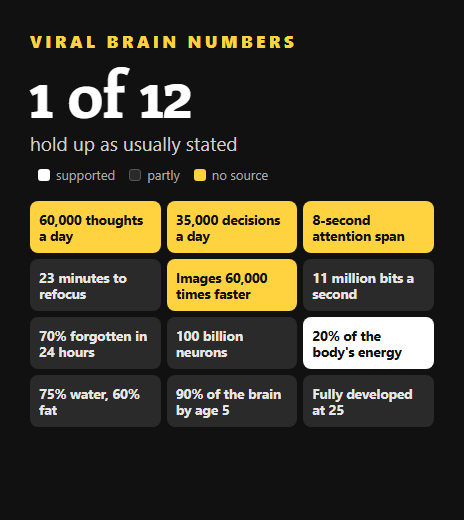
- Of 10 widely repeated claims, 4 trace to a source that prints the number and covers the same thing. “A brain runs on 12 W” and “a brain uses 4 MWh by 21” trace to no source we read; “a GPT-5 answer uses 18 Wh” is not in the paper it traces to.IQ Metrics claims list
02 Statistics to quote
published energy figures for brains and AI systems, from 22 sources, 2001 to 2026.
IQ Metrics, from the sourcesof the 47 AI energy figures are measurements / third-party estimates / company statements.
IQ Metrics labelling rulemedian Gemini Apps text prompt, measured across Google’s fleet in May 2025: 43 seconds of a 20 W brain.
Elsworth 2025; IQ Metrics calculationrange of 12 published figures for one chatbot text answer, a factor of 99.
IQ Metrics, from 8 sourceswhole-brain power in the three papers we converted; a PNAS review gives about 20 W.
Balasubramanian 2021; Kuzawa 2014; Herculano-Houzel 2011brain energy to type a 200-word answer at 51.56 words a minute (3.9 minutes) at 20 W; reading it aloud: 0.36 Wh.
IQ Metrics calculation; Dhakal 2018; Brysbaert 2019mean energy of one generated image across the models tested in 2023-24 (median 1.35, highest 11.49 Wh).
Luccioni 2024; IQ Metrics conversionenergy of one generated video clip of 1.6 to 6.1 seconds, six open models, GPU plus CPU plus memory.
Delavande 2025; IQ Metrics sumtraining-energy figures that are measurements; all are third-party estimates or our conversions of company GPU hours.
IQ Metricstwo outside estimates of GPT-4 training energy: 9,354 and 12,969 lifetimes of brain energy to age 20.
Morand 2026; Epoch table; IQ Metrics calculationenergy of one brain to age 20 at a constant 20 W (2.81 to 4.38 MWh at 16.0 and 25.0 W).
IQ Metrics calculationwidely repeated brain-versus-AI energy claims that trace to a source that prints the number and covers the same thing.
IQ Metricsfall in the energy of Google’s median Gemini text prompt from May 2024 to May 2025, as Google reports (about 7.9 Wh in May 2024 by our multiplication).
Elsworth 2025; IQ Metrics calculationenergy of one Google search in 2009, the only first-party search figure we found (0.0003 kWh).
Google 200903 What does this study compare?
We compare published energy figures for two kinds of system: a human brain, or the person around it, and AI systems doing a defined unit of work, and nothing else. This page says nothing about which is smarter. The table has 59 figures from 22 sources, 2001 to 2026: 11 about brains and 48 about AI, from one chatbot text answer to one training run. Each figure is labelled as a MEASUREMENT (a company or lab metered it), a third-party ESTIMATE (calculated from public numbers) or a company STATEMENT (said, with no method published), and by what it includes: the chips alone, the server, the data-centre overhead or the full stack [9] [15]. The brain side has its own labels and its own caveat: the brain also runs the body’s senses and movement at the same time.
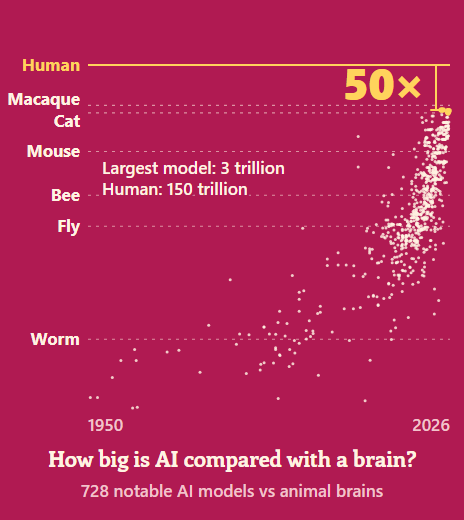
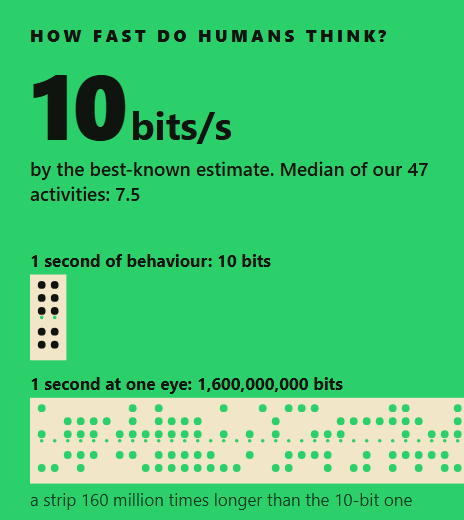
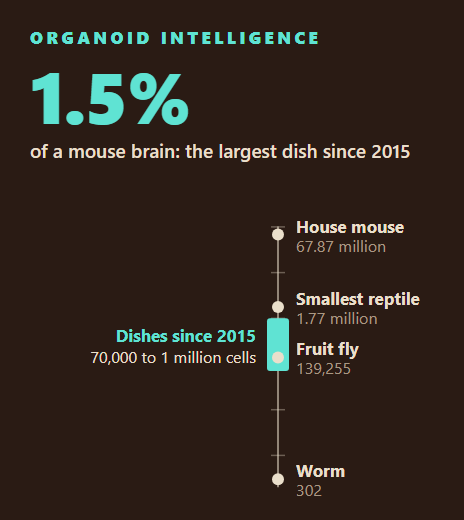
Two earlier studies on this site compared AI with a brain on other measures: size (parameters against synapses) and speed (bits per second). We link them and do not repeat their numbers. Our organoid intelligence study traces one energy ratio, “a million times less”, and our news explainer on brain and AI power covers the idea in prose; this page puts the figures themselves in one open table with the boundary of each.
- Watt and watt-hour
- A watt (W) is a rate of energy use; a watt-hour (Wh) is one watt for one hour, so 3,600 joules. A 20 W brain uses 20 Wh in an hour. 1 kWh = 1,000 Wh; 1 MWh = 1,000,000 Wh; 1 GWh = 10^9 Wh.
- Brain power
- The power of the whole brain, about 20 W in a PNAS review [1], built from glucose use. It is brain only: it leaves out the rest of the body and the food chain behind it.
- Measurement, estimate, statement
- Measurement: a lab or company metered the energy. Estimate: someone calculated it from public numbers. Statement: a company said it and has not published a method. Our own conversions of printed numbers are marked.
- What a figure includes
- The boundary: AI chips only; chips plus host CPU and memory; plus data-centre overhead (cooling, power conversion); or the full stack with idle reserved machines [9]. Not included anywhere: the user’s device, the network, chip manufacturing.
- Unit of work
- What one figure measures: one chatbot text answer, one long query, one image, one video clip, one web search or one training run. Figures are only comparable inside the same unit of work.
- Median prompt
- The middle prompt when all prompts are ranked by energy. Google’s 0.24 Wh is the median Gemini Apps text prompt in May 2025, not the average and not every prompt [9].
- Training run
- The one-off job that teaches a model from data. Its energy is paid once; the model then answers many prompts. A run has no measured energy figure in our data, only estimates.
- Brain-lifetime
- The energy of one brain to age 20 at a constant 20 W: 3,506,400 Wh (3.51 MWh). We use it only to express training runs on a human scale; it is an illustration, not a fair match.
04 What do all the figures look like on one scale?
On one log scale the 47 AI figures span almost 13 powers of ten, from 0.04 Wh (a Llama 3.1 70B answer, GPU only) to 310 GWh (Grok 4 training, Epoch’s estimate) [15] [14]. A chatbot text answer sits between 0.04 and 3.96 Wh; an image near 1 to 12 Wh; a video clip between 0.14 and 415 Wh; the one search figure at 0.3 Wh; training runs between 85.7 MWh (T5) and 310 GWh [20]. The brain side, in the top row, is our calculation at 20 W: 0.33 Wh for a minute, 20 Wh for an hour, 3.51 MWh to age 20. The gaps inside a row come mostly from what each figure includes and who made it, which the next sections go through unit by unit.
Every figure on one scale: from 0.04 Wh for a chatbot answer to 310 GWh for a training run
Each dot is one published figure in watt-hours (log scale: each step is ten times more), one row per unit of work, from the bottom up: the brain side (our calculation at 20 W), a chatbot text answer, a long query, a short model call, an image, a video clip, a web search and a training run. Colour = measurement, third-party estimate or company statement. Figures include different things (see the table); as of 25 November 2026.
Unit of work (one row each, see the sub line)
Watt-hours (Wh), log scale: 1k = 1 kWh, 1M = 1 MWh, 1B = 1 GWh
Source: Our dataset of 59 published figures [9] [11] [12] [15] [16] [17] [18] [19] [20] [13] [23]; brain side by IQ Metrics
Data table
| figure | wh | row_position | group |
|---|---|---|---|
| Gemini median prompt, full stack | 0.2 | 1.9 | MEASUREMENT |
| Gemini median prompt, chips only | 0.1 | 2 | MEASUREMENT |
| ChatGPT average query (statement) | 0.3 | 2.1 | STATEMENT |
| GPT-4o typical query | 0.3 | 2.3 | ESTIMATE |
| ChatGPT query, 2023 scenario | 2.9 | 1.7 | ESTIMATE |
| BLOOM request, research API | 4 | 1.9 | MEASUREMENT |
| GPT-4o short prompt | 0.4 | 2 | ESTIMATE |
| GPT-5 short prompt, minimal reasoning | 0.7 | 2.1 | ESTIMATE |
| Models over 200B parameters, median | 0.3 | 2.3 | ESTIMATE |
| Llama 3.1 70B, GPU only | 0 | 1.7 | MEASUREMENT |
| Llama 3.1 405B, GPU only | 0.2 | 1.9 | MEASUREMENT |
| Llama 3.1 70B, one at a time | 1.7 | 2 | MEASUREMENT |
| GPT-4o, 10,000 tokens in | 2.5 | 2.9 | ESTIMATE |
| GPT-4o, 100,000 tokens in | 40 | 3 | ESTIMATE |
| Long queries, median (test-time scaling) | 3.9 | 3.1 | ESTIMATE |
| DeepSeek-R1 query (estimate) | 10.6 | 3.3 | ESTIMATE |
| DeepSeek-R1 query (GPU only) | 7.5 | 2.7 | MEASUREMENT |
| GPT-5 long prompt, high reasoning | 33.8 | 2.9 | ESTIMATE |
| Text generation, 10 tokens (mean) | 0 | 3.9 | MEASUREMENT |
| Summarisation (mean) | 0 | 4 | MEASUREMENT |
| Image generation, mean | 2.9 | 4.9 | MEASUREMENT |
| Image generation, median | 1.4 | 5 | MEASUREMENT |
| Image generation, highest model | 11.5 | 5.1 | MEASUREMENT |
| AnimateDiff clip | 0.1 | 5.9 | MEASUREMENT |
| LTX-Video clip | 3.7 | 6 | MEASUREMENT |
| CogVideoX-5B clip | 25.3 | 6.1 | MEASUREMENT |
| Mochi-1 clip | 52.1 | 6.3 | MEASUREMENT |
| WAN2.1 1.3B clip | 90.5 | 5.7 | MEASUREMENT |
| WAN2.1 14B clip | 415.1 | 5.9 | MEASUREMENT |
| Google search, 2009 | 0.3 | 6.9 | STATEMENT |
| GPT-3, Patterson | 1287000000 | 7.9 | ESTIMATE |
| GPT-3, Epoch | 1811790000 | 8 | ESTIMATE |
| BLOOM, GPU hours x TDP | 433196000 | 8.1 | ESTIMATE |
| BLOOM, Epoch | 864963000 | 8.3 | ESTIMATE |
| T5, Patterson | 85700000 | 7.7 | ESTIMATE |
| Meena, Patterson | 232000000 | 7.9 | ESTIMATE |
| Switch Transformer, Patterson | 179000000 | 8 | ESTIMATE |
| Llama 2 70B, Meta hours x W | 688128000 | 8.1 | ESTIMATE |
| Llama 2 70B, Epoch | 1374720000 | 8.3 | ESTIMATE |
| Llama 3.1 405B, Meta hours x W | 21588000000 | 7.7 | ESTIMATE |
| Llama 3.1 405B, Epoch | 48457500000 | 7.9 | ESTIMATE |
| Llama 3.1 70B, Meta hours x W | 4900000000 | 8 | ESTIMATE |
| GPT-4, Epoch | 45473200000 | 8.1 | ESTIMATE |
| GPT-4, Morand | 32800000000 | 8.3 | ESTIMATE |
| Gemini 1.0 Ultra, Epoch | 92217400000 | 7.7 | ESTIMATE |
| Grok 3, Epoch | 237489000000 | 7.9 | ESTIMATE |
| Grok 4, Epoch | 310000000000 | 8 | ESTIMATE |
| Brain, 1 minute at 20 W | 0.3 | 0.7 | CALCULATION |
| Brain, 1 hour at 20 W | 20 | 0.9 | CALCULATION |
| Brain, 1 day at 20 W | 480 | 1 | CALCULATION |
| Brain, 1 year at 20 W | 175320 | 1.1 | CALCULATION |
| Brain to age 20 at 20 W | 3506400 | 1.3 | CALCULATION |
| Brain typing 200 words at 20 W | 1.3 | 0.7 | CALCULATION |
| Brain reading 200 words aloud at 20 W | 0.4 | 0.9 | CALCULATION |
Embed this chart
Paste this HTML into your page: it carries the numbers and the credit link to this figure.
Which order of magnitude does each kind of figure sit in? Text answers near 1 Wh, training runs from tens of MWh to hundreds of GWh
One dot per published figure (and per brain calculation), placed in its power of ten of watt-hours: 0 means 1 to 9.9 Wh, 3 means 1 to 9.9 kWh, 6 means 1 to 9.9 MWh, 9 means 1 to 9.9 GWh. The top panel is our brain-side calculation (1 minute, 1 hour, 1 day, 1 year, 20 years, a typed and a spoken 200-word answer). Dot colour is the order of magnitude, not a quality. As of 25 November 2026.
Power of ten of watt-hours: each step to the right is ten times more energy.
Source: Our dataset [9] [17] [19] [25] [20] [13]; brain side by IQ Metrics
Data table
| unit of work | power of ten of Wh | count |
|---|---|---|
| Brain side (our calculation) | -1 | 2 |
| Brain side (our calculation) | 0 | 1 |
| Brain side (our calculation) | 1 | 1 |
| Brain side (our calculation) | 2 | 1 |
| Brain side (our calculation) | 5 | 1 |
| Brain side (our calculation) | 6 | 1 |
| Text answer, query or call | -2 | 3 |
| Text answer, query or call | -1 | 8 |
| Text answer, query or call | 0 | 6 |
| Text answer, query or call | 1 | 3 |
| Image | 0 | 2 |
| Image | 1 | 1 |
| Video clip | -1 | 1 |
| Video clip | 0 | 1 |
| Video clip | 1 | 3 |
| Video clip | 2 | 1 |
| Web search | -1 | 1 |
| Training run | 7 | 1 |
| Training run | 8 | 5 |
| Training run | 9 | 4 |
| Training run | 10 | 5 |
| Training run | 11 | 2 |
Embed this chart
Paste this HTML into your page: it carries the numbers and the credit link to this figure.
05 How many watts does the human brain use?
The brain uses about 20 watts: a PNAS review puts the whole brain at roughly 20 W, and two papers we converted give 16.0 and 25.0 W [1] [3] [4]. The review says the whole-brain figure of 17 to 20 W is derived from glucose uptake, of which cortical grey matter takes about 3 W. The lower figure is the adult male brain’s glucose use from Kuzawa and colleagues, who print the childhood peak (167.0 g of glucose a day at age 5.2) as 1.88 times the adult value; the higher is Herculano-Houzel’s estimate for 86 billion neurons, 516 kcal a day. The spread between the lowest and highest whole-brain figure is 1.56 times.
What the brain figure includes is the brain and nothing else. A body at rest uses more: if a 20 W brain is about 20% of the body’s oxygen and calories, the whole body is about 100 W (our division), and the 2,000 calories a day that the US Food and Drug Administration uses as a general guide are 96.9 W averaged over a day [2] [6]. The brain is about 2% of body weight [2]. In children the brain uses more: glucose at a rate equal to 66% of the body’s resting metabolism at its peak, and 30.1 W for a boy at age 5.2 by our conversion [3]. See also our fact check of brain statistics and human brain facts.
How many watts does a brain use? Three whole-brain figures, 16.0 to 25.0 W, and a child peak of 30.1 W
Power in watts. All are brain-only figures built from glucose use; none includes the rest of the body. Two bars are our conversions of printed grams of glucose or kilocalories per day (1 g of glucose = 3.72 kcal; 1 kcal = 4,184 J). The adult figure from Kuzawa is the printed childhood peak divided by the printed 1.88. As of 25 November 2026.
Source: Balasubramanian 2021 [1]; Kuzawa 2014 [3]; Herculano-Houzel 2011 [4]; conversions by IQ Metrics
Data table
| label | value |
|---|---|
| Cortical grey matter only (Levy and Calvert) | 3 |
| Adult male brain, glucose only (Kuzawa; our conversion) | 16 |
| Whole brain, "energy budget" (Balasubramanian) | 20 |
| Whole brain, 86 billion neurons (Herculano-Houzel; our conversion) | 25 |
| Child brain at its peak, male, age 5.2 (Kuzawa; our conversion) | 30.1 |
Embed this chart
Paste this HTML into your page: it carries the numbers and the credit link to this figure.
Two things make a “brain energy for a task” figure approximate. First, the brain’s rate barely moves with what it is doing: Raichle and Gusnard call its metabolism “remarkably constant” despite varying mental and motor activity, and the blood-flow changes seen in brain scans during most cognitive tasks are often 5% or less [2]. So the time a task takes is what drives the brain’s energy for it. Second, most of the energy is spent on signalling: in rodent grey matter, action potentials account for 47%, postsynaptic effects of glutamate 34% and the resting potential 13% [5]. A figure of 12 W is repeated online; none of the papers we read prints it, so it is not in the table (see the claims below).
06 How much energy does one chatbot answer use?
Google measured 0.24 Wh for its median Gemini Apps text prompt in May 2025; the 12 published figures for a chatbot text answer run from 0.04 to 3.96 Wh, a factor of 99 [9]. Google’s figure is the only measurement we found from the operator of a widely used commercial chatbot, and the widest in what it counts: AI accelerators 0.14 Wh, host CPU and memory 0.06, idle reserved machines 0.02 and data-centre overhead 0.02. Counted with a narrower, earlier-style boundary the same prompts come to 0.10 Wh. Google says the data and claims have not been verified by an independent third party [10].
Where does the 0.24 Wh of a median Gemini text prompt go? 58% to the AI accelerators
Google's own breakdown of the median Gemini Apps text prompt in May 2025, measured across its fleet. Watt-hours per prompt: AI accelerators 0.14, host CPU and memory 0.06, idle reserved machines 0.02, data-centre overhead 0.02. Counted with a narrower boundary, Google gets 0.10 Wh, 2.4 times less.
- AI accelerators0.14 Wh58%
- Host CPU and memory0.06 Wh25%
- Idle reserved machines0.02 Wh8%
- Data-centre overhead0.02 Wh8%
Source: Elsworth et al. 2025, Table 1 and section 4.1 [9]; Google blog [10]
Data table
| part of the prompt's energy | value | share_pct |
|---|---|---|
| AI accelerators | 0.1 | 58.3 |
| Host CPU and memory | 0.1 | 25 |
| Idle reserved machines | 0 | 8.3 |
| Data-centre overhead | 0 | 8.3 |
Embed this chart
Paste this HTML into your page: it carries the numbers and the credit link to this figure.
The other figures differ in kind. OpenAI’s chief executive wrote in a blog post that the average ChatGPT query uses about 0.34 Wh, a statement with no published method, query length or hardware [11]. Epoch AI estimated about 0.3 Wh for a typical GPT-4o query of 500 output tokens, from roughly one second of H100 time at 1,500 W per GPU including server and data-centre overhead and 70% of peak power [12]. Microsoft authors estimated a median 0.31 Wh for models above 200 billion parameters, assuming 8-GPU nodes at 70% of peak and a PUE of 1.05 to 1.40 [15]. Rhode Island authors estimated 0.42 Wh for a short GPT-4o prompt (300 output tokens) and 0.67 Wh for a short GPT-5 prompt with minimal reasoning [16]. Measured on GPUs alone, the ML.ENERGY leaderboard gives 0.04 Wh for Llama 3.1 70B and 0.21 Wh for 405B (read in the Oviedo table) [15] [24]. The highest figures are older or narrower set-ups: 3.96 Wh per request for BLOOM-176B on a low-volume research API with no batching, including idle time between requests [18], and 2.9 Wh in a 2023 scenario [15].
Long inputs and long reasoning raise the number. Epoch estimates about 2.5 Wh for a 10,000-token input and almost 40 Wh for 100,000 tokens [12]; Oviedo and colleagues put queries 15 times longer than typical at a median 3.91 Wh and DeepSeek-R1 at 10.6 Wh [15]; the Rhode Island paper estimates 33.8 Wh for a long GPT-5 prompt with high reasoning [16]. Six long-query figures range from 2.5 to 40 Wh. Oviedo and colleagues warn that many public figures assume non-production settings and overstate energy; Google’s paper shows that a narrow boundary understates its own figure by a factor of 2.4. Both can be right for their own boundary, which is why the next figure counts them.
What does each figure include? Only 1 of 47 AI energy figures counts the full stack, and 9 count the chips alone
Number of figures per unit of work (rows) and per boundary (columns). Only figures in the same row and the same column are like for like. The one full-stack figure is Google's 0.24 Wh; the three "not stated" are OpenAI's 0.34 Wh, de Vries' 2.9 Wh and Google's 2009 search. As of 25 November 2026.
Source: Our dataset and the boundary stated in each source [9] [15] [16] [17] [19] [20] [13]; classification by IQ Metrics
Data table
| unit of work (figures) | AI chips only | Chips plus host CPU and memory | Server plus data-centre overhead | Full stack with idle capacity | Not stated |
|---|---|---|---|---|---|
| Chatbot text answer (12) | 4 | 1 | 4 | 1 | 2 |
| Long query (6) | 1 | 0 | 5 | 0 | 0 |
| Short model call (2) | 0 | 2 | 0 | 0 | 0 |
| Image (3) | 0 | 3 | 0 | 0 | 0 |
| Video clip (6) | 0 | 6 | 0 | 0 | 0 |
| Web search (1) | 0 | 0 | 0 | 0 | 1 |
| Training run (17) | 4 | 0 | 13 | 0 | 0 |
Embed this chart
Paste this HTML into your page: it carries the numbers and the credit link to this figure.
How were the 47 AI energy figures made? 18 measurements, 27 estimates and 2 statements
One square per published AI energy figure, grouped by how it was made. Measurements are text (9), images (3) and video clips (6); no training figure is a measurement. Brain figures are not in this grid: they come from glucose use measured in people and converted to watts.
47 figuresone square = one figure
Source: Our dataset and labelling rule (see the definitions); labels by IQ Metrics
Data table
| figure | group | label | detail |
|---|---|---|---|
| a01 | Measurement: a lab or company metered it | Gemini median prompt, full stack | Gemini median prompt, full stack: 0.24 Wh, 2025 |
| a02 | Measurement: a lab or company metered it | Gemini median prompt, chips only | Gemini median prompt, chips only: 0.1 Wh, 2025 |
| a06 | Measurement: a lab or company metered it | BLOOM request, research API | BLOOM request, research API: 3.961 Wh, 2022 |
| a10 | Measurement: a lab or company metered it | Llama 3.1 70B, GPU only | Llama 3.1 70B, GPU only: 0.04 Wh, 2025 |
| a11 | Measurement: a lab or company metered it | Llama 3.1 405B, GPU only | Llama 3.1 405B, GPU only: 0.21 Wh, 2025 |
| a12 | Measurement: a lab or company metered it | Llama 3.1 70B, one at a time | Llama 3.1 70B, one at a time: 1.72 Wh, 2025 |
| a17 | Measurement: a lab or company metered it | DeepSeek-R1 query (GPU only) | DeepSeek-R1 query (GPU only): 7.45 Wh, 2025 |
| a19 | Measurement: a lab or company metered it | Text generation, 10 tokens (mean) | Text generation, 10 tokens (mean): 0.047 Wh, 2023 |
| a20 | Measurement: a lab or company metered it | Summarisation (mean) | Summarisation (mean): 0.049 Wh, 2023 |
| i01 | Measurement: a lab or company metered it | Image generation, mean | Image generation, mean: 2.907 Wh, 2023 |
| i02 | Measurement: a lab or company metered it | Image generation, median | Image generation, median: 1.35 Wh, 2023 |
| i03 | Measurement: a lab or company metered it | Image generation, highest model | Image generation, highest model: 11.49 Wh, 2023 |
| v01 | Measurement: a lab or company metered it | AnimateDiff clip | AnimateDiff clip: 0.139 Wh, 2025 |
| v02 | Measurement: a lab or company metered it | LTX-Video clip | LTX-Video clip: 3.67 Wh, 2025 |
| v03 | Measurement: a lab or company metered it | CogVideoX-5B clip | CogVideoX-5B clip: 25.3 Wh, 2025 |
| v04 | Measurement: a lab or company metered it | Mochi-1 clip | Mochi-1 clip: 52.1 Wh, 2025 |
| v05 | Measurement: a lab or company metered it | WAN2.1 1.3B clip | WAN2.1 1.3B clip: 90.5 Wh, 2025 |
| v06 | Measurement: a lab or company metered it | WAN2.1 14B clip | WAN2.1 14B clip: 415 Wh, 2025 |
| a04 | Third-party estimate: calculated from public numbers | GPT-4o typical query | GPT-4o typical query: 0.3 Wh, 2025 |
| a05 | Third-party estimate: calculated from public numbers | ChatGPT query, 2023 scenario | ChatGPT query, 2023 scenario: 2.9 Wh, 2023 |
| a07 | Third-party estimate: calculated from public numbers | GPT-4o short prompt | GPT-4o short prompt: 0.42 Wh, 2025 |
| a08 | Third-party estimate: calculated from public numbers | GPT-5 short prompt, minimal reasoning | GPT-5 short prompt, minimal reasoning: 0.67 Wh, 2025 |
| a09 | Third-party estimate: calculated from public numbers | Models over 200B parameters, median | Models over 200B parameters, median: 0.31 Wh, 2025 |
| a13 | Third-party estimate: calculated from public numbers | GPT-4o, 10,000 tokens in | GPT-4o, 10,000 tokens in: 2.5 Wh, 2025 |
| a14 | Third-party estimate: calculated from public numbers | GPT-4o, 100,000 tokens in | GPT-4o, 100,000 tokens in: 40 Wh, 2025 |
| a15 | Third-party estimate: calculated from public numbers | Long queries, median (test-time scaling) | Long queries, median (test-time scaling): 3.91 Wh, 2025 |
| a16 | Third-party estimate: calculated from public numbers | DeepSeek-R1 query (estimate) | DeepSeek-R1 query (estimate): 10.6 Wh, 2025 |
| a18 | Third-party estimate: calculated from public numbers | GPT-5 long prompt, high reasoning | GPT-5 long prompt, high reasoning: 33.8 Wh, 2025 |
| t01 | Third-party estimate: calculated from public numbers | GPT-3, Patterson | GPT-3, Patterson: 1287000000 Wh, 2021 |
| t02 | Third-party estimate: calculated from public numbers | GPT-3, Epoch | GPT-3, Epoch: 1811790000 Wh, 2026 |
| t03 | Third-party estimate: calculated from public numbers | BLOOM, GPU hours x TDP | BLOOM, GPU hours x TDP: 433196000 Wh, 2022 |
| t04 | Third-party estimate: calculated from public numbers | BLOOM, Epoch | BLOOM, Epoch: 864963000 Wh, 2026 |
| t05 | Third-party estimate: calculated from public numbers | T5, Patterson | T5, Patterson: 85700000 Wh, 2021 |
| t06 | Third-party estimate: calculated from public numbers | Meena, Patterson | Meena, Patterson: 232000000 Wh, 2021 |
| t07 | Third-party estimate: calculated from public numbers | Switch Transformer, Patterson | Switch Transformer, Patterson: 179000000 Wh, 2021 |
| t08 | Third-party estimate: calculated from public numbers | Llama 2 70B, Meta hours x W | Llama 2 70B, Meta hours x W: 688128000 Wh, 2023 |
| t09 | Third-party estimate: calculated from public numbers | Llama 2 70B, Epoch | Llama 2 70B, Epoch: 1374720000 Wh, 2026 |
| t10 | Third-party estimate: calculated from public numbers | Llama 3.1 405B, Meta hours x W | Llama 3.1 405B, Meta hours x W: 21588000000 Wh, 2024 |
| t11 | Third-party estimate: calculated from public numbers | Llama 3.1 405B, Epoch | Llama 3.1 405B, Epoch: 48457500000 Wh, 2026 |
| t12 | Third-party estimate: calculated from public numbers | Llama 3.1 70B, Meta hours x W | Llama 3.1 70B, Meta hours x W: 4900000000 Wh, 2024 |
| t13 | Third-party estimate: calculated from public numbers | GPT-4, Epoch | GPT-4, Epoch: 45473200000 Wh, 2026 |
| t14 | Third-party estimate: calculated from public numbers | GPT-4, Morand | GPT-4, Morand: 32800000000 Wh, 2026 |
| t15 | Third-party estimate: calculated from public numbers | Gemini 1.0 Ultra, Epoch | Gemini 1.0 Ultra, Epoch: 92217400000 Wh, 2026 |
| t16 | Third-party estimate: calculated from public numbers | Grok 3, Epoch | Grok 3, Epoch: 237489000000 Wh, 2026 |
| t17 | Third-party estimate: calculated from public numbers | Grok 4, Epoch | Grok 4, Epoch: 310000000000 Wh, 2025 |
| a03 | Company statement: no method published | ChatGPT average query (statement) | ChatGPT average query (statement): 0.34 Wh, 2025 |
| s01 | Company statement: no method published | Google search, 2009 | Google search, 2009: 0.3 Wh, 2009 |
Embed this chart
Paste this HTML into your page: it carries the numbers and the credit link to this figure.
Eighteen of the 47 AI energy figures are measurements: nine for text (six chatbot answers, one long query and two short calls), three for images and six for video clips. The six chatbot-answer measurements come from Google, one research API and two public leaderboards; the other chatbot figures are estimates or one statement. Authors employed by AI or cloud companies (Google, Microsoft, Meta, OpenAI, Hugging Face) wrote 16 of the 47 AI energy rows; universities, Epoch AI and other independent groups wrote the other 31. We label who produced each figure in the CSV and take no side on any of them.
From unit of work to kind of figure: text, image and video are mostly measured; training energy is only estimated
47 AI energy figures. Left: the unit of work. Right: how the figure was made. Measurements: 9 of 20 text figures, 3 of 3 image, 6 of 6 video, 0 of 17 training, 0 of 1 search.
Source: Our dataset [9] [17] [19] [25] [20] [13]; counts by IQ Metrics
Data table
| from | to | figures |
|---|---|---|
| Text answer or query | Measurement | 9 |
| Text answer or query | Company statement | 1 |
| Text answer or query | Third-party estimate | 10 |
| Image | Measurement | 3 |
| Video clip | Measurement | 6 |
| Web search | Company statement | 1 |
| Training run | Third-party estimate | 17 |
Embed this chart
Paste this HTML into your page: it carries the numbers and the credit link to this figure.
07 How much energy does a brain use to write an answer?
At 20 W, typing a 200-word answer at 51.56 words a minute takes 3.9 minutes and 1.29 Wh of brain energy; reading it aloud at 183 words a minute takes 66 seconds and 0.36 Wh. The rates come from our study of thinking speed (typing from 168,960 volunteers [7]; reading aloud from a meta-analysis [8]). The formula is brain watts times the seconds the task takes, divided by 3,600. At 16.0 W the typing figure is 1.03 Wh and at 25.0 W it is 1.62 Wh; for the whole body at 100 W it is 6.46 Wh. Fast typists (89.56 words a minute) take 2.2 minutes, slow ones (20.91) 9.6.
Put next to Google’s median 0.24 Wh, which equals 43 seconds of a 20 W brain, the typed answer is about 5.4 times the energy and the spoken one 1.5 times. That is not a contest, for four reasons. The jobs differ: Google does not print the length of its median answer, and a person writing one also reads the question. The boundaries differ: 20 W is the brain alone, while 0.24 Wh includes idle reserved machines and data-centre overhead but not the user’s device or the network. The brain does other things at the same time. And the person is not the only energy behind an answer: the model was trained once, which is covered below.
In brain time: one AI answer is 0.3 to 101 minutes of a 20-watt brain's energy
Minutes a 20 W brain runs on the energy of one AI answer: Wh divided by 20, times 60. A unit conversion, not a contest: the answers differ in length, the figures in what they include, and brain power is brain only. For scale, the brain types a 200-word answer in 3.9 minutes and reads it aloud in 1.1 minutes. As of 25 November 2026.
Source: Our dataset [9] [11] [12] [15] [16] [18]; division by IQ Metrics
Data table
| label | value |
|---|---|
| Gemini median prompt, chips only (Google, measured) | 0.3 |
| Gemini median prompt, full stack (Google, measured) | 0.7 |
| GPT-4o typical query (Epoch, estimate) | 0.9 |
| Models over 200B parameters, median (Oviedo, estimate) | 0.9 |
| ChatGPT average query (OpenAI, statement) | 1 |
| GPT-4o short prompt (Jegham, estimate) | 1.3 |
| GPT-5 short prompt, minimal reasoning (Jegham, estimate) | 2 |
| Long queries, median (Oviedo, estimate) | 11.7 |
| BLOOM research API request (Luccioni, measured) | 11.9 |
| DeepSeek-R1 query (Oviedo, estimate) | 31.8 |
| GPT-5 long prompt, high reasoning (Jegham, estimate) | 101.4 |
Embed this chart
Paste this HTML into your page: it carries the numbers and the credit link to this figure.
The brain side: energy for each job, with the formula
Our calculations from the brain-power figures above and the typing and reading rates of our study on thinking speed. The brain also does other things at the same time; task-evoked changes in brain blood flow are often 5% or less.
| Brain, one minute at 20 W | 0.3333 | Wh = 20 W x 1/60 h |
| Brain, one hour at 20 W | 20 | Wh = 20 W x 1 h |
| Brain, one day at 20 W | 480 | Wh = 20 W x 24 h |
| Brain, one year at 20 W | 175320 | Wh = 20 W x 24 h x 365.25 days |
| Brain to age 20 at a constant 20 W | 3506400 | Wh = 20 W x 24 h x 365.25 days x 20 years |
| Brain to age 20 at 16.0 W | 2805500 | Wh = 16.0 W x 175,320 h |
| Brain to age 20 at 25.0 W | 4380860 | Wh = 25.0 W x 175,320 h |
| Brain to age 20, ceiling at 1.88 times the adult rate | 6592030 | Wh = 3,506,400 Wh x 1.88 (Kuzawa 2014 peak ratio, male, applied to all 20 years: a ceiling, not an estimate) |
| Brain typing a 200-word answer at 51.56 words a minute, at 20 W | 1.293 | Wh = 20 W x (200 / 51.56 x 60 s) / 3,600 s |
| Brain reading a 200-word answer aloud at 183 words a minute, at 20 W | 0.3643 | Wh = 20 W x (200 / 183 x 60 s) / 3,600 s |
| Whole body (100 W) typing a 200-word answer at 51.56 words a minute | 6.465 | Wh = 100 W x (200 / 51.56 x 60 s) / 3,600 s |
| Whole body (100 W) reading a 200-word answer aloud at 183 words a minute | 1.821 | Wh = 100 W x (200 / 183 x 60 s) / 3,600 s |
Source:
Reaction and processing speed matter here only as time: a faster thinker finishes sooner, so the same 20 W is drawn for less time (see processing speed and IQ and average reaction time by age). We do not claim that quicker means more efficient: no source here measures quality of the answer.
08 How much energy does an AI image or video use?
One generated image used a mean of 2.9 Wh across the models Luccioni and colleagues tested in 2023-24, with a median of 1.35 Wh and a highest of 11.49 Wh; one short video clip used 0.14 to 415 Wh across six open models in 2025 [17] [19]. The image study measured GPU, CPU and memory on a node of 8 A100 GPUs through a carbon-tracking package, and prints kilowatt-hours per 1,000 inferences, which equals watt-hours per image. The authors compare it with a smartphone charge of 0.022 kWh: the least efficient image model is about half a charge per image, and the mean (2.9 Wh) is about 13% of a charge by our division [17]. Image sizes differ between models, which is a main source of the spread.
The video paper measured six open models at default settings; energy rises with resolution, clip length and denoising steps, and the GPU accounts for over 80% of it [19]. The clips run from 1.6 seconds (AnimateDiff, 0.139 Wh) to 5.4 seconds at 720 x 1280 (WAN2.1 14B, 415.1 Wh); a factor of about 3,000 separates the lowest from the highest. No first-party figure for a proprietary image or video service was found, so none is in the table. The short-call figures of the same image study, 0.047 Wh for text generation of 10 tokens, are not chat answers and are shown in their own row.
Energy of one generated video clip, six open models (Wh per clip)
GPU, CPU and memory energy as printed in Table 4 of the paper; the total is our sum. Default settings of each model; one test set-up; no proprietary service was measured.
| AnimateDiff | 16 frames at 10 per second | 1.6 | 0.115 | 0.016 | 0.008 | 0.139 |
| LTX-Video 0.9.7 | 121 frames at 24 per second | 5.0 | 3.16 | 0.32 | 0.19 | 3.67 |
| CogVideoX-5B | 49 frames at 8 per second | 6.1 | 21.6 | 2.4 | 1.3 | 25.3 |
| Mochi-1 | 84 frames at 30 per second | 2.8 | 44.7 | 4.6 | 2.8 | 52.1 |
| WAN2.1 1.3B | 81 frames at 15 per second | 5.4 | 78.8 | 7.4 | 4.3 | 90.5 |
| WAN2.1 14B | 81 frames at 15 per second | 5.4 | 360 | 35.6 | 19.8 | 415 |
Source:
09 How much energy does a web search use?
Google said in 2009 that an average search used 0.0003 kWh, or 0.3 Wh (1 kJ); it is the only first-party per-search figure we found and it is 17 years old [25]. The post counts the servers a query touches plus work done before the search starts, such as building the index, and compares it with the food energy an adult burns in ten seconds. Oviedo and colleagues call the figure dated and say that, to their knowledge, no newer public disclosure exists [15]. Google’s 2025 median Gemini prompt of 0.24 Wh is a fifth lower than 0.3 Wh, but the two are 16 years and two different systems apart, so we draw no ratio between “AI” and “search” from them.
10 How much energy does it take to train a model like GPT-4?
Two outside estimates put GPT-4 training at 32.8 GWh and 45.5 GWh, and none of the 17 training figures we collected is a measurement [23] [13]. The 45.5 GWh is Epoch AI’s training power draw for GPT-4 (about 19.9 MW, “Likely” confidence) times 2,280 hours; Epoch’s method multiplies the number of chips by their rated power, a server overhead of 1.82 for multi-chip jobs and the data-centre PUE, at peak power. The 32.8 GWh is a French research group’s life-cycle estimate built on Epoch’s data: 27.4 GWh of server use and 5.4 GWh of infrastructure. We found no energy figure for GPT-4 published by its maker.
For other runs the figures come from papers or from our conversion of company statements. Patterson and colleagues estimated 1,287 MWh for GPT-3 [20]; Epoch’s method gives 1.81 GWh. BLOOM’s authors multiplied 1,082,990 GPU hours by the GPU’s 400 W rating to get 433,196 kWh and say they could not track real-time power; a measured split of the cluster shows only about 54% of its power was dynamic, the rest idle and infrastructure, and Epoch’s method gives 0.87 GWh [18]. Meta prints GPU hours and a per-GPU power for Llama 2 and Llama 3.1: our products are 688 MWh for Llama 2 70B and 21.6 GWh for Llama 3.1 405B, GPUs only [21] [22], against 1.37 and 48.5 GWh on Epoch’s method. Epoch’s own estimate for Grok 4 is 310 GWh, from 246 million H100-hours with stated overheads [14]. Where one run has two figures they differ by 1.4 to 2.2 times (median 2.0).
Two published figures for the same training run differ by 1.4 to 2.2 times
Gigawatt-hours for five training runs that have two figures in our data. The lower end is not "better": GPT-3 1.29 (Patterson) and 1.81 (Epoch); BLOOM 0.43 (GPU hours x 400 W) and 0.87 (Epoch); Llama 2 70B 0.69 (Meta hours x 400 W) and 1.37 (Epoch); Llama 3.1 405B 21.6 (Meta hours x 700 W) and 48.5 (Epoch); GPT-4 32.8 (Morand) and 45.5 (Epoch). None is a measurement.
Gigawatt-hours (GWh) of electricity for one training run
Source: Patterson 2021 [20]; Luccioni 2023 [18]; Meta [21] [22]; Morand 2026 [23]; Epoch table [13]; conversions by IQ Metrics
Data table
| training run | Lower figure | Higher figure |
|---|---|---|
| GPT-3 (1.4x apart) | 1.3 | 1.8 |
| BLOOM (2.0x apart) | 0.4 | 0.9 |
| Llama 2 70B (2.0x apart) | 0.7 | 1.4 |
| Llama 3.1 405B (2.2x apart) | 21.6 | 48.5 |
| GPT-4 (1.4x apart) | 32.8 | 45.5 |
Embed this chart
Paste this HTML into your page: it carries the numbers and the credit link to this figure.
Training energy rose about 170-fold from GPT-3 (2020) to Grok 4 (2025) on Epoch's estimates
Each bubble is one training run: release date across, training energy up (megawatt-hours, log scale; Epoch's power-draw-times-hours method, Grok 4 from its data insight), area = training compute. Colour = Epoch's own confidence in the hardware and time inputs. Estimates only: no measured figure exists for these runs in our data. As of 25 November 2026.
Training energy, MWh (log scale; 1k = 1 GWh)
Release date
Source: Epoch AI notable models table and Grok 4 data insight [13] [14]; conversion to MWh by IQ Metrics
Data table
| training run | year | mwh | group | compute_1e23_flop |
|---|---|---|---|---|
| GPT-3 | 2020.3 | 1811.8 | Confident | 3.1 |
| BLOOM | 2022.5 | 865 | Confident | 3.7 |
| Llama 2 70B | 2023.5 | 1374.7 | Confident | 8.1 |
| GPT-4 | 2023.2 | 45473.2 | Likely | 210 |
| Gemini 1.0 Ultra | 2023.9 | 92217.4 | Speculative | 500 |
| Llama 3.1 405B | 2024.5 | 48457.5 | Confident | 380 |
| Grok 3 | 2025.1 | 237489.1 | Likely | 3500 |
| Grok 4 | 2025.5 | 310000 | Speculative | 5000 |
Embed this chart
Paste this HTML into your page: it carries the numbers and the credit link to this figure.
To give these numbers a human scale we express them in brain-lifetimes: one brain to age 20 at a constant 20 W uses 3,506,400 Wh (3.51 MWh), between 2.81 and 4.38 MWh at 16.0 and 25.0 W and at most 6.59 MWh if the child peak of 1.88 times the adult rate held for all 20 years [3]. On that scale BLOOM’s GPU-hours figure is 124 brain-lifetimes, GPT-3 367, Llama 3.1 405B 6,157, GPT-4 9,354 to 12,969 and Grok 4 88,410. It is an illustration of scale, not a fair match: a training run happens once and then serves a very large number of answers, while a brain learns for 20 years and answers for 60 more and also runs a body.
A training run in lifetimes of brain energy: 124 for BLOOM, 9,354 to 12,969 for GPT-4, 88,410 for Grok 4
Training energy divided by one brain's energy to age 20 at a constant 20 W (3,506,400 Wh). An illustration of scale, not a fair match: a training run happens once and then serves many answers, while a brain learns for 20 years and answers for 60 more. Brain at 16.0 W or 25.0 W moves each bar by a factor of 0.8 or 1.25. As of 25 November 2026.
Source: Our dataset [18] [20] [21] [22] [23] [13] [14]; brain to age 20 by IQ Metrics (formula in the definitions)
Data table
| label | value |
|---|---|
| BLOOM, GPU hours x TDP | 124 |
| GPT-3, Patterson | 367 |
| Llama 2 70B, Meta hours x W | 196 |
| Llama 3.1 405B, Meta hours x W | 6157 |
| GPT-4, Morand | 9354 |
| GPT-4, Epoch | 12969 |
| Grok 3, Epoch | 67730 |
| Grok 4, Epoch | 88410 |
Embed this chart
Paste this HTML into your page: it carries the numbers and the credit link to this figure.
11 Is the brain more energy-efficient than AI?
No source we found measures a brain and an AI system on the same task at the same quality, so the question has no measured answer yet. Everything above compares different jobs: a brain’s watts for hours, a data centre’s watt-hours for one answer, and a training run that happened once. A fair test would give both the same task and the same accuracy, count the brain’s body and the data centre’s cooling, idle capacity and networking in the same way, and be published with its method. Our nearest comparisons, per minute and per lifetime, are unit conversions, and each says what it includes.
Claims that go further are traced in the next section. The best known, that living neurons or chips use “a million times less energy”, is a ratio of two power ratings for different tasks, covered in our organoid intelligence study. On the AI side we make no forecast: the IEA estimates that data centres used about 415 TWh in 2024, about 1.5% of global electricity, for all uses, not only AI [26]. That is one dated total, not a per-answer figure, and we draw no brain comparison from it. For what AI systems score on reasoning tests, which is a different question, see how smart AI is, five ways it is measured and what the 2026 benchmarks show.
12 Which brain-versus-AI energy claims hold up?
Of 10 widely repeated claims, 4 trace to a source that prints the number and covers the same thing: a brain at about 20 W, the brain at about 20% of the body’s energy, Google’s 0.24 Wh and GPT-3’s 1,287 MWh as an estimate. Two claims trace to no source we read (a brain at 12 W; a brain at 4 MWh by age 21). One is a statement whose scope cannot be checked (0.34 Wh). One is a 2023 scenario that we could read only in two later papers (3 Wh). One is not in the paper it traces to (18 Wh for GPT-5). One is a ratio of ratings, not a measurement (a million times less) [1] [2] [11] [9] [20] [16]. The list is our selection of claims seen on 25 November 2026, not a random sample.
Of 10 widely repeated claims, 4 trace to a source that prints the number and covers the same thing
Ten claims we saw repeated on 25 November 2026 (listed in the claims table). Stage 2: we found where the claim starts. Stage 3: we read the number in that source. Stage 4: the number covers what the claim says it does. "A brain runs on 12 W" and "a brain uses 4 MWh by 21" trace to no source we read; the 3 Wh and 18 Wh claims fail later.
Source: Our claims list (data/claims.tsv) [1] [2] [11] [9] [20] [16]; counts by IQ Metrics
Data table
| stage | count | pct_of_first | pct_of_previous |
|---|---|---|---|
| Claims we saw repeated | 10 | 100 | 100 |
| …traced to a source | 8 | 80 | 80 |
| …the source prints the number | 6 | 60 | 75 |
| …and it covers the same thing | 4 | 40 | 66.7 |
Embed this chart
Paste this HTML into your page: it carries the numbers and the credit link to this figure.
The ten claims, where we saw them and what the source says
Repeated = seen on 25 November 2026 in a web search or a paper (names of outlets as found; none is linked because none is a primary source). "Prints the number" means we read it in the source text.
| Claim and where we saw it | Traced to | Source checks | What we found |
|---|---|---|---|
| The human brain runs on about 20 watts. Seen: Web explainers on AI energy (for example BeInCrypto, Simply Explained, a Times of Israel blog), seen in a web search on 25 Nov 2026 | Balasubramanian 2021 (PNAS), “energy budget of ~20 W” | Number printed: yes Same thing: yes | Whole brain, derived from glucose uptake (17 W to 20 W); an estimate, and Kuzawa and Herculano-Houzel give 16 W and 25 W. |
| The brain uses 20% of the body’s energy. Seen: Repeated in the opening lines of two later papers (Herculano-Houzel 2011; Balasubramanian 2021) | Raichle and Gusnard 2002 (PNAS) | Number printed: yes Same thing: yes | The paper prints about 20% of the oxygen and calories consumed by the body, for a brain that is about 2% of body weight. |
| The brain runs on 12 watts. Seen: Viral posts and a blog (for example geeksaroundglobe), seen in a web search on 25 Nov 2026 | none found | Number printed: no Same thing: no | No source we read prints 12 W. The brain-power papers we read print 17 to 25 W (Kuzawa 16.0 W glucose only). |
| A ChatGPT query uses 3 Wh, ten times a Google search. Seen: Called “commonly cited” by Epoch AI (2025); quoted as 2.9 Wh in Oviedo et al. (2025) | de Vries 2023 (Joule) | Number printed: not read Same thing: no | The Joule paper was behind a bot check, so we read the figure only in two later papers (read_in). It is a 2023 scenario, not a measurement; later work finds about 0.3 Wh. |
| A ChatGPT query uses 0.34 Wh. Seen: Cited in Oviedo et al. and Jegham et al. (2025) | Altman blog post, June 2025 | Number printed: yes Same thing: no | A statement: no method, query length, hardware or model mix is published, so what it covers cannot be checked. |
| A median Gemini prompt uses 0.24 Wh. Seen: Axios, CBS News, MIT Technology Review, TechRadar coverage (August 2025) | Elsworth et al. 2025 (Google) | Number printed: yes Same thing: yes | Measured across Google’s fleet in May 2025, full stack; it describes the median text prompt, not every prompt, and is not independently verified (Google says so). |
| Training GPT-3 used 1,287 MWh. Seen: Luccioni et al. 2023 (BLOOM paper, Table 4) and other papers on AI carbon footprints (for example an ECOFORUM article, seen in a web search) | Patterson et al. 2021 | Number printed: yes Same thing: yes | Printed as an estimate by outside authors: OpenAI has not published the energy. |
| A GPT-5 response uses 18 Wh. Seen: Press coverage of the Rhode Island lab’s GPT-5 estimate (Tom’s Hardware, Windows Central, DIGITIMES, August 2025); the “just over 18 Wh average” wording was in a web-search summary of that coverage on 25 Nov 2026, and we did not read the articles | University of Rhode Island AI lab (Jegham et al.) | Number printed: no Same thing: no | The paper (v6, 24 Nov 2025) prints 0.67 Wh (short, minimal reasoning) and 33.8 Wh (long, high reasoning), not an 18 Wh average; we did not read the lab’s dashboard. |
| Biological computers use a million times less energy than AI. Seen: Company press lists and news (see our organoid-intelligence study) | Smirnova et al. 2023 (Frontiers in Science), Table 1 | Number printed: yes Same thing: no | A ratio of 21 MW to 20 W for “quite different tasks”, not a measured comparison; see the organoid-intelligence study. |
| A brain uses about 4 MWh of energy by age 21. Seen: A Substack post, seen in a web search on 25 Nov 2026 | none found | Number printed: no Same thing: no | The post’s own arithmetic. Ours at a constant 20 W for 20 years is 3.51 MWh (a different assumption, printed in the definitions). |
Source:
How "a ChatGPT query uses 3 Wh" and "a GPT-5 answer uses 18 Wh" travelled
Each step in time order; steps are evenly spaced. The first lane is the older figure and what later work found; the second is a press figure that the paper it traces to does not print.
- 2009Google: 0.0003 kWh (0.3 Wh) per searchThe only first-party search figure we found
- 2023A scenario puts a ChatGPT query at about 3 Wh (2.9 Wh in Oviedo et al.)Joule paper not read (bot check); read in two later papers
- 2025Epoch AI: a typical GPT-4o query is about 0.3 WhAbout ten times below the older figure
- 2025OpenAI blog: the average query uses about 0.34 WhNo method published
- 2025Google measures a median Gemini text prompt at 0.24 WhMay 2025, full stack
- 2025August 2025 coverage of the lab's GPT-5 estimate is summarised as an average of about 18 Wh per responseSeen in a web-search summary of coverage by Tom's Hardware, Windows Central and DIGITIMES; we did not read the articles
- 2025University of Rhode Island authors model GPT-5 and 29 other modelsarXiv 2505.09598, version 6, 24 November 2025
- 2025The paper prints 0.67 Wh (short, minimal reasoning) and 33.8 Wh (long, high reasoning)No 18 Wh average in the text; we did not read the lab dashboard
Source: Google 2009 [25]; Oviedo 2025 [15]; Epoch 2025 [12]; Altman 2025 [11]; Elsworth 2025 [9]; Jegham 2025 [16]
Data table
| claim | step | year | type | what happened | detail |
|---|---|---|---|---|---|
| A ChatGPT query uses 3 Wh, ten times a Google search | 1 | 2009 | Statement | Google: 0.0003 kWh (0.3 Wh) per search | The only first-party search figure we found |
| A ChatGPT query uses 3 Wh, ten times a Google search | 2 | 2023 | Estimate | A scenario puts a ChatGPT query at about 3 Wh (2.9 Wh in Oviedo et al.) | Joule paper not read (bot check); read in two later papers |
| A ChatGPT query uses 3 Wh, ten times a Google search | 3 | 2025 | Check against the source | Epoch AI: a typical GPT-4o query is about 0.3 Wh | About ten times below the older figure |
| A ChatGPT query uses 3 Wh, ten times a Google search | 4 | 2025 | Statement | OpenAI blog: the average query uses about 0.34 Wh | No method published |
| A ChatGPT query uses 3 Wh, ten times a Google search | 5 | 2025 | Measurement | Google measures a median Gemini text prompt at 0.24 Wh | May 2025, full stack |
| A GPT-5 answer uses 18 Wh | 1 | 2025 | Press coverage | August 2025 coverage of the lab's GPT-5 estimate is summarised as an average of about 18 Wh per response | Seen in a web-search summary of coverage by Tom's Hardware, Windows Central and DIGITIMES; we did not read the articles |
| A GPT-5 answer uses 18 Wh | 2 | 2025 | Estimate | University of Rhode Island authors model GPT-5 and 29 other models | arXiv 2505.09598, version 6, 24 November 2025 |
| A GPT-5 answer uses 18 Wh | 3 | 2025 | Check against the source | The paper prints 0.67 Wh (short, minimal reasoning) and 33.8 Wh (long, high reasoning) | No 18 Wh average in the text; we did not read the lab dashboard |
Embed this chart
Paste this HTML into your page: it carries the numbers and the credit link to this figure.
13 Has the energy of an AI answer changed over time?
Google reports a 33-fold fall in the energy of its median Gemini text prompt between May 2024 and May 2025, which by our multiplication puts the 2024 value near 7.9 Wh against 0.24 Wh [9]. The paper credits software efficiency, with a 23-fold gain from model changes and a 1.4-fold gain from better machine use. It is the only case in our data where one company reports two points for the same product; OpenAI gave one figure, Meta gave two different models, and Epoch’s figure of 0.3 Wh against the older 3 Wh is a different author on newer assumptions. The timeline therefore shows when figures were published, not the energy of one product over time. The spread inside a year is larger than the movement between years: in 2025 alone the text-answer figures run from 0.04 to 3.96 Wh.
Who published what, and when: 5 brain papers, then 10 of 17 AI-side figures in 2025 or later
Each dot is a dated source in our table; hover for the figure. Rows group brain papers, company disclosures, lab measurements, outside estimates and training estimates. 10 of the 17 AI-side dots fall in 2025 or later. The figures describe different systems and methods, so the row is a record of publication, not the energy of one product over time. As of 25 November 2026.
Source: Our dataset [5] [2] [4] [3] [1] [25] [21] [22] [11] [9] [18] [17] [19] [15] [12] [16] [20] [14] [23] [13]
Data table
| source | type | from | to | label | detail |
|---|---|---|---|---|---|
| Brain papers | event | 2001-10 | Attwell and Laughlin | Where rodent grey-matter signalling energy goes: 47% action potentials, 34% postsynaptic, 13% resting | |
| Brain papers | event | 2002-07 | Raichle and Gusnard | About 2% of body weight, about 20% of oxygen and calories | |
| Brain papers | event | 2011-03 | Herculano-Houzel | 86 billion neurons: 516 kcal a day, 25.0 W by our conversion | |
| Brain papers | event | 2014-09 | Kuzawa et al. | Daily glucose use peaks at age 5.2; adult male 16.0 W by our conversion | |
| Brain papers | event | 2021-08 | Balasubramanian | An energy budget of about 20 W for the whole brain | |
| Company disclosures | event | 2009-01 | Google search | 0.0003 kWh (0.3 Wh) per search | |
| Company disclosures | event | 2023-07 | Llama 2 hours | Meta prints GPU hours and 400 W per GPU: Llama 2 70B 688 MWh by our product | |
| Company disclosures | event | 2024-07 | Llama 3.1 hours | Meta prints GPU hours and 700 W per GPU: 405B 21.6 GWh by our product | |
| Company disclosures | event | 2025-06 | OpenAI 0.34 Wh | The average ChatGPT query, in a blog post; no method | |
| Company disclosures | event | 2025-08 | Google 0.24 Wh | Median Gemini Apps text prompt, measured May 2025, full stack | |
| Measurements by labs | event | 2022-12 | BLOOM 3.96 Wh | A research API: 914 kWh over 230,768 requests | |
| Measurements by labs | event | 2023-11 | Luccioni 2024 | Ten tasks, kWh per 1,000 inferences; image generation 2.907 Wh each on average | |
| Measurements by labs | event | 2025-09 | Video clips | Six open models: 0.139 to 415 Wh per clip | |
| Measurements by labs | event | 2025-10 | ML.ENERGY | Leaderboard values read in a Microsoft paper: Llama 3.1 70B 0.04 Wh, 405B 0.21 Wh | |
| Outside estimates per answer | event | 2023-10 | de Vries 2.9 Wh | A scenario for a ChatGPT query on 2023 hardware (read in a later paper) | |
| Outside estimates per answer | event | 2025-02 | Epoch 0.3 Wh | A typical GPT-4o query, ten times below the older figure | |
| Outside estimates per answer | event | 2025-09 | Oviedo 0.31 Wh | Median for models over 200B parameters; 10.6 Wh for DeepSeek-R1 | |
| Outside estimates per answer | event | 2025-11 | Jegham 0.42 Wh | Short GPT-4o prompt; GPT-5 0.67 to 33.8 Wh | |
| Training estimates | event | 2021-04 | GPT-3 1,287 MWh | Patterson et al., an outside estimate | |
| Training estimates | event | 2025-09 | Grok 4 310 GWh | Epoch AI data insight: 246 million H100-hours and stated overheads | |
| Training estimates | event | 2026-09 | GPT-4 32.8 GWh | Morand et al., from Epoch data with a life-cycle tool | |
| Training estimates | event | 2026-11 | Epoch table | Training power draw times hours: GPT-4 45.5 GWh, Gemini 1.0 Ultra 92.2 GWh, Grok 3 237.5 GWh |
Embed this chart
Paste this HTML into your page: it carries the numbers and the credit link to this figure.
14 What does energy have to do with intelligence?
Nothing in this data: energy per answer or per day does not measure how well a brain or a model reasons, and we make no comparison of ability. A person’s IQ score compares their reasoning with that of people of the same age; an AI system has no norm group, and scores on tests of reasoning belong to a separate question, discussed in our pieces on ChatGPT’s IQ score, AI on an IQ-style test, what the intelligence indexes say and what AGI would require. Related brain facts are in our study of AI and your brain and how much of the brain we have mapped.
The brain draws about 20 W whether it is resting or reasoning. You can see how you reason.
Our IQ test measures how you reason with patterns and compares your result with adults, with a percentile.
Take the IQ testUsing this in a class or thesis
The CSV holds 71 rows: 59 published figures, each with value as printed, watts or watt-hours, type, boundary, date, source link and the quote we checked, plus 12 brain-side calculations with formulas. It supports comparisons inside one unit of work and one boundary; it cannot say which system is better, how much energy a person or a data centre uses in total, or what a future year will bring. Licence: CC BY 4.0; cite this page.
15 Every figure in our dataset
Every figure in our dataset (59 rows)
Value as printed, then converted: watts for brain power, watt-hours for AI. "Includes" is the boundary the source states. Training rows from the Epoch table are our product of its power draw and hours. The CSV adds the date, the quote, formula, run, detail and the 12 brain-side calculations.
| Brain, power: Balasubramanian (PNAS) | ~20 W | 20 | estimate | Whole brain | Balasubramanian 2021 | |
| Brain, power: adult male, Kuzawa et al. (PNAS) | 167.0 g/d and 1.88 times adult g glucose per day | 16 | estimate | Whole brain | Kuzawa 2014 | |
| Brain, power: Herculano-Houzel (PLoS ONE) | 516 kcal per day (86 billion neurons) | 24.99 | estimate | Whole brain | Herculano-Houzel 2011 | |
| Brain, power (range): Balasubramanian (PNAS) | 17 W to 20 W W | 17 | estimate | Whole brain | Balasubramanian 2021 | |
| Brain part, power: Levy and Calvert, via Balasubramanian (PNAS) | about 3 W | 3 | estimate | Cortical grey matter | Balasubramanian 2021 | |
| Child brain, power: male, 5.2 y, Kuzawa et al. (PNAS) | 167.0 (male, 5.2 years) g glucose per day | 30.08 | estimate | Whole brain | Kuzawa 2014 | |
| Child brain, power: female, 5.2 y, Kuzawa et al. (PNAS) | 146.1 (female, 5.2 years) g glucose per day | 26.32 | estimate | Whole brain | Kuzawa 2014 | |
| Brain share of body: Raichle and Gusnard (PNAS) | about 20 % of the body’s oxygen and calories | estimate | Whole brain | Raichle 2002 | ||
| Brain, where it goes: Attwell and Laughlin (JCBFM) | 47% and 34% of grey-matter signalling energy (rodent) | estimate | Whole brain | Attwell 2001 | ||
| Body, power: US Food and Drug Administration | 2,000 calories (kcal) a day | 96.85 | statement | Whole body | FDA | |
| Body, power: IQ Metrics | 20 W / 20% W | 100 | estimate | Whole body | Raichle 2002 | |
| Chatbot text answer: Gemini Apps, Google (Elsworth et al.) | 0.24 Wh per median Gemini Apps text prompt | 0.24 | measurement | Full stack | Elsworth 2025 | |
| Chatbot text answer: Gemini Apps, Google (Elsworth et al.) | 0.10 Wh per median Gemini Apps text prompt (narrower boundary) | 0.1 | measurement | AI chips only | Elsworth 2025 | |
| Chatbot text answer: ChatGPT, OpenAI (Altman, blog) | 0.34 Wh per average ChatGPT query | 0.34 | statement | Not stated | Altman 2025 | |
| Chatbot text answer: GPT-4o, Epoch AI (You) | 0.3 Wh per typical GPT-4o query | 0.3 | estimate | Server plus data-centre overhead | Epoch 2025 | |
| Chatbot text answer: ChatGPT (2023 scenario), de Vries (Joule) (read in Oviedo 2025) | 2.9 Wh per ChatGPT query | 2.9 | estimate | Not stated | Oviedo 2025 | |
| Chatbot text answer: BLOOM (research API), Luccioni, Viguier and Ligozat | 914 kWh over 230,768 requests Wh per request (BLOOM, 176B parameters) | 3.961 | measurement | Chips plus host | Luccioni 2023 | |
| Chatbot text answer: GPT-4o, Jegham et al. (URI) | 0.42 Wh per short GPT-4o prompt | 0.42 | estimate | Server plus data-centre overhead | Jegham 2025 | |
| Chatbot text answer: GPT-5 (minimal reasoning), Jegham et al. (URI) | 0.67 Wh per short GPT-5 prompt, minimal reasoning | 0.67 | estimate | Server plus data-centre overhead | Jegham 2025 | |
| Chatbot text answer: models above 200B parameters, Oviedo et al. (Microsoft) | 0.31 (IQR 0.16 to 0.60) Wh per query, median of models above 200B parameters | 0.31 | estimate | Server plus data-centre overhead | Oviedo 2025 | |
| Chatbot text answer: Llama 3.1 70B, ML.ENERGY (Univ. of Michigan) (read in Oviedo 2025) | 0.04 Wh per query (Llama 3.1 70B, leaderboard v3.0) | 0.04 | measurement | AI chips only | Oviedo 2025 | |
| Chatbot text answer: Llama 3.1 405B, ML.ENERGY (Univ. of Michigan) (read in Oviedo 2025) | 0.21 Wh per query (Llama 3.1 405B, leaderboard v3.0) | 0.21 | measurement | AI chips only | Oviedo 2025 | |
| Chatbot text answer: Llama 3.1 70B (batch size 1), AI Energy Score (read in Oviedo 2025) | 1.72 Wh per query (Llama 3.1 70B, batch size 1) | 1.72 | measurement | AI chips only | Oviedo 2025 | |
| Long query: GPT-4o (10k tokens in), Epoch AI (You) | around 2.5 Wh for a query with a 10,000-token input | 2.5 | estimate | Server plus data-centre overhead | Epoch 2025 | |
| Long query: GPT-4o (100k tokens in), Epoch AI (You) | almost 40 Wh for a query with a 100,000-token input | 40 | estimate | Server plus data-centre overhead | Epoch 2025 | |
| Long query: models above 200B parameters (long), Oviedo et al. (Microsoft) | 3.91 (IQR 2.15 to 7.05) Wh per query, test-time scaling (15 times longer than typical) | 3.91 | estimate | Server plus data-centre overhead | Oviedo 2025 | |
| Long query: DeepSeek-R1, Oviedo et al. (Microsoft) | 10.6 (IQR 4.29 to 21.7) Wh per DeepSeek-R1 query | 10.6 | estimate | Server plus data-centre overhead | Oviedo 2025 | |
| Long query: DeepSeek-R1 (B200), ML.ENERGY (Univ. of Michigan) (read in Oviedo 2025) | 7.45 Wh per query (DeepSeek-R1 on B200, leaderboard v3.0) | 7.45 | measurement | AI chips only | Oviedo 2025 | |
| Long query: GPT-5 (high reasoning), Jegham et al. (URI) | 33.8 Wh per long GPT-5 prompt, high reasoning | 33.8 | estimate | Server plus data-centre overhead | Jegham 2025 | |
| Short model call: text generation models, Luccioni, Jernite and Strubell (FAccT) | 0.047 (SD 0.03) kWh per 1,000 inferences, text generation | 0.047 | measurement | Chips plus host | Luccioni 2024 | |
| Short model call: summarisation models, Luccioni, Jernite and Strubell (FAccT) | 0.049 (SD 0.01) kWh per 1,000 inferences, summarisation | 0.049 | measurement | Chips plus host | Luccioni 2024 | |
| Image: image generation models (mean), Luccioni, Jernite and Strubell (FAccT) | 2.907 (SD 3.31) kWh per 1,000 inferences, image generation, mean | 2.907 | measurement | Chips plus host | Luccioni 2024 | |
| Image: image generation models (median), Luccioni, Jernite and Strubell (FAccT) | 1.35 kWh per 1,000 inferences, image generation, median | 1.35 | measurement | Chips plus host | Luccioni 2024 | |
| Image: least efficient image model, Luccioni, Jernite and Strubell (FAccT) | 11.49 kWh per 1,000 inferences, least efficient image model | 11.49 | measurement | Chips plus host | Luccioni 2024 | |
| Video clip: AnimateDiff, Delavande, Pierrard and Luccioni (Hugging Face) | 0.115 + 0.016 + 0.008 Wh per clip: GPU + CPU + RAM (AnimateDiff) | 0.139 | measurement | Chips plus host | Delavande 2025 | |
| Video clip: LTX-Video 0.9.7, Delavande, Pierrard and Luccioni (Hugging Face) | 3.16 + 0.32 + 0.19 Wh per clip: GPU + CPU + RAM (LTX-Video 0.9.7) | 3.67 | measurement | Chips plus host | Delavande 2025 | |
| Video clip: CogVideoX-5B, Delavande, Pierrard and Luccioni (Hugging Face) | 21.6 + 2.4 + 1.3 Wh per clip: GPU + CPU + RAM (CogVideoX-5B) | 25.3 | measurement | Chips plus host | Delavande 2025 | |
| Video clip: Mochi-1, Delavande, Pierrard and Luccioni (Hugging Face) | 44.7 + 4.6 + 2.8 Wh per clip: GPU + CPU + RAM (Mochi-1) | 52.1 | measurement | Chips plus host | Delavande 2025 | |
| Video clip: WAN2.1 1.3B, Delavande, Pierrard and Luccioni (Hugging Face) | 78.8 + 7.4 + 4.3 Wh per clip: GPU + CPU + RAM (WAN2.1 1.3B) | 90.5 | measurement | Chips plus host | Delavande 2025 | |
| Video clip: WAN2.1 14B, Delavande, Pierrard and Luccioni (Hugging Face) | 359.7 + 35.6 + 19.8 Wh per clip: GPU + CPU + RAM (WAN2.1 14B) | 415 | measurement | Chips plus host | Delavande 2025 | |
| Web search: Google web search, Google (company blog) | 0.0003 kWh, or 1 kJ per search | 0.3 | statement | Not stated | Google 2009 | |
| Training run: GPT-3, Patterson et al. (Google, UC Berkeley) | 1,287 MWh | 1287000000 | estimate | Server plus data-centre overhead | Patterson 2021 | |
| Training run: GPT-3, Epoch AI (notable models table) | 5,100,759.6 W x 355.2 h W x hours | 1811790000 | estimate | Server plus data-centre overhead | Epoch table | |
| Training run: BLOOM, Luccioni, Viguier and Ligozat | 433,196 kWh | 433196000 | estimate | AI chips only | Luccioni 2023 | |
| Training run: BLOOM, Epoch AI (notable models table) | 308,035.2 W x 2,808 h W x hours | 864963000 | estimate | Server plus data-centre overhead | Epoch table | |
| Training run: T5, Patterson et al. (Google, UC Berkeley) | 86 MWh (T5, 11B) | 85700000 | estimate | Server plus data-centre overhead | Patterson 2021 | |
| Training run: Meena, Patterson et al. (Google, UC Berkeley) | 232 MWh (Meena, 2.6B) | 232000000 | estimate | Server plus data-centre overhead | Patterson 2021 | |
| Training run: Switch Transformer, Patterson et al. (Google, UC Berkeley) | 179 MWh (Switch Transformer) | 179000000 | estimate | Server plus data-centre overhead | Patterson 2021 | |
| Training run: Llama 2 70B, Meta (Llama 2 paper), converted by IQ Metrics | 1,720,320 GPU hours at 400 W GPU hours x W | 688128000 | estimate | AI chips only | Meta Llama 2 | |
| Training run: Llama 2 70B, Epoch AI (notable models table) | 795,557.1 W x 1,728 h W x hours | 1374720000 | estimate | Server plus data-centre overhead | Epoch table | |
| Training run: Llama 3.1 405B, Meta (Llama 3.1 model card), converted by IQ Metrics | 30.84M GPU hours at 700 W GPU hours x W | 21588000000 | estimate | AI chips only | Meta Llama 3.1 | |
| Training run: Llama 3.1 405B, Epoch AI (notable models table) | 22,622,532 W x 2,142 h W x hours | 48457500000 | estimate | Server plus data-centre overhead | Epoch table | |
| Training run: Llama 3.1 70B, Meta (Llama 3.1 model card), converted by IQ Metrics | 7.0M GPU hours at 700 W GPU hours x W | 4900000000 | estimate | AI chips only | Meta Llama 3.1 | |
| Training run: GPT-4, Epoch AI (notable models table) | 19,944,368 W x 2,280 h W x hours | 45473200000 | estimate | Server plus data-centre overhead | Epoch table | |
| Training run: GPT-4, Morand, Nevéol and Ligozat (CNRS, Paris-Saclay) | 32.8 GWh | 32800000000 | estimate | Server plus data-centre overhead | Morand 2026 | |
| Training run: Gemini 1.0 Ultra, Epoch AI (notable models table) | 38,423,900 W x 2,400 h W x hours | 92217400000 | estimate | Server plus data-centre overhead | Epoch table | |
| Training run: Grok 3, Epoch AI (notable models table) | 109,948,656 W x 2,160 h W x hours | 237489000000 | estimate | Server plus data-centre overhead | Epoch table | |
| Training run: Grok 4, Epoch AI (Data Insight) | 310 GWh | 310000000000 | estimate | Server plus data-centre overhead | Epoch Grok 4 | |
| All data centres, a year: all data centres, 2024, IEA (Energy and AI) | around 415 TWh in 2024 | 415000000000000 | estimate | All data centres | IEA 2025 |
Source:
16 How we built the dataset
- 01
Check for an existing table
We searched the web for a dated, open table that puts brain and AI energy figures side by side with what each includes, and found blog posts (one-off arithmetic), news explainers and, on the AI side only, a table of per-query estimates in a Microsoft paper [15] and a leaderboard [24]. None covers the brain, training runs, images and video together, so we built this one.
- 02
Read the primary text
Each paper, report or page was saved as text on 25 November 2026 and each figure was matched to a quote in that text by script (72 quotes). News and blogs were leads only. A figure we could not open is flagged as read in a later paper.
- 03
Label every row
Measurement, estimate or statement; what it includes; the unit of work; the date; whether the number is printed or our conversion. The rule and the conversions are in the definitions of the CSV.
- 04
Convert with printed rules
Watts and watt-hours only by 1 W x 1 h = 1 Wh, 1 kcal = 4,184 J, 1 g of glucose = 3.72 kcal, GPU hours x watts, and Epoch’s power draw x hours. Every conversion is recomputed by a second script.
- 05
Recount
Every number in the title, answer and key findings is recomputed from the CSV by a separate script (0 mismatches at the time of writing); 331 checks in the main script. Our general standards are in how we research.
Read every number with these in mind
- The count of 59 is a lower bound: we read the sources we could find and open. The Joule paper behind the “3 Wh” claim and the Rhode Island dashboard could not be read; Anthropic, Microsoft and Meta publish no per-answer figure that we found.
- Figures differ in what they include. Only figures in the same unit of work and boundary are like for like, and even then answer lengths, models, hardware and years differ.
- Brain figures are estimates built from glucose use, for the brain alone. The brain-side task and lifetime numbers are our arithmetic at constant power, which ignores that the brain does other things at the same time and that childhood power was higher.
- No brain and no AI system were measured on the same task, so every brain-versus-AI line here is a unit conversion, not a test.
- Training figures are estimates or our conversions of company GPU hours; they ignore idle capacity and cooling unless the method adds them. A “brain-lifetime” count is an illustration of scale.
- The list of ten widely repeated claims is our selection of what we saw on 25 November 2026; another selection would give other counts. Press coverage is named, not linked, because it is not a primary source.
- We add no forecast of data-centre demand and no carbon, water or price figures.
Sources
- PNAS. Balasubramanian V: Brain power. Proceedings of the National Academy of Sciences 2021;118(32):e2107022118. 2021. doi.org/10.1073/pnas.2107022118Open access in PubMed Central (CC BY-NC-ND 4.0); facts cited
- PNAS. Raichle ME, Gusnard DA: Appraising the brain's energy budget. Proceedings of the National Academy of Sciences 2002;99(16):10237-10239. 2002. doi.org/10.1073/pnas.172399499Read in PubMed Central; facts cited
- PNAS. Kuzawa CW, Chugani HT, Grossman LI, et al.: Metabolic costs and evolutionary implications of human brain development. Proceedings of the National Academy of Sciences 2014;111(36):13010-13015. 2014. doi.org/10.1073/pnas.1323099111Open access in PubMed Central; facts cited
- PLoS ONE. Herculano-Houzel S: Scaling of brain metabolism with a fixed energy budget per neuron: implications for neuronal activity, plasticity and evolution. PLoS ONE 2011;6(3):e17514. 2011. doi.org/10.1371/journal.pone.0017514CC BY 4.0 (read in full)
- JCBFM. Attwell D, Laughlin SB: An energy budget for signaling in the grey matter of the brain. Journal of Cerebral Blood Flow and Metabolism 2001;21(10):1133-1145. 2001. doi.org/10.1097/00004647-200110000-00001Abstract read (Europe PMC); full text not read
- FDA. US Food and Drug Administration: Calories on the Nutrition Facts label (content current as of 5 March 2024). 2024. www.fda.gov/food/nutrition-facts-label/calories-nutrition-facts-labelUS government web page; public domain
- ACM CHI 2018. Dhakal V, Feit AM, Kristensson PO, Oulasvirta A: Observations on typing from 136 million keystrokes. CHI 2018, Montreal, paper 646. 2018. doi.org/10.1145/3173574.3174220Facts cited; the typing rate is read from our live study how-fast-do-humans-think (51.56 words per minute, 168,960 people)
- Journal of Memory and Language. Brysbaert M: How many words do we read per minute? A review and meta-analysis of reading rate. Journal of Memory and Language 2019;109:104047. 2019. doi.org/10.1016/j.jml.2019.104047Facts cited; rates read from our live study how-fast-do-humans-think (183 words aloud, 238 silently)
- arXiv (Google). Elsworth C, Huang K, Patterson D, et al.: Measuring the environmental impact of delivering AI at Google Scale. arXiv:2508.15734 (Google), 21 August 2025. 2025. arxiv.org/abs/2508.15734Preprint read in full; facts cited, no tables copied
- Google Cloud. Vahdat A, Dean J: How much energy does Google's AI use? We did the math. Google Cloud blog, 22 August 2025. 2025. cloud.google.com/blog/products/infrastructure/measuring-the-environmental-impact-of-ai-inferenceCompany web page; facts cited
- blog.samaltman.com. Altman S: The Gentle Singularity. Personal blog, June 2025. 2025. blog.samaltman.com/the-gentle-singularityCompany statement; one sentence cited
- Epoch AI. You J: How much energy does ChatGPT use? Epoch AI, Gradient Updates, 7 February 2025. 2025. epoch.ai/gradient-updates/how-much-energy-does-chatgpt-useCC BY (Epoch AI's work, read on the page)
- Epoch AI. Epoch AI: Data on AI models (notable AI models table, downloaded 25 November 2026) and its documentation of "Training power draw (W)". 2026. epoch.ai/data/ai-modelsCC BY (Epoch AI's data, read on the documentation page)
- Epoch AI. Epoch AI: What did it take to train Grok 4? Data Insight, 12 September 2025. 2025. epoch.ai/data-insights/grok-4-training-resourcesCC BY (Epoch AI's work, read on the page)
- arXiv (Microsoft). Oviedo F, Kazhamiaka F, Choukse E, et al.: Energy use of AI inference, efficiency pathways, and test-time scaling. arXiv:2509.20241 (Microsoft), 2025. 2025. arxiv.org/abs/2509.20241Preprint read in full; facts cited, no tables copied
- arXiv (University of Rhode Island). Jegham N, Abdelatti M, Koh CY, Elmoubarki L, Hendawi A: Benchmarking energy, water and carbon footprint of LLM inference (title abridged). arXiv:2505.09598 v6, 24 November 2025. 2025. arxiv.org/abs/2505.09598Preprint read in full; facts cited, no tables copied
- ACM FAccT 2024. Luccioni AS, Jernite Y, Strubell E: Processing: watts driving the cost of AI deployment? (title abridged). ACM FAccT 2024; arXiv:2311.16863. 2024. arxiv.org/abs/2311.16863Preprint read in full; facts cited, no tables copied
- arXiv / JMLR. Luccioni AS, Viguier S, Ligozat AL: Estimating the carbon footprint of BLOOM, a 176B parameter language model. arXiv:2211.02001 (Journal of Machine Learning Research 2023). 2023. arxiv.org/abs/2211.02001Preprint read in full; facts cited, no tables copied
- arXiv (Hugging Face). Delavande J, Pierrard R, Luccioni S: Video Killed the Energy Budget: characterizing the latency and power regimes of open text-to-video models. arXiv:2509.19222 (NeurIPS 2025 workshop). 2025. arxiv.org/abs/2509.19222Preprint read in full; facts cited, no tables copied
- arXiv (Google, UC Berkeley). Patterson D, Gonzalez J, Le Q, et al.: Carbon emissions and large neural network training. arXiv:2104.10350, 2021. 2021. arxiv.org/abs/2104.10350Preprint read in full; facts cited, no tables copied
- arXiv (Meta). Touvron H, Martin L, Stone K, et al.: Llama 2: open foundation and fine-tuned chat models. arXiv:2307.09288 (Meta), 2023. 2023. arxiv.org/abs/2307.09288Preprint read in full; facts cited, no tables copied
- Meta. Meta: Llama 3.1 model card, "Training Energy Use" (GitHub repository meta-llama/llama-models). 2024. github.com/meta-llama/llama-models/blob/main/models/llama3_1/MODEL_CARD.mdCompany model card; facts cited
- arXiv (CNRS, Paris-Saclay). Morand C, Nevéol A, Ligozat AL: The environmental impacts of language model training keep rising: now is the time to catch impacts on the rebound. arXiv:2510.09022 v2. 2026. arxiv.org/abs/2510.09022Preprint read in full; its text states CC BY 4.0; facts cited
- arXiv (University of Michigan). Chung JW, Ma JJ, Wu R, et al.: The ML.ENERGY Benchmark: toward automated inference energy measurement and optimization. arXiv:2505.06371 (NeurIPS 2025). 2025. arxiv.org/abs/2505.06371Preprint read in full; facts cited, no tables copied
- Google. Google: Powering a Google search. Official Google Blog, 11 January 2009. 2009. googleblog.blogspot.com/2009/01/powering-google-search.htmlCompany web page; facts cited
- IEA. International Energy Agency: Energy and AI. IEA, Paris, 2025. 2025. www.iea.org/reports/energy-and-aiCC BY 4.0 (read on the report page)
Version history
- 2026.1125 November 2026First release. Next update due May 2027, or sooner when a company publishes a method for a per-answer figure, a lab measures a brain-sized task and an AI system together, or a maker prints training energy: 10 of the 17 AI-side dots in the timeline are from 2025 or later.
Leon Falkner, Data & Research Analyst. Leon owns the arithmetic on IQ Metrics: the percentile tables, the score converter and the figures in everyone else's drafts. On the research desk Leon pulls the data, builds each index and writes the method. More about Leon.
Questions
How many watts does the human brain use?
About 20 watts: a PNAS review gives an energy budget of roughly 20 W for the whole brain, and two other papers we converted give 16.0 and 25.0 W. A brain uses about 20% of the body's oxygen and calories while being about 2% of its weight [[balasubramanian2021]] [[raichle2002]].
Is the brain more efficient than AI?
No source we found measures a brain and an AI system on the same task, so no measured answer exists. We compare by time and by lifetime: a median Gemini text prompt of 0.24 Wh equals 43 seconds of a 20 W brain, and GPT-4 training of 32.8 to 45.5 GWh equals 9,354 to 12,969 brain-lifetimes to age 20.
How much energy does ChatGPT use per query?
OpenAI's chief executive wrote that the average query uses about 0.34 Wh, with no published method; Epoch AI estimates about 0.3 Wh for a typical GPT-4o query of 500 tokens, and long inputs of 10,000 to 100,000 tokens about 2.5 to 40 Wh [[altman2025]] [[epoch2025]].
How much energy does one Gemini prompt use?
Google measured 0.24 Wh for the median Gemini Apps text prompt in May 2025, counting accelerators (0.14 Wh), host CPU and memory (0.06), idle machines (0.02) and data-centre overhead (0.02). Counting active chips only gives 0.10 Wh; energy per prompt fell 33 times in a year [[elsworth2025]].
How much energy does an AI image or video use?
A generated image used a mean of 2.9 Wh across models tested in 2023-24 (median 1.35, highest 11.49 Wh); one video clip of 1.6 to 6.1 seconds used 0.14 to 415 Wh across six open models in 2025, with the GPU taking over 80% [[luccioni2024]] [[delavande2025]].
How much energy does it take to train GPT-4?
Two outside estimates give 32.8 GWh (a French life-cycle study) and 45.5 GWh (Epoch AI's power draw times hours). We found no figure published by its maker and no measured training energy for any model among 17 figures [[morand2025]] [[epoch-data]].
How much energy does a Google search use?
Google said in 2009 that an average search used 0.0003 kWh, or 0.3 Wh (1 kJ). It is the only first-party figure we found, it is 17 years old, and a 2025 paper calls it dated and notes that no newer public disclosure exists [[google2009]] [[oviedo2025]].
How much energy does a human brain use in a lifetime?
At a constant 20 W, one brain uses 3.51 MWh (3,506,400 Wh) by age 20, between 2.81 and 4.38 MWh at 16.0 and 25.0 W. A child's brain draws more: glucose use peaks at age 5.2 at 1.88 times the adult rate in males, so 6.59 MWh is a ceiling [[kuzawa2014]].
Why do the figures for one AI answer differ by 100 times?
Twelve figures for one chatbot answer run from 0.04 to 3.96 Wh because they count different things (chips only, the server, or the full stack with idle machines and cooling), use different models, answer lengths and years, and come from measurements, estimates and one statement [[elsworth2025]] [[oviedo2025]].
Does energy use say anything about intelligence?
No. This study compares only energy: it does not compare how well a brain or a model reasons. A person's IQ is a score against people of the same age; an AI system has no norm group, so energy per answer is not an IQ and says nothing about ability.
Share it, cite it, download it
You may reuse everything on this page under CC BY 4.0: in articles, reports, lessons and posts. The one condition is credit to IQ Metrics with a link to this page.
Cite this study
Version 2026.11. Citing the version lets readers find the exact numbers.
Archived copy with a DOI: 10.5281/zenodo.24522786 (report PDF and data on Zenodo).
Falkner, L. (2026). Is the brain more energy-efficient than AI? 59 published energy figures, compared (Version 2026.11) [Data set]. IQ Metrics Research. https://iqmetrics.org/research/is-the-brain-more-energy-efficient-than-ai/ (DOI: 10.5281/zenodo.24522786)
Falkner, Leon. "Is the brain more energy-efficient than AI? 59 published energy figures, compared." IQ Metrics Research, 25 Nov. 2026, iqmetrics.org/research/is-the-brain-more-energy-efficient-than-ai/. DOI: 10.5281/zenodo.24522786.
Falkner, Leon. "Is the brain more energy-efficient than AI? 59 published energy figures, compared." IQ Metrics Research. November 25, 2026. https://iqmetrics.org/research/is-the-brain-more-energy-efficient-than-ai/. DOI: 10.5281/zenodo.24522786.
@misc{iqmetrics2026isthebrainmoreenergyefficientthanai, author = {Falkner, Leon}, title = {Is the brain more energy-efficient than AI? 59 published energy figures, compared}, institution = {IQ Metrics}, year = {2026}, version = {2026.11}, doi = {10.5281/zenodo.24522786}, url = {https://iqmetrics.org/research/is-the-brain-more-energy-efficient-than-ai/} }
Source: Leon Falkner, "Is the brain more energy-efficient than AI? 59 published energy figures, compared." IQ Metrics Research, version 2026.11, https://iqmetrics.org/research/is-the-brain-more-energy-efficient-than-ai/ (DOI 10.5281/zenodo.24522786)
Embed the key numbers
Paste this into an article or post. It lists the main numbers and credits the source.
Get the data
One row per published energy figure (59 rows) plus 12 brain-side calculations: item and unit of work, run, what it includes, type, who and when, value as printed, watts or watt-hours, the formula for any conversion, the source and the quote checked, and the headline flag.
| Column | What it holds |
|---|---|
id, row_type, item, item_label, run | Row key; published figure or IQ Metrics calculation; the unit of work (brain power, text answer, long query, short call, image, video, search, training, context) and the model or system |
include, include_label | What the figure counts: whole brain, whole body, AI chips only, chips plus host, server plus data-centre overhead, full stack, not stated, all data centres |
type, derived_by | MEASUREMENT, ESTIMATE, STATEMENT or CALCULATION; what IQ Metrics did to the printed numbers (conversion, sum, product) |
who, who_type, date | Who produced the figure, company, academic, independent or agency, and the month it describes or was published |
value_printed, unit_printed | The value and unit exactly as the source prints them |
watts, wh | Brain and body power in watts; AI and brain-calculation energy in watt-hours (plain numbers) |
formula | The conversion in words |
source_id, source_url, read_in_source | Source id and link; the source in which we read the figure when we could not open its own text |
quote, detail | The fragment searched for in the cached source text; what the figure covers and its caveats |
headline_for_item, plotted | yes where the figure is the headline of its unit of work by the printed rule; whether it is drawn in the figures |
For journalists, researchers and teachers
Everything on this page may be quoted, charted and republished with credit. No embargo, no permission needed, no sign-up. If you need a number that is not here, ask.
Summary you can paste
Plain news style. Edit freely; keep the credit.
IQ Metrics Research assembled one row per published energy figure for a human brain or for an AI system doing a defined unit of work: 59 figures from 22 sources, 2001 to 2026, each labelled as a measurement, a third-party estimate or a company statement and by what it includes. A brain uses about 20 W (16.0 to 25.0 W in three papers). A median Gemini text prompt used 0.24 Wh in Google's own measurement; 12 published figures for one chatbot answer run from 0.04 to 3.96 Wh. None of 17 training-energy figures is a measurement. No source we found measures a brain and an AI system on the same task. Source: IQ Metrics Research, https://iqmetrics.org/research/is-the-brain-more-energy-efficient-than-ai/
Angles for a story
- A median Gemini prompt is 43 seconds of a brain (Figure 8)
- One chatbot answer: 12 figures, a factor of 99, and why (Figure 5)
- Not one training-energy figure is a measurement (Figure 6, Figure 7)
- GPT-4 training in brain-lifetimes (Figure 11)
- Where “3 Wh a query” and “18 Wh for GPT-5” came from (Figure 13)
- Ten claims, four that hold up (Figure 12)
Quotes you can use
Attributable as written, with the name and title. For a different angle or a quote on a specific figure, ask through the contact page.
Nobody has measured a brain and an AI system doing the same job. What exists is a brain’s watts, a data centre’s watt-hours per answer, and training runs that were estimated, not metered.
Leon Falkner, Data & Research Analyst, IQ Metrics ResearchFor one chatbot answer we found figures from 0.04 to 3.96 Wh. Most of that factor of 99 is what each figure counts: chips only, the server, or the whole data centre.
Leon Falkner, Data & Research Analyst, IQ Metrics ResearchOf ten claims people repeat about brain and AI energy, four trace to a source that prints the number and means the same thing. The 12-watt brain traces to none we could read.
Leon Falkner, Data & Research Analyst, IQ Metrics Research
Files
- CSV of every figure, with value as printed, watts or watt-hours, type, boundary, date, source link, the quote we checked and the 12 brain-side calculations (CC BY 4.0)
- Every figure as a print-ready PNG: use the Image button under each figure
- Embed code and data table under every figure
- Share images for social media in three sizes, with the credit line built in
- Citations in APA, MLA, Chicago, BibTeX and plain text
Terms, contact and corrections
Credit: “IQ Metrics Research, Brain vs AI energy (2026)” with a link to this page. On air or in print, “IQ Metrics” and the page address are enough.
What it covers: published energy figures for brains and AI systems (2001 to 25 November 2026) that we could read in the source text, labelled by type and boundary; energy only, no forecasts, no carbon, water or prices.
Contact: the research team, through the contact page. Corrections are made on this page with a dated note in the version history.
Related research