IQ Metrics
IIF Certified Assessment Start IQ Test
IIF Certified Assessment

Test Anxiety and IQ Scores

Mind & Everyday Life

How Many IQ Points Does Test Anxiety Actually Cost?

Almost everyone who has had a disappointing result has wondered whether nerves cost them fifteen or twenty points. The evidence says no. Test anxiety and cognitive performance correlate at roughly r = -0.20, which works out to a few points on a 15-point scale. Here is the number, and what it changes.
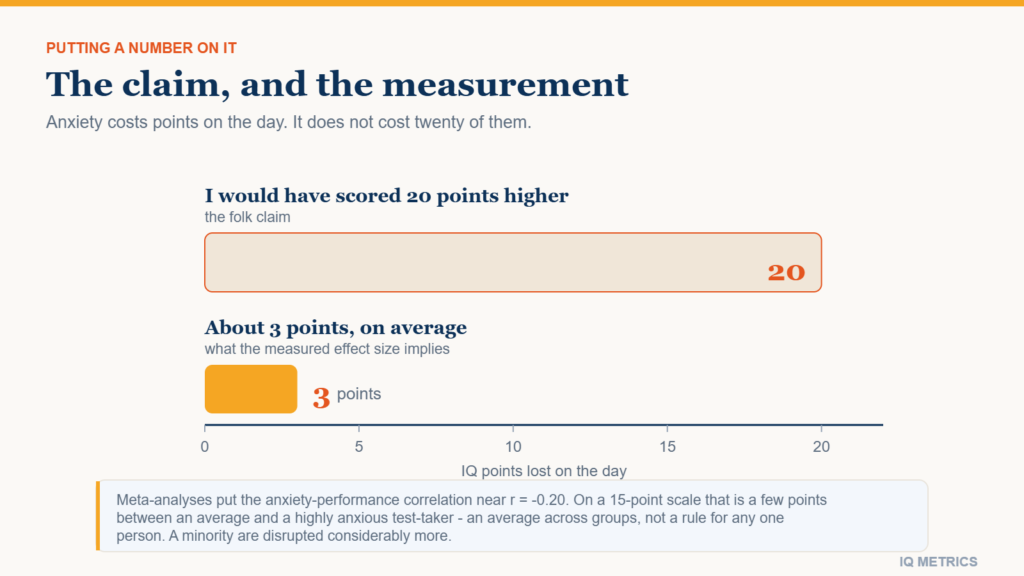
Bar chart comparing the twenty-point loss people claim test anxiety costs with the roughly three points the measured effect size implies

Can anxiety lower your IQ score? Yes — but not by anything close to the margin most people assume. Studies that measure test anxiety alongside cognitive test performance find a relationship of roughly r = -0.20, which translates to something on the order of three points on the familiar 15-point scale. That is a few points between an average test-taker and a highly anxious one, not fifteen and not twenty. The rest of this article shows where that figure comes from, why the effect is small but genuinely real, and what it should change about how you read your own result.

Where the fifteen-point claim comes from

Nearly everyone who has sat a supervised test has said some version of it: I would have scored fifteen or twenty points higher if I had not been so nervous. The thought is appealing because it explains away a disappointing number without asking anything of the person who got it.

The problem is scale. Fifteen points is a full standard deviation — the distance between the middle of the distribution and the edge of roughly the top sixteen percent of test-takers. Ordinary pre-test nerves do not move a person that far. Nothing in the measured relationship between test anxiety and test performance is anywhere near large enough to produce a shift of that size.

What the evidence does support is a smaller, stubborn, fairly consistent drag. Small effects are still real effects. They are just not the ones that rewrite a life story.

What the research actually finds

Meta-analyses pooling many studies of test anxiety and performance on cognitive and academic tests tend to land on a correlation in the region of r = -0.20. Much of that literature is built on school and university assessments rather than on standardised intelligence tests, so carrying the figure across to IQ points is a reasonable estimate rather than a direct measurement. Estimates range roughly from -0.15 to -0.25, and much of that spread is not noise: it moves with who was sampled, how anxiety was measured, and how much the test genuinely mattered to the person sitting it.
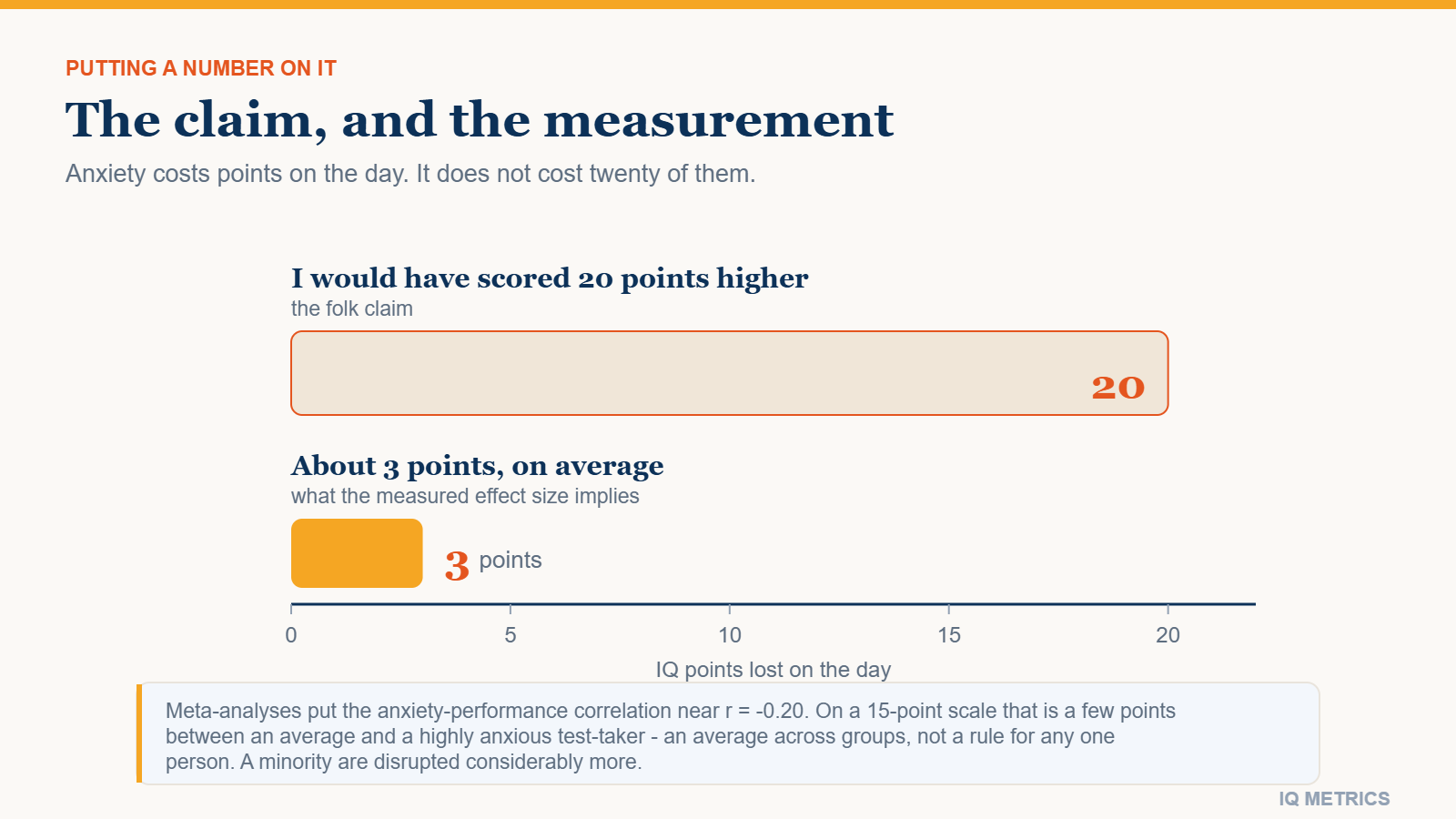
Bar chart comparing the twenty-point loss people claim test anxiety costs with the roughly three points the measured effect size implies

Three things push the estimate around, and they are worth knowing before you take any single figure too seriously:

  • How anxiety was measured. Questionnaires filled in after the test pick up disappointment as well as anxiety. Physiological measures of arousal track performance more weakly than self-reported worry does, so the method chosen moves the estimate before any real difference does.
  • How high the stakes were. A university entrance exam tends to generate more anxiety, and a larger measured effect, than a practice test taken at home out of curiosity.
  • Who was in the sample. Student samples dominate this literature, and students are not a random slice of the population, which limits how far any one estimate travels.

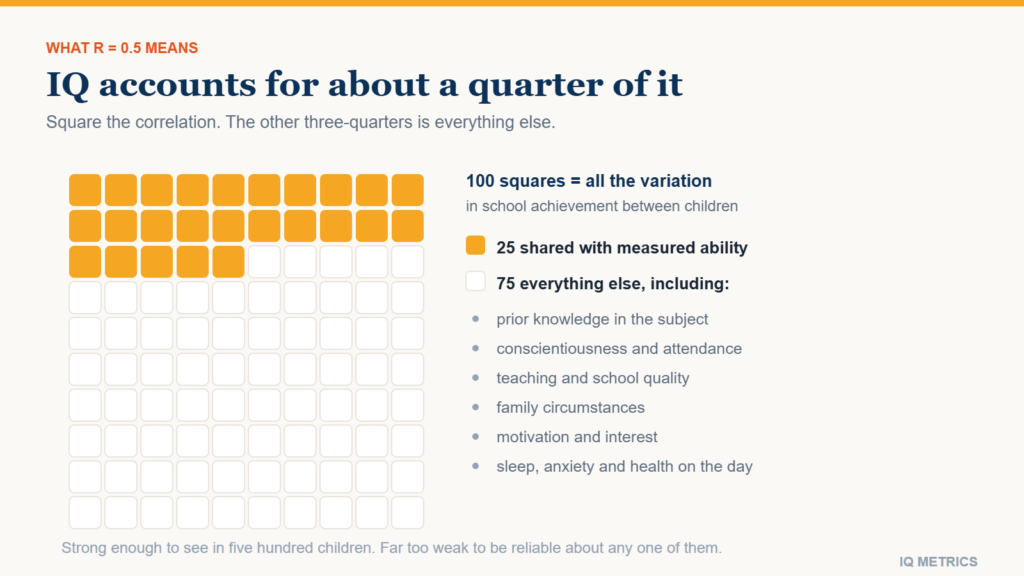
A correlation of -0.20 means anxiety is associated with something like four percent of the variation in scores across a group. The other ninety-six percent of the differences between people sits somewhere else entirely. That is the frame to hold before anyone converts anything into points.

Turning that correlation into IQ points

Correlations are hard to feel; points are easy. So here is the translation, with the reasoning shown, precisely so you can see how approximate it is.

Most IQ scales are built with a standard deviation of 15 points. If anxiety and score are related at about -0.20, a person one standard deviation above average in test anxiety is expected to score roughly 0.20 × 15, or about 3 points, below a person of average anxiety. Nothing in that figure is held constant: it is a raw association, not an isolated effect of anxiety. Push it to two standard deviations above the mean in test anxiety, which is uncommon, and the expected gap is around six points — though the linear assumption behind that extrapolation is doing a lot of work out at the tail.

So the honest headline is a few points, not twenty. Every word there is doing work. It is an average across groups, not a prediction about any one person, and it applies to people whose anxiety slows them down rather than stopping them. For the minority who freeze or leave a test unfinished, the loss can be far larger, because what they end up with is not a measure of their ability at all.

Your own number

Where would your own score land?

Take the IIF-certified assessment and get your score with the scale it was measured on, the percentile it corresponds to and the confidence range around it — the three figures most online tests leave out.

Find your IQ score now!

Secure & encryptedInstant results10–20 minutes

Why the cost is real but small

The best-supported explanation is crowding. Working memory — the small, temporary workspace where you hold a matrix pattern, a half-finished sequence, or the three candidate answers you are weighing against each other — has a hard capacity limit. Worry is not silent: it occupies that same workspace with self-monitoring, clock-watching and a running commentary on how badly things are going.

That account makes a prediction that can be checked, and it broadly holds up. The cost concentrates on items that load working memory heavily and on tests run against a clock, which is one reason a timed IQ test is likelier to expose anxiety than an untimed one. On easy items, or when you can take as long as you like, there is spare capacity to absorb the interference.

This is the same mechanism driven by a different stressor as the one behind sleep loss and test performance. Fatigue and worry both draw down the same limited resource, and both produce modest average losses concentrated in the same kinds of items. Read that piece as the companion to this one.

There is a trait side to all of this too — some people are dispositionally more anxious, and that disposition travels with a cluster of habits around testing. Rather than re-derive it here, see how personality relates to measured ability.

Anxious test-takers also behave differently

The raw observed gap between anxious and non-anxious test-takers is not purely anxiety pressing on cognition in the moment. Anxious people also do different things, and those things land in the score just as surely.

  • They prepare differently. Avoidance is a normal anxiety response, so some anxious test-takers do less familiarisation rather than more, and arrive facing a format they have never seen.
  • They start slower. Time spent re-reading the instructions and second-guessing item one is time not spent on items twelve through twenty.
  • They abandon hard items sooner. Giving up early is a behaviour, not a capacity limit — but on a scored test it looks identical to being unable to solve the item.
  • They are likelier to quit part-way. A test abandoned halfway does not measure ability. It measures how long the person stayed.

Each of those routes lowers a score without anxiety having interfered with reasoning directly. Which means some share of that already-modest -0.20 is behaviour rather than anxiety acting on reasoning in the moment, so the direct cognitive cost is probably smaller still. How much smaller is not something a correlation on its own can tell you.

That is better news than it sounds. Behaviour is a great deal easier to change than temperament, and the routes above are the ones a second, better-organised sitting can actually close.

What a few points should and should not change

An expected loss of around three points is a reason to consider retesting. It is not a reason to discard the result you have. If your score landed near a boundary you care about and the sitting was a genuinely rattled one, that is a legitimate argument for a second attempt.

It is worth being specific about what near a boundary means. A three-point expectation matters if your result sits a handful of points from a threshold you are using for something; it matters very little if you are twenty points away, because a calmer sitting is not going to carry you across a gap that size.

Go in knowing what a retest actually buys. Scores tend to rise on repeat testing for reasons that have nothing to do with your nerves improving: the practice effect on cognitive ability tests is well documented, so a higher second score is partly familiarity with the format and, if the first sitting was unusually low for you, partly ordinary regression toward your own average — and only partly a calmer state of mind.

It also helps to know how much any single sitting can move for perfectly mundane reasons. The guide to IQ test accuracy covers the measurement error surrounding one score. Anxiety is one contributor sitting inside a band that is wider than most people expect, and this article is only quantifying that one contributor.

What actually helps before a test

The interventions with the strongest support are unglamorous: familiarise yourself with the format, and practise under conditions that are genuinely timed. Both work for the same reason — they strip out the novelty and the surprise of time pressure that generate the anxiety in the first place, rather than trying to manage the feeling once it has already arrived.

In practice that means a full-length run with the clock genuinely running rather than a relaxed browse through sample items. The preparation guide and the walkthrough of how a test is structured cover those mechanics, so this piece will not repeat them.

None of this makes anxiety trivial. It makes it tractable. If you suspect nerves cost you something last time, the useful next step is a second run under conditions you control, with the clock running honestly. Take the IQ test that way and compare the two results, holding in mind that a few points of movement in either direction is exactly what the evidence predicts.

Share this article

Know someone who keeps seeing these numbers quoted without the scale they were measured on? Send it to them.

IQ vs EQ

Mind & Everyday Life

IQ vs EQ: What Each One Measures and Why You Need Both

IQ measures reasoning; EQ measures how well you read and manage emotion. They are different constructs, measured in different ways, with different amounts of evidence behind them. Here is what each one actually predicts, which is easier to change, and where the popular claim that EQ matters more comes from.

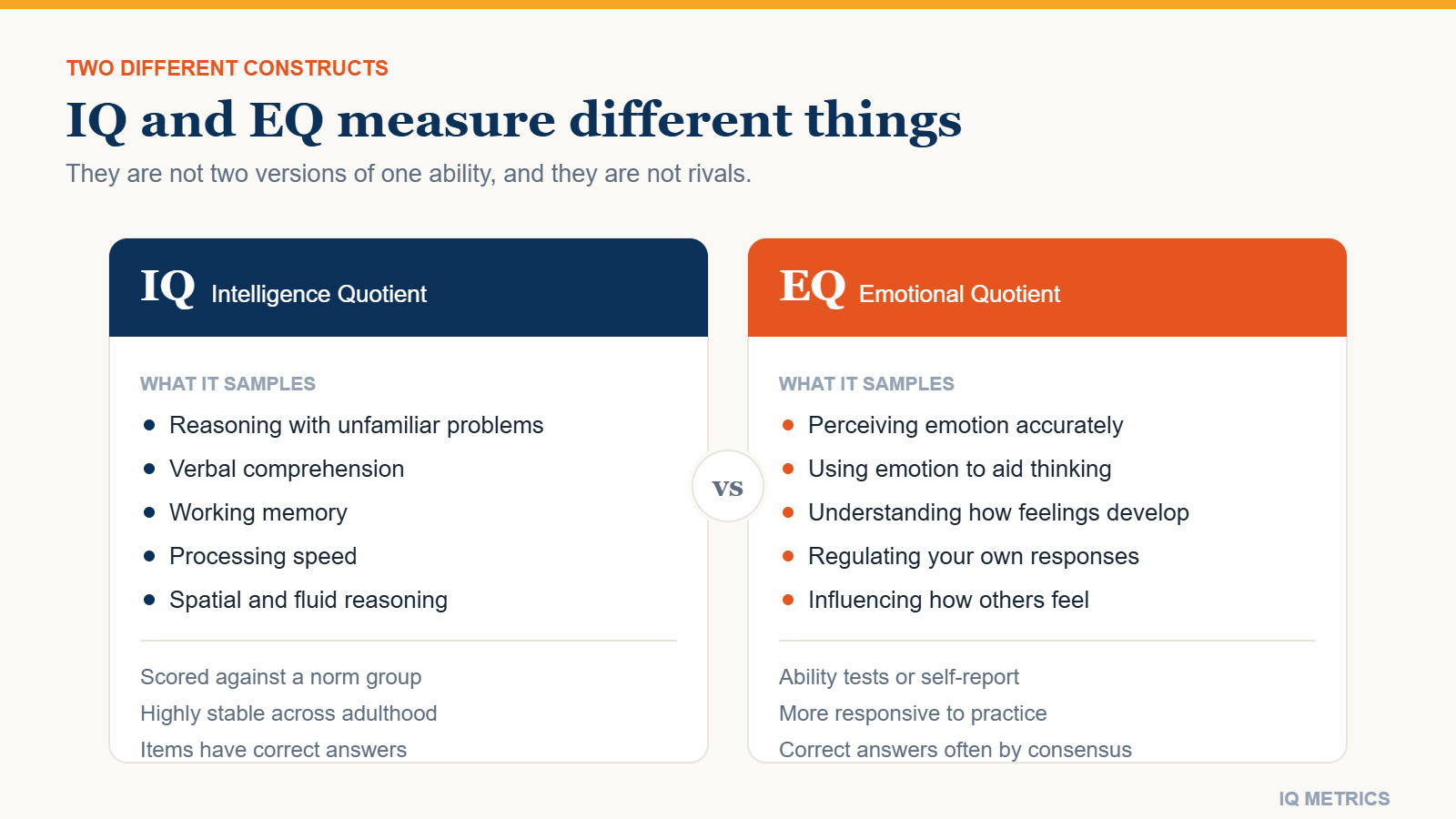
Side by side comparison of what IQ measures and what EQ measures

“IQ gets you hired, EQ gets you promoted” is one of the most repeated lines in workplace writing, and like most memorable lines it is partly true and partly a simplification that hides the interesting detail. IQ and EQ are not two versions of the same thing, and they are not rivals. They measure different capacities, they are measured by very different methods, and the quality of evidence behind them is not equal.

This article sets out what each one is, how each is assessed, what each actually predicts, and which of the two you can realistically change.

What IQ measures

IQ, or intelligence quotient, is a standardised measure of reasoning ability. A modern test samples several distinct capacities — verbal comprehension, perceptual or fluid reasoning, working memory and processing speed — and combines them into a single composite score scaled so that the population average is 100.

The score is not a count of correct answers. It is a position: a statement of how far your performance sits from the average of a norm group of people your own age. That is why the same raw performance yields different numbers on different scales, and why the IQ bell curve is the right mental picture for what a score means. If the concept is new, our explainer on what an intelligence quotient is covers the foundations.

What IQ deliberately does not measure is knowledge. A good test avoids anything you could revise for, because the target is how well you handle a problem you have never encountered, not how much you have accumulated.

What EQ measures

EQ, or emotional quotient, refers to emotional intelligence: the ability to perceive emotion accurately, to use emotion to assist thinking, to understand how emotions develop and combine, and to regulate emotion in yourself and others.

The concept was introduced in the academic literature by Peter Salovey and John Mayer in 1990 and reached a mass audience through Daniel Goleman’s 1995 book. Those two origins matter, because they produced two rather different ideas that share a name — a tightly defined ability model on one side and a much broader popular bundle of traits and habits on the other.

The four-branch model

  • Perceiving emotion — reading emotional signals in faces, voices and situations, including your own.
  • Using emotion — harnessing mood to support reasoning, judgement and creativity.
  • Understanding emotion — knowing how emotions escalate, blend and change over time, and what causes them.
  • Managing emotion — regulating your own responses and influencing those of other people.

Read as a list, these look like personality. Read as abilities, they are things you can be measurably better or worse at, which is what makes the ability model testable in a way the popular version is not.

IQ vs EQ at a glance

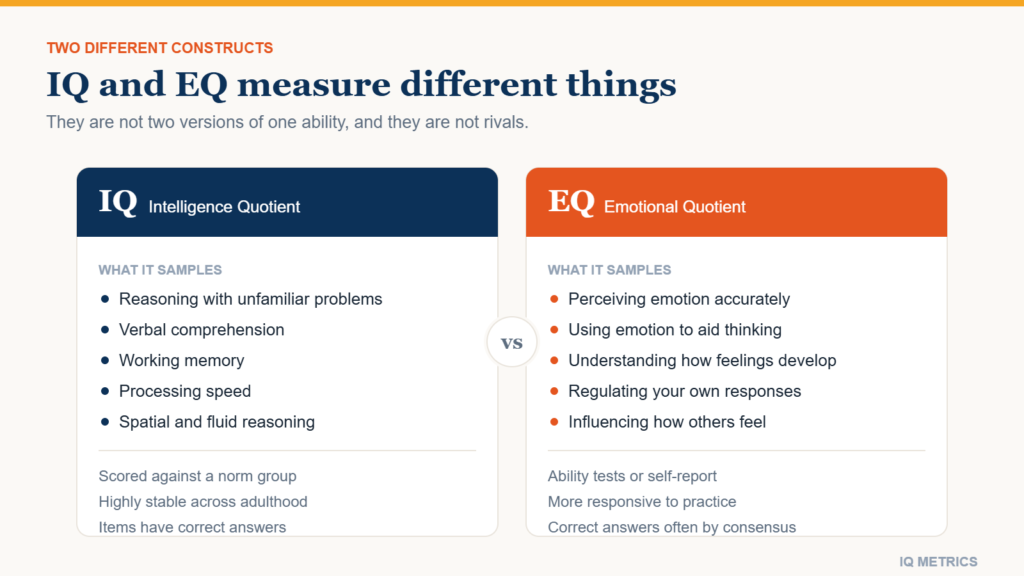
Side by side comparison of what IQ measures and what EQ measures

The two constructs differ on almost every dimension that matters: what they sample, how stable they are, how they are scored, and how confident we can be in the measurement.

  • What is sampled — IQ samples reasoning under time pressure; EQ samples emotional perception, understanding and regulation.
  • Stability — IQ is highly stable across adulthood; EQ is generally more responsive to experience and deliberate practice.
  • Measurement quality — IQ tests have close to a century of psychometric development behind them; EQ measurement is younger and much less settled.
  • Scoring — IQ items have objectively correct answers; many EQ instruments do not, which is the central difficulty in the field.

How each one is measured

Measuring IQ

Individually administered tests such as the Wechsler scales and the Stanford-Binet are the reference standard. They are delivered one-to-one by a trained administrator, take one to two hours, and report a composite score alongside index scores and a confidence interval. The methodology is mature and the reliability figures are high and publicly documented. Our guide to the professional IQ tests compares the major instruments.

Measuring EQ, which is a harder problem

EQ instruments split into two families, and the split is the reason the field is contested.

Ability tests, such as the MSCEIT, present emotional problems with scored answers — identify the emotion in this face, judge which action would best regulate this feeling. They behave like tests. The difficulty is deciding what counts as the correct answer, which is usually settled by consensus or expert judgement rather than by fact.

Self-report questionnaires, such as the EQ-i and the many quizzes derived from it, ask you to rate your own emotional skills. They are quick and popular, and they have an obvious structural weakness: someone with poor emotional perception is precisely the person least equipped to rate their own emotional perception accurately. Self-report EQ scores also correlate substantially with ordinary personality traits, which raises the question of how much new ground they cover.

Your own number

Where would your own score land?

Take the IIF-certified assessment and get your score with the scale it was measured on, the percentile it corresponds to and the confidence range around it — the three figures most online tests leave out.

Find your IQ score now!

Secure & encryptedInstant results10–20 minutes

Which one predicts success better?

This is where the popular claim needs unpacking. Across the research literature, measured cognitive ability is one of the more consistent predictors of academic attainment and of performance in cognitively demanding work, and its predictive power tends to increase with job complexity.

Emotional intelligence shows its clearest value in roles built around interpersonal demand — leadership, negotiation, care work, teaching, client-facing and team-based work — and in outcomes such as team cohesion and conflict handling that a reasoning test was never designed to touch.

The honest summary is that they predict different things, and the sensible question is not which is larger but which is relevant to the situation in front of you. Neither explains most of the variance in anyone’s life; motivation, opportunity, health, circumstance and luck do enormous work that neither construct captures. We explored that wider point in is intelligence limited to IQ.

Can you raise either one?

This is the most practically useful difference between them.

IQ is comparatively resistant to change in adulthood. Scores improve modestly with test familiarity, and they can be depressed by poor sleep, illness, stress or anxiety — which means removing those things can raise a measured score without changing the underlying ability at all. Our article on the factors that affect IQ test results covers what genuinely moves a number.

Emotional skills are more trainable. Perceiving emotion accurately, pausing before reacting, naming what you feel, and reading a room are all capacities that improve with deliberate attention and feedback. Whether that improvement shows up on an EQ test is a separate question from whether it shows up in your relationships, and the second one is the one worth optimising for.

Where "EQ matters more than IQ" comes from

The claim traces largely to popular writing from the mid-1990s, where figures attributing the large majority of workplace success to emotional intelligence were widely quoted. Those figures were considerably stronger than the peer-reviewed evidence supported at the time, and stronger than it supports now.

There is a second, more subtle reason the claim feels true. In selective environments — a competitive university course, a demanding profession — everyone present has already cleared a cognitive bar. Within that narrowed range, differences in reasoning ability explain less of what separates people, and interpersonal skill explains relatively more. The observation is real; the generalisation from it to the whole population is not.

How to use both

Treat them as answering different questions. If you want to know how you handle novel reasoning problems under time pressure, that is an IQ question, and it deserves a properly normed test that reports its scale, your percentile and a confidence range rather than a bare number. If you want to know why a conversation went badly or why a team is not functioning, no IQ score will help you.

If you are curious about the first, our IQ test reports all three figures, and the percentile calculator will show you what any score means as a rank. Just do not expect either to tell you how good you are at reading a room — that was never what they were built to measure.

Share this article

Know someone who keeps seeing these numbers quoted without the scale they were measured on? Send it to them.

Cognitive Diversity: The Secret to Workplace Efficiency and Success

Cognitive Diversity: The Secret to Workplace Efficiency and Success

In a world where unique ideas are the currency of success, there is a hidden gem transforming workplaces: Cognitive Diversity. Imagine a workplace where every decision, every project, and every team meeting buzzes with dynamic perspectives and innovative solutions. It’s the unsung hero behind the scenes, fueling innovation and problem-solving.

In the modern workplace, cognitive diversity has emerged as a key driver of innovation and efficiency. What exactly is it, and how does it revolutionize the way we work and transform our professional lives?

Cognitive Diversity: The Secret to Workplace Efficiency and Success

Understanding Cognitive Diversity

Cognitive diversity refers to the variety of thought processes, problem-solving approaches, and decision-making styles which are present in a group. Unlike demographic diversity, which focuses on visible traits, cognitive diversity delves into the unseen realm of how individuals usually think and process information.

The spectrum of cognitive abilities includes abilities like analytical thinking, creative ideation, practical problem-solving, and emotional intelligence. Each of these skills plays a very crucial role in tackling complex challenges. For example, while analytical thinkers excel in data-driven decision-making, creative minds can provide out-of-the-box solutions to seemingly impossible tasks.

The Power of Diverse Thinking

The real-world impact of cognitive diversity is substantial. Research has consistently shown that teams with diverse cognitive abilities are better equipped to solve complex tasks than their cognitively homogeneous counterparts. These teams tend to be more innovative, better at predicting trends, and capable of comprehensive problem-solving.

One striking example of cognitive diversity in action can be witnessed at Indian Space Research Organisation (ISRO), with its diverse team of engineers, scientists, and creative thinkers, successfully navigated the complex and unprecedented challenges of the Moon Lander/Rover mission. The analytical team members analyzed the data trends, while the creative members proposed innovative solutions, and the emotionally intelligent members facilitated effective team collaboration, leading to a milestone for humanity.

Assessing Cognitive Diversity

How do we measure and leverage this diversity? This is where tools like IQ tests and other cognitive ability assessments come into play. These tests provide insights into the diverse intellectual strengths within a team, allowing leaders to strategically assign tasks and projects.

However, it’s important to understand that cognitive diversity goes beyond mere IQ scores. It includes a broader range of cognitive abilities and learning styles. Therefore, assessments need to be comprehensive and multi-dimensional to capture the true cognitive landscape of a workforce.

Creating a Cognitive Diversity-Friendly Environment

Leveraging cognitive diversity requires more than just identifying it; there is a need for a cultivating environment where all forms of thinking are valued and utilized. This includes creating teams with a mix of cognitive abilities, encouraging open communication, and fostering a culture of continuous learning and development within the organization.

Moreover, leaders play a very important role in harnessing this diversity. By understanding the unique cognitive strengths of each team member, they can delegate tasks more effectively, encourage collaboration between different thinkers, and create a more inclusive and dynamic work environment.

The Way Forward

As we navigate the complexities of the 21st century, embracing cognitive diversity is no longer an option but a necessity for any organization aiming for the pinnacle of innovation and efficiency. It’s about recognizing that the collective intelligence of a diverse group is far more crucial than the sum of its parts. By valuing and harnessing these diverse abilities, we open the door to a new era of workplace productivity and success.

Are you ready to explore the cognitive diversity within your organization? Discover how IQMetrics can help you unlock the potential of your workforce.

Does IQ Predict School Success?

Does IQ Predict School Success?

IQ predicts school achievement better than any other single measure

Gardner’s Multiple Intelligences

Gardner’s Multiple Intelligences

Gardner's multiple intelligences theory is one of the most influential

Brain Myths About Intelligence

Brain Myths About Intelligence

You are not left-brained or right-brained, you do not use

How to Use Your IQ Test for Better Self-Improvement

How to Use Your IQ Test for Better Self-Improvement

When Yumi, a creative marketing specialist, received her IQ test results from IQ Metrics, it was a moment of self-realization. The results showed her exceptional verbal comprehension skills, a testament to her articulate communication and creative campaign ideas. However, her average numerical reasoning score was a gentle nudge towards areas that need improvement. Seeing this as an opportunity, Yumi embarked on a journey of self-improvization, determined to balance her cognitive abilities and decided to undertake the following steps.

IQ test for better self improvement

Understanding the Results:

Yumi’s score, while impressive in certain areas, was a revelation. She excelled in understanding and articulating complex concepts, a skill evident in her professional journey. However, the average numerical reasoning score turned out to be a wake-up call. She realized that balancing her cognitive skills was crucial for her professional and personal growth.

2. Setting Personal Goals:

Yumi then set out to enhance her numerical skills. She started with everyday number-based puzzles, advancing to more complex mathematical challenges as she progressed. Her morning routine now included a mix of numerical exercises and reading, catering to both her strengths as well as areas for improvement.

3. Applying Skills Professionally:

In her creative marketing job, Yumi’s verbal skills were invaluable in crafting compelling narratives and client pitches. She started leveraging on her her improved numerical skills by collaborating more with the data analytics team, bringing a new dimension to her marketing strategies.

4. Expanding Beyond Comfort Zones:

To push her boundaries further, Yumi joined a debate club, sharpening her argumentation and public speaking skills. Simultaneously, she enrolled in an online course in basic programming, intertwining her linguistic talent with a strong numerical logic.

5. Holistic Personal Development:

Recognizing that intelligence is multifaceted, Yumi embraced activities beyond the cognitive exercises. She took up yoga to enhance her emotional intelligence further and joined a local art class, fueling her creativity and providing a much-needed outlet for relaxation.

6. Navigating Challenges:

Balancing her ambitious self-improvement plan with a demanding career was not very easy but Yumi learned the importance of time management, self-care, and setting realistic expectations during this journey.

7. Reflecting on Growth:

Several months into her journey, Yumi noticed a significant improvement in her ability to analyze and understand data. She felt more intellectually balanced and equipped to handle diverse challenges in her job. Her confidence soared, and she found herself to be more engaged and fulfilled in both her professional and personal life.

8. Reflecting on Growth and Retesting:

After months of dedicated efforts, Yumi decided to retake the IQ test. The results were gratifying. Not only did her numerical reasoning scores improve, but she also witnessed significant enhancements in other cognitive areas. This retest wasn’t just about numbers; it was a confirmation of her growth, resilience, and the effectiveness of her self-improvement strategies throughout this process.

Finally:

Yumi’s story is a testament to the power of using IQ test results as a guide for effective self-improvement. It is about recognizing and enhancing your inherent abilities while working diligently on areas that need improvement. Yumi’s journey shows that with determination, a well-rounded approach, and the right mindset, anyone can use their IQ test results as a springboard for comprehensive personal growth and all-round development.

Remember, an IQ test score is a starting point, not a limitation. Embrace it as a tool for understanding and nurturing your unique talents and potential.

Get your IQ Certification today!

Does IQ Predict School Success?

Does IQ Predict School Success?

IQ predicts school achievement better than any other single measure

Gardner’s Multiple Intelligences

Gardner’s Multiple Intelligences

Gardner's multiple intelligences theory is one of the most influential

Brain Myths About Intelligence

Brain Myths About Intelligence

You are not left-brained or right-brained, you do not use

Mind Matters: The Surprising Link Between Emotions and IQ Test Scores

Mind Matters: The Surprising Link Between Emotions and IQ Test Scores

In this blog, we will discover how your feelings intertwine with your cognitive prowess in ways you never expected.

Cognitive intelligence (IQ) and Emotional intelligence (EI) have long been viewed as distinct realms of human capabilities. But what if the boundary between intellect and emotions is more connected than we thought? Emerging psychological studies are uncovering a fascinating connection that might just redefine our understanding of assessing intelligence.

The Emotional Coefficient in Intelligence

Traditionally, IQ tests have been the gold standard for measuring intellectual capabilities. However, this view has been expanding. According to Psychological Bulletin research, our emotional well-being significantly influences cognitive functions such as memory, problem-solving, and reasoning—the core components of IQ tests. The ability to manage emotions, empathize with others, and navigate social complexities isn’t just a soft skill, it also contributes to a holistic form of intelligence that intersects with traditional IQ measures.

Link Between Emotions and IQ Test Scores

How Emotions Affect IQ Test Performance

Test anxiety, a common challenge for many is not just about feeling nervous, anxiety can tangibly impact cognitive function, affecting memory recall and problem-solving abilities. Managing emotional state becomes crucial for optimal performance in IQ assessments. Interestingly, this extends beyond mere test-taking, emotional regulation influences everyday cognitive tasks, shaping how we process information, make decisions, and solve problems.

Beyond Tests: Emotional Intelligence in Everyday Life

The implications of this intertwining of IQ and Emotional Intelligence extend into various aspects of life. For example, in professional settings, individuals with high emotional intelligence are often better at conflict resolution and teamwork. Similarly, in personal relationships, emotional intelligence can help in understanding and responding to others’ feelings, fostering deeper connections and empathy.

Building Emotional Intelligence for Better IQ Scores

Recognizing the importance of Emotional Intelligence in relation to IQ, the question then becomes: How can we increase our emotional intelligence? The good news is that Emotional Intelligence is not a fixed trait; it can be developed. Practices such as empathy exercises, mindfulness, and effective communication can significantly improve emotional understanding and regulation. This development not only aids in managing emotions during high-pressure situations like taking IQ tests but also enhances overall cognitive function.

Practical Tips for Enhancing Emotional Intelligence

For those preparing for an IQ test, consider techniques that boost emotional intelligence like indfulness meditation, which for instance, can improve focus and reduce anxiety. Learning to recognize and label emotions helps in managing them more effectively and engaging in activities that require empathy and social interaction can also refine your emotional skills, providing a well-rounded approach to intellectual and emotional growth.

Final Thoughts

The relationship between emotions and IQ test scores is complex yet very significant. By acknowledging and nurturing our emotional intelligence, we can unlock a level of intellectual performance and understanding that help in IQ tests. As we continue to explore the human mind, emotional and cognitive intelligence promises a more comprehensive understanding of what it truly means to be intelligent.

In your journey towards intellectual excellence, remember: understanding and managing your emotions is as important as sharpening your cognitive abilities. Embrace this holistic approach, and you are bound to not only excel in IQ tests but also thrive in life’s myriad challenges.
Does IQ Predict School Success?

Does IQ Predict School Success?

IQ predicts school achievement better than any other single measure

Gardner’s Multiple Intelligences

Gardner’s Multiple Intelligences

Gardner's multiple intelligences theory is one of the most influential

Brain Myths About Intelligence

Brain Myths About Intelligence

You are not left-brained or right-brained, you do not use