





What Does an IQ of 138 Mean? IQ 138 Percentile, Rarity and What Sits Above Mensa
IQ 138 is the 99.4th percentile on SD 15, the top 0.56% or about 1 in 177 people, 8 points above the 130 Mensa line. It misses the top half of one percent by 0.6 points. See the other scales, the societies above Mensa and why tests blur at the top.

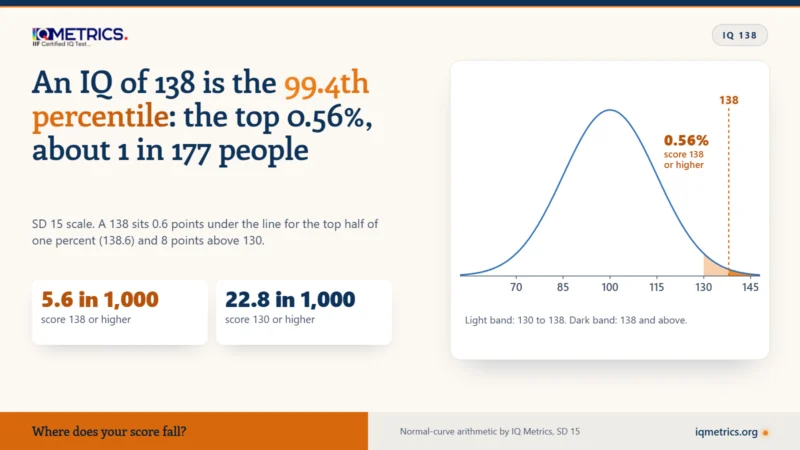
IQ 138 is the 99.4th percentile on a scale with a mean of 100 and a standard deviation (SD) of 15. That is the top 0.56%, or about 1 in 177 people. It is 8 points above the 130 line that Mensa and many gifted programmes use. On other scales the same 138 ranks lower: the 99.1st percentile on SD 16 and only the 94.3rd on SD 24.
New here: a 138 sits 0.6 points under the line for the top half of one percent (138.6). About 1 in 4 of the people who reach 130 also reach 138. No test defines genius, and the societies above Mensa start at 146. Below: the percentile, the rarity, three scales, the Mensa gap and why tests blur near the top.
Key takeaways
- An IQ of 138 is the 99.4th percentile on SD 15 (1 in 177), the 99.1st on SD 16 (1 in 114) and the 94.3rd on SD 24 (1 in 18).
- The line for the top half of one percent is 138.6 on SD 15, so 139 is the first whole score inside it. A 138 misses it by 0.6 points.
- Of every 1,000 people, about 23 score 130 or higher and about 5.6 score 138 or higher. About 1 in 4 of the 130-plus group reaches 138.
- Mensa’s IQ lines start at 130, so a 138 clears them with 8 points to spare. The Triple Nine Society’s line is 146.4 on SD 15.
- No test defines genius. A 138 is in the Very Superior band (130 and above) and sits where scores are least certain.
What is the IQ 138 percentile?
The 138 IQ percentile is the 99.4th on SD 15. That means 99.4% of people in the test’s norm group score below 138, and 0.56% score at or above it.
Here is the sum. The z-score is (138 minus 100) divided by 15, which is 2.53: the score sits 2.53 SDs above the average. On a normal curve, 99.44% of people fall below that point and 0.56% above. One divided by 0.0056 is about 177, so 1 person in 177 scores 138 or higher.
Our IQ percentile calculator gives the same figure for any score. Our IQ test range guide puts 138 at the 99.4th percentile in its table and names 138.6 as the 99.5th. Each point near 138 moves the percentile by only about 0.1.
| IQ score | Percentile | About 1 in | People per 1,000 at or above |
|---|---|---|---|
| 134 | 98.8th | 1 in 85 | 11.7 |
| 136 | 99.2nd | 1 in 122 | 8.2 |
| 138 | 99.4th | 1 in 177 | 5.6 |
| 140 | 99.6th | 1 in 261 | 3.8 |
| 142 | 99.7th | 1 in 391 | 2.6 |
For the scores either side, read what an IQ of 136 means and what an IQ of 140 means.
Is 138 IQ good?
Yes. An IQ of 138 is higher than more than 99 of every 100 people in the norm group, and it is 38 points above the average of 100.
It is in the Very Superior band, which starts at 130 on Wechsler-style charts. That puts it above the usual gifted line. In a class of 30 drawn from the norm group, about 0.17 children score 138 or higher, and the chance of at least one is 16%. In a school of 1,000 it is about 6 children.
Is 138 IQ genius?
No test defines genius, so no score makes someone one. A 138 is a very high score, and the word “genius” is a label that comes from outside the test.
Our page on whether an IQ of 130 is genius sets out why test manuals use bands such as Very Superior and not “genius”. Our IQ 140 page makes the same point: a 140 is not a genius score in any current test manual. For people whose names come up with very high numbers, see the highest IQ ever recorded.
How rare is 138 IQ?
About 1 person in 177 scores 138 or higher on SD 15. That is 5.6 in every 1,000, or 0.56%.
The top half of one percent starts at 138.6 on SD 15, so a 138 sits just outside it, and a 139 is the first whole score inside. The gap is small: 0.6 IQ points and about 0.06 percentile points. For a 138 the label “top half of one percent” is close, but it is not exact.
| Group | People | Expected at 138 or higher |
|---|---|---|
| A school class | 30 | 0.17 |
| A secondary school | 1,000 | 5.6 |
| A town | 10,000 | about 56 |
| A city | 1,000,000 | about 5,650 |
Here is the part the percentile hides. Of every 1,000 people, about 22.8 reach 130 and about 5.6 reach 138. So 138 is about 4 times as rare as 130, and about 1 in 4 of the people at 130 or higher also reach 138. The other 17.1 per 1,000 sit between 130 and 137.
Where would your own score land?
Take the IIF-certified assessment and get your score with the scale it was measured on, the percentile it corresponds to and the confidence range around it — the three figures most online tests leave out.
Find your IQ score now! →What is the 138 IQ meaning on SD 16 and SD 24 tests?
The 138 IQ meaning depends on the scale, because each test spreads its scores differently. Most modern tests use SD 15, older Stanford-Binet forms use SD 16, and the Cattell scales use SD 24.
| Scale (SD) | Used by | Percentile of a 138 | About 1 in | Same standing on SD 15 |
|---|---|---|---|---|
| SD 15 | Wechsler scales, Stanford-Binet 5 | 99.4th | 1 in 177 | 138.0 |
| SD 16 | Older Stanford-Binet forms | 99.1st | 1 in 114 | 135.6 |
| SD 24 | Cattell scales | 94.3rd | 1 in 18 | 123.8 |
A 138 on a Cattell test is only the 94th percentile. That is the standing of about a 124 on SD 15 (123.75), as our page on an IQ of 124 shows. A 138 on an older Stanford-Binet is about a 136 on SD 15. Our report on IQ scales with SD 15 and SD 16 explains the conversion.
How does 138 compare with Mensa and the societies above it?
A 138 clears every Mensa IQ line by at least 6 points, but it is 8.4 points under the Triple Nine Society’s 99.9th percentile (146.4 on SD 15).
American Mensa’s qualifying-scores page, read on 17 November 2026, lists four kinds of IQ line. They are 130 (Wechsler, Stanford-Binet 5, DAS-II, RIAS and NNAT), 131 (Otis-Gamma and Woodcock-Johnson IV), 132 (CogAT and OLSAT) and 148 (Cattell). So a 138 is 8 points over the Wechsler line, 6 over a CogAT line and 10 short of the Cattell one. Mensa’s own rule is the 98th percentile, which is 130.8 on SD 15. Mensa says it has about 150,000 members worldwide, as our Mensa statistics study reports.
| Line | Share of people | Score on SD 15 | A 138 is |
|---|---|---|---|
| Mensa, 98th percentile | top 2% | 130.8 | 7.2 above |
| 99th percentile | top 1% | 134.9 | 3.1 above |
| Top half of one percent, 99.5th | top 0.5% | 138.6 | 0.6 short |
| Triple Nine Society, 99.9th | top 0.1%, about 1 in 1,000 | 146.4 | 8.4 short |
| Prometheus Society, 99.997th | about 1 in 30,000 | about 160 | about 22 short |
The Triple Nine Society takes scores from several tests, and each has its own minimum. Our high-IQ societies guide lists the lines side by side and which tests each accepts. The Prometheus Society’s own site says no test now being administered is approved for admission.
Why do IQ tests lose accuracy near the top?
Because there are few people up there to measure, and few hard items to measure them with. A 138 is inside the range that major tests report, but the margin of error grows toward the tails.
Our page on the IQ ceiling effect says the WAIS-IV and the Stanford-Binet 5 cap their scores near 160. It adds that a norm sample of a few thousand people holds almost nobody at the far end. It also says the standard error is smallest near the middle and grows toward both tails. It gives no figure, so the table below is an illustration, not a manual value.
| Standard error (points) | 95% range of one sitting | Gap to 130 in standard errors | Chance one sitting reads below 130 |
|---|---|---|---|
| 2.5 | 133 to 143 | 3.2 | 0.03% (1 in 2,968) |
| 3.0 | 132 to 144 | 2.7 | 0.23% (1 in 434) |
| 4.0 | 130 to 146 | 2.0 | 1.68% (1 in 60) |
Even with a 4-point error, a true 138 reads 130 or higher in about 59 of 60 sittings. So a 138 is safer above the Mensa line than a score of 124 or 129. But the same wide error makes a 138 on one test and a 142 on another a poor basis for ranking two people. Scores are whole numbers, so “below 130” means below 129.5 before rounding.
To see where your own result falls on the curve, take the IQ test and check it with the percentile calculator.
Quick answers
- What does IQ 138 mean? The 99.4th percentile on SD 15: the top 0.56%, about 1 in 177 people.
- Is 138 IQ good? Yes. It is higher than more than 99 of every 100 people and 38 points above average.
- Is 138 IQ genius? No test defines genius. A 138 is in the Very Superior band, which starts at 130.
- How rare is 138 IQ? About 5.6 in every 1,000 people score 138 or higher. That is 0.6 points under the top-half-of-one-percent line of 138.6.
- What is a 138 IQ on SD 16 and SD 24? The 99.1st and 94.3rd percentiles, the standing of about 135.6 and 123.8 on SD 15.
Sources
- American Mensa. Qualifying test scores (page read on 17 November 2026).
- Percentiles, 1-in-N figures, people per 1,000, percentile lines and retest chances: normal-curve arithmetic by IQ Metrics, computed in code, not copied. The standard errors in the retest table are assumptions.
- Society lines (Triple Nine Society, Prometheus Society, Mega Society) as read on their own sites and set out on our high-IQ societies page (sites last read 14 November 2026).
- Our own pages: IQ ceiling effect, IQ test range, Mensa statistics and the Mensa IQ requirements guide.
Keep reading
All articles →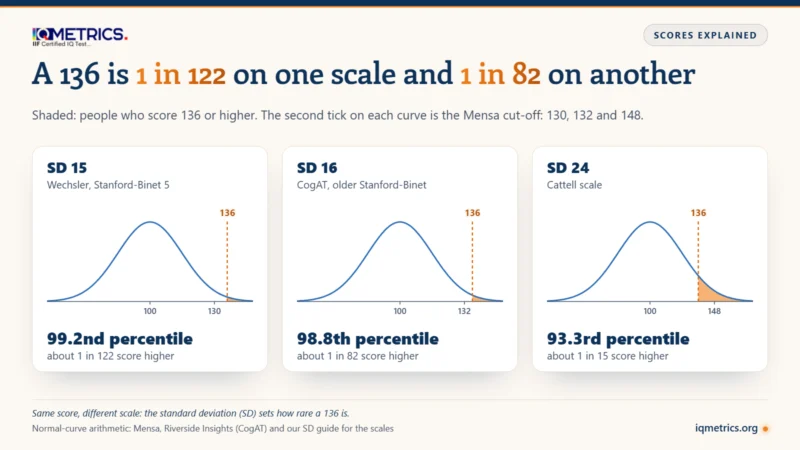 Scores & Scales
What Does an IQ of 136 Mean?
An IQ of 136 is the 99.2nd percentile on SD 15 (about 1 in 122) but the 98.8th on SD 16 (about 1 in 82) and the 93.3rd on the Cattell scale. How 136 stands against Mensa's own table, including the old Army tests that share the number, and how precise one score is.
 Scores & Scales
What an IQ of 140 Means
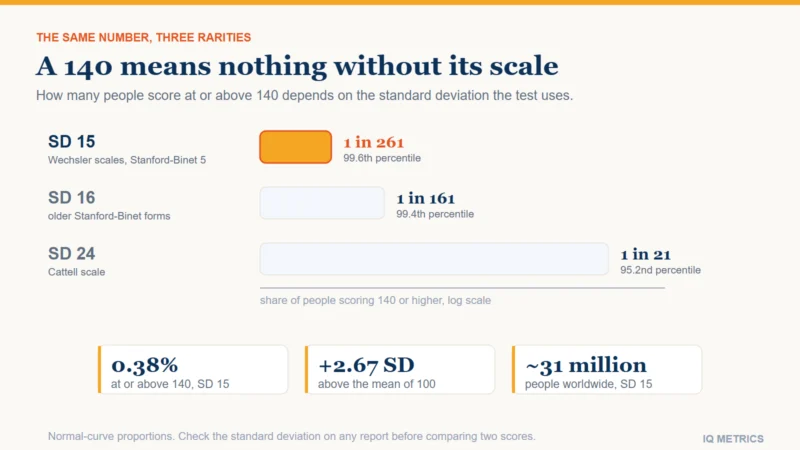
An IQ of 140 is the 99.6th percentile on the standard scale: about 1 person in 261 scores that high, roughly 3,800 in a city of a million. See the 140 IQ percentile on three scales, how it compares with 130 and 145, what a 140 on one index means and how precise the score is.
 Scores & Scales
High-IQ Societies Explained
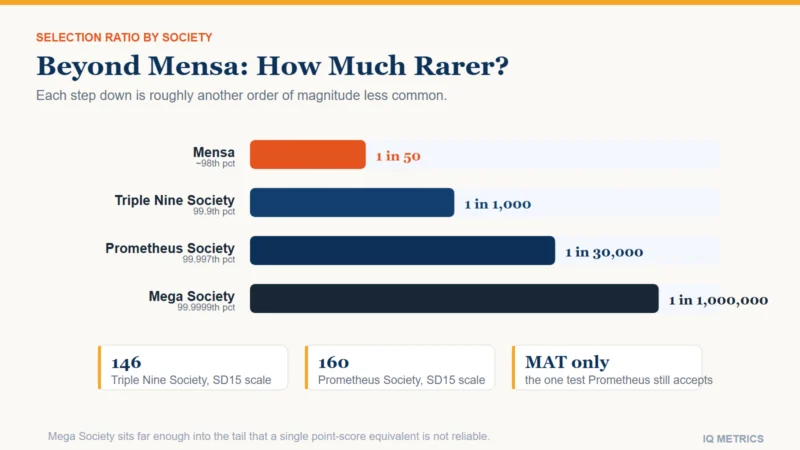
Mensa is the famous one, but it is nowhere near the most exclusive. The Triple Nine Society admits one person in a thousand; the Prometheus Society, one in thirty thousand. Here is how each threshold is actually set, what test you would need, and why the further out you go, the less any single number can be trusted.