





What Chess Ratings Actually Say About IQ
Chess has a reputation as a proxy for raw intelligence. The best available meta-analysis puts the real correlation at a modest 0.24, and it gets noticeably weaker once you look only at ranked, adult tournament players.

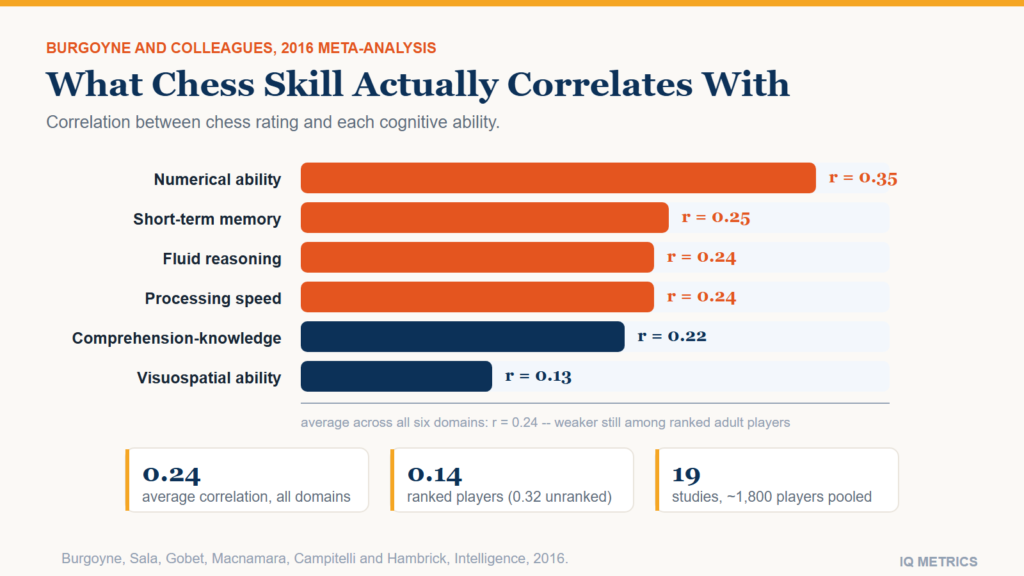
Weaker than the reputation suggests, and weaker still among serious players. The most comprehensive meta-analysis on the question, pooling 19 studies and roughly 1,800 participants across multiple countries and age groups, found chess skill correlates with cognitive ability at an average of 0.24 — a real, statistically reliable relationship, but a modest one, and nowhere near strong enough to treat a rating as a stand-in for an IQ score.
The more interesting finding here is not really the headline number at all. It is what happens to that number once you stop looking at chess players in general and start looking only at the players who take rating and ranking seriously.
What the best evidence actually found
The studies pooled into this meta-analysis measured chess skill in different ways — some by official Elo rating, others by tournament title or self-reported experience — and paired that against a range of standard cognitive batteries rather than a single test. Pooling studies that use different measures of both variables is exactly what a meta-analysis is for: a single study might overstate or understate the relationship depending on who it happened to sample, while pooling nineteen of them, across roughly 1,800 people in total, gives a far more stable estimate of the true underlying correlation than any one study could on its own.
Burgoyne and colleagues’ 2016 meta-analysis (Intelligence, corrected in 2018, with the overall estimate holding near 0.22 after correction) broke the 0.24 average down by cognitive domain: fluid reasoning correlated with chess skill at 0.24, comprehension-knowledge at 0.22, short-term memory at 0.25 and processing speed at 0.24. Numerical ability showed the strongest link at 0.35, ahead of verbal ability at 0.19 and visuospatial ability at only 0.13 — a genuine surprise, given how visual the game looks from the outside.
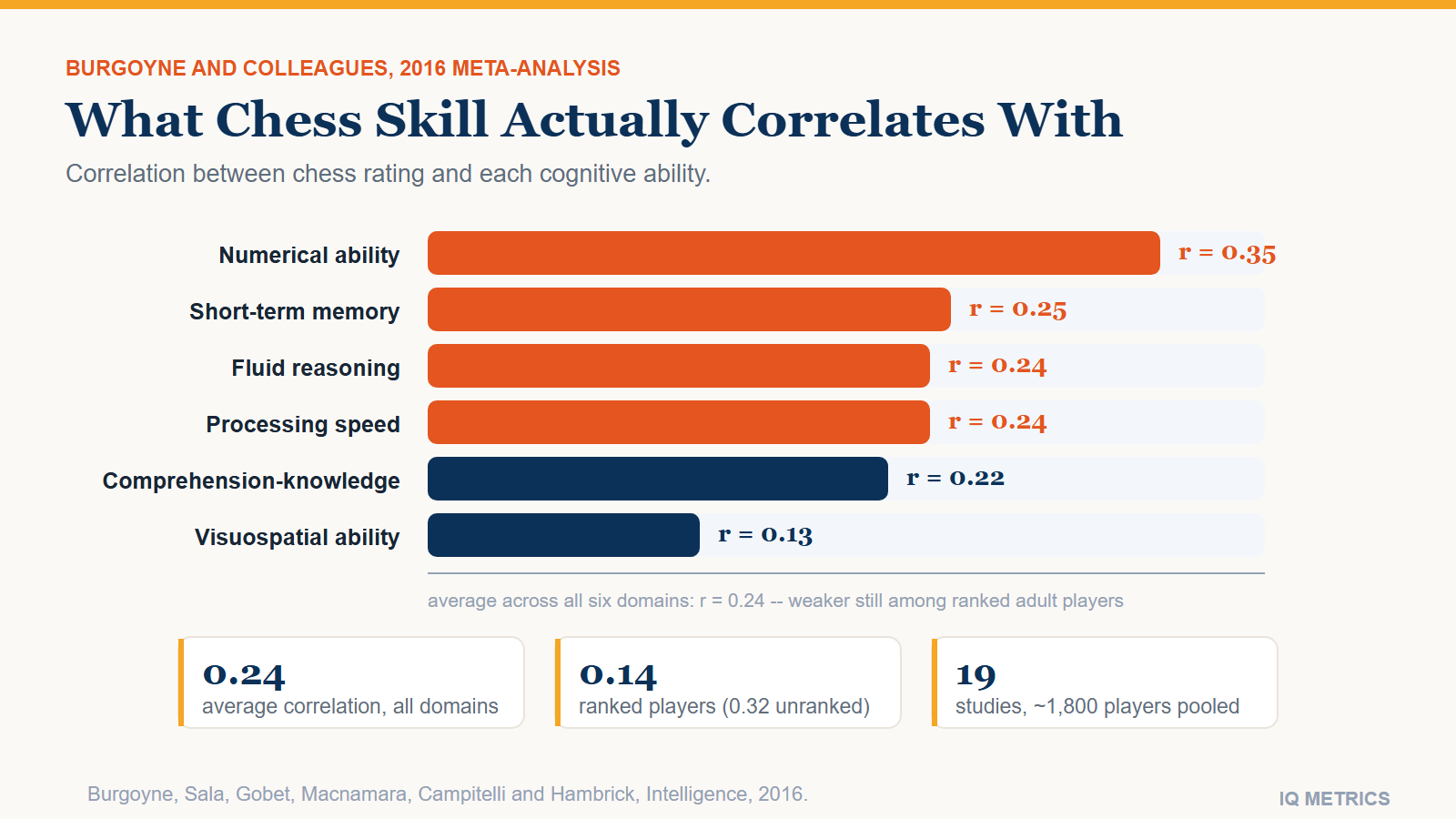
None of these numbers describe a strong relationship. A correlation of 0.24 means cognitive ability, as these tests measure it, accounts for somewhere around 5-6% of the variation in chess skill across the pooled samples — real, worth explaining, and a small fraction of what actually separates a strong player from a weak one.
Why numerical ability and not visuospatial
The domain breakdown holds a genuine surprise. Chess looks like a visuospatial game from the outside — a board, pieces, geometric patterns of attack and defence — yet visuospatial ability produced the weakest correlation of any domain tested, at 0.13, while numerical ability came out strongest at 0.35. The likely explanation is that strong chess play depends less on rotating shapes in your head and more on calculation: tracking forcing sequences, counting material across several moves, holding a chain of if-this-then-that reasoning in mind while checking it against constraints. That is closer to arithmetic reasoning under working-memory load than to the kind of spatial rotation task a visuospatial subtest actually measures, which is exactly the sort of finding that a broad, unexamined assumption — "chess is a spatial game" — gets wrong until someone measures it directly.
Why the reputation outran the evidence
Chess earned its status as a shorthand for raw intelligence long before anyone ran a meta-analysis on the question. Competitive chess is public, scored with a single precise number, and its best-known players — Bobby Fischer winning the world championship as a Cold War news event, Garry Kasparov’s televised matches against IBM’s Deep Blue — were covered in exactly the language used for exceptional intellect. A precise, public rating number attached to a famous "genius" is a much more compelling story than a modest, noisy correlation coefficient, and the story took hold well before the research existed to check it. It is the same gap between a vivid anecdote and a measured effect size that shows up across several other durable myths about intelligence.
Where would your own score land?
Take the IIF-certified assessment and get your score with the scale it was measured on, the percentile it corresponds to and the confidence range around it — the three figures most online tests leave out.
Find your IQ score now! →The correlation gets weaker at the top, not stronger
If chess skill were mostly a measure of raw reasoning ability, you would expect the correlation to hold steady, or even strengthen, as players get more serious about the game. The opposite happened. Fluid reasoning correlated with skill at 0.32 in youth samples but only 0.11 in adult samples, and at 0.32 in unranked players but only 0.14 in ranked, competitive ones.
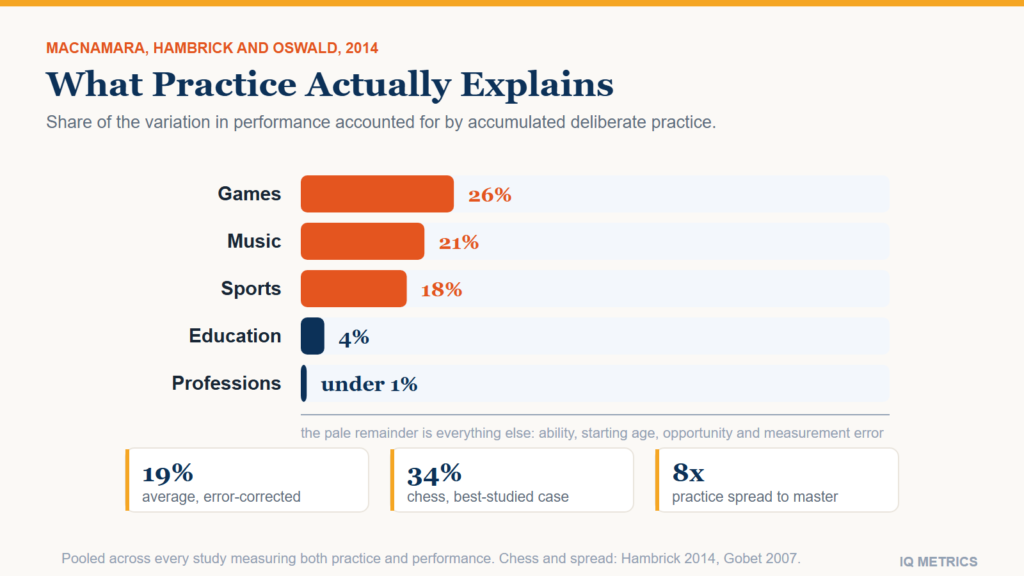
Two things are almost certainly driving that drop. The first is restriction of range: tournament players are already a self-selected group sitting well above the general population on cognitive measures, so there is simply less variation left for a correlation to be measured across. The second is that accumulated deliberate practice does most of the remaining work at the elite end — chess is the single best-documented case where practice explains a large share of skill variance, and that share only grows as players specialise. Raw ability may get you into the pool of serious players; once you are there, thousands of hours of study and opening preparation separate a 2000 rating from a 2700 one far more than a few IQ points would.
So, then, are grandmasters actually smart?
Probably above average, as a group — the selection into serious competitive chess in the first place likely filters on cognitive ability among other things, and the youth-sample correlations are meaningfully higher than the adult ones. But "probably above average as a group" is a much weaker claim than "rating tracks IQ," and it is the second claim that gets repeated far more often than the evidence supports.
The two claims can both be true at once precisely because group averages and individual prediction answer different questions. Chess players collectively skewing above the general population on cognitive measures is fully consistent with a correlation of 0.24 — and separately, that same 0.24 is far too weak to let you predict one specific player’s IQ from their rating with any real precision. Two players rated 2200 could sit at noticeably different points on a cognitive-ability test and the rating alone would not tell you which was which. A rating measures chess skill extremely precisely; it was simply never built to measure anything else, and the data confirm it does that other job only weakly.
The site’s celebrity pages carry profiles for several well-known players, including Magnus Carlsen, Garry Kasparov, Bobby Fischer and Judit Polgar. None of them have a documented, professionally administered IQ score attached to their chess achievements — the figures that circulate for public figures are almost always estimates rather than test results, for reasons explained in where celebrity IQ numbers actually come from. Their rating is real and precisely measured. Their IQ, as a specific number, generally is not.
A different question than "does chess raise your IQ"
It is worth being explicit that this is a different question from the one covered in our article on whether playing chess raises your IQ. That piece asks about causation and transfer: does taking up chess make you more intelligent. This one asks about correlation among people who already play: does a higher rating indicate a higher IQ. The answers are compatible but distinct — a weak-to-modest correlation between skill and ability is consistent with chess practice producing skill gains that are mostly specific to chess itself, rather than gains that generalise into a broader measure like a full IQ test.
That pattern — skill in a narrow, heavily practiced domain outpacing any change in general cognitive ability — shows up across most "brain game" claims once they are tested rigorously, which is the same caution worth applying to any single activity marketed as a shortcut to a higher score, chess included. Getting better at chess reliably makes you better at chess; the evidence that it reliably makes you better at anything else is much thinner than the reputation implies. If you want to know where you actually stand rather than infer it from a hobby or a rating, a properly normed test is the direct route — though even a properly normed one runs into its own limits at the very top of the scale, which is where the correlation evidence here and the measurement ceiling start to overlap.
Keep reading
All articles →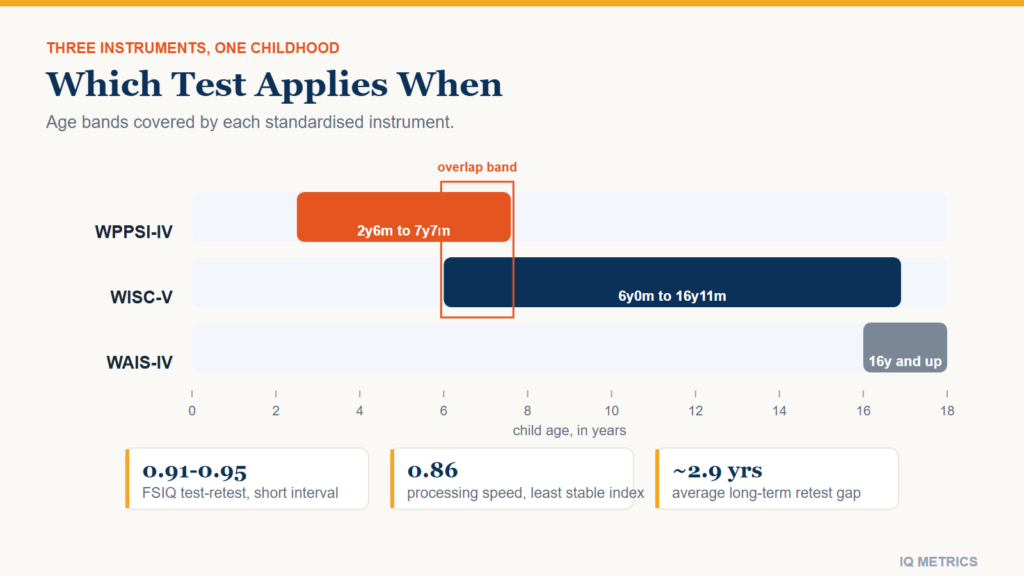 Taking a Test
IQ Testing for Children
Children are not tested on the same instrument as adults, and the test itself changes twice before age eighteen. Here is which one applies when, how reliable an early score really is, and what a parent should and should not conclude from a single number.
 Scores & Scales
IQ Score Ceiling Effects
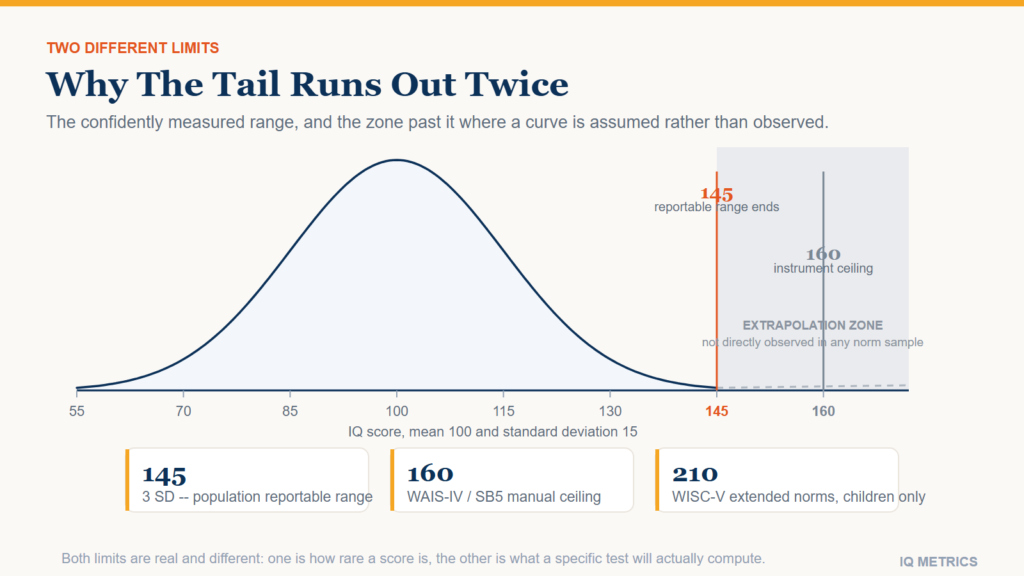
Two different numbers get used as "the top of the scale," 145 and 160, and they come from two different kinds of limit. One is a statement about population statistics; the other is about what a specific test manual will actually compute.
 Research & Evidence
Talent vs Practice
The 10,000-hour rule made a strong claim: expert performance is built by practice, not given by talent. When researchers pooled the studies that had actually measured it, practice explained about a quarter of the difference between people in games and almost none in professional work. Here is what fills the rest of the gap.