





KBIT-2 Test: Subtests, Scores and What the Kaufman Brief Intelligence Test Measures
The KBIT-2 is a 20-minute IQ screen for ages 4 to 90 with three subtests: Verbal Knowledge, Riddles and Matrices. See how its scores work, what the 2022 KBIT-2 Revised changed, how closely it matches the WISC-V and KABC-II, and why it is a screen rather than a full evaluation.

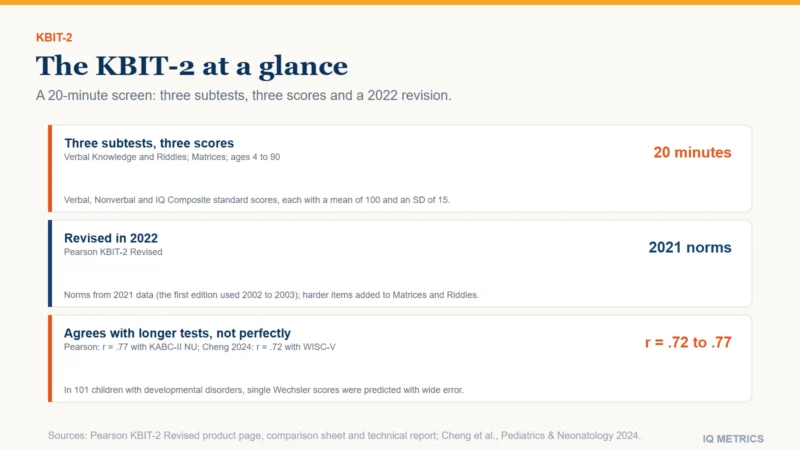
The KBIT-2 (Kaufman Brief Intelligence Test, Second Edition) is a brief IQ screening test, given one-to-one by a trained examiner in about 20 minutes, for people aged 4 to 90. It has three subtests, Verbal Knowledge and Riddles for crystallized (verbal) ability and Matrices for fluid (nonverbal) ability, and it reports Verbal, Nonverbal and IQ Composite standard scores with a mean of 100 and a standard deviation of 15. Pearson published a revised edition, the KBIT-2 Revised, in 2022, with norms built from 2021 data. Its job is screening: Pearson’s own technical report says a longer test such as the WISC-V is the next step when screening results warrant it. This guide covers the subtests, what changed in the revision, how scores are reported, how well the KBIT-2 agrees with longer tests and who can give it.
- What it is: a brief, individually administered intelligence screen; about 20 minutes; ages 4:0 to 90:0; qualification level B at Pearson.
- Subtests and scores: Verbal Knowledge and Riddles feed the Verbal (crystallized) score; Matrices is the Nonverbal (fluid) score; all three make the IQ Composite.
- Scale: standard scores with a mean of 100 and an SD of 15, plus percentile ranks by age.
- The revision: KBIT-2 Revised (2022), norms from 2021 data; the first edition used data collected in 2002 to 2003.
- Accuracy: Pearson reports r = .77 between the revised IQ Composite and the KABC-II NU; an independent study of 101 children found r = .72 with the WISC-V FSIQ but wide error for single scores.
What is the KBIT-2?
The KBIT-2 succeeded the original K-BIT and is published by Pearson, the same publisher as the Wechsler scales. It is meant for the situations where a long evaluation is not practical. Pearson’s technical report describes the demand directly: school psychologists face increasingly multifaceted evaluations, and in some settings practitioners routinely give a brief test like the KBIT-2 Revised to screen for cognitive issues, then a more comprehensive test, such as the KABC-II NU, the WISC-V or the Woodcock-Johnson IV Tests of Cognitive Abilities, if screening indicates more testing is warranted. For how brief tests compare on time, see our guide to how long an IQ test takes.
What are the KBIT-2 subtests?
| Subtest | What the examinee does | Feeds which score |
|---|---|---|
| Verbal Knowledge | Looks at pictures in a stimulus book and shows or says what fits a word or question, a vocabulary and general-knowledge task | Verbal (crystallized) |
| Riddles | Listens to a short riddle read aloud and answers with a word | Verbal (crystallized) |
| Matrices | Looks at a pattern or picture grid with a piece missing and picks the response that completes it | Nonverbal (fluid) |
Pearson describes Verbal Knowledge and Riddles as assessing crystallized ability, the store of words and knowledge a person has accumulated, and Matrices as a measure of nonverbal fluid reasoning. It adds that gifted and talented centers use Matrices as a standalone measure of nonverbal fluid reasoning. Fluid reasoning is the same ability that working-memory training claims aim at; see our dual n-back guide for the evidence on that, our executive function vs IQ guide for which control abilities track it, and our fluid vs crystallized intelligence guide for the distinction. Matrices items work like the ones in Raven’s matrices.
The KBIT-2 Revised shares design with a longer test: its Verbal Knowledge and Riddles subtests were built as parallel forms of the same-named subtests in the KABC-II Normative Update. Pearson says that when both tests are needed, substituting the KBIT-2 Revised scores into the KABC-II NU saves about 10 to 20 minutes and avoids repeating the same task, which could distort scores through procedural learning, changed effort or regression to the mean.
What changed in the KBIT-2 Revised?
Pearson released the revision in 2022. Its own side-by-side sheet and FAQ list the changes:
- New norms. The revision is based on 2021 data collection, with one norm for in-person and remote administration. The original KBIT-2 data were collected in 2002 and 2003.
- Refreshed items. Outdated drawings were replaced on several Verbal Knowledge items, and items were updated for auditory issues, diversity and alternate correct responses, with the target concepts left unchanged.
- Matrices. Pearson dropped an item that showed a book of matches because young children are not exposed to matches, after finding it could go with no effect on reliability, and added newly designed difficult items to extend the upper range.
- Riddles. Modern answers were added to the scoring responses, five items were dropped for diversity and bias concerns and two difficult items were added, making the subtest shorter.
- Scoring. Q-global scoring is now an option, and the scores come with 90% and 95% confidence intervals.
- Materials. The Manual and Record Form changed, so the two editions’ materials are not interchangeable, but Pearson says the overall scoring and administration procedures stay familiar.
How are KBIT-2 scores reported?
The KBIT-2 reports three scores, Crystallized (Verbal), Fluid (Nonverbal) and IQ Composite, as standard scores with a mean of 100 and a standard deviation of 15, along with percentile ranks by age. The table below shows what those standard scores mean on the normal curve; the published percentile ranks come from Pearson’s own norm tables and can differ slightly from the smooth curve.
| Standard score | Percentile (normal curve) | Our guides |
|---|---|---|
| 70 | 2.3% | See IQ classifications |
| 85 | 15.9% | See the percentile calculator |
| 100 | 50% | The average by definition |
| 115 | 84.1% | See IQ classifications |
| 130 | 97.7% | See gifted cut-off scores |
Because the KBIT-2 is short, a single score carries more uncertainty than a full scale; Pearson reports confidence intervals for that reason. If you want to compare against a scale with a different standard deviation, our SD 15 vs SD 16 guide shows the conversion.
Where would your own score land?
Take the IIF-certified assessment and get your score with the scale it was measured on, the percentile it corresponds to and the confidence range around it — the three figures most online tests leave out.
Find your IQ score now! →How well does the KBIT-2 agree with longer IQ tests?
Pearson’s KBIT-2 Revised and KABC-II NU technical report (Table 1.1) correlates the two tests. The KBIT-2 Revised IQ Composite correlates .77 with the KABC-II NU Fluid-Crystallized Index and .67 with its Mental Processing Index. The Verbal score correlates .87 with the KABC-II Knowledge/Gc scale. The Matrices-based Nonverbal score correlates .61 with Pattern Reasoning and .52 with the Planning/Gf scale, lower than the verbal link, and the same-named Verbal Knowledge and Riddles subtests correlate .75 across the two tests. These are the publisher’s own numbers.
An independent look at the original KBIT-2 comes from Cheng and colleagues (2024), who reviewed records of 101 children with developmental disorders at a children’s hospital in Singapore. The KBIT-2 IQ Composite correlated r = .722 with WISC-V Full Scale IQ and r = .648 with WPPSI-IV Full Scale IQ. Regression analysis showed that KBIT-2 scores tended to underestimate or overestimate Wechsler scores, with the highest variability for the Nonverbal IQ against the WISC-V Fluid Reasoning Index (error limits −53.1 to 39.7). The authors concluded that the KBIT-2 has good concurrent validity and is a good screening tool in this group, and that more studies are needed before it is used for diagnostic decisions or special-education placement.
Squared, a correlation of .72 means the two tests share about 52% of their variance, and .77 about 59%. That is strong enough for screening and not strong enough to treat a KBIT-2 score as a stand-in for a full Wechsler result. Our guides to the WPPSI-IV, the WISC-V, the Stanford-Binet and the Woodcock-Johnson cover the longer instruments.
Who gives the KBIT-2, and can you take it online?
It is a professional test, not an online quiz. Pearson lists the KBIT-2 Revised at qualification level B, one level below the level C that Wechsler scales need (see how an official IQ test works), and it is administered by a trained examiner using a stimulus book. Pearson’s comparison sheet lists administration in person and remotely for the revised edition, with digital stimulus books and the manual on Q-global, and the product page lists a Spanish version and telepractice guidance. A page or PDF online that calls itself the KBIT is not the test, because the items and norms are the publisher’s. If what you want is a score on the IQ scale from home, our IQ test is built for that.
When is a brief test enough?
For screening, to find out whether a longer evaluation is worth the time, a brief test does its job, and that is how Pearson positions it. For decisions with consequences, such as a school placement or a disability determination, the longer instruments are the usual next step, and the Singapore authors above say more research is needed before the KBIT-2 supports such decisions. Gifted programs are a nuance: Matrices alone is used by some centers as a nonverbal measure, but a cut-off score on any single test has an interval around it; our gifted cut-off scores guide and guide to IQ testing for children explain how those decisions are made.
Quick answers
- What is the KBIT-2 test? The Kaufman Brief Intelligence Test, Second Edition: a brief, individually administered intelligence screen from Pearson.
- What does the KBIT-2 measure? Verbal (crystallized) ability through Verbal Knowledge and Riddles, and nonverbal (fluid) ability through Matrices, combined into an IQ Composite.
- How long does the KBIT-2 take? About 20 minutes, according to Pearson.
- What ages is the KBIT-2 for? 4 years 0 months to 90 years 0 months.
- What is the KBIT-2 Revised? A 2022 update with norms from 2021 data, refreshed items, new hard items in Matrices and Riddles, and Q-global scoring.
- What scale does the KBIT-2 use? Standard scores with a mean of 100 and a standard deviation of 15.
- Is the KBIT-2 as accurate as the WISC-V? It correlated .72 with WISC-V Full Scale IQ in one independent study, with wide error for single scores; it is a screen, not a replacement.
- Can I take the KBIT-2 online? No. A trained examiner gives it; Pearson sells it at qualification level B.
Sources
- Pearson Assessments: Kaufman Brief Intelligence Test, Second Edition Revised (KBIT-2 Revised), product page: age range, scores, qualification level, completion time and norms.
- Pearson: KBIT-2 Revised comparison sheet (what changed, side by side), 2022.
- Pearson: KBIT-2 Revised FAQs (publication, compatibility, scoring and administration).
- Pearson: KBIT-2 Revised and KABC-II NU Technical Report (correlations in Table 1.1, the substitution studies and the screening rationale).
- Cheng, A.S.M. et al. (2024): Concurrent validity of intelligence assessments in children with developmental disabilities in an Asian setting: comparison of the Kaufman brief intelligence test - Second edition with the Wechsler Intelligence Scales, Pediatrics & Neonatology, 65(4), 341-347.
Keep reading
All articles →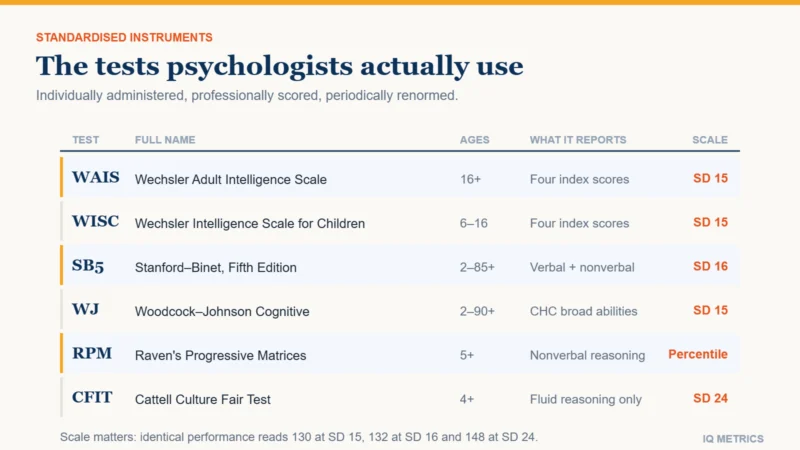 Taking a Test
Professional IQ Tests
When a psychologist measures intelligence, they reach for one of a small number of standardised instruments. This guide covers what the Wechsler scales, Stanford-Binet, Woodcock-Johnson and Raven's Progressive Matrices each measure, who each one is for, and where an online test genuinely fits.
 Taking a Test
How Long Does an IQ Test Take?
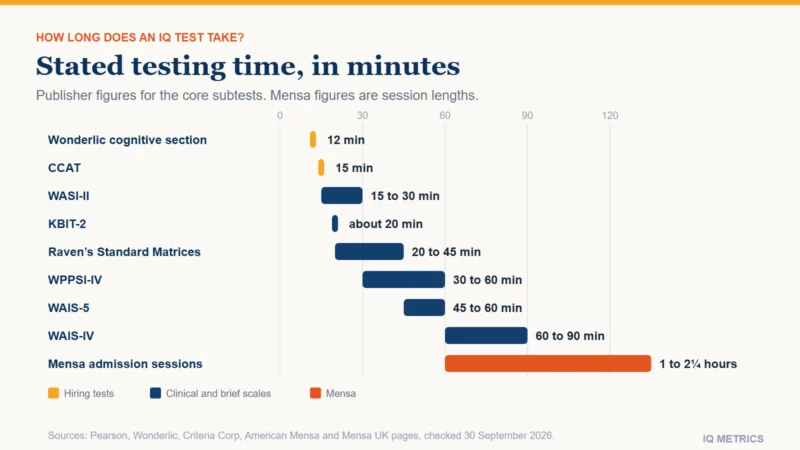
An official IQ test usually takes 45 to 90 minutes of testing: 45 for the WAIS-5, 60 to 90 for the WAIS-IV, 12 for the Wonderlic. See the time for every major test, how many questions to expect, why two people take different amounts of time and what a full evaluation adds.
 Scores & Scales
WPPSI-IV Test
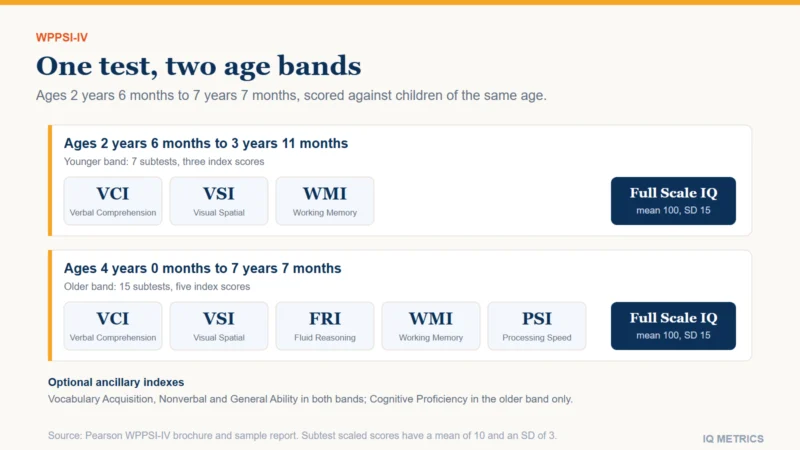
The WPPSI-IV test covers ages 2:6 to 7:7 in two bands, with 15 subtests, five index scores and a Full Scale IQ. See what each subtest asks, how a published sample report reads, how the score labels work, and what a preschool score can and cannot tell parents.