





Williams Syndrome and IQ: Average Scores, Range and the Uneven Profile
Williams syndrome and IQ: mean full-scale IQ was 61 in 62 adults, and 292 children averaged in the borderline range on the KBIT-2, stable from age 4 to 17. Language is a relative strength and visuospatial construction an extreme weakness. Here is what the studies show.

Williams syndrome and IQ: the syndrome typically comes with a mild to moderate intellectual disability, but the numbers depend on the test and the age. In a study of 62 adults the mean full-scale IQ was 61. In 292 children tested on the Kaufman Brief Intelligence Test-2, the mean composite and both subscores fell in the borderline range, and on average scores stayed stable from age 4 to 17. The profile is uneven: language and auditory memory are relative strengths, while visuospatial construction is an extreme weakness. This guide explains how common Williams syndrome is, what the IQ studies report, why one total score hides the pattern, and what the research says about anxiety and reading. It is general information, not medical advice.
- Rare: about 1 in 7,500 people, caused by the loss of one copy of 25 to 27 genes on chromosome 7.
- Adults: mean full-scale IQ of 61 in 62 adults (average age 26).
- Children: mean KBIT-2 composite in the borderline range in 292 children aged 4 to 17, with variability similar to the general population.
- Stable: on average, standard scores did not change from age 4 to 17 in a longitudinal study.
- Uneven: relative strengths in language and auditory rote memory; extreme weakness in visuospatial construction.
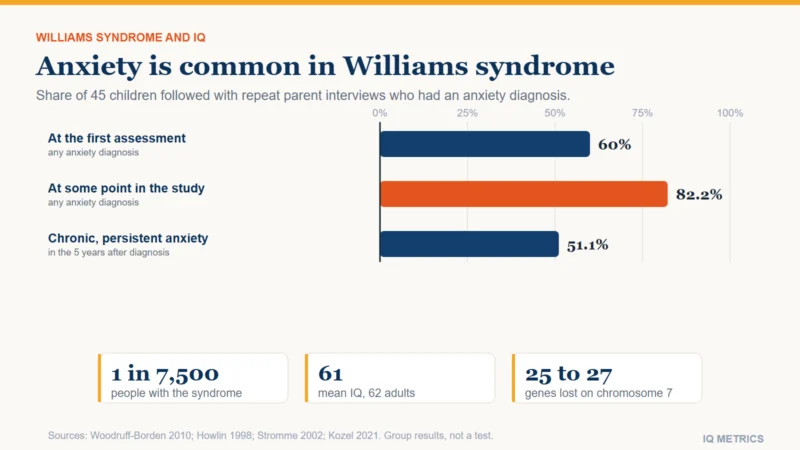
- Anxiety: 82.2% of 45 children had an anxiety diagnosis at some point.
Williams syndrome is one of several genetic conditions where IQ research is common. Compare Down syndrome and IQ and fragile X and IQ, and for the wider question of when a score reflects intellectual disability, see low IQ versus learning disability.
What is Williams syndrome, and how common is it?
Williams syndrome is a microdeletion disorder: in most people with it, one copy of 25 to 27 genes on chromosome 7q11.23 is missing. A 2021 review in Nature Reviews Disease Primers lists cardiovascular disease (characteristically narrowing of the great arteries), a distinctive facial appearance and a specific cognitive and behavioral profile with intellectual disability and hypersociability as the cardinal features. The elastin gene (ELN) is behind the vascular and connective tissue features, while the transcription factor genes GTF2I and GTF2IRD1 are known to affect intellectual ability, social functioning and anxiety.
Prevalence rests on a small study. Strømme and colleagues (2002) studied 30,037 Norwegian children born between 1980 and 1985 in one county, in a survey of intellectual disability, and found three with Williams syndrome. Adding one case from a national survey who met their criteria gave an estimate of 1 in 7,500; all had the typical 7q11.23 deletion. They also reported that Williams syndrome accounted for about 6% of patients with a genetic cause of mental retardation (their term). With only a handful of cases behind it, treat 1 in 7,500 as an approximation, which is how the 2021 review writes it (“as many as” 1 in 7,500).
What is the average IQ in Williams syndrome?
Two studies give a feel for the numbers, and they are not directly comparable. Howlin, Davies and Udwin (1998) assessed a representative sample of 62 adults with Williams syndrome, average age 26, and reported a mean full-scale IQ of 61. Differences between verbal and performance IQ were smaller than in children, yet the subtest profile was almost identical. Reading, spelling, arithmetic and social adaptation were at a low level, generally around a 6 to 8 year age equivalent.
Pitts and Mervis (2016) described 292 children aged 4 to 17 on the Kaufman Brief Intelligence Test-2, a brief test (see KBIT-2). The mean IQ Composite, Verbal and Nonverbal standard scores were all in the borderline range relative to the general population, with variability similar to the general population. Scores did not track age (correlations close to 0), and there were no significant sex differences. Different tests, ages, eras and samples mean the two sets of means should not be lined up as a trend (our reading). Mervis and Klein-Tasman’s review (2000) puts the overall picture as mild to moderate intellectual disability or learning disability; in UK usage “learning disability” means intellectual disability.
| Study | Who | Result |
|---|---|---|
| Howlin, Davies and Udwin, 1998 | 62 adults, average age 26 | Mean full-scale IQ 61; reading, spelling and arithmetic around a 6 to 8 year age equivalent |
| Pitts and Mervis, 2016 | 292 children aged 4 to 17, KBIT-2 | Mean composite, verbal and nonverbal scores in the borderline range; variability like the general population |
| Mervis et al., 2012 | 40 children tested 4 to 7 times over a mean of 5.06 years | On average stable from age 4 to 17, with large individual differences |
Two practical limits apply. The KBIT-2 captures the full range of performance of 8- to 17-year-olds with Williams syndrome, but the authors say it lacks easy enough items for the lowest-scoring quarter of 4-year-olds, so floor effects are possible at the youngest ages. And the group is varied: “borderline” describes the mean, not each person. To see where a given number sits, use the IQ percentile calculator or the IQ bell curve page.
Does IQ change with age in Williams syndrome?
On average, little. Mervis, Kistler, John and Morris (2012) followed 40 children with genetically confirmed Williams syndrome who took the KBIT-2 four to seven times over a mean of about five years (mean age at first assessment 7.44). Composite IQ, Verbal and Nonverbal standard scores were stable on average from 4 to 17, although there were significant individual differences in starting level and, for Composite IQ and Nonverbal scores, in slope. In the larger cross-sectional sample, standard scores also showed close to zero correlation with age. A standard score compares a child with same-age peers, so a stable score means the child is gaining skills at roughly the same pace as peers (our reading). Maternal education was related to the Verbal standard score in both studies; that is an association, and could reflect genes, home environment or both (our reading).
The uneven profile: why one IQ number hides the pattern
Mervis and Klein-Tasman (2000) summarize the typical cognitive profile this way: relative to overall level, a clear strength in auditory rote memory, a strength in language, and an extreme weakness in visuospatial construction (building patterns or copying shapes). The personality profile involves high sociability, overfriendliness and empathy with an undercurrent of anxiety about social situations. Everyday skills show strength in socialization and communication and weakness in daily living and motor skills.
A single full-scale score averages a relative strength with an extreme weakness, so it describes neither well. That is why clinicians report subscores, and why our guides on verbal versus non-verbal IQ scores and reading an IQ test report matter here. You can see the contrast in the verbal and spatial formats. For other uneven profiles see savant syndrome and IQ tests.
A caution about the strengths. Martens, Wilson and Reutens (2008) reviewed 178 published studies and flagged small samples, the use and type of control groups, and multiple measures per task as methodological problems. They closely examined previously described “peaks” in the cognitive profile to test whether they hold up, so treat popular claims of special talents with care.
Where would your own score land?
Take the IIF-certified assessment and get your score with the scale it was measured on, the percentile it corresponds to and the confidence range around it — the three figures most online tests leave out.
Find your IQ score now! →Anxiety and IQ in Williams syndrome
Anxiety is one of the best-documented co-occurring issues. Woodruff-Borden and colleagues (2010) followed 45 children, aged 4 to 13 at the start, with repeated parent interviews: 60% had at least one anxiety diagnosis at the first assessment, 82.2% received one at some time, and 51.1% of the whole sample had chronic, persistent anxiety. Specific phobias and generalized anxiety disorder were the most common. IQ was not significantly related to having an anxiety disorder, but executive functioning was. In a larger sample of 194 children aged 6 to 17, Pitts and colleagues (2016) found that as IQ increased the probability of a specific phobia decreased, and that behavior regulation difficulties were the strongest predictor; the authors give a range of 37% to 56% for specific phobia across diagnostic interview studies. The studies measure different outcomes (any anxiety disorder versus specific phobia), which may explain the difference. For the general-population picture, see anxiety and IQ.
Learning to read with Williams syndrome
Richter, Cardoso-Martins and Mervis (2023) followed 69 children with Williams syndrome from age 6 to 7 to about age 9 to 10. Word reading at the second time point ranged from none to slightly above the level expected for age. Early phonological awareness and visual-spatial perception each explained unique variance, and children who had received systematic phonics instruction did significantly better than those taught other ways. The instruction type was classified rather than assigned, so this is an association, but it supports teaching sounds directly. It also fits the profile above, where language strengths can be put to work and visuospatial demands need extra support.
How to use an IQ score for someone with Williams syndrome
- Ask for the profile. Verbal and nonverbal standard scores, plus working memory and processing speed where available, are more useful than the total.
- Use the right test for the age. Brief tests may not separate low scores in young children; see WPPSI-IV and IQ testing for children.
- Pair IQ with adaptive skills. Daily living and motor skills can lag behind verbal ability.
- Remember the limits. An online test such as the IQ Metrics test is not a clinical assessment and is not designed for diagnosis.
Quick answers
- What is the IQ of someone with Williams syndrome? A mean of 61 in one adult study; the mean was in the borderline range for children on the KBIT-2. Individuals vary widely.
- Is Williams syndrome an intellectual disability? It typically comes with mild to moderate intellectual disability or learning disability, but the range is wide.
- Do people with Williams syndrome have high verbal ability? Language is a relative strength compared with their own overall level, not compared with the general population.
- Does IQ get lower with age? On average, standard scores were stable from age 4 to 17.
- How common is it? About 1 in 7,500.
Sources
- Kozel, B.A. et al. (2021): Williams syndrome, Nature Reviews Disease Primers, 7, 42.
- Strømme, P., Bjørnstad, P.G. and Ramstad, K. (2002): Prevalence estimation of Williams syndrome, Journal of Child Neurology, 17(4), 269-271.
- Howlin, P., Davies, M. and Udwin, O. (1998): Cognitive functioning in adults with Williams syndrome, Journal of Child Psychology and Psychiatry, 39(2), 183-189.
- Pitts, C.H. and Mervis, C.B. (2016): Performance on the Kaufman Brief Intelligence Test-2 by children with Williams syndrome, American Journal on Intellectual and Developmental Disabilities, 121(1), 33-47.
- Mervis, C.B., Kistler, D.J., John, A.E. and Morris, C.A. (2012): Longitudinal assessment of intellectual abilities of children with Williams syndrome: multilevel modeling of performance on the Kaufman Brief Intelligence Test-Second Edition, American Journal on Intellectual and Developmental Disabilities, 117(2), 134-155.
- Mervis, C.B. and Klein-Tasman, B.P. (2000): Williams syndrome: cognition, personality, and adaptive behavior, Mental Retardation and Developmental Disabilities Research Reviews, 6(2), 148-158.
- Martens, M.A., Wilson, S.J. and Reutens, D.C. (2008): Research review: Williams syndrome: a critical review of the cognitive, behavioral, and neuroanatomical phenotype, Journal of Child Psychology and Psychiatry, 49(6), 576-608.
- Woodruff-Borden, J. et al. (2010): Longitudinal course of anxiety in children and adolescents with Williams syndrome, American Journal of Medical Genetics Part C, 154C(2), 277-290.
- Pitts, C.H., Klein-Tasman, B.P., Osborne, J.W. and Mervis, C.B. (2016): Predictors of specific phobia in children with Williams syndrome, Journal of Intellectual Disability Research, 60(10), 1031-1042.
- Richter, C.G., Cardoso-Martins, C. and Mervis, C.B. (2023): Longitudinal predictors of word reading for children with Williams syndrome, Reading and Writing, 36(8), 2119-2145.
Keep reading
All articles →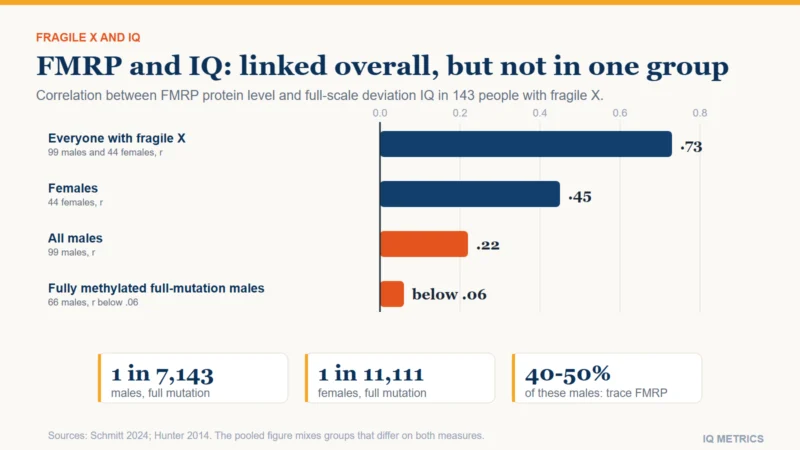 Understanding IQ
Fragile X and IQ
Fragile X and IQ: fully methylated full-mutation males are described as moderate to severe intellectual disability, while females vary widely. A 2024 study of 143 people found a near-normal IQ curve shifted down, and FMRP protein level mattered except in fully methylated males.
 Understanding IQ
Down Syndrome and IQ
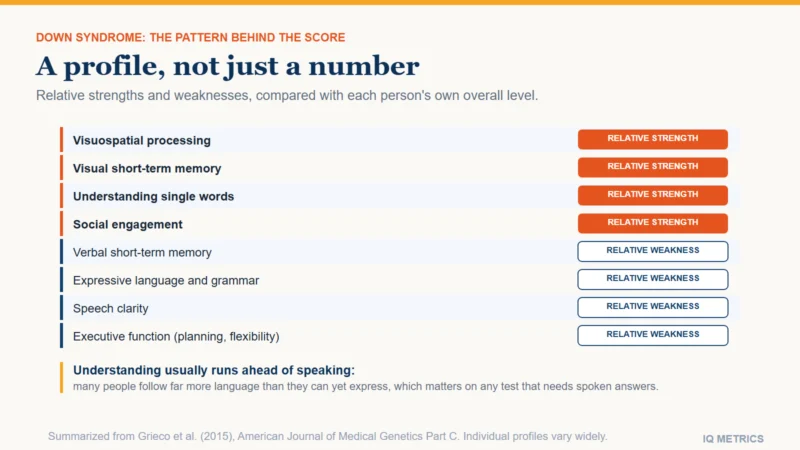
Most people with Down syndrome score in the mild to moderate range of intellectual disability, with an average IQ of around 50 and a typical range of about 30 to 70. The number hides a wide spread, a consistent profile of strengths, and test limits that matter more here than almost anywhere else.
 Scores & Scales
KBIT-2 Test
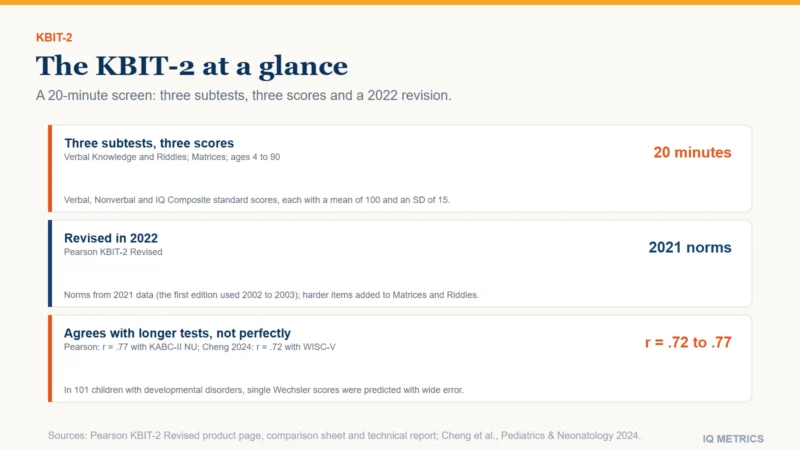
The KBIT-2 is a 20-minute IQ screen for ages 4 to 90 with three subtests: Verbal Knowledge, Riddles and Matrices. See how its scores work, what the 2022 KBIT-2 Revised changed, how closely it matches the WISC-V and KABC-II, and why it is a screen rather than a full evaluation.