





Parrot IQ: How Smart Are Parrots Compared With Humans?
Parrots have no IQ score: no validated test gives one. Studies measure single skills instead. Alex, a grey parrot, named the number in sets of up to six items and used none for zero, kea predicted draws from odds, and parrot brains hold about twice as many neurons as primate brains of the same mass.

Parrots do not have an IQ score. No validated intelligence test produces one for any parrot, so a number quoted as a parrot IQ is not a test result. What researchers can measure is a set of separate abilities, and parrots do well on several: a grey parrot named Alex named the number in sets of up to six items and used “none” for zero, kea used the relative numbers of two kinds of item to predict what would be drawn, a cockatoo made and used a tool without being shown how, and companion parrots use human names in ways that look like labels. The brain behind this is small, yet parrots hold on average about twice as many neurons as a primate brain of the same mass. This guide sets out what the studies found, how parrots compare with crows, dogs and humans, and why no test can reduce it to one number.
- Parrot IQ: none. There is no norm sample and no standard test, so researchers test one skill at a time, usually on a handful of birds.
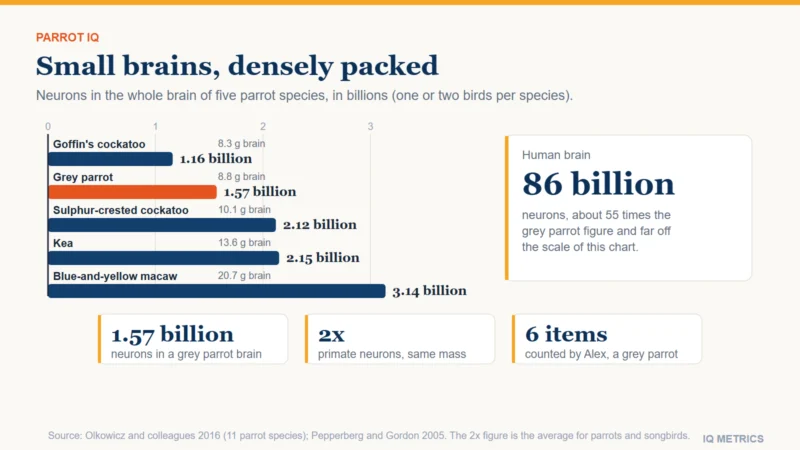
- Brain: the grey parrots counted had brains of 8.8 g holding about 1.57 billion neurons, and the largest brain in the parrot sample, a blue-and-yellow macaw's at 20.7 g, held 3.14 billion (Olkowicz and colleagues, 2016; one or two birds per species).
- Counting: Alex named the number in sets of up to six items with accuracy above 80% and used “none” for zero (Pepperberg and Gordon, 2005).
- Reasoning: kea combined relative quantities, a barrier and an experimenter's biased sampling to predict the outcome of a draw (Bastos and Taylor, 2020).
- Names: in a 2026 owner survey, 47% of the reports on 884 companion parrots included name use, and some birds used a name for one individual only (Benedict and colleagues).
Is there a parrot IQ test?
No. An IQ score is a position on a bell curve: a test is given to thousands of people, the results are ranked, and each person's rank is printed on a scale whose average is 100 (an IQ of 80, for example, is simply the 9th percentile; see what an IQ of 80 means). Nothing like that exists for parrots. There is no standard test, no norm sample and no agreed way to compare a cockatoo with a macaw, so researchers run single experiments, each measuring one narrow skill with a few birds, and report whether the birds beat chance. Our explainer on how IQ tests work shows what a real score needs that a parrot experiment lacks.
The field is growing fast. A 2023 update on parrot cognition counted more than 50 new parrot studies in the four years or so since the previous comprehensive review in 2018, and notes that the field was long pioneered by Irene Pepperberg's work with Alex, whose name stands for Avian Learning EXperiment. Popular claims that a parrot thinks like a young child borrow the idea of mental age (see IQ and mental age), but the published claims are narrower and tied to single skills, as the sections below show.
How big is a parrot's brain, and what does it hold?
Small, but densely packed. A 2016 count in PNAS used the isotropic fractionator method to count the cells in the brains of 11 parrot species, 13 songbird species and 4 other bird species. Across the parrots, body mass ranged from 23 to 1,008 grams, brain mass from 1.15 to 20.73 grams and the number of neurons in the brain from 227 million to 3.14 billion. The authors found that songbirds and parrots hold about twice as many neurons as primate brains of the same mass, and that parrots and corvids keep an unusually large share of their neurons in the pallium, the forebrain region that does the work the cerebral cortex does in mammals.
| Parrot | Brain mass | Neurons in the whole brain |
|---|---|---|
| Goffin's cockatoo | 8.3 g | 1.16 billion |
| Grey parrot | 8.8 g | 1.57 billion |
| Sulphur-crested cockatoo | 10.1 g | 2.12 billion |
| Kea | 13.6 g | 2.15 billion |
| Blue-and-yellow macaw | 20.7 g | 3.14 billion |
Read the table with care, because each figure comes from one or two birds. Against the human brain, which holds about 86 billion neurons (the average used in our guide to elephant IQ), a grey parrot holds about 1.8%, or roughly 1 neuron for every 55. The authors' point is not that parrots match us. It is that a brain of under ten grams can hold as many neurons as a much larger primate brain: large-brained parrots and corvids have forebrain neuron counts equal to or greater than primates with much larger brains. They suggest that these numbers, packed at high density into the forebrain, contribute substantially to the neural basis of avian intelligence.
The insult “bird brain” is therefore out of date. In 2005 an international consortium of neuroscientists proposed replacing the 100-year-old terminology for the bird cerebrum, because the avian pallium has neocortex-like cognitive functions that the old names hid (Jarvis and colleagues). Our guide to crow IQ covers the other bird group the 2016 paper singles out.
Can parrots count?
One grey parrot could, within limits. Alex was trained to name how many items were in a set, and a 2005 study in the Journal of Comparative Psychology tested whether he understood those answers as numbers rather than as sounds. Without extra training he was asked questions such as “What color?” or “What object?” about a stated number of items in a collection shown all at once, for example subsets of 4, 5 and 6 blocks in three colours, or subsets of 2, 4 and 6 keys, corks and sticks. His accuracy was above 80% and was not affected by the quantity, the mass or the outline of the array. He also used “none” to describe the absence of items, which the authors call a zero-like concept.
A 2006 review by the same researcher adds that he could sum small quantities and concludes that his sense of number compares favourably with that of chimpanzees and young human children. Two cautions follow. The results come from one bird in a long research programme, and they cover sets of up to six, so they show what a grey parrot can learn with training, not what a typical parrot does. They also use spoken English labels, which makes the test closer to a human number test than most animal studies, and that is part of why the result is quoted so often. Our guide to chimpanzee IQ sets out the ape results the review compares with.
Do parrots understand words, or only repeat them?
Mimicry alone does not explain Alex, because the 2005 test asked questions he had not been drilled on and he answered them correctly. For companion parrots the evidence is looser but broader. In a 2026 study in PLOS One, researchers surveyed owners about the words and phrases their birds use. Of the reports on 884 birds, 47% included examples of name use, and those 413 parrots spoke 802 phrases that included names. For a subset the owners gave context: reports on 88 birds of 30 species suggested that parrots applied names appropriately as vocal labels for people and animals, and in some birds the evidence was strong that a name was used for one individual only, not as a category label.
The same paper warns against reading too much into this. Many parrots also used names outside human convention, such as calling their own name to get attention, and the data are owner reports, not controlled tests. A 2025 study in Cognitive Science looked at the other side of language, mistakes. When a grey parrot called Apollo used the word “ball” for a bead, his word choices followed the pattern a model of toddlers' overextension predicted better than models based on word frequency or sound similarity, using more than 200 pairs of objects and utterances from his YouTube channel. Both studies treat parrot speech as something to model rather than a trick. For wild elephants that appear to address each other with name-like calls, see elephant IQ.
Do parrots use tools and solve problems?
Some do, and at least one cockatoo did it without a lesson. A 2012 report in Current Biology described spontaneous innovation in tool manufacture and use in a Goffin's cockatoo. The 2023 update counts four new spontaneous innovations described in parrots over the previous four years. It also describes how often the simplest test is passed: as of the earlier review it builds on, string-pulling, in which a bird reels in food hanging from a string, was the task used with the largest number of parrot species, and parrots were generally successful at the basic version, though results were mixed on control versions that check whether the bird understands what it is doing. A pass on the basic task is not, on its own, proof of insight.
Reasoning is harder to show, and kea provide the strongest case. In a 2020 study in Nature Communications, kea were tested on whether they could use the relative numbers of two kinds of item to predict the outcome of a draw, and then combine that with the presence of a barrier and with an experimenter's biased sampling. They showed three signatures of statistical inference. The authors read this as evidence that true statistical inference is found outside the great apes, and that parts of domain-general thinking can evolve in brains built very differently from ours.
Where would your own score land?
Take the IIF-certified assessment and get your score with the scale it was measured on, the percentile it corresponds to and the confidence range around it — the three figures most online tests leave out.
Find your IQ score now! →Do parrots keep a beat?
One cockatoo did. A 2009 study in Current Biology played a sulphur-crested cockatoo a musical excerpt whose tempo was changed across a wide range. The bird spontaneously adjusted the tempo of its rhythmic movements to stay in sync with the beat, which the authors took as evidence that synchronising to a beat is not uniquely human. They link the skill to vocal learning, the ability to copy complex sounds: the hypothesis predicts that only vocal learners, such as humans and some birds, can do it. It is one animal, so it shows what is possible rather than a species norm, but it shows why parrot research looks beyond puzzle boxes.
How do parrots compare with crows, dogs and humans?
There is no common test, so the comparison goes brain cell by brain cell and ability by ability. On brain cells, the 2016 paper puts parrots and corvids together: the raven and the kea have about 1.2 billion neurons in the pallium, more than the pallium of a capuchin monkey, and the blue-and-yellow macaw has about 1.9 billion, more than a rhesus monkey's. For comparison, the 2017 counts quoted in dog IQ and cat IQ put the cerebral cortex at 627 million neurons in a golden retriever and about 250 million in a domestic cat, so a kea's pallium holds roughly twice the golden retriever figure (the regions are not defined identically, so treat this as a rough guide).
On ability the pattern is mixed. On counting, the grey parrot's results are comparable with chimpanzees and young children in the researcher's own review. On tool innovation a cockatoo joins the crows described in crow IQ. On names, the 2026 evidence is owner reports rather than controlled tests. For the other animals in our series, see dolphin IQ, gorilla IQ and octopus IQ. The honest summary is that parrots belong with the most capable non-human animals, but no study ranks them against one another, and a single number would be invented.
Why do parrot results come from so few birds?
Most parrot experiments test a handful of birds, and the best-known numerical result comes from one. The brain counts above rest on one or two birds per species. That does not make the findings wrong, but it limits how far they stretch: read “grey parrots can count to six” as “one grey parrot, trained in a research programme, did”, and wait for replication in other birds. The 2023 update expects the number of parrot studies to keep rising, so the picture will sharpen.
Quick answers about parrot IQ
- What is the IQ of a parrot? There is none. No validated test produces a parrot IQ.
- Which parrot is the smartest? No study ranks species. The grey parrot has the strongest number and language results, mostly from one bird; cockatoos have tool and rhythm results; kea have the inference result.
- Are parrots smarter than dogs? No study measures that directly. A kea's pallium holds roughly twice the neurons counted in a golden retriever's cortex, but dogs have been tested on far more tasks.
- Are parrots as smart as humans? No test compares them. A grey parrot's brain holds about 1.8% of the neurons in a human brain.
- Do parrots understand what they say? Alex answered new questions with words correctly. For pet parrots the evidence is owner reports, which suggest some birds use names as labels.
- Can a parrot count? One grey parrot named the number in sets of up to six and used “none” for zero.
Sources
- Olkowicz, S., Kocourek, M., Lucan, R.K., Portes, M., Fitch, W.T., Herculano-Houzel, S. and Nemec, P. (2016): Birds have primate-like numbers of neurons in the forebrain, PNAS, 113(26), 7255-7260.
- Pepperberg, I.M. and Gordon, J.D. (2005): Number comprehension by a grey parrot (Psittacus erithacus), including a zero-like concept, Journal of Comparative Psychology, 119(2), 197-209.
- Pepperberg, I.M. (2006): Grey parrot numerical competence: a review, Animal Cognition, 9(4), 377-391.
- Bastos, A.P.M. and Taylor, A.H. (2020): Kea show three signatures of domain-general statistical inference, Nature Communications, 11, 828.
- Benedict, L., Groiss, V., Hoeschele, M., Reinisch, E. and Dahlin, C.R. (2026): Name use by companion parrots, PLOS One, 21(4), e0346830.
- Fishkin, M., Chang, S. and Xu, Y. (2025): From human child to grey parrot: exploring a common model of word meaning extension across species, Cognitive Science, 49(10), e70129.
- Auersperg, A.M.I., Szabo, B., von Bayern, A.M.P. and Kacelnik, A. (2012): Spontaneous innovation in tool manufacture and use in a Goffin's cockatoo, Current Biology, 22(21), R903-R904.
- Patel, A.D., Iversen, J.R., Bregman, M.R. and Schulz, I. (2009): Experimental evidence for synchronization to a musical beat in a nonhuman animal, Current Biology, 19(10), 827-830.
- Rossler, T. and Auersperg, A.M.I. (2023): Recent developments in parrot cognition: a quadrennial update, Animal Cognition, 26(1), 199-228.
- Jarvis, E.D., Gunturkun, O., Bruce, L. et al. (2005): Avian brains and a new understanding of vertebrate brain evolution, Nature Reviews Neuroscience, 6(2), 151-159.
- Jardim-Messeder, D. et al. (2017): Dogs have the most neurons, though not the largest brain, Frontiers in Neuroanatomy, 11, 118.
- Herculano-Houzel, S. et al. (2014): The elephant brain in numbers, Frontiers in Neuroanatomy, 8, 46 (human average of 86 billion neurons).
Keep reading
All articles →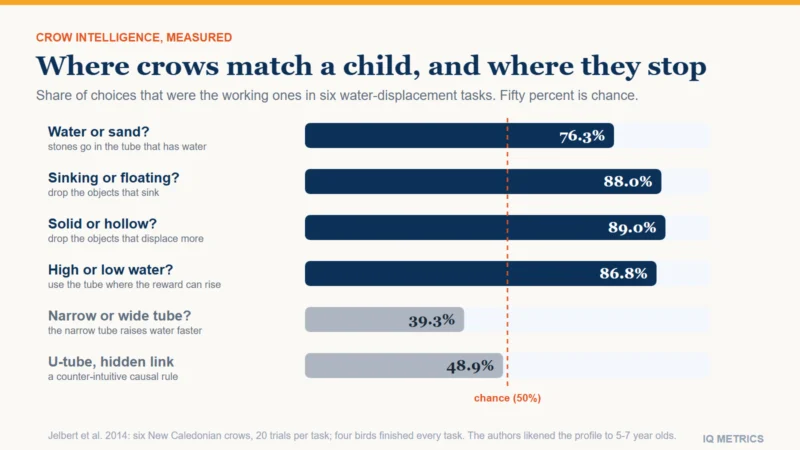 Understanding IQ
Crow and Raven IQ
A crow has no IQ, but tests show what corvids can do: bend wire, plan hours ahead, count their own calls. The 7-year-old comparison traces to one 2014 study of six crows, who were at chance on two of six puzzles.
 Understanding IQ
Elephant IQ
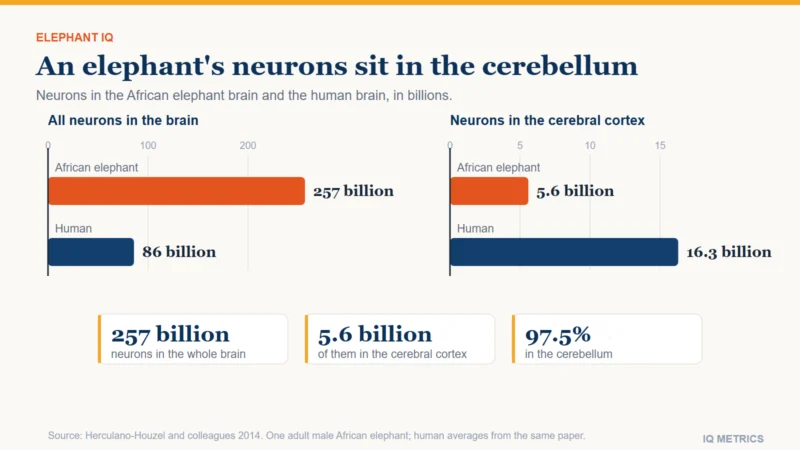
Elephants have no IQ score: no validated test gives one. Studies measure single skills instead. One of three Asian elephants passed the mirror mark test, six waited for a partner before pulling a rope, and wild herds use name-like calls, yet one elephant's cortex held 5.6 billion neurons, a third of the human count.
 Understanding IQ
Dog IQ
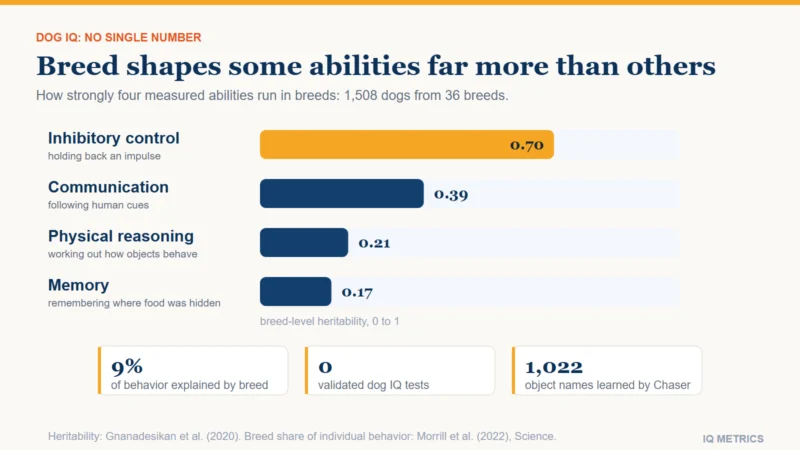
Dogs do not have an IQ: no validated test gives them one. Researchers can measure trainability, memory, self-control and a small general factor, and those results say more about how dogs think than any breed ranking, at-home dog IQ test or "as smart as a toddler" comparison ever could.