





Human Brain Facts: What Color It Is, How Much It Weighs, How Many Neurons
Human brain facts, each with its source: about 1,336 g in men and 1,198 g in women, 86.1 billion neurons and about 20% of the body's calories. The surprise is that the cerebellum holds about 80% of the neurons. Colour, weight, neurons and energy, with the study and method behind each.

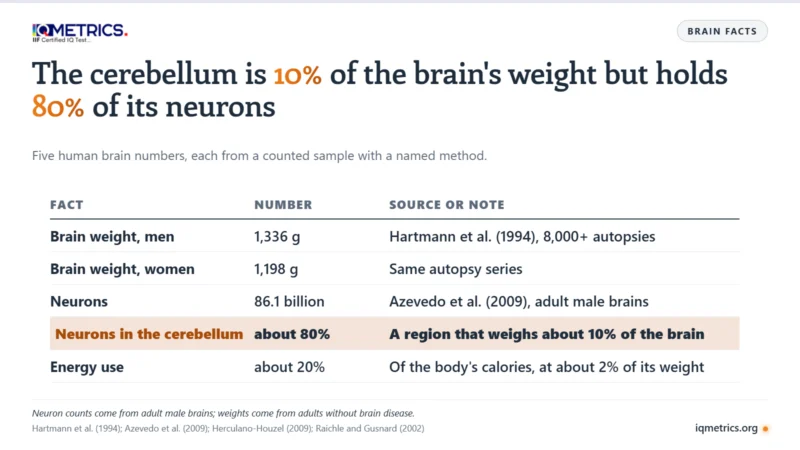
Human brain facts, each traced to its source: an adult male brain averages about 1,336 g and a female brain about 1,198 g, from over 8,000 autopsies. It holds about 86 billion neurons and uses about 20% of the body’s calories while making up about 2% of its weight. In life, grey matter is a very light grey with pinkish or yellowish tints.
Below: facts about the human brain, from colour and weight to neurons and energy, with the study and method behind each number, and one surprise. The cerebellum is about 10% of the brain’s weight but holds about 80% of its neurons. We leave out numbers that trace to no study.
Key takeaways
- Weight: about 1,336 g in men and 1,198 g in women, in more than 8,000 autopsies (Hartmann et al., 1994).
- Neurons: 86.1 billion, plus 84.6 billion other cells, so about 1 to 1 and not 10 to 1 (Azevedo et al., 2009).
- Where: the cerebral cortex holds 19% of the neurons. The cerebellum holds about 80%.
- Energy: about 2% of body weight but about 20% of the oxygen and calories the body uses (Raichle and Gusnard, 2002).
- Size and IQ: across 88 studies, brain volume and IQ correlate at r = .24, so size explains about 6% of the differences (Pietschnig et al., 2015).
What are the key human brain facts?
Eight numbers cover most questions people ask. Each row names the study and the method behind it.
| Fact | Number | Source and method |
|---|---|---|
| Brain weight, men | about 1,336 g | Hartmann et al. 1994: more than 8,000 autopsies |
| Brain weight, women | about 1,198 g | Hartmann et al. 1994: same series |
| Neurons | 86.1 billion (plus or minus 8.1) | Azevedo et al. 2009: cell counts in adult male brains |
| Other (non-neuronal) cells | 84.6 billion (plus or minus 9.8) | Azevedo et al. 2009: same method |
| Share of neurons in the cerebral cortex | 19% | Azevedo et al. 2009 |
| Share of neurons in the cerebellum | about 80% | Azevedo et al. 2009, as tabulated in Herculano-Houzel 2009 |
| Energy use | about 20% of the body’s oxygen and calories | Raichle and Gusnard 2002 (about 2% of body weight) |
| Brain volume and IQ | r = .24 | Pietschnig et al. 2015: 88 studies, over 8,000 people |
What color is the human brain?
In life, grey matter looks very light grey with yellowish or pinkish tints, according to the Wikipedia entry on grey matter. It credits capillary blood vessels and nerve cell bodies for the tint. White matter looks white mainly because of myelin, the insulating coat on long nerve fibres.
We found no measurement paper for the exact hues, so treat this as a reference-book description, not a measured value. The names describe tissue type: grey matter is rich in cell bodies, and white matter is made of long, myelin-coated fibres.
How much does the human brain weigh?
An average adult brain weighs about 1,336 g in men and 1,198 g in women. Those are means from more than 8,000 autopsies of adults without brain disease (Hartmann and colleagues, Der Pathologe, 1994).
Height and age matter. In that series, brain weight rose about 3.7 g for each centimetre of height in both sexes. It fell about 2.7 g a year in men and 2.2 g a year in women as they aged.
Dekaban (Annals of Neurology, 1978) weighed fresh brains from 2,773 males and 1,963 females. Male brains were 9.8% heavier overall. Weight quadrupled in the first 3 years of life, peaked at about age 19 and was about 11% below that peak by age 86.
You will often see 1.5 kg. That is the average of the adult male brains in the neuron-counting study below (1,508 g), a different sample from the autopsy series. For heavier and lighter brains, see our study of 136 famous brains weighed, where Einstein’s brain was 1,230 g.
How many neurons are in the human brain?
About 86 billion. Azevedo and colleagues (Journal of Comparative Neurology, 2009) counted 86.1 billion (plus or minus 8.1 billion) neurons and 84.6 billion (plus or minus 9.8 billion) other cells in adult male brains.
They used the isotropic fractionator and counted cells that carry NeuN, a marker for neurons. The older figures, 100 billion neurons and ten times as many glial cells, were quoted for half a century. A 2016 review by von Bartheld, Bahney and Herculano-Houzel found that the original counts always supported about 1 glial cell per neuron.
The newer figure is winning. In our own check, 65% of journal articles in 2026 that give a neuron count say 86 billion, up from 4% in 2009 (brain myths versus facts: 12 viral numbers checked).
For scale, a dog brain holds about 2.25 billion neurons (Jardim-Messeder et al., 2017, in the data table of our smartest animals study). A human brain has about 38 times as many. Our human brain versus dog brain news article compares the two.
Where are most of the brain's neurons?
In the cerebellum, the small structure at the back of the head, and not in the cortex. The cerebellum weighs about 154 g, roughly 10% of the brain, yet holds about 69 billion neurons, about 80% of the total.
The cerebral cortex is the folded outer layer. It weighs about 1,233 g, 82% of brain mass, and holds about 16 billion neurons, which is 19% (Azevedo et al., 2009; figures as tabulated by Herculano-Houzel, Frontiers in Human Neuroscience, 2009).
| Region | Weight | Share of weight | Neurons | Share of neurons |
|---|---|---|---|---|
| Cerebral cortex | about 1,233 g | 82% | about 16 billion | 19% |
| Cerebellum | about 154 g | 10% | about 69 billion | about 80% |
| Rest of the brain | about 121 g | 8% | about 1 billion | about 1% |
So weight is a poor guide to neuron count. Herculano-Houzel’s review makes the same point across species: brain size can no longer be treated as a stand-in for the number of neurons.
Where would your own score land?
Take the IIF-certified assessment and get your score with the scale it was measured on, the percentile it corresponds to and the confidence range around it — the three figures most online tests leave out.
Find your IQ score now! →How much energy does the human brain use?
About 20% of the body’s oxygen and calories, at about 2% of its weight. Raichle and Gusnard (PNAS, 2002) give those figures for the average adult. They add that the rate stays remarkably constant, whatever mental or physical activity the person is doing.
It is the one viral brain number that holds up as usually stated in our 12-number fact-check. Figures such as 60,000 thoughts a day trace to no study. The “we use only 10% of our brain” idea is covered in how much of our brain we use.
Does a bigger brain mean a higher IQ?
A little, on average, but size is a weak guide to any one person. Pietschnig and colleagues (Neuroscience and Biobehavioral Reviews, 2015) pooled 88 studies of 148 samples and more than 8,000 people. Brain volume and IQ correlated at r = .24, which means size explains about 6% of the differences.
They also found that stronger correlations were reported more often than weak ones. They warned against reading brain size as a direct measure of intelligence. For a way to measure your own ability, see how smart are you, and for the memory side of the brain try our brain games.
Quick answers
- What color is the human brain? In life, a very light grey with pinkish or yellowish tints. We found this in a reference entry, not a measurement paper.
- How much does the human brain weigh? About 1,336 g in men and 1,198 g in women, in more than 8,000 autopsies.
- How many neurons does the human brain have? About 86 billion, plus about 85 billion other cells.
- How much energy does the brain use? About 20% of the body’s oxygen and calories, at about 2% of body weight.
- Where are most neurons? About 80% are in the cerebellum, which weighs about 10% of the brain.
The bottom line
Most human brain facts are less round than the versions you have heard. The number that is quoted most, 100 billion neurons, was replaced by a counted 86 billion, and the cortex that gets all the credit holds under a fifth of the neurons. Each figure here has a named study, a sample and a method.
Looking for storage, not size? See how much data the human brain can store. For what intelligence tests tap into, read which part of the brain IQ tests measure.
Sources
- Hartmann P, Ramseier A, Gudat F, Mihatsch MJ, Polasek W (1994). Normal weight of the brain in adults in relation to age, sex, body height and weight. Der Pathologe 15, 165-170.
- Dekaban AS (1978). Changes in brain weights during the span of human life: relation of brain weights to body heights and body weights. Annals of Neurology 4, 345-356.
- Azevedo FAC, Carvalho LRB, Grinberg LT, et al. (2009). Equal numbers of neuronal and nonneuronal cells make the human brain an isometrically scaled-up primate brain. Journal of Comparative Neurology 513, 532-541.
- Herculano-Houzel S (2009). The human brain in numbers: a linearly scaled-up primate brain. Frontiers in Human Neuroscience 3, 31.
- von Bartheld CS, Bahney J, Herculano-Houzel S (2016). The search for true numbers of neurons and glial cells in the human brain: a review of 150 years of cell counting. Journal of Comparative Neurology 524, 3865-3895.
- Raichle ME, Gusnard DA (2002). Appraising the brain’s energy budget. PNAS 99, 10237-10239.
- Pietschnig J, Penke L, Wicherts JM, Zeiler M, Voracek M (2015). Meta-analysis of associations between human brain volume and intelligence differences. Neuroscience and Biobehavioral Reviews 57, 411-432.
- Colour of living grey matter: Wikipedia, Grey matter (reference description, no measurement paper found).
- Dog neuron count: Jardim-Messeder et al. (2017), from the data table of our smartest animals study.
Keep reading
All articles →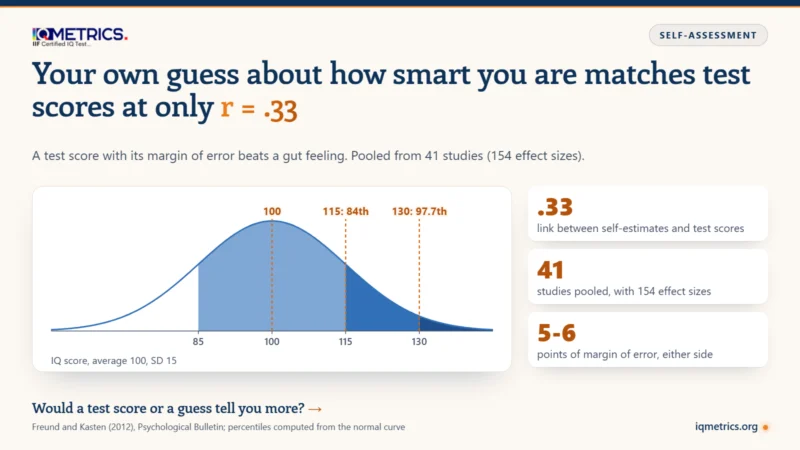 Understanding IQ
How Smart Are You?
How smart are you? A test score with its margin of error is the best answer. Your own guess matches test results at only r = .33 across 41 studies, so smart is better measured than felt. See what an IQ score says, the five parts of smart on a test, how accurate a score is and how to find yours.
 Understanding IQ
Which Part of the Brain, IQ Tests Measures
Finally, IQ tests focus on certain regions of the brain to reveal the chemical basis of intelligence. If we want to know how we gain intelligence, we must study the roles and connections between these domains. It is essential to recognize that IQ tests have limitations, and a more thorough assessment of intelligence is necessary.
 Understanding IQ
Brain Myths About Intelligence
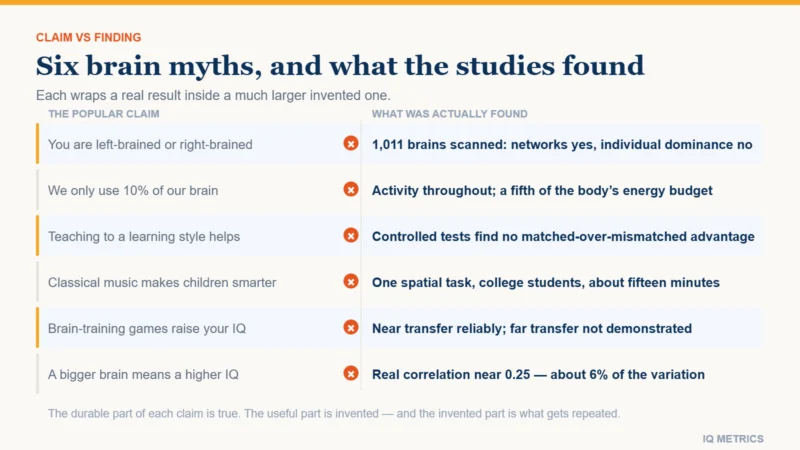
You are not left-brained or right-brained, you do not use ten per cent of your brain, and matching a lesson to your learning style does not help you learn. Six claims about intelligence that almost everyone repeats, what the studies that tested them found, and the smaller true fact hiding inside each one.