Where to Find IQ and Intelligence Data: 447 datasets found, 230 open
We built the first dataset-by-dataset table of open research data on intelligence and cognition: 447 datasets with test scores found in DataCite and OpenNeuro, a lower bound. 230 are open to download as their records state, 288 name the test, 231 state how many people took it.

By Leon Falkner, Data & Research Analyst · Reviewed by Aarav Vardhan, Editor-in-Chief · Published 18 November 2026 · 16 min read
About this study
- Report type
- Data study: our one-row-per-dataset table of research data on intelligence and cognition, from DataCite and OpenNeuro records
- Data
- 447 datasets on topic from 1,956 candidates (3,148 raw DataCite hits, 1,949 OpenNeuro READMEs); a seeded sample of 204 hits read by hand
- Sources
- DataCite REST API (CC0 metadata), OpenNeuro API, NIMH OpenCogData and the ISIR data page as lead lists
- Dates
- Records read 18 November 2026; datasets first published 1984 to 2026; as of 18 November 2026
- Licence
- CC BY 4.0 (our dataset and charts)
- Version
- 2026.11
- Sources
- 11
We found 447 datasets in two open indexes that hold scores from intelligence or cognitive-ability tests, and 230 of them are open to download as their records state (18 November 2026). That is a lower bound: 3,148 keyword hits narrowed to 447 after our check. 288 name the test and 231 state how many people. Source: IQ Metrics Research.
01 Key findings
- 447 datasets found, 230 open. No list counts them: the lists researchers cite are short hand-made pages with no totals, years or licences. Ours is a floor from two indexes and a read sample.DataCite; OpenNeuro; IQ Metrics count
- The keywords alone mislead. 3,148 raw hits shrank to 447: Wechsler queries were on topic in 28 of 30 sampled hits, general intelligence or g in 2.IQ Metrics sample
- Licences are patchy. 144 of 447 records name no licence; 147 carry CC BY and 72 CC0 or public domain. 86 of ICPSR’s 98 records state no access terms in their DOI records.IQ Metrics coding
- Tests and samples. 288 name a standard test (129 Wechsler, 73 Raven’s); 231 state a sample, median 254, up to 1,020,195.IQ Metrics coding
- Fast growth. 207 datasets first published in 2021-2025, 8.0 times 2011-2015.DataCite; IQ Metrics count
- Blind spots. 75 Open Science Framework records match our IQ terms but only 1 is typed Dataset; we found none of the 8 OpenCogData intelligence entries.DataCite; OpenCogData
02 Where can you find IQ and intelligence data? The numbers to quote
Search the large research repositories and you can find 447 datasets that hold scores from intelligence or cognitive-ability tests, or have such scores as a documented variable; 230 of them are open to download as their own records state [1] [3]. No list we could find counts them: the lists researchers point to are short hand-made pages with no totals, years, licences or file [5] [4]. IQ Metrics Research built one row per dataset from the repositories’ own records, as of 18 November 2026.
datasets with intelligence or cognitive-ability test scores found in DataCite and OpenNeuro (a lower bound, not a census).
DataCite; OpenNeuro; IQ Metrics countraw dataset records returned by seven keyword queries; about 736 (95% interval 556 to 927) are on topic by a sample read by us.
DataCite; IQ Metrics sampledatasets (51%) are open to download as their records state; 46 need registration or an agreement, 5 are on request, 30 restricted or closed, 136 state nothing.
IQ Metrics codingdatasets carry CC0 or CC BY (72 and 147); 144 name no licence in the record.
IQ Metrics codingof the datasets (288 of 447) name a standard test; 129 name a Wechsler scale and 73 Raven’s matrices.
IQ Metrics codingof the datasets (231) state how many people; the median is 254, from 8 to 1,020,195.
IQ Metrics codingmore datasets first published in 2021-2025 (207) than in 2011-2015 (26); all DataCite dataset records grew x21.
DataCite; IQ Metrics countrepositories hold them; ICPSR (98) and figshare (94) hold 43%, and 32 repositories hold exactly one.
DataCite; IQ Metrics countcountries are named, by 142 records (32%); 92 name the United States; 305 name none.
IQ Metrics codingdatasets name only children, 77 only adults, 157 both and 98 no age.
IQ Metrics codingof the records (197) name a related paper; 1 landing page returned “not found” and 95 refused an automated check.
IQ Metrics checksampled Wechsler hits were on topic, against 5/30 for “cognitive ability” and 2/30 for general intelligence or g.
IQ Metrics sampleOpen Science Framework records match our IQ terms, but only 1 is typed as a dataset in DataCite, so a Dataset search cannot see them.
DataCite; IQ Metrics queryEvery row of the table at the end links the dataset by its DOI and shows the repository, year, type of data, test named, people stated, access and licence as the record gives them. We never write that this is all there is: 447 is what two indexes returned for our queries after a check, so it is a lower bound. Datasets in repositories that do not register DOIs with DataCite, and datasets filed there under another resource type, are not in it.
What this study does not say
This page lists where data are and what each record says about itself. It does not call any dataset good, best or reliable, does not rank repositories, gives no national or group IQ numbers and holds no personal data. A licence on a record is the depositor’s claim; read each record’s terms before you use it. This is not legal advice.
03 What counts as an IQ or intelligence dataset here?
A dataset is on topic when its record says it holds participant-level scores or item responses from a standard intelligence or cognitive-ability test or battery, or that such scores are a documented variable in a cohort, imaging or genetic dataset [1]. A “dataset” is a DataCite DOI record whose resource type is Dataset. We read titles, subjects and abstracts only: no data file was downloaded, and creators’ names are not stored. Tests such as the Wechsler adult scale, the Wechsler scale for children, Raven’s Progressive Matrices and the Stanford-Binet are named in the records we count.
- Dataset (here)
- A DataCite DOI record whose resource type is Dataset; one row per dataset after version DOIs and copies are merged.
- On topic
- The record says it holds scores or item responses from a standard intelligence or cognitive-ability test or battery, or documents such scores as a variable.
- Open to download
- The record says anyone can download without a request or agreement: an open licence or “open access”, and no wording about requests or registration. The depositor’s claim.
- Registered access, on request
- Separate values, never counted as open: the record or repository says access needs registration, an agreement or approval, or asks you to contact the authors.
- Test named
- The record names a test family from our fixed list: Wechsler scales, Raven’s matrices, Stanford-Binet, Woodcock-Johnson, Kaufman tests, Cattell Culture Fair, ICAR, NIH Toolbox, CogAT, Leiter or another named test.
- People stated
- A participant number printed in the record (for example “N = 120”); the first sample size it gives. Never inferred.
- Lower bound
- We found this many with these queries and this check; more exist that our queries or filters could not see.
We left out 1,509 candidates, each for one reason (table below). The biggest group is 880 records where the keywords occur but the record is about something else; 345 concern artificial or business “intelligence” and 133 animal cognition. We also left out 8 national or group IQ compilations: after the 2020 statement of the European Human Behaviour and Evolution Association on national IQ datasets, this study neither reproduces nor ranks such numbers. 67 records sit on a commercial platform and are counted here without being named or linked.
What we left out: 1,509 candidates, each with one reason (as of 18 November 2026)
| Reason | Candidates | What it covers |
|---|---|---|
| No test scores in the record | 880 | The keywords occur but the record is about something else: a survey of attitudes, a paper’s tables, a software tool, a test manual, a dataset of places or prices, an empty or spam record. |
| Artificial or business “intelligence” | 345 | Machine-learning sets, benchmarks, chatbots, business or military intelligence. |
| Animal cognition | 133 | Primates, rodents, birds, fish, insects: cognition tests, not intelligence tests of people. |
| Hosted by a commercial platform | 67 | Copies on a commercial data-sharing or test site; not named or linked here. |
| A paper’s supplementary file | 40 | Records titled “Supplementary Material for …” from journal publishers; tables of a paper, not participant data we could confirm. |
| The same dataset in two places | 29 | The same title and text deposited twice (two repositories or two DOIs); kept once. |
| National or group IQ compilations | 8 | Country-level or group-level IQ numbers; left out by rule, never reproduced or ranked. |
| Patients with no test score | 7 | Clinical datasets that report diagnosis or symptoms with no test score as a variable. |
Source: DataCite and OpenNeuro records; IQ Metrics coding of each candidate
04 How many IQ datasets are there?
We found 447 on-topic datasets: 424 through DataCite and 23 more through OpenNeuro READMEs [1] [3]. Seven keyword queries returned 3,148 dataset records; merging version DOIs and copies left 1,931 distinct datasets, and our check kept 424 of them. The funnel shows the steps.
Of 1,956 candidate datasets, 447 are on topic, 288 name the test, 165 state how many people and 72 are open
Datasets found by the keyword queries in DataCite (1,931 after merging version DOIs) and in OpenNeuro READMEs (25), narrowed in steps: on topic by our reading, then also naming a standard test, then also stating a participant number in the record, then also open to download as the record states. Each step is a subset of the one above. A lower bound; IQ Metrics coding. As of 18 November 2026.
Source: DataCite API [1]; OpenNeuro API [3]; IQ Metrics coding
Data table
| stage | count | pct_of_first | pct_of_previous |
|---|---|---|---|
| Candidates found by the queries | 1956 | 100 | 100 |
| On topic by our check | 447 | 22.9 | 22.9 |
| Name a standard test | 288 | 14.7 | 64.4 |
| Also state how many people | 165 | 8.4 | 57.3 |
| Also open to download | 72 | 3.7 | 43.6 |
Embed this chart
Paste this HTML into your page: it carries the numbers and the credit link to this figure.
The queries are noisy, so we measured how noisy. For each of the seven queries we drew a seeded random sample of 30 hits and read every record ourselves (204 distinct records) [6]. Wechsler terms were on topic in 28 of 30 hits (93%), Raven’s matrices in 25, IQ terms in 23, fluid intelligence in 18, other named tests in 10, “cognitive ability” in 5 and general intelligence or g in 2: the last two bring in physics (the g-factor of electrons), artificial general intelligence, animal studies and clinical papers.
Of 30 sampled hits per query, 28 for Wechsler terms were on topic but only 2 for general intelligence or g
Share of raw keyword hits that are on topic, from a seeded random sample of 30 hits for each of seven queries, each read by us (204 distinct records). The dot is the share; the bar is the 95% interval (Wilson, n = 30). The broad queries bring in physics, artificial intelligence, animal studies and business records. IQ Metrics sample. As of 18 November 2026.
Source: IQ Metrics precision sample [6]; DataCite API [1]
Data table
| label | low | estimate | high |
|---|---|---|---|
| Wechsler scales (157 hits) | 79 | 93 | 98 |
| Raven's matrices (133 hits) | 66 | 83 | 93 |
| IQ terms (200 hits) | 59 | 77 | 88 |
| Fluid intelligence (112 hits) | 42 | 60 | 75 |
| Other named tests (701 hits) | 19 | 33 | 51 |
| Cognitive ability (1,288 hits) | 7 | 17 | 34 |
| General intelligence, g (807 hits) | 2 | 7 | 21 |
Embed this chart
Paste this HTML into your page: it carries the numbers and the credit link to this figure.
Weighting each sampled record by its chance of being drawn, about 736 of the 3,148 raw records are on topic, with a 95% interval of 556 to 927; our own pipeline keeps 793 DOI records, which merge into the 424 DataCite datasets. The two agree within the interval. Before any correction, our automatic rules matched our reading on 92 of the 105 sampled records we judged on topic, with 3 more being copies whose twin was kept and 10 missed; they wrongly kept 4 of 96 they accepted. We then corrected the misses, so the final table’s agreement with that sample is not an independent test: the first-pass figures are the honest ones.
The seven queries returned 3,148 records; the sample puts the on-topic ones near 736 (95% interval 556 to 927)
Raw hits per query (left dot is the estimate of how many are on topic, right dot is the raw count). Estimate = raw hits x the sample share on topic for that query. A record can match several queries, so the rows add up to more than 3,148. The estimate for the whole set weights each sampled record by its chance of being drawn. IQ Metrics calculation. As of 18 November 2026.
Source: DataCite API [1]; IQ Metrics precision sample [6]; IQ Metrics calculation
Data table
| query | Estimated on topic | Raw hits |
|---|---|---|
| Cognitive ability | 215 | 1288 |
| General intelligence, g | 54 | 807 |
| Other named tests | 234 | 701 |
| IQ terms | 153 | 200 |
| Wechsler scales | 147 | 157 |
| Raven's matrices | 111 | 133 |
| Fluid intelligence | 67 | 112 |
Embed this chart
Paste this HTML into your page: it carries the numbers and the credit link to this figure.
05 Where are IQ datasets stored?
In 65 repositories, with ICPSR (98 datasets) and figshare (94) holding 43% of the 447, then Zenodo (29), OpenNeuro (23), Mendeley Data (21), Harvard Dataverse (20), the NIMH Data Archive (19) and Dryad (19) [1]. These are counts of datasets found by our queries, not a measure of quality, size or ease of use. figshare’s count includes supplementary files that journal publishers deposit there, and ICPSR’s includes many survey waves of one study.
ICPSR (98) and figshare (94) hold 43% of the datasets we found; 32 of 65 repositories hold only one
On-topic datasets by repository, the ten with the most (75% of all 447). The count is of datasets found by our queries, not a measure of quality or size, and the repository is the DataCite client (figshare includes journal supplements deposited there). As of 18 November 2026.
Source: DataCite API [1]; OpenNeuro API [3]; IQ Metrics count
Data table
| label | value |
|---|---|
| ICPSR / openICPSR | 98 |
| figshare | 94 |
| Zenodo | 29 |
| OpenNeuro | 23 |
| Mendeley Data | 21 |
| Harvard Dataverse | 20 |
| NIMH Data Archive | 19 |
| Dryad | 19 |
| ADA Dataverse | 7 |
| DANS | 6 |
Embed this chart
Paste this HTML into your page: it carries the numbers and the credit link to this figure.
Most ICPSR records state no access terms at all (86 of 98), so we count none of them as open; 11 say registration or an agreement is needed. By contrast 92 of 94 figshare records and all 23 OpenNeuro datasets state open terms. The ICPSR studies include well-known cohorts: the Terman Life-Cycle Study of children with high ability [10], which our study of the Terman cohort revisits, and the Chicago neighbourhoods project, which releases the score files of single Wechsler and Stanford-Binet scales one by one [9].
Most of the 447 datasets sit in a few repositories, and the open ones are mostly figshare, Zenodo, OpenNeuro, Mendeley Data and Dataverse
The 447 on-topic datasets by repository (left), by type of data (middle) and by access as the record states it (right). Six repositories are named; the other 59 are grouped. Counts of datasets found, not a ranking of repositories. IQ Metrics coding. As of 18 November 2026.
Source: DataCite API [1]; OpenNeuro API [3]; IQ Metrics coding
Data table
| from | to | repository |
|---|---|---|
| Harvard Dataverse | Cohort or survey with a test | 13 |
| Harvard Dataverse | Compiled study-level data | 1 |
| Harvard Dataverse | IQ or ability-test scores | 6 |
| ICPSR / openICPSR | Cognitive-task battery | 3 |
| ICPSR / openICPSR | Cohort or survey with a test | 72 |
| ICPSR / openICPSR | Compiled study-level data | 3 |
| ICPSR / openICPSR | Brain imaging with scores | 1 |
| ICPSR / openICPSR | IQ or ability-test scores | 19 |
| Mendeley Data | Cognitive-task battery | 7 |
| Mendeley Data | Cohort or survey with a test | 1 |
| Mendeley Data | Compiled study-level data | 1 |
| Mendeley Data | Brain imaging with scores | 3 |
| Mendeley Data | IQ or ability-test scores | 9 |
| OpenNeuro | Brain imaging with scores | 23 |
| Other repositories | Cognitive-task battery | 14 |
| Other repositories | Cohort or survey with a test | 64 |
| Other repositories | Compiled study-level data | 2 |
| Other repositories | Genetic data | 9 |
| Other repositories | Brain imaging with scores | 26 |
| Other repositories | IQ or ability-test scores | 47 |
| Zenodo | Cognitive-task battery | 6 |
| Zenodo | Cohort or survey with a test | 5 |
| Zenodo | Genetic data | 3 |
| Zenodo | Brain imaging with scores | 3 |
| Zenodo | IQ or ability-test scores | 12 |
| figshare | Cognitive-task battery | 35 |
| figshare | Cohort or survey with a test | 15 |
| figshare | Compiled study-level data | 2 |
| figshare | Genetic data | 8 |
| figshare | Brain imaging with scores | 2 |
| figshare | IQ or ability-test scores | 32 |
| Cognitive-task battery | Not stated | 8 |
| Cognitive-task battery | On request | 2 |
| Cognitive-task battery | Open to download | 51 |
| Cognitive-task battery | Registered access | 3 |
| Cognitive-task battery | Restricted or closed | 1 |
| Cohort or survey with a test | Not stated | 75 |
| Cohort or survey with a test | On request | 1 |
| Cohort or survey with a test | Open to download | 55 |
| Cohort or survey with a test | Registered access | 24 |
| Cohort or survey with a test | Restricted or closed | 15 |
| Compiled study-level data | Not stated | 1 |
| Compiled study-level data | Open to download | 5 |
| Compiled study-level data | Registered access | 2 |
| Compiled study-level data | Restricted or closed | 1 |
| Genetic data | Not stated | 3 |
| Genetic data | Open to download | 15 |
| Genetic data | Registered access | 1 |
| Genetic data | Restricted or closed | 1 |
| Brain imaging with scores | Not stated | 9 |
| Brain imaging with scores | Open to download | 35 |
| Brain imaging with scores | Registered access | 11 |
| Brain imaging with scores | Restricted or closed | 3 |
| IQ or ability-test scores | Not stated | 40 |
| IQ or ability-test scores | On request | 2 |
| IQ or ability-test scores | Open to download | 69 |
| IQ or ability-test scores | Registered access | 5 |
| IQ or ability-test scores | Restricted or closed | 9 |
Embed this chart
Paste this HTML into your page: it carries the numbers and the credit link to this figure.
A different gap is on the hosting side. The Open Science Framework is where many psychologists deposit data, yet it registers its projects in DataCite as resource type Text: of 576,971 OSF records only 3,519 are typed Dataset, and our four IQ-term queries match 75 OSF records of any type but only 1 typed Dataset (22 for Wechsler, 61 for Raven’s, 195 for fluid intelligence, with 1 typed Dataset) [1]. Those deposits are not in our count, and a search that filters on “dataset” will not show them either.
06 How many IQ datasets are open, and under what licence?
230 of 447 datasets (51%) are open to download as their records state, 46 need registration or an agreement, 5 are available on request, 30 are restricted or closed and 136 state nothing [1]. Registered access and on request are separate values and never counted as open. Of the open ones, 139 carry CC BY, 68 CC0 or public domain, 3 CC BY-SA and 18 a non-commercial CC BY-NC licence, which allows download but not every reuse.
One dataset in three has no licence stated in its record (144 of 447); 147 carry CC BY and 72 CC0 or public domain
One square per on-topic dataset (447), coloured by the licence its DataCite or OpenNeuro record names. A licence on a record is the depositor's claim, and records with no licence are not necessarily closed: 2 datasets are read as open with a licence of another kind. IQ Metrics coding. As of 18 November 2026.
447 datasetsone square = one dataset
Source: Rights fields of the DataCite and OpenNeuro records [1] [3]; IQ Metrics coding
Data table
| dataset | group | label | detail |
|---|---|---|---|
| d0 | CC0 or public domain | Lernbehinderte | GESIS, 1968: access open |
| d1 | CC0 or public domain | Zwillings-Intervallstudie 2. Welle 1984-1986 | GESIS, 2008: access open |
| d2 | CC0 or public domain | Replication data for: Executive Functioning in Children with Specific… | Harvard Dataverse, 2014: access open |
| d3 | CC0 or public domain | Data from: Hyper-Theory-of-Mind in children with psychotic experiences | Dryad, 2015: access open |
| d4 | CC0 or public domain | Selected ICAR data from the SAPA-Project: Development and initial val… | Harvard Dataverse, 2015: access open |
| d5 | CC0 or public domain | Intestinal Worm Infections and Child Health & Educational Outcomes in… | Harvard Dataverse, 2016: access restricted or closed |
| d6 | CC0 or public domain | NIH Toolbox Norming Study | Harvard Dataverse, 2016: access open |
| d7 | CC0 or public domain | PIAAC-Longitudinal (PIAAC-L), Germany | GESIS, 2016: access open |
| d8 | CC0 or public domain | Raw scores for KBIT-2 and total scores for informant questionnaires | figshare, 2016: access open |
| d9 | CC0 or public domain | Who can afford self-control? The neural efficiency mechanism explains… | OpenNeuro, 2016: access open |
| d10 | CC0 or public domain | Beyond the “30 Million Word Gap:” Children’s Conversational Exposure… | Harvard Dataverse, 2017: access open |
| d11 | CC0 or public domain | NIH Toolbox Cognition Validation | Harvard Dataverse, 2017: access restricted or closed |
| d12 | CC0 or public domain | Data from: Large and fast human pyramidal neurons associate with inte… | Dryad, 2018: access open |
| d13 | CC0 or public domain | Berliner Erhebung der Lernausgangslagen arbeitsrelevanter Basiskompet… | IQB (Germany), 2019: access open |
| d14 | CC0 or public domain | Children of Immigrants Longitudinal Survey in Four European Countries… | GESIS, 2019: access open |
| d15 | CC0 or public domain | Children of Immigrants Longitudinal Survey in Four European Countries… | GESIS, 2019: access open |
| d16 | CC0 or public domain | Data from: Assessing for interaction between APOE ε4, sex, and lifest… | Dryad, 2019: access open |
| d17 | CC0 or public domain | Data from: Cognitive ability and fertility amongst Swedish men born 1… | Dryad, 2019: access open |
| d18 | CC0 or public domain | Data from: Perceiving the evil eye: investigating hostile interpretat… | Dryad, 2019: access open |
| d19 | CC0 or public domain | Data from: What caused over a century of decline in general intellige… | Dryad, 2019: access open |
| d20 | CC0 or public domain | Interactive effects of dopamine transporter genotype and aging on res… | G-Node, 2019: access open |
| d21 | CC0 or public domain | Data from: Characteristics of university students supported by counse… | Dryad, 2020: access open |
| d22 | CC0 or public domain | Data from: Cognition at age 70: life course predictors and associatio… | Dryad, 2020: access open |
| d23 | CC0 or public domain | TüEyeQ, a rich IQ test performance data set with eye movement, educat… | Harvard Dataverse, 2020: access open |
| d24 | CC0 or public domain | Clinical and genetic features in patients with reflex bathing epilepsy | Dryad, 2021: access open |
| d25 | CC0 or public domain | Component processes of word reading in adults and children | OpenNeuro, 2021: access open |
| d26 | CC0 or public domain | Data from: Differential neuropsychological profile of ALS patients wi… | Dryad, 2021: access open |
| d27 | CC0 or public domain | Naturalistic Neuroimaging Database | OpenNeuro, 2021: access open |
| d28 | CC0 or public domain | Reproducibility Data for: Creative Achievement and Individual Differe… | Harvard Dataverse, 2021: access open |
| d29 | CC0 or public domain | Socioeconomic Status Differences in Children’s Affective Decision-Mak… | figshare, 2021: access on request |
| d30 | CC0 or public domain | Zusammenhalt in Vielfalt. Das Vielfaltsbarometer 2019 der Robert Bosc… | GESIS, 2021: access open |
| d31 | CC0 or public domain | Auditory-Visual Shift Study | OpenNeuro, 2022: access open |
| d32 | CC0 or public domain | BIDS Phenotype Aggregation Example Dataset | OpenNeuro, 2022: access open |
| d33 | CC0 or public domain | BIDS Phenotype External Example Dataset | OpenNeuro, 2022: access open |
| d34 | CC0 or public domain | BIDS Phenotype Segregation Example Dataset | OpenNeuro, 2022: access open |
| d35 | CC0 or public domain | EEG: First Episode Psychosis vs. Control Resting Task 2 | OpenNeuro, 2022: access open |
| d36 | CC0 or public domain | A pragmatic randomized maternal education trial in rural Uganda – Eig… | Dryad, 2023: access open |
| d37 | CC0 or public domain | DABS – correlation between adaptive behavior and intelligence | Science Data Bank, 2023: access open |
| d38 | CC0 or public domain | Effects of brain maintenance and cognitive reserve on age-related dec… | Dryad, 2023: access registered |
| d39 | CC0 or public domain | Replication Data for: Fluid intelligence and fertility intentions | Harvard Dataverse, 2023: access open |
| d40 | CC0 or public domain | Replication Data for: Structure of personal networks and cognitive ab… | Harvard Dataverse, 2023: access open |
| d41 | CC0 or public domain | Replication Data for: The Development Gap in Economic Rationality of… | Harvard Dataverse, 2023: access open |
| d42 | CC0 or public domain | Reproducibility Data: Two-Dimensional Rotation Ability Item Developme… | Harvard Dataverse, 2023: access open |
| d43 | CC0 or public domain | Single Dose Intranasal Oxytocin Administration: Data from Healthy You… | OpenNeuro, 2023: access open |
| d44 | CC0 or public domain | Stability and change in male fertility patterns by cognitive ability… | Dryad, 2023: access open |
| d45 | CC0 or public domain | Data for: Will you read how I will read? Naturalistic fMRI predictors… | Dryad, 2024: access open |
| d46 | CC0 or public domain | Data from: An experimental paradigm for triggering a depressive syndr… | Dryad, 2024: access open |
| d47 | CC0 or public domain | Emotion and Development Branch Phenotyping and DTI (2012-2017) | OpenNeuro, 2024: access open |
| d48 | CC0 or public domain | All Student Measures, Child, Early Education in Rural North Carolina | Dataverse (UNC Dataverse), 2025: access open |
| d49 | CC0 or public domain | Cognitive Abilities and Achievement, Child, Early Education in Rural… | Dataverse (UNC Dataverse), 2025: access open |
| d50 | CC0 or public domain | Dataset of psychophysiological data from children with learning diffi… | OpenNeuro, 2025: access open |
| d51 | CC0 or public domain | Examining relationship between auditory brainstem responses, cognitiv… | Dryad, 2025: access open |
| d52 | CC0 or public domain | Heart rate variability biofeedback training and emotion regulation | OpenNeuro, 2025: access open |
| d53 | CC0 or public domain | NIH Toolbox Cognition Battery, Child, De-identified Data, Early Educa… | Dataverse (UNC Dataverse), 2025: access open |
| d54 | CC0 or public domain | Organizational Skills Training | OpenNeuro, 2025: access open |
| d55 | CC0 or public domain | Perception of vowel sounds in children with autism spectrum disorders… | OpenNeuro, 2025: access open |
| d56 | CC0 or public domain | Replication Data for: Informed or Overwhelmed? Disentangling the Effe… | Harvard Dataverse, 2025: access open |
| d57 | CC0 or public domain | Tetralogy of Fallot Neurodevelopment Research: An Open-Source Dataset | OpenNeuro, 2025: access open |
| d58 | CC0 or public domain | The Dallas Lifespan Brain Study | OpenNeuro, 2025: access open |
| d59 | CC0 or public domain | The NIMH Healthy Research Volunteer Dataset | OpenNeuro, 2025: access open |
| d60 | CC0 or public domain | The impact of cognitive ability on multitalker speech perception in n… | Dryad, 2025: access open |
| d61 | CC0 or public domain | The insidious degeneration of white matter and cognitive decline in F… | Dryad, 2025: access open |
| d62 | CC0 or public domain | BrainMorphometry_DiminishedGrowth_BEANstudy_2021 | OpenNeuro, 2026: access open |
| d63 | CC0 or public domain | Choking Under Pressure Scale: Construction and Validation | Jagiellonian University in Kraków, 2026: access open |
| d64 | CC0 or public domain | EEG: First Episode Psychosis vs. Control Resting Task 1 | UC San Diego Library, 2026: access open |
| d65 | CC0 or public domain | Longitudinal-Trajectories-Early-Brain-Development-Language | OpenNeuro, 2026: access open |
| d66 | CC0 or public domain | RSA of Sub-Components of Reading Study | OpenNeuro, 2026: access open |
| d67 | CC0 or public domain | Reduced Threat-Related Neural Efficiency: A Possible Biomarker for Pe… | OpenNeuro, 2026: access open |
| d68 | CC0 or public domain | Reihenfolge der Diagnosestellung bei Twice- und Triple-Exceptionality… | OSF Registries, 2026: access open |
| d69 | CC0 or public domain | STERNBERG DIFFICULT | UC San Diego Library, 2026: access open |
| d70 | CC0 or public domain | Temporal Lobe Epilepsy – UNAM | OpenNeuro, 2026: access open |
| d71 | CC0 or public domain | YaleNeuroConnect | OpenNeuro, 2026: access open |
| d72 | CC BY | Intelligence Quotient in Children with Hypermetropia | figshare, 2014: access open |
| d73 | CC BY | Adult Verbal Abstract Reasoning Assessment Instruments and their Clin… | figshare, 2015: access open |
| d74 | CC BY | Participant Demographic Information | figshare, 2016: access open |
| d75 | CC BY | Working Memory Training in Healthy Adults | figshare, 2016: access open |
| d76 | CC BY | BENEFITS OF LIP READING AND ORALIZATION IN THE READING PERFORMANCE OF… | figshare, 2017: access open |
| d77 | CC BY | Cognitive performance of premature infants: association between bronc… | figshare, 2017: access open |
| d78 | CC BY | Data for: The structure of intuitive abilities and their relationship… | Mendeley Data, 2017: access open |
| d79 | CC BY | Mini-mental state exam for children (MMC) in children with hemiplegic… | figshare, 2017: access open |
First 80 of 447 rows; the Data button gives all of them.
Embed this chart
Paste this HTML into your page: it carries the numbers and the credit link to this figure.
144 records (32%) name no licence, and 98 of them are ICPSR records, whose terms sit on the study page, not in the DOI record. 58 carry custom terms such as a data-use agreement or a repository’s own licence. We did not read the landing page of every record: a record’s rights field is the depositor’s claim, and a dataset can be open although its record says nothing. For classes and theses the rule is simple: open the landing page, read the terms there, and cite the DOI.
Of the 288 datasets that name a test, 139 are also open, and 72 are open, name the test and state how many people took it: the shortest list for a first search. The landing pages answered for 351 of 447 records; 1 returned “not found” and 95 refused an automated check, mostly ICPSR pages, which block scripts [1].
07 Which tests do IQ datasets use?
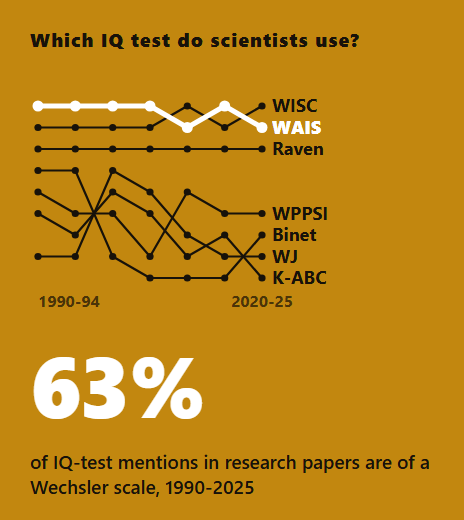
288 of 447 records (64%) name a standard test, 129 of them a Wechsler scale and 73 Raven’s Progressive Matrices, then Woodcock-Johnson (53), NIH Toolbox cognition (24) and Kaufman tests (19) [1] [3]. 159 records say only “IQ”, “intelligence” or “cognitive ability”, so a search for a particular test finds fewer datasets than one for the construct. Which tests dominate the published papers, rather than the datasets, is counted in our study of the most used IQ tests.
Wechsler scales are named in 129 records and Raven's matrices in 73; 159 datasets name no standard test
On-topic datasets whose record names each family of tests (a dataset can name several, so the bars overlap: 331 mentions in 288 datasets). 159 datasets (36%) say only "intelligence", "IQ" or "cognitive ability". Names are our reading of titles, subjects and abstracts. IQ Metrics coding. As of 18 November 2026.
Source: DataCite and OpenNeuro records [1] [3]; IQ Metrics coding
Data table
| label | value |
|---|---|
| Wechsler scales | 129 |
| Raven's matrices | 73 |
| Woodcock-Johnson | 53 |
| NIH Toolbox | 24 |
| Kaufman tests | 19 |
| Stanford-Binet | 9 |
| Leiter | 9 |
| ICAR | 7 |
| Other named test | 4 |
| Cattell Culture Fair | 3 |
| CogAT | 1 |
| No standard test named | 159 |
Embed this chart
Paste this HTML into your page: it carries the numbers and the credit link to this figure.
The test families also split by what the files hold. Wechsler records are mostly cohorts (51 of 129) and imaging datasets (28); Raven’s records spread across cohorts (24), score files (21) and batteries (16); NIH Toolbox cognition records split between imaging (9) and cohorts (9). Genetic datasets rarely name a test: the fluid-intelligence scores behind them are recorded as a variable. The figure counts datasets, not people or papers. What brain-imaging data with such scores can and cannot show is the subject of our study can a brain scan show your IQ.
Wechsler records lean to cohorts (51) and imaging (28); Raven's records spread across cohorts, score files and batteries
On-topic datasets by test family (rows) and type of data (columns); counts, printed in each cell. A dataset that names two families is in two rows; datasets naming no test are not shown (159). Types are our coding of what the record says the files hold. IQ Metrics coding. As of 18 November 2026.
Source: DataCite and OpenNeuro records [1] [3]; IQ Metrics coding
Data table
| test family | IQ or ability-test scores | Cognitive-task battery | Brain imaging with scores | Genetic data | Cohort or survey with a test | Compiled study-level data |
|---|---|---|---|---|---|---|
| Wechsler scales | 19 | 23 | 28 | 6 | 51 | 2 |
| Raven's matrices | 21 | 16 | 9 | 2 | 24 | 1 |
| Woodcock-Johnson | 12 | 1 | 6 | 0 | 31 | 3 |
| NIH Toolbox | 3 | 3 | 9 | 0 | 9 | 0 |
| Kaufman tests | 5 | 0 | 6 | 0 | 8 | 0 |
| Stanford-Binet | 1 | 0 | 0 | 0 | 6 | 2 |
| Leiter | 0 | 0 | 0 | 0 | 9 | 0 |
| ICAR | 5 | 0 | 0 | 0 | 2 | 0 |
| Other named test | 0 | 0 | 0 | 1 | 3 | 0 |
| Cattell Culture Fair | 1 | 1 | 0 | 0 | 1 | 0 |
| CogAT | 0 | 0 | 0 | 0 | 1 | 0 |
Embed this chart
Paste this HTML into your page: it carries the numbers and the credit link to this figure.
Item-level data show up mainly with open item banks, such as the ICAR data of 97,000 people [8] and an eye-tracking study of a culture-fair test taken by 315 people [11]. We did not code score files against item files, so we cannot count them. A compiled example is the Mendeley Data file behind a meta-analysis of Progressive Matrices samples, 1950-2014 [7]; what those scores mean over time is explained in our piece on why IQ norms expire.
08 How many people are in IQ datasets? How big are the samples?
231 of 447 records (52%) print a participant number; the median is 254, the middle half runs from 72 to 1,249, and the range is 8 to 1,020,195 [1]. 69 state fewer than 100 people and 64 state 1,000 or more. We never add the numbers up: the same cohort appears in several waves, versions and repositories.
231 records state how many people; the middle is 254, and 69 state fewer than 100
Datasets whose record states a participant number (231 of 447, 52%), by the number stated. Median 254, middle half 72 to 1,249, from 8 to 1,020,195. The number is the first sample size the record prints; it is not summed, because versions, waves and repositories overlap. IQ Metrics coding. As of 18 November 2026.
Source: DataCite and OpenNeuro records [1] [3]; IQ Metrics coding
Data table
| label | value |
|---|---|
| 5 to 49 | 40 |
| 50 to 99 | 29 |
| 100 to 499 | 67 |
| 500 to 999 | 31 |
| 1,000 to 9,999 | 56 |
| 10,000 or more | 8 |
Embed this chart
Paste this HTML into your page: it carries the numbers and the credit link to this figure.
Stated samples have not grown with the number of datasets: the median is 1,065 for the 47 datasets first published up to 2014 and 215 for the 135 published since 2021, because newer deposits are more often single experiments. The largest are item banks, a dating-site survey and several deposits that draw on the US Adolescent Brain Cognitive Development study at the NIMH Data Archive; small samples sit in single-experiment deposits [1].
Sample sizes stated in the records run from 8 people to over a million; the median fell from 1,065 before 2015 to 215 since 2021
Each dot is one dataset that states a participant number (231): year first published (across) against people stated (up, log scale), coloured by type of data. A link is not a cause: large samples come from cohorts and online item banks, small ones from single experiments. IQ Metrics coding. As of 18 November 2026.
People stated in the record (log scale)
Year first published
Source: DataCite and OpenNeuro records [1] [3]; IQ Metrics coding
Data table
| dataset | year | people | group |
|---|---|---|---|
| 6- and 12-month test-retest score reliability and p… [share.35003721] | 2026 | 29 | battery |
| A Three-Wave Longitudinal Dataset of Reading-Relate… [db.psych.01150] | 2026 | 94 | cohort |
| Analysis of selected cognitive abilities and temper… [145/akf/pjz3ce] | 2026 | 67 | scores |
| Cognitive profile, autistic traits, visual percepti… [share.34914618] | 2026 | 24 | battery |
| Comparison of WISC-V and WAIS-IV IQ Scores Data [a.ncl.33132161] | 2026 | 11 | scores |
| Data and Code for: Cognitive Ability and Perceived… [0.3886/e239101] | 2026 | 918 | cohort |
| Dataset and statistics [share.32760174] | 2026 | 55 | scores |
| Effort Project. Parent experimental data and associ… [0.21950/68ctb1] | 2026 | 806 | cohort |
| Housing and Children's Healthy Development Study (H… [886/icpsr39274] | 2026 | 2396 | cohort |
| Housing and Children's Healthy Development Study (H… [886/icpsr39275] | 2026 | 2328 | cohort |
| Improving Literacy Instruction for Adults: Reading… [886/icpsr34887] | 2026 | 13 | scores |
| Longitudinal Relationship between Internalizing and… [db.psych.01022] | 2026 | 500 | cohort |
| Multimodal Czech online handwriting and cognitive d… [enodo.18299326] | 2026 | 161 | battery |
| Neurocognitive mechanisms underlying interindividua… [ata.hnme25ne29] | 2026 | 215 | battery |
| Neurocognitive mechanisms underlying interindividua… [ata.hnme25ne01] | 2026 | 215 | imaging |
| Neurocognitive mechanisms underlying interindividua… [ata.hnme25ne06] | 2026 | 215 | imaging |
| Neurocognitive mechanisms underlying interindividua… [ata.hnme25ne02] | 2026 | 215 | imaging |
| OSU RRTC NIDILRR Study 1b – Can You Hear Me Now? Li… [0.3886/e186781] | 2026 | 50 | cohort |
| OSU RRTC NIDILRR Study 2 Prevalence – Can You Hear… [0.3886/e238063] | 2026 | 500 | cohort |
| Raw Data from a Randomized Controlled Trial of Conc… [632/t6gv8cbc4c] | 2026 | 50 | scores |
| Reduced Threat-Related Neural Efficiency: A Possibl… [s006303.v1.1.2] | 2026 | 206 | imaging |
| SMART Study of Medication and Cognitive Behavioral… [886/icpsr39702] | 2026 | 272 | cohort |
| Support data for "Responsiveness to phonological in… [2/hku.32953021] | 2026 | 84 | cohort |
| The predictive role of executive function and verba… [share.33256125] | 2026 | 110 | battery |
| Aberrant Neural Entrainment to Word-Level Speech Pa… [enodo.17435553] | 2025 | 17 | imaging |
| An examination of the psychometric properties of a… [3/sun.27929394] | 2025 | 219 | scores |
| Cognitive vulnerabilities in adolescents with suici… [enodo.15673493] | 2025 | 261 | battery |
| Dataset and Statistics [share.29910839] | 2025 | 53 | battery |
| DNA methylation associations with cognitive functio… [share.29843352] | 2025 | 109 | genetic |
| Effect of Non-dominant Hand Function Optimization t… [632/dnjvwtvhpp] | 2025 | 24 | scores |
| Follow-up infant learning progress project [4973/31ee-x555] | 2025 | 60 | cohort |
| Heart rate variability biofeedback training and emo… [s003823.v1.3.5] | 2025 | 193 | imaging |
| Integrated Dataset on the Screening and Cognitive A… [enodo.17686325] | 2025 | 1366 | cohort |
| Metadata fom "Early Cochlear Implantation Supports… [share.29488553] | 2025 | 43 | cohort |
| Organizational Skills Training [s006905.v1.1.0] | 2025 | 30 | imaging |
| Perception of vowel sounds in children with autism… [s005234.v2.2.0] | 2025 | 35 | imaging |
| PGAE-ICA: A simplified digital system for intellect… [632/fpxkskt86z] | 2025 | 103 | battery |
| Replication data for: Air pollution exposure during… [34810/data2663] | 2025 | 5170 | cohort |
| Replication Data for: The Role of Intelligence, the… [34810/data2275] | 2025 | 786 | cohort |
| Replication Data for: Which Profile of People Tends… [34810/data2276] | 2025 | 404 | cohort |
| The Dallas Lifespan Brain Study [s004856.v1.3.0] | 2025 | 315 | imaging |
| The NIMH Healthy Research Volunteer Dataset [s005752.v2.1.0] | 2025 | 15 | imaging |
| UK C-BiLLT: UK Computer-Based instrument for Low mo… [a.ncl.27194901] | 2025 | 424 | scores |
| Alteration of fractional anisotropy in preterm-born… [share.26235540] | 2024 | 650 | compilation |
| Cognitive impairment after stroke in young adults [4973/r4t5-3d49] | 2024 | 23 | imaging |
| Data and Scripts for 'A Predictive Model for Attent… [share.27886836] | 2024 | 316 | genetic |
| Data and Scripts for 'Application of Multidimension… [share.27999089] | 2024 | 316 | genetic |
| Double-Blind 2-Site Randomized Clinical Trial of Ne… [98003v1-150021] | 2024 | 58 | imaging |
| Early Steps Multisite Study (Age 8), Pittsburgh, Pe… [886/icpsr38752] | 2024 | 731 | scores |
| Early Steps Multisite Study (Condition Files), Pitt… [886/icpsr38755] | 2024 | 731 | scores |
| EEG power spectrum and Intelligence of Children wit… [632/t6xw4sdfdc] | 2024 | 45 | imaging |
| Emotion and Development Branch Phenotyping and DTI… [s004605.v1.0.1] | 2024 | 126 | imaging |
| Health-related quality of life and cognitive functi… [share.25196428] | 2024 | 11 | cohort |
| Linguistic and Cognitive abilities in Children with… [share.27647529] | 2024 | 120 | battery |
| PGAE-ICA: A simplified digital system for intellect… [1227/negv-4h04] | 2024 | 103 | battery |
| Pre-test and post-test dataset of working memory in… [share.27141603] | 2024 | 40 | battery |
| Quantifying Language Experience in Bilingual and Tr… [ukda-sn-856987] | 2024 | 299 | battery |
| Screening for intellectual disabilities and borderl… [4973/m2sc-xk45] | 2024 | 625 | scores |
| Urine metabolomic profiles of autism and autistic t… [8723/6821-pn89] | 2024 | 105 | genetic |
| Wechsler Adult Intelligence Scale (WAIS) [0641/69p3-h691] | 2024 | 2700 | cohort |
| Wechsler Intelligence Scale for Children (WISC) [0641/a8ky-2547] | 2024 | 800 | cohort |
| Wechsler Intelligence Scale for Children (WISC) [0641/jrxt-jx66] | 2024 | 500 | cohort |
| Wechsler Intelligence Scale for Children (WISC-R) [0641/wvcv-3810] | 2024 | 2700 | cohort |
| Wechsler Intelligence Scale for Children (WISC-V) [0641/1yq7-sm25] | 2024 | 2700 | cohort |
| Wechsler Preschool and Primary Scale of Intelligenc… [0641/mdee-q823] | 2024 | 500 | cohort |
| A pragmatic randomized maternal education trial in… [ryad.n8pk0p31r] | 2023 | 263 | cohort |
| Associations between socioeconomic status and white… [.15154/1528516] | 2023 | 8842 | imaging |
| Caffeine intake and cognitive functions in children [.15154/1519021] | 2023 | 11718 | cohort |
| Characteristics of cognition impairment in patients… [share.22762579] | 2023 | 227 | battery |
| Cognition and Disabilities in incarcerated male you… [47341v1-146263] | 2023 | 110 | cohort |
| Cognitive ability & central auditory processing of… [/asha.22670473] | 2023 | 34 | cohort |
| Data for “Occupation shapes cognition? The case of… [632/wzyx3c4kfb] | 2023 | 53 | battery |
| database with pre- intervention data of children wi… [zenodo.7618343] | 2023 | 55 | scores |
| Dataset for The Relationship between Number Line Es… [25949/22757006] | 2023 | 347 | cohort |
| Dataset: Stunting and Its Association with Educatio… [zenodo.7553743] | 2023 | 4851 | cohort |
| DeGennaro_Children&Adolescents [share.21981644] | 2023 | 30 | battery |
| Docosahexaenoic Acid (DHA) for the Improvement of N… [8138/jxkc-7a04] | 2023 | 657 | cohort |
| Early Steps Multisite Study (Age 10), Pittsburgh, P… [886/icpsr38754] | 2023 | 731 | scores |
| Early Steps Multisite Study (Age 3), Pittsburgh, Pe… [886/icpsr38745] | 2023 | 731 | scores |
| Early Steps Multisite Study (Age 4), Pittsburgh, Pe… [886/icpsr38748] | 2023 | 731 | scores |
First 80 of 231 rows; the Data button gives all of them.
Embed this chart
Paste this HTML into your page: it carries the numbers and the credit link to this figure.
The ten largest stated samples are shown below. Records of item responses count people who answered at least one item, so the largest number belongs to an item bank of rotation problems, not to a cohort that took a full test [8]. For how a full-scale score is built from subtests and why index scores differ, see full-scale IQ versus index scores; for the units, standard deviation 15 versus 16 and the IQ z-score.
The ten largest stated samples run from 1,020,195 to 8,842 people; the largest is an item bank, not a cohort
The ten datasets with the largest participant number printed in their record (people, as stated; "approximately" kept as printed). Records of item responses count people who answered at least one item; cohort records count children enrolled. Not summed, not ranked as better. IQ Metrics coding. As of 18 November 2026.
Source: DataCite records [1]; IQ Metrics coding
Data table
| label | value |
|---|---|
| Reproducibility Data: Two-Dimensional Rotatio… (2023) | 1020195 |
| Selected ICAR data from the SAPA-Project: Dev… (2015) | 97000 |
| OKCupid Datasets (2021) | 68371 |
| Assessing the Texas Christian University Drug… (2003) | 18364 |
| Associations of Family Distress, Family Incom… (2022) | 11878 |
| M145: Structural and Resting State Neural Cor… (2020) | 11876 |
| Caffeine intake and cognitive functions in ch… (2023) | 11718 |
| National Comorbidity Survey: Adolescent Suppl… (2011) | 10000 |
| Effect of exposure to maternal diabetes durin… (2022) | 9963 |
| Associations between socioeconomic status and… (2023) | 8842 |
Embed this chart
Paste this HTML into your page: it carries the numbers and the credit link to this figure.
09 Which countries and which ages do IQ datasets cover?
Only 142 of 447 records (32%) name where people were recruited, in 24 countries, and 92 of those name the United States, then Germany (8), Brazil (7), the United Kingdom (6) and Spain (5) [1]. 305 records name no country, so grey on the map means none named, not none exist. The map says where the records say data were collected; it is a count of datasets, not a comparison of countries, and it carries no national IQ numbers.
Only 142 of 447 records name a country, and 92 of those are the United States
Datasets whose record names the country where people were recruited or data were collected, 24 countries in all; the other 305 records name none (grey is none named, not none exist). Our reading of geographic fields and plain statements such as "collected in"; never the depositor's home country. A count of datasets, not a ranking of countries. IQ Metrics coding. As of 18 November 2026.
Source: DataCite and OpenNeuro records [1] [3]; IQ Metrics coding
Data table
| country | iso2 | value |
|---|---|---|
| United States | US | 92 |
| Germany | DE | 8 |
| Brazil | BR | 7 |
| United Kingdom | GB | 6 |
| Spain | ES | 5 |
| Netherlands | NL | 4 |
| Sweden | SE | 4 |
| France | FR | 2 |
| Ecuador | EC | 2 |
| China | CN | 2 |
| Italy | IT | 2 |
| Tanzania | TZ | 2 |
| Switzerland | CH | 1 |
| Peru | PE | 1 |
| Kenya | KE | 1 |
| Bangladesh | BD | 1 |
| Denmark | DK | 1 |
| Iceland | IS | 1 |
| Czechia | CZ | 1 |
| Indonesia | ID | 1 |
| Pakistan | PK | 1 |
| Australia | AU | 1 |
| Mexico | MX | 1 |
| Cuba | CU | 1 |
Embed this chart
Paste this HTML into your page: it carries the numbers and the credit link to this figure.
By age, 115 datasets name only children, 77 only adults, 157 both and 98 no age. Score files lean to children (for the tests used with them see IQ testing for children), imaging and genetic data slightly to adults. Cohort studies that follow families over years cover both. How stable a childhood score is over time is the subject of high-scoring children at age 7.
Children outnumber adults in score files (35 to 16); adults edge ahead in imaging (20 to 14) and genetic data (5 to 4)
On-topic datasets whose record names only children (left) or only adults (right), by type of data. 157 datasets name both and 98 state no age; they are not drawn. Children = under 18 including adolescents. IQ Metrics coding. As of 18 November 2026.
Source: DataCite and OpenNeuro records [1] [3]; IQ Metrics coding
Data table
| type | Children only | Adults only |
|---|---|---|
| Scores | 35 | 16 |
| Battery | 20 | 18 |
| Imaging | 14 | 20 |
| Genetic | 4 | 5 |
| Cohort | 42 | 17 |
| Compiled | 0 | 1 |
Embed this chart
Paste this HTML into your page: it carries the numbers and the credit link to this figure.
Cohorts and surveys mostly cover children and adults together (93 of 170); 43 of 125 score files state no age
On-topic datasets by type of data (rows) and age group the record names (columns); counts, printed in each cell. "Unstated" means the record says nothing about age, not that the people were of any age. IQ Metrics coding. As of 18 November 2026.
Source: DataCite and OpenNeuro records [1] [3]; IQ Metrics coding
Data table
| type of data | Children | Adults | Both | Not stated |
|---|---|---|---|---|
| IQ or ability-test scores | 35 | 16 | 31 | 43 |
| Cognitive-task battery | 20 | 18 | 13 | 14 |
| Brain imaging with scores | 14 | 20 | 13 | 11 |
| Genetic data | 4 | 5 | 2 | 9 |
| Cohort or survey with a test | 42 | 17 | 93 | 18 |
| Compiled study-level data | 0 | 1 | 5 | 3 |
Embed this chart
Paste this HTML into your page: it carries the numbers and the credit link to this figure.
197 of 447 records (44%) name a related paper, which is where the method and the test version are described; the rest need a search for the authors. Twin and family cohorts, which underlie the heritability estimates in twin studies of IQ, are not a separate type in our coding: a twin study with an ability test is a cohort here.
10 How fast is the number of IQ datasets growing?
207 datasets were first published in 2021-2025 against 26 in 2011-2015, 8.0 times as many, and 56 appeared in 2026 so far; 45 are older than 2010, mostly archive studies deposited decades after collection [1]. All dataset records in DataCite rose 21 times over the same windows, mostly through bulk deposits, so intelligence datasets became a smaller share of the whole while growing in number. The year is the first publication of any DOI in a version group.
207 datasets were first published in 2021-2025 against 26 in 2011-2015, 8.0 times as many
On-topic datasets by year of first publication (earliest DOI of a version group), by type of data; 45 appeared before 2010 and 2026 is open until 18 November 2026. All dataset records in DataCite rose 21 times over the same two windows, mostly through bulk deposits, so the intelligence share of DataCite fell. IQ Metrics count. As of 18 November 2026.
Source: DataCite API [1]; OpenNeuro API [3]; IQ Metrics count
Data table
| year of first publication | IQ or ability-test scores | Cognitive-task battery | Brain imaging with scores | Genetic data | Cohort or survey with a test | Compiled study-level data | total |
|---|---|---|---|---|---|---|---|
| before 2010 | 14 | 2 | 0 | 0 | 29 | 0 | 45 |
| 2010 | 1 | 0 | 0 | 0 | 4 | 1 | 6 |
| 2011 | 0 | 0 | 0 | 0 | 4 | 0 | 4 |
| 2012 | 0 | 0 | 0 | 0 | 1 | 0 | 1 |
| 2013 | 1 | 0 | 1 | 0 | 4 | 0 | 6 |
| 2014 | 1 | 0 | 0 | 0 | 5 | 0 | 6 |
| 2015 | 2 | 1 | 0 | 1 | 4 | 1 | 9 |
| 2016 | 3 | 1 | 1 | 0 | 4 | 1 | 10 |
| 2017 | 6 | 3 | 0 | 0 | 7 | 0 | 16 |
| 2018 | 12 | 4 | 3 | 1 | 3 | 0 | 23 |
| 2019 | 9 | 6 | 0 | 3 | 19 | 1 | 38 |
| 2020 | 5 | 6 | 3 | 1 | 5 | 0 | 20 |
| 2021 | 13 | 5 | 5 | 2 | 12 | 0 | 37 |
| 2022 | 9 | 7 | 7 | 4 | 4 | 2 | 33 |
| 2023 | 16 | 9 | 5 | 2 | 16 | 1 | 49 |
| 2024 | 9 | 5 | 11 | 4 | 15 | 1 | 45 |
| 2025 | 10 | 6 | 10 | 1 | 16 | 0 | 43 |
| 2026 (to Nov) | 14 | 10 | 12 | 1 | 18 | 1 | 56 |
Embed this chart
Paste this HTML into your page: it carries the numbers and the credit link to this figure.
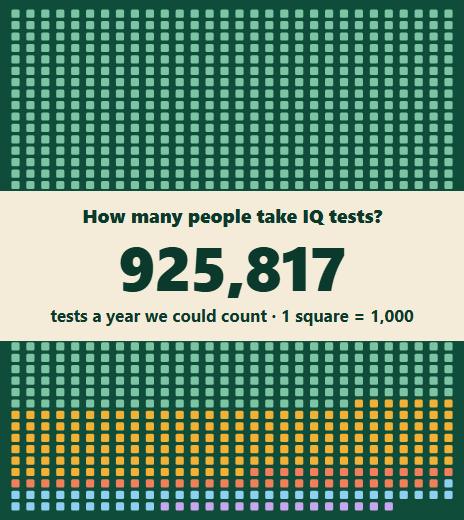
We cannot say from the records how much of the rise is more sharing and how much is better description: a record can only be found if it says what it holds. For the papers and the test-takers behind such data, see our studies of the most cited intelligence papers and of how many people take IQ tests.
11 How complete is this list? What did it miss?
It misses datasets the index cannot see. We checked two curated lists. The International Society for Intelligence Research lists seven entries on its “Data to test your ideas” page [5]: one is a repository, one a national IQ spreadsheet we leave out, and of the other five only the MIDUS cognition studies have DataCite dataset records that our queries found; for the four others, NLSY, ECLS, the Human Cognitive Abilities archive and MISTRA, none of our hits matched. The NIMH OpenCogData catalogue lists 795 cognitive-task datasets, and 8 of its entries name an intelligence or ability test; none of those 8 are in our list: five of the six OSF DOIs we looked up are typed Text in DataCite and one is not in DataCite at all [4]. So the recall against those curated lists is low, and it is low for a known reason: where the data live.
OpenNeuro is the one repository we read beyond DataCite. Its DOI records hold no README text, so the DataCite queries found none of its datasets; reading the READMEs of 1,949 public datasets through its API found 39 that mention an intelligence test or IQ, of which 25 say scores were collected (the others use IQ only as an inclusion rule or matched an unrelated word) and 23 remain after removing two copies already found [3]. Other repositories may hold the same kind of unseen records.
Findings built on such data have their own track record: see which famous brain findings held up and how many brain papers are retracted. Our check has limits too. The coding of type, age, country and participant number is automatic, and we read samples to test it: in 20 random rows the participant number was right in 19 (the 20th was a per-classroom figure, for which we added a rule) and the country matched the record in all 20. Rules and every manual decision are in the data pack, so a reader can reverse any one of them.
Using this in a class or thesis
The CSV (where-to-find-iq-datasets-2026-iqmetrics.csv, 447 rows, 17 columns, CC BY 4.0) lists each dataset with its DOI and what its record says about itself. Use it to find datasets and to cite where you found them. It cannot tell you whether a dataset is suitable, how the test was given, or whether the terms allow your use: open the landing page, read the terms and cite the dataset’s own DOI. Do not use the counts to compare countries or groups.
Curious how your own reasoning measures up?
This study lists where data are, not how smart anyone is. An IQ test is how reasoning is measured.
Take the IQ test12 How we built the dataset
Every number on the page comes from scripts in open-intelligence-datasets/data (analyse.py runs 150 checks; recount.py recounts the headline numbers from the public CSV alone), which read cached API responses, each logged with its date and sha256. Our general standards for sources, licences and numbers are on the methods page.
- 01
Definitions first
We wrote the definition of a dataset, of on topic, of open, and the list of reasons for leaving a record out before pulling any data (DEFINITIONS.md).
- 02
Seven DataCite queries
Keyword queries for IQ terms, Wechsler, Raven’s, fluid intelligence, other named tests, cognitive ability and general intelligence, filtered to resource type Dataset: 3,148 records. Creators’ names were removed at once.
- 03
Merge and code
Version DOIs were merged (1,931 datasets), then each record was coded by printed rules and an analyst audit of every record that names a test or says IQ, and of every other record whose title or text states a cognition test; 29 copies were removed.
- 04
Read a sample
A seeded random sample of 30 hits per query (204 records) was read and labelled by the analyst without seeing the rule’s decision, to measure precision per query.
- 05
OpenNeuro and the lists
OpenNeuro READMEs were read through its public API; OpenCogData and the ISIR page were checked as lead lists. No wording of any list was copied.
- 06
Landing pages
Each landing page got one automated request (status only); 351 answered, 1 was gone and 95 refused.
Read every number with these in mind
- 447 is a lower bound: it counts datasets that DataCite types as Dataset and OpenNeuro READMEs; it misses datasets elsewhere, other resource types (such as OSF projects) and records that do not say what they hold.
- Open means open as the record states; registered access and on request are separate. We read no data file and did not test any download.
- The coding of type, age, country and participant number comes from short record texts and can be wrong; 10 sampled on-topic records were missed by the first rules and fixed by hand.
- 40 records titled “Supplementary Material for” were left out as a paper’s supplements, even where the paper is about IQ.
- Counts by repository or country are counts of datasets found, not measures of quality, openness policy or research output.
- No national or group IQ numbers, no personal data and no dataset ranked as better. Not legal advice: read each record’s terms.
13 Is there an IQ dataset for my topic? Every dataset in one table
Every on-topic dataset we found (447 rows), newest first; click a header to sort. Empty cells mean the record does not say. The CSV (where-to-find-iq-datasets-2026-iqmetrics.csv) has the DOI, the phrase behind each participant number and which queries found the record. The left-out records are listed in the data pack.
Every on-topic dataset we found (447): repository, year, type, test named, people stated, access and licence, each linked by its DOI (as of 18 November 2026)
Source:
Sources
- DataCite. DataCite REST API (api.datacite.org/dois), public API, DOI records of resource type Dataset: titles, subjects, descriptions (used for coding only, never republished), publisher, client, publication year, rights, related identifiers, landing-page URL; seven keyword queries printed on the page; creators' names removed at once. 2026. support.datacite.org/docs/apiCC0. DataCite Data File Use Policy: "To the extent possible under law, DataCite e.V. has waived all copyright and related or neighboring rights to DataCite Data File. The DataCite Data File includes all DOIs and deposited metadata in our database." (https://support.datacite.org/docs/datacite-data-file-use-policy); harvesting page: "All DataCite metadata is openly available with a CC0 license" (https://support.datacite.org/docs/harvesting-datacite-doi-metadata). The waiver does not cover the datasets the records point to.
- DataCite. DataCite Data File Use Policy (the CC0 waiver for DOI metadata). 2026. support.datacite.org/docs/datacite-data-file-use-policyPage text read for the waiver wording quoted above; metadata CC0
- OpenNeuro. OpenNeuro GraphQL API (openneuro.org/crn/graphql): 1,949 public datasets, name, licence line and README text, read in 100-dataset pages; 7 edges came back without a node and were skipped. 2026. openneuro.orgPer dataset (the licence line in each dataset description). OpenNeuro FAQ: "When OpenNeuro first began accepting data, we hosted datasets that were dedicated to the public domain (CC0 or PDDL) or released under the CC-BY license." (https://docs.openneuro.org/faq). README text is read for coding and never republished.
- NIMH Data Science and Sharing Team (DSST). OpenCogData, a database of publicly available cognitive task datasets (795 entries; repository copy of 7 March 2024, MIT licence); used as a lead list and recall check only, no wording copied. 2024. nimh-dsst.github.io/OpenCogData/aboutMIT License (GitHub repository nimh-dsst/OpenCogData). Scope on its about page: "The scope of this project is to catalogue all open datasets involving cognitive tasks (e.g., Stroop, delay discounting, 2-arm bandits)."
- International Society for Intelligence Research (ISIR). "Data to test your ideas", International Society for Intelligence Research (seven entries); a lead list and recall check only, no wording copied. 2026. isironline.org/resources/collaboration-and-data-sharingPage text not reused; entry names are facts (an organisation's list of resources)
- IQ Metrics Research. IQ Metrics precision sample: 7 seeded random draws of 30 raw hits (one per query; 204 distinct records), each read by the analyst and labelled on topic or not (data/precision_labels.json). 2026. iqmetrics.org/research/where-to-find-iq-datasetsCC BY 4.0
- Mendeley Data. Datasets for Coloured, Standard, and Advanced Progressive Matrices (CPM, SPM, and APM) over 65 years (1950-2014), Mendeley Data (an example of a compilation dataset on the list). 2019. doi.org/10.17632/9jkchm9tnwLicence as stated on the dataset's own record (we count the record's rights field only)
- Harvard Dataverse. Selected ICAR data from the SAPA-Project: Development and initial validation of a public-domain measure (Harvard Dataverse; an example of an open item-response dataset). 2015. doi.org/10.7910/DVN/AD9RVYAs stated on the dataset's own record
- ICPSR. Project on Human Development in Chicago Neighborhoods (PHDCN): Wechsler Intelligence Scale for Children-Revised (ICPSR 13604; an example of a single-test dataset in a social-science archive). 2006. doi.org/10.3886/ICPSR13604ICPSR terms of use on the study page
- ICPSR. Terman Life-Cycle Study of Children with High Ability, United States, 1922-1991 (ICPSR 8092; an example of an old cohort in the list). 1984. doi.org/10.3886/ICPSR08092ICPSR terms of use on the study page
- Harvard Dataverse. TüEyeQ, a rich IQ test performance data set with eye movement, educational and socio-demographic information (Harvard Dataverse record; an example of item-level IQ-test data). 2020. doi.org/10.7910/DVN/JGOCKIAs stated on the dataset's own record
Version history
- 2026.1118 November 2026First release: DataCite and OpenNeuro read 18 November 2026. Next update in mid-February 2027 for Love Data Week, when OSF-typed records, other repositories and the supplementary files left out are re-examined.
Leon Falkner, Data & Research Analyst. Leon owns the arithmetic on IQ Metrics: the percentile tables, the score converter and the figures in everyone else's drafts. On the research desk Leon pulls the data, builds each index and writes the method. More about Leon.
Questions
Where can I find IQ datasets?
In research repositories: IQ Metrics Research found 447 datasets with intelligence or cognitive-ability test scores in DataCite and OpenNeuro (18 November 2026), most at ICPSR (98) and figshare (94). Our table links each by DOI; 230 state open access.
Is there an open dataset of IQ scores?
Yes: 230 of the 447 datasets we found are open to download as their records state, 68 of them under CC0 or public domain. Check the landing page terms before you use any, because a licence on a record is the depositor's claim.
Where can I find Wechsler (WAIS or WISC) data?
129 of the 447 records name a Wechsler scale, from ICPSR cohorts such as the Chicago neighbourhoods project to OpenNeuro brain-imaging datasets. Our table links each by DOI; check the record for scale scores or item responses.
Where can I find Raven's Progressive Matrices data?
73 records name Raven's matrices, among them a Mendeley Data file behind a meta-analysis of samples from 1950 to 2014 and several experiments with raw scores. Our CSV lists each with its repository and licence.
How many IQ datasets are there?
At least 447: IQ Metrics Research found 447 datasets in DataCite and OpenNeuro after checking 3,148 keyword hits. A sample read by us puts the on-topic hits near 736 records (95% interval 556 to 927). Datasets elsewhere are not counted.
Do IQ datasets include children?
Many do: 115 of the 447 name only children, 77 only adults and 157 both; 98 state no age. Children's data are mostly cohorts and score files from schools and clinics.
How big are open intelligence datasets?
231 of the 447 records state a number of people: the median is 254, the middle half 72 to 1,249, the largest 1,020,195 (an item bank). Most are small experiments; the numbers are never added.
Can I use these datasets for a thesis?
Often, but read each record's terms first: 230 of 447 are open to download, 46 need registration, 5 are on request. Cite the dataset's own DOI. This page is a finding aid, not legal advice and not a judgement of any dataset.
Why are national IQ datasets not included?
We left out 8 national or group IQ compilations: after the 2020 statement of the European Human Behaviour and Evolution Association, this study neither reproduces nor ranks such numbers. Individual-level test scores from named tests are listed instead.
Which datasets are missing from this list?
Any not typed as Dataset in DataCite: Open Science Framework projects (75 match our IQ terms, 1 typed Dataset), datasets on repositories without DOIs, and datasets whose records do not say what they hold. We found none of the 8 OpenCogData intelligence entries.
Share it, cite it, download it
You may reuse everything on this page under CC BY 4.0: in articles, reports, lessons and posts. The one condition is credit to IQ Metrics with a link to this page.
Cite this study
Version 2026.11. Citing the version lets readers find the exact numbers.
Archived copy with a DOI: 10.5281/zenodo.24331113 (report PDF and data on Zenodo).
Falkner, L. (2026). Where to Find IQ and Intelligence Data: 447 datasets found, 230 open (Version 2026.11) [Data set]. IQ Metrics Research. https://iqmetrics.org/research/where-to-find-iq-datasets/ (DOI: 10.5281/zenodo.24331113)
Falkner, Leon. "Where to Find IQ and Intelligence Data: 447 datasets found, 230 open." IQ Metrics Research, 18 Nov. 2026, iqmetrics.org/research/where-to-find-iq-datasets/. DOI: 10.5281/zenodo.24331113.
Falkner, Leon. "Where to Find IQ and Intelligence Data: 447 datasets found, 230 open." IQ Metrics Research. November 18, 2026. https://iqmetrics.org/research/where-to-find-iq-datasets/. DOI: 10.5281/zenodo.24331113.
@misc{iqmetrics2026wheretofindiqdatasets, author = {Falkner, Leon}, title = {Where to Find IQ and Intelligence Data: 447 datasets found, 230 open}, institution = {IQ Metrics}, year = {2026}, version = {2026.11}, doi = {10.5281/zenodo.24331113}, url = {https://iqmetrics.org/research/where-to-find-iq-datasets/} }
Source: Leon Falkner, "Where to Find IQ and Intelligence Data: 447 datasets found, 230 open." IQ Metrics Research, version 2026.11, https://iqmetrics.org/research/where-to-find-iq-datasets/ (DOI 10.5281/zenodo.24331113)
Get the data
One row per on-topic dataset (447 rows; version DOIs and copies merged). Repository records read 18 November 2026. Titles, DOIs, years, licence and rights are the records’ own; type, test named, age group, participants, country and access are IQ Metrics coding of the record text, audited on samples. No description text, no creators’ names. Rules: open-intelligence-datasets/data/DEFINITIONS.md.
| Column | What it holds |
|---|---|
doi, link | The dataset's DOI (empty only where the repository gives none) and the link to its DOI or landing page |
title | Title as the record gives it, tags and entities removed |
repository | The DataCite client (repository) or OpenNeuro |
year_first_published | Earliest publication year of any DOI in the dataset's version group |
type | Our coding: scores, battery, imaging, genetic, cohort or compilation |
instruments_named | Test families the record names (fixed list; semicolon separated; empty = none named) |
age_group | children, adults, both or unstated (our reading of the record) |
participants_stated, participants_phrase | The first participant number the record prints, and the few words around it |
countries_named | Countries the record names as where people were recruited or data collected (empty = none named) |
access | open, registered, on request, restricted or closed, or not stated (the record's claim) |
licence | Licence class from the record's rights field |
related_paper_in_record | yes if the record names a related paper |
landing_page_check | live (2xx or 3xx), dead (404 or 410), unchecked (refused or errored) |
found_by | Which queries found the record |
doi_versions_merged | Number of DOI records merged into the row |
For journalists, researchers and teachers
Everything on this page may be quoted, charted and republished with credit. No embargo, no permission needed, no sign-up. If you need a number that is not here, ask.
Summary you can paste
Plain news style. Edit freely; keep the credit.
IQ Metrics Research built a one-row-per-dataset table of research data on intelligence and cognitive-ability tests from DataCite and OpenNeuro records: 447 datasets, 230 open to download as their records state, 288 naming a standard test and 231 stating how many people, as of 18 November 2026, a lower bound. 3,148 keyword hits were narrowed by a check and a sample read by hand. Source: IQ Metrics Research, https://iqmetrics.org/research/where-to-find-iq-datasets/
Angles for a story
- Nobody counts the open intelligence datasets. The lists researchers cite are short hand-made pages; our table finds 447 with DOIs, years, licences and access.
- Keyword search misleads. 3,148 hits became 447 datasets; “general intelligence” hits were on topic in 2 of 30 samples.
- Open is patchy. 230 of 447 state open access; 144 name no licence; 86 of ICPSR’s 98 state no terms in the DOI record.
- Love Data Week hook. How open is intelligence research data? 51% of the datasets we found; 288 name the test.
- What search cannot see. The Open Science Framework registers projects as text, so 75 matching records hide from a dataset search.
Quotes you can use
Attributable as written, with the name and title. For a different angle or a quote on a specific figure, ask through the contact page.
We could not find a count of open intelligence datasets, so we built one: 447 found, and a lower bound, because the biggest open deposit service does not tag its projects as datasets.
Leon Falkner, Data & Research Analyst, IQ Metrics ResearchKeyword search overstates it by a factor of seven: 3,148 hits, 447 datasets. The general-intelligence search was right in 2 of 30 samples.
Leon Falkner, Data & Research Analyst, IQ Metrics ResearchOpen is a claim on a record, not a test. 144 of our 447 records state no licence at all, so read the landing page before you build on a dataset.
Leon Falkner, Data & Research Analyst, IQ Metrics Research
Files
- CSV of every dataset in our table: DOI, link, title, repository, year, type, tests named, age group, people stated, countries named, access, licence, related paper, landing-page check (CC BY 4.0)
- Every figure as a print-ready PNG: use the Image button under each figure
- Embed code and data table under every figure
- Share images for social media in three sizes, with the credit line built in
- Citations in APA, MLA, Chicago, BibTeX and plain text
- Also in the data pack: the left-out candidates with the reason for each, the precision sample with our labels, and the coding rules, shared on request through the contact page
Terms, contact and corrections
Licence and credit: CC BY 4.0. Credit “IQ Metrics Research, Where to find IQ and intelligence data (2026)” with a link to this page. On air or in print, “IQ Metrics” and the page address are enough.
What it covers: Repository records are cited for facts (a title, a DOI, a year, a licence name); no description text or data file is copied. No personal data, no ranking of datasets, repositories or countries, no national or group IQ numbers, no legal advice.
Contact: the research team, through the contact page. Corrections are made on this page with a dated note in the version history.