





What Does an IQ of 200 Mean? Is It Possible?
An IQ of 200 is 6.67 standard deviations above average, about 1 in 76 billion, and no adult test can measure it. See why a child's ratio IQ of 200 is possible, how test ceilings stop it by about age 11, what Terman and Cox found near that line and where the famous 200s come from.

An IQ of 200 is 6.67 standard deviations above the average of 100 on the standard Wechsler scale, a score that about 1 person in 76 billion would reach, so the bell curve predicts roughly 0.1 of a person among the 8.2 billion alive today and about 1.5 among the roughly 117 billion humans ever born. No adult test can print it as a measured rank, and nobody has been shown to have scored it. The 200s that do appear come from three places: a young child’s ratio IQ (mental age divided by age), a score on a wide-spread scale or a high-range test, and retrospective estimates for people who died long before testing existed. This guide covers the arithmetic of 200 on each scale, why a child’s 200 is possible but an adult’s is not, what Lewis Terman’s gifted children and Catharine Cox’s historical geniuses show near that line, and how to read a claim of 200 when you meet one.
- Rarity: 1 in 76 billion on a standard deviation (SD) 15 scale, 1 in 4.9 billion on SD 16 and 1 in 64,700 on Cattell’s SD 24, where a printed 200 matches a Wechsler 162.
- Ceiling: the WAIS-IV and Stanford-Binet 5 stop near 160. Pearson’s WISC-V extended norms reach 210, for children only.
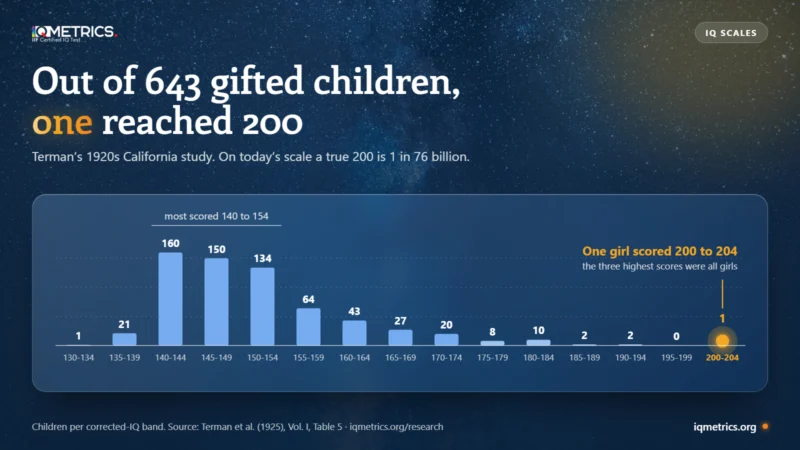
- The one 200 in the record: among 643 gifted California children in Terman’s main group, one girl scored 200 to 204 on a corrected ratio IQ, and the three highest scores were all girls’.
- Possible? As a young child’s ratio IQ, yes. As a certified rank among adults, no.
How rare is an IQ of 200?
On a normal curve with a mean of 100 and a standard deviation of 15, a score of 200 sits at z = +6.67. The share of people at or above it is about 0.0000000013%, or 1 in 76 billion. That is more than nine times the number of people alive, so the curve expects about a tenth of a person at 200 today. At this distance the bell curve is a model, not a measurement: a standardisation sample of 3,000 people holds about 0.00000004 of a person at 200 or above, which is why every norm table stops long before it (see the IQ bell curve and the IQ ceiling effect). The IQ percentile calculator places any score on the curve.
| Scale | Standard deviation | z score for 200 | A score of 200 is about | Wechsler score with the same rarity | People alive (of 8.2 billion) |
|---|---|---|---|---|---|
| Wechsler tests, Stanford-Binet 5 | 15 | 6.67 | 1 in 76.4 billion | 200 | 0.1 |
| Stanford-Binet Form L-M (older edition) | 16 | 6.25 | 1 in 4.9 billion | 194 | 2 |
| Cattell scales | 24 | 4.17 | 1 in 64,700 | 162 | 127,000 |
So a Cattell 200 is roughly a 162 on the Wechsler scale and an L-M 200 is roughly a 194. That is one reason 200 turns up in older and high-range literature: it was quoted on a wide scale or as a child’s ratio score. Standard deviation 15 versus 16 covers the mechanics, and the IQ score converter moves a score between scales. Even counting every human who has ever lived, the SD 15 curve implies 1.5 people and the SD 16 curve about 24. That is arithmetic, not evidence: nobody could confirm one of them, and our guides to an IQ of 180 and an IQ of 170 show the same limit one rung down.
Is an IQ of 200 possible?
It depends on what is meant by IQ. Three different things carry the same number, and only one of them is a rank.
- As a rank among adults (a deviation IQ). Not measurable. The main adult tests cap their Full Scale IQ near 160, and a norm sample of a few thousand cannot contain anyone this rare, so a printed 200 would be an extrapolation.
- As a young child’s ratio IQ. Yes, arithmetically. Under the original formula a child with a mental age twice their real age scores 200. Such children are real but very rare: Leta Hollingworth found only twelve above 180 in 23 years of searching New York schools, as the IQ of 180 guide reports.
- As a number a test prints. Yes. Pearson’s WISC-V extended norms list composite scores up to 210 for children, and an unsupervised online quiz or a high-range test can print any number it likes. A printed score is not the same as a certified one.
So the honest answer is that 200 is possible as a number and as a young child’s ratio score, and unproven as a rank. Nobody has produced a test record showing an adult 200 against a normed sample.
The ratio IQ route: what a child needs for 200
The first IQ formula, used by the 1916 Stanford-Binet, was mental age divided by chronological age, multiplied by 100 (see deviation IQ versus ratio IQ and IQ and mental age). A 200 therefore means a mental age of exactly twice the real age. The table shows what that demands.
| Real age | Mental age needed | What the child must pass |
|---|---|---|
| 4 years | 8 years | Items an average 8-year-old can pass |
| 5 years | 10 years | Items an average 10-year-old can pass |
| 6 years | 12 years | Items an average 12-year-old can pass |
| 7 years | 14 years | Items an average 14-year-old can pass |
| 8 years | 16 years | Items written for a 16-year-old, close to adult level |
| 9 years | 18 years | Adult-level items |
| 10 years | 20 years | Adult-level items |
The arithmetic hits a wall quickly, because a test has a last item. The 1937 Stanford-Binet Form L-M reached a top mental age of 22 years 10 months in one published description (another gives 22 years 11 months, so we use the lower). Dividing that ceiling by a child’s age gives the highest ratio IQ the test could ever report at that age.
| Real age | Highest possible ratio IQ | Can it reach 200? |
|---|---|---|
| 6 years | 381 | Yes |
| 8 years | 285 | Yes |
| 10 years | 228 | Yes |
| 11 years | 208 | Yes |
| 12 years | 190 | No |
| 14 years | 163 | No |
| 16 years | 143 | No |
Two things follow. Past 11 years and 5 months no child can reach 200 on such a test, however able, because the mental-age scale has run out. And the table explains the best-known big number: 228 is exactly what a ten-year-old who reached the top of the scale would score. We have not found a published test record behind the famous 228, and the highest IQ ever recorded covers why Guinness dropped the category. The point here is structural: a ratio IQ above 200 is a statement about the test running out of items, not about a bigger mind. What is the highest IQ score a test can report? sets out the modern limits.
What did Terman find near 200?
The best evidence on children at the top comes from a study that began in 1921. Lewis Terman searched the public schools of Los Angeles, San Francisco, Oakland, Berkeley and Alameda, about 168,000 pupils, and followed 1,528 children who scored in the top 1% (see our data study of the Termites). Of the 1,070 tested on the individual Stanford-Binet, the range ran from 135 to 200 and 77 scored 170 or more. In the main group of 643 children, Terman’s corrected scores put 15 at 180 or above and 3 at 190 or above, and exactly one in the 200 to 204 band.
| Score band (corrected ratio IQ) | Boys | Girls | Children |
|---|---|---|---|
| 200 to 204 | 0 | 1 | 1 |
| 195 to 199 | 0 | 0 | 0 |
| 190 to 194 | 0 | 2 | 2 |
| 185 to 189 | 1 | 1 | 2 |
| 180 to 184 | 8 | 2 | 10 |
| 175 to 179 | 2 | 6 | 8 |
| 170 to 174 | 11 | 9 | 20 |
The bands are Terman’s own corrected scores: for older children who hit the top of the test he applied a correction, which makes the highest rows partly estimates by design. One child at 200 among about 168,000 searched is a striking result against the curve, which predicts 0.000003 of a pupil at 200 on SD 15 and 0.00004 on SD 16. Two things explain the gap. The 1916 scale gave ratio IQs, which stretch in the tails, and the group was hand-picked from teacher nominations, not a random draw. So the one 200 is not a count of people who would score 200 on today’s tests. It is the closest thing to a documented example of what the number looked like in 1920s California, and the three highest scores belonged to girls.
Where do the 200s in books and lists come from?
Almost every 200 on a famous-people list is one of four things: a retrospective estimate, a childhood ratio IQ, a high-range test score or a second-hand claim. The table sorts the best-known ones.
| Person | Figure | What the number is |
|---|---|---|
| Johann Wolfgang von Goethe | 210 | A 1926 retrospective estimate from biographies (Cox), corrected upward from 185 for his first 17 years and 200 to age 26 |
| Gottfried Leibniz | 205 | Cox's corrected estimate; the rating she obtained was 190 |
| John Stuart Mill | 200 | Cox's corrected estimate for his first 17 years; the rating she obtained was 190 |
| Marilyn vos Savant | 228 | A child's ratio IQ; Guinness listed it from 1986 to 1989, then retired the category in 1990 |
| William James Sidis | 250 to 300 | A second-hand report in a 1946 book; no test record has surfaced |
| Christopher Langan | 195 | A high-range test score; its own creator's later renorming puts the conversion about thirty points lower |
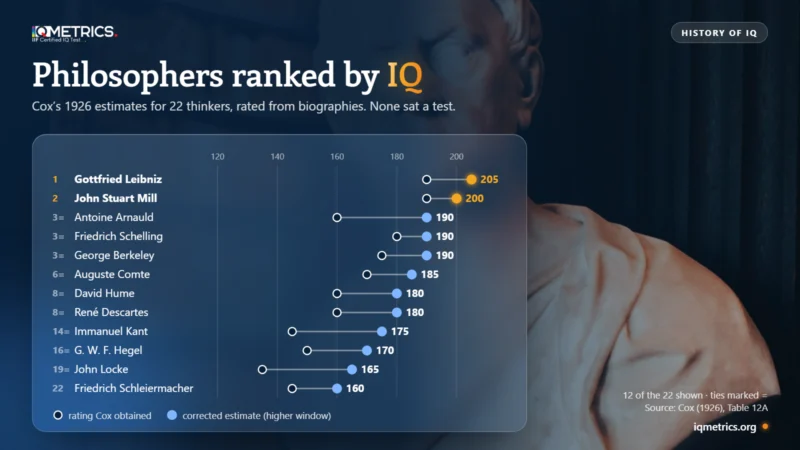
The first three rows come from Catharine Cox’s 1926 study of 301 historical figures, which estimated childhood and youth IQs from biographies. The highest rating she obtained before any correction was Goethe’s 200 for the period to age 26, on records she graded .82 reliable. Five of the 301 have a corrected estimate of 200 or more in at least one of her two columns: Goethe, Leibniz, Mill, Hugo Grotius and Thomas Wolsey. Wolsey’s shows how fragile the correction is: his record was graded only .11 reliable, so the formula pulled his obtained 165 up to 200. Cox called the correction a crude approximation. Philosophers ranked by IQ sets out her method and the full table for the 22 philosophers in her study, and what is a genius IQ score covers how the word “genius” got attached to numbers like these.
Where would your own score land?
Take the IIF-certified assessment and get your score with the scale it was measured on, the percentile it corresponds to and the confidence range around it — the three figures most online tests leave out.
Find your IQ score now! →Can any test report an IQ of 200?
For adults, no. The WAIS-IV and the Stanford-Binet Fifth Edition cap their Full Scale IQ near 160, so a report that prints 160 means “at or above the top of what this test can measure”. For children there is one genuine route. Pearson’s WISC-V Technical Report 6 (Extended Norms, 2019) raises the top of the composite scales to 210, and says the extension is most useful for younger children because older age bands leave less room above them. That makes 200 a printable number on one children’s test, and an extrapolated one: it rests on a few children at the top of the standardisation sample, not on a count of people at 200. The IQ of 170 guide explains how the extension works.
High-range tests are different again. They are untimed, usually unsupervised, and normed on volunteers who already thought they would do well, so their top scores say more about the scoring table than about rarity. A result above about 145 from an online quiz says more about its scoring formula than about the test-taker, and high-IQ societies explain why their lines are best read as percentiles.
Is an IQ of 200 twice as smart as an IQ of 100?
No. An IQ score is a position on a distribution, not a quantity with a true zero, so “twice” has no meaning for it, in the same way that 20 degrees Celsius is not twice as warm as 10. The only place a ratio is literal is the old mental-age formula, where 200 meant a mental age double the real age. The IQ of zero guide covers the zero point, and the IQ comparison page shows what a gap between two scores means in percentile terms. At the top, the precision is also poor. Applying Kelley’s formula to an observed 200 gives an expected true score below it, because extreme scores are partly luck.
| Test reliability | Expected true score | Likely range (95%) |
|---|---|---|
| 0.90 (a short or unsupervised test) | 190 | 181 to 199 |
| 0.95 (a good group-administered test) | 195 | 189 to 201 |
| 0.98 (a full individually administered battery) | 198 | 194 to 202 |
Error also grows toward the tails and no test has enough hard items at this level, so the table is optimistic. The margin-of-error explainer shows the same arithmetic nearer the middle of the scale.
If you have been told you scored 200
- Find the scale. Ask which test it was and whether its spread was 15, 16 or 24. A Cattell 200 is closer to a Wechsler 162.
- Ask whether it is a ratio score. A child’s 200 on an old Stanford-Binet is mental age over age, and it cannot exist past about 11 years old on that test.
- Check who gave it. An individually administered test from a psychologist carries weight; an unsupervised web quiz or a high-range test does not.
- Look for the ceiling. If the test stops at 160, a 200 cannot come from it.
- Ask for a percentile or a range. “Far into the top fraction of a percent” is honest; “exactly 200” is not. To see how your own result sits on the curve, start with the IQ Metrics IQ test.
Quick answers
- Is an IQ of 200 possible? As a young child’s ratio IQ and as a printed number, yes. As a certified adult score against a normed sample, no.
- What percentile is an IQ of 200? Effectively the top 0.0000000013% on SD 15, about the 99.9999999987th percentile.
- How many people have an IQ of 200? None verified. The SD 15 curve predicts about 0.1 of a person among 8.2 billion.
- Who has an IQ of 200? No one with a verified adult score. The names that circulate are ratio IQs, retrospective estimates or second-hand claims.
- Is 200 the highest IQ ever? No. Larger numbers such as 228 and 250 to 300 circulate, and none is a verified deviation IQ.
- Can an online test give an IQ of 200? It can print one. It cannot certify one.
The bottom line
An IQ of 200 means 6.67 standard deviations above average on the Wechsler scale, about 1 person in 76 billion, far beyond the ceiling of any adult test. The 200s in circulation are children’s ratio IQs, which run out of items by about age 11, wide-scale or high-range scores, or biographical estimates such as Cox’s. Terman’s one 200 in 643 gifted children shows what the number looked like in practice, and the arithmetic shows why it cannot be a rank. Read the scale, the test and the date before taking any 200 at face value, and start from a percentile with the IQ tests hub.
Sources
- Terman, L.M. et al. (1925): Genetic Studies of Genius, Volume I: Mental and Physical Traits of a Thousand Gifted Children, Stanford University Press (Table 5 for the corrected score bands), and the range of 135 to 200 and 77 children at 170 or more as tabulated in our Terman study page.
- Cox, C.M. (1926): The Early Mental Traits of Three Hundred Geniuses (Genetic Studies of Genius, Volume II), Stanford University Press: the obtained and corrected ratings in Table 12A and the correction formula, as transcribed and cross-checked by IQ Metrics against the book’s own summary tables.
- Pearson (2019): WISC-V Technical Report 6, Extended Norms (Raiford et al.).
- The top mental age of the 1937 Stanford-Binet Form L-M (22 years 10 months to 22 years 11 months) as given in reference works on the scale; the ratio-ceiling table is our own arithmetic. Population Reference Bureau: estimate of about 117 billion humans ever born.
- Rarity, percentile and Kelley figures are computed from the normal distribution. The scale facts and the vos Savant, Sidis and Hollingworth background follow our guides to the highest IQ ever recorded, an IQ of 180 and the ceiling effect.
Keep reading
All articles →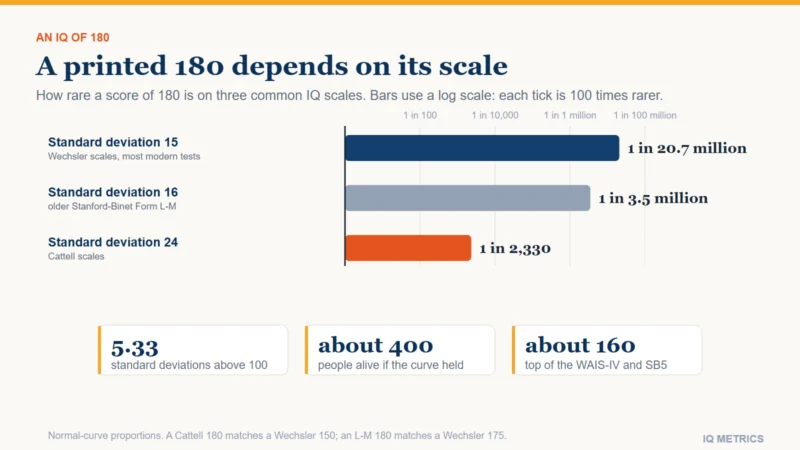 Scores & Scales
What Does an IQ of 180 Mean?
An IQ of 180 is 5.3 standard deviations above average: about 1 in 20.7 million on the Wechsler scale, 1 in 3.5 million on SD 16 and 1 in 2,330 on Cattell's SD 24. See why no adult test prints it and where 180 really comes from, from children's ratio IQs to Hollingworth's twelve.
 Scores & Scales
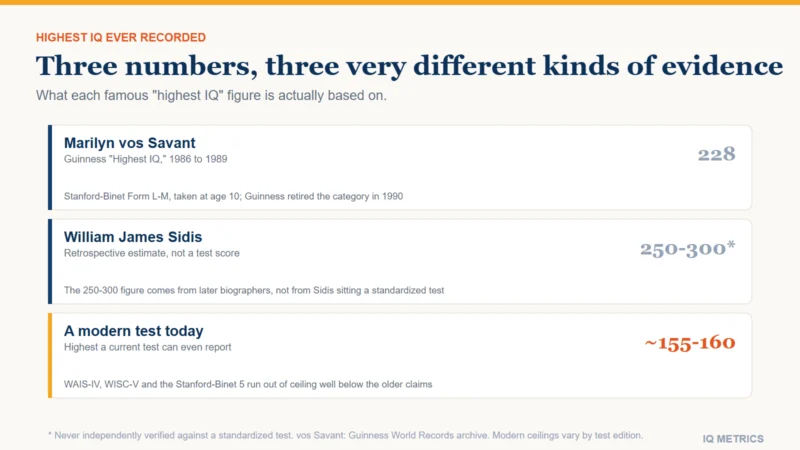
Highest IQ Ever Recorded
The highest IQ ever recorded is usually given as Marilyn vos Savant's 228 or William James Sidis's claimed 250 to 300 - neither from a test in use today. Where the famous numbers actually come from, and what a modern test can really report.
 Research & Evidence
Philosophers Ranked by IQ
Philosophers ranked by IQ: no philosopher has a measured score, but Catharine Cox's 1926 study estimated 22 of them from biographies. See the full table from Leibniz (205) and Mill (200) down, why the gaps sit inside the error, who is missing and what the GRE shows for philosophy students.