





Philosophers Ranked by IQ: What Cox's 1926 Study Estimated for 22 Thinkers
Philosophers ranked by IQ: no philosopher has a measured score, but Catharine Cox's 1926 study estimated 22 of them from biographies. See the full table from Leibniz (205) and Mill (200) down, why the gaps sit inside the error, who is missing and what the GRE shows for philosophy students.

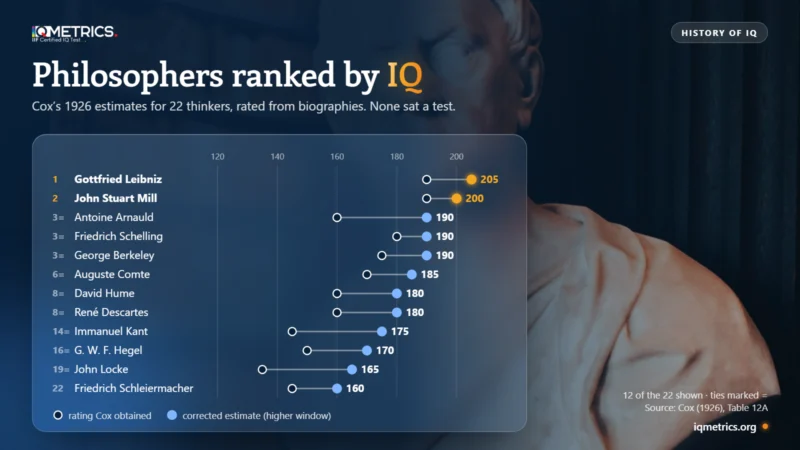
No philosopher has an IQ on record, so every list of philosophers ranked by IQ rests on one source: Catharine Cox’s 1926 study, which estimated childhood and youth IQs from biographies for 301 historical figures, 22 of them philosophers. On her corrected figures Leibniz comes first at 205 and John Stuart Mill second at 200 for his first 17 years, with Kant at 160 to 175 in the middle of the table. Plato, Aristotle, Socrates, Nietzsche and Russell are not in the study at all, so the numbers attached to them online are guesses. This guide gives the full table of 22, explains how the estimates were made and why the gaps between neighbours are smaller than the method’s error, lists what circulates for the philosophers Cox left out, and sets beside it the one thing that has actually been measured in living philosophy students: their GRE scores.
- The source: Cox’s The Early Mental Traits of Three Hundred Geniuses (1926), which in fact rates 301 people born between 1450 and 1850.
- The top of the table: Leibniz 205, Mill 200, then Arnauld, Berkeley and Schelling at 190.
- The field average: before any correction, her philosophers averaged 156 for the period to age 26, the highest of any field in the study. Her soldiers averaged 125.
- The catch: the figures are retrospective, rounded to the nearest five, and corrected upward by a formula that Cox called a crude approximation.
How did Cox estimate IQ for people who never took a test?
Cox, a student of Lewis Terman, collected biographical records of the first 26 years of life for each of her subjects and wrote each up as a case study. Two or more qualified judges then read the material and assigned an IQ, using the logic of the early Stanford-Binet: what the person did, and at what age, implies a mental age, and mental age over real age gives a ratio IQ (see IQ and mental age and deviation IQ versus ratio IQ). Each person got two ratings. The first, called AI, rests on the first 17 years. The second, AII, adds ages 17 to 26. She also graded how reliable each record was, from .11 for a thinly documented life to .82 for the best, and the philosophers’ records averaged .60 for the longer period against .53 across the whole study.
Because records are incomplete, raw ratings are pulled toward the middle. Cox corrected them with a formula: corrected = obtained + (field average − 100) × (1 − reliability), rounded to the nearest five. For Leibniz that is 190 + 56 × (1 − .75) = 204, printed as 205. For Kant it is 145 + 56 × (1 − .43) = 177, printed as 175. Cox described the result as a crude approximation that indicates a point below which the true IQ probably did not fall. The corrected figures are the ones that travel: the 205 on popular lists for Leibniz and the 175 for Kant are her corrected AII values, not scores. The method is the same one behind many genius IQ lists, and it is why an IQ of 200 appears for historical figures at all.
Philosophers ranked by IQ: all 22 in Cox's study
The table ranks the 22 philosophers by the higher of their two corrected estimates, breaking ties by the second figure, and shows the ratings she obtained before correction beside them. Ties are marked with an equals sign.
| Rank | Philosopher (lived) | Obtained, to age 17 / 26 | Corrected, to age 17 / 26 | Record reliability, to age 26 |
|---|---|---|---|---|
| 1 | Gottfried Leibniz (1646–1716) | 185 / 190 | 195 / 205 | .75 |
| 2 | John Stuart Mill (1806–1873) | 190 / 170 | 200 / 180 | .82 |
| 3= | Antoine Arnauld (1612–1694) | 135 / 160 | 175 / 190 | .43 |
| 3= | Friedrich Schelling (1775–1854) | 175 / 180 | 180 / 190 | .82 |
| 3= | George Berkeley (1685–1753) | 150 / 175 | 170 / 190 | .75 |
| 6= | Auguste Comte (1798–1857) | 150 / 170 | 170 / 185 | .75 |
| 6= | Tommaso Campanella (1568–1639) | 145 / 155 | 170 / 185 | .43 |
| 8= | David Hume (1711–1776) | 155 / 160 | 175 / 180 | .60 |
| 8= | Francis Bacon (1561–1626) | 145 / 155 | 165 / 180 | .53 |
| 8= | Marquis de Condorcet (1743–1794) | 155 / 165 | 175 / 180 | .75 |
| 8= | Nicolas Malebranche (1638–1715) | 125 / 135 | 165 / 180 | .20 |
| 8= | René Descartes (1596–1650) | 150 / 160 | 170 / 180 | .60 |
| 8= | Victor Cousin (1792–1867) | 135 / 165 | 155 / 180 | .75 |
| 14= | Baruch Spinoza (1632–1677) | 130 / 145 | 170 / 175 | .43 |
| 14= | Immanuel Kant (1724–1804) | 135 / 145 | 160 / 175 | .43 |
| 16= | Johann Gottlieb Fichte (1762–1814) | 145 / 155 | 165 / 170 | .75 |
| 16= | Sir William Hamilton (1788–1856) | 140 / 160 | 150 / 170 | .82 |
| 16= | G. W. F. Hegel (1770–1831) | 150 / 145 | 170 / 165 | .60 |
| 19= | Henri de Saint-Simon (1760–1825) | 130 / 135 | 155 / 165 | .43 |
| 19= | John Locke (1632–1704) | 125 / 135 | 150 / 165 | .43 |
| 19= | Thomas Hobbes (1588–1679) | 140 / 135 | 165 / 165 | .43 |
| 22 | Friedrich Schleiermacher (1768–1834) | 150 / 145 | 160 / 160 | .75 |
Read the table as tiers, not as a league. Cox rounded to the nearest five and the method’s own error is larger than that, so the order inside a band means nothing. Two philosophers reach 200 or more (Leibniz and Mill), three sit at 190 (Arnauld, Berkeley and Schelling), eight at 180 to 185, eight at 165 to 175 (Kant and Spinoza at 175, Hegel at 170, Locke at 165) and one at 160. A philosopher who tops the table on one record may drop on another: four of the 22 rated lower on the longer record than on the first, Mill by 20 points and Hegel, Hobbes and Schleiermacher by five.
What the top of the table shows
Leibniz leads on the longer rating: 185 to age 17 and 190 to age 26, on records graded .75, corrected to 195 and 205. Cox notes that he had taken a bachelor’s degree and written a treatise before his 17th birthday. Our Leibniz profile puts his estimated IQ at 180 to 195, because the 205 is a corrected figure, not a score.
John Stuart Mill has the best-documented childhood in the study. His record is graded .82, and Cox wrote that no other record of an eminent man’s early development is more complete. The three ratings of his first 17 years averaged 190, corrected to 200, and she cites his conversation at five with Lady Spencer on the merits of Marlborough and Wellington. Yet his second rating is 170 (corrected 180), because she judged his later achievement less striking than that of many other youths. Mill is therefore first among her philosophers on the first 17 years and joint seventh on the longer window. That is a method result, not a fact about Mill.
Kant sits mid-table: 135 to age 17 and 145 to age 26, on records graded only .43, corrected to 160 and 175. Because the reliability is low, the correction adds 25 to 30 points. Our Kant profile puts the documented record at 150 to 170. The extremes show the same effect: Nicolas Malebranche was rated 135 on records graded .20, and the formula lifted him to 180, level with Descartes and Hume. A low-reliability record produces a big correction, which is why the corrected column is flattering to the least-documented lives.
Which fields scored highest in Cox's study?
Cox also reported the average estimate for each field before correction (her Tables 20A and 20B). Philosophers lead, ahead of scientists, and soldiers are lowest. The two groups of writers (149 and 148 to age 26) and the revolutionary statesmen (144) fall between scientists and statesmen.
| Field | People | Average, to age 17 | Average, to age 26 |
|---|---|---|---|
| Philosophers | 22 | 147 | 156 |
| Scientists | 39 | 135 | 152 |
| Religious leaders | 23 | 132 | 145 |
| Statesmen | 43 | 135 | 142 |
| Musicians | 11 | 130 | 140 |
| Artists | 13 | 122 | 135 |
| Soldiers | 27 | 115 | 125 |
The order matches the idea behind the whole exercise, that fields which reward abstract reasoning and verbal ability should rate high, but it is also partly built into the sample. Cox rated people who were already famous, judges knew who they were rating, and the philosophers’ records were better documented than the soldiers’, which raises their reliability and so their corrected scores. Pascal (195 corrected), Voltaire (190) and Goethe (210) are often called philosophers, but Cox classed them as a scientist and two writers. Our Pascal, Voltaire and Goethe profiles give each one’s source.
Which philosophers are missing, and what circulates for them?
Cox drew her 301 subjects from a list of the thousand most eminent people, kept only those born between 1450 and 1850, and excluded hereditary aristocrats. The ancient philosophers fall outside the window. Nietzsche, born in 1844, was inside it but is not among the 301, and neither are Schopenhauer or Russell (born 1872). That leaves a set of famous names whose IQs online come from nowhere in particular.
| Philosopher | Number that circulates | What the evidence is |
|---|---|---|
| Socrates | 140 to 180 | No test and nothing written by him. Our profile estimates 135 to 165. |
| Plato | 146 and 180 | No test. The two circulating numbers do not even agree with each other. |
| Aristotle | 148 to 200 | No test. Our profile estimates 150 to 170 from his documented career. |
| Friedrich Nietzsche | 165 and 190 | No test. A scholarship at Schulpforta and a Basel chair at 24 support an estimate of 150 to 165. |
| Bertrand Russell | 180 | No source at all, and born too late for Cox’s survey. |
| Christopher Langan | 195 | A real test, but its own creator’s later renorming puts the conversion about thirty points lower. |
A fair rule from these rows: if a number attached to a philosopher cites neither a test nor Cox’s table, it is a guess with a confident tone. Where celebrity IQ numbers come from explains how the same pattern plays out across the whole celebrity IQ section.
Where would your own score land?
Take the IIF-certified assessment and get your score with the scale it was measured on, the percentile it corresponds to and the confidence range around it — the three figures most online tests leave out.
Find your IQ score now! →What has been measured: GRE scores of philosophy students
The one measurement we have is of living students, and it is not an IQ test. The American Philosophical Association summarised Educational Testing Service data on GRE takers from August 2011 to April 2014, grouped by the field they intended to study. Prospective philosophy graduate students had the highest mean Verbal Reasoning score of any field and the highest Analytical Writing score (4.4, ahead of English at 4.2), and ranked 19th on Quantitative Reasoning at 153.
| Intended field | Mean Verbal Reasoning |
|---|---|
| Philosophy | 160 |
| English | 157 |
| Physics | 156 |
| History | 156 |
| Chemistry | 153 |
| Psychology | 152 |
| Finance | 151 |
Three cautions apply. The GRE measures learned verbal and quantitative skills, so it is not an IQ test (see GRE and LSAT scores to IQ). The sample is people who chose to apply to graduate school in each field, a self-selected group, which is the same caveat that applies to average IQ by college major. And the data are a decade old, on a revised test. The result is still the nearest thing to a measured comparison, and it points the same way as Cox’s field averages.
Why historical IQ rankings should be read with care
- They are retrospective. Judges rated records of people whose fame was already known, which can colour the ratings.
- Record quality drives the number. The philosophers’ records ranged from .20 to .82 reliable, and a low reliability triggers a large upward correction.
- They are rounded and tied. Nineteen of the 22 share a rank with someone else; the real uncertainty is wider than five points.
- They select on success. Only people famous enough to be written about are rated, so the table says nothing about philosophers as a group.
- They are childhood ratio IQs. They estimate precocity, not adult reasoning, and they are not on the deviation scale of a modern test. IQ and creativity covers why a high score does not predict philosophical originality.
Quick answers
- Who is the smartest philosopher by IQ? No philosopher has a measured IQ. On Cox’s corrected estimates Leibniz ranks first at 205 and John Stuart Mill second at 200.
- What was Kant’s IQ? Never tested. Cox obtained 135 and 145 on records graded .43 reliable and corrected them to 160 and 175.
- What was Nietzsche’s IQ? Never tested, and he is not in Cox’s study. The 165 and 190 that circulate cite no test.
- What was Plato’s IQ? Unknown. The numbers 146 and 180 both circulate and contradict each other.
- Do philosophers have high IQs? There is no IQ data on philosophers as a group. Prospective philosophy graduate students had the top GRE Verbal and Analytical Writing means among all fields in 2011 to 2014.
The bottom line
Philosophers ranked by IQ means philosophers ranked by Cox’s 1926 estimates: Leibniz at 205 and Mill at 200 lead 22 thinkers whose figures are corrected, rounded and uncertain, with Kant at 175 and Locke at 165 further down. Everyone outside her window, from Socrates to Russell, has a number with no source. Treat the table as a record of how one 1920s method rated documented childhoods, and for a score of your own, start with the IQ Metrics IQ test and the IQ tests hub.
Sources
- Cox, C.M. (1926): The Early Mental Traits of Three Hundred Geniuses (Genetic Studies of Genius, Volume II), Stanford University Press: Table 12A (obtained and corrected ratings, record reliability), Tables 20A and 20B (field averages), the correction formula and her comments on Mill, Leibniz and the correction. Transcribed and cross-checked by IQ Metrics against the book’s own Tables 6, 7, 20A and 20B.
- Terman, L.M. et al. (1925): Genetic Studies of Genius, Volume I, summarised in our Terman study page.
- American Philosophical Association (2014): Philosophy Student Performance on the Graduate Record Examinations (GRE), summarising Educational Testing Service data for tests taken 1 August 2011 to 30 April 2014 (ETS GRE guide).
- The circulating numbers and estimates for Socrates, Plato, Aristotle, Nietzsche, Russell and Langan come from our own celebrity profiles linked above, each of which names its sources.
Keep reading
All articles →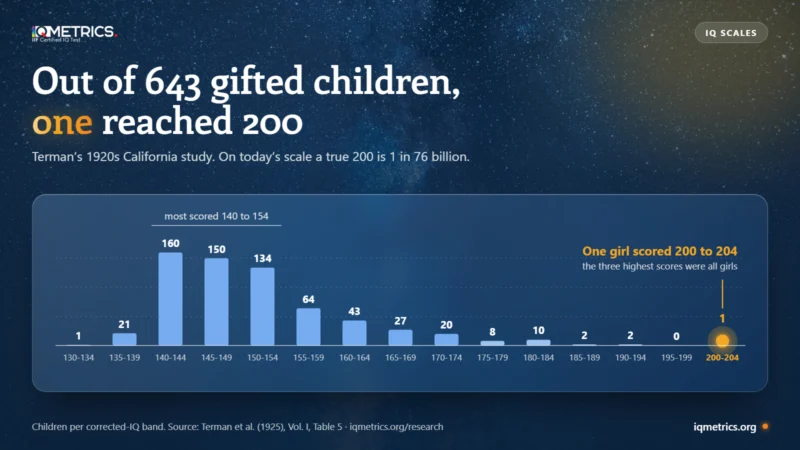 Scores & Scales
What Does an IQ of 200 Mean?
An IQ of 200 is 6.67 standard deviations above average, about 1 in 76 billion, and no adult test can measure it. See why a child's ratio IQ of 200 is possible, how test ceilings stop it by about age 11, what Terman and Cox found near that line and where the famous 200s come from.
 Scores & Scales
What is a Genius IQ Score On An IQ Scale ?
There is no official genius IQ score. The label comes from Terman in 1916 and is usually put at 140, about 1 person in 261. See how rare each score from 130 to 160 is, where the line sits on current tests, why no test measures far above 155 and what famous scores really are.
 Research & Evidence
Average IQ by College Major
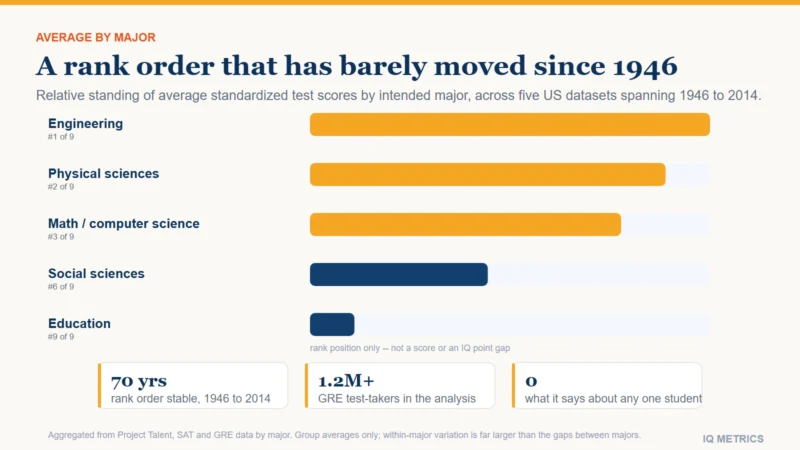
Average test scores really do differ by college major, and the rank order has barely moved in 70 years. What a landmark cross-dataset analysis found, why SAT and GRE scores are not IQ scores, and what the ranking cannot tell you about one student.