





Are Fish Smart? What Studies Show About Memory, Tool Use and Recognising Faces
Fish have passed memory, face-recognition and quantity tasks, and cleaner wrasse reacted to a mark seen in a mirror, but most results rest on a handful of fish. The 3-second memory claim fails: rainbowfish escape times were still low after 11 months. See each study, its sample size and why there is no fish IQ.

Are fish smart? Yes, in tests built for fish. Fish have passed memory, face-recognition and quantity tasks, and cleaner wrasse reacted to a mark they could see only in a mirror. But no valid like-for-like test compares fish with birds, mammals or people, so there is no fish IQ and no honest ranking against a dog.
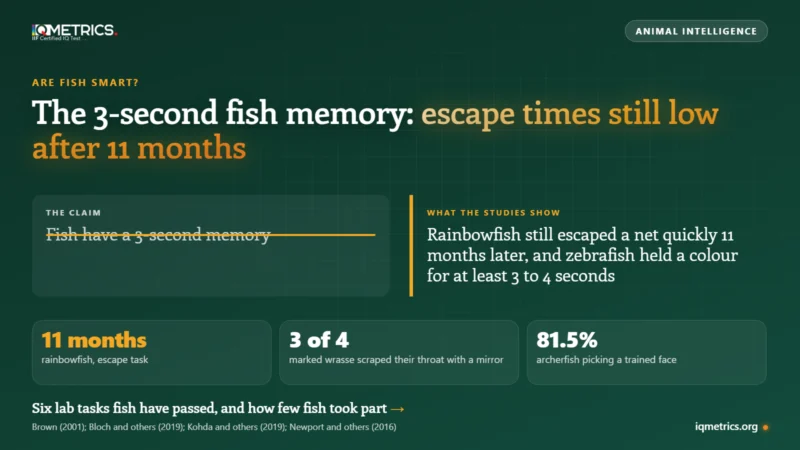
New here: the only 3-second figure we found in the fish papers we read is a floor, not a ceiling. Zebrafish passed a working-memory task with a delay of at least 3 to 4 seconds, and rainbowfish still escaped a net quickly 11 months after their first run. Below: one table of the named lab tasks fish have passed, how many fish took part, and where each result is thin.
Key takeaways
- Fish have passed lab tasks for memory, face discrimination, quantity comparison and a mirror mark test. Most results rest on a handful of fish.
- The 3-second memory claim has no support in the studies we read: rainbowfish escape times were still low after 11 months.
- The cleaner wrasse mirror result is real but argued over: 3 of 4 marked fish scraped their throat with a mirror, and the journal’s editor note says reviews were mixed.
- The tuskfish tool-use report is one 75-second photo sequence of one fish seen once.
- No test puts a fish and a dog on one scale, so “smarter than a dog” has no valid answer.
Are fish smart compared with birds and mammals?
How smart are fish? Smart for the lives they lead, and often smarter than people assume. But there is no common test to rank them. A 2015 review by Culum Brown concludes that fish perception and cognitive abilities often match or exceed those of other vertebrates. A 2002 review by Bshary, Wickler and Fricke searched the fish literature for tool use, memory and cognitive maps, among other things. It found that most of the phenomena primate researchers study appear in fish as well.
Those are the reviewers’ conclusions, not an IQ ranking. The tasks differ by species: a bird opens a tube, a fish picks a face on a screen. So scores cannot be placed on one scale. Fish intelligence is best read one task at a time. Our pages on octopus IQ, sharks, squid, dolphin IQ and orcas do the same for other animals, and our smartest animals research compares what has been measured. That data has no fish rows, so we give no fish neuron count here.
Do fish really have a three-second memory?
No. Do fish have a 3 second memory? In the studies we read, fish remembered far longer, and none of the fish papers we read gives a three-second limit. A related claim, that a goldfish can focus for only 9 seconds, sits on one 2015 slide, as our report on the human attention span vs goldfish shows.
In a 2001 study, Culum Brown ran crimson spotted rainbowfish through a trawl-net escape task five times. Escape times improved, and they were still low when the fish met the net again 11 months later. The study says part of the gain was probably habituation to the tank, not memory alone, so it is evidence of long memory, not proof of how long fish remember.
A 2019 study by Bloch and colleagues trained adult zebrafish to match colours. When a delay was added between the sample and the choice, the fish managed a delay of at least 3 to 4 seconds. That is a working-memory test, and “at least” means a floor, not a limit. The authors also note that the fish did well only in a certain set-up. To test your own short-term memory, try our memory game.
Which fish have passed mirror, tool-use or face-recognition tests?
Cleaner wrasse, archerfish, guppies and one tuskfish have each passed a named lab task or been seen doing something that matches one. The table lists what was done, how many fish took part and what we read.
| Fish and study | Task | Result as reported | How many fish | What we read |
|---|---|---|---|---|
| Cleaner wrasse (Kohda and colleagues, 2019) | Mirror mark test | 3 of 4 marked fish scraped their throat with a mirror; none did without one | 10 fish, 4 marked | Full text |
| Archerfish (Newport and colleagues, 2016) | Tell a trained human face from new faces | Last-block average 81.5% (44 new faces) and 86.25% (18 new faces) | 4 + 4 fish | Full text |
| Guppy (Agrillo and colleagues, 2012) | Pick the larger of two groups of fish | Same pattern as students: ratio did not matter for 1 to 4, larger numbers improved with distance | 140 adult females, 200 juveniles | Full text |
| Black spot tuskfish (Jones and colleagues, 2011) | Rock used as an anvil to crack a cockle | One 75-second photo sequence | 1 fish | Full text (one page) |
| Rainbowfish (Brown, 2001) | Escape a net, retest later | Escape times still low 11 months later | Not given in the abstract | Abstract |
| Zebrafish (Bloch and colleagues, 2019) | Delayed matching-to-sample | Delay of at least 3 to 4 seconds | Not given in the abstract | Abstract |
Cleaner wrasse and the mirror. In a lab study, ten female cleaner wrasse were given a mirror. Seven of the ten first attacked the reflection. Seven fish later showed short, unusual behaviours near the mirror, such as swimming upside down.
When a brown mark was placed on the throat, where only a mirror shows it, three of four fish scraped their throat against the bottom of the tank. None did when there was no mirror or the mark was transparent. The paper compares this with one of three Asian elephants and two of five magpies in earlier mark tests.
The authors ask whether this means self-awareness or some other process, and the journal’s editor note says reviewers’ opinions were both positive and negative. The result happened. What it shows is argued.
Archerfish and faces. Can fish recognise faces? Archerfish, which spit water at targets, learned to avoid one trained human face among 44 new ones. Four other fish then did the same with 18 faces matched for brightness, colour and head shape. In the last block of testing the groups averaged 81.5% and 86.25% correct in a choice between two faces, where chance is 50%.
The paper itself calls its sample small, four fish each time, and in the first test only two of the four fish reached the last block.
Guppies and numbers. Guppies do not count in words, but they can pick the larger of two groups of other fish. In a 2012 study they followed the same pattern as university students shown dots. For 1 to 4 items the ratio did not matter, and for larger numbers they did better as the gap widened. The authors read this as two number systems shared by humans and fish.
A tuskfish and a rock. Do fish use tools? A 2011 note describes one black spot tuskfish photographed by a diver in the Keppel Islands region of the Great Barrier Reef. Over 75 seconds it held a cockle in its mouth and rolled on its side to land blows on a rock until the shell cracked. The authors say it fits Goodall’s definition of tool use and call it a starting point for more study. It is one fish seen once.
Where would your own score land?
Take the IIF-certified assessment and get your score with the scale it was measured on, the percentile it corresponds to and the confidence range around it — the three figures most online tests leave out.
Find your IQ score now! →How big is a fish brain, and does brain size decide intelligence?
Brain size does not settle it, and fish show a price for a bigger brain. In 2013, Kotrschal and colleagues bred guppies for larger or smaller brains relative to body size. After two generations the relative brain size was 9% larger in the upward lines.
In a numerical learning test of 48 fish, large-brained females did better than small-brained females. Males showed no difference. The larger brain had costs: guts were 8% smaller in females and 20% smaller in males, and the large-brained lines had 19% fewer offspring. A bigger brain had a cost, even in a fish. For the birds and mammals we have measured, see the smartest animals study.
Is there a fish IQ, and are fish smarter than dogs?
No. IQ places a person among people of the same age on one test, so no fish has a fish IQ. Are fish smarter than dogs? No valid like-for-like test exists, so the question has no answer.
A dog and a fish are tested on different tasks, with different senses and different rewards. A score on one task cannot be set against a score on another, so neither result ranks them. Our page on dog IQ shows how dog studies are read. For the kind of rule-finding questions people get, see our abstract reasoning test examples. For your own number, take the IQ test.
Quick answers
- Are fish smart? Yes, in tests built for fish: memory, face discrimination, quantity comparison and a mirror mark test, mostly with few fish.
- Do fish have a 3 second memory? No. Rainbowfish escape times were still low after 11 months, and zebrafish passed a working-memory delay of at least 3 to 4 seconds.
- Can fish recognise faces? Archerfish told a trained human face from 44 new ones, in a study of four fish.
- Do fish use tools? One tuskfish was photographed cracking a cockle on a rock. It is a single report.
- Are fish smarter than dogs? No valid like-for-like test exists, and fish have no IQ.
Sources
- Kohda M, Hotta T, Takeyama T, Awata S, Tanaka H, Asai J, Jordan AL (2019). If a fish can pass the mark test, what are the implications for consciousness and self-awareness testing in animals? PLOS Biology 17(2), e3000021 (full text read).
- Newport C, Wallis G, Reshitnyk Y, Siebeck UE (2016). Discrimination of human faces by archerfish. Scientific Reports 6, 27523 (full text read).
- Agrillo C, Piffer L, Bisazza A, Butterworth B (2012). Evidence for two numerical systems that are similar in humans and guppies. PLoS ONE 7(2), e31923 (full text read).
- Jones AM, Brown C, Gardner S (2011). Tool use in the tuskfish Choerodon schoenleinii? Coral Reefs 30, 865 (full text read).
- Brown C (2001). Familiarity with the test environment improves escape responses in the crimson spotted rainbowfish. Animal Cognition 4, 109-113 (abstract read).
- Bloch S, Froc C, Pontiggia A, Yamamoto K (2019). Existence of working memory in teleosts: delayed matching-to-sample in adult zebrafish. Behavioural Brain Research 370, 111924 (abstract read).
- Kotrschal A and colleagues (2013). Artificial selection on relative brain size in the guppy. Current Biology 23(2), 168-171 (full text read).
- Brown C (2015). Fish intelligence, sentience and ethics. Animal Cognition 18, 1-17; Bshary R, Wickler W, Fricke H (2002). Fish cognition: a primate’s eye view. Animal Cognition 5, 1-13 (abstracts read).
- Percentages, counts and ratios in the text are as printed in the papers or simple arithmetic on them; the studies and their sample sizes are as the authors report.
Keep reading
All articles →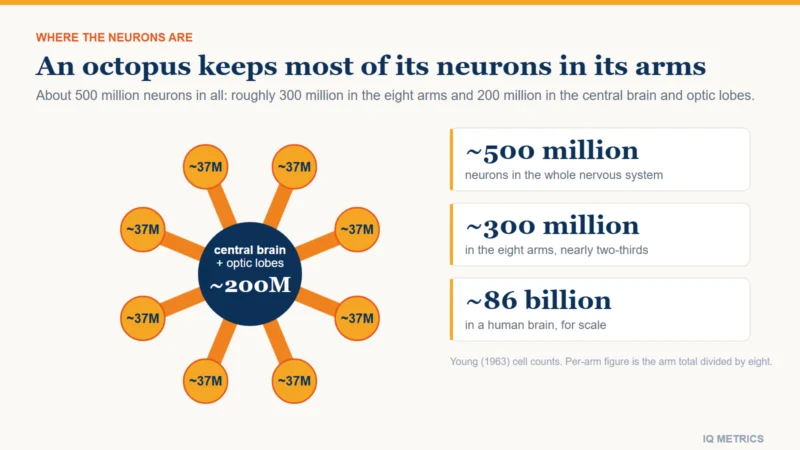 Understanding IQ
Octopus IQ
An octopus has no IQ, but it has about 500 million neurons, most of them in its arms. The neuron count, the tool-use and recognition studies, why short lives leave no room for teaching, and why UK law now treats octopuses as sentient.
 Research & Evidence
Dolphin IQ
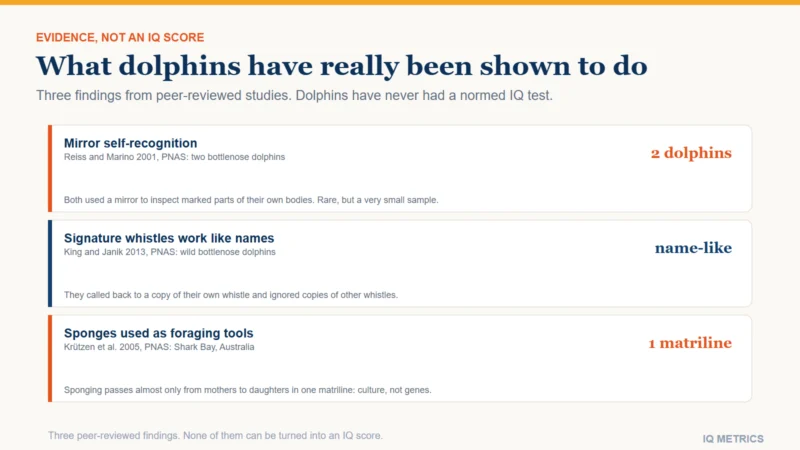
Dolphins have no IQ, but they have passed a mirror test, use signature whistles like names and pass tool use down the female line. See the evidence, the brain data, and the peer-reviewed sceptics who question the hype.
 Mind & Everyday Life
Are Sharks Smart?
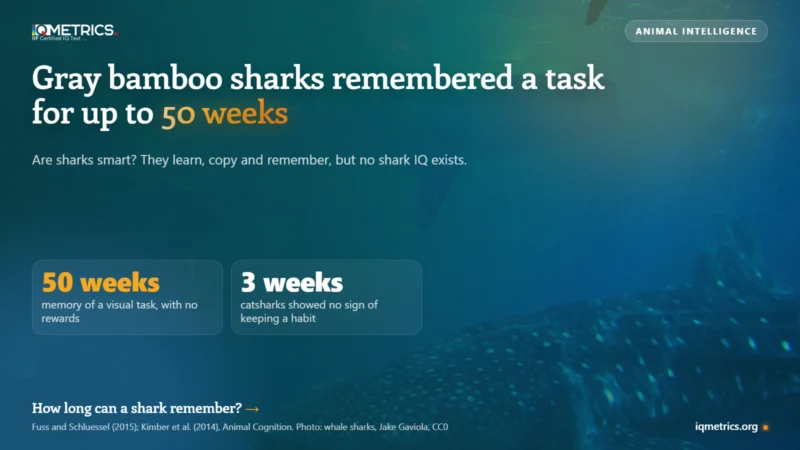
Are sharks smart? Yes, at learning and remembering, though no shark IQ exists. Bamboo sharks remembered a task for up to 50 weeks, lemon sharks learned by watching, and catsharks kept a habit for under 3 weeks. See the studies and what shark brains show.