





How Smart Are Alligators and Crocodiles? Brain Size, Tool Use, Play and What the Studies Show
How smart are alligators and crocodiles? Reports show sticks used as bird lures and signs of play, yet a 90-kg Nile crocodile has 83 million brain neurons against 86.1 billion in a human. See brain size, tool use, play and why no reptile has an IQ.

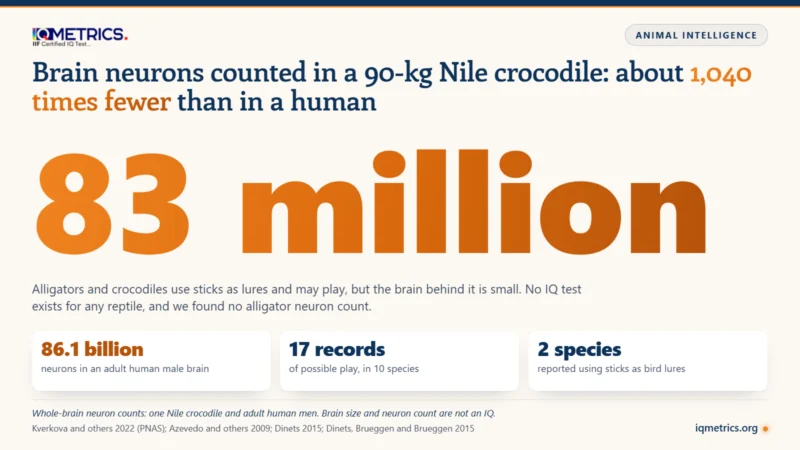
How smart are alligators and crocodiles? They show flexible behaviour, but no one can give them an IQ. Studies report sticks used as bird lures and signs of play, yet the brain is a few grams, and no IQ test exists for any reptile.
New here: a 90-kg Nile crocodile has 83 million brain neurons, about 1,040 times fewer than the 86.1 billion in an adult human male. The behaviour reports are thin too: 17 records of possible play for 10 species, and sticks used as lures by 2 species. Below: brain size, tool use, play and how crocodilians compare with other reptiles.
Key takeaways
- Two crocodilian species, the American alligator and the mugger, have been reported using twigs and sticks as bird lures, mostly when their prey is building nests.
- A 2015 overview lists 17 records of possible play in 10 crocodilian species, 6 of them in American alligators. The author says the species counts most likely reflect where people looked.
- The only whole-brain neuron count for a crocodilian we found is for the Nile crocodile: 83 million, against 86.1 billion for a human.
- A crocodilian’s brain fills only part of its skull, and a smaller share as the animal grows: 29% in the largest crocodile scanned and 32% in the largest alligator from an earlier study.
- No standardised IQ test exists for reptiles, and we found no study that ranks reptile species on one set of tasks.
How smart are alligators and crocodiles?
They are capable animals with a small brain, and no one has measured how smart they are on a common scale. Our page on the smartest reptile found no study that ranks reptile species, and no reptile IQ test.
What the studies do show is behaviour that is flexible rather than fixed. The table lists each line of evidence we read, and its limit. None of this makes crocodilians slow learners. It means the evidence is behaviour seen by a few researchers, not test scores.
| Evidence | What it reports | Limit |
|---|---|---|
| Tool use (Dinets, Brueggen and Brueggen, 2015) | Twigs and sticks used as bird lures by two species; at least one mostly in its prey’s nest-building season | Two species named; one report |
| Play (Dinets, 2015) | 17 records of possible play in 10 species: 6 American alligator, 3 Cuban crocodile, 1 each for the rest | Mostly informal reports; only 7 sightings of the author’s own in 3,000+ hours |
| Brain size (Watanabe, 2019; Jirak and Janacek, 2017) | Brains of 0.5 to 8.5 cubic centimetres in the animals scanned | Young alligators, one caiman, one Nile crocodile |
| Neuron count (Kverkova and others, 2022) | 83 million brain neurons in a 90-kg Nile crocodile | One species; no alligator count found |
How big is an alligator's brain compared with a human's?
Alligator brain size is a few cubic centimetres, against about 1.5 kg for a human brain. Crocodile brain size reaches 8.5 cubic centimetres in the largest animal we found. We found no adult alligator brain mass in the open papers we could read.
What we did read: in 11 American alligators aged 0 to 3 years, brain volume ran from 0.52 to 2.63 cubic centimetres (Watanabe and colleagues, 2019). In a 7-year-old male caiman it was 5.65, and in a 16-year-old female Nile crocodile 8.54 (Jirak and Janacek, 2017).
| Animal | Brain figure | Source |
|---|---|---|
| American alligator, 0 to 3 years (11 animals) | 0.52 to 2.63 cm3 (volume) | Watanabe and others, 2019 |
| Caiman, 7-year-old male | 5.65 cm3 (volume) | Jirak and Janacek, 2017 |
| Nile crocodile, 16-year-old female | 8.54 cm3 (volume), 29% of its skull cavity | Jirak and Janacek, 2017 |
| Nile crocodile | 5.8 g (mass), as listed on our T. rex page | Kverkova and others, 2022 |
| Human, adult men (4) | 1,508 g (mass), as listed on our T. rex page | Azevedo and others, 2009 |
By mass, that is about 260 times as much brain in a human as in the Nile crocodile (1,508 g against 5.8 g).
The brain also fills only part of a crocodilian’s skull. In the 11 young alligators it filled 52% to 99% of the cavity, and a smaller share in the larger animals. It is 29% of the cavity in the largest crocodile scanned, and an earlier study of the largest alligator found 32%. That is why a skull alone overstates the brain, which our page on T. rex brain size uses for dinosaurs.
Counting cells tells the same story. The 90-kg Nile crocodile has 83 million brain neurons (Kverkova and colleagues, 2022). The adult male human brain has 86.1 billion (Azevedo and colleagues, 2009). That is about 1,040 times more in the human.
Do crocodilians use tools or play?
Reports say yes to both, with limits. The evidence is a few papers.
On tools: Dinets and colleagues report twigs and sticks used as lures for birds by two crocodilian species, at least one mostly in the nest-building season of its prey. A 2023 paper in Human Nature names them as the American alligator and the mugger crocodile. The authors call it the first known case of a predator that also takes the season of its prey into account. Using objects as lures is very rare in nature, they note.
On play: Dinets gathered 17 records of possible play from his own watching, the literature and a survey of people who work with crocodilians. They cover 10 species. Six are American alligators and three are Cuban crocodiles. Object play is the type reported most often. He says it is far more likely that the alligator count reflects where people looked than that alligators play more. His own tally was 7 sightings in more than 3,000 hours.
Play and lure use do not make an animal clever by themselves. They show that crocodilian behaviour can change with context, which is why researchers keep studying it. Our memory game lets you test your own recall.
Where would your own score land?
Take the IIF-certified assessment and get your score with the scale it was measured on, the percentile it corresponds to and the confidence range around it — the three figures most online tests leave out.
Find your IQ score now! →Are crocodiles smarter than other reptiles?
No one can say. We found no study that ranks reptile species on one set of tasks, and our page on the smartest reptile explains why a ranking would be unsafe.
One thing can be counted: neurons. The 90-kg Nile crocodile has 83 million brain neurons. The Asian water monitor, a 3.9-kg lizard with the most neurons of any squamate in the same dataset, has 78 million. On average, birds and mammals have about 21 and 20 times more neurons than reptiles of the same body size, say Kverkova and colleagues.
So a Nile crocodile’s neuron count is close to that of the lizard with the most neurons in the same dataset. Tortoises have their own evidence, covered on our page on turtles. For birds, see our crow IQ page, and for the wider picture our smartest animals study. Our report on the reptilian brain myth explains that a reptile’s brain has the same basic regions as ours, including a cortex of its own, and our report on the smartest land animal looks at what studies measured on land.
Do alligators have an IQ?
No. No standardised IQ test exists for any reptile, so an “alligator IQ” you see online has no published basis. IQ is a score on a human scale, built from norms for people. To see how a human score is read, see what an IQ of 84 means, try our IQ test and use the IQ percentile calculator.
Quick answers
- How smart are alligators? Flexible enough to use sticks as lures and perhaps to play, with a brain of a few cubic centimetres. There is no IQ.
- Are crocodiles smart? Reports of lure use and play say they adapt. No study ranks them against other reptiles.
- How big is an alligator’s brain? 0.52 to 2.63 cm3 in 11 young alligators. A Nile crocodile’s is 5.8 g, a human’s 1,508 g.
- Do crocodiles use tools? Two species have been reported using sticks and twigs as bird lures, mostly in nest-building season.
- Are alligators smarter than other reptiles? Unknown. A Nile crocodile has 83 million brain neurons, a water monitor 78 million.
Sources
- Dinets V, Brueggen JC, Brueggen JD (2015). Crocodilians use tools for hunting. Ethology Ecology & Evolution 27(1):74-78. DOI 10.1080/03949370.2013.858276 (abstract read on 26 November 2026).
- Moser C, Buckner W, Sarian M, Winking J (2023). Aggressive mimicry and the evolution of the human cognitive niche. Human Nature. DOI 10.1007/s12110-023-09458-y (open full text read; names the two species).
- Dinets V (2015). Play behavior in crocodilians. Animal Behavior and Cognition 2(1):49-55. DOI 10.12966/abc.02.04.2015 (full text read).
- Kverkova K and others (2022). The evolution of brain neuron numbers in amniotes. PNAS e2121624119. DOI 10.1073/pnas.2121624119 (open full text read).
- Azevedo FAC and others (2009). Equal numbers of neuronal and nonneuronal cells make the human brain an isometrically scaled-up primate brain. J Comp Neurol 513:532-541. DOI 10.1002/cne.21974 (abstract read).
- Watanabe A and others (2019). Are endocasts good proxies for brain size and shape in archosaurs throughout ontogeny? J Anat, pages 291-305. DOI 10.1111/joa.12918 (open full text read).
- Jirak D, Janacek J (2017). Volume of the crocodilian brain and endocast during ontogeny. PLoS ONE e0178491. DOI 10.1371/journal.pone.0178491 (open full text read).
- Brain masses of 5.8 g (Nile crocodile) and 1,508 g (four men) are as listed on our T. rex brain size page; we did not re-read those two papers’ tables. Ratios (260 times by mass, 1,040 times by neurons) and volume conversions: arithmetic by IQ Metrics.
Keep reading
All articles →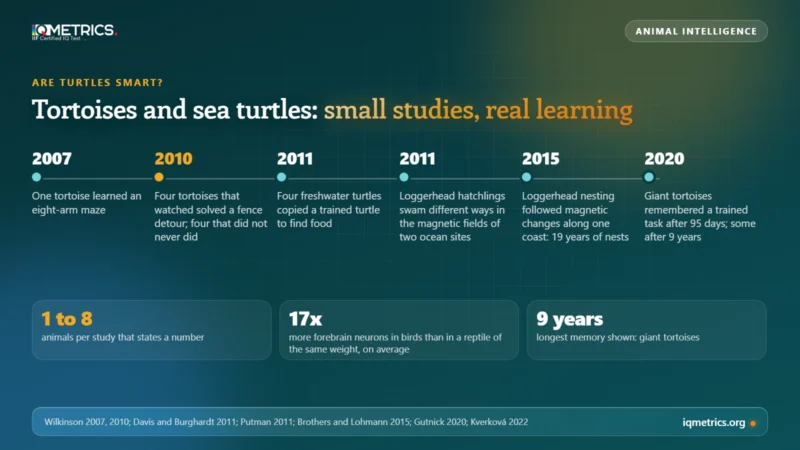 Research & Evidence
Are Turtles Smart?
How smart are turtles? Tortoises learned a maze, copied each other and kept a task for years in small studies, and sea turtles read Earth's magnetic field to navigate. See eight experiments in one table, why no turtle has an IQ, and what a 2022 brain-cell count says about size.
 Research & Evidence
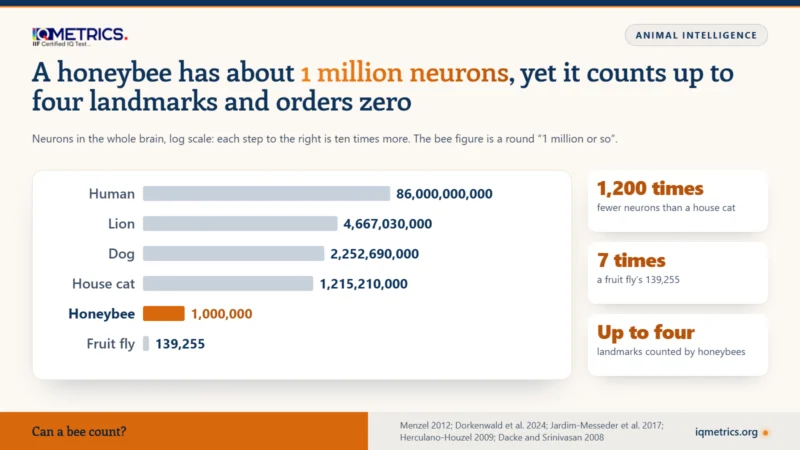
Are Bees Smart?
A honeybee brain has about 1 million neurons, yet bees count up to four landmarks, order zero, learn same and different and, in bumblebees, learn by watching. See nine experiments with the species and each limit, the neuron counts against a fruit fly, cat and human, and why no bee has an IQ.
 Research & Evidence
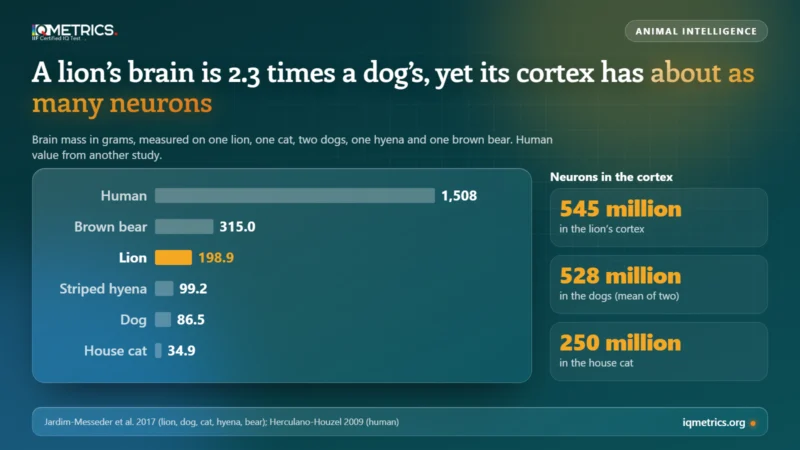
Are Lions Smart?
A lion's cortex holds about 545 million neurons, almost the same as a dog's, from a brain 2.3 times heavier. See how lion and tiger brains compare with house cats, what roar playbacks and cooperation studies found, what captivity does to brain size, and why no big cat has an IQ.