





Are Bees Smart? What Bee Brains, Counting and Learning Experiments Show
A honeybee brain has about 1 million neurons, yet bees count up to four landmarks, order zero, learn same and different and, in bumblebees, learn by watching. See nine experiments with the species and each limit, the neuron counts against a fruit fly, cat and human, and why no bee has an IQ.

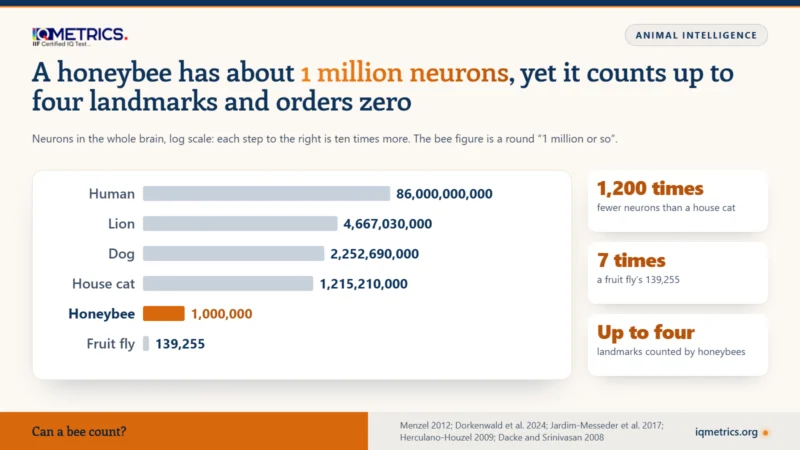
Are bees smart? Yes, in the ways tests have measured. Honeybees count up to four landmarks, put zero below one and learn rules such as same and different. They do it with about 1 million neurons, roughly 1,200 times fewer than a house cat’s brain holds. No test gives a bee an IQ, though.
New here: a table of nine bee experiments, each read at its paper, with the species and the limit the authors report. Three used bumblebees, not honeybees, and every skill has an edge: counting stops at four, a learned sign could not be reversed, and string pulling spread by watching, not by insight. Below: the table, the neuron counts and why a bee has no IQ.
Key takeaways
- A honeybee brain has about 1 million neurons. A fruit fly’s brain has 139,255, a house cat’s 1.2 billion and a human’s 86 billion.
- Honeybees counted up to four landmarks, ordered zero below one, added or subtracted one element and learned the rules same and different.
- Bumblebees learned to pull a string and to move a ball by watching other bees. The string skill spread through whole colonies.
- Each skill has a limit the authors report: counting stops at four, a number-to-sign match could not be reversed, and a rotated face drops the score.
- A bee has no IQ. No like-for-like test exists, and a bee IQ you see online is a guess.
Are bees smart?
Yes. In lab tests, bees solve problems that were once thought to need a bigger brain. The table lists nine experiments, the bee species each used and the limit the authors report.
| Study | Bees | What the bees were asked to do | What it showed, and the limit |
|---|---|---|---|
| Dacke and Srinivasan 2008, Animal Cognition | Honeybees | Fly past a set number of landmarks to reach food, with the distance changed at random | They counted up to four landmarks, also new ones. Counting was sequential and held only up to four. |
| Howard et al. 2018, Science | Honeybees | Pick the “greater than” or “less than” picture, with 1 to 6 elements | They extended “less than” to order zero at the low end. |
| Howard et al. 2019, Science Advances | Honeybees | Use blue and yellow as signs for adding or subtracting one element | They solved new problems of adding or subtracting one. It needed long-term rules and short-term memory. |
| Howard et al. 2019, Proc R Soc B | Honeybees | Match a sign to two or three elements, or the reverse | They learned the match and used it on new stimuli. They could not reverse the task. |
| Giurfa et al. 2001, Nature | Honeybees | Delayed matching and non-matching to sample | They learned “same” and “different” and used the rules on new stimuli, even in another sense. |
| Dyer, Neumeyer and Chittka 2005, J Exp Biol | Honeybees | Tell a target human face from similar faces taken from a human test | Over 80% correct. Performance dropped a lot when the faces were turned upside down. |
| Alem et al. 2016, PLoS Biology | Bumblebees | Pull a string to reach a reward | A small minority solved it alone. Most learned in steps or by watching. It spread through colonies and needed no insight. |
| Loukola et al. 2017, Science | Bumblebees | Move a ball to a marked spot for a reward | Bees that watched a demonstration learned faster, then used the ball closest to the target. |
| Solvi et al. 2020, Science | Bumblebees | Tell cubes from spheres by touch in the dark, or by sight alone | They recognised the shapes through the other sense. |
Honeybees and bumblebees are different bees, so read the second column. The counting, zero, arithmetic, sign, rule and face results are for honeybees. The string, ball and shape results are for bumblebees.
How big is a bee's brain, and how many neurons does it have?
A honeybee brain has about 1 million neurons, according to a 2012 review by Menzel. For bee brain size in neurons, that is about 7 times a fruit fly’s whole brain and about 1,200 times fewer than a house cat’s.
The table sets the bee beside animals whose whole brains were counted. The fly count comes from a 2024 map of one female’s brain. The cat, dog and lion counts come from one 2017 study, which measured one cat, two dogs and one lion. The human figure is the standard 86 billion.
| Animal | What was counted | Neurons | Times the bee's 1 million | Source |
|---|---|---|---|---|
| Fruit fly | one adult female | 139,255 | 0.14 | Dorkenwald et al. 2024 |
| Honeybee | a brain, “1 million or so” | 1,000,000 | 1 | Menzel 2012 |
| House cat | one cat | 1,215,210,000 | 1,215 | Jardim-Messeder et al. 2017 |
| Dog | mean of two dogs | 2,252,690,000 | 2,253 | Jardim-Messeder et al. 2017 |
| Lion | one lion | 4,667,030,000 | 4,667 | Jardim-Messeder et al. 2017 |
| Human | adult male brain | 86,000,000,000 | 86,000 | Herculano-Houzel 2009 |
Treat the bee row as a round figure. The review says “1 million or so”, so the last column is a guide, not a count. A human brain holds about 86,000 times the neurons of a bee’s. Our lion page, cat page and dog page use the same counts.
Other bee counts exist. Our ant page quotes about 613,000 brain cells for a honeybee, counting neurons and glia together by a different method, so that is a different quantity. Treat every bee figure as approximate.
Size is a weak guide to bee intelligence. A 2009 review by Chittka and Niven says insects show that complex behaviour is possible with very small brains. It adds that numerosity, attention and categorisation-like processes may need only very limited numbers of neurons.
Can bees count, learn symbols and recognise faces?
Yes to all three, with limits. Honeybees count up to four landmarks, match signs to the numbers two and three, and pick a target human face from similar ones more than 80% of the time.
Can bees count? In the 2008 landmark study, the food was always after the same number of landmarks, but the distance changed at random. So bees could not use distance. They counted up to four, and they also counted new objects they had never seen. The authors say the counting was mainly sequential and held only while the number did not exceed four.
In 2018, a team trained bees on “greater than” and “less than” with 1 to 6 elements. The bees then extended “less than” to order zero at the lower end. In 2019 the same team showed bees using blue and yellow as signs for adding or subtracting one element. The bees solved new problems, which the authors say needs long-term rules and short-term working memory.
The sign study set a limit. Bees learned to match a sign to two or three elements, and the match carried over to new colours, shapes and layouts. But a bee that learned sign-to-number could not reverse it to number-to-sign. The authors conclude the skill was tied to the specific task.
Bees also learn rules. In 2001 honeybees solved delayed matching-to-sample and non-matching tasks, so they learned “same” and “different”. They applied the rules to new stimuli, even in another sense. In 2005 bees trained on faces from a human face test chose the target face more than 80% of the time. Turning the faces upside down caused a large drop.
Can bees learn by watching other bees?
Yes. Bumblebees learned to pull a string and to move a ball by watching a trained bee. The string skill spread through whole colonies.
In the string study, only a small minority of bees solved the task on their own. Most learned when trained in steps. Bees that watched a trained demonstrator also learned. The skill passed through several “generations” of learners and outlasted the first trained bees. The authors found it needed no insight, because bees failed a coiled-string test where tugging gave no instant visual feedback.
In the ball study, bees that watched a live or model demonstrator learned faster than bees that saw a ball move by magnet, or saw nothing. The watchers then used the ball nearest the target, even in a different colour, instead of copying the demonstrator’s longer route. A third bumblebee study found that bees trained to tell cubes from spheres by touch alone could then tell them by sight alone, and the other way round.
Where would your own score land?
Take the IIF-certified assessment and get your score with the scale it was measured on, the percentile it corresponds to and the confidence range around it — the three figures most online tests leave out.
Find your IQ score now! →How do bees compare with ants, crows and octopuses?
A bee has far fewer neurons than a crow or an octopus, but the animals were tested on different tasks, so no ranking exists. Ants have no neuron count to compare.
For ants, our ant page explains why no one has counted their neurons. For crows, a 2016 study found that corvids and parrots have forebrain neuron counts equal to or greater than primates with much larger brains. Our crow page has the detail. For octopuses, a 2025 review reports that 60% of their neurons sit in the arms, and our octopus page gives the count.
Our smartest animals study sets whole-brain neuron counts side by side, and our smartest insect report answers a different question: which insect is the smartest.
Why is there no IQ number for a bee?
There is no bee IQ because an IQ is a score on a human test, set against a norm group of people. No bee has taken such a test, and none could.
An IQ test sets the average of its norm sample at 100 and one standard deviation at 15 points. A score only means something against that sample: an IQ of 147 is 1 in 1,157 people on that scale, as our page on what an IQ of 147 means shows. Our IQ percentile calculator works only on that scale. Bee studies use other tools, such as counting tasks, rule learning and demonstrations. Each measures one thing, and none is like-for-like with a human score.
You can test one skill bees are also tested on, which is memory. Try our memory game and read how memory relates to IQ, then take the IQ test for a score on the human scale.
Quick answers
- Are bees smart? Yes, in lab tests: honeybees count up to four landmarks, order zero and learn same and different, and bumblebees learn by watching.
- How smart are bees compared with other animals? A honeybee brain has about 1 million neurons, against 1.2 billion for a house cat and 86 billion for a human. The tasks differ, so there is no ranking.
- Can bees count? Honeybees counted up to four landmarks in one study, and treated zero as less than one in another.
- How big is a bee’s brain? About 1 million neurons, roughly 7 times a fruit fly’s 139,255.
- What is a bee’s IQ? There is none. No like-for-like test exists.
Sources
- Dacke M, Srinivasan MV. Evidence for counting in insects. Animal Cognition, 2008 (abstract read on 25 November 2026).
- Howard SR et al. Numerical ordering of zero in honey bees. Science, 2018 (abstract read).
- Howard SR et al. Numerical cognition in honeybees enables addition and subtraction. Science Advances, 2019 (abstract read).
- Howard SR et al. Symbolic representation of numerosity by honeybees: matching characters to small quantities. Proceedings of the Royal Society B, 2019 (abstract read).
- Giurfa M et al. The concepts of ’sameness’ and ’difference’ in an insect. Nature, 2001 (abstract read).
- Dyer AG, Neumeyer C, Chittka L. Honeybee vision can discriminate between and recognise images of human faces. Journal of Experimental Biology, 2005 (abstract read).
- Alem S et al. Associative mechanisms allow for social learning and cultural transmission of string pulling in an insect. PLoS Biology, 2016 (abstract read).
- Loukola OJ et al. Bumblebees show cognitive flexibility by improving on an observed complex behavior. Science, 2017 (abstract read).
- Solvi C, Gutierrez Al-Khudhairy S, Chittka L. Bumble bees display cross-modal object recognition between visual and tactile senses. Science, 2020 (abstract read).
- Menzel R. The honeybee as a model for understanding the basis of cognition. Nature Reviews Neuroscience, 2012 (abstract read). Chittka L, Niven J. Are bigger brains better? Current Biology, 2009 (abstract read).
- Dorkenwald S et al. Neuronal wiring diagram of an adult brain. Nature, 2024 (abstract read).
- Jardim-Messeder D et al. Dogs have the most neurons, though not the largest brain. Frontiers in Neuroanatomy, 2017, Table 1 (full text read). Herculano-Houzel S. The human brain in numbers. Frontiers in Human Neuroscience, 2009 (full text read).
- Olkowicz S et al. Birds have primate-like numbers of neurons in the forebrain. PNAS, 2016 (abstract read). Bava R et al. Honeybee sentience: scientific evidence and implications for EU animal welfare policy. Veterinary Sciences, 2025 (full text read).
Keep reading
All articles →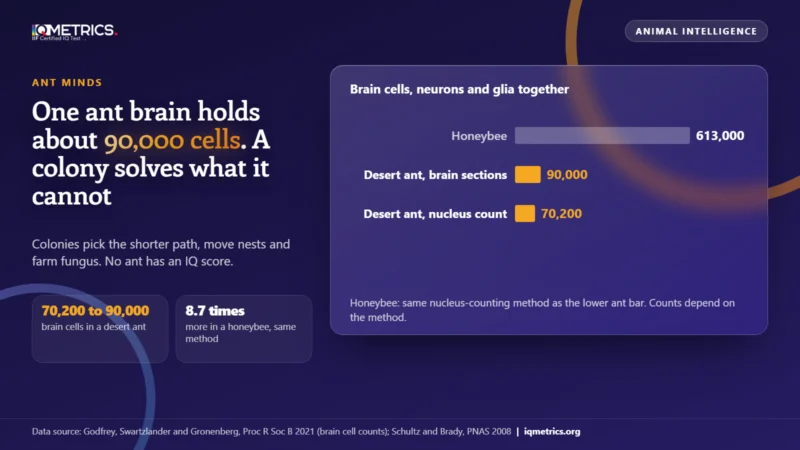 Mind & Everyday Life
Are Ants Smart?
Ants are smart as colonies: they pick shorter paths, move nests and farm fungus, with a desert ant brain of only about 70,200 to 90,000 cells against 613,000 in a honeybee. No ant has an IQ score, and the mirror-test claim has not been independently verified. See what each study shows.
 Understanding IQ
Crow and Raven IQ
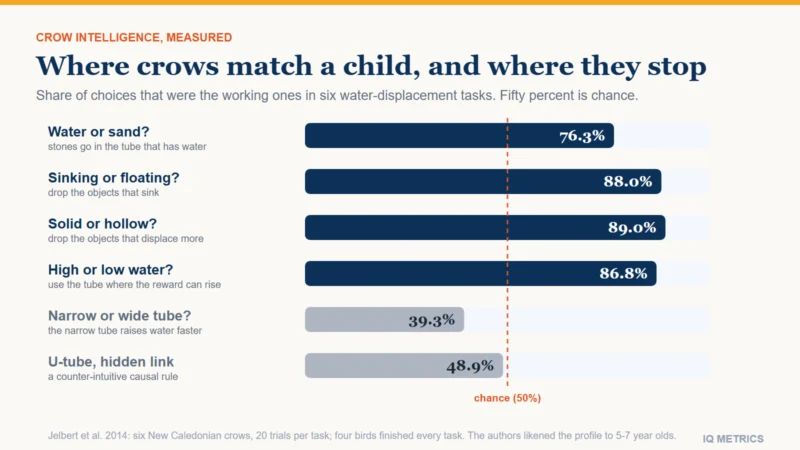
A crow has no IQ, but tests show what corvids can do: bend wire, plan hours ahead, count their own calls. The 7-year-old comparison traces to one 2014 study of six crows, who were at chance on two of six puzzles.
 Understanding IQ
Octopus IQ
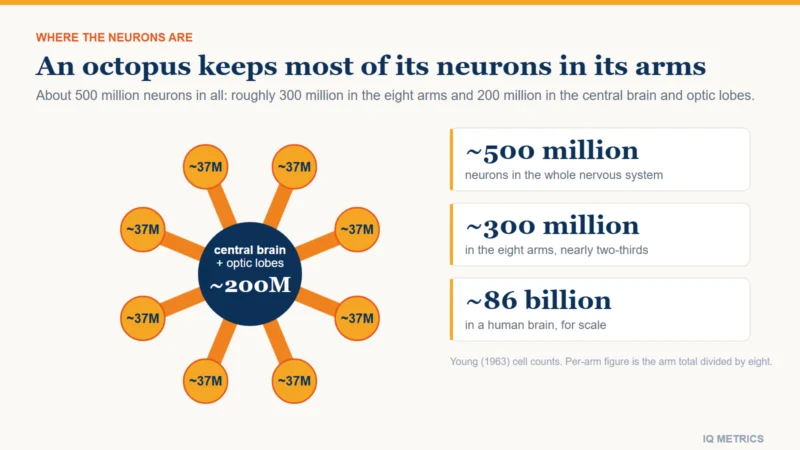
An octopus has no IQ, but it has about 500 million neurons, most of them in its arms. The neuron count, the tool-use and recognition studies, why short lives leave no room for teaching, and why UK law now treats octopuses as sentient.