



What was J.R.R. Tolkien’s IQ?
A Second Class hides an “alpha plus” in philology, then a First in 1915 and thirty-four years across two Oxford chairs — yet no site we opened puts a number on the IQ people search for.
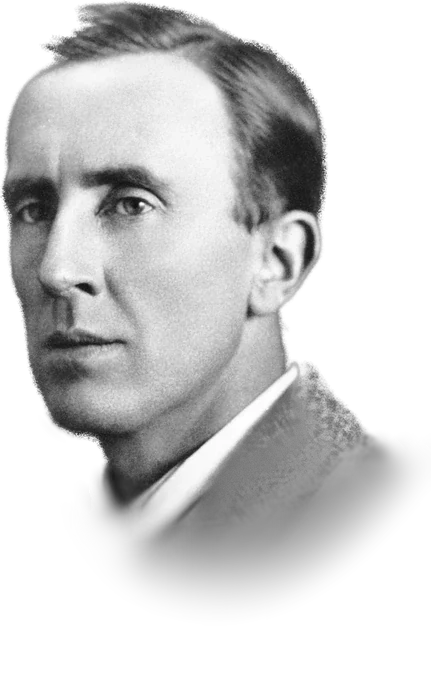
No IQ test result for J.R.R. Tolkien has been published, and no page we could open — including the aggregator sites that print numbers for other writers on this site — states one either. What is documented, a First Class Oxford degree salvaged from a weak start and thirty-four years across two Oxford chairs, supports an estimated IQ of 150–165: an inference from a career, not a score.
J.R.R. Tolkien’s estimated IQ
- A Second Class in Honour Moderations in 1913 — the halfway Classics exam — redeemed by an “alpha plus” in his special subject, Comparative Philology, after which his tutors let him switch to the English School; he graduated with a First Class degree in English Language and Literature at Exeter College, Oxford, in June 1915.
- Assistant Lexicographer on the Oxford English Dictionary from late 1918 to 1920, drafting etymologies for words beginning with W, including warm, waggle, wain and waistcoat; he later said he “learned more in those two years than in any other equal period of” his life.
- Reader (1920) then Professor (1924) of English Language at the University of Leeds, followed by the Rawlinson and Bosworth Professorship of Anglo-Saxon at Oxford (1925–1945) and the Merton Professorship of English Language and Literature (1945–1959) — thirty-four years across Oxford’s two chairs in English, held without ever sitting a doctorate.
- Documented command of Old English, Old Norse, Middle English and Gothic, taught to undergraduates, alongside the Latin, Greek, French and German of his schooling and a further, self-directed study of Welsh and Finnish.
- “Beowulf: The Monsters and the Critics” (the Sir Israel Gollancz Memorial Lecture, British Academy, November 25, 1936), the Clarendon edition of Sir Gawain and the Green Knight with E. V. Gordon (1925), and, built on the side as a separate hobby, the constructed languages Quenya and Sindarin, which underpin The Hobbit (1937) and The Lord of the Rings (1954–1955).
This is an inference from a documented career, not a measurement: the transcript behind it is genuinely mixed, a Second Class alongside the “alpha plus” and the First that followed it, and neither Oxford chair required a doctorate Tolkien never sat for. No circulating figure exists to weigh the range against, sourced or not — every aggregator and quiz page we could open for a Tolkien IQ score returns a question, not a number, which is unusual among the writers on this site.
- Born
- January 3, 1892, Bloemfontein (then capital of an independent Boer republic)
- Died
- September 2, 1973, Bournemouth, England, aged 81
- Education
- Exeter College, Oxford — Second Class, Honour Moderations, 1913 (“alpha plus” in Comparative Philology); First Class Honors, English Language and Literature, 1915
- Oxford English Dictionary
- Assistant Lexicographer, late 1918 to 1920, on words beginning with W
- Professorships
- Rawlinson and Bosworth Professor of Anglo-Saxon, Oxford, 1925–1945; Merton Professor of English Language and Literature, 1945–1959
- Documented languages studied
- Latin, Greek, French and German at school; Old English, Old Norse, Middle English and Gothic as a philologist; Welsh and Finnish by choice
- Invented languages
- Quenya (Latin- and Finnish-influenced) and Sindarin (Welsh-influenced), among other constructed languages built for Middle-earth
- Circulating IQ figure
- None found — no page we could open states a number
What an IQ of 150–165 actually means
Set the claim aside for a moment. If someone genuinely scored in this range, here is what that would represent.
| Score range | Classification | Share of people | What it indicates |
|---|---|---|---|
| 85 – 114 | Average | ~68% | The range most people fall into. |
| 115 – 129 | Above average | ~13.6% | Roughly one person in seven. |
| 130 – 144 | Gifted | ~2% | The threshold most high-IQ societies use. |
| Above 144 | Highly gifted | ~0.1% | Figures above this range are extrapolated from the curve rather than measured. |
Percentages are approximate and describe a normal distribution. The same number means different things on tests with different standard deviations.
Thirty questions gives you a measured position on this exact scale — your score, your percentile and the ability breakdown behind it.
Find out in 30 minutes →Who J.R.R. Tolkien was
John Ronald Reuel Tolkien was born on January 3, 1892, in Bloemfontein, in what was then the Orange Free State, where his father worked for a bank; after his father’s death in 1896 his mother brought him and his brother back to England, settling near Birmingham. He won a place at King Edward’s School, Birmingham, and matriculated at Exeter College, Oxford, on October 17, 1911, aged nineteen, as a Classics exhibitioner. In 1913 he took a Second Class in Honour Moderations, the halfway examination of the four-year Classics course, with an “alpha plus” in his special subject, Comparative Philology; his tutors allowed him to switch to the English School, and in June 1915 he graduated with a First Class degree in English Language and Literature. He was commissioned into the Lancashire Fusiliers that July.
He served at the Battle of the Somme in 1916, including actions at the Schwaben Redoubt and the Leipzig Salient, before trench fever, contracted on October 27, forced his evacuation to England on November 8, 1916; he remained on the army’s books, mostly on home service, until his formal discharge on November 3, 1920. From late 1918 he worked as an Assistant Lexicographer on the Oxford English Dictionary, drafting etymologies for words beginning with W, among them warm, waggle, wain and waistcoat, until 1920. He later called the work formative, saying he “learned more in those two years than in any other equal period of” his life.
The dictionary work led directly into an academic career: Reader in English Language at the University of Leeds in 1920, a professorship there in 1924, and, in 1925, the Rawlinson and Bosworth Professorship of Anglo-Saxon at Oxford, a chair he held at Pembroke College until 1945. With E. V. Gordon he produced the Clarendon edition of Sir Gawain and the Green Knight (1925), still assigned to students; on November 25, 1936, he delivered “Beowulf: The Monsters and the Critics” as the Sir Israel Gollancz Memorial Lecture to the British Academy, arguing that the poem’s monsters were central rather than a distraction, a lecture credited with redirecting Beowulf scholarship toward literary criticism. In 1945 he moved to the Merton Professorship of English Language and Literature, which he held until his retirement in 1959, thirty-four years across Oxford’s two chairs in English.
Alongside Old English, Old Norse, Middle English and Gothic, the core of his teaching, and the Latin, Greek, French and German of his schooling, Tolkien studied Welsh and Finnish by choice; he described discovering a Finnish grammar as “like discovering a complete wine-cellar filled with bottles of an amazing wine of a kind and flavour never tasted before,” in a 1955 letter to W. H. Auden. That reading fed a separate, self-described hobby: inventing languages. Quenya, sketched from 1915 onward, drew its sound mainly from Latin with elements of Finnish; Sindarin was given a character modelled on Welsh. Both are spoken by Elves in The Hobbit (1937) and The Lord of the Rings (1954–1955), alongside invented tongues for Dwarves, Orcs and Men, a work of constructed-language design built on, but distinct from, the historical philology he was paid to teach (see IQ and creativity for how the two kinds of ability relate). He was appointed CBE in the 1972 New Year Honours and held honorary doctorates from the National University of Ireland (1954), Oxford (1972) and Edinburgh (1973); he died in Bournemouth on September 2, 1973, aged eighty-one.
 By Elora Mercer, Celebrity Research WriterFigures checked by Leon Falkner, Data & Research Analyst
Reviewed by Aarav Vardhan, Editor-in-Chief · Last reviewed August 2026

J.R.R. Tolkien: the documented record
The estimate above rests on this record. Every entry here is a matter of public fact, which is more than can be said for the number itself.
- 1892Born January 3 in Bloemfontein.
- 1911Matriculates at Exeter College, Oxford, on October 17 as a Classics exhibitioner.
- 1913Takes a Second Class in Honour Moderations, with an “alpha plus” in Comparative Philology, and switches to the English School.
- 1915Graduates with a First Class degree in English Language and Literature in June; commissioned into the Lancashire Fusiliers in July.
- 1916Serves at the Battle of the Somme; invalided to England on November 8 with trench fever.
- 1920Becomes Reader in English Language at the University of Leeds, after roughly two years as Assistant Lexicographer on the Oxford English Dictionary.
- 1925Appointed Rawlinson and Bosworth Professor of Anglo-Saxon at Oxford, Pembroke College.
- 1936Delivers “Beowulf: The Monsters and the Critics” to the British Academy on November 25.
- 1937Publishes The Hobbit.
- 1954Publishes the first volume of The Lord of the Rings.
- 1973Dies in Bournemouth on September 2.
Why no figure circulates
Following a claim back to its first appearance is the part almost nobody does — and it is what most people are actually asking.
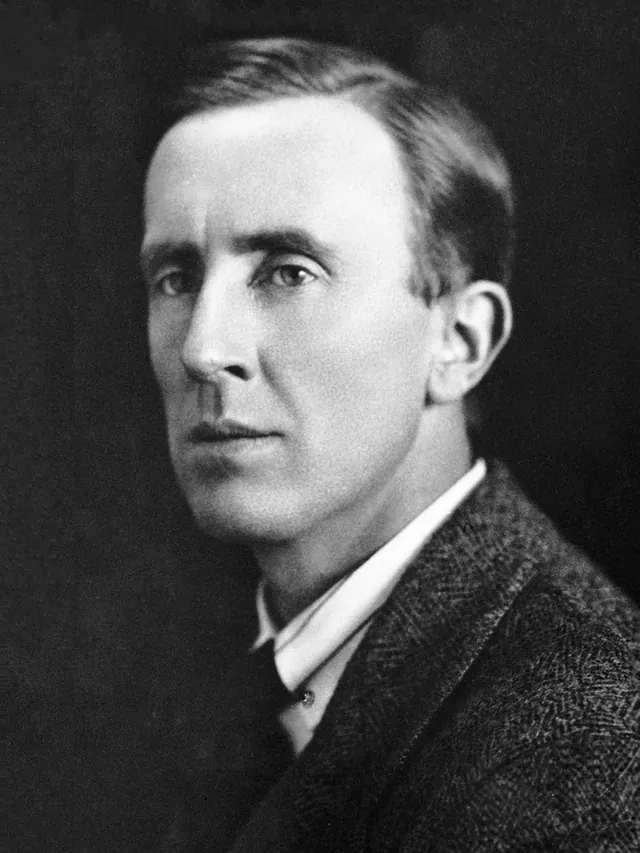
Type “jrr tolkien iq” into a search engine and autocomplete offers “jrr tolkien iq score” and “jrr tolkien iq estimate” before a single page answers with a number. We could not find one. iqcelebs.com titles a page “What Was J.R.R. Tolkien’s IQ?”, but its domain would not resolve for us, so we cannot say what it claims; a Quora thread asks “How intelligent was J.R.R. Tolkien? What is his IQ?” and is blocked to automated readers; and two fan blogs weigh Tolkien’s intelligence against his friend C.S. Lewis’s without ever landing on a figure. The ranking pages that carry numbers for other writers on this site turned up nothing for Tolkien: pumpkinperson.com and corebrain.app return no result, geniuses.club has no page for him despite advertising “30,000+ biographies” with IQ scores, and a public database of crowd-estimated IQs for public figures does not include his name. For how these numbers usually spread from page to page, see where celebrity IQ numbers come from; for Tolkien, nothing spread at all.
The absence has a reason. Alfred Binet and Théodore Simon published the first practical intelligence test in 1905, when Tolkien was thirteen (see the history of intelligence testing); mass IQ testing did not become routine until after the Second World War, by which point he was already in his fifties and the Merton Professor of English Language and Literature at Oxford. answers.com puts the point plainly: “it is extremely unlikely that anyone would have been cheeky enough to ask him to take a test, and even more unlikely he would have consented.” No test, no unsourced blogger guess, no crowd-poll median — the kind of number that survives, however weakly sourced, for a fellow writer on this site such as Stephen King — exists for Tolkien at all.
What is documented reads like the opposite of a dilettante’s reputation for languages. Tolkien took a Second Class in Honour Moderations in 1913, a disappointing result on the Classics course he had started, redeemed by an “alpha plus” — a top mark — in his special subject, Comparative Philology; his tutors let him switch to the English School, where he took a First Class degree in June 1915. Two years as an Assistant Lexicographer on the Oxford English Dictionary followed, drafting etymologies for words beginning with W; he later said he “learned more in those two years than in any other equal period of” his life. A readership, then a professorship, at Leeds (1920–1925) led to the Rawlinson and Bosworth Professorship of Anglo-Saxon at Oxford (1925–1945) and the Merton Professorship of English Language and Literature (1945–1959): thirty-four years across Oxford’s two chairs in English, built without ever sitting a doctorate, on a working command of Old English, Old Norse, Middle English and Gothic, taught to undergraduates alongside the Latin, Greek, French and German of his schooling and a further study of Welsh and Finnish.
Set against the writers on this site whose ranges also rest on achievement rather than a test, 150–165 places Tolkien level with Friedrich Nietzsche (150–165), another philologist-turned-professor who held a chair without a fully examined doctorate, and above Oscar Wilde (140–155), whose Oxford record was in one sense cleaner, a double first straight through Classical Moderations and Greats, but whose academic career stopped at graduation. It sits below Bertrand Russell (160–175), a near-contemporary British don whose high place in the Cambridge Mathematical Tripos and a Nobel Prize in Literature give his range a floor Tolkien’s mixed transcript cannot quite match. None of the three has a sourced test result; each range is this site’s own inference from a documented career, and Tolkien’s runs through a Second Class as often as a First, extremity in one subject rather than excellence across the board.
How we read a number →The Estate’s own account: excellence in French, German, Latin and Greek at school; Old Norse, Old English and Middle English as his university focus within Germanic philology; teaching Old English, Old Norse, Gothic and Germanic philology to undergraduates; a first-class degree in June 1915; the 1920 Leeds readership, 1924 professorship, 1925 Oxford Anglo-Saxon chair at Pembroke College, 1945 Merton chair, and 1959 retirement. Does not name Quenya or Sindarin specifically and gives no IQ figure.
Shippey, an academic authority on Tolkien’s philology, on the Gothic poem Tolkien wrote with his Leeds colleague E. V. Gordon, Tolkien’s work with Old Norse and Old English material, and the distinction between his scholarly study of documented historical languages and his invention of Elvish languages built with a historical depth modelled on real language families. No IQ figure.
Confirms matriculation on October 17, 1911 and that he “changed course to English Language and Literature graduating in 1915 with first class Honors.” No IQ figure.
States the 1913 result verbatim: a “disappointing second class degree” in Honour Moderations “although with an ‘alpha plus’ in philology,” followed by “a first-class degree in June 1915.” Names Classics, Old English, the Germanic languages (especially Gothic), Welsh and Finnish as languages he “immersed himself in”; gives the 1925 Rawlinson and Bosworth appointment and the 1945 move to the Merton Professorship, “which he retained until his retirement in 1959”; names his early invented language, Qenya, as “heavily influenced by Finnish.” No IQ figure.
Wikidata confirms Q892 as the author of The Hobbit and The Lord of the Rings, born January 3, 1892 in Bloemfontein and died September 2, 1973. Wikipedia supplies the Lancashire Fusiliers commission (July 15, 1915), Somme service including the Schwaben Redoubt and Leipzig Salient, trench fever contracted October 27, 1916 with evacuation on November 8, 1916, formal demobilisation on November 3, 1920, the CBE in the 1972 New Year Honours (insignia received March 28, 1972), and honorary doctorates from the National University of Ireland (1954), Oxford (1972) and Edinburgh (July 22, 1973). No IQ figure.
Summarizing Peter Gilliver, Jeremy Marshall and Edmund Weiner’s study: Tolkien served as Assistant Editor on the OED from “the end of 1918” to “the spring of 1920,” with manuscript examples of his draft entries for warm, waggle, wain and waistcoat, and his own verdict, “I learned more in those two years than in any other equal period of my life.” No IQ figure.
Lists Quenya, Sindarin and the other Middle-earth languages as Tolkien’s inventions; states Quenya’s pronunciation drew “more on Latin than on Finnish, though it has elements derived from both,” and that Sindarin was given “a linguistic character very like… British-Welsh.” The Finnish-influences article dates his encounter with the Kalevala to around 1910–1911 and quotes his 1955 letter to W. H. Auden describing Finnish grammar as “like discovering a complete wine-cellar filled with bottles of an amazing wine of a kind and flavour never tasted before.” No IQ figure.
Dates the lecture to November 25, 1936, delivered as the Sir Israel Gollancz Memorial Lecture to the British Academy and first published that year in the Proceedings of the British Academy; describes its argument that Beowulf’s monsters are central to the poem’s meaning, credited with redirecting Beowulf scholarship toward literary criticism. No IQ figure.
answers.com gives no number and explains why none exists: “IQ testing only became commonplace after WWII. By then JRR Tolkien was already in his 50’s and a distinguished Oxford academic. It is extremely unlikely that anyone would have been cheeky enough to ask him to take a test, and even more unlikely he would have consented.” pumpkinperson.com and corebrain.app return no result for a Tolkien search; geniuses.club, which advertises “30,000+ biographies” with IQ scores, has no page for him; the public database of crowd-estimated IQs used elsewhere on this site does not include his name. iqcelebs.com titles a page “What Was J.R.R. Tolkien’s IQ?”, but the domain would not resolve for us, so we could not read it or use it as a source.
No IQ test, score or self-reported figure for J.R.R. Tolkien appears in the Tolkien Estate’s biography, Tom Shippey’s essay, the Exeter College archive, David Doughan’s biographical sketch, Wikipedia or Wikidata, or on any IQ-ranking or aggregator page we could open. Not checked: Quora’s “How intelligent was J.R.R. Tolkien? What is his IQ?” thread and the Tolkien Society’s biography page, both of which blocked automated access.
The sources behind our estimate
The figures that circulate for J.R.R. Tolkien, what we were able to confirm, and where the two diverge.
No page we could open gives a specific number for J.R.R. Tolkien’s IQ. iqcelebs.com titles a page “What Was J.R.R. Tolkien’s IQ?”, but its domain would not resolve for us; a Quora thread, “How intelligent was J.R.R. Tolkien? What is his IQ?”, is blocked to automated readers; and fan blogs weighing his intelligence against C.S. Lewis’s discuss the comparison without ever naming a figure.
No IQ test result, self-reported score, or even an unsourced guess-number for Tolkien appears on any page we could open — not the Tolkien Estate’s biography, Tom Shippey’s essay on Tolkien and philology, the Exeter College archive, David Doughan’s biographical sketch, or Wikipedia and Wikidata. The IQ-ranking sites that carry numbers for other writers on this site have nothing for him either: pumpkinperson.com and corebrain.app return no result for a Tolkien search, geniuses.club (which advertises “30,000+ biographies” with IQ scores) has no page for him, and a public spreadsheet of crowd-estimated IQs for public figures used elsewhere on this site does not include his name. answers.com is the one page that addresses the question directly, and its answer is that no number exists: “IQ testing only became commonplace after WWII. By then JRR Tolkien was already in his 50’s and a distinguished Oxford academic. It is extremely unlikely that anyone would have been cheeky enough to ask him to take a test, and even more unlikely he would have consented.”
There is no outside figure to place on this spread: 150 and 165 are this site’s own low and high for Tolkien, not points anyone else has published. That is itself the finding — for most writers on this site, at least one aggregator prints a number, however weakly sourced; for Tolkien, none does.
Want a number that does hold up? Every figure on this page is somebody’s claim. Take the 30-question test and get a percentile you can check rather than a figure you have to trust.
J.R.R. Tolkien — frequently asked
What is J.R.R. Tolkien’s IQ?
No IQ test result for J.R.R. Tolkien has been published, and no page we could open, including the sites that print numbers for other writers, states one either. From his documented record, a First Class Oxford degree in 1915 and thirty-four years across two Oxford chairs, IQ Metrics estimates a range of 150–165: an inference from a career, not a score.
Did J.R.R. Tolkien ever take an IQ test?
No public record shows that he did. He was thirteen when the first practical intelligence test was published in 1905, and mass testing did not become routine until after the Second World War, by which time he was already in his fifties and the Merton Professor of English Language and Literature at Oxford, an unlikely candidate for anyone to test.
Is J.R.R. Tolkien considered a genius?
No test has certified him one, and “genius” is not a documented status. What is documented is a First Class Oxford degree salvaged from a weak start, thirty-four years across two Oxford chairs, and the historical linguistics behind Quenya and Sindarin: evidence for an estimated IQ level of 150–165, high but not measured.
How many languages could J.R.R. Tolkien read or teach?
His documented record covers Latin, Greek, French and German from school; Old English, Old Norse, Middle English and Gothic, which he taught to undergraduates at Leeds and Oxford; and Welsh and Finnish, both studied by choice rather than assigned. No single source gives an exact total, so this site lists the languages rather than a count.
Did Tolkien speak the languages he invented, like Elvish?
He built them rather than learned them: Quenya and Sindarin are constructed languages, invented by Tolkien with historical depth and internal grammar, not natural languages with native speakers. Quenya drew mainly on Latin with elements of Finnish; Sindarin took its character from Welsh. Both appear in The Lord of the Rings, spoken by Elves.
What degree did J.R.R. Tolkien earn at Oxford?
A First Class degree in English Language and Literature from Exeter College, Oxford, in June 1915. It followed a disappointing Second Class in Honour Moderations, the Classics exam he sat in 1913, where he scored an “alpha plus,” a top mark, in his specialist subject, Comparative Philology, and was allowed to change course.
How does J.R.R. Tolkien’s estimated IQ compare with Friedrich Nietzsche’s or Bertrand Russell’s?
This site places Tolkien at 150–165, level with Friedrich Nietzsche’s 150–165 and below Bertrand Russell’s 160–175. All three ranges rest on achievement and academic record rather than a test; Russell’s Cambridge honors and Nobel Prize in Literature give his range a floor that neither Tolkien’s mixed Oxford transcript nor Nietzsche’s undefended doctorate can quite match.
How does my IQ compare with J.R.R. Tolkien?
You can find out in about fifteen minutes. The IQ Metrics assessment is 30 questions, scored on the same 100-mean scale used throughout this page, so your result and the estimate above are at least expressed in the same units — one measured, one inferred. Once you have a number, the leaderboard shows where it would sit, and how we score and norm it explains the benchmarking.
Where does this estimate come from?
From the documented record rather than a test — the method is named above and set out in full under how we read a number. Compare it against the other writers profiles, starting with Voltaire.
- Take the 30-question IQ test — get a measured score and percentile of your own
- Average IQ by country — how the scale behaves across populations
- How IQ Metrics scores its assessment — the method behind our own number
- More on how IQ testing works — reliability, error and what a score can and cannot say
- More writers profiles — same field, same method
More writers
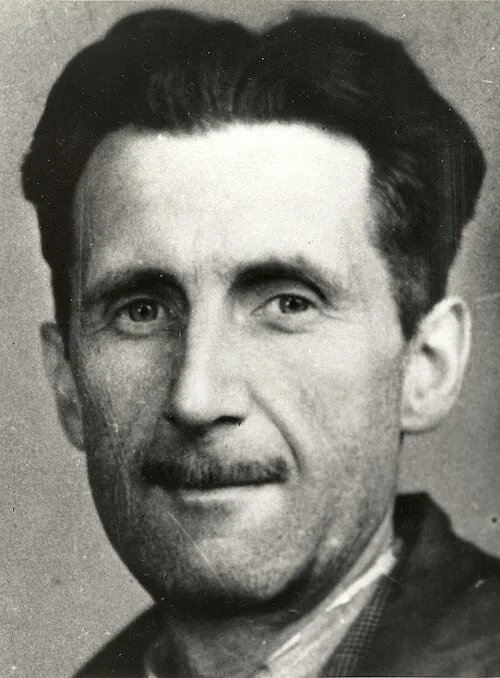
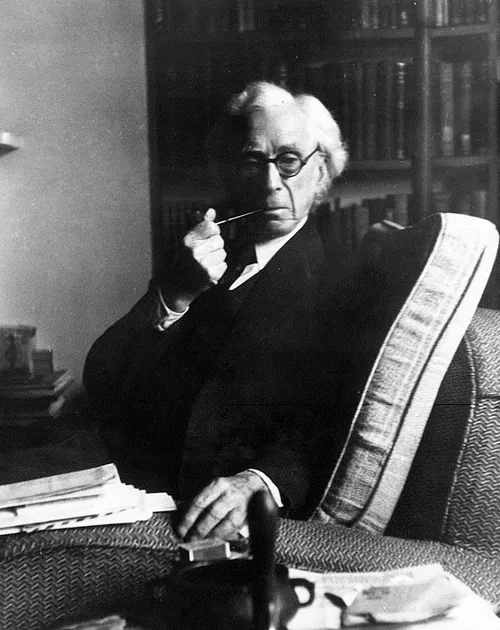
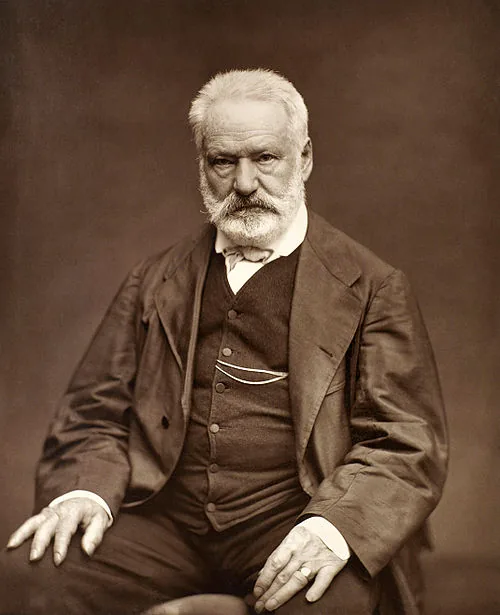
Press photograph by the Branch of the National Union of Journalists (1943), public domain. Background removed for the portrait above. · Photograph, 1954, via Wikimedia Commons, public domain. · Photograph by Étienne Carjat (1876), public domain. Background removed for the portrait above.


An estimate is an inference.
Yours can be measured.
Thirty questions, scored against general-population benchmarks. Your score, your percentile, your ability breakdown and a printable IIF certificate.
Find your IQ score now! →