





Horse IQ: How Smart Are Horses Compared With Dogs and Humans?
Horses have no IQ score: no validated test gives one. Studies measure single skills instead. Horses matched a herd-mate's call to the right horse, reacted to human laughter and growls, and gave weak evidence on quantity. Their brain weighs about 599 g. Clever Hans shows why animal tests need controls.

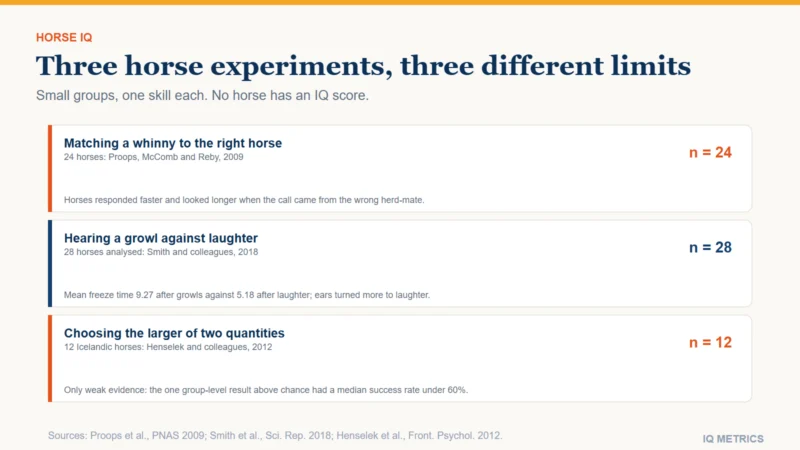
Horses do not have an IQ score. No validated intelligence test produces one for any horse, so a number quoted as a horse IQ is not a test result. What researchers have measured is a set of separate abilities, nearly always in small groups: 24 horses matched a herd-mate’s whinny to the horse they had just watched, 28 horses reacted differently to recorded human laughter and growling, and 12 Icelandic horses gave only weak evidence of telling a larger quantity from a smaller one. The brain behind this is large in absolute terms and modest in proportion to the body: across 131 horses it weighed 599 g on average, about 0.12% of body weight. This guide sets out what the studies found, how horses compare with dogs, pigs and humans, what Clever Hans taught psychologists about testing animals, and why “are horses smarter than dogs” cannot be settled on today’s evidence.
- Horse IQ: none. There is no norm sample and no standard test, so researchers test one skill at a time, usually in a few dozen animals or fewer.
- Brain: 131 horses had a mean fresh brain weight of 598.63 g at a mean body weight of 514.12 kg, giving an encephalization quotient of 0.78 (Cozzi and colleagues, 2014).
- Recognition: in a 24-horse experiment, horses responded faster and looked at the speaker more when a herd-mate’s whinny came from the wrong horse (Proops, McComb and Reby, 2009).
- Emotion: 28 horses froze for longer after recorded growls than after laughter (Smith and colleagues, 2018).
- Quantity: contested. A 2009 study reported horses choosing the larger of two small sets; a 2012 study of 12 Icelandic horses found weak evidence.
- Method: a 2025 systematic review of 86 articles found that studies often leave out breed, housing and feeding, which makes results hard to compare.
Is there a horse IQ test?
No. An IQ score is a position on a bell curve: a test is given to thousands of people, the results are ranked and each person’s rank is printed on a scale whose average is 100 (see what an IQ of 100 means for the middle of that scale, with an IQ of 95 and an IQ of 105 just either side). Nothing like that exists for horses. There is no standard test, no norm sample and no agreed way to compare an Arabian with a Shetland pony, so researchers run single experiments, each measuring one narrow skill in a small group, and report whether the animals beat chance. Our explainer on how IQ tests work shows what a real score needs that a horse experiment lacks.
A 2025 systematic review in Animal Cognition shows how the field is organised. Ricci-Bonot, Brosche, Baragli and Nicol screened 1,954 records, kept 86 research articles on equine cognition and sorted them by skill: discrimination learning (28 studies), learning sets, categorisation and concept formation (27), spatial cognition (8), memory (12) and social learning. Each study tests one skill. None of them adds the skills up into a score. Popular lines such as “a horse has the mind of a toddler” borrow the idea of mental age (see IQ and mental age), but we found no published test that produced such a number for horses.
How big is a horse's brain?
Large in absolute terms, small for the body. In a 2014 paper in Brain, Behavior and Evolution, Cozzi, Povinelli, Ballarin and Granato weighed the fresh brains of 131 horses. The mean was 598.63 g (standard error 7.65) at a mean body weight of 514.12 kg (standard error 15.42). On our arithmetic that is a brain of about 0.12% of body mass. The authors calculated an encephalization quotient of 0.78 and a cerebellar quotient of 0.841. An encephalization quotient below 1 means a brain smaller than a formula expects for that body size, and it depends on the formula and on the sample, so read 0.78 as one estimate from one set of animals.
The horse is much larger than a dog, a cat or a pig, so a brain of 599 g says little on its own. Scientists therefore compare brain with body or count neurons. Our guides to dog IQ, cat IQ and pig IQ quote cortical neuron counts (a cat about 250 million, one pig 307 million, a small mixed-breed dog 429 million, a golden retriever 627 million), and elephant IQ gives the African elephant. We found no matching count for the horse, so no table can place it among them, and a figure for the horse would have to be invented.
Can horses recognise individuals by sight and sound?
Yes, in the way the experiments test it. In a study published in PNAS in 2009, Proops, McComb and Reby tested 24 horses. Each horse watched a familiar herd-mate being led out of sight behind a barrier. After a delay of at least 10 seconds, a whinny was played from a speaker near the barrier. It came either from the horse that had just disappeared or from a different familiar herd-mate, and each horse had four counterbalanced trials. Horses responded faster when the call did not match the horse they had seen (P = 0.035), looked towards the speaker more often (P = 0.042) and looked for longer in total (P = 0.034). The authors read this as evidence that horses hold a representation of each companion that links the sight and the sound.
A follow-up in Proceedings of the Royal Society B in 2012, by Proops and McComb, carries its finding in the title: the cross-modal recognition of individuals “extends to familiar humans”. We cite it as the title states it and report no sample size, because the full methods are in the paper. Playing the call from a speaker is a basic control of this kind: the horse hears a sound that no person is producing at that moment, which matters for the Clever Hans question further down.
Can horses tell a happy human voice from an angry one?
They react differently, which is not the same as understanding the words. In a 2018 playback study in Scientific Reports, Smith, Proops, Grounds, Wathan, Scott and McComb recruited 32 horses and analysed 28 after four were excluded for distraction. In an outdoor riding arena each horse heard laughter (positive) and growling (negative) from male or female speakers, one of each, at least a week apart. The team coded how long the horse froze, what its ears did and its facial movements. Mean freeze time was 9.27 after negative sounds against 5.18 after positive ones (P = 0.006). Horses made more ear movements towards positive sounds (13.61 against 8.46, P = 0.002), and held both ears forward longer towards negative ones (20.22 against 17.73, P = 0.04). No facial action unit differed significantly by emotion.
The authors read the longer freeze and the forward ears after growls as vigilance, which suggests the horses took the negative voice as more threatening. That is a finding about reacting to the tone of a human sound. It is not a finding about vocabulary, and 28 horses from riding settings are not a sample of all horses.
Can horses count or compare quantities?
The answer depends on which study you read. Uller and Lewis reported in Animal Cognition in 2009 that horses reliably chose the larger of two quantities when the numbers were small, in contrasts such as 2 versus 1. A later attempt, by Henselek, Fischer and Schloegl in 2012, tested 12 Icelandic horses, nine of which reached the training criterion. The horses chose between apple slices or wooden blocks in six pairs across three ratios (1:2, 1:3 and 2:3). The authors found only weak evidence of quantity discrimination, and stimulus type made no difference. The one result above chance at group level, for 1 versus 3, came with a median success rate below 60%.
The 2025 review lists a third result: Balestrieri and colleagues (2024) found that horses failed a quantity task and showed a left-side bias. A bias towards one side is a reminder of how easily an animal’s habits, not its understanding of number, can drive the outcome. For comparison, our guides to crow IQ and chimpanzee IQ describe quantity tasks in species where the results are firmer.
Where would your own score land?
Take the IIF-certified assessment and get your score with the scale it was measured on, the percentile it corresponds to and the confidence range around it — the three figures most online tests leave out.
Find your IQ score now! →What else have horses done in the lab?
The review gathers a long list of small experiments. The table picks five from it, with the number of animals and the outcome as the review reports them.
| Task | Horses | Outcome | Study |
|---|---|---|---|
| Pick a symbol to signal blanket preference | 23 | All 23 discriminated the symbols | Mejdell and colleagues, 2016 |
| Tell two dog toys apart | 33 | 27 learned it (81.8%); only one matched real-object training to images | Kappel and colleagues, 2023 |
| Learn “same as” and “different from” | 7 ponies | Four learned it and transferred it to new stimuli | Gabor and Gerken, 2012 |
| Recognise itself in a mirror | 4 | No consistent evidence of self-recognition | Baragli and colleagues, 2017 |
| Detour around a barrier to food | 11 horses, 11 ponies | About 45% of ponies succeeded, against 36% of horses after a demonstration | Henriksson and colleagues, 2019 |
Read the table the way the review does. The groups are small, ponies and horses are not the same, and the percentages come from different set-ups, so none of the rows ranks one horse above another. The mirror result is typical of the field: a test built for apes and elephants does not transfer cleanly. Our guide to elephant IQ describes the mark test and how few species pass it.
What was Clever Hans, and why does it matter for animal IQ?
Clever Hans was a horse in Germany in the early 1900s whose owner, Wilhelm von Osten, said he could do arithmetic by tapping a hoof. A 13-person panel formed by the psychologist Carl Stumpf concluded in September 1904 that there was no trick. The psychologist Oskar Pfungst then ran the controls the panel had not. He showed that Hans was responding to involuntary cues in the questioner’s body language: the questioner’s tension rose as the right number of taps approached and relaxed at the last one. When the questioner did not know the answer, or Hans could not see the questioner, he failed. Pfungst published the work in German in 1907 and in English in 1911 (the English text is online at Project Gutenberg, linked below).
The lesson reached well beyond horses. The “Clever Hans effect” is the name for a subject responding to cues the experimenter does not know they are giving. It is why animal studies often play calls from speakers and use experimenters who do not know the correct answer. The same logic sits behind human testing: an examiner follows a standard script so that nothing in tone or timing helps one person and not another (see how IQ tests work and cultural bias in IQ tests). Hans was showing a real ability, reading people, and it was being credited to arithmetic.
Are horses smarter than dogs?
No study answers it. The claim rests on separate experiments with different animals, tasks and training, and on brain figures that cannot be lined up, because we found a horse brain weight and encephalization quotient but no cortical neuron count to set beside the dog and cat counts. On behaviour, dogs and horses are both tested on recognition of people and on social cues, but never on the same tasks under the same rules. Questions such as horse versus donkey or horse versus cow have the same answer: we found no study that tests them head to head.
For the other animals in our series, see dog IQ, pig IQ, parrot IQ, octopus IQ, dolphin IQ and gorilla IQ. The fair summary is that horses belong with the animals that learn discriminations, recognise familiar individuals across senses and react to the tone of human voices. A single horse IQ would be invented.
Why do horse results come from so few animals?
Because horse cognition has been studied in pockets, and the studies are described unevenly. The 2025 review found that age (96.51% of studies) and sex (95.35%) were nearly always reported, while breed (67.44%), housing (68.60%), riding status (56.98%) and feeding (72.09%) were reported less often. Breed reporting largely disappeared after 2006. Only 3 of 11 multi-breed discrimination studies tested whether breed mattered, and where age or sex was tested it often made no difference, with one exception: older horses learned better in a discrimination study (Kappel and colleagues). Only 2 of 12 memory studies examined contextual factors, with mixed results.
None of that makes the findings wrong. It limits how far they stretch: read “horses can tell a growl from laughter” as “28 horses reacted differently”, and expect better reporting before anyone can rank breeds or compare horses with other species. The review itself calls for better reporting of subject characteristics and for standardised methods.
Quick answers about horse IQ
- What is the IQ of a horse? There is none. No validated test produces a horse IQ.
- What is horse IQ compared to a human? No test compares them. A horse brain weighs about 599 g on average, but there is no neuron count to set beside the human figures.
- Horse IQ vs dog IQ: who wins? Nobody has tested them on the same tasks.
- Are horses smart? They learn discriminations, tell familiar individuals apart by sight and sound and react to the tone of human voices, in small studies.
- Can horses count? Disputed: one 2009 study found a preference for the larger set, a 2012 study of 12 horses found weak evidence.
- Can horses recognise themselves in a mirror? Not shown: four horses showed no consistent evidence of self-recognition.
- What was Clever Hans? A horse that seemed to do arithmetic and was in fact reading his questioner’s body language.
Sources
- Cozzi, B., Povinelli, M., Ballarin, C. and Granato, A. (2014): The brain of the horse: weight and cephalization quotients, Brain, Behavior and Evolution, 83, 9-16.
- Proops, L., McComb, K. and Reby, D. (2009): Cross-modal individual recognition in domestic horses (Equus caballus), PNAS, 106(3), 947-951.
- Proops, L. and McComb, K. (2012): Cross-modal individual recognition in domestic horses (Equus caballus) extends to familiar humans, Proceedings of the Royal Society B, 279(1741), 3131-3138.
- Smith, A.V., Proops, L., Grounds, K., Wathan, J., Scott, S.K. and McComb, K. (2018): Domestic horses (Equus caballus) discriminate between negative and positive human nonverbal vocalisations, Scientific Reports, 8.
- Uller, C. and Lewis, J. (2009): Horses (Equus caballus) select the greater of two quantities in small numerical contrasts, Animal Cognition, 12, 733-738.
- Henselek, Y., Fischer, J. and Schloegl, C. (2012): Does the stimulus type influence horses’ performance in a quantity discrimination task?, Frontiers in Psychology, 3.
- Ricci-Bonot, C., Brosche, K., Baragli, P. and Nicol, C. (2025): A systematic review on the effect of individual characteristics and management practices on equine cognition, Animal Cognition, 28(1), 96 (source of the study counts, reporting rates and the experiments in the table).
- Pfungst, O. (1911): Clever Hans (the horse of Mr. von Osten): a contribution to experimental animal and human psychology, New York: Henry Holt.
Keep reading
All articles →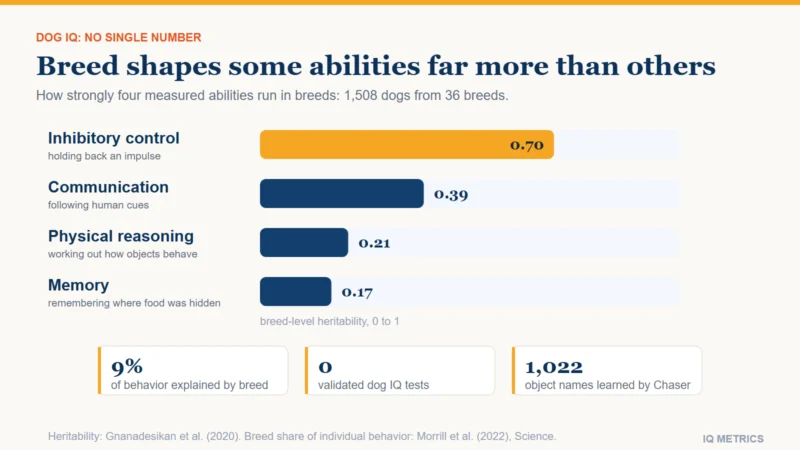 Understanding IQ
Dog IQ
Dogs do not have an IQ: no validated test gives them one. Researchers can measure trainability, memory, self-control and a small general factor, and those results say more about how dogs think than any breed ranking, at-home dog IQ test or "as smart as a toddler" comparison ever could.
 Understanding IQ
Pig IQ
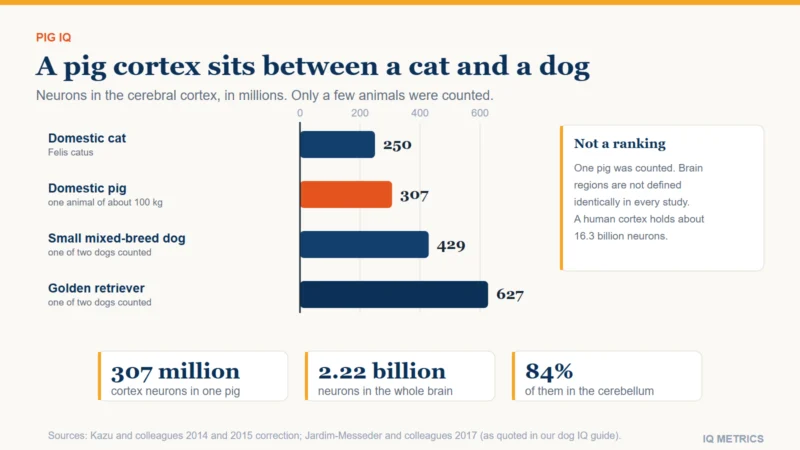
Pigs have no IQ score: no validated test gives one. Studies measure single skills instead. Four pigs acquired a joystick video task, pigs follow each other to food and read some human cues, a mirror result failed to replicate, and one pig cortex held 307 million neurons, between a cat and a dog.
 Understanding IQ
Elephant IQ
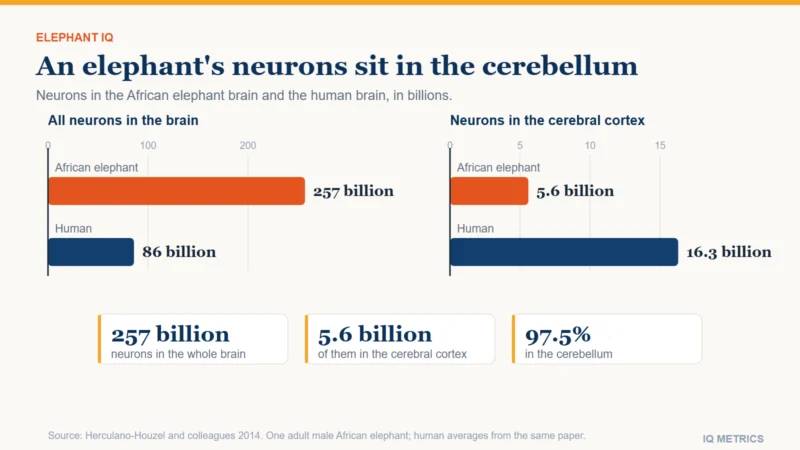
Elephants have no IQ score: no validated test gives one. Studies measure single skills instead. One of three Asian elephants passed the mirror mark test, six waited for a partner before pulling a rope, and wild herds use name-like calls, yet one elephant's cortex held 5.6 billion neurons, a third of the human count.