





Are Lions Smart? What Studies Show About Lion and Tiger Brains, Roar Counting and Teamwork
A lion's cortex holds about 545 million neurons, almost the same as a dog's, from a brain 2.3 times heavier. See how lion and tiger brains compare with house cats, what roar playbacks and cooperation studies found, what captivity does to brain size, and why no big cat has an IQ.

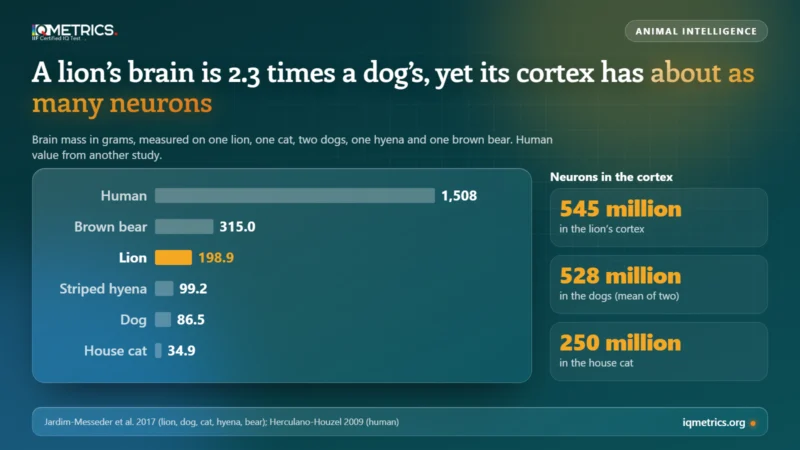
Are lions smart? Yes, in the ways tested so far. Wild lionesses weigh the odds of a fight by listening to roars, and they cooperate in guarding territory. No test gives a lion an IQ, though. The one lion whose brain was counted had about 545 million neurons in its cortex, almost the same as a dog’s, from a brain 2.3 times heavier.
That is the new part of this page: size and smarts do not line up one for one. Below: how lions and tigers compare with house cats and dogs, how big their brains are, what the roar-playback and cooperation studies found, and why no IQ number exists.
Key takeaways
- A lion brain weighed 198.9 g in a published count: 2.3 times a dog’s (86.5 g, mean of two dogs) and 5.7 times a house cat’s (34.9 g). A human brain weighs about 1,508 g.
- The lion’s cortex held 545 million neurons, against 528 million for the dogs and 250 million for the cat. A golden retriever had more (627 million) than the lion.
- Wild female lions treat three roaring strangers as more dangerous than one, and approach more cautiously. The best predictor was the ratio of defenders to intruders.
- Some lionesses lead in territorial defence and others lag, and the leaders do not punish the laggards.
- Captive-bred big cats generally have smaller brains than wild ones. No big cat has an IQ, because no like-for-like test exists.
How smart are lions and tigers compared with house cats, dogs and other predators?
Lions and tigers are clever predators, but lion intelligence has never been ranked against cats and dogs on one scale. The best evidence is brain size, neuron counts and a few behaviour tests, and it gives a mixed picture.
Are big cats smarter than house cats? Their brains are far bigger, but not in proportion to their cortical neuron counts. In the 2017 study that counted neurons in eight carnivorans, one lion (180 kg) had a brain of 198.9 g and 545 million cortical neurons. One house cat (4.5 kg) had a brain of 34.9 g and 250 million. So the lion’s brain was 5.7 times heavier and its cortex held 2.2 times as many neurons. Our cat intelligence page covers the house cat.
| Animal | Body mass (kg) | Brain mass (g) | Cortex neurons (millions) | Animals measured |
|---|---|---|---|---|
| House cat | 4.5 | 34.9 | 250 | 1 |
| Dog | 19.7 | 86.5 | 528 | 2 (mean) |
| Striped hyena | 40 | 99.2 | 495 | 1 |
| Lion | 180 | 198.9 | 545 | 1 |
| Brown bear | 350 | 315.0 | 251 | 1 |
| Human (adult male) | n/a | 1,508 | 16,000 | brain mass and neuron count from other studies |
The big finding is in the last column pair. The lion’s cortex holds 1.03 times the dogs’ neurons from a brain 2.3 times heavier. The brown bear, at 315.0 g, has only 251 million, which is 46% of the lion’s. The authors say cortical neuron counts seem to level off near 500 to 600 million in the larger carnivorans. A human cortex holds about 16 billion, 29 times the lion’s figure. Our dog intelligence page, bear page and elephant page give the same comparison for other animals.
Caution: this is one lion, one cat and two dogs, one brain hemisphere each. It shows what is possible, not an average for every lion. On the puzzle-box side, a study of 39 carnivore species found that animals with larger brains relative to body mass opened the boxes more often, and that measures of social complexity did not predict success. Are tigers smart? That study does not single them out, and fewer tests have used tigers than lions.
How big is a lion or tiger brain, and what does captivity do to it?
A lion brain weighed 198.9 g in the 2017 count. A tiger’s braincase is larger: CT scans of skulls gave an average volume of 289 cm3 for tigers and 244 cm3 for lions, an 18% gap.
That is the lion vs tiger brain size comparison from one 2016 study of 13 wild-cat species (75 skulls, scanned with CT). The numbers are the volume of the braincase, not the weight of the brain, so do not set them beside the grams above. For scale, the same table gives the wildcat, the house cat’s wild relative, 39 cm3.
A study of lions and tigers from 2009 measured skull volume against skull length. It found that tigers have a larger brain for their skull length than lions, leopards or jaguars.
Captivity matters. The same 2009 paper reports that captive-bred big cats generally have a reduced brain size compared with wild animals. The 2016 study tried to avoid captive animals for that reason. So a zoo lion’s skull is not a fair stand-in for a wild lion’s. Our famous brains weighed study and smartest animals study compare more species.
One more finding concerns teamwork. Across the 13 cat species, being social did not predict a bigger brain overall. But lions, the only truly social cat, had the largest relative anterior cerebrum, a region that includes the frontal cortex, and female lions had a larger one than males. The authors say this may reflect a female’s more complex social world, and that more studies are needed.
Are lions smart enough to count and cooperate?
Lions do not count aloud, but wild females act as if they compare numbers. They approach three roaring strangers less often than one, and more cautiously when they do.
Can lions count? The roar-playback study, as summarised in a 2017 review, played recordings of one or three unknown females roaring to wild lionesses. The lions were less likely to approach three intruders. The best predictor of approach was the ratio of adult defenders to intruders, which suggests they combined what they saw with what they heard. The original paper is McComb, Packer and Pusey (1994). Its own text was not available to us, so we rely on the review.
The review adds two more studies. In a study of males, a lone male was slower to approach three unknown males than one, though males approached almost every time: 3 failures in 36 playbacks. In a crowded area, lions approached faster than in a quiet one and did not slow down for bad odds. So the skill is there, but lions may not use it when competition is high.
Cooperation is less tidy. In a 1995 Science study, playback of aggressive calls showed that some lionesses consistently led the approach and others lagged behind and avoided the risk. The leaders recognised the laggards but did not punish them. The authors conclude that cooperation in large groups is not held together by simple tit-for-tat.
A third study found that lions beat leopards and tigers on measures of innovation and exploration at a puzzle box. We know that only through a 2016 paper that describes it, and we did not read the original. We also read no hunting study for this page, so the evidence above is about territorial contests.
Where would your own score land?
Take the IIF-certified assessment and get your score with the scale it was measured on, the percentile it corresponds to and the confidence range around it — the three figures most online tests leave out.
Find your IQ score now! →Why is there no IQ number for a big cat?
There is no lion IQ because an IQ is a score on a human test, set against a norm group of people. No lion or tiger has taken such a test, and none could.
An IQ test sets the average of its norm sample at 100 and one standard deviation at 15 points. Our IQ percentile calculator works only on that scale. Animal studies use other tools: brain mass, neuron counts, puzzle boxes and playback. Each measures one thing, and none is like-for-like with a human score. Any lion IQ you see online is a guess.
Even for people, national and group figures need care: see average IQ in Russia, where two published figures differ by 7.49 points. Our sea lion page, orca page and human brain vs dog brain guide say the same about other animals.
You can measure your own memory, which is one skill animal studies also test. Try our memory game, then take the IQ test for a score on the human scale.
Quick answers
- Are lions smart? Yes, in the social ways tests have measured: they compare the number of roaring intruders with their own numbers, and lionesses cooperate in territory defence.
- How smart are lions compared with house cats? A lion’s brain is 5.7 times heavier and its cortex holds 2.2 times the neurons, in the one lion and one cat measured.
- How smart are tigers? Few studies test tigers. Their braincase is about 18% larger than a lion’s, and captive-bred big cats have smaller brains.
- Can lions count? Wild females respond to the ratio of defenders to intruders in roar playbacks, which suggests they compare numbers.
- What is a lion’s IQ? There is none. No like-for-like test exists.
Sources
- Jardim-Messeder D et al. Dogs have the most neurons, though not the largest brain. Frontiers in Neuroanatomy, 2017 (full text read on 22 November 2026).
- Herculano-Houzel S. The human brain in numbers. Frontiers in Human Neuroscience, 2009, Table 2 (read on 22 November 2026).
- Sakai ST et al. Big cat coalitions: a comparative analysis of regional brain volumes in Felidae. Frontiers in Neuroanatomy, 2016 (full text read).
- Yamaguchi N et al. Brain size of the lion and the tiger. Biological Journal of the Linnean Society, 2009 (abstract read).
- Heinsohn R, Packer C. Complex cooperative strategies in group-territorial African lions. Science, 1995 (abstract read).
- Benson-Amram S, Gilfillan G, McComb K. Numerical assessment in the wild: insights from social carnivores. Philosophical Transactions of the Royal Society B, 2017 (full text read), which describes McComb K, Packer C, Pusey A. Roaring and numerical assessment in contests between groups of female lions. Animal Behaviour, 1994.
- Benson-Amram S et al. Brain size predicts problem-solving ability in mammalian carnivores. PNAS, 2016 (read).
Keep reading
All articles → Mind & Everyday Life
Are Sea Lions Smart?
Sea lions are smart by the tests that exist: one matched shapes it was never taught to pair and remembered a concept after about 10 years, and Ronan kept a beat. No sea lion has an IQ score, and no study compares them with dogs or dolphins. See what each study did and did not show.
 Understanding IQ
Cat IQ
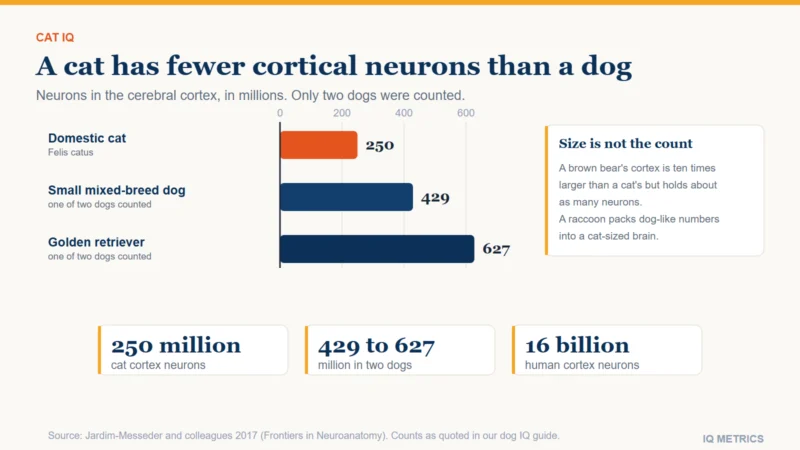
Cats have no IQ: no validated test gives one. Studies measure narrower skills. Cats tell their own names from other words and follow a pointing finger as well as dogs do, but struggle with hidden-object puzzles, and a cat's cortex holds about 250 million neurons against 429 to 627 million in the dogs counted.
 Understanding IQ
Dog IQ
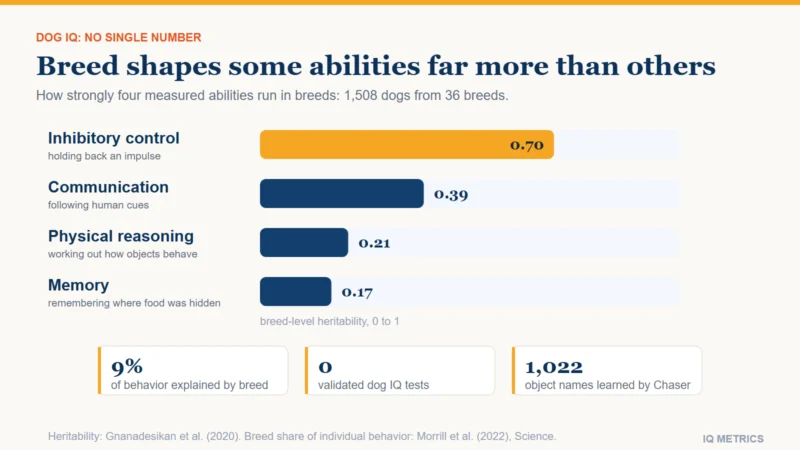
Dogs have no IQ score: no validated test gives one. See dog IQ compared with humans, what researchers measure instead (words, memory, self-control, a gifted border collie that learned 1,022 names), how breeds differ, and how a dog cortex compares with a cat, a pig and a person.