Where were history’s great minds born?
3,553 scientists, mathematicians, inventors and philosophers born 1400-1999, counted by country, century and city: who led per head, the golden ages of cities from Vienna to Edinburgh, and where prize winners moved. Eight charts, every person in the CSV.

By Leon Falkner, Data & Research Analyst · Reviewed by Aarav Vardhan, Editor-in-Chief · Published 28 October 2026 · 12 min read
About this study
- Report type
- Data study combining public records
- Data
- Wikidata (birthplaces, dates, occupations, fame), Our World in Data (population), Nobel Prize API, our prize-winner and Cox (1926) datasets
- Covers
- 3,553 great minds born 1400-1999 in 98 countries (today's borders)
- Licence
- CC BY 4.0 (our tables and CSV); Wikidata and Nobel data CC0; population CC BY 4.0
- Version
- 2026.10
- Sources
- 10
Per head, Switzerland produced the most great minds: according to IQ Metrics’ analysis of 3,553 great minds (scientists, inventors, philosophers and prize winners) born between 1400 and 1999, Switzerland had 5.6 per million people per century, ahead of the United Kingdom (4.9) and the United States (4.7). By count, the United States leads with 950, then the United Kingdom (494), Germany (390) and France (363). New York City (162), London (133) and Paris (102) are the top birth cities. Data: Wikidata, Our World in Data, Nobel Prize API (2026).
01 Key findings
- Switzerland leads per head: 5.6 great minds per million people per century (1400-1999), ahead of the United Kingdom (4.9), the United States (4.7), Sweden (4.0) and Netherlands (3.6), among 23 countries with at least 20 great minds.IQ Metrics analysis of 3,553 great minds; population from Our World in Data
- The lead moved century by century: most great minds were born in Italy in the 1400s (13), in Britain in the 1500s and 1600s, in France in the 1700s (118), in Germany in the 1800s (167) and in the United States in the 1900s (781 of 1,916).IQ Metrics analysis, births by century
- Britain in the 1700s had the highest rate of any country of a million or more before 1900: 10.7 per million people (99 great minds). In the 1900s the highest was Israel, 14.1 per million (28).IQ Metrics analysis; countries with at least 1 million people and 5 great minds in the century
- Cities have golden ages: Vienna produced 37 of its 51 great minds in the 50 years from 1875, Budapest 27 of 34 from 1881. Overall, New York City (162), London (133) and Paris (102) lead.IQ Metrics analysis of 1,938 birth cities
- Many did not stay: 134 of the 397 laureates whose prize work was done in the United States were born abroad (34%). None of the 19 born in today’s Poland did the prize work there.Nobel Prize API, physics, chemistry, medicine and economics, 1901-2026
02 Statistics to quote
great minds born per million people per century in Switzerland, 1400-1999: the highest of 23 countries.
IQ Metrics, 2026great minds born in the United States, the most of any country; 781 were born in the 1900s.
IQ Metrics, 2026per million people in 18th-century Britain, the highest rate of any large country before 1900.
IQ Metrics, 2026of laureates whose prize work was done in the US were born in another country (134 of 397).
Nobel Prize API; IQ MetricsGreat minds cluster in time as much as in place. Britain in the 1700s, Switzerland and Austria in the 1800s and Budapest and Vienna around 1900 produced far more than their size would suggest, and each burst faded.
Leon Falkner, IQ Metrics Research
03 Which country has produced the most geniuses?
It depends on whether you count heads or people. By count, the United States: 950 of the 3,553 great minds in our dataset were born there, ahead of the United Kingdom (494), Germany (390) and France (363). These four account for 62% of everyone counted [1] [3] [5].
Per head, Switzerland. Dividing each country’s great minds by its population in today’s borders [2] gives 5.6 per million people per century for Switzerland, 4.9 for the United Kingdom and 4.7 for the United States. Sweden and the Netherlands complete the top five. The largest countries by population rank low: India (0.03) and China (0.02), where whose great minds are under-counted in Wikidata, which over-represents Europe and North America [10].
Great minds born per million people per century, 1400-1999
Scientists, mathematicians, inventors and philosophers known in 30+ Wikipedia languages, top science prize winners and Cox's 301 geniuses, by country of birth in today's borders, divided by the country's average population over the six centuries. 23 countries with at least 20 great minds and 1 million people are shaded; hatched = not ranked (fewer than 20 great minds, under 1 million people, or no population series).
Source: IQ Metrics analysis of 3,553 great minds; Wikidata [1], population from Our World in Data [2]
Data table
| country | iso2 | value |
|---|---|---|
| Switzerland | CH | 5.6 |
| United Kingdom | GB | 4.9 |
| United States | US | 4.7 |
| Sweden | SE | 4 |
| Netherlands | NL | 3.6 |
| Denmark | DK | 3.4 |
| Norway | NO | 3.4 |
| Austria | AT | 3.3 |
| Canada | CA | 3 |
| Germany | DE | 2.5 |
| France | FR | 2.3 |
| Hungary | HU | 2.2 |
| Belgium | BE | 1.8 |
| Australia | AU | 1.6 |
| Poland | PL | 1.5 |
| Italy | IT | 1 |
| Czech Republic | CZ | 0.9 |
| Russia | RU | 0.7 |
| Ukraine | UA | 0.6 |
| Japan | JP | 0.3 |
| Spain | ES | 0.3 |
| India | IN | 0 |
| China | CN | 0 |
Embed this chart
Paste this HTML into your page: it carries the numbers and the credit link to this figure.
Great minds per million people, the 23 leading countries
| 1 | Switzerland | 65 | 5.6 | 1700s (9.0) |
| 2 | United Kingdom | 494 | 4.9 | 1700s (10.7) |
| 3 | United States | 950 | 4.7 | 1700s (6.0) |
| 4 | Sweden | 59 | 4.0 | 1700s (7.2) |
| 5 | Netherlands | 71 | 3.6 | 1800s (5.9) |
| 6 | Denmark | 29 | 3.4 | 1800s (8.1) |
| 7 | Norway | 23 | 3.4 | 1800s (5.5) |
| 8 | Austria | 65 | 3.3 | 1800s (7.3) |
| 9 | Canada | 60 | 3.0 | 1800s (3.5) |
| 10 | Germany | 390 | 2.5 | 1800s (4.9) |
| 11 | France | 363 | 2.3 | 1700s (4.7) |
| 12 | Hungary | 45 | 2.2 | 1800s (3.3) |
| 13 | Belgium | 36 | 1.8 | 1500s (4.4) |
| 14 | Australia | 20 | 1.6 | 1800s (4.1) |
| 15 | Poland | 96 | 1.5 | 1800s (3.3) |
| 16 | Italy | 119 | 0.99 | 1400s (1.5) |
| 17 | Czech Republic | 27 | 0.94 | 1800s (1.9) |
| 18 | Russia | 130 | 0.66 | 1800s (1.5) |
| 19 | Ukraine | 43 | 0.61 | 1800s (1.2) |
| 20 | Japan | 59 | 0.30 | 1900s (0.62) |
| 21 | Spain | 21 | 0.28 | 1500s (0.53) |
| 22 | India | 43 | 0.03 | 1900s (0.06) |
| 23 | China | 37 | 0.02 | 1900s (0.05) |
Source: Countries (today’s borders) with at least 20 great minds born 1400-1999 and at least 1 million people on average. Best century: the highest rate per million in one century. Every country, with its rank by count and its top birth city, is in the lookup below and the CSV.
04 Which country produced the most great minds in each century?
The lead moved with the centre of science. Italy led the 1400s (13); Britain led the 1500s (17) and 1600s (43); France the 1700s (118); Germany the 1800s (167); and the United States the 1900s, when 781 of the 1,916 great minds born that century were American-born.
Which country produced the most great minds, century by century
Rank by the number of great minds born in each century (1 = most), for the 8 countries with the most over all six centuries; ties share a rank. A gap = ranked below 12th that century.
Source: IQ Metrics analysis of 3,553 great minds [1] [3] [5]
Data table
| country | 1400s | 1500s | 1600s | 1700s | 1800s | 1900s |
|---|---|---|---|---|---|---|
| United States | 4 | 3 | 1 | |||
| United Kingdom | 3 | 1 | 1 | 2 | 2 | 2 |
| Germany | 2 | 4 | 4 | 3 | 1 | 3 |
| France | 2 | 2 | 1 | 4 | 4 | |
| Russia | 12 | 11 | 5 | 5 | ||
| Italy | 1 | 3 | 3 | 5 | 8 | 8 |
| Poland | 6 | 6 | 8 | 6 | 10 | |
| Netherlands | 6 | 6 | 5 | 9 | 11 | 10 |
Embed this chart
Paste this HTML into your page: it carries the numbers and the credit link to this figure.
Per head the picture is sharper. Britain reached 10.7 great minds per million people in the 1700s, the Age of Watt, Hume and Adam Smith. In the 1800s the leaders per head were small countries: Switzerland (8.7 per million), Denmark (8.1) and Austria (7.3). In the 1900s Israel led (14.1 per million, 28 great minds), ahead of Switzerland (4.8) and the United States (4.8).
Great minds born per million people, by century
Births in each century divided by the country's average population in that century (millions, today's borders). The 16 countries with the highest rate over 1400-1999 among those with at least 40 great minds. Births after about 1960 are still undercounted: fame takes decades.
Source: IQ Metrics analysis; population from Our World in Data (HYDE 3.3 before 1800, Gapminder, UN WPP) [2]
Data table
| country | 1400s | 1500s | 1600s | 1700s | 1800s | 1900s |
|---|---|---|---|---|---|---|
| Switzerland | 2.9 | 2.2 | 2.7 | 9 | 8.7 | 4.8 |
| United Kingdom | 0.8 | 3.7 | 7.3 | 10.7 | 5.7 | 3.5 |
| United States | 0 | 0 | 0 | 6 | 5.1 | 4.8 |
| Sweden | 0 | 1.6 | 2.8 | 7.2 | 5.9 | 3 |
| Netherlands | 1.2 | 3.8 | 4 | 2.8 | 5.9 | 3.2 |
| Austria | 0.6 | 0.5 | 0 | 0.8 | 7.3 | 4.4 |
| Canada | 0 | 3.5 | 3.2 | |||
| Germany | 1.4 | 0.8 | 0.9 | 4.5 | 4.9 | 1.6 |
| France | 0 | 1 | 1.4 | 4.7 | 2.9 | 2.2 |
| Hungary | 0 | 0 | 0 | 0 | 3.3 | 3 |
| Poland | 0.3 | 0 | 0.7 | 1.2 | 3.3 | 1.1 |
| Italy | 1.5 | 1.3 | 1 | 0.9 | 1.1 | 0.8 |
| Russia | 0 | 0 | 0.1 | 0.2 | 1.5 | 0.6 |
| Ukraine | 0 | 0 | 0 | 0.2 | 1.2 | 0.6 |
| Japan | 0 | 0 | 0 | 0 | 0.1 | 0.6 |
| India | 0 | 0 | 0 | 0 | 0.1 | 0.1 |
Embed this chart
Paste this HTML into your page: it carries the numbers and the credit link to this figure.
Early centuries rest on small numbers (37 great minds born in the 1400s, against 1,916 in the 1900s), and population estimates before 1800 are model estimates [2]. The 1900s are still filling in: only 211 people born in 1960 or later pass the fame test so far.
05 Where were most geniuses born? The top cities and their golden ages
New York City is the birthplace of the most great minds (162), ahead of London (133) and Paris (102), then Vienna (51) and Berlin (49). Most of New York’s were born in the 20th century, many of them later winners of the top science prizes.
Cities also have golden ages, short runs when far more great minds were born there than before or after. Vienna: 37 of its 51 were born in 1875-1924, among them Erwin Schrödinger (1887), Ludwig Wittgenstein (1889), Karl Popper (1902). Budapest: 27 of 34 in 1881-1930, including John von Neumann (1903), Eugene Paul Wigner (1902), Dennis Gabor (1900). Edinburgh‘s busiest half-century was 1726-1775, with 4 of its 14, among them Walter Scott (1771), James Hutton (1726), Daniel Rutherford (1749).
The 15 cities where the most great minds were born, 1400-1999
Great minds born in each city (districts and boroughs counted with their city). Their golden-age windows are in the table below.
Source: IQ Metrics analysis; birthplaces from Wikidata [1]
Data table
| label | value |
|---|---|
| New York City (US) | 162 |
| London (UK) | 133 |
| Paris (France) | 102 |
| Vienna (Austria) | 51 |
| Berlin (Germany) | 49 |
| Chicago (US) | 44 |
| Moscow (Russia) | 37 |
| Boston (US) | 34 |
| Budapest (Hungary) | 34 |
| Philadelphia (US) | 27 |
| Washington, D.C. (US) | 20 |
| Los Angeles (US) | 18 |
| Frankfurt (Germany) | 17 |
| Hamburg (Germany) | 17 |
| Saint Petersburg (Russia) | 16 |
Embed this chart
Paste this HTML into your page: it carries the numbers and the credit link to this figure.
Birth cities and their golden ages
| New York City (US) | 162 | 1911-1960 (135) | Richard Feynman (1918), Carl Sagan (1934), Milton Friedman (1912) |
| London (UK) | 133 | 1910-1959 (43) | Alan Turing (1912), Tim Berners-Lee (1955), Rosalind Franklin (1920) |
| Paris (France) | 102 | 1895-1944 (26) | Jean-Paul Sartre (1905), Simone de Beauvoir (1908), Irène Joliot-Curie (1897) |
| Vienna (Austria) | 51 | 1875-1924 (37) | Erwin Schrödinger (1887), Ludwig Wittgenstein (1889), Karl Popper (1902) |
| Berlin (Germany) | 49 | 1871-1920 (23) | Alfred Wegener (1880), Walter Benjamin (1892), Herbert Marcuse (1898) |
| Chicago (US) | 44 | 1909-1958 (38) | James Watson (1928), Ben Roy Mottelson (1926), Jerome Isaac Friedman (1930) |
| Moscow (Russia) | 37 | 1901-1950 (21) | Andrei Sakharov (1921), Alexei Abrikosov (1928), Vitaly Ginzburg (1916) |
| Boston (US) | 34 | 1917-1966 (20) | Robert Burns Woodward (1917), Carolyn Bertozzi (1966), John McCarthy (1927) |
| Budapest (Hungary) | 34 | 1881-1930 (27) | John von Neumann (1903), Eugene Paul Wigner (1902), Dennis Gabor (1900) |
| Philadelphia (US) | 27 | 1895-1944 (17) | Joseph Hooton Taylor (1941), Vera Rubin (1928), Karl Barry Sharpless (1941) |
| Washington, D.C. (US) | 20 | 1903-1952 (16) | David Gross (1941), Robert Coleman Richardson (1937), Norman Foster Ramsey (1915) |
| Los Angeles (US) | 18 | 1922-1971 (17) | Elinor Ostrom (1933), Lee Hartwell (1939), Eugene Merle Shoemaker (1928) |
| Frankfurt (Germany) | 17 | 1873-1922 (7) | Otto Hahn (1879), Theodor W. Adorno (1903), Erich Fromm (1900) |
| Hamburg (Germany) | 17 | 1882-1931 (8) | Gustav Ludwig Hertz (1887), James Franck (1882), Johannes Hans Daniel Jensen (1907) |
| Saint Petersburg (Russia) | 16 | 1863-1912 (9) | Pyotr Kapitsa (1894), Ilya Frank (1908), Leonid Kantorovich (1912) |
| Wroclaw (Poland) | 16 | 1865-1914 (10) | Max Born (1882), Fritz Haber (1868), Friedrich Bergius (1884) |
| Copenhagen (Denmark) | 14 | 1852-1901 (7) | Niels Bohr (1885), Henrik Dam (1895), Inge Lehmann (1888) |
| Edinburgh (UK) | 14 | 1726-1775 (4) | Walter Scott (1771), James Hutton (1726), Daniel Rutherford (1749) |
| Warsaw (Poland) | 14 | 1867-1916 (11) | Marie Curie (1867), Casimir Funk (1884), Joseph Rotblat (1908) |
| Munich (Germany) | 13 | 1906-1955 (9) | Arno Allan Penzias (1933), Rudolf Ludwig Mössbauer (1929), Wassily Leontief (1906) |
Source: Golden age = the 50-year run of birth years holding the most great minds born in the city, with how many were born in it (the earliest run on a tie). Best known = most Wikipedia languages.
06 Do bigger countries produce more great minds?
Bigger countries produce more, but far from in proportion. Across 1800-1999, the countries sit along a rising band in Figure 5, and small European countries sit well above it. Over the two centuries together, Switzerland had 12.1 great minds per million people and Sweden 7.9, against 1.6 for Russia and 0.97 for Japan. A link like this says nothing about the people themselves; it tracks universities, wealth, and how fully each country’s history is written up in Wikipedia.
Bigger countries, more great minds? 1800-1999
Each bubble is a country: average population over 1800-1999 (across, log scale) and great minds born there in those two centuries (up, log scale). Bubble area = top science prize winners born there. Countries high above others of the same size produced more than their size suggests.
Great minds born 1800-1999
Average population, 1800-1999 (millions)
Source: IQ Metrics analysis [1] [2]; prize winners from our prize study [4]
Data table
| country | population_millions | great_minds_1800_1999 | group | prize_winners |
|---|---|---|---|---|
| Switzerland | 3.7 | 45 | c | 24 |
| United Kingdom | 38.8 | 332 | c | 156 |
| United States | 96.9 | 931 | c | 606 |
| Sweden | 5.3 | 42 | c | 23 |
| Netherlands | 6.8 | 52 | c | 32 |
| Denmark | 2.9 | 24 | c | 12 |
| Norway | 2.4 | 21 | c | 12 |
| Austria | 5.6 | 61 | c | 25 |
| Canada | 9.3 | 60 | c | 40 |
| Germany | 52.9 | 281 | c | 106 |
| France | 40.7 | 201 | c | 79 |
| Hungary | 7.2 | 45 | c | 20 |
| Belgium | 6.6 | 29 | c | 17 |
| Australia | 5.5 | 19 | c | 13 |
| Poland | 22.2 | 82 | c | 33 |
| Italy | 35.7 | 63 | c | 24 |
| Czech Republic | 8.5 | 21 | c | 5 |
| Russia | 75.3 | 124 | c | 44 |
| Ukraine | 27 | 42 | c | 12 |
| Japan | 59.9 | 58 | c | 46 |
| Spain | 21.8 | 11 | c | 5 |
| India | 360.2 | 43 | c | 13 |
| China | 533.1 | 36 | c | 27 |
Embed this chart
Paste this HTML into your page: it carries the numbers and the credit link to this figure.
07 What were each country's great minds famous for?
Across all countries, life sciences and medicine are the largest field (29% of the great minds in these fields), then physics and astronomy (21%) and mathematics (12%). Some countries stand out: mathematics makes up 28% of Russia’s great minds and 27% of Hungary’s, physics 36% of the Netherlands’, and chemistry 20% of Sweden’s. Pick a country to compare.
What each country's great minds were known for
Share of a country's great minds in each field, 1400-1999 (Cox's writers, artists and leaders left out), against all countries together (dashed). Countries with at least 60 great minds in these fields.
Source: IQ Metrics analysis; field from the prize, else the Wikidata description [1] [4]
Data table
| country | maths | physics | chem | life | earth | eng | phil | social |
|---|---|---|---|---|---|---|---|---|
| United States | 5 | 19 | 9 | 36 | 1 | 14 | 4 | 12 |
| United Kingdom | 10 | 19 | 12 | 30 | 3 | 11 | 9 | 6 |
| Germany | 10 | 23 | 12 | 26 | 3 | 5 | 13 | 8 |
| France | 19 | 18 | 9 | 22 | 0 | 7 | 15 | 10 |
| Russia | 28 | 24 | 9 | 8 | 5 | 10 | 8 | 7 |
| Italy | 19 | 26 | 5 | 21 | 0 | 4 | 19 | 5 |
| Poland | 20 | 19 | 10 | 26 | 2 | 5 | 10 | 7 |
| Netherlands | 4 | 36 | 7 | 37 | 0 | 4 | 1 | 9 |
| Austria | 10 | 24 | 11 | 27 | 0 | 3 | 10 | 16 |
| Switzerland | 18 | 16 | 13 | 38 | 2 | 2 | 7 | 5 |
| Canada | 8 | 22 | 8 | 30 | 0 | 12 | 3 | 17 |
| All countries | 12 | 21 | 10 | 29 | 2 | 9 | 8 | 9 |
Embed this chart
Paste this HTML into your page: it carries the numbers and the credit link to this figure.
08 Do great minds stay where they were born?
Among the 754 laureates in physics, chemistry, physiology or medicine and economics with an institution named at the award, 134 of the 397 whose prize work was done in the United States were born in another country, most often the United Kingdom, Canada and Germany [3]. The pull ran one way: of the 19 laureates born in Canada, 15 did the prize work in the United States.
Borders moved too. None of the 19 laureates born in today’s Poland did the prize work there: most were born in German cities such as Breslau, now Wroclaw, and worked in Germany or the United States. This study always uses today’s borders, so Max Born (1882) counts for Poland and Immanuel Kant (1724), born in Konigsberg, counts for Russia.
Born here, did the prize work there
754 laureates of the physics, chemistry, physiology or medicine and economics prizes, 1901-2026: country of birth (today's borders) and the country of the institution named at their first award. Hover or tap a ribbon.
Source: Nobel Prize API 2.1 [3]: birth country and affiliation at the award
Data table
| from | to | laureates |
|---|---|---|
| United States | United States | 263 |
| Other countries | Other countries | 67 |
| United Kingdom | United Kingdom | 66 |
| Other countries | United States | 58 |
| Germany | Germany | 49 |
| France | France | 29 |
| Japan | Japan | 20 |
| United Kingdom | United States | 20 |
| Other countries | United Kingdom | 19 |
| Canada | United States | 15 |
| Other countries | Switzerland | 15 |
| Germany | United States | 11 |
| Russia | Other countries | 10 |
| Other countries | Germany | 10 |
| Poland | Germany | 9 |
| Netherlands | Other countries | 9 |
| France | United States | 8 |
| Other countries | France | 8 |
| Japan | United States | 7 |
| Poland | United States | 6 |
| Russia | United States | 5 |
| United Kingdom | Other countries | 5 |
| Germany | Other countries | 5 |
| Canada | Other countries | 4 |
| Netherlands | United States | 4 |
| Germany | Switzerland | 4 |
| Netherlands | Germany | 3 |
| Germany | United Kingdom | 3 |
| France | Other countries | 3 |
| Russia | Germany | 2 |
| Poland | France | 2 |
| Russia | United Kingdom | 2 |
| United States | United Kingdom | 2 |
| United States | Other countries | 2 |
| Germany | France | 1 |
| France | Switzerland | 1 |
| Russia | Switzerland | 1 |
| Poland | Switzerland | 1 |
| Poland | United Kingdom | 1 |
| Netherlands | United Kingdom | 1 |
| Netherlands | Switzerland | 1 |
| United Kingdom | Switzerland | 1 |
| France | Germany | 1 |
Embed this chart
Paste this HTML into your page: it carries the numbers and the credit link to this figure.
Laureates whose prize work was done in each country, and how many were born elsewhere
| United States | 397 | 134 | 34% |
| United Kingdom | 94 | 28 | 30% |
| Germany | 74 | 25 | 34% |
| France | 40 | 11 | 28% |
| Switzerland | 24 | 12 | 50% |
| Japan | 20 | 0 | 0% |
| Sweden | 18 | 4 | 22% |
| Russia | 12 | 3 | 25% |
Source: Physics, chemistry, physiology or medicine and economics laureates, 1901-2026, with an affiliation at the award; birth country in today’s borders, from the Nobel Prize API [3].
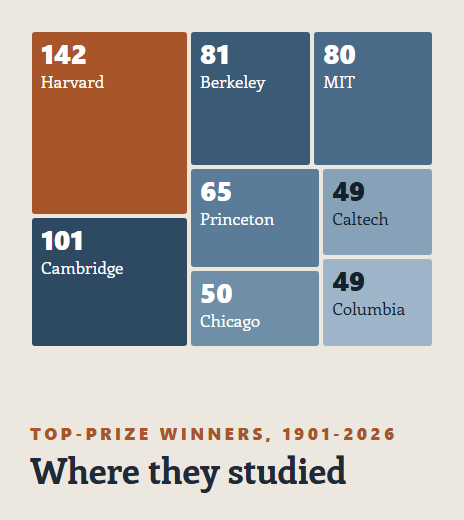
Where the same prize winners studied, from first degree to doctorate, is in our study of universities with the most prize winners; what is and is not known about their IQ is in IQ of Nobel Prize winners.
09 Famous scientists from your country
Pick a country for its count, its rate per head, its best century, its top birth city and the best-known great minds born there. Every country with at least 10 great minds is in the list; all 98 are in the CSV.
Ranks 1st of 23 per capita
- Great minds born 1400-1999
- 65
- Per million people per century
- 5.6
- Rank per capita
- 1st of 23
- Rank by count
- 10th of 98
- Best century
- 1700s (9.0 per million)
- Top birth city
- Geneva (11)
- Main fields
- life sciences 38%, maths 18%, physics 16%
- Top-prize winners born there
- 24
Switzerland: 65 great minds were born in Switzerland between 1400 and 1999, 5.6 per million people per century (1st of 23 countries per capita). Its strongest century per head was the 1700s (9.0 per million). Most were born in Geneva (11). Best known: Leonhard Euler (1707), Jean-Jacques Rousseau (1712), Carl Jung (1875), Jean Piaget (1896), Charles Édouard Guillaume (1861).
How to read it: “per million people per century” divides the great minds born in a country (today’s borders) by its average population over 1400-1999 [2]. Countries with fewer than 20 great minds get counts but no rank.
Great minds are rare in every country. See where your own reasoning stands: take the IQ test
The best-known scientists and thinkers born in each country
| United States | 950 | Thomas Edison (1847), Benjamin Franklin (1706), Richard Feynman (1918), J. Robert Oppenheimer (1904) |
| United Kingdom | 494 | Isaac Newton (1643), Charles Darwin (1809), Adam Smith (1723), James Cook (1728) |
| Germany | 390 | Albert Einstein (1879), Karl Marx (1818), Friedrich Nietzsche (1844), Johannes Gutenberg (1400) |
| France | 363 | René Descartes (1596), Louis Pasteur (1822), Jean-Paul Sartre (1905), Simone de Beauvoir (1908) |
| Russia | 130 | Immanuel Kant (1724), Dmitri Mendeleev (1834), David Hilbert (1862), Ivan Pavlov (1849) |
| Italy | 119 | Leonardo da Vinci (1452), Galileo Galilei (1564), Enrico Fermi (1901), Florence Nightingale (1820) |
| Poland | 96 | Marie Curie (1867), Nicolaus Copernicus (1473), L. L. Zamenhof (1859), Arthur Schopenhauer (1788) |
| Netherlands | 71 | Benedictus de Spinoza (1632), Hendrik Lorentz (1853), Christiaan Huygens (1629), Antonie van Leeuwenhoek (1632) |
| Austria | 65 | Erwin Schrödinger (1887), Ludwig Wittgenstein (1889), Karl Popper (1902), Wolfgang Pauli (1900) |
| Switzerland | 65 | Leonhard Euler (1707), Jean-Jacques Rousseau (1712), Carl Jung (1875), Jean Piaget (1896) |
| Canada | 60 | Donna Strickland (1959), Frederick Banting (1891), Jordan Peterson (1962), Marshall McLuhan (1911) |
| Sweden | 59 | Carl Linnaeus (1707), Alfred Nobel (1833), Tycho Brahe (1546), Anders Celsius (1701) |
| Japan | 59 | Hideki Yukawa (1907), Shinichiro Tomonaga (1906), Masatoshi Koshiba (1926), Leo Esaki (1925) |
| Hungary | 45 | John von Neumann (1903), Eugene Paul Wigner (1902), Dennis Gabor (1900), Ignaz Semmelweis (1818) |
| India | 43 | Chandrasekhara Venkata Raman (1888), Srinivasa Ramanujan (1887), Ronald Ross (1857), Amartya Sen (1933) |
| Ukraine | 43 | Élie Metchnikoff (1845), Sergei Korolev (1907), Georges Charpak (1924), Selman Abraham Waksman (1888) |
| China | 37 | Tu Youyou (1930), Chen-ning Yang (1922), Walter Houser Brattain (1902), Tsung-Dao Lee (1926) |
| Belgium | 36 | Andreas Vesalius (1515), Georges Lemaître (1894), François Englert (1932), Gerardus Mercator (1512) |
| Denmark | 29 | Niels Bohr (1885), Hans Christian Ørsted (1777), Ole Rømer (1644), Aage Bohr (1922) |
| Israel | 28 | Ada Yonath (1939), Daniel Kahneman (1934), Dan Shechtman (1941), Aaron Ciechanover (1947) |
| Czech Republic | 27 | Sigmund Freud (1856), Gregor Mendel (1822), Kurt Gödel (1906), Edmund Husserl (1859) |
| Norway | 23 | Niels Henrik Abel (1802), Ivar Giæver (1929), May-Britt Moser (1963), Ragnar Frisch (1895) |
| Spain | 21 | Santiago Ramón y Cajal (1852), Santiago Calatrava (1951), Michael Servetus (1511), Severo Ochoa (1905) |
| Ireland | 21 | Robert Boyle (1627), Ernest Walton (1903), William Rowan Hamilton (1805), William C. Campbell (1930) |
| Australia | 20 | William Lawrence Bragg (1890), Alexander Prokhorov (1916), Elizabeth Blackburn (1948), Barry Marshall (1951) |
| Finland | 16 | Linus Torvalds (1969), Artturi Ilmari Virtanen (1895), Elias Lönnrot (1802), Ragnar Granit (1900) |
| Romania | 13 | Stefan Hell (1962), George Emil Palade (1912), Emil Cioran (1911), Hermann Oberth (1894) |
| Argentina | 12 | Javier Milei (1970), Bernardo Houssay (1887), César Milstein (1927), Alberto Granado (1922) |
| Belarus | 11 | Zhores Alferov (1930), Lev Vygotsky (1896), Simon Kuznets (1901), Yakov Zeldovich (1914) |
| Turkey | 11 | Dani Rodrik (1957), Aziz Sancar (1946), Daron Acemoğlu (1967), Henri Fayol (1841) |
Source: The 30 countries with the most great minds born 1400-1999. Cox’s writers, artists and leaders are left out of the names. Linked names have an IQ Metrics profile.
Linked names open our profiles; more are in the IQ of famous scientists. Cox’s 1926 IQ estimates for 301 of history’s great minds are in IQ of 301 historical geniuses, and what counts as a genius score on an IQ test today is explained in what is genius IQ level.
10 How is this different from Pantheon and other rankings?
Several projects map famous people by birthplace. Pantheon counts globally famous biographies by country and city [6]; Laouenan and colleagues built a database of 2.29 million notable people [7]; Schich and colleagues traced births and deaths of more than 150,000 to map cultural centres [8]. The closest to ours, de Courson and colleagues, measured scientific production per person in Europe from 1300 to 1850 and found England and the Dutch Republic far ahead [9], as Britain and the Netherlands are here. What is new here: one open rule for who counts as a great mind, rates per million people for every century from 1400 to 1999 worldwide, birth cities with their golden ages, and where prize winners went.
How this study differs from earlier maps of famous people
| Project | Who is counted | What it ranks | Data licence |
|---|---|---|---|
| Pantheon (MIT Media Lab), pantheon.world [6] | People in more than 15 Wikipedia languages, every occupation (Pantheon 1.0: 11,341 in more than 25 languages) | Counts of famous people by place, occupation and era; no per-capita rates | CC BY-SA 4.0 (share-alike), so not used here |
| Laouenan et al. (2022), Scientific Data [7] | 2.29 million notable people, 3500 BC to 2018 | A research database; the paper compares famous people with world population over time | CC BY-SA (database) |
| Schich et al. (2014), Science [8] | More than 150,000 notable people | Birth-to-death migration and cultural centres over 2,000 years | Paper; data not reused here |
| de Courson, Thouzeau and Baumard (2023), Evolutionary Human Sciences [9] | 22,943 biographies | Scientific production per capita in Europe, 1300-1850 | Article CC BY 4.0 |
| This study | 3,553 scientists, mathematicians, inventors and philosophers, top-prize winners and Cox’s 301 | Births per million people, by country and century, 1400-1999; birth cities and their golden ages; field mix; born vs worked | CC BY 4.0 (CSV); sources CC0 and CC BY 4.0 |
Source: Figures for other projects are as their own papers and sites state them.
How does your reasoning compare?
Great minds are rare in every century. Our IQ test shows where you stand against adults today, with a percentile and a confidence range.
Take the IQ test11 How was this study built?
How the dataset was built
Candidates: Wikidata people with a science, maths, engineering or philosophy occupation and 20+ site links, plus top-prize winners and Cox's 301. The test: 30+ Wikipedia languages and a description naming the work, or a top prize, or Cox's list. Birth year to the decade or better; birthplace placed in a country in today's borders. 3,553 great minds remain.
Source: IQ Metrics; Wikidata query of 2026-10-28 [1]
Data table
| stage | count | pct_of_first | pct_of_previous |
|---|---|---|---|
| All candidates | 12388 | 100 | 100 |
| Humans | 12268 | 99 | 99 |
| Pass the great-mind test | 3837 | 31 | 31.3 |
| Birth year known | 3786 | 30.6 | 98.7 |
| Born 1400-1999 | 3602 | 29.1 | 95.1 |
| Placed in today's countries | 3553 | 28.7 | 98.6 |
Embed this chart
Paste this HTML into your page: it carries the numbers and the credit link to this figure.
- 01
Collect the candidates
From Wikidata [1]: everyone whose occupation is in the subclass trees of mathematician, statistician, physicist, astronomer, chemist, biologist, naturalist, physician, geologist, meteorologist, engineer, inventor, computer scientist, philosopher, economist, psychologist or sociologist (2,016 occupations), or is “scientist” or “polymath”, with at least 20 Wikidata site links. Added: the 1,571 winners of 21 top prize categories in our prize study [4] and Cox’s 301 [5], matched to Wikidata by name and birth year (10 checked by hand).
- 02
Apply the great-mind test
A Wikidata candidate counts if it has articles in at least 30 Wikipedia languages and its one-line English description names the work before anything else (“Swiss mathematician”, not “politician and physician”). Prize winners and Cox’s 301 always count. 3,553 people pass: 2,719 by the fame test, 1,509 as prize winners and 299 from Cox’s list (some by two routes).
- 03
Place each birth
Birth year from Wikidata (to the decade or better). Birthplace from Wikidata, mapped to the country it is in today, using the country statement without an end date; districts are counted with their city (Brooklyn with New York). Every birthplace was checked against its coordinates on our world map; five historical places were fixed by hand (Konigsberg to Russia, for example).
- 04
Divide by population
Population by country in today’s borders from Our World in Data [2]: HYDE estimates before 1800, Gapminder 1800-1949 and the UN from 1950. A century’s rate is the great minds born in it divided by the century’s average population. The overall rate divides all great minds born 1400-1999 by the sum of the six century averages, so it reads “per million people per century”.
- 05
Fields, cities and moves
Field: the prize’s field for prize winners, else the first kind of work in the description. Golden age: the 50-year run of birth years with the most great minds born in a city. Born vs worked: the Nobel Prize API’s birth country and the institution at each laureate’s first award [3].
- 06
Publish everything
One CSV row per person with the source of every field, under CC BY 4.0. The pull scripts and raw query results are kept, so each number can be rebuilt.
What this study cannot tell you
- Wikidata is not neutral: it over-represents people from Europe and North America [10], and English-language Wikipedia most of all. Great minds from Asia, Africa, Latin America and the Islamic world are under-counted, more so before 1900. The rankings describe who is famous in today’s Wikipedias, not who mattered most.
- The fame threshold is a choice: 30 Wikipedia languages. A lower one adds more recent and more local figures; the rule is stated so it can be changed.
- Countries are today’s borders, not the states people were born into. Kant counts for Russia and Max Born for Poland.
- The window is 1400-1999. 182 great minds born before 1400 (Aristotle, Archimedes, Ibn Sina and others) are left out, because neither birthplaces nor populations are reliable enough for rates.
- Per-capita rates for small countries and early centuries rest on few people; a few births move them a lot.
- The description test is automatic. It keeps a few people better known for other work and drops some scientists whose description puts another role first. Cox’s 301 add writers, artists and leaders, shown apart in the field mix.
- This is about where people were born, not about the intelligence of any population. It is not a ranking of national intelligence and should never be quoted as one.
Sources
- Wikimedia Foundation. Wikidata: occupation (P106), date of birth (P569), place of birth (P19), country (P17), located in (P131), coordinates (P625), English descriptions and Wikipedia site links; queries of 2026-10-28. 2026. query.wikidata.orgCC0
- Our World in Data. Population, 10,000 BCE to 2023, by country in today's borders (HYDE 3.3 to 1799, Gapminder v7 1800-1949, UN World Population Prospects 2024 from 1950). 2024. ourworldindata.org/grapher/populationCC BY 4.0
- Nobel Prize Outreach. Nobel Prize API 2.1: laureates in physics, chemistry, physiology or medicine and economic sciences, with birth place and affiliation, 1901-2026. 2026. api.nobelprize.org/2.1/laureatesCC0 (data)
- IQ Metrics. IQ Metrics Research. Universities With the Most Prize Winners 2026: 1,571 winners of 21 top prize categories (the winner list used here). 2026. iqmetrics.org/research/universities-with-the-most-prize-winnersCC BY 4.0
- Stanford University Press. Cox, C. M. Genetic Studies of Genius, Vol. II: The Early Mental Traits of Three Hundred Geniuses (the 301 rated people, as transcribed in our study IQ of 301 Historical Geniuses). 1926. iqmetrics.org/research/iq-of-historical-geniusesPublic domain (US)
- Springer Nature. Yu, A. Z., Ronen, S., Hu, K., Lu, T. and Hidalgo, C. A. Pantheon 1.0, a manually verified dataset of globally famous biographies. Scientific Data, 3, 150075 (and pantheon.world). 2016. doi.org/10.1038/sdata.2015.75Article CC BY 4.0; site data CC BY-SA 4.0
- Springer Nature. Laouenan, M., Bhargava, P., Eymeoud, J.-B., Gergaud, O., Plique, G. and Wasmer, E. A cross-verified database of notable people, 3500BC-2018AD. Scientific Data, 9, 290. 2022. doi.org/10.1038/s41597-022-01369-4Article CC BY 4.0; database CC BY-SA
- AAAS. Schich, M., Song, C., Ahn, Y.-Y., Mirsky, A., Martino, M., Barabasi, A.-L. and Helbing, D. A network framework of cultural history. Science, 345(6196), 558-562. 2014. doi.org/10.1126/science.1240064Cited
- Cambridge University Press. de Courson, B., Thouzeau, V. and Baumard, N. Quantifying the scientific revolution. Evolutionary Human Sciences, 5, e19. 2023. doi.org/10.1017/ehs.2023.6CC BY 4.0
- arXiv. Shaik, Z., Ilievski, F. and Morstatter, F. Analyzing race and country of citizenship bias in Wikidata. arXiv:2108.05412. 2021. arxiv.org/abs/2108.05412Cited
Version history
- 2026.1028 October 2026First release.
Leon Falkner, Data & Research Analyst. Leon owns the arithmetic on IQ Metrics: the percentile tables, the score converter and the figures in everyone else's drafts. On the research desk Leon pulls the data, builds each index and writes the method. More about Leon.
Questions
Which country has produced the most geniuses?
By count, the United States: 950 of the 3,553 great minds born 1400-1999 in the IQ Metrics dataset, ahead of the United Kingdom (494) and Germany (390). Per head, Switzerland leads with 5.6 per million people per century.
Where were most geniuses born?
In cities, and mostly in Europe and North America: 2,207 of the 3,553 were born in today's European countries (Russia included). The top birth cities are New York City (162), London (133) and Paris (102).
Which country has the most famous scientists per capita?
Switzerland, with 5.6 great minds per million people per century between 1400 and 1999, then the United Kingdom (4.9), the United States (4.7) and Sweden (4.0). In the 1900s alone, Israel led with 14.1 per million.
Which city has produced the most geniuses?
New York City, with 162 great minds born there between 1400 and 1999, most in the 20th century. London (133) and Paris (102) follow. For a single half-century, Vienna in 1875-1924 (37) and Budapest in 1881-1930 (27) stand out.
Does this show which countries are more intelligent?
No. It counts where famous people were born. Fame depends on schooling, universities, money, language and how fully Wikipedia covers a country's history, so it says nothing about the intelligence of any population.
How do you define a great mind?
Three routes: scientists, mathematicians, inventors and philosophers with Wikipedia articles in at least 30 languages whose description names that work first; every winner of 21 top science prize categories; and the 301 people Catharine Cox rated in 1926.
Share it, cite it, download it
You may reuse everything on this page under CC BY 4.0: in articles, reports, lessons and posts. The one condition is credit to IQ Metrics with a link to this page.
Cite this study
Version 2026.10. Citing the version lets readers find the exact numbers.
Archived copy with a DOI: 10.5281/zenodo.23723875 (report PDF and data on Zenodo).
Falkner, L. (2026). Where were history's great minds born? (Version 2026.10) [Data set]. IQ Metrics Research. https://iqmetrics.org/research/where-geniuses-are-born/ (DOI: 10.5281/zenodo.23723875)
Falkner, Leon. "Where were history's great minds born?" IQ Metrics Research, 28 Oct. 2026, iqmetrics.org/research/where-geniuses-are-born/. DOI: 10.5281/zenodo.23723875.
Falkner, Leon. "Where were history's great minds born?" IQ Metrics Research. October 28, 2026. https://iqmetrics.org/research/where-geniuses-are-born/. DOI: 10.5281/zenodo.23723875.
@misc{iqmetrics2026wheregeniusesareborn, author = {Falkner, Leon}, title = {Where were history's great minds born?}, institution = {IQ Metrics}, year = {2026}, version = {2026.10}, doi = {10.5281/zenodo.23723875}, url = {https://iqmetrics.org/research/where-geniuses-are-born/} }
Source: Leon Falkner, "Where were history's great minds born?" IQ Metrics Research, version 2026.10, https://iqmetrics.org/research/where-geniuses-are-born/ (DOI 10.5281/zenodo.23723875)
Get the data
One row per person: 3,553 scientists, mathematicians, inventors, philosophers, top-prize winners and Cox (1926) geniuses born 1400-1999, with birth year, birthplace, the city and today’s country it is counted for, field, Wikipedia language count, why the person is included, and the source of each field.
| Column | What it holds |
|---|---|
name, wikidata_id | Who it is (Wikidata, CC0) |
birth_year, birth_year_source, century | Birth year (Wikidata P569, else our prize or Cox data) and its century |
birthplace, birthplace_wikidata_id, city_counted | Wikidata place of birth (P19) and the city it is counted for (districts with their city) |
country_today, country_iso3, country_source | Today's country of the birthplace and how it was found |
field, field_source | One of nine fields, from the prize or the Wikidata description |
wikipedia_languages | Number of Wikipedia language editions with an article (the fame measure) |
included_because, top_prizes, cox_1926_row | Route into the dataset: fame test, top prize, Cox's list |
description_wikidata | The one-line English description used for the field test |
For journalists, researchers and teachers
Everything on this page may be quoted, charted and republished with credit. No embargo, no permission needed, no sign-up. If you need a number that is not here, ask.
Summary you can paste
Plain news style. Edit freely; keep the credit.
IQ Metrics Research counted 3,553 great minds born between 1400 and 1999 (scientists, mathematicians, inventors and philosophers known in 30 or more Wikipedia languages, every winner of 21 top science prize categories and Cox's 301 geniuses) by birthplace in today's borders. Per head, Switzerland leads with 5.6 per million people per century, ahead of the United Kingdom (4.9) and the United States (4.7). By count, the United States leads (950), then the United Kingdom (494), Germany (390) and France (363). The lead moved from Italy in the 1400s to Britain, France, Germany and finally the United States. Britain in the 1700s reached 10.7 per million, the highest rate of any large country before 1900. Vienna produced 37 of its 51 great minds in 1875-1924. Of 397 laureates whose prize work was done in the US, 134 were born abroad. Source: IQ Metrics Research, https://iqmetrics.org/research/where-geniuses-are-born/
Angles for a story
- Your country’s great minds, its best century and its top birth city (the lookup).
- The golden ages of Vienna, Budapest and Edinburgh (the city table).
- The century-by-century race between Britain, France, Germany and the US (Figure 2).
- One in three US-based laureates was born abroad (Figure 7).
- Why Kant counts for Russia: history in today’s borders (born vs worked).
Quotes you can use
Attributable as written, with the name and title. For a different angle or a quote on a specific figure, ask through the contact page.
Great minds cluster in time as much as in place. Vienna produced most of its great minds in a single half-century, and Edinburgh’s burst came in the 1700s.
Leon Falkner, Data & Research Analyst, IQ Metrics ResearchCount heads and the biggest countries win. Count per person and small, rich, well-schooled countries such as Switzerland, Sweden and the Netherlands come out on top.
Leon Falkner, Data & Research Analyst, IQ Metrics ResearchOur data shows where famous people were born, not how intelligent any population is. It is a history of opportunity and record-keeping as much as of talent.
Leon Falkner, Data & Research Analyst, IQ Metrics Research
Files
- CSV of every great mind, one row per person, with the source of each field (CC BY 4.0)
- Every figure as a print-ready PNG: use the Image button under each figure
- Share images for social media in three sizes, with the credit line built in
- Citations in APA, MLA, Chicago, BibTeX and plain text
Terms, contact and corrections
Credit: “IQ Metrics Research, Where Geniuses Are Born” with a link to this page. On air or in print, “IQ Metrics” and the page address are enough.
Data credit: birthplaces, dates and fame from Wikidata [1]; population from Our World in Data [2]; laureates from the Nobel Prize API [3]; the counts, rates and checks are ours.
Please say “great minds as defined by IQ Metrics” and “per million people per century”; this is not a measure of any population’s intelligence.
Contact: the research team, through the contact page. Corrections are made on this page with a dated note in the version history.