IQ Metrics
IIF Certified Assessment Start IQ Test
IIF Certified Assessment

Executive Function vs IQ

Understanding IQ

Executive Function vs IQ: How They Relate and Where They Differ

Executive function and IQ overlap but are not the same thing. Of the three executive functions, only updating working memory was highly correlated with intelligence in one study of young adults. See the three functions, a twin study, how reliable the tasks are and why training claims fall short.

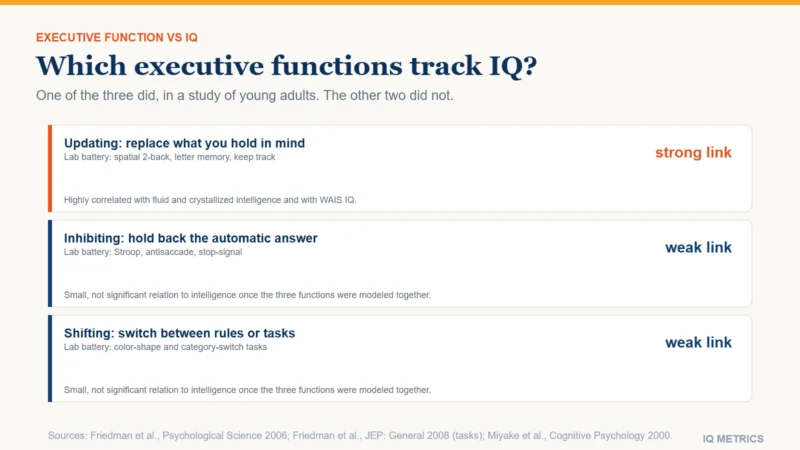
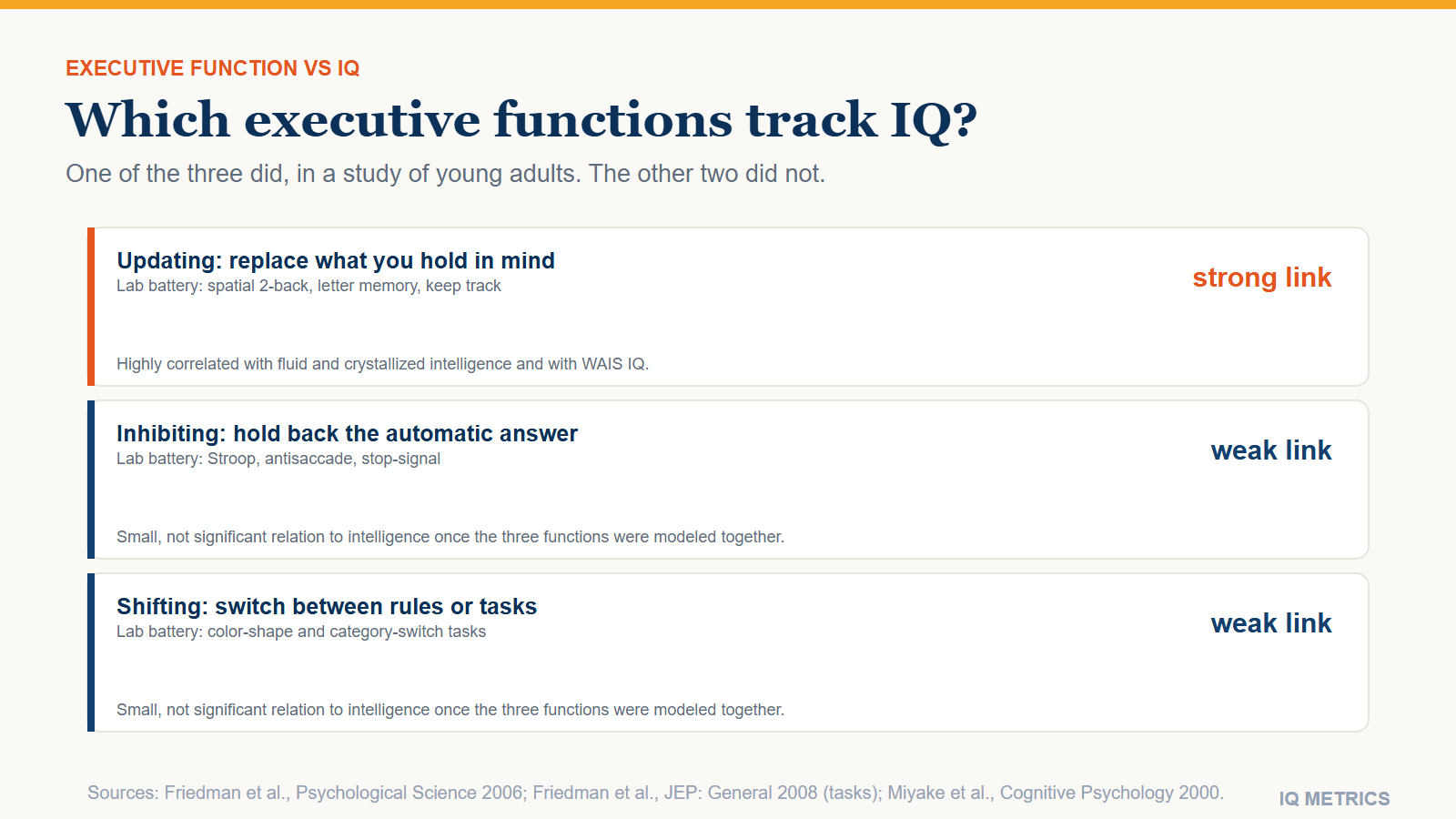
Three finding cards about executive function and IQ from Friedman and colleagues' 2006 study of young adults. Updating, replacing what you hold in mind: highly correlated with fluid and crystallized intelligence and with WAIS IQ, a strong link. Inhibiting, holding back the automatic answer: a small, not significant relation to intelligence once the three functions were modeled together, a weak link. Shifting, switching between rules or tasks: a small, not significant relation, a weak link.

Executive function vs IQ: the two overlap, but they are not the same thing. Executive functions are control abilities: updating what you hold in mind, holding back an automatic response and switching between tasks or rules. In one study of young adults, only the first of those three, updating working memory, was highly correlated with intelligence; inhibiting and shifting showed small relations that were not significant. In a separate analysis of 137 college students the three functions were moderately correlated with one another but clearly separable, and a later twin study found that what they share is a highly heritable common factor that goes beyond general intelligence. This guide explains the three functions, how each relates to IQ, how heritable and reliable they are, and why training claims have not held up.

  • What it is: executive functions are the cognitive control processes that regulate thought and action. The standard model has three: shifting, updating and inhibiting (Miyake et al., 2000).
  • Unity and diversity: in 137 college students the three were moderately correlated but clearly separable.
  • The IQ link: updating was highly correlated with fluid and crystallized intelligence and with WAIS IQ; inhibiting and shifting were not (Friedman et al., 2006).
  • Heritability: a common executive-function factor was 99% heritable in a twin analysis and went beyond general intelligence and perceptual speed (Friedman et al., 2008).
  • Training: a 2016 review of 87 working-memory training publications found no convincing far transfer against treated controls.
Three finding cards about executive function and IQ from Friedman and colleagues' 2006 study of young adults. Updating, replacing what you hold in mind: highly correlated with fluid and crystallized intelligence and with WAIS IQ, a strong link. Inhibiting, holding back the automatic answer: a small, not significant relation to intelligence once the three functions were modeled together, a weak link. Shifting, switching between rules or tasks: a small, not significant relation, a weak link.
Three finding cards about executive function and IQ from Friedman and colleagues’ 2006 study of young adults. Updating, replacing what you hold in mind: highly correlated with fluid and crystallized intelligence and with WAIS IQ, a strong link. Inhibiting, holding back the automatic answer: a small, not significant relation to intelligence once the three functions were modeled together, a weak link. Shifting, switching between rules or tasks: a small, not significant relation, a weak link.

What is executive function?

Executive functions are the cognitive control processes that regulate thought and action. In the model most of this research uses, set out by Miyake and colleagues in 2000, there are three: shifting between mental sets, updating and monitoring information in working memory, and inhibiting prepotent, meaning dominant and automatic, responses. Each is measured with simple laboratory tasks. The table lists the tasks in the battery of the same lab’s later twin study (Friedman et al., 2008).

The three executive functions and example tasks
Function What it asks of you Example tasks in that battery
Inhibiting Hold back the dominant response Antisaccade, stop-signal, Stroop
Updating Replace what you hold in mind with new information Keep track, letter memory, spatial 2-back
Shifting Switch between task rules Color-shape and category-switch tasks (three tasks in all)

Two of those tasks have guides of their own on this site: our news guide to the Stroop test covers inhibition, and the dual n-back task guide covers an updating task and the claim that training it raises IQ.

Are the three executive functions the same thing?

Not quite. Miyake and colleagues (2000) tested 137 college students on simple tasks meant to tap each function, plus several frequently used executive tasks: the Wisconsin Card Sorting Test, the Tower of Hanoi, random number generation, operation span and dual tasking. Confirmatory factor analysis showed that the three functions are moderately correlated with one another but clearly separable. The functions also contributed differently to the complex tasks. Card sorting related most strongly to shifting, the Tower of Hanoi to inhibition, random number generation to inhibition and updating, and operation span to updating. The authors drew the lesson that executive functions show both unity and diversity.

Two results stand out. The Tower of Hanoi puzzle, often treated as a planning task, related most strongly to inhibition. And dual-task performance was not related to any of the three functions, even though doing two things at once is often treated as an executive demand; see our guide to multitasking and IQ.

Which executive functions track IQ?

Friedman and colleagues (2006) examined how fluid intelligence, crystallized intelligence and WAIS IQ relate to the three functions in young adults. Updating was highly correlated with the intelligence measures; inhibiting and shifting were not. In structural equation models that controlled for the correlations among the three functions, updating remained strongly related to intelligence, while the relations of inhibiting and shifting to intelligence were small and not significant. The authors concluded that current intelligence measures do not equally assess the wide range of executive control abilities that many “intelligent” behaviors probably require.

The updating result fits a wider pattern about working memory and reasoning. Schmiedek, Lövdén and Lindenberger (2014) gave nine working-memory tasks to 101 younger and 103 older adults and found that a working-memory factor predicted 71% of the variance in a reasoning factor among younger adults (83% among older adults). Kane and colleagues (2007) found that the n-back task and a verbal span task correlated only weakly, yet each accounted for independent variance in Raven’s matrices. Our news guide to working memory and reasoning and our guide to fluid vs crystallized intelligence cover the neighboring ideas. These are single studies, mostly of young adults, and we did not find a meta-analysis that pools the relations of all three functions with IQ.

How heritable is executive function?

In a multivariate twin study, Friedman and colleagues (2008) modeled the three functions as latent variables. They concluded that the functions are correlated because they are influenced by a highly heritable (99%) common factor that goes beyond general intelligence or perceptual speed, and that they are separable because of additional genetic influences unique to particular functions. That combination, they wrote, places executive functions among the most heritable psychological traits.

Heritability is a statement about variation in a particular sample and population, not about any one person’s fate, and it does not say what a changed environment could do; our guide to what twin studies of IQ show explains how to read such figures.

Your own number

Where would your own score land?

Take the IIF-certified assessment and get your score with the scale it was measured on, the percentile it corresponds to and the confidence range around it — the three figures most online tests leave out.

Find your IQ score now! →

Secure & encryptedInstant results10–20 minutes

How reliable are executive function tasks?

Less than their fame suggests. Hedge, Powell and Sumner (2018) measured the test-retest reliability of seven classic tasks, including the Stroop, in three studies. Reliabilities ranged from 0 to .82 and were, in their words, surprisingly low for most tasks. The Stroop reaction-time cost came out at .60 and .66 in two studies. Their “reliability paradox” says why: a task becomes a classic because nearly everyone shows the effect, which leaves little difference between people to measure on a retest. Studies like those above use several tasks per function and model what the tasks share, which is the usual way around the problem, and a single online result should not be read as a trait.

Can you train executive function to raise IQ?

The strongest test is the 2016 meta-analysis by Melby-Lervåg, Redick and Hulme: 87 publications and 145 experimental comparisons of working-memory training. Training produced reliable improvements on measures of intermediate transfer (verbal and visuospatial working memory). For far transfer (nonverbal ability, verbal ability, word decoding, reading comprehension, arithmetic) there was no convincing evidence of improvement when training was compared with a treated control condition, and the size of the working-memory gain did not predict the size of any far-transfer effect. Our dual n-back guide covers the best-known training task, and our review of brain-training apps covers the wider market.

What does this mean for IQ tests and for you?

An IQ score summarizes many abilities, and executive control is only partly in it. The twin and factor studies above suggest that updating, the working-memory side, travels with intelligence, while inhibiting and shifting are separate abilities that an IQ score does not track closely. A high score on one therefore does not guarantee a high score on the other. The working-memory side shows up in subtests such as digit span, and the speed side in the processing speed index. For ADHD, where executive control is often discussed, see our guides to ADHD and IQ and high IQ and ADHD.

A real-world window on executive load is walking while doing something else. In a New Zealand cohort of 904 adults, adding a spoken task cut average walking speed from 1.30 to 1.16 meters a second, about 11%; our guide to walking speed and IQ covers what that cohort showed. If what you want is a score on the IQ scale, take our IQ test or read how an official IQ test works.

Quick answers

  • What is executive function? The cognitive control processes that regulate thought and action. The standard model has three: shifting, updating and inhibiting.
  • Is executive function the same as IQ? No. In one study of young adults, updating was highly correlated with intelligence while inhibiting and shifting were not.
  • Which executive function is most related to intelligence? Updating working memory, in that study.
  • Are executive functions one ability or several? Both. In 137 college students they were moderately correlated but clearly separable.
  • Is executive function genetic? A twin study estimated a common executive-function factor at 99% heritable, going beyond general intelligence and perceptual speed. That describes a sample, not an individual.
  • Can brain training improve executive function and IQ? A 2016 review of 87 publications found no convincing far transfer against treated controls.
  • Is the Stroop test a good measure of executive function? It is a classic inhibition task, but its reaction-time cost had test-retest reliabilities of .60 and .66 in two studies.

Sources

Share this article

Know someone who keeps seeing these numbers quoted without the scale they were measured on? Send it to them.

Tagged cognitive flexibility, executive function, executive function and intelligence, executive function heritability, executive function tasks, executive function vs iq, inhibitory control, intelligence research, IQ Science, is executive function the same as iq, task switching, unity and diversity of executive functions, working memory and iq, working memory updating

Reaction Time Test

Understanding IQ

Reaction Time Test: How to Measure It, Why Online Scores Run Slow and What Changes It

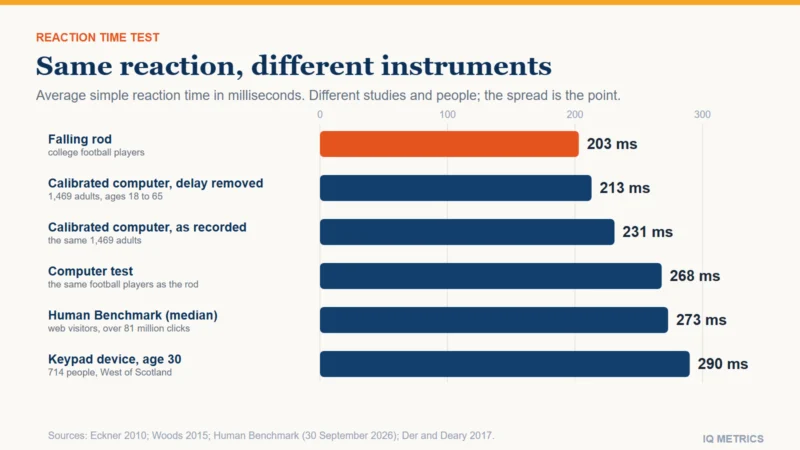
A reaction time test depends on the equipment: 203 ms with a falling rod, 231 ms on a calibrated computer, 273 ms online. See the ruler drop conversion table, why online scores run slow, driving and sprint reaction times, and what really changes your speed.

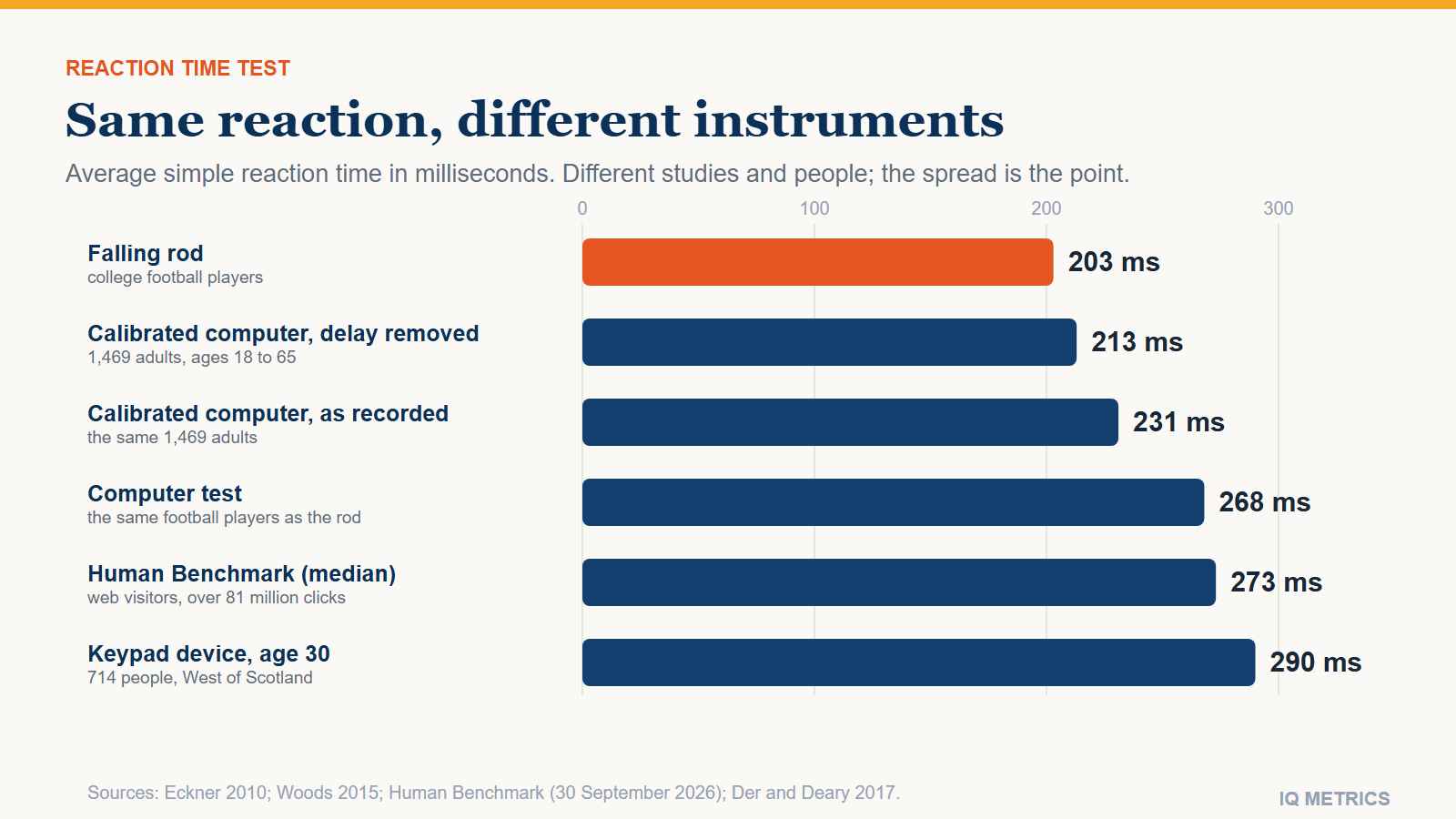
A bar chart of average simple reaction time in milliseconds from six instruments. A falling rod gave 203 in college football players, a calibrated computer 213 after removing hardware delay and 231 as recorded, a computerized test in the same football players 268, the Human Benchmark online median 273 and a keypad device 290 at age 30.

A reaction time test measures the delay between a signal and your response, and the result depends on the equipment as much as on you. A ruler drop test needs only a ruler: catching it after 20 cm means about 202 ms of fall, though that includes closing your fingers. Online tests add lag. Robot-pressed keys on realistic browser set-ups lagged by about 80 ms on average, and college football players averaged 203 ms with a falling rod but 268 ms on a computer. Real-world reactions are slower than a lab click: drivers need about 0.7 second when they expect a signal and 1.5 seconds for a surprise. Sleep loss slows responses, and simple reaction time barely trains. For average reaction times by age and the link to IQ, see our news guide to average reaction time by age; this guide covers how to measure reaction time, why online scores run slow and what changes it.

  • Ruler drop: 10 cm is about 143 ms, 20 cm about 202 ms and 30 cm about 247 ms (our calculation); the simple ruler drop had poor test-retest reliability in older adults (0.57).
  • Online lag: web set-ups added about 80 ms on average in robot tests, and at least 30 ms on all 19 computers in an earlier check.
  • Same people, two tests: 203 ms with a falling rod and 268 ms on a computer in college football players.
  • Driving: about 0.7 second expected, 1.25 seconds unexpected, 1.5 seconds for a surprise; road design uses 2.5 seconds.
  • Sleep: after 17 to 19 hours awake, response speeds were “up to 50% slower for some tests.”
  • Practice: simple reaction time did not differ by sport or skill in baseball, tennis and non-athlete groups.
A bar chart of average simple reaction time in milliseconds from six instruments. A falling rod gave 203 in college football players, a calibrated computer 213 after removing hardware delay and 231 as recorded, a computerized test in the same football players 268, the Human Benchmark online median 273 and a keypad device 290 at age 30.

How does a reaction time test work?

Simple reaction time is one stimulus and one response, such as pressing a button when a light comes on. Choice reaction time adds decisions, such as pressing the button that matches one of four lights, and takes about twice as long. A careful lab test looks like this: in a 2015 study of 1,469 adults aged 18 to 65 in New Zealand, people sat 0.7 m from a monitor, practiced for 20 trials, then did 120 test trials with a random wait of 1,000 to 1,800 ms before each signal, using a gaming mouse (Woods et al. 2015). Responses outside a window of 110 to 1,000 ms did not count. The average was 231 ms, or 213 ms after subtracting 17.8 ms of measured screen and mouse delay.

Three features of a good test come straight from those numbers. A random wait matters, because reactions were about 15% slower after the shortest wait than the longest, a gap of about 28 ms. Fatigue matters within a sitting: mean reaction time rose from 228.1 ms in the first block of 20 trials to 237.2 ms in the sixth. And one click is noisy, since a person’s own trial-to-trial standard deviation was about 40 ms on the calibrated test and 72 ms on a keypad device at age 30, so several trials should be averaged. Human Benchmark itself tells users to perform “at least 5 clicks.”

The ruler drop test: what the distance means

The ruler drop test needs no equipment beyond a 30 cm ruler and a friend. The dropper releases it without warning, you catch it, and the distance fallen gives the time from falling-object physics, t = √(2d/g). Our conversion, ignoring air resistance:

Ruler drop distance and the time it represents (our calculation)
Distance fallen Time Distance fallen Time
5 cm 101 ms 30 cm 247 ms
10 cm 143 ms 35 cm 267 ms
15 cm 175 ms 40 cm 286 ms
20 cm 202 ms 45 cm 303 ms
25 cm 226 ms 50 cm 319 ms

Hold the ruler with its zero at the top of your open thumb and finger, and have the dropper vary the moment of release so you cannot time it. The time includes closing your fingers, so it is not a pure reaction time, but it has no screen or input lag. That is why it reads shorter than a computer: in college football players a falling rod averaged 203 ms and a computerized test 268 ms, and the two correlated only .445 in the 68 whose computer tests passed an integrity check (Eckner et al. 2010). In a study of 903 adults in Sri Lanka, 95% caught the ruler at or under 40 cm (about 286 ms of fall time), and the authors proposed more than 40 cm as a screen for alcohol intoxication (Rajapaksha et al. 2023). Do not treat a single drop as precise. In 51 older adults the simple ruler drop had poor test-retest reliability (intraclass correlation 0.57) a week apart, and its correlation with a computer test was .42 (Ferreira et al. 2024).

Why online reaction tests read slower than the lab

Human Benchmark, the best-known online test, says its own median is 273 ms “according to the data collected so far” and its mean 284 ms across more than 81 million clicks, and warns that the test “is affected by the latency of your computer and monitor.” Its test page adds, without naming a source, that “an average human reaction time may fall between 200-250ms” and that your computer “could be adding 10-50ms on top.” Its statistics page says recorded times have gotten slightly slower over the years, “almost certainly due to changes in input / display technology.”

Independent checks agree that hardware matters. Robot-pressed keys on realistic browser set-ups showed response times that “on average lag 80 ms, and extend to 100 ms on some set-ups” (Anwyl-Irvine et al. 2021). An earlier test of 19 computers found that “all systems overestimated response times, by at least 30 ms” (Reimers and Stewart 2015). A comparison of five cognitive tasks found “a fixed additive timing offset” of 37 ms for web technology and 87 ms for recording online, against lab data (Semmelmann and Weigelt 2017). In the calibrated study the screen and mouse alone added 17.8 ms. Because much of the lag looks like a fixed offset, comparing your own score across days on the same device is more informative than comparing it with a stranger’s on another.

Measured average reaction times from different instruments
Measurement Mean Who and how
Falling rod, college football players 203 ms Eckner et al. 2010: 94 US Division I players, rod caught by hand
Calibrated computer test, delay subtracted 213 ms Woods et al. 2015: 1,469 adults aged 18 to 65 in New Zealand
Calibrated computer test, as recorded 231 ms Same study, before subtracting 17.8 ms of delay
Computer test, same football players 268 ms Same study, computerized simple reaction time
Human Benchmark, all visitors 273 ms median; 284 ms mean Self-selected web visitors, over 81 million clicks, lag included
Keypad device, age 30 290 ms Der and Deary 2017: 714 people in West Scotland

Reaction time on the road

Lab reaction time is only the first part of stopping a car. Marc Green’s review of driver studies found that when drivers fully expect a brake signal they need about 0.70 to 0.75 second to detect it and move the foot to the brake, about 1.25 seconds for an unexpected but common signal such as brake lights, and roughly 1.5 seconds for a surprise such as an object moving into the path (Green 2000). Green’s own website adds that a standard perception-brake time “cannot and does not exist.” Highway design uses a longer figure: the Iowa Department of Transportation’s manual, following the AASHTO Green Book, specifies a brake reaction time of 2.5 seconds in its stopping-distance formula. At 60 mph (26.8 m/s), our calculation gives 6.7 m covered in 0.25 second, 18.8 m in 0.7 second, 40.2 m in 1.5 seconds and 67.1 m in 2.5 seconds. A meta-analysis of 33 driving studies (94 effect sizes, about 2,000 participants) found that phone-related tasks added a mean of 0.25 second to reaction times, with handheld phones and phones used without holding them causing similar decrements (Caird et al. 2008).

Reaction time in sport

Sprinting sets the fast end. World Athletics counts a reaction under 0.100 second as a false start, a rule that a 2021 paper on hurdlers also cites, and the threshold is disputed: a study of nine sprinters and ex-sprinters found five with mean reaction times under 100 ms in at least one condition, measured as the start of force in the blocks (Pain and Hibbs 2007). That is a force-plate measurement with an athlete already braced, not the reaction of a relaxed finger. Formula 1 quotes are looser still. Valtteri Bottas said his first movement after the lights went out in 2019 took “four-hundredths,” and clarified that this was the paddle, not the car moving; in 2017 Sebastian Vettel said that “normally, the reactions are 0.2s for everyone.” Treat those as driver statements, not measurements. Athletes are not necessarily faster on a simple test: in 82 university students and 17 professional baseball players, and in 94 senior high school students followed for two years, “there were no differences in simple reaction time either for sports experience or for skill levels,” although Go/No-go reaction time improved with hitting practice (Kida et al. 2005).

Your own number

Where would your own score land?

Take the IIF-certified assessment and get your score with the scale it was measured on, the percentile it corresponds to and the confidence range around it — the three figures most online tests leave out.

Find your IQ score now! →

Secure & encryptedInstant results10–20 minutes

What changes your reaction time?

  • Sleep loss: in 39 transport and army volunteers, after 17 to 19 hours awake “performance on some tests was equivalent or worse” than at a blood alcohol level of 0.05%, and “response speeds were up to 50% slower for some tests” (Williamson and Feyer 2000). See our guides to sleep and IQ and sleep loss and test performance.
  • Fatigue and waiting time: both shift results within a single sitting, as the lab numbers above show.
  • Practice: simple reaction time barely trains, as the sport data show; choice and Go/No-go reaction times can improve.
  • Caffeine: small trials suggest it speeds responses through attention, with effects that vary by dose and task; see our guide to caffeine and test performance.
  • Video games: the evidence is contested. One review says the very act of playing action video games “significantly reduces reaction times without sacrificing accuracy” (Dye et al. 2009), while a 2018 meta-analysis found “small or null overall effect sizes” for cognitive ability (Sala et al. 2018); see video games and IQ.
  • Age: about 0.55 ms slower per year between 18 and 65 in the calibrated test, with trial-to-trial variability growing after 60.

Age, IQ and what a fast reaction time means

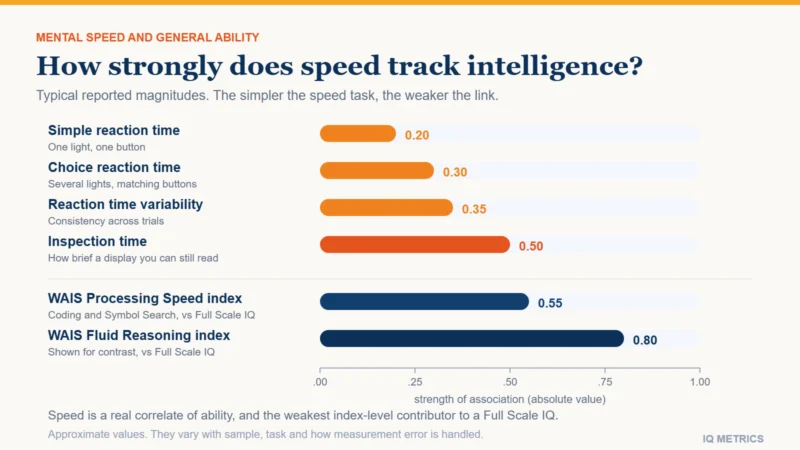
Two questions come up next, and our news guide to average reaction time by age and what it says about IQ answers them in detail. In brief: in the calibrated test, group means rose from about 218 ms at a mean age of 21 to 239 ms at 62, and on a keypad device three Scottish cohorts averaged 290, 318 and 354 ms at ages 30, 50 and 69 (Der and Deary 2017). The same study found simple reaction time correlated between −0.27 and −0.32 with a timed reasoning test, and four-choice reaction time between −0.44 and −0.53. Those are observed correlations, worth about 7% to 28% of shared variance (our calculation), so a click score cannot tell you your IQ. Speed is one strand of a full test; see our guide to processing speed and IQ and the timed IQ test page.

Quick answers

  • What is a good reaction time? On a computer, roughly 200 to 300 ms is ordinary; the device changes the number by tens of milliseconds, so compare like with like.
  • How accurate is an online reaction time test? It includes screen, input and browser lag: robot tests found about 80 ms on average, and Human Benchmark says its own scores are affected by latency.
  • How do you do the ruler drop test? Have a friend drop a ruler without warning, catch it, read the distance and convert it: 20 cm is about 202 ms. Average several drops.
  • What is the average reaction time when driving? About 0.7 second when expected, 1.25 seconds when unexpected and 1.5 seconds for a surprise (Green 2000); road design uses 2.5 seconds.
  • Can you improve your reaction time? Simple reaction time barely changes with practice; sleep, attention and the task matter more.
  • Does reaction time measure IQ? Only weakly: correlations of −0.27 to −0.32 for simple and −0.44 to −0.53 for four-choice reaction time in three Scottish cohorts.

The bottom line

A reaction time score is a reading from an instrument. The same person can score 203 ms with a falling rod, 231 ms on a calibrated computer and close to 300 ms on a phone or keypad, and the difference is mostly the device. Use the ruler drop for a quick comparison with no screen lag, average several trials, test when rested, and compare yourself with yourself on the same device. If you want a measure of reasoning rather than speed, a timed IQ test asks for both under standard conditions, and our digit span guide covers a different short-term-memory measure.

Sources

Share this article

Know someone who keeps seeing these numbers quoted without the scale they were measured on? Send it to them.

Tagged driver reaction time, f1 driver reaction time, how to improve reaction time, human benchmark reaction time, intelligence research, IQ Science, online reaction time test accuracy, reaction time and sleep, reaction time test, reaction time test average score, ruler drop test, ruler drop test chart, simple vs choice reaction time, sprinter reaction time 0.1 second

Digit Span Test

Scores & Scales

Digit Span Test: How It Works, Average Scores and What They Mean for IQ

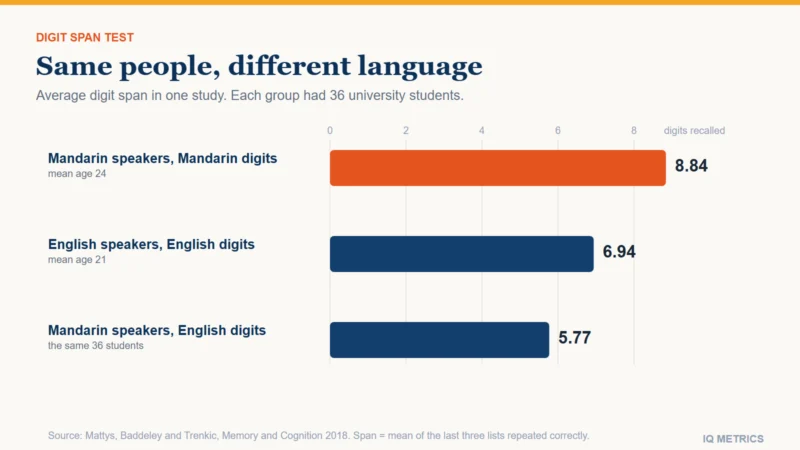
A digit span test asks you to repeat lists of digits; on the WAIS it has three tasks of eight items. Verified adult averages run from 5.3 to 6.9 digits, not seven, and language matters: 8.84 in Mandarin versus 5.77 in English for the same people.

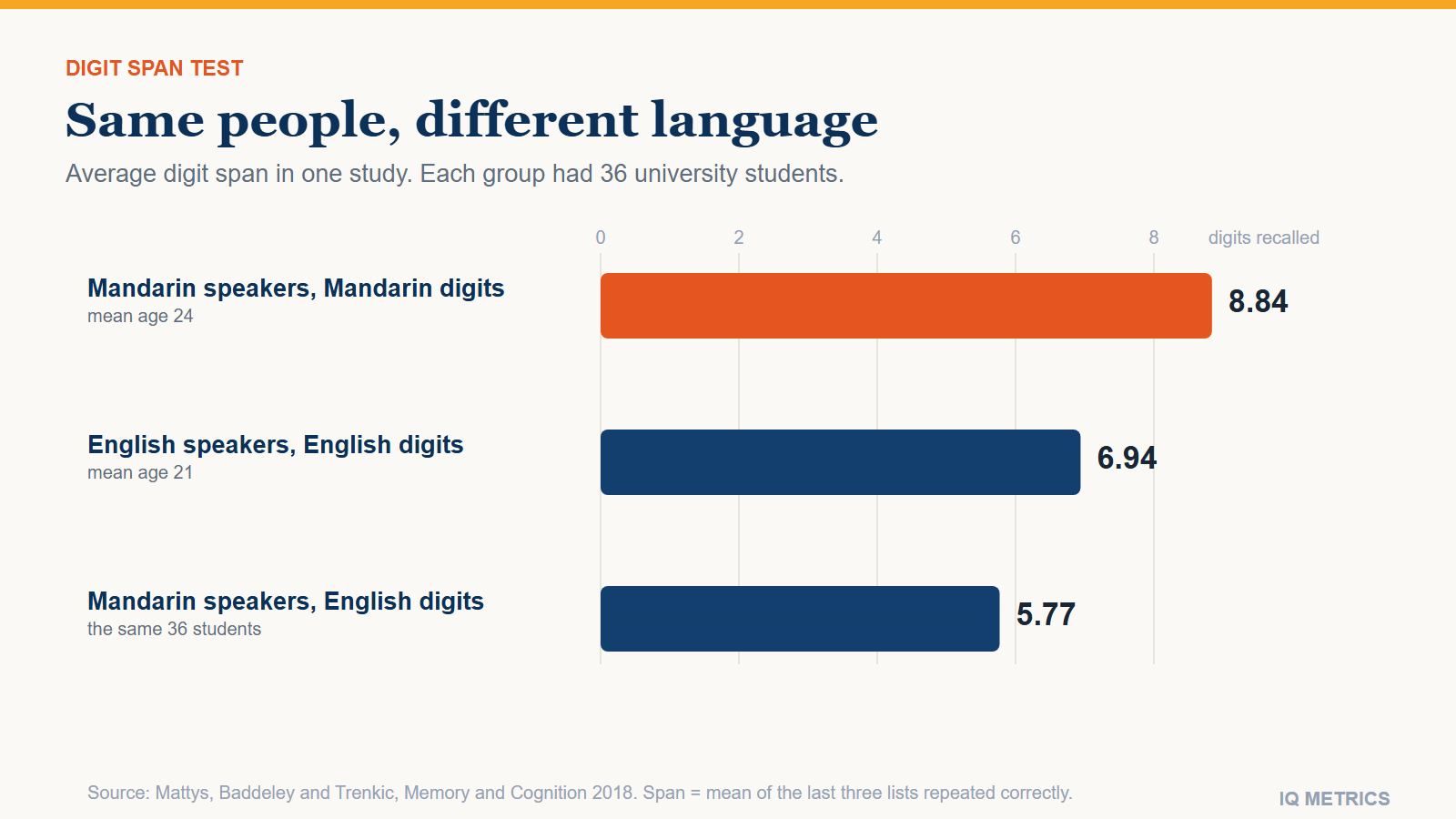
A bar chart shows average digit span in one University of York study. Native Mandarin speakers recalled 8.84 digits in Mandarin, native English speakers recalled 6.94 digits in English, and the same Mandarin speakers recalled 5.77 digits in English. Each group had 36 students.

A digit span test asks you to repeat lists of digits that get longer, and your span is the longest list you get right. On the Wechsler adult scales it has been three tasks, forward, backward and sequencing, each with eight items of two trials, stopping when both trials of an item are missed. There is no single average score. The adult means we could verify run from about 5.3 to 6.9 digits forward, depending on language and procedure, so the popular “seven” is only a rough rule of thumb, and the same Mandarin-speaking students recalled 8.84 digits in Mandarin but 5.77 in English. Digit span rises roughly in a straight line with intelligence in the WAIS-IV norm sample of 1,800, yet training it has not been shown to raise intelligence. This guide covers how the test works, how it is scored, what changed in the WAIS-5, average spans, the language effect, the link to IQ, online versions and training.

  • Forward: repeat the digits in the order you heard them. Backward and sequencing tasks also require you to manipulate the digits before answering.
  • WAIS-IV structure: three tasks of eight items, two trials per item, stopping after both trials of an item are missed; the longest span that can be scored is 9 digits forward and 8 backward.
  • WAIS-5: no subtest is called Digit Span any more. Digit Sequencing is a primary subtest in the Full Scale IQ, Digits Forward and Digits Backward are secondary, and Running Digits is new.
  • Average: verified adult means of 5.3 to 6.9 digits forward; the figure depends on the language and the procedure.
  • IQ: a mostly linear link with Full Scale IQ (Gignac and Weiss 2015); working-memory training shows no convincing far transfer (Melby-Lervåg et al. 2016).
A bar chart shows average digit span in one University of York study. Native Mandarin speakers recalled 8.84 digits in Mandarin, native English speakers recalled 6.94 digits in English, and the same Mandarin speakers recalled 5.77 digits in English. Each group had 36 students.

What is the digit span test?

An examiner reads a list of digits and you repeat it. On forward span you repeat the digits in the order heard. On backward span you say them in reverse, and the WAIS-IV includes a third, sequencing task. Researchers describe forward span as mainly short-term storage, while backward and sequencing demand active mental manipulation (Lintas et al. 2025). The task is old: Baddeley’s group notes that digit span was first developed by Jacobs in 1887. On the WAIS-IV it is presented by voice only, and a 2015 study of 226 patients referred for neuropsychological examination found the modality mattered, advising clinicians to “consider testing visual span as well before drawing conclusions about impaired WM from the WAIS-IV” (Egeland 2015). Because it is spoken, hearing matters; see our guide to hearing loss and test scores.

In the WAIS-IV, Digit Span is one of ten core subtests behind the Full Scale IQ and sits in the Working Memory Index with Arithmetic; our guide to WAIS-IV and WAIS-5 index scores explains how subtests roll up into index scores, and our WISC-V guide covers the children’s version. We do not reproduce test items here, because they are copyrighted.

How is the WAIS digit span scored?

  • Structure: forward, backward and sequencing each have eight items, and each item has two trials scored 0 or 1, so an item is worth 0, 1 or 2 points (Abdelhamid et al. 2021, describing an Arabic adaptation; a US record form shows the same two-trial structure).
  • Stopping rule: a task ends after scores of 0 on both trials of an item.
  • Two numbers per task: the total raw score, with a maximum of 16 for forward and 16 for backward, and the longest span, the number of digits on the last trial passed, which is at most 9 forward and 8 backward (from a WAIS-IV record form).
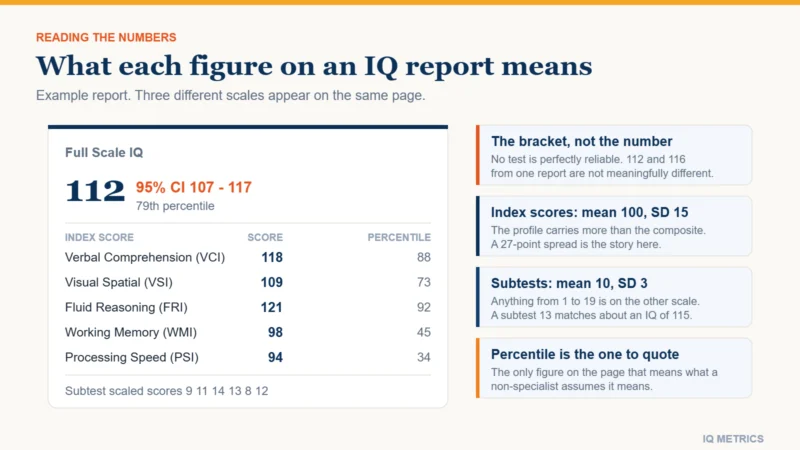
  • Conversion: raw scores become scaled scores with a mean of 10 and a standard deviation of 3, and index scores with a mean of 100 and a standard deviation of 15, through the publisher’s age-based norm tables. We could not verify the exact rule that combines the three tasks into one scaled score; the tables sit in the publisher’s manuals.

What changed in the WAIS-5?

The WAIS-5, published in 2024, no longer has a subtest called Digit Span. Pearson lists Digit Sequencing as a primary subtest that counts toward the Full Scale IQ, Digits Forward and Digits Backward as secondary subtests that do not, and a new Running Digits subtest, described as an auditory working-memory task “designed to measure registration and maintenance, including refreshing and updating information held in short term storage.” The primary Working Memory Index is now Digit Sequencing plus Running Digits, and Arithmetic is no longer part of it. A 2024 review sums up the changes: “one subtest was eliminated (Arithmetic), one was added (Running Digits), and one was substantially modified (Digit Span, now called Digit Sequencing)” (Winter, Trudel and Kaufman 2024). The Full Scale IQ is now a composite of seven subtests.

Pearson’s FAQ gives one worked example of how the norms read. At ages 16 to 17, a longest Digit Sequencing of four digits is at a cumulative percentage of 18.9, and eight digits at 96.1, where a cumulative percentage is “the percentage of examinees in the normative sample scoring below that score.” That is one age band on one task, not a table for every age.

What is the average digit span?

Not seven. George Miller’s 1956 paper “The Magical Number Seven, Plus or Minus Two” is the source of that idea, but Nelson Cowan’s 2001 reconsideration says Miller’s figure “was meant more as a rough estimate and a rhetorical device than as a real capacity limit,” and puts the limit at “about four chunks” when people cannot group items. Digits are easy to group, and the spans measured in real samples depend on the language, the pace and the scoring rule. These are the data points we could verify:

Verified average digit spans, by study
Group Procedure Forward Backward
36 native English speakers, University of York, mean age 21 Digits spoken 650 ms apart; span is the mean of the last three lists repeated correctly 6.94 (SD 1.03) not tested
36 native Mandarin speakers, same university, mean age 24 Same procedure, digits in Mandarin 8.84 (SD 1.30) not tested
The same Mandarin speakers, digits in English Same procedure 5.77 (SD 0.93) not tested
225 healthy Italian adults Computer, headphones, Italian digits 5.30 (SD 1.16; range 2 to 9) 4.54 (SD 1.23; range 1 to 9)

The first three rows are from Mattys, Baddeley and Trenkic (2018) and the last from Italian norms (Priftis et al. 2025). Neither is a Wechsler score, so they cannot be read straight against a scaled score. Two more findings put the numbers in context. In 784 healthy adults aged 60 to 90 in Seoul, tested on the WAIS-R digit span, education accounted for 29.8% of the variance in forward span and 28.3% in backward span, while age accounted for 1.1% and 0.6% (Choi et al. 2014). And backward spans are shorter than forward spans, by about 0.8 digit in the Italian sample.

We could not find an open table of average forward and backward spans by age band, for children or adults, and Wechsler’s norm tables are copyrighted. If a chart claims to give the normal digit span for a ten-year-old or a fifty-year-old without naming its sample, treat it as unverified.

Does language change your digit span?

Yes, and by a lot. In the York study, Mandarin speakers recalled 8.84 digits in Mandarin against 6.94 for English speakers in English (a difference of 1.62 standard deviations), and the same Mandarin speakers fell to 5.77 in English digits. Chinese digits were also spoken faster, at 6.44 syllables per second against 4.47 for English. The old explanation is that memory span depends on how many items you can rehearse aloud before the trace fades, so shorter names mean longer spans. The authors found it was not the whole story: single spoken digits lasted 417 ms in Chinese and 449 ms in English, a difference that was not significant, and they concluded that “speed of rehearsal did not provide an adequate account of differences between Mandarin and English spans.”

  • Welsh and English: in bilingual speakers, Welsh digits take longer to say and digit span is significantly smaller in Welsh; the authors argued that this word-length difference, “rather than intellectual differences,” explains why Welsh children’s digit-span norms were lower than American ones (Ellis and Hennelly 1980). A later study, as summarized by Mattys and colleagues, put the Welsh gap on coarticulation between words instead.
  • Four languages: across English, Spanish, Hebrew and Arabic, faster reading rates went with larger memory spans, tied to the number of syllables or phonemes per item (Naveh-Benjamin and Ayres 1986).
  • Children: in kindergarten to second grade, Chinese children remembered at least two more digits on average than American or Japanese children, with no Chinese advantage on backward span (Stigler et al. 1986, as summarized by Mattys and colleagues).
  • Older adults: a 2025 conference abstract covering 3,681 people aged 40 to 90 in 14 language cohorts found that, among cognitively normal people, forward and backward spans differed significantly between languages even after adjusting for age and education, and the best cut-offs for spotting Alzheimer’s differed by language (Tee et al. 2025).

The practical point is that a digit span is not a measure of memory that ignores language. A test given in a second language can understate the span, as the York Mandarin speakers show, and a single cut-off cannot serve every language. Our guides to second-language test scores and bilingualism and IQ cover the wider issue.

Your own number

Where would your own score land?

Take the IIF-certified assessment and get your score with the scale it was measured on, the percentile it corresponds to and the confidence range around it — the three figures most online tests leave out.

Find your IQ score now! →

Secure & encryptedInstant results10–20 minutes

Digit span and IQ: what the research says

Wechsler himself contended in 1958 that beyond an average span there was little benefit to a longer one. The WAIS-IV norm sample says otherwise. Gignac and Weiss analyzed 1,800 people aged 16 to 69 and found that all three longest-span scores “were found to exhibit primarily linear associations with FSIQ/g,” so “the commonly held position that Digit Span performance beyond an average level is not indicative of greater intellectual functioning was not supported” (Gignac and Weiss 2015). Every extra digit counts, on average, but one subtest is only one of ten (WAIS-IV) or seven (WAIS-5) inputs to the Full Scale IQ, so no chart converts a span into an IQ. No source we could open gives a reliable span-to-IQ conversion, whatever a search for “digit span iq” or “reverse digit span iq” turns up.

Forward and backward span are related but different. In a national sample of 1,342 children aged 5 to 19, Reynolds found the two processes distinct enough that they “should not be combined for clinical interpretation” (Reynolds 1997). The common belief that backward span is the more sensitive test is not supported either: in WAIS-III and WMS-III data, the backward conditions “did not appear more affected by risk factors such as aging or pathology than the forward scores” (Wilde et al. 2004). Our guides to working memory and reasoning and memory and IQ explain why remembering things and reasoning about them are different abilities.

What does a low digit span mean?

On its own, not much. Baddeley’s group notes that low digit span has been found in children with delayed reading and with slow vocabulary learning, and that it predicts difficulty learning a second language, so it is a useful clue in a full evaluation, for example alongside the working-memory profile described in our dyslexia and IQ guide. It is not a diagnosis. The score also depends on language, education, hearing, attention and the mode of presentation, as this guide has shown.

Digit span online and at home

Online digit span tests vary: some show the digits on screen, some play them, and each chooses its own pace and scoring. That matters because a Wechsler score is a total of trial points with a longest-span record, while the York study averaged the last three correct lists; a visual test also taps a different route than the spoken WAIS test (Egeland 2015). None of them is normed the way a Wechsler subtest is, and we could not verify any published average for the popular online number-memory tests, so treat a “level” on a website as an entertaining benchmark, not a norm. For an informal try with a friend, keep the pace steady at about one digit a second (the rate used in a large WAIS-R-based study of older adults) and stop when two tries at one length fail. Our guide to taking an official IQ test explains what a supervised evaluation involves.

Can you improve your digit span?

You can improve the skill, dramatically, with a method. In a 1980 Science paper, one subject raised his memory span “from 7 to 79 digits” after “more than 230 hours of practice in the laboratory,” and the authors concluded that with an appropriate mnemonic system there is “seemingly no limit to memory performance with practice” (Ericsson, Chase and Faloon 1980). What does not follow is that intelligence rises. A meta-analysis of 87 publications and 145 comparisons found “no convincing evidence of any reliable improvements” in nonverbal ability, verbal ability, word decoding, reading comprehension or arithmetic when working-memory training was compared with a treated control (Melby-Lervåg, Redick and Hulme 2016). See our guides to brain training apps and the memory athletes study. Some trials of supplements have also used backward digit span as an outcome; see our news guide to creatine and IQ.

Quick answers

  • What is a good digit span? Most healthy adults fall between about 5 and 7 digits forward in the studies we could verify, and less backward; the range depends on language and procedure.
  • What is the average digit span? Not a single number: 6.94 for English speakers in a York study, 5.30 for Italian adults in a computer test, 8.84 for Mandarin speakers in Mandarin.
  • How is the WAIS digit span scored? Eight items per task, two trials each, 0 or 1 point per trial, stopping after both trials of an item fail; raw scores convert to scaled scores with a mean of 10.
  • Does the WAIS-5 still have digit span? Its digit tasks continue as Digit Sequencing, Digits Forward, Digits Backward and Running Digits; the name Digit Span was retired.
  • Does digit span measure IQ? It is one input to IQ and relates to it roughly linearly, but a span cannot be converted into an IQ.
  • Is backward digit span harder or better? It is a different task, but not more sensitive to aging or pathology than forward span in WAIS-III and WMS-III data.
  • Can you train digit span? Yes, with mnemonics, but training has not been shown to raise intelligence.

The bottom line

A digit span score is a short, spoken window on short-term storage and manipulation. It carries real information about working memory, it rises with intelligence across the whole range in the WAIS-IV norm sample, and it moves with language, education and the way it is presented. For a score you can interpret, you need the whole battery and the publisher’s norms; for curiosity, an online test is a fun benchmark against yourself. Reaction time is another simple speed measure that gets over-read; see our guide to reaction time test.

Sources

Share this article

Know someone who keeps seeing these numbers quoted without the scale they were measured on? Send it to them.

Tagged average digit span, average digit span by age, digit span backwards, digit span iq, digit span online, digit span test, digit span test score interpretation, forward and backward digit span, intelligence research, IQ Science, reverse digit span iq, wais digit span scoring, wais-5 digit sequencing, working memory test

Official IQ Test

Taking a Test

Official IQ Test: How to Get IQ Tested, Where to Take One and What It Costs

There is no single official IQ test: official means a standardized test given by a qualified psychologist or a supervised exam such as Mensa’s. See how long it takes, what it costs (from $60 to $2,500), where to book one and what score you actually get.

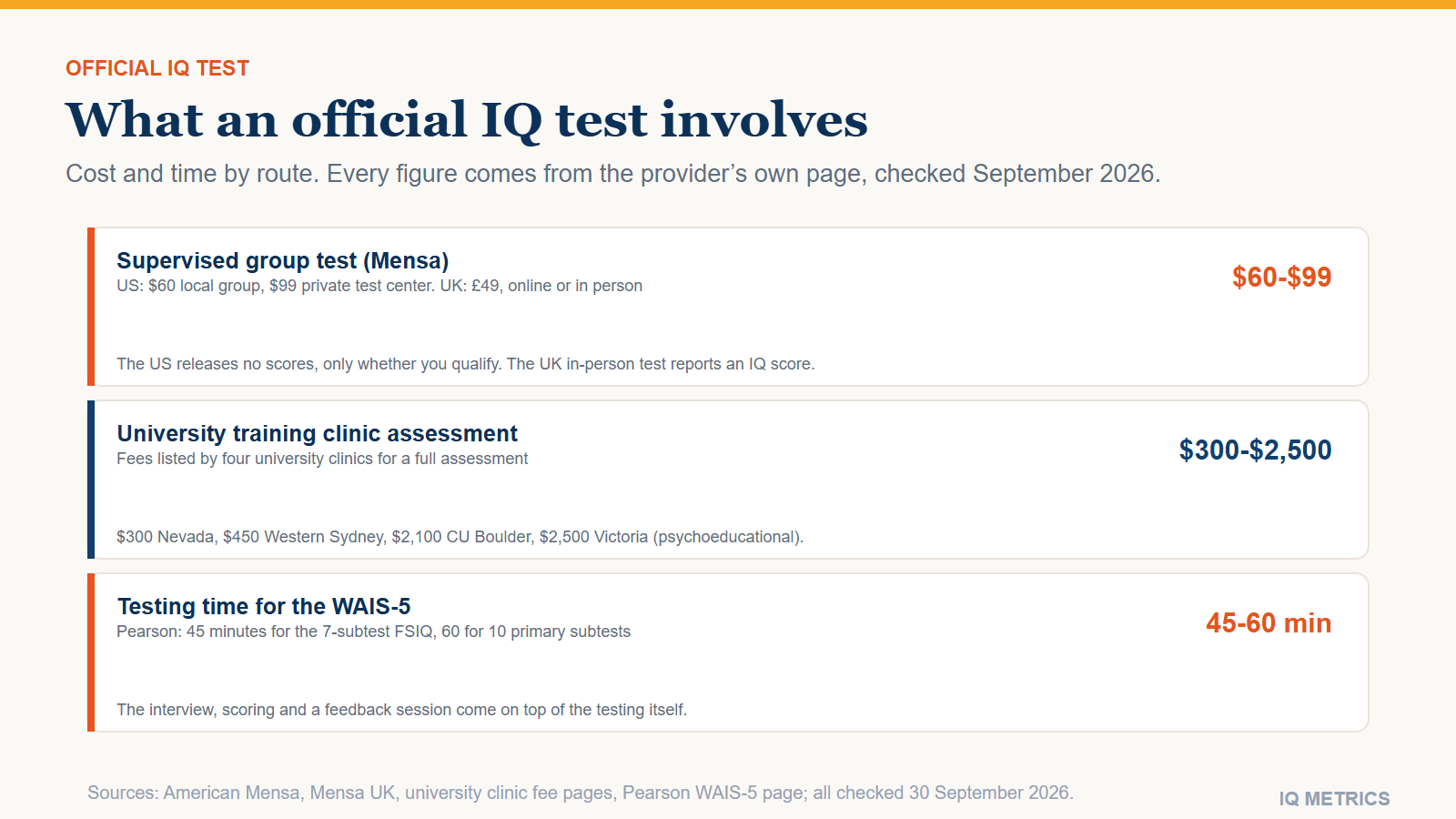
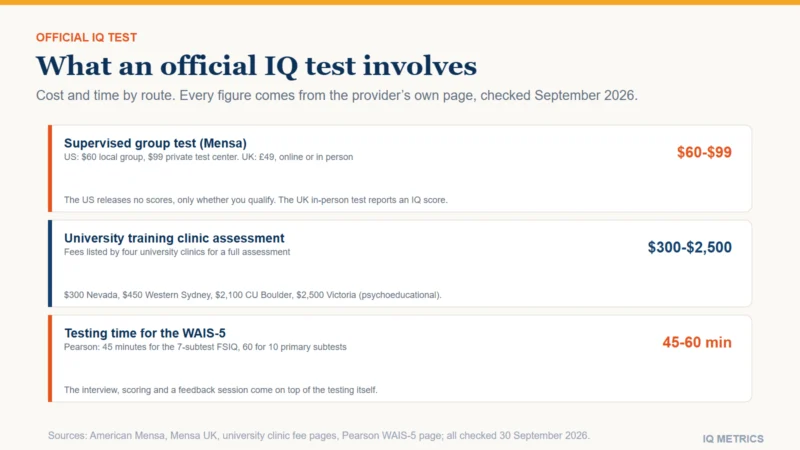
Three cards summarize an official IQ test. Supervised group test: American Mensa lists $60 for local group testing and $99 for private testing at approved testing facilities, and Mensa UK lists 49 pounds. University training clinic assessment: fees run from $300 at the University of Nevada, Reno to $2,500 at the University of Victoria. Testing time: Pearson lists 45 minutes for the seven-subtest WAIS-5 FSIQ and 60 minutes for the ten primary subtests.

How do you get an official IQ test? Book a standardized test with a licensed psychologist, or sit a supervised admission test with Mensa. An IQ test costs $60 to $99 with American Mensa, £49 with Mensa UK, and about $300 to $2,500 for a full assessment at the university clinics we checked. An unsupervised online quiz cannot be official.

There is no single official IQ test. In practice, “official” means a standardized intelligence test, such as the WAIS-5 for adults, given one-to-one by a qualified psychologist, or a supervised admission exam such as Mensa’s. Pearson lists 45 minutes of testing for the WAIS-5’s seven-subtest Full Scale IQ and 60 minutes for its ten primary subtests, and Mensa sessions run one to two and a quarter hours. On price, American Mensa charges $60 for local-group testing and $99 for private testing, Mensa UK charges £49, and the full assessments listed by four university clinics run from $300 to $2,500. This guide covers what counts as official, how long it takes, what it costs, where to book one, whether you can take one online and what score you actually receive.

  • What counts: a standardized test given one-to-one by a qualified professional, or a supervised exam such as Mensa’s. No single test holds the title.
  • Time: 45 to 60 minutes of testing for the WAIS-5 (Pearson); one to two hours for American Mensa; 1½ hours online and 2¼ hours in person for Mensa UK.
  • Cost: $60 (American Mensa, local group) to $99 (private testing); £49 (Mensa UK); $300 to $2,500 for full assessments at four university training clinics.
  • Who gives it: for a Wechsler scale, someone with Pearson “Level C” qualifications, such as a psychologist with a doctorate or a licensed practitioner with assessment training.
  • The score you get: a Full Scale IQ and index scores from a clinician. American Mensa releases no IQ score at all, Mensa Canada gives a percentile and Mensa UK reports an IQ score for its in-person test.
  • Online: Mensa UK’s online supervised test is proctored (£49); an unsupervised online quiz cannot be official.
Three cards summarize an official IQ test. Supervised group test: American Mensa lists $60 for local group testing and $99 for private testing at approved testing facilities, and Mensa UK lists 49 pounds. University training clinic assessment: fees run from $300 at the University of Nevada, Reno to $2,500 at the University of Victoria. Testing time: Pearson lists 45 minutes for the seven-subtest WAIS-5 FSIQ and 60 minutes for the ten primary subtests.

What counts as an official IQ test?

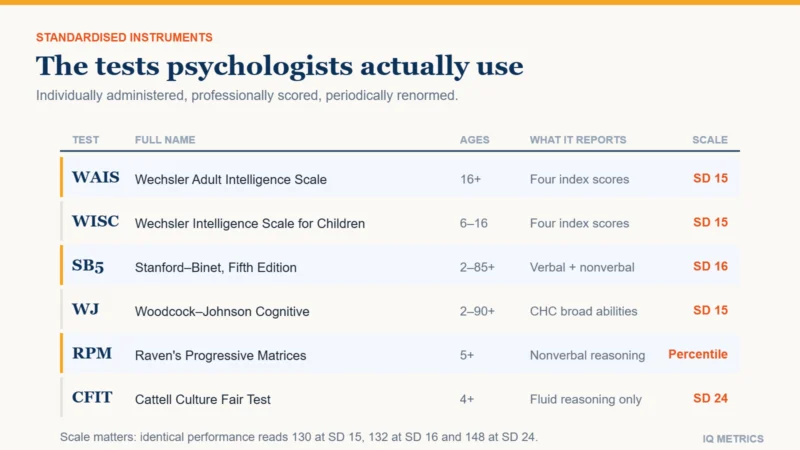
No test carries the title. What people mean is a test with three features: it is standardized against a large norm sample, it is given individually or under supervision by someone trained to do it, and its results come from a professional or an organization with the standing to stand behind them. The clinical batteries are the Wechsler scales, the Stanford-Binet, the Woodcock-Johnson cognitive battery and a handful of others, all compared in our guide to professional IQ tests. For adults the Wechsler choice is the WAIS-5 (published 2024, ages 16:0 to 90:11) or the older WAIS-IV, and for children the WISC-V or, for the youngest, the WPPSI-IV.

Publishers control who can use these tests. Pearson gives every product a qualification level, and the WAIS-5 is Level C, the highest. Its policy says Level C tests “require a high level of expertise in test interpretation” and can be purchased by people with a doctorate in psychology, education or a closely related field plus formal assessment training; or a license or certification to practice in a related field; or certification by, or full active membership in, a professional organization such as APA or NASP that requires assessment training and experience. A quiz website cannot license a Wechsler test, and a psychologist cannot skip the qualification.

Mensa uses the word differently. It runs its own supervised admission tests and also accepts evidence of a professional test. Mensa UK lists “a full educational psychologist’s report” and “documentary evidence of a professionally administered IQ test” as acceptable, and Mensa New Zealand accepts a score above the 98th percentile on any IQ test given in person by a registered psychologist, if its supervisory psychologist approves it. Our guides to Mensa score requirements and high-IQ societies cover the cut-offs.

How long does an official IQ test take?

Pearson lists 45 minutes of testing for the WAIS-5’s seven-subtest Full Scale IQ and 60 minutes for its ten primary subtests; the WAIS-IV took 60 to 90 minutes and the WISC-V takes about 60. American Mensa sessions run one to two hours, and Mensa UK’s take 1½ hours online or 2¼ hours in person. A full clinical evaluation is longer, because it adds an interview, other tests, scoring and a feedback session: one US university clinic quotes five to seven hours of testing over two visits. Our guide to how long an IQ test takes gives the time for every major test, how many questions to expect and why two people take different amounts of time.

How much does an official IQ test cost?

The price depends on what you buy: a pass-or-fail admission exam, or a full clinical assessment with an interview, several tests, a written report and a feedback session. The prices below were read from each provider’s own page on 30 September 2026, and promotions change often.

Prices listed by providers, 30 September 2026
Route Listed price What the page says it covers
American Mensa, local group testing (US) $60 A supervised session of “between one to two hours”; no scores released
American Mensa, private testing (US) $99 Sessions at “more than 400 approved testing facilities nationwide”; “exam administered electronically”; results “in days”
Mensa UK, Home Test £15 A 45-minute assessment taken at home; you receive an “indicative score”
Mensa UK, online or in-person supervised test £49 Proctored online (1½ hours) or in person (2¼ hours); the in-person page says you receive your IQ score
University of Nevada, Reno, Psychological Services Center (US) $300 ($150 for students) “Psychodiagnostic Assessment,” a training-clinic fee
Western Sydney University psychology clinic (Australia) $450 ($250 concession) “Interview, test administration, written report and feedback session”
CU Boulder, CU PATH clinic (US) $2,100 “Comprehensive adult evaluation”; $200 deposit; no insurance accepted
University of Victoria Psychology Clinic (Canada) $2,500 or $3,500 Psychoeducational assessment or neuropsychological assessment; sliding scale available

Two cautions apply. First, the clinic lines are prices for whole assessments, of which an IQ test is one part; none of these four pages lists an IQ-only fee, and psychologists in private practice price it in their own way. Second, CU Boulder says its fee is “lower than what psychologists typically charge in the community,” so a training-clinic price is closer to a floor than to an average.

Does insurance cover an IQ test?

Usually not when the reason is curiosity, education or membership. Aetna’s clinical policy on psychological and neuropsychological testing (last reviewed 20 March 2026) says testing “for educational reasons is not covered,” adding: “This testing is usually provided by school systems under applicable state and federal rules. Most benefit plans exclude coverage of educational testing.” It excludes testing “for employment, disability qualification, or legal/court-related purposes” too, while treating neuropsychological testing to assess cognitive impairment due to medical or psychiatric conditions as medically necessary when its criteria are met. Other insurers have their own policies, so check yours.

Can a school give a child an IQ test at no cost?

In the United States, sometimes. Under the federal special-education law (IDEA), a school district must evaluate a child it suspects has a disability. The regulation says the initial evaluation must be conducted “within 60 days of receiving parental consent,” or within the state’s own timeframe (34 CFR 300.301), and defines “public expense” as the agency either paying “the full cost of the evaluation” or ensuring it is “otherwise provided at no cost to the parent” (34 CFR 300.502, the independent-evaluation rule). The purpose is to decide whether a child has a disability and needs special education, so a school evaluation is not an on-demand IQ test, and scores from group gifted-program screeners such as the OLSAT are a separate matter. Our guide to IQ testing for children covers what children’s sessions involve.

How do you get IQ tested as an adult?

In four steps. The order matters, because the right test depends on why you want the score.

  • 1. Decide what the score is for. A diagnosis, an education plan or a full profile needs a psychologist. Mensa membership needs only a supervised admission test. Curiosity can start with an online estimate.
  • 2. Choose the route. For a psychologist, look for someone who lists cognitive or intellectual assessment; directories such as the American Psychological Association’s Psychologist Locator help. For Mensa, American Mensa lists sessions by ZIP code and Mensa UK lists test centers and online bookings.
  • 3. Ask before you book. Which test and edition (for adults, usually the WAIS-5 or WAIS-IV), what the fee includes, and when the report arrives.
  • 4. Know what you will get back. A psychologist gives a Full Scale IQ and index scores in a written report. American Mensa gives no IQ score at all, only whether you qualified.

Where to take an IQ test, then, comes down to two places that can be official: a psychologist’s office or clinic, and a supervised Mensa session, in person or proctored online. University training clinics are often the cheapest clinical option.

Where can you take an official IQ test near you?

Start with the purpose. For a clinical evaluation, look for a licensed psychologist who lists cognitive or intellectual assessment, and ask which test and edition they use. National directories help: the American Psychological Association’s Psychologist Locator in the US, the British Psychological Society’s find-a-psychologist search in the UK and the Australian Psychological Society’s find-a-psychologist search. For a child, a school psychologist is the usual first contact. For a membership test, American Mensa asks for your ZIP code and lists sessions near you, and Mensa UK lists test centers and online bookings. Suggested searches such as “psychologist IQ test near me” and “Mensa IQ test near me” point to the two routes that can be official; an online quiz found through “IQ test near me” cannot be.

Before you book with a psychologist, ask:

  • Which test and edition? For adults, the WAIS-5 or the WAIS-IV, and whether you will get the Full Scale IQ and the index scores.
  • What does the fee include? The interview, the written report and a feedback session, or testing alone.
  • How long is testing, and how soon is the report? One session or two, and the turnaround.
  • Are they qualified for the test? Licensed, and eligible to buy and use it (Level C for Wechsler scales).
  • Paper, digital or remote? The WAIS-5 can be given on paper or on Pearson’s Q-interactive platform.
Your own number

Where would your own score land?

Take the IIF-certified assessment and get your score with the scale it was measured on, the percentile it corresponds to and the confidence range around it — the three figures most online tests leave out.

Find your IQ score now! →

Secure & encryptedInstant results10–20 minutes

Can you take an official IQ test online?

Some, yes. Mensa UK’s online supervised test takes place in “a fully proctored, secure online environment.” American Mensa’s two options are local-group sessions and private sessions at “approved testing facilities,” the second with the exam “administered electronically.” On the clinical side, Pearson’s FAQ says the WAIS-5 Nonmotor Index “can be easily applied in remote testing situations” because “no manipulatives or response booklets are required,” and the publisher offers telepractice guidance. What cannot be official is an unsupervised online quiz: nobody verifies who took it, under what conditions or with what help. Our guides to online IQ test quality and IQ test accuracy explain what such a score can and cannot tell you. If you want a quick estimate of where you stand, the IQ Metrics test is an online estimate, not a clinical evaluation.

What score do you actually get?

It depends on who ran the test. A clinician reports a Full Scale IQ, usually with a confidence interval and index scores, in a written report; see our guide to reading an IQ test report. Mensa works differently on purpose. American Mensa says its test “is given for the purpose of admission into Mensa and not to quantify intelligence,” that a qualifying score means you “tested at, or above, 98 percent of the general population,” and: “We are not able to provide a detailed report with scores, percentile ranks, or your IQ score,” citing Psychology Board of Texas regulations. Mensa Canada says an IQ score “per se, isn’t given but your percentile ranking is.” Mensa UK says of its in-person test: “you will receive your IQ score.”

The reason for percentiles is scale confusion. Mensa Canada quotes Mensa International: “The result on one test of 132 can be the same as a score 148 on another test.” That gap is the standard-deviation problem covered in our guide to SD 15 versus SD 16 and in Mensa score requirements. A single score also carries a margin of error; see IQ score margin of error.

Age limits, retests and waiting times

  • Minimum ages: Mensa UK tests candidates “over the age of 10 and a half”; American Mensa cannot test under 14 and encourages younger children to submit results from a clinical psychologist or their school; the WAIS-5 covers ages 16:0 to 90:11.
  • Retests: American Mensa says individuals “may take a test or test battery once every eight weeks.” Repeating the same test soon inflates a score through practice; see the practice effect.
  • Waiting: American Mensa lists private-testing results “in days”; Mensa Canada asks candidates to follow up after a month with no answer; clinic report times vary by practice, so ask when you book.

Quick answers

  • Is there an official IQ test? No single test holds the title. Official means a standardized test given by a qualified professional, or a supervised exam such as Mensa’s.
  • How long does an official IQ test take? Pearson lists 45 to 60 minutes of testing for the WAIS-5; Mensa sessions run one to two and a quarter hours; add the interview, scoring and feedback for a clinical evaluation.
  • How much does an IQ test cost? $60 to $99 for American Mensa, £49 for Mensa UK, and $300 to $2,500 for full assessments at four university clinics.
  • Can I take an official IQ test online? Yes, if it is proctored: Mensa UK’s online test is £49, while American Mensa’s $99 option is taken at an approved testing facility.
  • Does insurance pay? Aetna’s policy excludes testing for educational reasons; check your own plan.
  • Do I get an IQ score from Mensa? Not from American Mensa; Mensa Canada gives a percentile and Mensa UK reports an IQ score for its in-person test.
  • Where do I take one near me? Through a licensed psychologist (use a national directory), a school psychologist for a child, or a Mensa session.
  • How much does an IQ test cost? From $60 (American Mensa, local group) to about $2,500 for a full clinical assessment at the university clinics we checked; £49 with Mensa UK.
  • How do I get IQ tested as an adult? Book a licensed psychologist for a full assessment, or a supervised Mensa admission test.
  • Where can I take a real IQ test? With a psychologist, at a university psychology clinic, or at a supervised Mensa session.
  • Can I take an official IQ test online? Only a proctored one, such as Mensa UK’s online supervised test. An unsupervised quiz is an estimate.

The bottom line

“Official” is a matter of who runs the test and under what conditions, not of a brand name. If you want a diagnosis, an educational placement or a full profile, book a psychologist and expect thousands of dollars for a comprehensive assessment or a few hundred at a training clinic. If you only want to know whether you would qualify for a high-IQ society, a supervised Mensa session costs $60 to $99 in the US and £49 in the UK, and the answer may be a pass or a fail rather than a number. An online quiz can only be an estimate.

Sources

  • American Mensa: Take the Mensa Admission Test (fees, duration, score policy, retest rule), checked 30 September 2026.
  • Mensa UK: Test Yourself (Home Test, online and in-person supervised tests, prior evidence, age limit), checked 30 September 2026.
  • Mensa Canada: Frequently Asked Questions (percentile reporting, quoting Mensa International), checked 30 September 2026.
  • Mensa New Zealand: How to join (prior evidence from a registered psychologist).
  • Pearson: Wechsler Adult Intelligence Scale, Fifth Edition (WAIS-5): completion time, age range, qualification level and FAQ, checked 30 September 2026.
  • Pearson: Qualifications policy (Levels A, B and C).
  • University of Nevada, Reno: Psychological Services Center fees.
  • Western Sydney University: Psychology Clinics, about our services (psychometric assessment fees).
  • University of Colorado Boulder: CU PATH clinic, how much does an evaluation cost.
  • University of Victoria: Psychology Clinic fees.
  • Aetna: Clinical Policy Bulletin 0158, Neuropsychological and Psychological Testing (last review 20 March 2026).
  • 34 CFR 300.301: Initial evaluations (IDEA).
  • 34 CFR 300.502: Independent educational evaluation and the definition of public expense (IDEA).

Share this article

Know someone who keeps seeing these numbers quoted without the scale they were measured on? Send it to them.

Tagged how do i get an official iq test, how much does an iq test cost, intelligence research, IQ Science, iq test near me, iq test with insurance, is there an official iq test, mensa test cost, official iq test, online proctored iq test, professional iq test cost, psychologist iq test, wais-5 qualification level, where to take an official iq test

How Long Does an IQ Test Take?

Taking a Test

How Long Does an IQ Test Take? Test-by-Test Times, Questions and What Adds Hours

An official IQ test usually takes 45 to 90 minutes of testing: 45 for the WAIS-5, 60 to 90 for the WAIS-IV, 12 for the Wonderlic. See the time for every major test, how many questions to expect, why two people take different amounts of time and what a full evaluation adds.

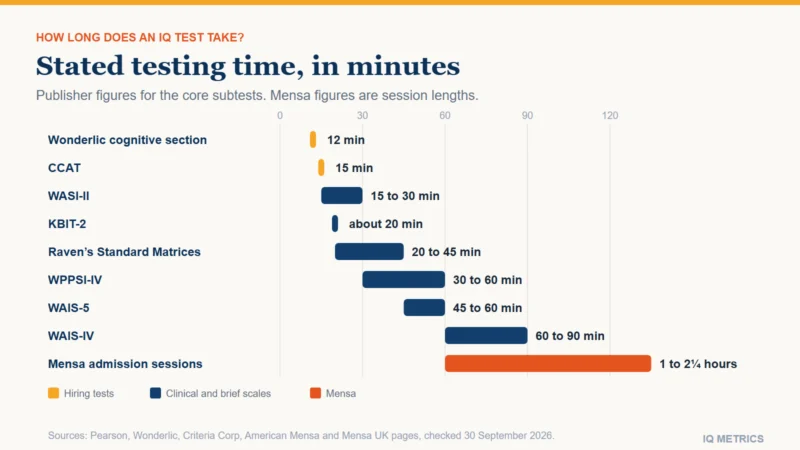
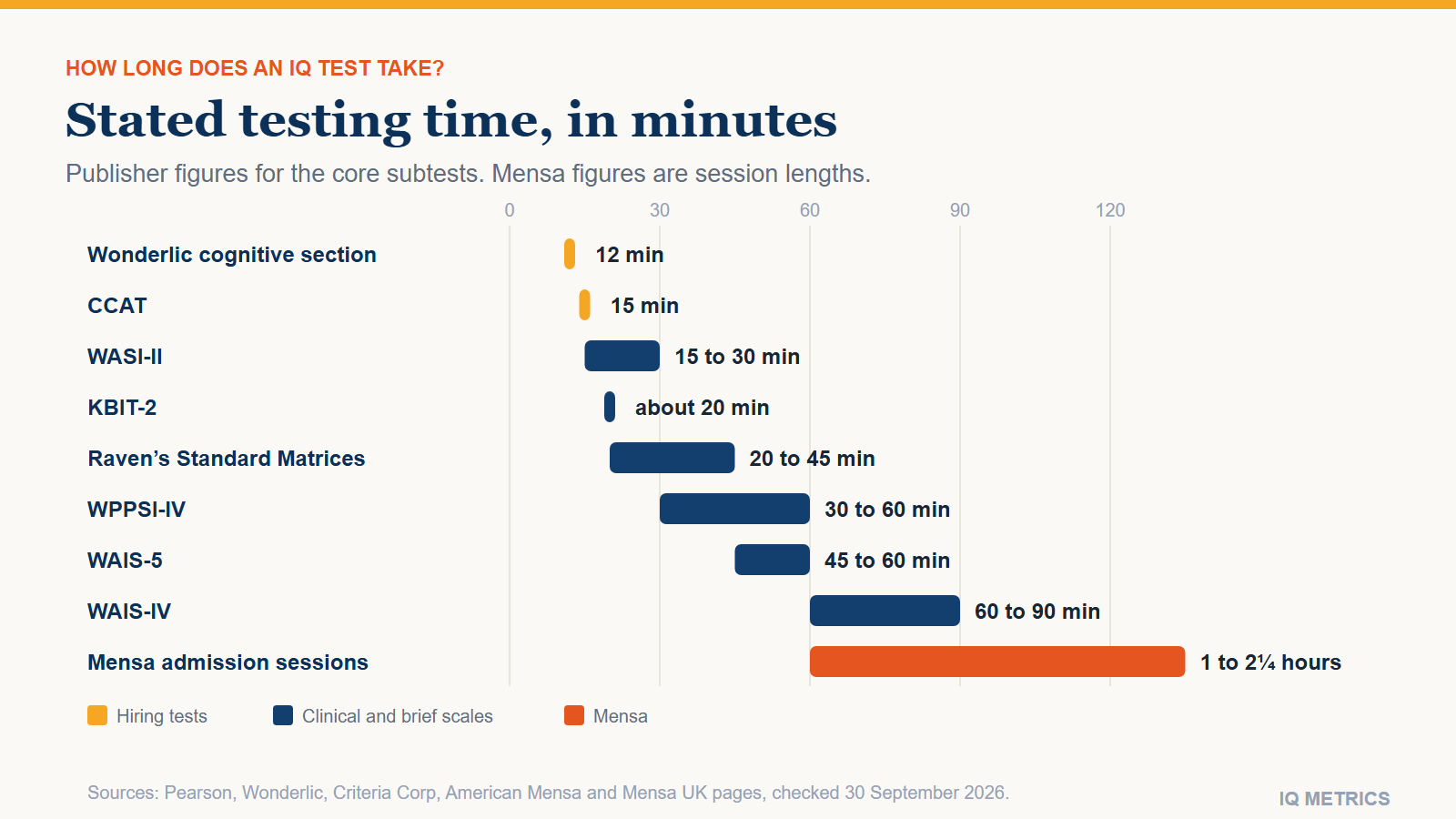
A chart of stated testing times in minutes. The WASI-II runs 15 to 30, the KBIT-2 about 20, the CCAT 15, the Wonderlic cognitive section 12, Raven's Standard Progressive Matrices 20 to 45, the WPPSI-IV 30 to 60, the WAIS-5 45 to 60, the WAIS-IV 60 to 90 and Mensa admission sessions 60 to 135 minutes.

How long does an IQ test take? An official IQ test usually takes about 45 to 90 minutes of testing, and a full evaluation takes several hours over one or two visits. Publisher-stated times for the core subtests are 45 minutes for the WAIS-5’s seven-subtest Full Scale IQ (60 for its ten primary subtests), 60 to 90 minutes for the WAIS-IV, about 60 for the WISC-V, 30 to 60 for the WPPSI-IV, about 20 for the KBIT-2 and 15 to 30 for the WASI-II. Mensa sessions run one to two and a quarter hours. Hiring tests are shorter: the Wonderlic cognitive section gives 50 questions in 12 minutes and the CCAT 50 in 15. This guide covers the time test by test, how many questions to expect, why two people take different amounts of time, what a full evaluation adds, whether a shorter test can do the same job, and whether the time of day matters.

  • Wechsler scales: WAIS-5 45 or 60 minutes (7 or 10 subtests), WAIS-IV 60 to 90, WISC-V about 60, WPPSI-IV 30 to 60 depending on age.
  • Brief tests: WASI-II 15 or 30 minutes, KBIT-2 about 20; Raven’s Standard Progressive Matrices has 60 items and is listed as untimed at 20 to 45 minutes.
  • Hiring tests: Wonderlic 50 questions in 12 minutes (the whole Select assessment takes about 35); CCAT 50 items in 15.
  • Mensa: one to two hours in the US; 1½ hours online or 2¼ hours in person in the UK.
  • A full evaluation: five to seven hours of testing over two visits plus a one-hour feedback meeting at one US university clinic, with the written report within about four weeks at another.
A chart of stated testing times in minutes. The WASI-II runs 15 to 30, the KBIT-2 about 20, the CCAT 15, the Wonderlic cognitive section 12, Raven's Standard Progressive Matrices 20 to 45, the WPPSI-IV 30 to 60, the WAIS-5 45 to 60, the WAIS-IV 60 to 90 and Mensa admission sessions 60 to 135 minutes.
A chart of stated testing times in minutes. The WASI-II runs 15 to 30, the KBIT-2 about 20, the CCAT 15, the Wonderlic cognitive section 12, Raven’s Standard Progressive Matrices 20 to 45, the WPPSI-IV 30 to 60, the WAIS-5 45 to 60, the WAIS-IV 60 to 90 and Mensa admission sessions 60 to 135 minutes.

How long does an IQ test take, test by test?

Publisher-stated testing times for the main instruments are in the table, with Mensa’s session lengths and two hiring tests for comparison. Pearson labels its figure “completion time” for the core subtests, and none of its pages says the figure includes the interview, breaks, scoring or the report.

Stated testing time, by test
Test Ages Stated time Source
WAIS-5 (2024) 16:0 to 90:11 45 minutes for the 7-subtest FSIQ; 60 minutes for the 10 primary subtests Pearson
WAIS-IV (2008) 16:0 to 90:11 60 to 90 minutes for the core subtests Pearson
WISC-V (2014) 6:0 to 16:11 About 60 minutes for the core subtests Pearson
WPPSI-IV (2012) 2:6 to 7:7 30 to 45 minutes (ages 2:6 to 3:11); 45 to 60 minutes (ages 4:0 to 7:7) Pearson
Stanford-Binet 5 2 to 85+ “Typical administration time is 5 minutes per subtest” Riverside
Differential Ability Scales II 2:6 to 17:11 Core battery 45 to 60 minutes; diagnostic subtests 30 minutes Pearson
KBIT-2 4:0 to 90:0 Approximately 20 minutes Pearson
WASI-II (2011) 6:0 to 90:11 30 minutes (four subtests); 15 minutes (two subtests) Pearson
Raven’s Standard Progressive Matrices 6:0 to 16:0; 17:0 and up 60 items; “Untimed” at 20 to 45 minutes Pearson
Raven’s Advanced Progressive Matrices 12:0 to 16:0; 17:0 and up “Untimed” at 40 to 60 minutes; the usual research procedure is 36 items in 40 minutes Pearson; Little et al. 2014
Wonderlic Select, cognitive section not stated 50 questions in 12 minutes; the whole assessment takes about 35 minutes Wonderlic
CCAT not stated 50 items in a 15-minute limit Criteria Corp
Mensa Norway online practice test norm bands from 16 35 puzzles in a 25-minute limit Mensa Norway
American Mensa admission test 14 and over “between one to two hours” American Mensa
Mensa UK Home Test / online supervised / in-person over 10½ for supervised 45 minutes / 1½ hours / 2¼ hours Mensa UK

Pearson says the WAIS-5 Full Scale IQ, which now needs seven subtests instead of ten, “can be obtained about 20 minutes faster than the WAIS-IV.” The Woodcock-Johnson publisher pages we could read give no total time, only the size of the batteries: 20 cognitive and 26 achievement tests in the WJ V (see our Woodcock-Johnson guide). Our guides to the Stanford-Binet, the WPPSI-IV and the WISC-V cover the children’s instruments.

How many questions are on an IQ test?

There is no single number. A Wechsler scale is a set of subtests, each with its own item list that stops after a run of misses, so nobody answers every item. Raven’s Standard Progressive Matrices has 60 items in five sets of 12; the Wonderlic and the CCAT each give 50 questions, and test takers are not expected to finish either in time (Criteria says fewer than 1% answer all 50 on the CCAT). Mensa does not publish item counts for its supervised tests, and Mensa International says it is “in the final stages of implementing computerised adaptive testing,” a format that “does not have a fixed set of test items.” The practice test on Mensa Norway’s site is 35 puzzles in 25 minutes, and its own page warns it is “not a substitute for professional intelligence tests.” For sample items and how the question types differ, see our guides to IQ test question types and Raven’s matrices, and the Wonderlic practice test and CCAT score guide.

Why two people take different amounts of time

Wechsler subtests start at an age- or ability-based item and stop after a run of misses, so the number of questions answered differs from person to person. Pearson’s WAIS-5 FAQ points out an irony of this: “Examinees who are intellectually gifted commonly require long testing times because they meet discontinue rules late in the item order or not at all.” The WAIS-5 therefore has special start points for examinees suspected of giftedness that “result in testing time reduction of approximately 25%.” Time limits also differ by task. In Pearson’s telepractice guide for the WAIS-5, Block Design, Visual Puzzles, Figure Weights, Arithmetic and Naming Speed Quantity carry item time limits, and Coding and Symbol Search a limit for the whole task, while Similarities, Vocabulary, Matrix Reasoning and the digit tasks have no strict limit. Speed still earns credit where it is measured: Pearson says removing the WISC-V Block Design time bonuses “would result in a loss of the ceiling, greatly reduced reliability, and a much lower correlation with general intelligence.” Our guides to WAIS-IV and WAIS-5 index scores and processing speed explain which subtests reward speed, and our digit span guide covers one of the untimed working-memory subtests. The Raven’s tests show the same trade-off: in an online experiment with 18 items, “20 min were sufficient for virtually all participants” when time was unrestricted, “whereas 10 min were sufficient for less than half” (Gonthier 2023).

How long does a full IQ evaluation take?

A clinical evaluation is much longer than the intelligence test inside it, because it usually adds other instruments. The University of Tennessee, Knoxville says a psychoeducational evaluation starts with a parent interview and testing that “typically lasts between three and four hours on the first day,” needs a second appointment, and totals “somewhere between five and seven hours” of testing, followed by a one-hour feedback meeting. The San Diego State University Psychology Clinic describes two to four appointments of a few hours each and says the written report “is generally provided within four weeks of your final assessment session.” Those are US clinics testing more than intelligence, so an IQ-only booking can be much shorter. One Australian clinic states that its fee “includes interview, test administration, written report and feedback session.” Our guide to taking an official IQ test covers what such an evaluation costs and where to book one.

Can a shorter IQ test do the same job?

Only roughly. In a clinical sample of 94 adults, Ryan and colleagues found that the WASI-II two-subtest IQ (about 15 minutes) correlated .96 with the four-subtest IQ (about 30 minutes) but overestimated it in 69.1% of cases, and only half of the two-subtest scores fell within 3 points of the four-subtest score. In a study of 198 people with Fragile X syndrome, the Stanford-Binet abbreviated score fell within one standard deviation (15 points) of the full-scale score at 77.2% of time points; the authors’ experience was that the routing subtests take 10 to 15 minutes against 60 to 90 for the full battery. A short test is a screen, not a substitute, which matters for the 10-minute quizzes online; see our guide to online IQ test quality and the timed IQ test page.

Your own number

Where would your own score land?

Take the IIF-certified assessment and get your score with the scale it was measured on, the percentile it corresponds to and the confidence range around it — the three figures most online tests leave out.

Find your IQ score now! →

Secure & encryptedInstant results10–20 minutes

Does the time of day matter?

A little, at least for school tests. A study of 2,034,964 test results from 570,376 Danish school children aged 8 to 15 found that, for every hour later in the day, performance fell by 0.9% of a standard deviation, while a 20 to 30 minute break raised it by 1.7% of a standard deviation (Sievertsen, Gino and Piovesan, 2016). Those were computer-based national school tests, not IQ tests, so the numbers are not IQ points, but they are a reason to ask for a break and a morning slot. A separate study of 198 high-school students aged 17 to 20 found a time-of-day match effect for a crystallized test but not for fluid reasoning on the Cattell Culture Fair Scale 3 (Jankowski, Díaz-Morales and Vollmer, 2023). See also our guides to sleep loss and test performance and how to prepare for an IQ test.

How long until you get the result?

It depends on who scores the test. An online test scores at once. American Mensa lists private-testing results “in days”; Mensa Canada asks candidates to follow up if they have heard nothing after a month; and one US clinic says its written report generally arrives within four weeks of the last session. In the US, a school district’s initial special-education evaluation must be conducted within 60 days of parental consent, or within the state’s own timeframe (34 CFR 300.301). How long a result stays useful is a separate matter; see our guide to how long an IQ test result is valid.

Quick answers

  • How long does an IQ test take? About 45 to 90 minutes of testing for a Wechsler scale, 15 to 20 minutes for a brief scale, and 12 to 15 minutes for a hiring test; a full evaluation takes several hours.
  • How long does an official IQ test take for adults? Pearson lists 45 minutes for the WAIS-5 seven-subtest Full Scale IQ and 60 for its ten primary subtests; the WAIS-IV took 60 to 90.
  • How long does an IQ test take for kids? About 60 minutes for the core WISC-V subtests and 30 to 60 for the WPPSI-IV, by age.
  • How long does the Mensa test take? One to two hours in the US; 1½ hours online or 2¼ hours in person in the UK.
  • How many questions are on an IQ test? No fixed number: Raven’s has 60 items, the Wonderlic and the CCAT 50, and Wechsler subtests stop after a run of misses.
  • How long does an online IQ test take? It varies: Mensa UK’s online workout is up to 15 minutes, Mensa Norway’s practice test 25 and Mensa UK’s Home Test 45. A short quiz is a screen, not a substitute for a full test.
  • Does a faster finish mean a higher IQ? No: on Wechsler scales high-ability examinees often take longer, and speed earns credit only on the timed subtests.

The bottom line

Plan on about an hour of testing for a Wechsler scale and an afternoon or two for a full evaluation, and on minutes rather than hours for a hiring test or a quiz. The publisher figures cover the core subtests only, so ask a psychologist what your booking includes and when the report will arrive. For what an evaluation costs, who can give it and what score you receive, read our guide to the official IQ test.

Sources

Share this article

Know someone who keeps seeing these numbers quoted without the scale they were measured on? Send it to them.

Tagged ccat time limit, how long does an iq test take, how long is the mensa test, how long is the wonderlic test, how many questions are on an iq test, intelligence research, IQ Science, iq test length, iq test time limit, ravens matrices time limit, short iq test accuracy, timed vs untimed iq test, wais-5 administration time, wisc-v administration time