IQ Metrics
IIF Certified Assessment Start IQ Test
IIF Certified Assessment

What an IQ of 125 Means

Scores & Scales

What Does an IQ of 125 Mean? Percentile and Accuracy

An IQ of 125 is about 1 person in 21 on a standard deviation 15 scale, the 95th percentile and one band below most gifted cutoffs. See how rare it is, what “Superior” means, how accurate a single score is, and what it predicts.

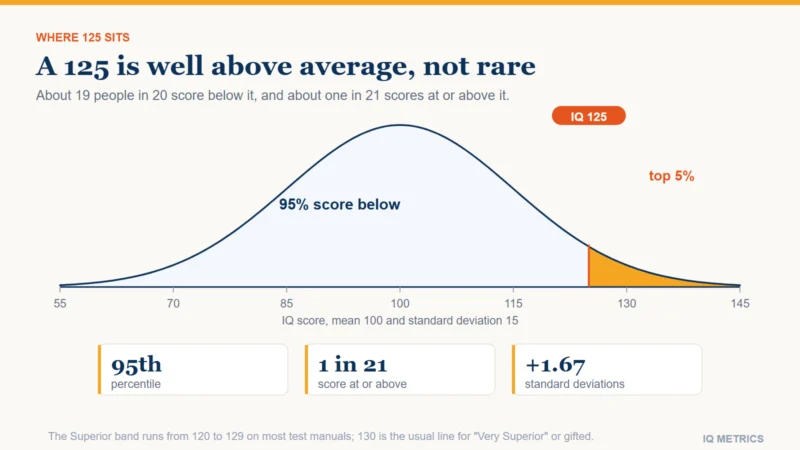
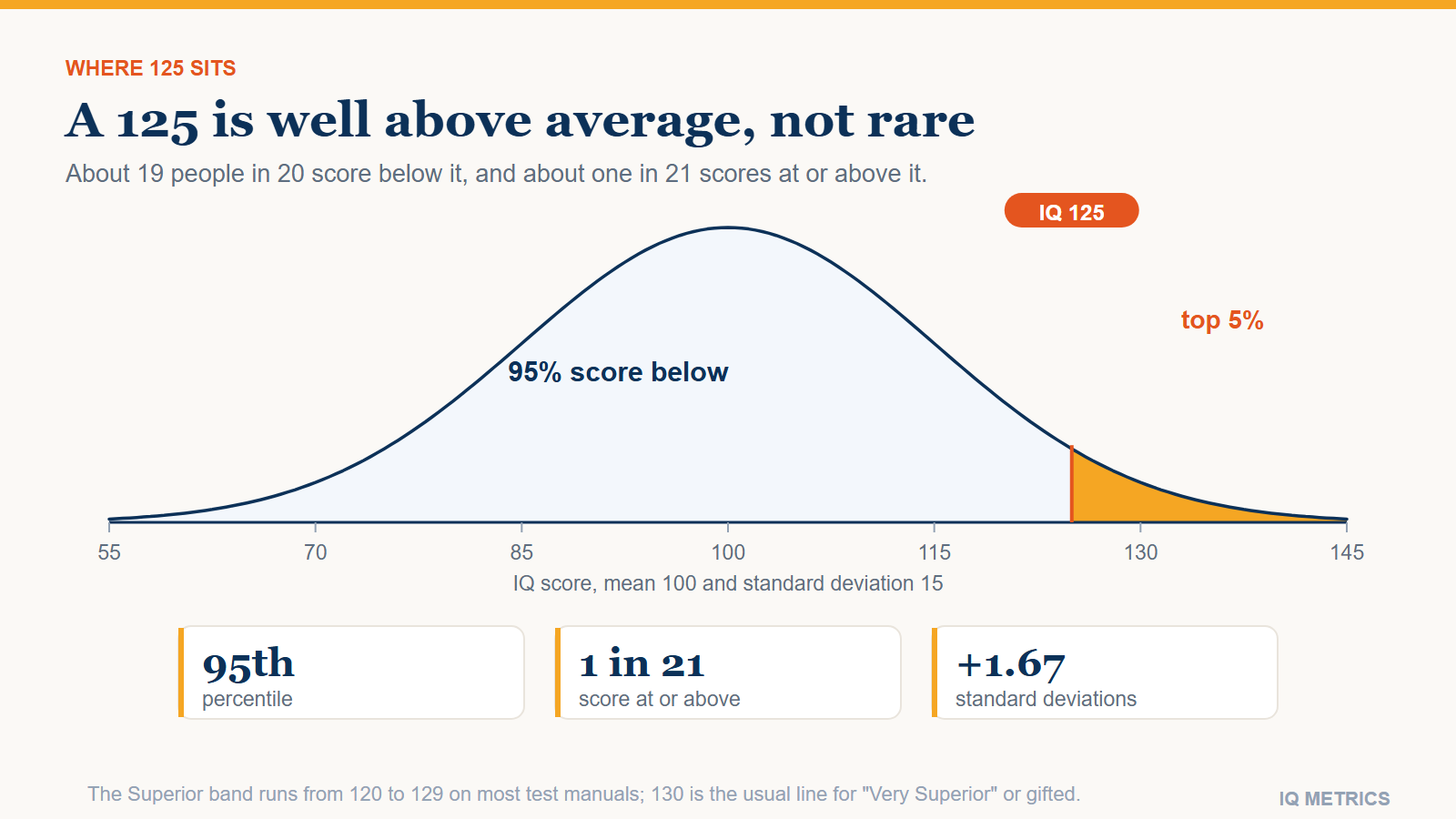
A bell curve for IQ scores from 55 to 145 with the top 5 percent above 125 shaded gold, showing 125 at the 95th percentile, about one person in 21.

An IQ of 125 is well above average but not rare enough to count as gifted. On a test scaled to a mean of 100 and a standard deviation of 15 — the scale used by the Wechsler tests and the current Stanford–Binet — a 125 sits 1.67 standard deviations above the mean, at about the 95th percentile. Roughly one person in 21 scores 125 or higher. That places it inside the band most test manuals call “Superior”, one full band below the “Very Superior” line at 130 that most sources use for “gifted”. This article covers how rare 125 really is, what the classification bands mean, how much a single 125 can be trusted, and what it does and does not predict.

  • Rarity: about 1 in 21 people score 125 or higher on a standard deviation 15 scale, the 95th percentile.
  • Classification: most Wechsler-family manuals label 120 to 129 “Superior”, one band below the 130-and-up line commonly used for “gifted”.
  • Accuracy: a reported 125 on a reliable test has an expected true score around 124, with a 95% range of roughly 117 to 131.
  • Prediction: this range links to somewhat better odds of finishing a demanding degree or entering a skilled profession, on average across large groups — not a guarantee for any one person.
A bell curve for IQ scores from 55 to 145 with the top 5 percent above 125 shaded gold, showing 125 at the 95th percentile, about one person in 21.

How rare is an IQ of 125?

On a normal curve with a mean of 100 and a standard deviation of 15, a score of 125 sits at z = +1.67. About 4.75% of people score that high or higher, which works out to about 1 in 21. Applied to a world population of roughly 8.2 billion, that implies somewhere near 390 million people, though almost none of them have ever taken a test that could confirm it. The IQ percentile calculator places any score on the same curve, and the IQ scale by age page covers how the same raw ability compares across ages.

Rarity of upper-range scores on a standard deviation 15 scale
IQ score Percentile About 1 person in
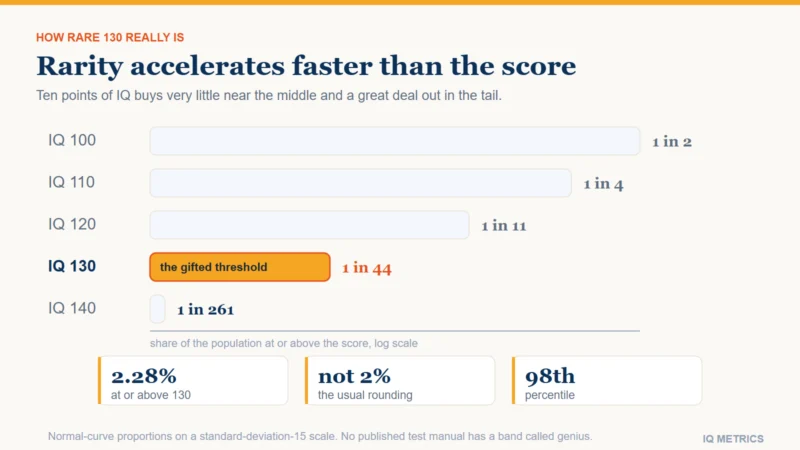
110 74.75 4
115 84.13 6
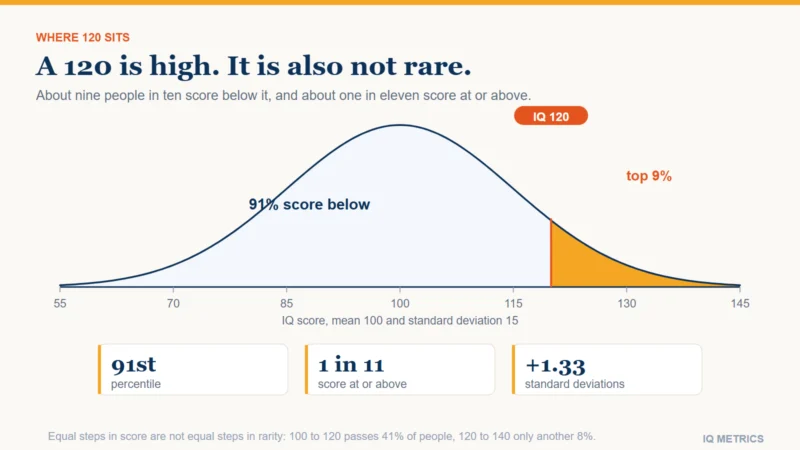
120 90.82 11
125 95.22 21
130 97.72 44
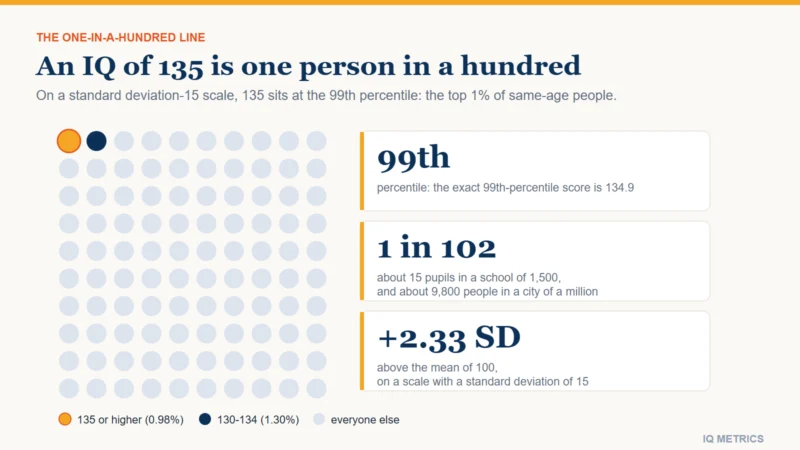
135 99.02 102
140 99.62 261

Equal steps in score are not equal steps in rarity. Moving from 100 to 110 passes about a quarter of the population; moving from 115 to 125 passes only about another 11%. The IQ of 120, IQ of 135 and IQ of 140 articles cover the neighbouring bands in the same way.

What is a 125 on other IQ scales?

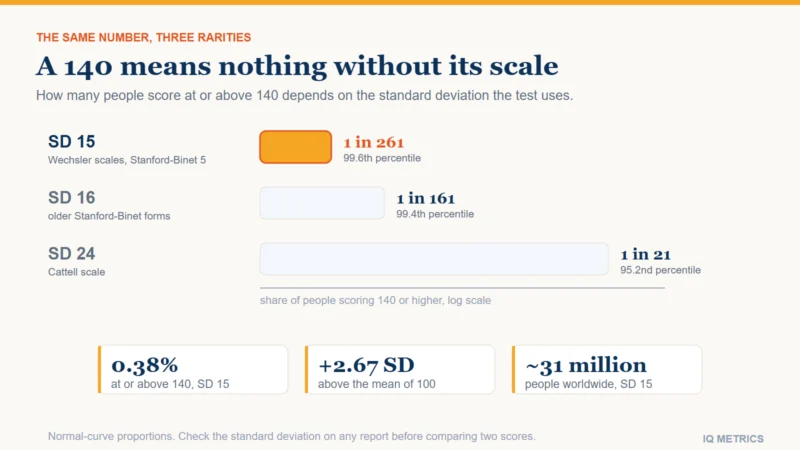
A bare number means little without its scale. The Wechsler tests and the current Stanford–Binet use a standard deviation of 15, but older and alternative scales spread scores further, so the same underlying rarity prints a different number on each one. A result with the same 1-in-21 rarity as a Wechsler 125 would print as roughly 127 on the older Stanford–Binet Form L-M scale (standard deviation 16), and roughly 140 on one of Cattell’s scales (standard deviation 24). This is one reason two people who sat different tests should never compare raw numbers directly; the standard deviation 15 versus 16 explainer covers the mechanics, and the IQ scale by age page shows how the same ability can also read differently depending on the age norms used.

The same rarity as a Wechsler 125 on other scales
Scale Standard deviation Score with the same 1-in-21 rarity
Wechsler tests, Stanford–Binet 5 15 125
Stanford–Binet Form L-M 16 ~127
Cattell scales 24 ~140

Is an IQ of 125 the same as being “gifted”?

Not on most definitions, though the line moves depending on who is drawing it. Test manuals typically reserve “Very Superior” or “Extremely High” for 130 and above, and many gifted-education programmes set their cutoff there too. Others set it lower, sometimes 120, so a 125 qualifies for admission in some school systems and not in others. Gifted cutoff scores covers how much these lines vary, and is 130 genius and what counts as a genius-level IQ go further up the scale. A 125 sits in the “Superior” band on most Wechsler-based tables: clearly above average, one notch below the line most people mean by “gifted”.

How accurate is a single score of 125?

Every score carries measurement error, and psychologists correct for it with Kelley’s formula: the expected true score is 100 plus the test’s reliability times the distance of the observed score from 100. For a good test with a reliability of 0.95, an observed 125 implies an expected true score of about 124, with a 95% range of roughly 117 to 131. A less reliable test, such as a short online quiz, widens that range considerably. The pattern is regression to the mean: a person who scores 125 is, on average, a little less exceptional than the raw number suggests, and a retest on a different instrument tends to land a little closer to 100. See regression to the mean and how to read an IQ test report for the same arithmetic applied elsewhere.

Your own number

Where would your own score land?

Take the IIF-certified assessment and get your score with the scale it was measured on, the percentile it corresponds to and the confidence range around it — the three figures most online tests leave out.

Find your IQ score now! →

Secure & encryptedInstant results10–20 minutes

What does an IQ of 125 predict?

At the population level, scores in this range associate with somewhat better odds of completing a demanding degree and entering a skilled profession, but the relationship is a group average, not a rule for any one person. Effort, opportunity, personality and plain circumstance carry much of the rest, which is why some people with lower scores outperform people who scored 125, and why the correlation between IQ and later outcomes, while real, is far from perfect. Does IQ predict school success? and talent versus practice cover how much of the rest depends on factors a test cannot see.

Where a score around 125 tends to show up

Scores in the low-to-mid 120s are unremarkable in settings that already select for academic or professional achievement, which is part of why the number feels more common in some contexts than the population-wide 1-in-21 rarity suggests. Selective university programmes, graduate study and many licensed professions draw disproportionately from people who score above average on cognitive measures, simply because admissions and training filter on related skills such as verbal and quantitative reasoning. That selection effect is also why a 125 can feel ordinary inside a specific workplace or classroom while still sitting in the top 5% of the general population. Mensa’s IQ requirements sit well above this range, at the top 2%, which is one reason a 125 does not qualify on its own.

Quick answers

  • Is 125 a good IQ? Yes. It is about 25 points above average, in the top 5% of scores on a standard deviation 15 scale.
  • Is an IQ of 125 gifted? Usually not by the most common cutoff of 130, though some programmes set the line at 120.
  • What percentile is an IQ of 125? About the 95th, roughly 1 person in 21.
  • Is 125 higher than average? Yes, 25 points above the mean of 100.
  • Can an online test accurately report a 125? A short unsupervised test can print a number, but with wider error than an individually administered test; see IQ test accuracy.
  • Does an IQ of 125 qualify for Mensa? No. Mensa requires scoring in the top 2%, roughly 132 on a standard deviation 15 scale, well above 125.
  • Will an IQ of 125 change if retested? A little, usually. Retesting on the same instrument tends to nudge scores up through familiarity, and testing on a different instrument can move a score a few points in either direction; treat any single number as an estimate, not a fixed trait.

The bottom line

An IQ of 125 means about 1.67 standard deviations above average on a standard deviation 15 scale: the 95th percentile, roughly 1 person in 21, and squarely inside the “Superior” band just below most gifted cutoffs. Treat it as a range in the high 110s to low 130s rather than an exact point, and as one input among many for judging ability, not the whole picture.

Sources

  • Wechsler test manuals (WAIS–IV, WISC–V): standard qualitative classification table, “Superior” for 120 to 129 and “Very Superior” for 130 and above.
  • National Association for Gifted Children: published guidance noting that gifted identification criteria, including IQ cutoffs, vary by school district and state.

Share this article

Know someone who keeps seeing these numbers quoted without the scale they were measured on? Send it to them.

Tagged gifted cutoff, iq 125, iq accuracy, iq classification, iq of 125, iq percentile, iq scale, IQ Science, IQ Score, iq score meaning, is 125 a good iq, Regression to the Mean, standard deviation iq, superior iq, wechsler classification

Low IQ vs Learning Disability

Understanding IQ

Low IQ vs Learning Disability: What Is the Difference?

A low IQ, an intellectual disability and a specific learning disability are three different things, and the UK uses "learning disability" for the second. What each requires, how each is assessed, the US and UK terms, and what to do if you are worried.

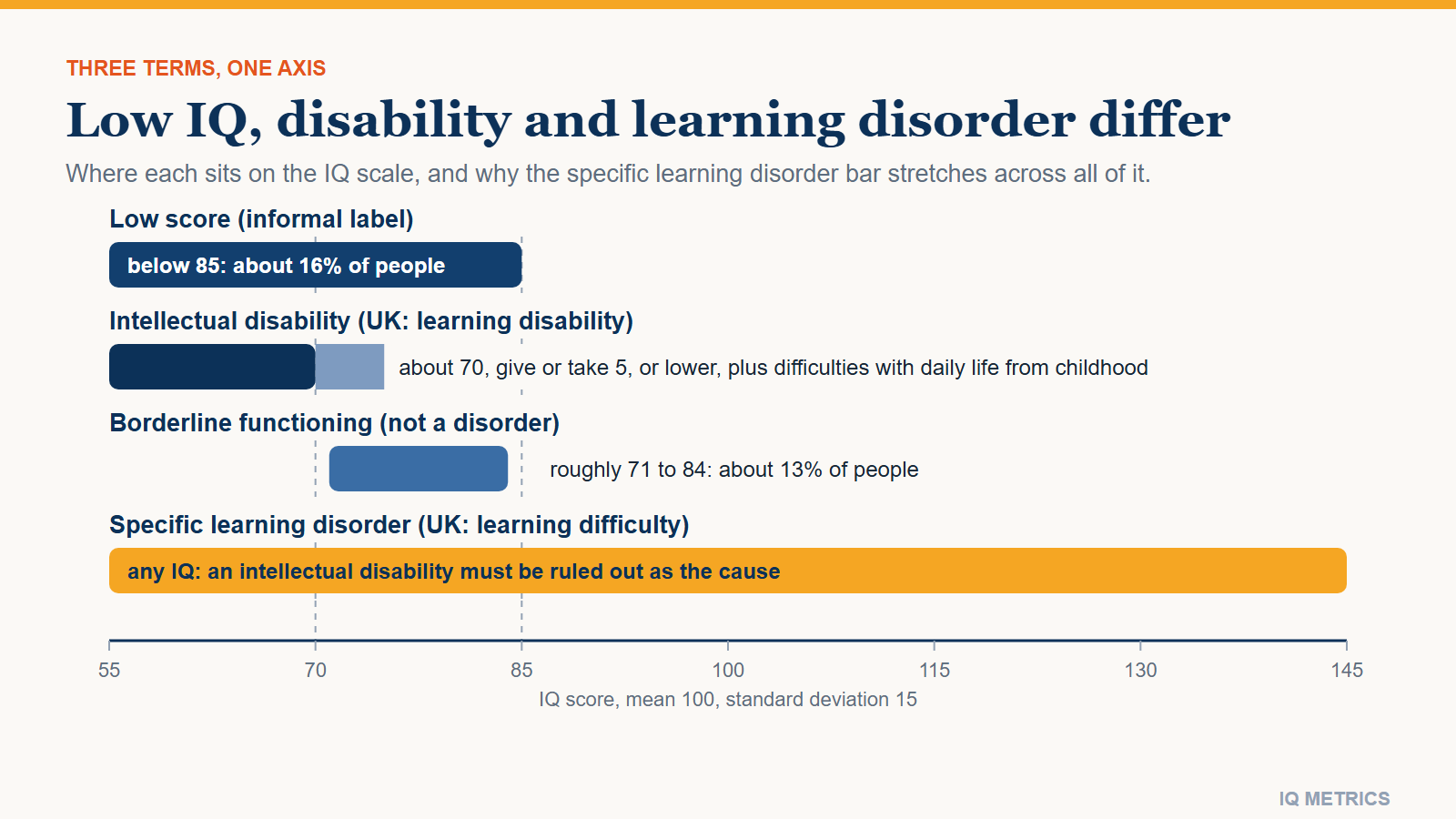
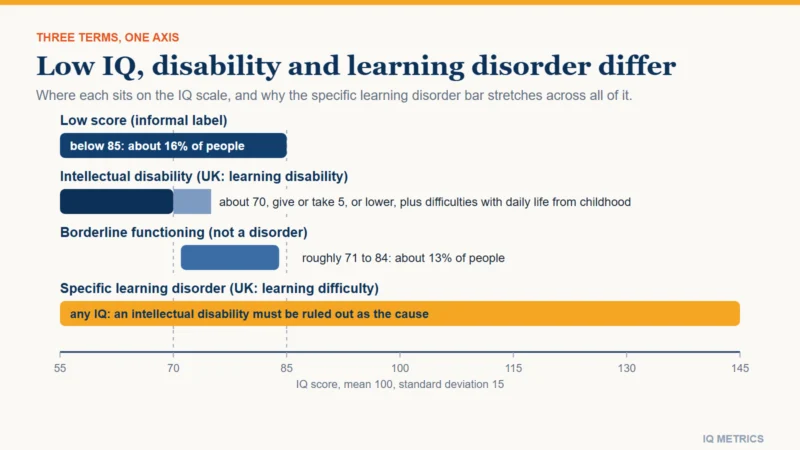
An IQ axis from 55 to 145 with four bars: intellectual disability at about 70 or below plus adaptive difficulties, borderline functioning from 71 to 84, a low score below 85, and a specific learning disorder that spans the whole range.

A low IQ and a learning disability are not the same thing. A low IQ is a test score. An intellectual disability is a diagnosis that needs a low score plus difficulty with everyday skills, starting in childhood. A specific learning disability, of which dyslexia is the best known, is an unexpected difficulty with reading, writing or mathematics that can occur at any IQ, including a high one. To add to the confusion, in the UK “learning disability” means what the US calls an intellectual disability. This article sorts out the three terms, what each one requires, how they are assessed, and what to do if you are worried.

  • Low IQ: a number, usually meaning a score well below 100. Not a diagnosis on its own.
  • Intellectual disability: a low score (about 70, give or take 5) plus difficulty with daily life, starting in childhood. About 1% of people.
  • Specific learning disorder: a persistent, unexpected difficulty with reading, writing or maths, with no IQ cut-off. About 5 to 15% of school-age children.
  • Terminology trap: the UK’s “learning disability” is the US “intellectual disability”.
An IQ axis from 55 to 145 with four bars: intellectual disability at about 70 or below plus adaptive difficulties, borderline functioning from 71 to 84, a low score below 85, and a specific learning disorder that spans the whole range.

Low IQ, intellectual disability and learning disability: the three terms

Three terms that get mixed up
Term What it is Is a low IQ score required? Roughly how common
Low IQ A test result, usually a score well below the average of 100 It is the score. On its own it is not a diagnosis About 16% score below 85 and about 2.3% below 70 on a standard deviation 15 scale
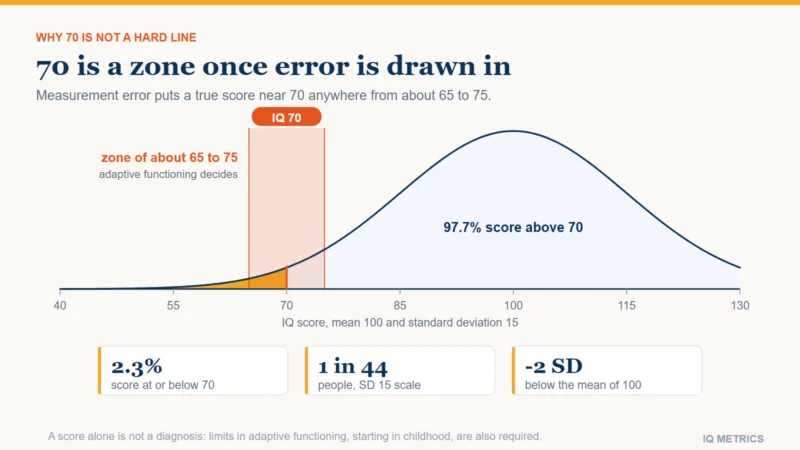
Intellectual disability (US). UK: “learning disability” A diagnosis: deficits in intellectual functioning and in adaptive functioning, with onset in childhood Yes: about two standard deviations below the mean, roughly 65 to 75 once measurement error is allowed for About 1% of the population (DSM-5)
Specific learning disorder (US). UK: “specific learning difficulty” Persistent difficulty with reading, written expression or maths, well below what age and teaching predict No. Intellectual disability must be ruled out as the explanation About 5 to 15% of school-age children (DSM-5)
Borderline intellectual functioning Scores of roughly 71 to 84. Not a disorder, but a range where daily life can be hard It is a score band, not a diagnosis About 13% of people if the curve holds

What does an intellectual disability require?

Under DSM-5 and the American Association on Intellectual and Developmental Disabilities definition, three things have to be present together. First, deficits in intellectual functioning, such as reasoning, problem solving, planning, abstract thinking and learning from experience, confirmed by clinical assessment and an individually administered IQ test. The score is about two standard deviations below the mean, roughly 65 to 75 with the margin of error included. Second, deficits in adaptive functioning across the conceptual (language, reading, money, time), social and practical (self-care, work, travel) areas that mean ongoing support is needed. Third, onset during the developmental period.

Since DSM-5 in 2013, severity (mild, moderate, severe, profound) is set by adaptive functioning, not by IQ bands. The old term “mental retardation” was replaced in US federal law by “intellectual disability” through Rosa’s Law in 2010. Because 70 is a zone rather than a line, what an IQ of 70 means goes into the detail, and the Social Security score rules cover how benefits treat the same numbers. Two conditions that often come with intellectual disability are covered in Down syndrome and IQ and fetal alcohol spectrum disorder and IQ.

What is a specific learning disability?

In US education law, a specific learning disability is a disorder in one or more of the basic processes involved in understanding or using language, spoken or written, that can show up as an imperfect ability to listen, think, speak, read, write, spell or do mathematical calculations. It covers conditions such as dyslexia, and it excludes problems that are mainly due to vision, hearing or motor disabilities, intellectual disability, emotional disturbance, or environmental, cultural or economic disadvantage. DSM-5 calls the same idea a specific learning disorder: difficulties with reading, written expression or mathematics that persist for at least six months despite targeted help, with skills substantially and measurably below what is expected for age, beginning in the school years.

It is common. DSM-5 puts it at 5 to 15% of school-age children across languages and cultures. In the US in 2022–23, 7.5 million students aged 3 to 21 (15% of public school students) received special education under the federal disability law, and 32% of them, about 2.4 million, were classed as having a specific learning disability, compared with 6%, about 450,000, classed as having an intellectual disability (National Center for Education Statistics).

Why the words change from country to country

The UK uses “learning disability” for what US clinicians call intellectual disability. The English government definition (Valuing People, 2001) describes a significantly reduced ability to understand new or complex information and to learn new skills, with a reduced ability to cope independently, which started before adulthood. Dyslexia and dyspraxia are “specific learning difficulties” there, not learning disabilities. The World Health Organization’s ICD-11 avoids the clash by using “disorders of intellectual development” for the first and “developmental learning disorder” for the second. When you read advice, check which country wrote it before assuming which condition it means.

Do you need a gap between IQ and achievement?

For decades the answer in the US was yes. The 1977 federal rules identified a specific learning disability by a severe discrepancy between IQ and achievement. Critics said the approach made children wait to fail, and that an IQ test cannot separate a child’s ability from what they have been taught. The 2004 revision of the federal law removed the requirement: schools are not required to consider a discrepancy, states may not require it, and schools may instead look at how a child responds to research-based teaching. DSM-5 does not require a gap either. In practice an evaluation now looks for a pattern of difficulty that persists despite good instruction, and rules out other explanations. That is also why an IQ of 85 does not rule out a specific learning disability, and why a score in the top hundredth of a percent (see what an IQ of 160 means) does not either.

Can someone have a high IQ and a learning disability?

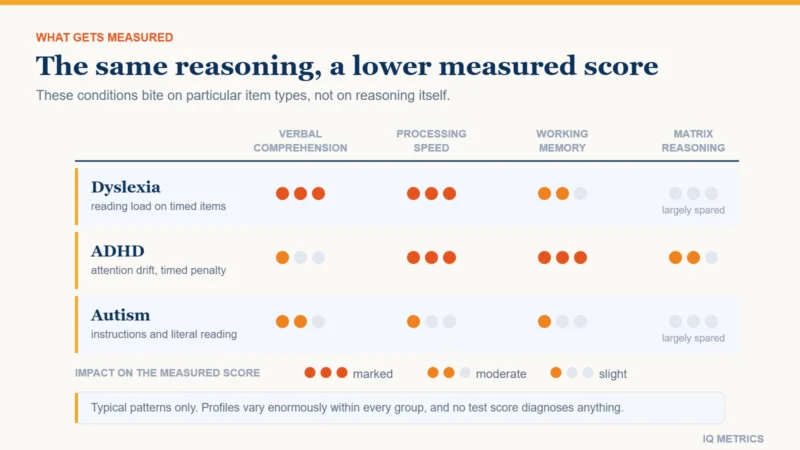
Yes. Educators call it twice-exceptional: strong reasoning alongside a specific difficulty such as dyslexia or dysgraphia. A single full-scale IQ can hide the pattern, because modern tests report separate index scores. The WISC-V, for example, gives five primary indexes (verbal comprehension, visual spatial, fluid reasoning, working memory and processing speed), and a large gap between them is often the first clue. See WISC-V index scores explained, full-scale IQ versus index scores, processing speed and IQ and high IQ and ADHD for how the profile is read, and ADHD, autism, dyslexia and IQ test scores for how these conditions affect the score.

Your own number

Where would your own score land?

Take the IIF-certified assessment and get your score with the scale it was measured on, the percentile it corresponds to and the confidence range around it — the three figures most online tests leave out.

Find your IQ score now! →

Secure & encryptedInstant results10–20 minutes

How is each one assessed?

A full evaluation normally combines several tools, each answering a different question.

  • A cognitive test such as the WISC-V, WAIS-IV or Stanford–Binet 5 gives the IQ and the index profile.
  • An achievement test such as the WIAT-4 or the Woodcock–Johnson measures reading, writing and maths directly; achievement tests versus IQ tests explains how the two differ.
  • An adaptive behaviour scale such as the Vineland-3 or the ABAS-3, completed by parents or teachers, shows how a person manages daily life.
  • History and screening cover hearing, vision, health, schooling and language background, all of which can mimic or hide a disability.

An intellectual disability needs the first and third to agree. A specific learning disorder needs the second to fall well below expectations, with the first used mainly to rule out an intellectual disability. For the difference between a score on one instrument and a diagnosis, see how to read an IQ test report.

What about scores between 70 and 85?

This band, often called borderline, is not an intellectual disability, yet day-to-day demands such as reading contracts or managing money can still be hard. On a normal curve about 13% of people fall in it. Many people in this range sit between services: too able to qualify for disability programmes built around a score of about 70 to 75, yet struggling in ways an average score would not predict. What an IQ of 85 means covers the upper edge of the band and IQ classifications shows where the labels come from.

If you are worried about a child, or yourself

  • Start with the school or a psychologist. In the US a parent can ask the school in writing for an evaluation; elsewhere, a GP, paediatrician or educational psychologist is the usual route.
  • Ask for the whole profile. Request the index scores, the achievement results and any adaptive ratings, not just one IQ number.
  • Ask what each result rules in or out. A good report says whether the pattern fits an intellectual disability, a specific learning disorder, both or neither.
  • Do not use an online quiz to decide. No online IQ test, this site’s included, can diagnose anything; see IQ test accuracy.
  • Expect support to matter. An intellectual disability is lifelong, but daily functioning usually improves with the right supports, and a specific learning disorder does not disappear but responds to targeted teaching.

Quick answers

  • Is a learning disability the same as a low IQ? No. A low IQ is a score; a specific learning disability is an unexpected difficulty with reading, writing or maths that can occur at any IQ.
  • What IQ counts as a learning disability? There is no IQ cut-off for a specific learning disability. For an intellectual disability, which the UK calls a learning disability, the score is about 70 give or take 5, plus difficulty with daily life.
  • Is dyslexia a low IQ? No. Dyslexia occurs across the whole IQ range.
  • What is the difference between intellectual disability and learning disability? In the US, the first affects overall intellectual and adaptive functioning and the second affects specific skills. In the UK, the first is what the second means.
  • Can you have a learning disability and a high IQ? Yes. It is called twice-exceptional.
  • Is an IQ of 75 a learning disability? Not by score alone. It sits in the zone around the cut-off, where adaptive functioning decides.

The bottom line

Low IQ, intellectual disability and specific learning disability answer three different questions. A low IQ says how a person scored. An intellectual disability says that a low score and difficulty with daily life go together and began early. A specific learning disability says that one skill, most often reading, is well below where teaching and age say it should be, whatever the IQ. Check which country the words come from, ask for the full profile instead of one number, and treat a score as a starting point for a conversation with a professional.

Sources

Share this article

Know someone who keeps seeing these numbers quoted without the scale they were measured on? Send it to them.

Tagged adaptive functioning, borderline intellectual functioning, child iq testing, Dyslexia, intellectual disability, iq 70, IQ achievement discrepancy, IQ Science, IQ Score, learning disability, low iq vs learning disability, special education, specific learning disorder, twice exceptional, WISC-V

Octopus IQ

Understanding IQ

Octopus IQ: How Smart Is an Octopus, Really?

An octopus has no IQ, but it has about 500 million neurons, most of them in its arms. The neuron count, the tool-use and recognition studies, why short lives leave no room for teaching, and why UK law now treats octopuses as sentient.

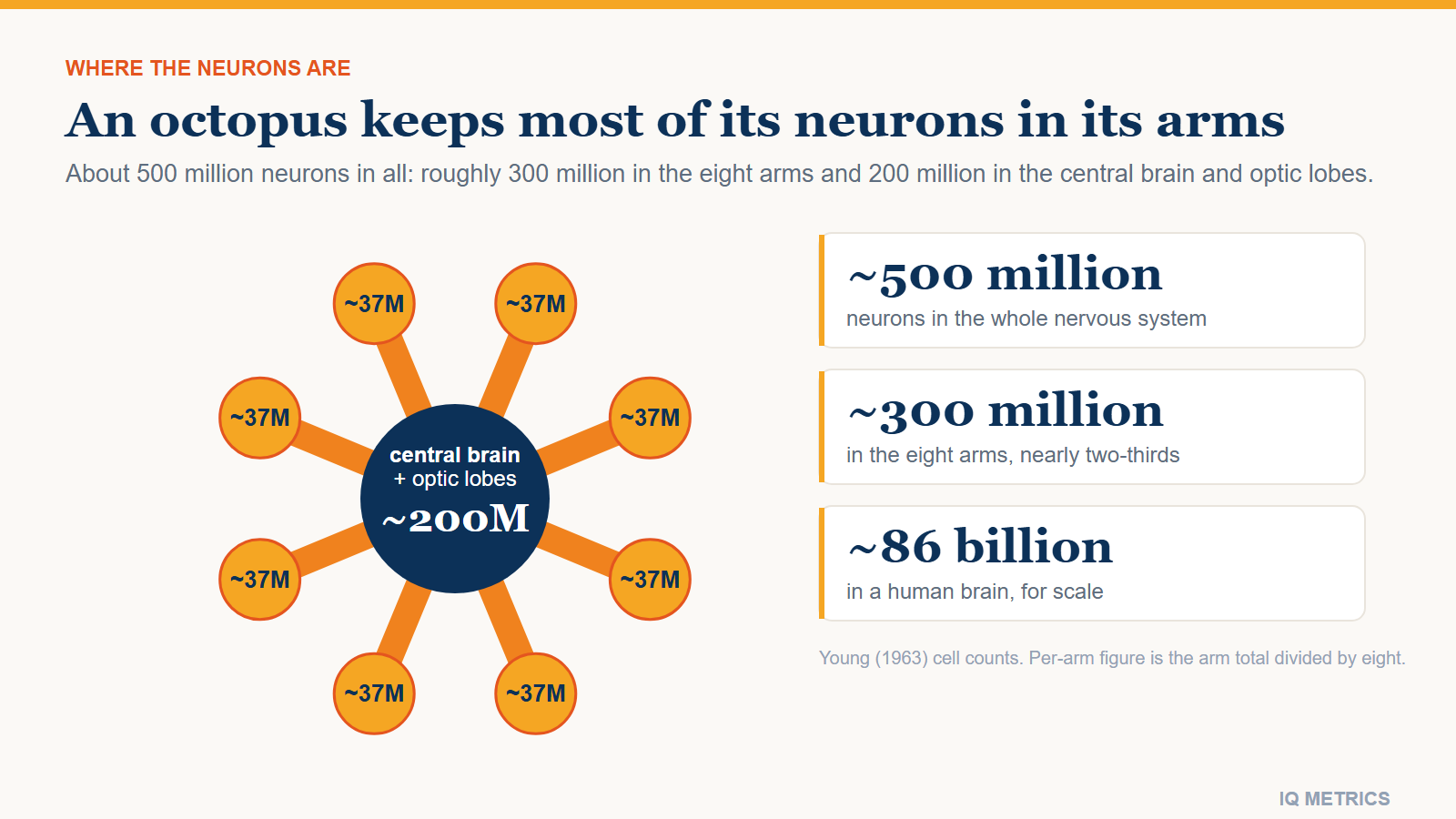
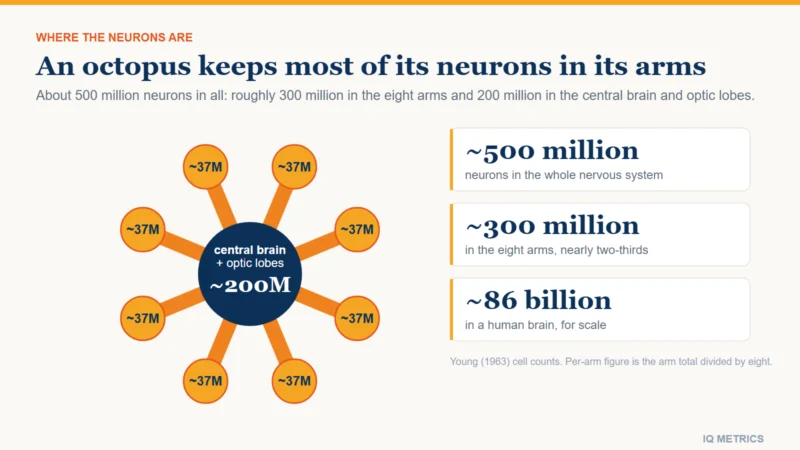
A diagram of an octopus nervous system: a central circle for the brain and optic lobes holding about 200 million of roughly 500 million neurons, surrounded by eight arm circles holding about 300 million between them, or about 37 million each.

An octopus does not have an IQ. IQ is a rank within humans on a human-normed test, and no standard battery exists for cephalopods. What scientists have documented instead is a set of problem-solving abilities that are remarkable in an animal with a completely different nervous system: about 500 million neurons, roughly 300 million of them in the arms, recognition of individual people, coconut-shell shelters that are carried from place to place, and a sleep cycle with active and quiet phases. This article covers the neuron count and where the neurons sit, the best-documented experiments, why octopus lives are too short for teaching, what UK law now says about octopus sentience, and how the animal compares with crows, chimpanzees and dogs.

  • Neurons: about 500 million in total, about 300 million of them in the arms (Young, 1963), against about 86 billion in a human brain.
  • Tool use: veined octopuses carry coconut-shell halves to use as shelter (Finn, Tregenza and Norman, 2009).
  • Lifespan: one to two years in the common octopus, so almost no octopus ever meets its parents.
  • Law: the UK’s Animal Welfare (Sentience) Act 2022 was amended to cover cephalopods.
A diagram of an octopus nervous system: a central circle for the brain and optic lobes holding about 200 million of roughly 500 million neurons, surrounded by eight arm circles holding about 300 million between them, or about 37 million each.

Does an octopus have an IQ?

No. An IQ score compares a person with a norm group of the same age, and there is no such group for an octopus or for the roughly 300 octopus species, most of which have never been studied in a laboratory. The experiments that exist involve a few species (the common octopus, the giant Pacific octopus and a handful of others), and each tests something specific: learning a maze, telling two shapes apart, opening a jar. As far as published work shows, nobody has tested whether octopus performance across tasks shares a general factor of the kind the g factor describes in people and, as chimpanzee IQ shows, in chimpanzees. The large multi-task batteries used for primates have not been run on them.

How many neurons does an octopus have, and where are they?

The common octopus has about 500 million neurons, a figure from the anatomist J. Z. Young’s cell counts. Roughly 300 million, nearly two-thirds, sit in the nerve cords and ganglia of the eight arms, and the remaining 200 million or so are in the central brain and the two large optic lobes. Each arm can taste, touch and move with a good deal of local control, and an arm cut from a living octopus keeps responding to touch for a while. The central brain sets goals; the arms do much of the execution, which is what people mean when they say an octopus has “nine brains”. It is a figure of speech, not an anatomical count.

Neuron counts for animals people compare with octopuses
Animal Neurons What was counted
Human about 86 billion whole brain
Raven about 2.2 billion whole brain (Olkowicz et al., 2016)
Chimpanzee about 6 to 8 billion cerebral cortex only; estimates differ
Dog 429 to 627 million cerebral cortex of two dogs (Jardim-Messeder et al., 2017)
Common octopus about 500 million whole nervous system, about 300 million in the arms

Read the table loosely: the counts cover different tissue and were made by different methods, and more neurons do not simply mean more intelligence. What makes octopuses useful to researchers is that their large, flexible nervous system evolved independently of ours, from a common ancestor that lived more than 500 million years ago. The octopus genome, published in 2015 by Albertin and colleagues, turned out to be large and complex, about 2.7 billion base pairs with roughly 33,000 protein-coding genes.

What has an octopus actually been shown to do?

  • Use tools. Veined octopuses in Indonesia were filmed collecting coconut-shell halves, carrying them across the sea floor and assembling them into a shelter (Finn, Tregenza and Norman, 2009). Carrying the shells is slow and costly, which is what makes it look like planning for later use.
  • Tell people apart. In a 2010 study, giant Pacific octopuses learned to distinguish two identically dressed caretakers, one who fed them and one who prodded them with a bristly stick. They approached the feeder and squirted water at the other (Anderson and colleagues).
  • Change shape on demand. The mimic octopus of Indonesian waters appears to switch between shapes and movements that resemble a sea snake, a lionfish or a flatfish (Norman, Finn and Tregenza, 2001).
  • Sleep in stages. Octopuses have a quiet sleep phase and an “active” phase in which skin patterns flicker and brain activity looks like waking (Pophale and colleagues, 2023, Nature).
  • Escape. Keepers tell of octopuses lifting lids and slipping through tiny gaps. One named Inky vanished from the National Aquarium of New Zealand in 2016 and was presumed to have gone down a drainpipe to the sea, an anecdote rather than an experiment.

Why octopus intelligence is unusual: short lives and no teachers

Most octopuses live one to two years, and the giant Pacific octopus three to five. Females typically guard their eggs without feeding and die soon after hatching; males decline after mating. Hatchlings therefore never meet a parent, so skills cannot pass down by teaching or imitation, and the cumulative culture seen in chimpanzees (see chimpanzee IQ) has no obvious route in octopuses. Each animal learns alone. The extreme case is a deep-sea species, Graneledone boreopacifica: a female watched in Monterey Canyon guarded her eggs for about 4.5 years, 53 months, the longest brooding period recorded for any animal (Robison and colleagues, 2014).

Your own number

Where would your own score land?

Take the IIF-certified assessment and get your score with the scale it was measured on, the percentile it corresponds to and the confidence range around it — the three figures most online tests leave out.

Find your IQ score now! →

Secure & encryptedInstant results10–20 minutes

Do octopuses feel? Sentience and the law

Intelligence and sentience are different questions. Sentience is the capacity to feel pain and distress; it is what animal-welfare law cares about, and it does not depend on an IQ-style ranking. In 2021 a review from the London School of Economics judged the evidence strong for cephalopod molluscs and decapod crustaceans, and the UK government then amended the Animal Welfare (Sentience) Act 2022 to bring both groups into its definition of “animal”. European law had already protected live cephalopods in scientific research under Directive 2010/63/EU. In practice, when octopuses appear in policy debates, farming proposals or research rules, the argument is about what they can feel, not how they would score on a test.

Octopus, crow, chimpanzee and dog: who is smartest?

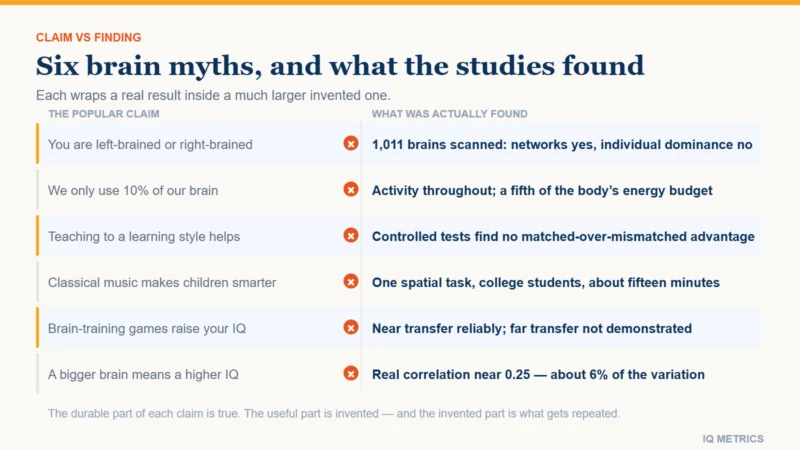
There is no honest ranking. Ravens match chimpanzees on some tasks (crow IQ), dogs read human gestures better than chimpanzees do (dog IQ), and octopuses solve problems with a body plan none of them share. What the comparisons do show is that intelligence has evolved in different lineages by different routes, which is a reason to distrust any single number. The same point runs through brain myths about intelligence.

Quick answers

  • What is the IQ of an octopus? There is none. IQ is a rank within humans of the same age, and no octopus norm group exists.
  • How many neurons does an octopus have? About 500 million, with about 300 million of them in the arms.
  • Do octopuses have nine brains? No. They have one central brain plus arm nerve cords with local control; “nine brains” is a figure of speech.
  • Can octopuses use tools? Yes. Veined octopuses carry coconut-shell halves and use them as shelter.
  • How long do octopuses live? One to two years for the common octopus and three to five for the giant Pacific octopus.
  • Is an octopus smarter than a dog? No shared test exists, so the honest answer is that they are good at different things.
  • Are octopuses sentient? UK law has recognised cephalopods as sentient since the 2022 Act was amended to include them.

The bottom line

An octopus has no IQ, but it has about 500 million neurons, most of them in its arms, and it has been shown to use tools, recognise individual people and sleep in stages. It does all this on a short life with no parents to learn from, and the law in the UK now treats it as a feeling animal. The lesson for anyone comparing animals is the same as for chimpanzees and crows: describe what each species does, and be wary of a single score.

Sources

  • Young (1963), Proceedings of the Zoological Society of London: the number and sizes of nerve cells in Octopus.
  • UK Parliament: amendment 39 to the Animal Welfare (Sentience) Bill, adding cephalopod molluscs and decapod crustaceans to the definition of animal.
  • Also cited: Albertin et al. (2015), Nature 524:220–224; Finn, Tregenza and Norman (2009), Current Biology 19:R1069–R1070; Anderson, Mather, Monette and Zimsen (2010), Journal of Applied Animal Welfare Science 13:261–272; Norman, Finn and Tregenza (2001), Proceedings of the Royal Society B 268:1755–1758; Pophale et al. (2023), Nature 619:129–134; Robison, Seibel and Drazen (2014), PLOS ONE 9(7):e103437; Olkowicz et al. (2016), PNAS; Jardim-Messeder et al. (2017), Frontiers in Neuroanatomy 11:118.

Share this article

Know someone who keeps seeing these numbers quoted without the scale they were measured on? Send it to them.

Tagged animal cognition, animal intelligence, animal sentience, Brain Size and IQ, cephalopods, comparative cognition, how smart is an octopus, intelligence research, invertebrate intelligence, iq of an octopus, IQ Science, neurons, octopus intelligence, octopus iq, tool use

Chimpanzee IQ

Understanding IQ

Chimpanzee IQ: How Smart Are Chimps Compared to Humans?

Chimpanzees have no IQ, but they have been tested. How chimps and 2.5-year-old children scored on the same 16 tasks, what a chimpanzee brain holds, the memory claim that did not survive practice, and whether chimps have a g factor.

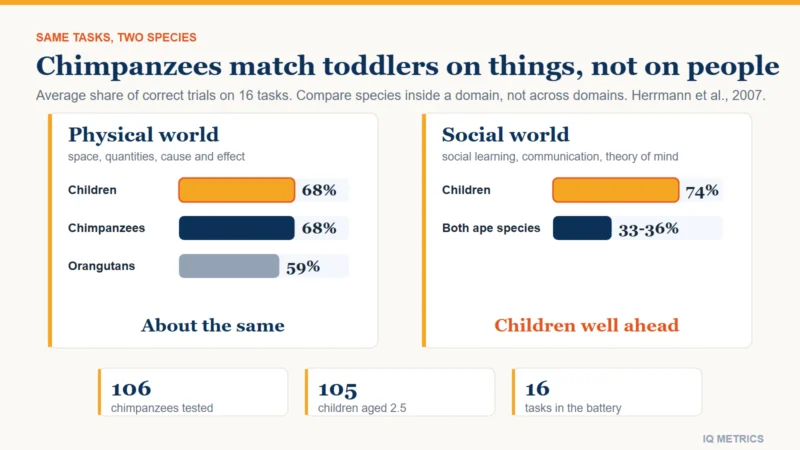
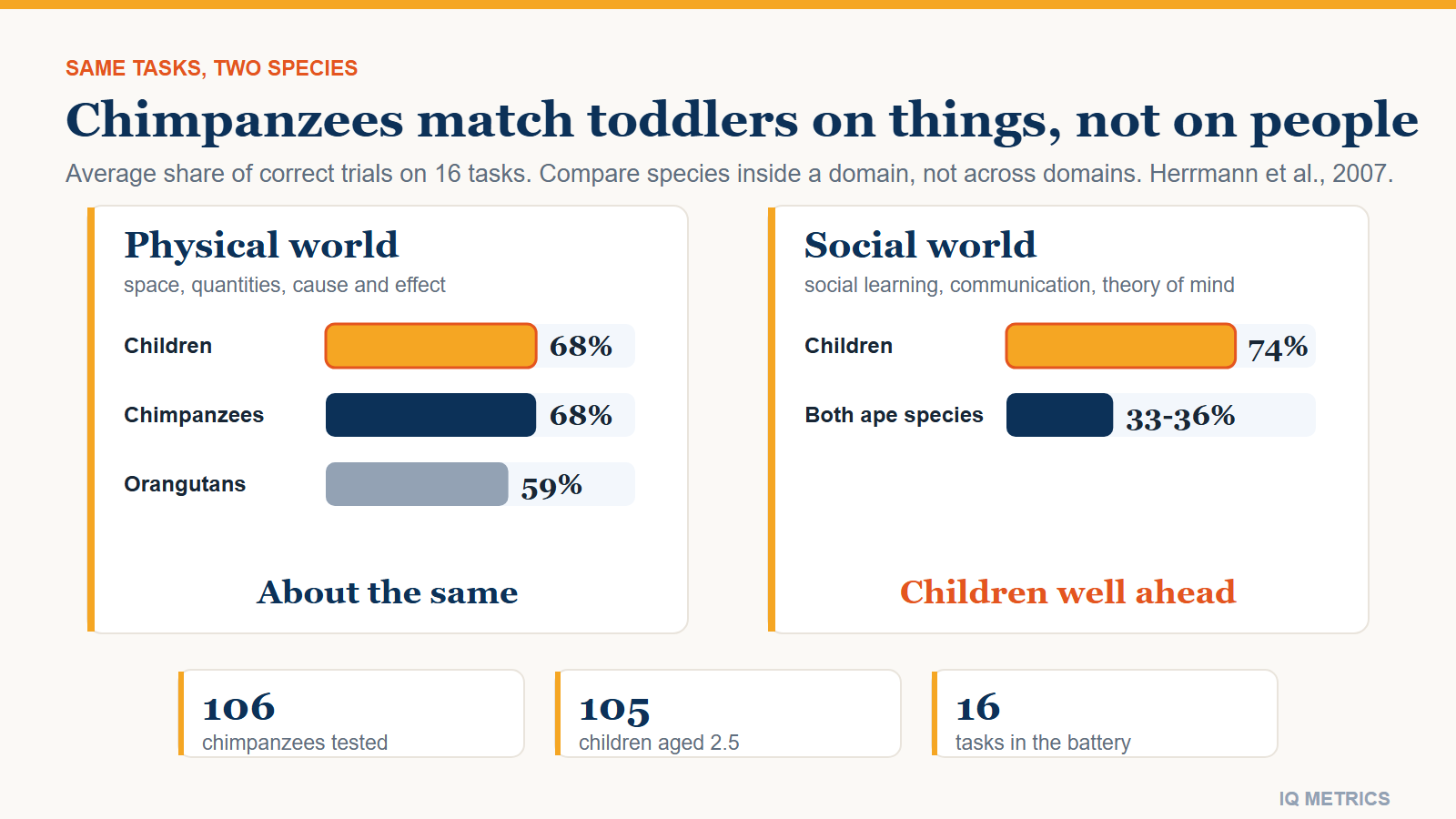
Two panels comparing chimpanzees with 2.5-year-old children on the same 16-task battery: on physical tasks chimpanzees and children were each right on about 68% of trials, while on social tasks children scored about 74% against 33 to 36% for the two ape species.

Chimpanzees do not have an IQ. An IQ is your rank against people of your own age on a test built and normed on humans, so no chimpanzee can be given one, and the figures sometimes quoted online, anywhere from the 20s to the 70s, trace back to no published norming study. What researchers can do is give chimpanzees the same tasks as human children and compare the results. On a 2007 battery of 16 tasks, chimpanzees and 2.5-year-old children were each right on about 68% of physical-world trials, while on social trials the children scored about 74% against 33 to 36% for the apes. This article covers those tests, the brain numbers, the chimpanzee that supposedly beat humans at memory, whether chimps have a g factor, and how they compare with crows, dogs and octopuses.

  • Brain: about 400 cubic centimetres against about 1,350 in humans, with roughly 6 to 8 billion cortical neurons against about 16 billion.
  • Best test: Herrmann and colleagues (2007) gave 106 chimpanzees and 105 children aged 2.5 the same 16 tasks: about 68% correct for both on physical tasks, but 74% for children against 33 to 36% for the apes on social ones.
  • Memory claim: the famous chimp-beats-human result did not survive a fair comparison after practice.
  • Heredity: in one study of 99 chimpanzees, about half the differences in overall cognitive performance were heritable.
Two panels comparing chimpanzees with 2.5-year-old children on the same 16-task battery: on physical tasks chimpanzees and children were each right on about 68% of trials, while on social tasks children scored about 74% against 33 to 36% for the two ape species.

Do chimpanzees have an IQ?

No, and the reason is structural rather than a shortage of testing. An IQ score places a person on a bell curve of people the same age (see how IQ tests work). A chimpanzee has no such curve: the norm samples are human, most items lean on language and culture, and the two species mature on different schedules, so even the old mental-age method (ratio IQ) has nothing sensible to divide by. Numbers such as “chimpanzee IQ 25” or “chimpanzee IQ 70” circulate widely, but no published norming study stands behind them. The same is true of crow IQ and dog IQ. What exists instead is comparative cognition: standard tasks given to many animals and scored against each other.

How do chimpanzees compare with human children on real tests?

The most cited comparison is Herrmann, Call, Hernández-Lloreda, Hare and Tomasello (2007) in Science. They gave 106 chimpanzees (aged 3 to 21, living in sanctuaries in Uganda and the Republic of Congo), 32 orangutans and 105 German children aged 2.5 the same Primate Cognition Test Battery. It has 16 tasks grouped into six scales in two families: physical cognition (space, quantities and cause and effect) and social cognition (social learning, communication and theory of mind, meaning understanding what others want or know). Every participant took all of it, three to five hours in all, and none had seen the tasks before.

Chimpanzees and 2.5-year-olds on the same 16-task battery
Task family What was tested Share of trials correct
Physical cognition Space, quantities, and cause and effect, including tool use Chimpanzees about 68% and children about 68%; orangutans about 59%
Social cognition Social learning, communication, and theory of mind Children about 74%; the two ape species 33 to 36%

Inside the physical family the picture was mixed rather than flat. Chimpanzees beat the children on a transposition task, on combining quantities and on the one cause-and-effect task that involved actively using a tool, while the children did better on object permanence and on three cause-and-effect tasks that required a judgment before acting. In the social family the children were consistently ahead. The authors present this as support for the cultural intelligence hypothesis, and as evidence against the idea that humans simply have more general intelligence: what sets us apart early in life is a specialised set of social-learning skills. Two caveats keep it in proportion. The absolute percentages are not comparable across the two families, because chance levels differ from task to task. And the children were 2.5, before schooling and with about a year of language, while the apes were captive, so the result says little about what either does in the wild. It is one battery at one age, not a chimpanzee IQ.

How does a chimpanzee brain compare with a human brain?

A chimpanzee brain is roughly 400 cubic centimetres against about 1,350 for a human, about a third of the volume. In neurons the gap is a little smaller than the volume gap suggests: Suzana Herculano-Houzel and colleagues have counted or estimated roughly 6 to 8 billion neurons in the chimpanzee cerebral cortex (estimates differ) against about 16 billion in humans. The DNA gap is smaller still, about 1.2% in single-letter differences, so the contrast is one of scale and wiring within a shared plan. Within humans, brain size correlates only modestly with IQ, as brain size and IQ: what the correlation really is explains. Across species, neuron count is a better guide than volume but still not a ranking of intelligence: the crow IQ article notes that a 14-gram raven brain holds about 2.2 billion neurons.

What can chimpanzees actually do?

  • Make and use tools. Jane Goodall reported termite fishing with stripped twigs at Gombe in 1960, and nut-cracking with stone hammers and anvils is well documented in West African communities. At Fongoli in Senegal, chimpanzees have been seen sharpening sticks to jab bushbabies out of tree hollows (Pruetz and Bertolani, 2007).
  • Pass on local traditions. A 1999 Nature analysis of seven long-term field sites found 39 behaviour patterns, from tool use to grooming, that were customary in some communities and absent in others (Whiten and colleagues).
  • Recognise themselves. Chimpanzees pass mirror self-recognition tests (Gallup, 1970), a result shared by only a handful of species.
  • Learn numerals. A chimpanzee named Ai learned to use Arabic numerals to label and order quantities, and her son Ayumu grew up in the same Kyoto laboratory (Kawai and Matsuzawa, 2000).
  • Fall behind dogs at reading people. Hare and colleagues (2002, Science) found that dogs followed a human pointing gesture to hidden food better than chimpanzees did.

Did a chimpanzee really beat humans at memory?

In 2007 Inoue and Matsuzawa reported that Ayumu, a young chimpanzee, outperformed three university students at touching numerals in order after they had been shown briefly on a touchscreen and replaced by white squares. Headlines called it photographic memory. Cook and Wilson (2010) pointed out the mismatch: Ayumu had been trained extensively on the task, while the students had received no practice. When two students were trained comparably, with five digits shown for 650 milliseconds across 300 training blocks, they substantially outperformed the chimpanzee, and there was no evidence that chimpanzees have a superior or different kind of spatial memory. The lesson applies to every animal-versus-human comparison: compare trained with trained. It is also a reminder that working memory is not reasoning, a distinction covered in working memory and reasoning are not the same.

Your own number

Where would your own score land?

Take the IIF-certified assessment and get your score with the scale it was measured on, the percentile it corresponds to and the confidence range around it — the three figures most online tests leave out.

Find your IQ score now! →

Secure & encryptedInstant results10–20 minutes

Do chimpanzees have a g factor?

Probably, in a modest sense. Hopkins, Russell and Schaeffer (2014) gave 99 chimpanzees aged 9 to 54 a set of 13 cognitive tasks and found that performance shared a general component, much as human test scores do. About half of the differences between individual chimpanzees in overall performance were heritable, and neither sex nor rearing history made a significant difference. As with people, heritability describes a group rather than one animal (see is IQ genetic?), and the sample was captive and small, so treat it as evidence rather than a settled figure. For the human version of the idea, see what is the g factor?.

Chimpanzee IQ versus crow, dog and octopus intelligence

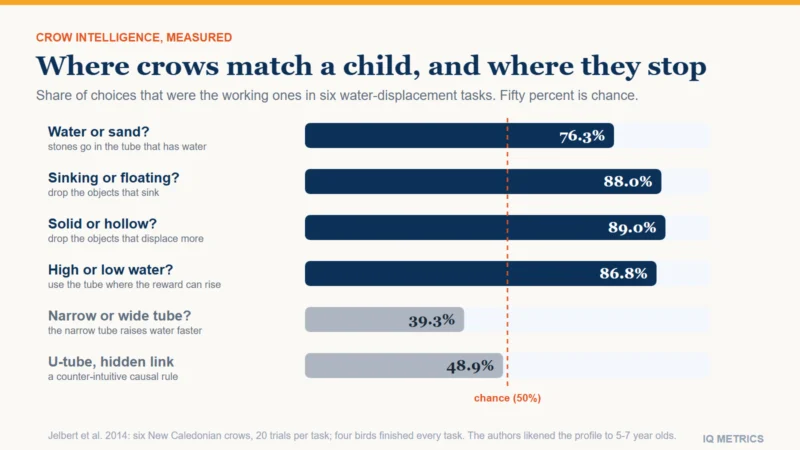
No ranking across species and tasks exists, because each animal is good at different things. In a self-control task, ravens scored 100%, level with chimpanzees, according to the comparison in our crow IQ article. Dogs read human signals better than chimpanzees do, while chimpanzees use tools that dogs do not; dog IQ covers what dog testing can and cannot show. Octopus IQ looks at an invertebrate with about 500 million neurons and a nervous system that evolved separately from ours. The shared lesson is that intelligence has evolved in different lineages by different routes, which is a reason to distrust any single number.

Why a chimpanzee IQ number would mislead

  • The tests are human-shaped. Language, pictures, schooling and culture are built into most IQ items.
  • Conditions differ. Food rewards, rearing history and familiarity with the tester can move results; Cook and Wilson found practice alone reversed the famous memory result.
  • Intelligence is not one line. Chimpanzees do well on some tasks, such as short-term spatial memory and tool use, and poorly on others, such as following a pointing gesture, which is why comparative researchers report profiles instead of a single number.

Quick answers

  • What is the IQ of a chimpanzee? There is no chimpanzee IQ. IQ is a rank within humans of the same age.
  • Is a chimpanzee smarter than a human child? On a 2007 battery, about level with a 2.5-year-old on physical tasks and behind on social ones.
  • What is the average IQ of a chimpanzee? None is published. Figures online have no norming study behind them.
  • Are chimpanzees smarter than dogs? It depends on the task. Dogs beat chimpanzees at following a human pointing gesture, and chimpanzees use tools that dogs do not.
  • Is chimpanzee intelligence genetic? In one study of 99 chimpanzees, about half the differences in overall performance were heritable.
  • How many neurons does a chimpanzee have? Roughly 6 to 8 billion in the cerebral cortex, against about 16 billion in humans.

The bottom line

A chimpanzee has no IQ, but it has been tested. On a 16-task battery it matches a 2.5-year-old child on physical problems and trails on social ones, its brain holds roughly half as many cortical neurons as ours, its overall performance is partly heritable, and its most famous memory feat shrank once the humans were given practice. The useful question is not how high a chimpanzee would score on a human test but what each species does well and why.

Sources

Share this article

Know someone who keeps seeing these numbers quoted without the scale they were measured on? Send it to them.

Tagged animal cognition, animal intelligence, Brain Size and IQ, chimp iq, chimpanzee iq, chimpanzee vs human, comparative cognition, G Factor, great apes, intelligence research, iq of a chimpanzee, IQ Science, primate cognition, tool use, Working Memory

What an IQ of 160 Means

Scores & Scales

What Does an IQ of 160 Mean? Rarity, Accuracy and Limits

An IQ of 160 is about 1 person in 31,600 on a standard deviation 15 scale, but only 1 in 161 on the Cattell scale. What a 160 means on each scale, which tests can print one, how accurate it is, what it predicts and where the claims come from.

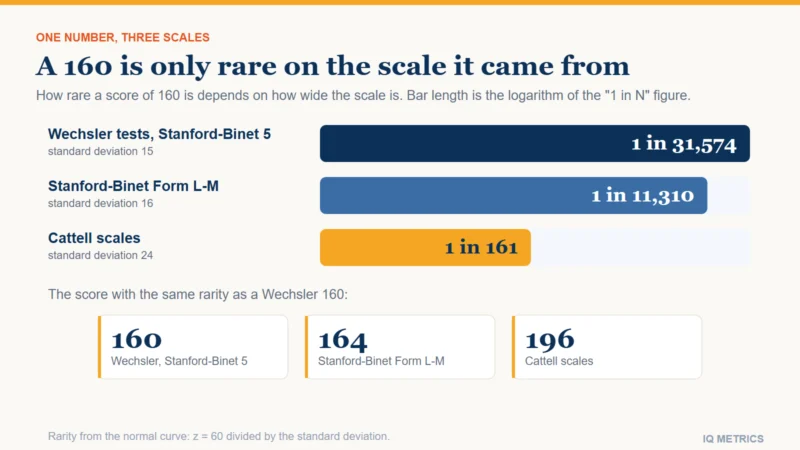
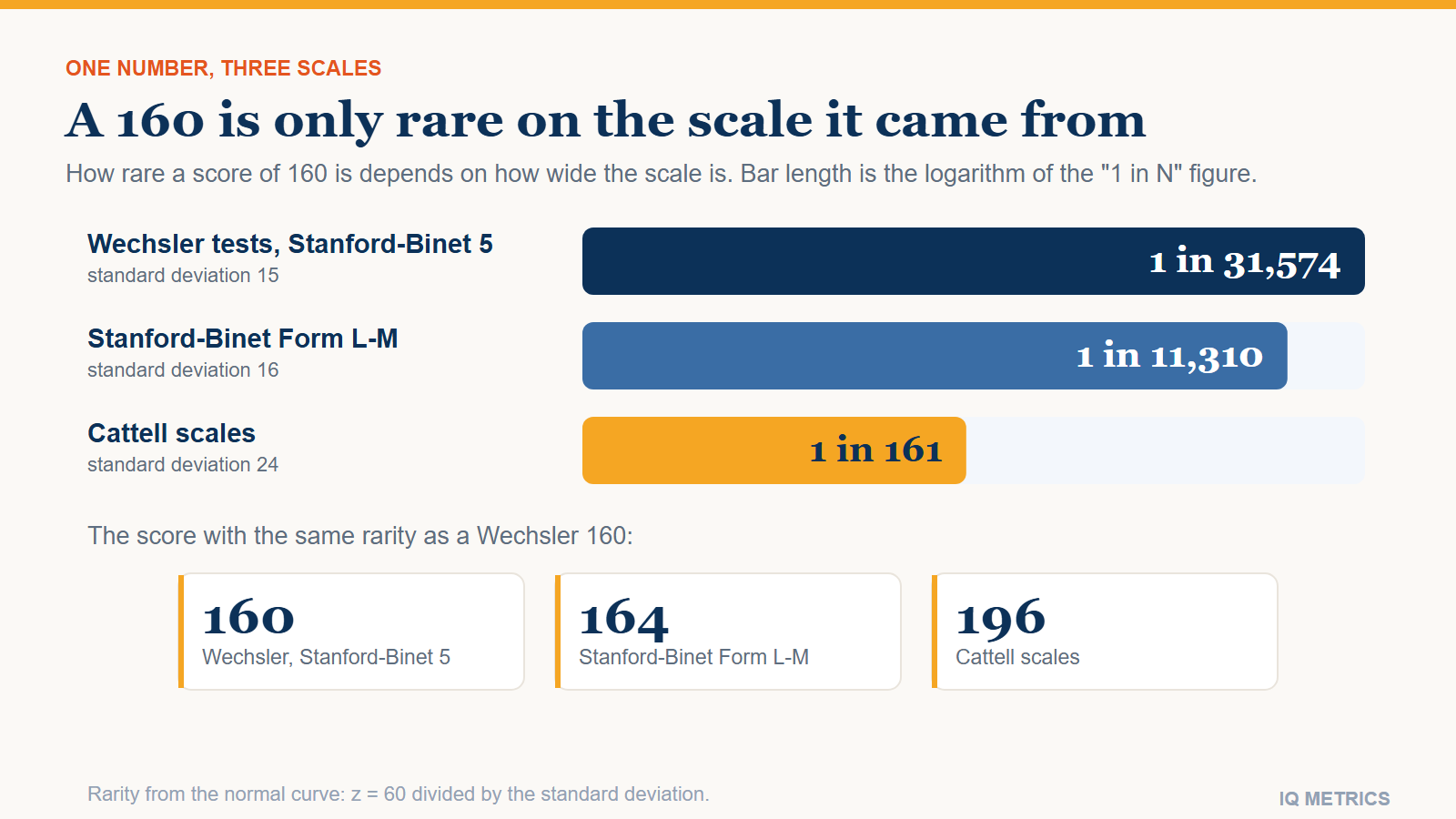
Three horizontal bars showing how rare an IQ of 160 is on three scales: about 1 in 31,600 on a standard deviation 15 scale, 1 in 11,300 on a standard deviation 16 scale and 1 in 161 on the Cattell standard deviation 24 scale.

An IQ of 160 is four standard deviations above the mean of 100 on a standard deviation 15 scale, the scale used by the Wechsler tests and the current Stanford–Binet. That is the 99.997th percentile, roughly one person in 31,600. The number is not portable, though: the same 160 on the old Stanford–Binet L-M scale (standard deviation 16) is about 1 in 11,300, and on Cattell’s scale (standard deviation 24) it is only about 1 in 161. This article covers what a 160 means on each scale, which tests can print one, how accurate it is, what scores this high predict, where claims of 160 come from and what to do with one.

  • Rarity: about 1 in 31,574 on a standard deviation 15 scale. A stadium of 70,000 randomly chosen people would be expected to hold about two.
  • Ceiling: the WAIS-IV and the Stanford–Binet Fifth Edition stop near 160, so a printed 160 usually means “at or above the top of the scale”, not an exact value.
  • Accuracy: a reported 160 has an expected true score of about 157 to 159 and a 95% range that runs from the low 150s to about 163.
  • Evidence: the best long-term data on people this rare comes from the Study of Mathematically Precocious Youth, which followed the top 1 in 10,000.
Three horizontal bars showing how rare an IQ of 160 is on three scales: about 1 in 31,600 on a standard deviation 15 scale, 1 in 11,300 on a standard deviation 16 scale and 1 in 161 on the Cattell standard deviation 24 scale.

How rare is an IQ of 160?

On a normal curve with a mean of 100 and a standard deviation of 15, a score of 160 sits at z = +4.0. About 0.0032% of people score that high or higher, which is 1 in 31,574. Applied to a world population of about 8.2 billion, that implies roughly 260,000 people; fill a 70,000-seat stadium with people chosen at random and the expected count is about two. Two cautions go with those numbers. The bell curve is a model, and real distributions drift from it in the extreme tails (the explainer how rare is a high IQ score? shows how far the model and the data can part). And almost none of those people have ever sat a test that could measure them.

Rarity of high scores on a standard deviation 15 scale
IQ score Percentile About 1 person in
130 97.72 44
140 99.62 261
145 99.865 741
150 99.957 2,331
155 99.988 8,139
160 99.997 31,574
165 99.9993 136,176
170 99.9998 653,327

To turn any score into a percentile, use the IQ percentile calculator. The IQ bell curve page explains why anything much beyond 145 is extrapolation rather than measurement.

Is an IQ of 160 genius level?

Genius is not a psychometric category. Test manuals label scores of 130 and above “very superior” or “extremely high” and stop there. The word appears in popular tables: Lewis Terman’s 1916 Stanford–Binet scheme labelled 140 and above “near genius or genius”, so 160 clears that bar with 20 points to spare. But work that changes a field depends on creativity, opportunity and years of effort, which is why many very high scorers stay unknown and most famous minds have no test score at all. The numbers attached to Einstein or Hawking are estimates, not results; where celebrity IQ numbers come from walks through the sourcing. For the wider question, see what is a genius IQ level and whether 130 is genius.

What is a 160 IQ on other scales?

IQ scales differ in spread, and a bare “160” hides which one was used. The Wechsler tests and the current Stanford–Binet use a standard deviation of 15. The older Stanford–Binet Form L-M used 16. Cattell’s scales use 24. A given number of points above 100 is worth fewer standard deviations on a wider scale, so it is far less rare.

The same 160 on three scales
Scale Standard deviation A score of 160 is about 1 in Score with the same rarity as a Wechsler 160
Wechsler tests, Stanford–Binet 5 15 31,574 160
Stanford–Binet Form L-M 16 11,310 164
Cattell scales 24 161 196

So a Cattell 160 is roughly a 137 on the Wechsler scale, and an L-M 160 is roughly a 156. It is also one reason very large numbers such as 180 or 200 turn up in older and high-range literature: they were quoted on wide scales. The explainer on standard deviation 15 versus 16 covers the mechanics, and the IQ score converter moves a score between scales.

Which tests can report a 160?

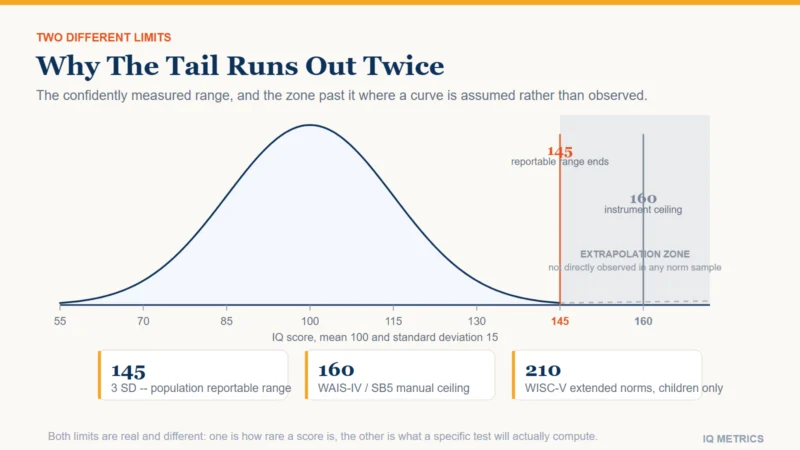
Very few. The two most widely used individually administered tests, the WAIS-IV and the Stanford–Binet Fifth Edition, cap their Full Scale IQ at about 160, and their manuals give no conversion above the hardest items. A report that says 160 therefore often means “at or above the top of what this test can measure”: a floor rather than a point estimate. Beneath the ceiling sits a second problem. Standardisation samples run to a few thousand people, too few to contain anyone this rare, so the top rows of a norms table are extrapolated rather than observed. The IQ ceiling effect and the explainer what is the highest IQ score a test can report? cover both limits in detail.

How accurate is a score of 160?

Every score carries measurement error, and an extreme score is more likely than a typical one to have been helped by chance. Statisticians correct for this with Kelley’s formula: the expected true score is 100 plus the test’s reliability times the distance of the observed score from 100. Assuming ordinary, normally distributed error, an observed 160 works out as follows.

What an observed score of 160 implies at three reliabilities
Test reliability Expected true score Likely range (95%)
0.90 (a short or unsupervised test) 154 145 to 163
0.95 (a good group-administered test) 157 151 to 163
0.98 (a full individually administered battery) 159 155 to 163

The pattern is regression to the mean. The person who scores 160 is, on average, a little less exceptional than the score says, and a retest on a different instrument usually lands a little lower. Retaking the same test pushes scores back up through practice (Scharfen, Peters and Holling, 2018). The table is also optimistic, because error grows toward the tails rather than staying constant, and the top of every range sits above the ceiling of most tests. Read a 160 as “somewhere in the top hundredth of a percent”, not as a single value. The regression to the mean page and the margin-of-error explainer show the same arithmetic for other scores.

Your own number

Where would your own score land?

Take the IIF-certified assessment and get your score with the scale it was measured on, the percentile it corresponds to and the confidence range around it — the three figures most online tests leave out.

Find your IQ score now! →

Secure & encryptedInstant results10–20 minutes

What does an IQ of 160 predict?

The best evidence on people this rare comes from the Study of Mathematically Precocious Youth (SMPY), which has followed young people identified before age 13 as the top 1 in 10,000 in mathematical or verbal reasoning. That rarity matches an IQ of roughly 156 on a standard deviation 15 scale (z = 3.72), close to a 160, although SMPY selected on above-level SAT scores rather than IQ tests. In a 2013 paper in Psychological Science, Kell, Lubinski and Benbow followed 320 of them for nearly three decades and found that by age 38 many held leadership positions in business, health care, law, the professoriate and STEM fields.

Three things keep that from becoming a promise. It is a group result, not a guarantee for any one person, and interests, opportunity and persistence carry much of the rest. The SMPY team also reports that ability differences inside the top 1% still line up with later accomplishment on average, but individual outcomes vary widely. And across the whole population the link between IQ and income is real but modest, as does IQ predict income? and does IQ predict school success? show. A very high score does not rule out a specific learning disability either; see low IQ versus learning disability.

Where do claims of an IQ of 160 come from?

  • High-IQ societies. The Prometheus Society sets its line at 1 in 30,000 (the 99.997th percentile), which is about 160 on a standard deviation 15 scale and 164 on a standard deviation 16 scale. Each society decides which tests it accepts, and self-report does not count; see high-IQ societies.
  • Children’s ratio IQs. Under the old formula, mental age divided by chronological age times 100, a 5-year-old who performs like a typical 8-year-old scores exactly 160. The formula stretches badly at the extremes and does not match modern deviation scores; see deviation IQ versus ratio IQ.
  • Online tests. A short unsupervised quiz can print any number but cannot certify one this rare. A result above about 145 from that kind of test says more about the scoring formula than about the test-taker.
  • Retrospective estimates. Scores attached to historical figures were inferred from biographies, not measured; see the highest IQ ever recorded.

If you have been told you scored 160

  • Find the scale. Ask which test it was and whether its spread was 15, 16 or 24. The same number means very different things.
  • Check who gave it. An individually administered test from a psychologist carries weight; an unsupervised web quiz does not.
  • Read the index scores. A full-scale number can hide an uneven profile; full-scale IQ versus index scores explains how to read them.
  • Quote a range or a percentile. “Top 0.01%” is honest; “exactly 160” is not.
  • Treat a child’s score as provisional. Scores are less stable in childhood; see what age is most accurate for an IQ test.

To see how a score of your own compares, the IQ Metrics IQ test and the IQ tests hub are the place to start.

Quick answers

  • Is 160 IQ good? It is higher than all but about 1 in 31,600 people on a standard deviation 15 scale.
  • How many people have an IQ of 160? About 1 in 31,574 if the bell curve holds, which is roughly 260,000 people worldwide.
  • Is an IQ of 160 possible? Yes, on paper. On the WAIS-IV and the Stanford–Binet 5 it is the top of the printed scale.
  • Is 160 higher than Einstein’s IQ? Einstein never sat a modern IQ test, so there is no verified number to compare with.
  • Can an online test give a 160? It can print one, but it cannot certify one.
  • Is a Cattell 160 the same as a Wechsler 160? No. The Cattell 160 is about 1 in 161, close to a Wechsler 137.

The bottom line

An IQ of 160 means four standard deviations above average on a standard deviation 15 scale: about 1 in 31,600, the top of the printed scale on the leading tests and beyond what any norm sample can check. It is best read as a range from the high 150s up to the ceiling, tied to its scale and its test, and as a statement about rank rather than worth. The number that travels between tests is the percentile, not the score.

Sources

Share this article

Know someone who keeps seeing these numbers quoted without the scale they were measured on? Send it to them.

Tagged genius iq, high iq societies, iq 160, iq ceiling, iq of 160, iq percentile, iq scale, IQ Science, IQ Score, is 160 iq good, prometheus society, Regression to the Mean, standard deviation iq, Terman, top 0.01 percent