How old were history’s great minds at their breakthrough?
We dated the work behind 663 prizes in physics, chemistry and medicine (1901-2026) and the best-known work of 132 historical geniuses, from Newton to Darwin. When did they break through, how long did the prize take, and who bloomed late? Eight charts, every person in the CSV.

By Leon Falkner, Data & Research Analyst · Reviewed by Aarav Vardhan, Editor-in-Chief · Published 28 October 2026 · 11 min read
About this study
- Report type
- Data study from public records
- Data
- Li et al. 2019 prize-winning papers; Nobel Prize API; Nobel committee documents; Wikidata; Cox (1926)
- Covers
- 663 dated breakthroughs (659 laureates) and 132 historical geniuses
- Years
- Prizes 1901-2026, including the 2026 laureates
- Licence
- CC BY 4.0 (our tables and CSV); source data CC0
- Version
- 2026.10
- Sources
- 9
Great scientific breakthroughs are made at a median age of 39. According to IQ Metrics’ analysis of 663 prize-winning discoveries in physics, chemistry and medicine (prizes 1901-2026), the typical laureate did the work that won the prize at 39: physicists at 35, chemists at 39 and medical scientists at 39. 44% came at 40 or older and 11% at 50 or older. The prize now follows the work by a median 30 years. Data: Li et al. 2019 and the Nobel Prize API, October 2026.
01 Key findings
- Median age 39. Across 663 dated breakthroughs that won a prize in physics, chemistry or medicine (1901-2026), the median age at the work was 39: physicists at 35, chemists at 39 and medical scientists at 39.IQ Metrics analysis of Li et al. 2019 and the Nobel Prize API, 663 breakthroughs
- Breakthroughs come later than they used to. Work done before 1920: median 36, 31% at 40 or older. Work done from 1980 on: median 41, 61% at 40 or older. Physics stayed near 35 for work up to 1979, then rose to 41.IQ Metrics analysis; 94 and 171 breakthroughs in the two periods
- The wait for the prize grew from 8 to 30 years. For prizes of 1920-1939 the median gap between the work and the prize was 8 years; for prizes of 2020-2026 it was 30 years, and the median laureate was 71 in the prize year.IQ Metrics analysis; 69 and 52 breakthroughs in those periods
- Late bloomers are not rare. 11% of the breakthroughs came at 50 or older. The oldest: John B. Fenn, 72 at the work in 1989. The youngest: Theodore W. Richards, 19 in 1887.IQ Metrics analysis of 663 breakthroughs
- Women and men broke through at about the same age: a median of 37 for the 27 breakthroughs by women and 39 for the 636 by men.Sex as recorded by the Nobel Prize API; IQ Metrics analysis
- The historical geniuses were older at their best-known work: a median of 41.5 for 132 scientists, writers, philosophers, artists and composers born 1450-1850 (Cox 1926).Best-known work and its date: Wikidata; people: Cox 1926 via IQ Metrics
02 The short answer in four numbers
Median age at the prize-winning work: 663 breakthroughs in physics, chemistry and medicine, 1901-2026.
IQ Metrics, 2026of the breakthroughs were made at 40 or older.
IQ Metrics, 2026came at 50 or older: the late bloomers.
IQ Metrics, 2026median wait from the work to the prize, prizes of 2020-2026 (8 years for 1920-1939).
IQ Metrics, 2026The lone young genius is the exception in our data. The typical prize-winning breakthrough came at 39, and the age keeps rising.
Leon Falkner, IQ Metrics Research
03 At what age do scientists make their greatest discoveries?
We dated the prize-winning work of 663 laureate-prizes in physics, chemistry and physiology or medicine, from the first prizes in 1901 to the 2026 laureates [1] [3] [2]. The age is the year of the work minus the year of birth. The median is 39; the middle half of the breakthroughs fell between 33 and 44.
How old the laureates were when they did the prize-winning work
All 663 breakthroughs in physics, chemistry and medicine whose year we could date (prizes 1901-2026), in five-year age bands. 1 under 20 is in the first band.
Age in the year of the work
Source: Prize-winning papers: Li et al. 2019 [1]; 2017-2026 and gaps: Nobel committee documents [3]; birth years: Nobel Prize API [2]; IQ Metrics analysis
Data table
| from | to | breakthroughs |
|---|---|---|
| 20 | 25 | 16 |
| 25 | 30 | 59 |
| 30 | 35 | 146 |
| 35 | 40 | 147 |
| 40 | 45 | 142 |
| 45 | 50 | 80 |
| 50 | 55 | 47 |
| 55 | 60 | 19 |
| 60 | 65 | 6 |
| 65 | 70 | 0 |
| 70 | 75 | 1 |
Embed this chart
Paste this HTML into your page: it carries the numbers and the credit link to this figure.
The spread is wide: 11% of the breakthroughs came before 30, 44% at 40 or older and 11% at 50 or older. Albert Einstein was 26 in 1905, the year of the light-quanta paper behind the 1921 physics prize.
04 What is the peak age of creativity in each field?
Physicists made their prize-winning breakthroughs youngest (median 35, 95% interval 34 to 38), then chemists (39, 37 to 41) and medical scientists (39, 39 to 40). The gap between fields is a few years; the spread inside each field is decades wide.
Age at the breakthrough, field by field
Each dot is one person; the shape shows where the ages bunch; the navy tick is the median. Laureates: the year of the prize-winning work. The historical geniuses of Cox (1926): the year of the best-known work recorded in Wikidata, a different measure.
Age in the year of the work
Source: Laureates: Li et al. 2019 [1], Nobel committee documents [3], Nobel Prize API [2]; best-known works: Wikidata [5]; geniuses: Cox 1926 via IQ Metrics [6]; IQ Metrics analysis
Data table
| group | item | value |
|---|---|---|
| Physics laureates | Guglielmo Marconi | 21 |
| Physics laureates | Subrahmanyan Chandrasekhar | 21 |
| Physics laureates | Brian D. Josephson | 22 |
| Physics laureates | Frank Wilczek | 22 |
| Physics laureates | Owen Willans Richardson | 22 |
| Physics laureates | Lawrence Bragg | 23 |
| Physics laureates | Paul A.M. Dirac | 23 |
| Physics laureates | H. David Politzer | 24 |
| Physics laureates | Murray Gell-Mann | 24 |
| Physics laureates | Werner Heisenberg | 24 |
| Physics laureates | Russell A. Hulse | 25 |
| Physics laureates | Wolfgang Pauli | 25 |
| Physics laureates | Albert Einstein | 26 |
| Physics laureates | Donald A. Glaser | 26 |
| Physics laureates | Donna Strickland | 26 |
| Physics laureates | Ernst Ruska | 26 |
| Physics laureates | Gerardus 't Hooft | 26 |
| Physics laureates | Hiroshi Amano | 26 |
| Physics laureates | John M. Martinis | 26 |
| Physics laureates | Robert Schrieffer | 26 |
| Physics laureates | Anthony J. Leggett | 27 |
| Physics laureates | Ben R. Mottelson | 27 |
| Physics laureates | Douglas D. Osheroff | 27 |
| Physics laureates | John H. Van Vleck | 27 |
| Physics laureates | Leon N. Cooper | 27 |
| Physics laureates | Carl D. Anderson | 28 |
| Physics laureates | Hideki Yukawa | 28 |
| Physics laureates | Martin Ryle | 28 |
| Physics laureates | Niels Bohr | 28 |
| Physics laureates | Adam G. Riess | 29 |
| Physics laureates | Alexei Abrikosov | 29 |
| Physics laureates | Charles Glover Barkla | 29 |
| Physics laureates | Didier Queloz | 29 |
| Physics laureates | Ernest T.S. Walton | 29 |
| Physics laureates | Gustav Hertz | 29 |
| Physics laureates | Il´ja M. Frank | 29 |
| Physics laureates | Makoto Kobayashi | 29 |
| Physics laureates | Robert Woodrow Wilson | 29 |
| Physics laureates | Rudolf Mössbauer | 29 |
| Physics laureates | Sheldon Glashow | 29 |
| Physics laureates | Victor F. Hess | 29 |
| Physics laureates | Wilhelm Wien | 29 |
| Physics laureates | Anne L’Huillier | 30 |
| Physics laureates | Ernest Lawrence | 30 |
| Physics laureates | Eugene Wigner | 30 |
| Physics laureates | F. Duncan M. Haldane | 30 |
| Physics laureates | J. Michael Kosterlitz | 30 |
| Physics laureates | James Peebles | 30 |
| Physics laureates | John Clauser | 30 |
| Physics laureates | Julian Schwinger | 30 |
| Physics laureates | Konstantin Novoselov | 30 |
| Physics laureates | Manne Siegbahn | 30 |
| Physics laureates | Melvin Schwartz | 30 |
| Physics laureates | Pavel A. Cherenkov | 30 |
| Physics laureates | Richard P. Feynman | 30 |
| Physics laureates | Tsung-Dao Lee | 30 |
| Physics laureates | Aage N. Bohr | 31 |
| Physics laureates | Arthur H. Compton | 31 |
| Physics laureates | Brian P. Schmidt | 31 |
| Physics laureates | Giorgio Parisi | 31 |
| Physics laureates | Hannes Alfvén | 31 |
| Physics laureates | Ivar Giaever | 31 |
| Physics laureates | Marie Curie | 31 |
| Physics laureates | Michel H. Devoret | 31 |
| Physics laureates | Pieter Zeeman | 31 |
| Physics laureates | Riccardo Giacconi | 31 |
| Physics laureates | Arno Penzias | 32 |
| Physics laureates | David J. Gross | 32 |
| Physics laureates | François Englert | 32 |
| Physics laureates | Gustaf Dalén | 32 |
| Physics laureates | Louis de Broglie | 32 |
| Physics laureates | Nicolay G. Basov | 32 |
| Physics laureates | Percy W. Bridgman | 32 |
| Physics laureates | Philipp Lenard | 32 |
| Physics laureates | Andrea Ghez | 33 |
| Physics laureates | Charles K. Kao | 33 |
| Physics laureates | Edward V. Appleton | 33 |
| Physics laureates | Enrico Fermi | 33 |
| Physics laureates | Hans Bethe | 33 |
| Physics laureates | Horst L. Störmer | 33 |
First 80 of 790 rows; the Data button gives all of them.
Embed this chart
Paste this HTML into your page: it carries the numbers and the credit link to this figure.
For the geniuses Catharine Cox rated in 1926 [6], born between 1450 and 1850, there is no prize-winning paper to date, so we took the best-known work Wikidata records for each person and its date [5]. That is a different measure: a famous book, theory or composition, not a prize citation. Cox’s scientists produced theirs at a median 44 (20 people), the philosophers at 43 (16), the writers at 40 (69) and the artists and composers at 38.5 (22).
05 Are great discoveries made later than they used to be?
Yes, in all three fields. Work done before 1920 was made at a median 36; work done from 1980 on at 41. The share made at 40 or older rose from 31% to 61%, and the share made before 30 fell from 24% to 4%.
The breakthrough age has risen in all three fields
Median age at the prize-winning work done before 1920 (94 breakthroughs) and from 1980 on (171).
Medians move in half-years because a period with an even count takes the middle of two ages.
Source: Li et al. 2019 [1]; Nobel committee documents [3]; Nobel Prize API [2]; IQ Metrics analysis
Data table
| field | Work before 1920 | Work from 1980 |
|---|---|---|
| Physics | 35 | 41 |
| Chemistry | 36 | 42 |
| Medicine | 36.5 | 40 |
| All three fields | 36 | 41 |
Embed this chart
Paste this HTML into your page: it carries the numbers and the credit link to this figure.
Physics had a young golden age: in the 1920s quantum mechanics was built largely by people in their twenties [7] (in our data Heisenberg was 24 and Dirac 23 in 1925). The physics breakthrough age stayed near 35 for work up to 1979, then rose to 41 for work from 1980 on. Chemistry rose step by step, from 36 to 42; medicine moved least, from 36.5 to 40.
Median breakthrough age by field and period of the work
Median age in the year of the prize-winning work. Blank: fewer than five breakthroughs in that cell. Darker = older.
Source: Li et al. 2019 [1]; Nobel committee documents [3]; Nobel Prize API [2]; IQ Metrics analysis
Data table
| field | Before 1920 | 1920-1939 | 1940-1959 | 1960-1979 | 1980-1999 | 2000 on |
|---|---|---|---|---|---|---|
| Physics | 35 | 33 | 35 | 34.5 | 40 | |
| Chemistry | 36 | 37.5 | 38 | 41 | 42 | 44 |
| Medicine | 36.5 | 39 | 40 | 39 | 40 | 42.5 |
| All three fields | 36 | 36 | 38 | 38 | 41 | 43.5 |
Embed this chart
Paste this HTML into your page: it carries the numbers and the credit link to this figure.
Jones and Weinberg (2011) found this rise first, in 525 laureates up to 2008: the mean age at the prize-winning work grew by 13.4 years in physics, 10.2 in chemistry and 7.4 in medicine between work done by 1905 and work done from 1985. They link it to longer training and to the end of the theory-driven quantum era [7]. Our data, built independently from other sources and running to 2026, show a rise in every field too: about the same in chemistry (+11.2 years) but smaller in physics (+6.9) and medicine (+5.4). Only 18 to 19 breakthroughs per field date from 1905 or earlier, and the two studies date the work by different rules, so treat the early numbers as rough:
Our numbers next to Jones and Weinberg (2011)
| Measure | Jones & Weinberg | IQ Metrics |
|---|---|---|
| Physics: rise in mean age, work by 1905 to work from 1985 | +13.4 years | +6.9 years (n = 19, 37) |
| Chemistry: rise in mean age, work by 1905 to work from 1985 | +10.2 years | +11.2 years (n = 18, 45) |
| Medicine: rise in mean age, work by 1905 to work from 1985 | +7.4 years | +5.4 years (n = 18, 36) |
| Physics: work by 1905 done before 40 | 60% | 63% (n = 19) |
| Chemistry: work by 1905 done before 40 | 69% | 89% (n = 18) |
| Medicine: work by 1905 done before 40 | 63% | 72% (n = 18) |
| Physics: mean age of work from 1980 on | 48 | 42.1 (n = 53) |
Source: Jones and Weinberg 2011, 525 laureates, prizes 1901-2008 [7]; ours: IQ Metrics analysis of 663 breakthroughs [1] [3] [2]
06 How long after the breakthrough does the prize come?
Longer and longer, after a start that honoured older work. The first prizes, 1901-1919, went partly to discoveries made before the prize existed: a median wait of 13 years. For prizes of 1920-1939 the median laureate waited 8 years after the work; for prizes of 2020-2026, 30 years. Over all 663 breakthroughs the median wait is 18 years and the longest 59.
Years from the breakthrough to the prize, by period of the prize
Median number of years between the prize-winning work and the prize, for the breakthroughs we could date. Breakthroughs per period: 1901-1919: 56, 1920-1939: 69, 1940-1959: 84, 1960-1979: 122, 1980-1999: 126, 2000-2019: 154, 2020-2026: 52.
Source: Li et al. 2019 [1]; Nobel committee documents [3]; Nobel Prize API [2]; IQ Metrics analysis
Data table
| label | value |
|---|---|
| 1901-1919 | 13 |
| 1920-1939 | 8 |
| 1940-1959 | 13.5 |
| 1960-1979 | 14.5 |
| 1980-1999 | 19.5 |
| 2000-2019 | 26 |
| 2020-2026 | 30 |
Embed this chart
Paste this HTML into your page: it carries the numbers and the credit link to this figure.
The longest wait was Karl von Frisch’s: 28 at the work in 1914 and 87 in the prize year, 1973. The prize is not given after death, so a long wait also takes a long life.
The longest waits: age at the work and age in the prize year
The 12 laureates with the longest gap between the prize-winning work and the prize.
Age in years
Source: Li et al. 2019 [1]; Nobel committee documents [3]; Nobel Prize API [2]; IQ Metrics analysis
Data table
| laureate | Age at the work | Age in the prize year |
|---|---|---|
| Karl von Frisch (Medicine 1973) | 28 | 87 |
| Syukuro Manabe (Physics 2021) | 33 | 90 |
| Peyton Rous (Medicine 1966) | 31 | 87 |
| Roger Penrose (Physics 2020) | 34 | 89 |
| Ernst Ruska (Physics 1986) | 26 | 80 |
| James Peebles (Physics 2019) | 30 | 84 |
| Vitaly L. Ginzburg (Physics 2003) | 34 | 87 |
| Subrahmanyan Chandrasekhar (Physics 1983) | 21 | 73 |
| John H. Van Vleck (Physics 1977) | 27 | 78 |
| Sir John B. Gurdon (Medicine 2012) | 29 | 79 |
| John Clauser (Physics 2022) | 30 | 80 |
| François Englert (Physics 2013) | 32 | 81 |
Embed this chart
Paste this HTML into your page: it carries the numbers and the credit link to this figure.
07 Who were the youngest discoverers, and who bloomed late?
Theodore W. Richards was the youngest at the breakthrough: 19 in 1887. At the other end, John B. Fenn was 72. 11% of all breakthroughs, about one in 9, came at 50 or older.
The youngest and the oldest at the breakthrough
| Laureate (prize) | Prize-winning work | Year | Age then | Age at prize | |
|---|---|---|---|---|---|
| Youngest | Theodore W. Richards (Chemistry 1914) | accurate determinations of the atomic weight of a large number of … | 1887 | 19 | 46 |
| Youngest | Guglielmo Marconi (Physics 1909) | contributions to the development of wireless telegraphy | 1895 | 21 | 35 |
| Youngest | Subrahmanyan Chandrasekhar (Physics 1983) | the structure and evolution of the stars | 1931 | 21 | 73 |
| Youngest | Joshua Lederberg (Medicine 1958) | genetic recombination and the organization of the genetic material … | 1946 | 21 | 33 |
| Youngest | Wilhelm Ostwald (Chemistry 1909) | catalysis and for his investigations into the fundamental … | 1875 | 22 | 56 |
| Youngest | Owen Willans Richardson (Physics 1928) | the thermionic phenomenon and especially for the discovery of the … | 1901 | 22 | 49 |
| Oldest | John B. Fenn (Chemistry 2002) | ionisation methods for mass spectrometry | 1989 | 72 | 85 |
| Oldest | Robert F. Furchgott (Medicine 1998) | nitric oxide as a signalling molecule in the cardiovascular system | 1980 | 64 | 82 |
| Oldest | Charles J. Pedersen (Chemistry 1987) | development and use of molecules with structure-specific … | 1967 | 63 | 83 |
| Oldest | Egas Moniz (Medicine 1949) | the therapeutic value of leucotomy in certain psychoses | 1937 | 63 | 75 |
| Oldest | Masatoshi Koshiba (Physics 2002) | pioneering contributions to astrophysics, in particular for the … | 1987 | 61 | 76 |
| Oldest | Otto Hahn (Chemistry 1944) | the fission of heavy nuclei | 1939 | 60 | 65 |
Source: Work years: Li et al. 2019 [1] and Nobel committee documents [3]; birth years and prize motivations: Nobel Prize API [2]; IQ Metrics analysis
08 Do women make their breakthroughs at the same age as men?
Yes, within the noise. The 27 breakthroughs by women in the data came at a median 37 (middle half 32 to 42.5); the 636 by men at 39. Women are 4.1% of the data, so their figures move with every new laureate.
Women and men: at what age the breakthrough came
Share of each sex's breakthroughs in each age band (percent of 27 by women, of 636 by men). The women's side is 27 people, so one person moves a band by 3.7 points.
Source: Sex and birth year: Nobel Prize API [2]; work years: Li et al. 2019 [1] and Nobel committee documents [3]; IQ Metrics analysis
Data table
| age_band | Women | Men |
|---|---|---|
| 60+ | 0 | 1.1 |
| 55-59 | 0 | 3 |
| 50-54 | 3.7 | 7.2 |
| 45-49 | 7.4 | 12.3 |
| 40-44 | 29.6 | 21.1 |
| 35-39 | 25.9 | 22 |
| 30-34 | 25.9 | 21.9 |
| 25-29 | 3.7 | 9.1 |
| Under 25 | 3.7 | 2.4 |
Embed this chart
Paste this HTML into your page: it carries the numbers and the credit link to this figure.
Every woman in the data, in the order of the breakthrough
| Marie Curie | Physics | 1898 | 31 | 1903 | 36 |
| Marie Curie | Chemistry | 1898 | 31 | 1911 | 44 |
| Irène Joliot-Curie | Chemistry | 1934 | 37 | 1935 | 38 |
| Gerty Cori | Medicine | 1935 | 39 | 1947 | 51 |
| Dorothy Crowfoot Hodgkin | Chemistry | 1945 | 35 | 1964 | 54 |
| Barbara McClintock | Medicine | 1948 | 46 | 1983 | 81 |
| Maria Goeppert Mayer | Physics | 1949 | 43 | 1963 | 57 |
| Gertrude B. Elion | Medicine | 1952 | 34 | 1988 | 70 |
| Rita Levi-Montalcini | Medicine | 1952 | 43 | 1986 | 77 |
| Rosalyn Yalow | Medicine | 1956 | 35 | 1977 | 56 |
| Tu Youyou | Medicine | 1972 | 42 | 2015 | 85 |
| Elizabeth H. Blackburn | Medicine | 1978 | 30 | 2009 | 61 |
| Ada E. Yonath | Chemistry | 1980 | 41 | 2009 | 70 |
| Christiane Nüsslein-Volhard | Medicine | 1980 | 38 | 1995 | 53 |
| Françoise Barré-Sinoussi | Medicine | 1983 | 36 | 2008 | 61 |
| Carol W. Greider | Medicine | 1985 | 24 | 2009 | 48 |
| Donna Strickland | Physics | 1985 | 26 | 2018 | 59 |
| Anne L’Huillier | Physics | 1988 | 30 | 2023 | 65 |
| Linda B. Buck | Medicine | 1991 | 44 | 2004 | 57 |
| Frances H. Arnold | Chemistry | 1993 | 37 | 2018 | 62 |
| Carolyn Bertozzi | Chemistry | 1997 | 31 | 2022 | 56 |
| Andrea Ghez | Physics | 1998 | 33 | 2020 | 55 |
| Mary E. Brunkow | Medicine | 2001 | 40 | 2025 | 64 |
| May-Britt Moser | Medicine | 2005 | 42 | 2014 | 51 |
| Katalin Karikó | Medicine | 2005 | 50 | 2023 | 68 |
| Emmanuelle Charpentier | Chemistry | 2011 | 43 | 2020 | 52 |
| Jennifer A. Doudna | Chemistry | 2012 | 48 | 2020 | 56 |
Source: Sex, birth and prize years: Nobel Prize API [2]; work years: Li et al. 2019 [1] and Nobel committee documents [3]
09 How old were Newton, Darwin and Einstein at their breakthrough?
Choose a name to see the age at the breakthrough, the prize and the wait, with a sentence you can copy. Laureates are dated by the prize-winning work; the historical geniuses by their best-known work in Wikidata [5].
Albert Einstein, 1905
- Breakthroughthe law of the photoelectric effect
- 1905
- Age then
- 26
- field median 35
- PrizePhysics
- 1921
- Age at the prize
- 42
- a wait of 16 years
Albert Einstein was 26 in 1905, the year of the work that won the 1921 Nobel Prize in Physics: the law of the photoelectric effect. The prize came 16 years later, when Einstein was 42.
How to read it: the age is the year of the work minus the year of birth, so it can be one year more than the age on the day. Prize years are the year the prize is named for [2].
A breakthrough takes decades; a test takes minutes. See where your own reasoning stands: take the IQ test
Age at the breakthrough by year of birth, from Copernicus to the 2026 laureates
Each dot is one person: the year of birth across, the age at the breakthrough up. 795 people.
Age at the breakthrough
Year of birth
Two different measures sit on one chart: laureates are dated by the prize-winning paper, everyone else by the best-known work. A link over time, not a cause.
Source: Li et al. 2019 [1]; Nobel committee documents [3]; Nobel Prize API [2]; Wikidata [5]; Cox 1926 via IQ Metrics [6]; IQ Metrics analysis
Data table
| person | birth_year | age_at_work | group |
|---|---|---|---|
| Leonardo da Vinci | 1452 | 38 | cox |
| Albrecht Dürer | 1471 | 44 | cox |
| Nicolaus Copernicus | 1473 | 70 | cox |
| Ludovico Ariosto | 1474 | 42 | cox |
| Michelangelo | 1475 | 29 | cox |
| Francesco Guicciardini | 1483 | 38 | cox |
| Raphael | 1483 | 29 | cox |
| Titian | 1490 | 48 | cox |
| Ignatius of Loyola | 1491 | 57 | cox |
| François Rabelais | 1494 | 40 | cox |
| Gerolamo Cardano | 1501 | 44 | cox |
| Luís de Camões | 1524 | 48 | cox |
| Joseph Justus Scaliger | 1540 | 66 | cox |
| Torquato Tasso | 1544 | 36 | cox |
| Miguel de Cervantes | 1547 | 58 | cox |
| John Napier | 1550 | 64 | cox |
| Edmund Spenser | 1552 | 38 | cox |
| Lope de Vega | 1562 | 57 | cox |
| William Shakespeare | 1564 | 38 | cox |
| Tommaso Campanella | 1568 | 55 | cox |
| Ben Jonson | 1572 | 29 | cox |
| Johannes Kepler | 1572 | 47 | cox |
| Peter Paul Rubens | 1577 | 32 | cox |
| Thomas Hobbes | 1588 | 63 | cox |
| Pierre Gassendi | 1592 | 32 | cox |
| Nicolas Poussin | 1594 | 44 | cox |
| René Descartes | 1596 | 41 | cox |
| Anthony van Dyck | 1599 | 36 | cox |
| Diego Velázquez | 1599 | 57 | cox |
| Pedro Calderón de la Barca | 1600 | 51 | cox |
| Pierre Corneille | 1606 | 30 | cox |
| Rembrandt | 1606 | 36 | cox |
| John Milton | 1608 | 59 | cox |
| Antoine Arnauld | 1612 | 48 | cox |
| Molière | 1622 | 47 | cox |
| Blaise Pascal | 1623 | 19 | cox |
| Robert Boyle | 1627 | 34 | cox |
| John Bunyan | 1628 | 50 | cox |
| Christiaan Huygens | 1629 | 44 | cox |
| John Dryden | 1631 | 37 | cox |
| Benedictus de Spinoza | 1632 | 45 | cox |
| John Locke | 1632 | 58 | cox |
| Nicolas Malebranche | 1638 | 36 | cox |
| Jean Racine | 1639 | 38 | cox |
| Isaac Newton | 1643 | 44 | cox |
| Gottfried Wilhelm Leibniz | 1646 | 64 | cox |
| Pierre Bayle | 1647 | 50 | cox |
| Daniel Defoe | 1660 | 59 | cox |
| Jonathan Swift | 1667 | 59 | cox |
| Joseph Addison | 1672 | 41 | cox |
| George Berkeley | 1685 | 25 | cox |
| George Frideric Handel | 1685 | 39 | cox |
| Johann Sebastian Bach | 1685 | 59 | cox |
| Alexander Pope | 1688 | 24 | cox |
| Montesquieu | 1689 | 59 | cox |
| Voltaire | 1694 | 65 | cox |
| William Hogarth | 1697 | 45 | cox |
| Carl Linnaeus | 1707 | 28 | cox |
| Georges-Louis Leclerc, Comte de Buffon | 1707 | 42 | cox |
| Samuel Johnson | 1709 | 46 | cox |
| David Hume | 1711 | 28 | cox |
| Jean-Jacques Rousseau | 1712 | 50 | cox |
| Denis Diderot | 1713 | 38 | cox |
| Christoph Willibald von Gluck | 1714 | 48 | cox |
| Jean Le Rond d'Alembert | 1717 | 34 | cox |
| Johann Joachim Winckelmann | 1717 | 46 | cox |
| Adam Smith | 1723 | 53 | cox |
| Joshua Reynolds | 1723 | 46 | cox |
| Friedrich Gottlieb Klopstock | 1724 | 24 | cox |
| Immanuel Kant | 1724 | 57 | cox |
| Oliver Goldsmith | 1728 | 38 | cox |
| Gotthold Ephraim Lessing | 1729 | 50 | cox |
| Joseph Haydn | 1732 | 62 | cox |
| Pierre-Augustin de Beaumarchais | 1732 | 46 | cox |
| Joseph-Louis Lagrange | 1736 | 52 | cox |
| Edward Gibbon | 1737 | 39 | cox |
| Antoine Lavoisier | 1743 | 46 | cox |
| Jean-Antoine-Nicolas de Caritat de Condorcet | 1743 | 38 | cox |
| Johann Gottfried Herder | 1744 | 28 | cox |
| Johann Wolfgang von Goethe | 1749 | 59 | cox |
First 80 of 795 rows; the Data button gives all of them.
Embed this chart
Paste this HTML into your page: it carries the numbers and the credit link to this figure.
How old were they? Famous minds and the year of their breakthrough
| Leonardo da Vinci | Vitruvian Man | 1490 | 38 | – |
| Michelangelo | David | 1504 | 29 | – |
| William Shakespeare | Hamlet | 1602 | 38 | – |
| Blaise Pascal | Pascal’s calculator | 1642 | 19 | – |
| Isaac Newton | Philosophiæ Naturalis Principia Mathematica | 1687 | 44 | – |
| Gottfried Wilhelm Leibniz | Théodicée | 1710 | 64 | – |
| Voltaire | Candide | 1759 | 65 | – |
| Immanuel Kant | Critique of Pure Reason | 1781 | 57 | – |
| Wolfgang Amadeus Mozart | The Magic Flute | 1791 | 35 | – |
| Johann Wolfgang von Goethe | Faust | 1808 | 59 | – |
| Ludwig van Beethoven | Symphony No. 9 | 1826 | 56 | – |
| Charles Darwin | On the Origin of Species | 1859 | 50 | – |
| Victor Hugo | Les Misérables | 1862 | 60 | – |
| Marie Curie | research on radioactivity | 1898 | 31 | 36 (1903) |
| Max Planck | energy quanta | 1901 | 43 | 60 (1918) |
| Ernest Rutherford | the disintegration of the elements | 1902 | 31 | 37 (1908) |
| Albert Einstein | the law of the photoelectric effect | 1905 | 26 | 42 (1921) |
| Peyton Rous | tumour-inducing viruses | 1910 | 31 | 87 (1966) |
| Lawrence Bragg | crystal structure by X-rays | 1913 | 23 | 25 (1915) |
| Niels Bohr | the structure of atoms | 1913 | 28 | 37 (1922) |
| Paul A.M. Dirac | new forms of atomic theory (the electron equation) | 1925 | 23 | 31 (1933) |
| Werner Heisenberg | the creation of quantum mechanics | 1925 | 24 | 31 (1932) |
| Erwin Schrödinger | new forms of atomic theory (wave mechanics) | 1926 | 39 | 46 (1933) |
| Linus Pauling | the nature of the chemical bond | 1928 | 27 | 53 (1954) |
| Subrahmanyan Chandrasekhar | the structure and evolution of the stars | 1931 | 21 | 73 (1983) |
| Enrico Fermi | new radioactive elements made by neutrons | 1934 | 33 | 37 (1938) |
| Dorothy Crowfoot Hodgkin | structures of biochemical substances by X-rays | 1945 | 35 | 54 (1964) |
| Frederick Sanger | the structure of insulin | 1945 | 27 | 40 (1958) |
| Barbara McClintock | mobile genetic elements | 1948 | 46 | 81 (1983) |
| Richard P. Feynman | quantum electrodynamics | 1948 | 30 | 47 (1965) |
| William B. Shockley | the transistor effect | 1949 | 39 | 46 (1956) |
| Francis Crick | the molecular structure of DNA | 1953 | 37 | 46 (1962) |
| James Watson | the molecular structure of DNA | 1953 | 25 | 34 (1962) |
| Peter Higgs | the mechanism behind the mass of particles | 1964 | 35 | 84 (2013) |
| Frederick Sanger | DNA sequencing | 1965 | 47 | 62 (1980) |
| Roger Penrose | black hole formation in general relativity | 1965 | 34 | 89 (2020) |
| Arthur Ashkin | optical tweezers | 1970 | 48 | 96 (2018) |
| John B. Goodenough | lithium-ion batteries | 1980 | 58 | 97 (2019) |
| Geoffrey Hinton | machine learning with artificial neural networks | 1983 | 36 | 77 (2024) |
| Donna Strickland | ultra-short, high-intensity laser pulses | 1985 | 26 | 59 (2018) |
| Andrea Ghez | the black hole at the centre of our galaxy | 1998 | 33 | 55 (2020) |
| Karl Deisseroth | light-gated ion channels and optogenetics | 2005 | 34 | 55 (2026) |
| Katalin Karikó | the base modifications behind mRNA vaccines | 2005 | 50 | 68 (2023) |
| Emmanuelle Charpentier | CRISPR genome editing | 2011 | 43 | 52 (2020) |
| Jennifer A. Doudna | CRISPR genome editing | 2012 | 48 | 56 (2020) |
| Demis Hassabis | protein structure prediction | 2021 | 45 | 48 (2024) |
Source: Laureates: prize-winning work (Li et al. 2019 [1], Nobel committee documents [3]); others: best-known work in Wikidata [5]; birth years: Nobel Prize API [2] and Wikidata. Linked names have an IQ Metrics profile.
10 Does the breakthrough age match the age when the brain is sharpest?
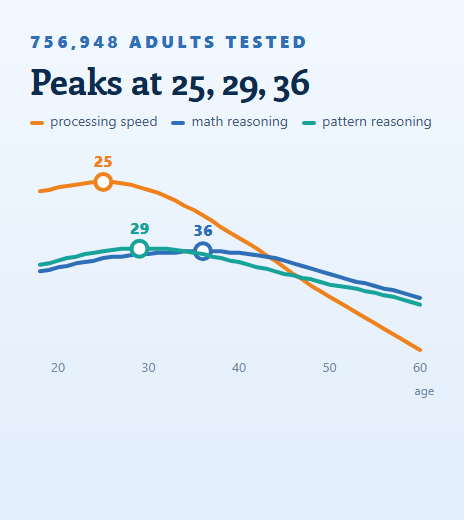
No. In our peak brain age study of 756,948 adults, overall test performance peaked at 25, pattern reasoning at 29 and math reasoning at 36 [8]. The median prize-winning breakthrough came at 39, after all three. A breakthrough needs more than speed: years of training, a field ready for the idea and the work itself. Jones and Weinberg tie the later breakthroughs to the growing body of knowledge a scientist must master first [7].
At what age is your brain sharpest?
Peak ages for 15 thinking skills, from 756,948 adults who took the same online tests.
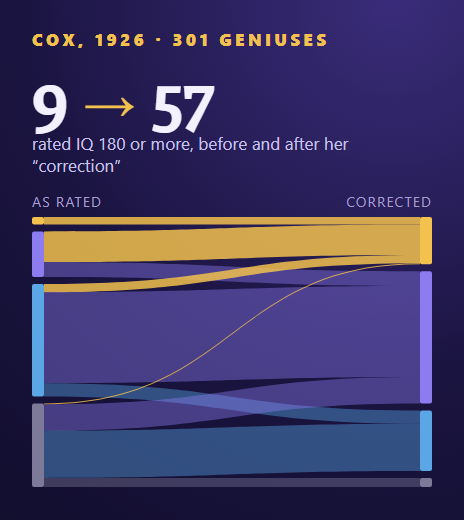
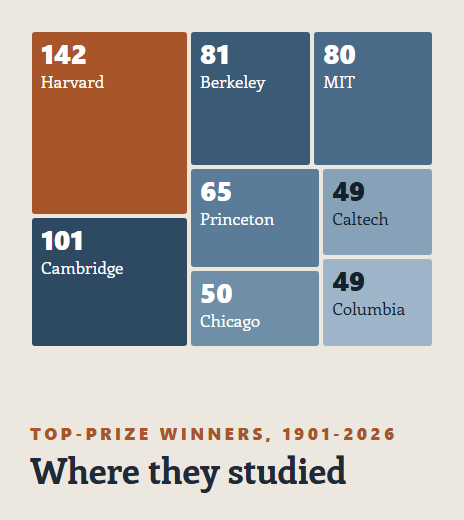
See the peak brain age studyThe age at the prize itself, prize by prize and for 21 top science prizes, is in our study of the universities with the most prize winners [9]; the IQ estimates behind Cox’s geniuses are in the IQ of 301 historical geniuses [6].
11 How old were the laureates of 2017-2026?
Li et al. end in 2016, so we dated the 76 laureates since then ourselves, from the prize committees’ scientific background documents [3]. Their median age at the work was 40 and at the prize 72.
The laureates of 2017-2026: age at the work and at the prize
| Henri B. Kagan (Chemistry) | 2026 | 1986 | 56 | 96 | 40 |
| Kenso Soai (Chemistry) | 2026 | 1990 | 40 | 76 | 36 |
| Francis Halzen (Physics) | 2026 | 1988 | 44 | 82 | 38 |
| Georg Nagel (Medicine) | 2026 | 2002 | 49 | 73 | 24 |
| Karl Deisseroth (Medicine) | 2026 | 2005 | 34 | 55 | 21 |
| Peter Hegemann (Medicine) | 2026 | 1991 | 37 | 72 | 35 |
| Omar M. Yaghi (Chemistry) | 2025 | 1995 | 30 | 60 | 30 |
| Richard Robson (Chemistry) | 2025 | 1989 | 52 | 88 | 36 |
| Susumu Kitagawa (Chemistry) | 2025 | 1992 | 41 | 74 | 33 |
| John Clarke (Physics) | 2025 | 1984 | 42 | 83 | 41 |
| John M. Martinis (Physics) | 2025 | 1984 | 26 | 67 | 41 |
| Michel H. Devoret (Physics) | 2025 | 1984 | 31 | 72 | 41 |
| Fred Ramsdell (Medicine) | 2025 | 2001 | 41 | 65 | 24 |
| Mary E. Brunkow (Medicine) | 2025 | 2001 | 40 | 64 | 24 |
| Shimon Sakaguchi (Medicine) | 2025 | 1995 | 44 | 74 | 30 |
| David Baker (Chemistry) | 2024 | 2003 | 41 | 62 | 21 |
| Demis Hassabis (Chemistry) | 2024 | 2021 | 45 | 48 | 3 |
| John Jumper (Chemistry) | 2024 | 2021 | 36 | 39 | 3 |
| Geoffrey Hinton (Physics) | 2024 | 1983 | 36 | 77 | 41 |
| John J. Hopfield (Physics) | 2024 | 1982 | 49 | 91 | 42 |
| Gary Ruvkun (Medicine) | 2024 | 1993 | 41 | 72 | 31 |
| Victor Ambros (Medicine) | 2024 | 1993 | 40 | 71 | 31 |
| Aleksey Yekimov (Chemistry) | 2023 | 1980 | 35 | 78 | 43 |
| Louis Brus (Chemistry) | 2023 | 1983 | 40 | 80 | 40 |
| Moungi Bawendi (Chemistry) | 2023 | 1993 | 32 | 62 | 30 |
| Anne L’Huillier (Physics) | 2023 | 1988 | 30 | 65 | 35 |
| Ferenc Krausz (Physics) | 2023 | 1997 | 35 | 61 | 26 |
| Pierre Agostini (Physics) | 2023 | 1994 | 53 | 82 | 29 |
| Drew Weissman (Medicine) | 2023 | 2005 | 46 | 64 | 18 |
| Katalin Karikó (Medicine) | 2023 | 2005 | 50 | 68 | 18 |
| Carolyn Bertozzi (Chemistry) | 2022 | 1997 | 31 | 56 | 25 |
| K. Barry Sharpless (Chemistry) | 2022 | 1999 | 58 | 81 | 23 |
| Morten Meldal (Chemistry) | 2022 | 2001 | 47 | 68 | 21 |
| Alain Aspect (Physics) | 2022 | 1981 | 34 | 75 | 41 |
| Anton Zeilinger (Physics) | 2022 | 1997 | 52 | 77 | 25 |
| John Clauser (Physics) | 2022 | 1972 | 30 | 80 | 50 |
| Svante Pääbo (Medicine) | 2022 | 1997 | 42 | 67 | 25 |
| Benjamin List (Chemistry) | 2021 | 2000 | 32 | 53 | 21 |
| David W.C. MacMillan (Chemistry) | 2021 | 2000 | 32 | 53 | 21 |
| Giorgio Parisi (Physics) | 2021 | 1979 | 31 | 73 | 42 |
| Klaus Hasselmann (Physics) | 2021 | 1976 | 45 | 90 | 45 |
| Syukuro Manabe (Physics) | 2021 | 1964 | 33 | 90 | 57 |
| Ardem Patapoutian (Medicine) | 2021 | 2002 | 35 | 54 | 19 |
| David Julius (Medicine) | 2021 | 1997 | 42 | 66 | 24 |
| Emmanuelle Charpentier (Chemistry) | 2020 | 2011 | 43 | 52 | 9 |
| Jennifer A. Doudna (Chemistry) | 2020 | 2012 | 48 | 56 | 8 |
| Andrea Ghez (Physics) | 2020 | 1998 | 33 | 55 | 22 |
| Reinhard Genzel (Physics) | 2020 | 1996 | 44 | 68 | 24 |
| Roger Penrose (Physics) | 2020 | 1965 | 34 | 89 | 55 |
| Charles M. Rice (Medicine) | 2020 | 1996 | 44 | 68 | 24 |
| Harvey J. Alter (Medicine) | 2020 | 1972 | 37 | 85 | 48 |
| Michael Houghton (Medicine) | 2020 | 1989 | 40 | 71 | 31 |
| Akira Yoshino (Chemistry) | 2019 | 1985 | 37 | 71 | 34 |
| John B. Goodenough (Chemistry) | 2019 | 1980 | 58 | 97 | 39 |
| M. Stanley Whittingham (Chemistry) | 2019 | 1974 | 33 | 78 | 45 |
| Didier Queloz (Physics) | 2019 | 1995 | 29 | 53 | 24 |
| James Peebles (Physics) | 2019 | 1965 | 30 | 84 | 54 |
| Michel Mayor (Physics) | 2019 | 1995 | 53 | 77 | 24 |
| Gregg L. Semenza (Medicine) | 2019 | 1989 | 33 | 63 | 30 |
| Sir Peter J. Ratcliffe (Medicine) | 2019 | 1991 | 37 | 65 | 28 |
| William G. Kaelin Jr (Medicine) | 2019 | 1995 | 38 | 62 | 24 |
| Frances H. Arnold (Chemistry) | 2018 | 1993 | 37 | 62 | 25 |
| George P. Smith (Chemistry) | 2018 | 1985 | 44 | 77 | 33 |
| Sir Gregory P. Winter (Chemistry) | 2018 | 1990 | 39 | 67 | 28 |
| Arthur Ashkin (Physics) | 2018 | 1970 | 48 | 96 | 48 |
| Donna Strickland (Physics) | 2018 | 1985 | 26 | 59 | 33 |
| Gérard Mourou (Physics) | 2018 | 1985 | 41 | 74 | 33 |
| James P. Allison (Medicine) | 2018 | 1996 | 48 | 70 | 22 |
| Tasuku Honjo (Medicine) | 2018 | 1992 | 50 | 76 | 26 |
| Jacques Dubochet (Chemistry) | 2017 | 1981 | 39 | 75 | 36 |
| Joachim Frank (Chemistry) | 2017 | 1975 | 35 | 77 | 42 |
| Richard Henderson (Chemistry) | 2017 | 1975 | 30 | 72 | 42 |
| Rainer Weiss (Physics) | 2017 | 1972 | 40 | 85 | 45 |
| Jeffrey C. Hall (Medicine) | 2017 | 1984 | 39 | 72 | 33 |
| Michael Rosbash (Medicine) | 2017 | 1984 | 40 | 73 | 33 |
| Michael W. Young (Medicine) | 2017 | 1984 | 35 | 68 | 33 |
Source: Work years traced from the Nobel committees’ scientific background documents, one per prize [3]; birth years: Nobel Prize API [2]. The document and page for each laureate are in the CSV.
12 How we dated each breakthrough
- 01
List the laureates
Every laureate in physics, chemistry and physiology or medicine, 1901-2026, with birth date, sex and prize year, from the Nobel Prize API [2]: 668 prizes to 664 people.
- 02
Date the prize-winning work, 1901-2016
Li, Yin, Fortunato and Wang (2019) identified the prize-winning papers of 545 laureates from the references of their Nobel lectures and the prize records [1]. We take the year of each laureate’s earliest prize-winning paper as the year of the breakthrough. Two rows were wrong in their file: Wilhelm Wien’s 1893 displacement law is dated 1983, corrected from his Nobel biography [4]; Hans Fischer was given Emil Fischer’s 1894 paper, so he is left out.
- 03
Date the rest by hand
For the laureates of 2017-2026 and the early laureates Li et al. lack, we read the prize committee’s scientific background document or the Nobel lecture and took the year of the earliest key paper the committee cites by that laureate [3]. Each year in the CSV carries its document and a quote.
- 04
Check the names we quote
We checked 109 of Li et al.’s years against the Nobel lectures, presentation speeches and biographies on nobelprize.org: every laureate this page names, the youngest, the oldest, the longest waits, every woman and a random sample of 30. In the random sample 18 of 30 matched (within a year), 11 differed and 1 could not be settled; of the 11 that differed, 10 started earlier than Li et al.’s paper (by a median 6 years), because Li et al. picked a later paper of the same prize work. The sample’s median age moved from 36.5 to 35. Every year that differed was replaced by the checked one (31 in all) and the CSV notes the change; the ages of laureates we did not check may run a year or two high.
- 05
Add the historical geniuses
For the people in Catharine Cox’s 1926 study [6] we found each person in Wikidata by name and birth year, took their “notable work” with its publication date or, failing that, its creation date, kept only works dated to the year, after age 10 and before death, and chose the one with the most Wikipedia language editions [5]. We tried the same for the mathematics and Turing Award winners in our prize-winner data [9], but Wikidata dates a notable work for only 2 of 139 mathematicians and 22 of 79 computer scientists, too few to use.
- 06
Count
Medians with a 95% interval from order statistics (it assumes no particular shape of the ages), shares at 40 and 50 or older, and the wait from work to prize. One script computes every number on this page from the files above, and the CSV holds every row it used.
What this study cannot tell you
- A prize-winning paper is not the same as a person’s best idea. The Nobel committee rewards one discovery, often the first paper of a long programme; laureates kept working, and some did their most cited work later.
- The age is the year of the work minus the year of birth, so it can be one year more than the age on the day. Medians therefore move in half-years.
- Prize-winning science is a tiny, select group: mostly men, mostly from Europe and North America, and the prize is never given after death, so people who broke through late but died early are missing.
- Laureates are dated by the prize-winning work; Cox’s geniuses by the best-known work Wikidata records. The two measures are shown side by side, never pooled. Wikidata’s “notable work” reflects what editors listed and what is famous today.
- 5 of the 668 science laureate-prizes could not be dated and are left out: Robert Bárány (1914), Christiaan Eijkman (1929), Hans Fischer (1930): the Nobel records give no year for the work; Barry C. Barish (2017), Kip S. Thorne (2017): the only paper of theirs the committee cites is the 2016 detection paper, which would misdate the work.
- Our age is not a measure of intelligence. Nothing here says that a younger or older breakthrough means a higher or lower IQ.
Sources
- Springer Nature; Harvard Dataverse. Li J, Yin Y, Fortunato S, Wang D. A dataset of publication records for Nobel laureates. Scientific Data 6:33 (2019); data: "Prize-winning paper record", Harvard Dataverse, doi:10.7910/DVN/6NJ5RN, version 1. 2019. doi.org/10.7910/DVN/6NJ5RNCC0 1.0 (data); CC BY 4.0 (article)
- Nobel Prize Outreach. Nobel Prize API 2.1: laureates in physics, chemistry and physiology or medicine, 1901-2026. 2026. api.nobelprize.org/2.1/laureatesCC0 (data)
- Nobel Prize Outreach; the Nobel committees. Scientific background documents of the Nobel committees for physics, chemistry and physiology or medicine, 2017-2026, and Nobel lectures; one document per laureate in the CSV. 2017-2026. www.nobelprize.org/prizesFacts cited
- Nobel Prize Outreach. Wilhelm Wien, biographical (from Nobel Lectures, Physics 1901-1921). 1967. www.nobelprize.org/prizes/physics/1911/wien/biographicalFacts cited
- Wikimedia Foundation. Wikidata: notable work (P800) with publication date (P577) or inception (P571), date of birth and death, sitelinks; queries of 2026-10-28. 2026. query.wikidata.orgCC0
- IQ Metrics. IQ Metrics Research: The IQ of 301 historical geniuses (Cox 1926, Tables 12A-12B, transcribed). 2026. iqmetrics.org/research/iq-of-historical-geniusesCC BY 4.0
- National Academy of Sciences. Jones BF, Weinberg BA. Age dynamics in scientific creativity. PNAS 108(47):18910-18914 (2011). doi:10.1073/pnas.1102895108. 2011. doi.org/10.1073/pnas.1102895108Facts cited
- IQ Metrics. IQ Metrics Research: At what age is your brain sharpest? (peak brain age, 756,948 adults). 2026. iqmetrics.org/research/peak-brain-ageCC BY 4.0
- IQ Metrics. IQ Metrics Research: Universities with the most prize winners (age at the award). 2026. iqmetrics.org/research/universities-with-the-most-prize-winnersCC BY 4.0
Version history
- 2026.1028 October 2026First release, with the 2026 laureates.
Leon Falkner, Data & Research Analyst. Leon owns the arithmetic on IQ Metrics: the percentile tables, the score converter and the figures in everyone else's drafts. On the research desk Leon pulls the data, builds each index and writes the method. More about Leon.
Questions
At what age do scientists make their greatest discoveries?
At about 39. Across 663 prize-winning breakthroughs in physics, chemistry and medicine (prizes 1901-2026), the median laureate did the work at 39: physicists at 35, chemists at 39, medical scientists at 39. The age has risen over the century, to 41 for work done from 1980 on.
What is the peak age of creativity?
It depends on the field and the era. Prize-winning scientific work peaks in the late 30s (median 39); 11% came before 30 and 11% at 50 or older. Physics breakthroughs were youngest in the 1920s and 1930s. Thinking speed itself peaks earlier: overall test performance at 25 in our peak brain age study.
Are there late bloomers in science?
Yes. 11% of prize-winning breakthroughs came at 50 or older, about one in 9. The oldest in our data: John B. Fenn, 72 at the work in 1989.
How old was Einstein when he made his breakthrough?
Albert Einstein was 26 in 1905, the year of the work that won the 1921 Nobel Prize in Physics: the law of the photoelectric effect. The prize came 16 years later, when Einstein was 42. Einstein was 26 in his "miracle year", 1905.
How long after a discovery does the prize usually come?
For prizes of 1920-1939, a median 8 years after the work; for prizes of 2020-2026, 30 years. Over every breakthrough we dated the median is 18 years.
Who made a prize-winning discovery at the youngest age?
Theodore W. Richards, at 19 (1887). The work behind the 1914 prize: accurate determinations of the atomic weight of a large number of ….
Share it, cite it, download it
You may reuse everything on this page under CC BY 4.0: in articles, reports, lessons and posts. The one condition is credit to IQ Metrics with a link to this page.
Cite this study
Version 2026.10. Citing the version lets readers find the exact numbers.
Archived copy with a DOI: 10.5281/zenodo.23723883 (report PDF and data on Zenodo).
Falkner, L. (2026). How old were history's great minds at their breakthrough? (Version 2026.10) [Data set]. IQ Metrics Research. https://iqmetrics.org/research/age-at-breakthrough/ (DOI: 10.5281/zenodo.23723883)
Falkner, Leon. "How old were history's great minds at their breakthrough?" IQ Metrics Research, 28 Oct. 2026, iqmetrics.org/research/age-at-breakthrough/. DOI: 10.5281/zenodo.23723883.
Falkner, Leon. "How old were history's great minds at their breakthrough?" IQ Metrics Research. October 28, 2026. https://iqmetrics.org/research/age-at-breakthrough/. DOI: 10.5281/zenodo.23723883.
@misc{iqmetrics2026ageatbreakthrough, author = {Falkner, Leon}, title = {How old were history's great minds at their breakthrough?}, institution = {IQ Metrics}, year = {2026}, version = {2026.10}, doi = {10.5281/zenodo.23723883}, url = {https://iqmetrics.org/research/age-at-breakthrough/} }
Source: Leon Falkner, "How old were history's great minds at their breakthrough?" IQ Metrics Research, version 2026.10, https://iqmetrics.org/research/age-at-breakthrough/ (DOI 10.5281/zenodo.23723883)
Get the data
One row per person and breakthrough: 663 dated prize-winning breakthroughs in physics, chemistry and physiology or medicine (prizes 1901-2026) and 149 people from Cox’s 1926 study of geniuses dated by their best-known work (17 of them statesmen, soldiers or religious leaders, kept in the CSV but not in the charts), with birth year, work year, age, prize year, wait and the source of every year.
| Column | What it holds |
|---|---|
name, group, field | The person; the group (Nobel Prize or Historical genius (Cox 1926)); the prize field or Cox's field group |
sex, birth_year | Sex as recorded by the Nobel Prize API (laureates only); year of birth |
work_year, age_at_work, work | Year of the breakthrough, the age that year (work year minus birth year) and the paper or work |
prize, prize_year, age_at_prize, wait_years | The prize, the year it is named for, the age that year and the years from work to prize |
year_source, year_source_url | Where the work year comes from: Li et al. 2019, a Nobel committee document (with confidence), or a Wikidata work item |
wikidata_id, nobel_id, note | Identifiers and any correction made |
For journalists, researchers and teachers
Everything on this page may be quoted, charted and republished with credit. No embargo, no permission needed, no sign-up. If you need a number that is not here, ask.
Summary you can paste
Plain news style. Edit freely; keep the credit.
An IQ Metrics Research study dated 663 prize-winning breakthroughs in physics, chemistry and physiology or medicine (prizes 1901-2026), using the prize-winning papers identified by Li et al. (2019) and, for 2017-2026, the Nobel committees' scientific background documents. The median laureate did the prize-winning work at 39: physicists at 35, chemists at 39, medical scientists at 39. 11% of the breakthroughs came at 50 or older. The age has risen: from a median 36 for work done before 1920 to 41 for work from 1980 on. The wait for the prize grew from 8 years (prizes of 1920-1939) to 30 years (prizes of 2020-2026). Every person is listed in an open CSV. Source: IQ Metrics Research, https://iqmetrics.org/research/age-at-breakthrough/
Angles for a story
- Prize week: the 2026 laureates receive their prizes in Stockholm on 10 December; how old were they at the work (table)?
- October laureate season: the wait from work to prize, from the first prizes to 2026 (Figure 5).
- Late bloomers all year: who broke through at 50, 60 or 70 (youngest and oldest).
- Physics was young once: the quantum generation against today (Figure 3).
- How old was Newton, Darwin or Einstein? Each has a card and a link (pick a name).
Quotes you can use
Attributable as written, with the name and title. For a different angle or a quote on a specific figure, ask through the contact page.
The lone young genius is the exception in our data. The typical prize-winning breakthrough came at 39, and the age keeps rising.
Leon Falkner, Data & Research Analyst, IQ Metrics ResearchThe prize now arrives about 30 years after the work. Many of today’s laureates are honoured for something they did before their students were born.
Leon Falkner, Data & Research Analyst, IQ Metrics ResearchPhysics was young once. In the quantum years of the 1920s, people in their twenties rewrote the field; that window has closed.
Leon Falkner, Data & Research Analyst, IQ Metrics Research
Files
- CSV of every person, with the source of every year (CC BY 4.0)
- Every figure as a print-ready PNG: use the Image button under each figure
- Share images for social media in three sizes, with the credit line built in
- Citations in APA, MLA, Chicago, BibTeX and plain text
Terms, contact and corrections
Credit: “IQ Metrics Research, Age at Breakthrough 2026” with a link to this page. On air or in print, “IQ Metrics” and the page address are enough.
Data credit: prize-winning papers from Li et al. 2019 [1]; laureates from the Nobel Prize API [2]; best-known works from Wikidata [5]; the dating of 2017-2026, the checks and the analysis are ours.
Contact: the research team, through the contact page. Corrections are made on this page with a dated note in the version history.
Please say that the age is the age in the year of the prize-winning work (not the age at the prize), and that historical geniuses are dated by their best-known work.